
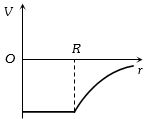
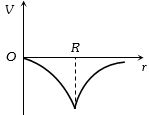
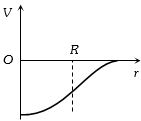
The diagram showing the variation of gravitational potential of Earth with distance from the centre of Earth is
- A
- B
- C
- D
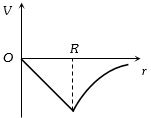
Explore More
Similar Questions
$A$ thin rod of length $L$ is bent to form a semicircle. The mass of the rod is $M$. What will be the gravitational potential at the center of the circle?
Medium
View SolutionTwo bodies of masses $m$ and $9m$ are placed at a distance $r$. The gravitational potential at a point on the line joining them,where the gravitational field is zero,is ($G$ is the universal gravitational constant).
If one wants to remove all the mass of the earth to infinity in order to break it up completely,the amount of energy that needs to be supplied will be $\frac{x}{5} \frac{GM^2}{R}$,where $x$ is .......... (Round off to the Nearest Integer). ($M$ is the mass of earth,$R$ is the radius of earth,$G$ is the gravitational constant)
DifficultJEE MAIN 2021
View SolutionThe gravitational field in a region is given by the equation $E = (5\hat{i} + 12\hat{j}) \,N/kg$. If a particle of mass $2 \,kg$ is moved from the origin to the point $(12 \,m, 5 \,m)$ in this region, what is the change in gravitational potential energy (in $\,J$)?
DifficultAP EAMCET 2012
View SolutionEarth has mass $M_{1}$ and radius $R_{1}$. Moon has mass $M_{2}$ and radius $R_{2}$. The distance between their centres is $r$. $A$ body of mass $M$ is placed on the line joining them at a distance $r/3$ from the centre of the Earth. To project the mass $M$ to escape to infinity,the minimum speed required is:
DifficultMHT CET 2020
View SolutionVedclass Products
For Students
Vedclass Test Series
Mock tests in real JEE/NEET style with performance analysis. 5-day free trial.
Start Free TrialFor Teachers
Exam Paper Generator
Generate Set A/B/C/D exam papers from 7.5L+ questions in 2 minutes. 3 chapters free.
Try FreeFor Institutes
Online Exam Module
Live online exams with unlimited students, 360° analytics & white-label branding.
See Demo