
Medium
The graph of potential energy $U(x)$ versus distance $x$ is shown in the following figure. The force $F$ versus distance $x$ graph will be represented by (assume that the force is conservative):
- A
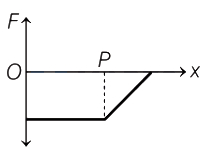
- B
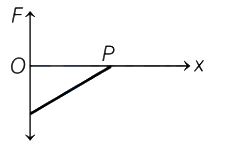
- C
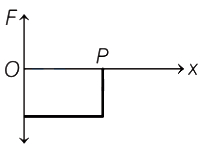
- D
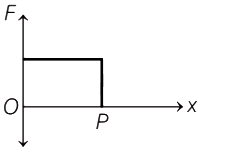
Explore More
Similar Questions
Match Column-$I$ with Column-$II$.
Column-$I$ Column-$II$ $(1)$ Conservative force $(a)$ Frictional force $(2)$ Non-conservative force $(b)$ Gravitational force $(c)$ Internal force
| Column-$I$ | Column-$II$ |
|---|---|
| $(1)$ Conservative force | $(a)$ Frictional force |
| $(2)$ Non-conservative force | $(b)$ Gravitational force |
| $(c)$ Internal force |
Easy
View SolutionPotential energy is defined ............
Easy
View SolutionThe points of maximum and minimum attraction in the curve between potential energy $(U)$ and distance $(r)$ of a diatomic molecule are respectively:
Medium
View SolutionGiven below are two statements:
Statement $I$: An object moves from position $r_{1}$ to position $r_{2}$ under a conservative force field $\vec{F}$. The work done by the force is $W = -\int_{r_{1}}^{r_{2}} \vec{F} \cdot d\vec{r}$.
Statement $II$: Any object moving from one location to another location can follow an infinite number of paths. Therefore, the amount of work done by the object changes with the path it follows for a conservative force.
In the light of the above statements, choose the correct answer from the options given below:
When a conservative force does positive work on a body,
Medium
View SolutionVedclass Products
For Students
Vedclass Test Series
Mock tests in real JEE/NEET style with performance analysis. 5-day free trial.
Start Free TrialFor Teachers
Exam Paper Generator
Generate Set A/B/C/D exam papers from 7.5L+ questions in 2 minutes. 3 chapters free.
Try FreeFor Institutes
Online Exam Module
Live online exams with unlimited students, 360° analytics & white-label branding.
See Demo