
The variation of acceleration due to gravity $g$ with distance $d$ from the centre of the earth is best represented by ($R =$ Earth's radius)
- A
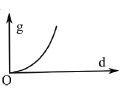
- B
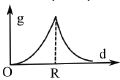
- C
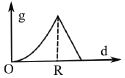
- D
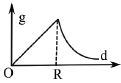
Explore More
Similar Questions
$A$ very long (length $L$) cylindrical galaxy is made of uniformly distributed mass and has radius $R$ $(R << L)$. $A$ star outside the galaxy is orbiting the galaxy in a plane perpendicular to the galaxy and passing through its centre. If the time period of the star is $T$ and its distance from the galaxy's axis is $r$,then:
Two bodies of masses $m_1$ and $m_2$ initially at rest at infinite distance apart move towards each other under gravitational force of attraction. Their relative velocity of approach when they are separated by a distance $r$ is ($G=$ universal gravitational constant.)
The relative uncertainty in the period of a satellite orbiting around the Earth is $10^{-2}$. If the relative uncertainty in the radius of the orbit is negligible,the relative uncertainty in the mass of the Earth is:
Answer the following:
$(a)$ You can shield a charge from electrical forces by putting it inside a hollow conductor. Can you shield a body from the gravitational influence of nearby matter by putting it inside a hollow sphere or by some other means?
$(b)$ An astronaut inside a small space ship orbiting around the earth cannot detect gravity. If the space station orbiting around the earth has a large size,can he hope to detect gravity?
$(c)$ If you compare the gravitational force on the earth due to the sun to that due to the moon,you would find that the Sun's pull is greater than the moon's pull. However,the tidal effect of the moon's pull is greater than the tidal effect of the sun. Why?
Medium
View Solution$(a)$ Earth can be thought of as a sphere of radius $6400 \, km$. Any object (or a person) is performing circular motion around the axis of the Earth due to the Earth's rotation (period $1 \, \text{day}$). What is the acceleration of an object on the surface of the Earth (at the equator) towards its centre? What is it at latitude $\theta$? How do these accelerations compare with $g = 9.8 \, m/s^2$?
$(b)$ The Earth also moves in a circular orbit around the Sun once every year with an orbital radius of $1.5 \times 10^{11} \, m$. What is the acceleration of the Earth (or any object on the surface of the Earth) towards the centre of the Sun? How does this acceleration compare with $g = 9.8 \, m/s^2$?
$(b)$ The Earth also moves in a circular orbit around the Sun once every year with an orbital radius of $1.5 \times 10^{11} \, m$. What is the acceleration of the Earth (or any object on the surface of the Earth) towards the centre of the Sun? How does this acceleration compare with $g = 9.8 \, m/s^2$?
Medium
View SolutionVedclass Products
For Students
Vedclass Test Series
Mock tests in real JEE/NEET style with performance analysis. 5-day free trial.
Start Free TrialFor Teachers
Exam Paper Generator
Generate Set A/B/C/D exam papers from 7.5L+ questions in 2 minutes. 3 chapters free.
Try FreeFor Institutes
Online Exam Module
Live online exams with unlimited students, 360° analytics & white-label branding.
See Demo