
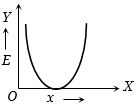
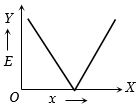
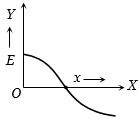
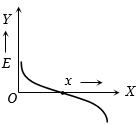
Two identical point charges are placed at a separation of $d$. $P$ is a point on the line joining the charges, at a distance $x$ from any one charge. The field at $P$ is $E$. $E$ is plotted against $x$ for values of $x$ from close to zero to slightly less than $d$. Which of the following represents the resulting curve?
- A
- B
- C
- D
Explore More
Similar Questions
An infinitely long uniformly charged string is placed along the $z-$axis. Its linear charge density is $\lambda$. $A$ point charge $q$ is moved from position $(a, 0, 0)$ to $(2a, 0, 0)$. The work done by the external agent is:
Difficult
View SolutionTwo point electric charges $+10^{-8} \text{ C}$ and $-10^{-8} \text{ C}$ are placed $0.1 \text{ m}$ apart. Find the magnitude of the total electric field at the centre of the line joining the two charges.
Two charges $+5\,\mu C$ and $+10\,\mu C$ are placed $20\,cm$ apart. The net electric field at the midpoint between the two charges is
Difficult
View Solution$A$ negative charge $-q$ is placed at the midpoint between two fixed equal positive charges $Q$, separated by a distance $2d$. If the negative charge is given a small displacement $x$ $(x \ll d)$ perpendicular to the line joining the positive charges, how will the net force $(F)$ acting on it approximately depend on $x$?
How does the number of electric field lines passing through a unit area depend on the distance from a point charge?
Medium
View SolutionVedclass Products
For Students
Vedclass Test Series
Mock tests in real JEE/NEET style with performance analysis. 5-day free trial.
Start Free TrialFor Teachers
Exam Paper Generator
Generate Set A/B/C/D exam papers from 7.5L+ questions in 2 minutes. 3 chapters free.
Try FreeFor Institutes
Online Exam Module
Live online exams with unlimited students, 360° analytics & white-label branding.
See Demo