
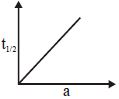
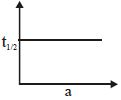
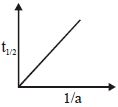
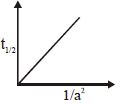
Which of the following curves represents a first-order reaction?
- A
- B
- C
- D
Explore More
Similar Questions
The reaction $A \to B$ follows first-order kinetics. It takes $1 \ hr$ for $0.60 \ mole$ of $B$ to be formed from $0.80 \ mole$ of $A$. How much time (in $hr$) will it take for $0.675 \ mole$ of $B$ to be formed from $0.90 \ mole$ of $A$?
Medium
View Solution$A$ substance $A$ decomposes by a first order reaction starting initially with $[A]_0 = 2.00 \, M$ and after $200 \, \min$,$[A]_t = 0.15 \, M$. For this reaction,what is the value of the rate constant $k$?
For the reaction shown in the image,the half-life does not depend on the concentration of the reactant. After $10 \, \text{min}$,the volume of $N_2$ gas evolved is $20 \, \text{L}$ and after the completion of the reaction,it is $100 \, \text{L}$. Hence,the rate constant is:
Difficult
View SolutionThe half-life of a first-order reaction is $850 \text{ s}$. The initial concentration of the reactant is $[R]_0 = 0.06 \text{ mol dm}^{-3}$. What concentration $[R]$ would remain after $t = 1200 \text{ s}$?
DifficultMHT CET 2026
View SolutionFor a first order reaction,the concentration of reactant was reduced from $0.03 \ mol \ L^{-1}$ to $0.02 \ mol \ L^{-1}$ in $25 \ min$. What is its rate (in $mol \ L^{-1} \ s^{-1}$)?
Vedclass Products
For Students
Vedclass Test Series
Mock tests in real JEE/NEET style with performance analysis. 5-day free trial.
Start Free TrialFor Teachers
Exam Paper Generator
Generate Set A/B/C/D exam papers from 7.5L+ questions in 2 minutes. 3 chapters free.
Try FreeFor Institutes
Online Exam Module
Live online exams with unlimited students, 360° analytics & white-label branding.
See Demo