
Which of the four arrangements in the figure correctly shows the vector addition of two forces $\overrightarrow {{F_1}} $ and $\overrightarrow {{F_2}} $ to yield the third force $\overrightarrow {{F_3}} $?
- A
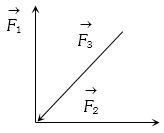
- B
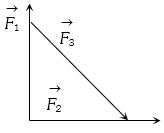
- C
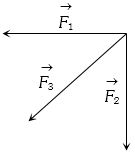
- D
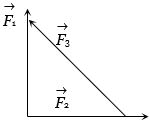
Explore More
Similar Questions
Statement $I:$ Two forces $(\overrightarrow{P}+\overrightarrow{Q})$ and $(\overrightarrow{P}-\overrightarrow{Q})$,where $\overrightarrow{P} \perp \overrightarrow{Q}$,act at an angle $\theta_{1}$ to each other,and the magnitude of their resultant is $\sqrt{3(P^{2}+Q^{2})}$. When they act at an angle $\theta_{2}$,the magnitude of their resultant becomes $\sqrt{2(P^{2}+Q^{2})}$. This is possible only when $\theta_{1} < \theta_{2}$.
Statement $II:$ In the situation given above,$\theta_{1} = 60^{\circ}$ and $\theta_{2} = 90^{\circ}$.
In the light of the above statements,choose the most appropriate answer from the options given below.
Statement $II:$ In the situation given above,$\theta_{1} = 60^{\circ}$ and $\theta_{2} = 90^{\circ}$.
In the light of the above statements,choose the most appropriate answer from the options given below.
DifficultJEE MAIN 2021
View SolutionGiven below in Column $-I$ are the relations between vectors $\vec a$,$\vec b$,and $\vec c$,and in Column $-II$ are the orientations of $\vec a$,$\vec b$,and $\vec c$ in the $XY-$ plane. Match the relation in Column $-I$ to the correct orientations in Column $-II$.
Column $-I$ Column $-II$ $(a) \vec a + \vec b = \vec c$ $(i)$ Vector $\vec a$ is along $+Y$,$\vec c$ is along $+X$,and $\vec b$ connects the origin to the tip of $\vec c$ $(b) \vec a - \vec c = \vec b$ $(ii)$ Vector $\vec a$ is along $+X$,$\vec b$ is along $+Y$,and $\vec c$ connects the origin to the tip of $\vec b$ $(c) \vec b - \vec a = \vec c$ $(iii)$ Vector $\vec c$ is along $+X$,$\vec a$ is along $+Y$,and $\vec b$ connects the tip of $\vec c$ to the tip of $\vec a$ $(d) \vec a + \vec b + \vec c = 0$ $(iv)$ Vector $\vec a$ is along $-X$,$\vec b$ is along $-Y$,and $\vec c$ connects the origin to the tip of $\vec b$
| Column $-I$ | Column $-II$ |
| $(a) \vec a + \vec b = \vec c$ | $(i)$ Vector $\vec a$ is along $+Y$,$\vec c$ is along $+X$,and $\vec b$ connects the origin to the tip of $\vec c$ |
| $(b) \vec a - \vec c = \vec b$ | $(ii)$ Vector $\vec a$ is along $+X$,$\vec b$ is along $+Y$,and $\vec c$ connects the origin to the tip of $\vec b$ |
| $(c) \vec b - \vec a = \vec c$ | $(iii)$ Vector $\vec c$ is along $+X$,$\vec a$ is along $+Y$,and $\vec b$ connects the tip of $\vec c$ to the tip of $\vec a$ |
| $(d) \vec a + \vec b + \vec c = 0$ | $(iv)$ Vector $\vec a$ is along $-X$,$\vec b$ is along $-Y$,and $\vec c$ connects the origin to the tip of $\vec b$ |
Medium
View SolutionIf $\overrightarrow{A} = 3\widehat{i} + 2\widehat{j}$ and $\overrightarrow{B} = \widehat{i} + \widehat{j} - 2\widehat{k}$,find their sum using the algebraic method.
Easy
View SolutionWhat is the meaning of subtraction of two vectors?
Easy
View SolutionGiven $\vec{A}=(2 \hat{i}-3 \hat{j}+\hat{k})$,$\vec{B}=(3 \hat{i}+\hat{j}-2 \hat{k})$ and $\vec{C}=(3 \hat{i}+2 \hat{j}+\hat{k})$. The value of $(\vec{A}+\vec{B}) \cdot \vec{C}$ will be
Vedclass Products
For Students
Vedclass Test Series
Mock tests in real JEE/NEET style with performance analysis. 5-day free trial.
Start Free TrialFor Teachers
Exam Paper Generator
Generate Set A/B/C/D exam papers from 7.5L+ questions in 2 minutes. 3 chapters free.
Try FreeFor Institutes
Online Exam Module
Live online exams with unlimited students, 360° analytics & white-label branding.
See Demo