
A English
Mix Examples - Control and Coordination Questions in English
Class 10 Science · Control and Coordination · Mix Examples - Control and Coordination
14+
Questions
English
Language
100%
With Solutions
Showing 14 of 14 questions in English
1
EasyMCQ
The brain is responsible for
A
all of the above
B
thinking
C
regulating the heart beat
D
balancing the body
Solution
(A) The brain is the main coordinating centre of the body.
It is responsible for complex processes like thinking,processing information,and memory.
It also controls involuntary actions such as regulating the heart beat through the medulla oblongata.
Furthermore,it is responsible for maintaining the posture and balancing the body,a function primarily performed by the cerebellum.
Therefore,all the given options are correct.
0 likes
View Solution2
Medium
What is the need for a system of control and coordination in an organism?
Solution
(N/A) The maintenance of body functions in response to changes in the environment by the integrated working of various body systems is known as coordination.
All movements that occur in response to stimuli are carefully coordinated and controlled.
In animals,control and coordination are provided by the nervous and muscular systems.
The nervous system sends messages to and from the brain,while the spinal cord plays a crucial role in relaying these signals.
Without a system of control and coordination,the body would not be able to function as a unified whole.
For example,when we accidentally touch a hot object,we immediately withdraw our hand due to a reflex action.
In the absence of this system,we would not perceive the danger or react,leading to severe injury or burns.
0 likes
View Solution3
Medium
How are involuntary actions and reflex actions different from each other?
Solution
(N/A) Involuntary actions are those that cannot be consciously controlled,such as the movement of food in the alimentary canal or the beating of the heart. These actions are directly regulated by the brain.
Reflex actions are sudden,automatic,and involuntary responses to a stimulus that do not involve conscious thought or processing by the brain. For example,closing eyes immediately when exposed to bright light. Unlike involuntary actions,reflex actions are primarily controlled by the spinal cord,allowing for a faster response.
Reflex actions are sudden,automatic,and involuntary responses to a stimulus that do not involve conscious thought or processing by the brain. For example,closing eyes immediately when exposed to bright light. Unlike involuntary actions,reflex actions are primarily controlled by the spinal cord,allowing for a faster response.
0 likes
View Solution4
Medium
Compare and contrast the nervous and hormonal mechanisms for control and coordination in animals.
Solution
(N/A)
| Nervous system mechanism | Hormonal system mechanism |
|---|---|
| $1.$ Information is conveyed as electrical impulses. | $1.$ Information is conveyed as chemical messengers (hormones). |
| $2.$ Information is transmitted through neurons (axons and dendrites). | $2.$ Information is transported through the blood. |
| $3.$ The flow of information is rapid,and the response is quick. | $3.$ The flow of information is slow,and the response is gradual. |
| $4.$ The effects are short-lived. | $4.$ The effects are prolonged and sustained. |
0 likes
View Solution5
Medium
What is the difference between the manner in which movement takes place in a sensitive plant and the movement in our legs?
Solution
(N/A)
| Movement in sensitive plants | Movement in our legs |
|---|---|
| $1$. The movement that takes place in a sensitive plant such as $Mimosa \text{ } pudica$ occurs in response to touch (stimulus). | $1$. Movement in our legs is an example of voluntary actions. |
| $2$. For this movement, the information is transmitted from cell to cell by electrochemical signals as plants do not have any specialised tissue for conduction of impulses. | $2$. The signals or messages for these actions are passed to the brain and hence are consciously controlled. |
| $3$. For this movement to occur, the plant cells change shape by changing the amount of water in them. | $3$. In animal muscle cells, specialized proteins are found which allow the movement to occur upon contraction. |
0 likes
View Solution6
MediumMCQ
What is the correct direction of flow of electrical impulses?
A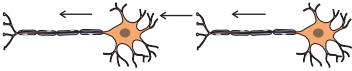
B
C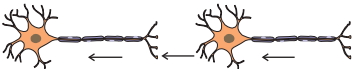
D
Solution
(A) In a neuron,electrical impulses are received by the dendrites.
From the dendrites,the impulse travels to the cell body (cyton).
Then,the impulse is transmitted along the axon towards the axon terminals.
This unidirectional flow ensures that signals are processed and transmitted correctly through the nervous system.
Therefore,the correct direction is: Dendrites $\rightarrow$ Cell Body $\rightarrow$ Axon $\rightarrow$ Axon Terminals.
0 likes
View Solution7
EasyMCQ
In humans,the life processes are controlled and regulated by
A
nervous and endocrine systems
B
endocrine and digestive systems
C
respiratory and nervous systems
D
reproductive and endocrine systems
Solution
(A) In humans,the life processes are controlled and regulated by the nervous system and the endocrine system.
The nervous system uses electrical impulses (nerve impulses) for rapid communication and coordination.
The endocrine system uses chemical messengers called hormones,which are secreted into the blood to regulate slower,long-term physiological processes.
Together,these two systems ensure homeostasis and proper functioning of the body.
0 likes
View Solution8
Medium
"Nervous and hormonal systems together perform the function of control and coordination in human beings." Justify the statement.
Solution
(N/A) The nervous system and the endocrine system work in tandem to maintain homeostasis and respond to stimuli in the human body.
$1$. Nervous System: It uses electrical signals called nerve impulses to transmit information rapidly between the brain, spinal cord, and various body parts. This allows for quick, reflex actions and immediate responses to environmental changes.
$2$. Hormonal System: It uses chemical messengers called hormones, which are secreted by endocrine glands directly into the blood. These hormones travel to target organs to regulate slow, long-term processes like growth, metabolism, and reproduction.
$3$. Integration: While the nervous system provides rapid, short-lived responses, the hormonal system provides slower, sustained responses. Together, they ensure that the body functions as a coordinated unit, where the nervous system can even trigger the endocrine system (e.g., the hypothalamus stimulating the pituitary gland) to maintain overall balance.
0 likes
View Solution9
Medium
Write two differences between the response of the plants and the response of the animals to stimuli.
Solution
(N/A)
| Plants | Animals |
|---|---|
| $(i)$ No specific specialized tissue is present for the conduction of information. | $(i)$ Specialized tissues (nervous system) are present in the body for the conduction of information. |
| $(ii)$ Plant cells change shape by changing the amount of water in them (turgor pressure). | $(ii)$ Specialized proteins are found in muscle cells that help in changing shape for movement. |
0 likes
View Solution10
Easy
Differentiate between the nervous system and the hormonal system.
Solution
(N/A)
| Nervous System | Hormonal System |
| $1$. Immediate effect is observed in the nervous system,as seen in reflex actions. | $1$. Hormonal effect is slow and delayed. The effects of hormones are observed after some time. |
| $2$. Nerve impulses are carried along neurons. | $2$. Hormones are transported through the bloodstream. |
| $3$. The nervous system does not directly regulate growth. | $3$. Hormones play a significant role in regulating growth and development. |
0 likes
View Solution11
Medium
$(a)$ Identify the phytohormone used by plants while performing the following functions:
$(i)$ Cell division in shoot tip.
$(ii)$ Inhibiting growth on approach of unfavourable conditions.
$(b)$ List in tabular form two differences between the movement in 'touch me not' plant and movement of shoot towards light.
$(i)$ Cell division in shoot tip.
$(ii)$ Inhibiting growth on approach of unfavourable conditions.
$(b)$ List in tabular form two differences between the movement in 'touch me not' plant and movement of shoot towards light.
Solution
(A) $(i)$ Auxin,
$(ii)$ Abscisic acid.
$(b)$
$(ii)$ Abscisic acid.
$(b)$
| Movement of shoot towards light (Tropism) | Movement in 'touch me not' plant (Nastic movement) |
| $(i)$ It is a slow response towards a stimulus. | $(i)$ It is an immediate response towards a stimulus. |
| $(ii)$ It is directional. | $(ii)$ It is non-directional. |
| $(iii)$ It is growth-dependent. | $(iii)$ It is growth-independent. |
0 likes
View Solution12
Medium
$(a)$ Define reflex arc. Draw a flow chart showing the sequence of events which occur during sneezing.
$(b)$ List four plant hormones. Write one function of each.
$(b)$ List four plant hormones. Write one function of each.
Solution
(N/A) reflex arc is the neural pathway that controls a reflex action. It is the path taken by nerve impulses in a reflex action,from the receptor to the effector.
Flow chart for sneezing:
Unwanted particles in the nostril $\to$ Receptors $\to$ Sensory neuron $\to$ Spinal cord $\to$ Motor neuron $\to$ Effectors (muscles of the respiratory system) $\to$ Sneezing.
$(b)$ Four plant hormones and their functions:
$1$. Auxins: Promote cell elongation and growth.
$2$. Gibberellins: Promote stem elongation and seed germination.
$3$. Cytokinins: Promote cell division.
$4$. Abscisic acid: Inhibits growth and promotes seed dormancy or leaf wilting.
0 likes
View Solution13
MediumMCQ
What is the correct direction of flow of electrical impulses in a neuron?
A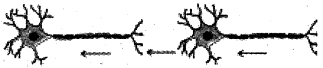
B
C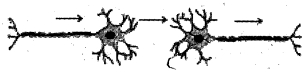
D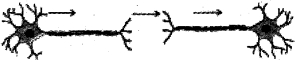
Solution
(C) In a neuron, electrical impulses are received by the dendrites.
From the dendrites, the impulse travels to the cell body (cyton).
Then, it moves along the axon towards the nerve endings (axon terminals).
At the synapse, the impulse is converted into a chemical signal to be transmitted to the dendrites of the next neuron.
Therefore, the correct direction is: $\text{Dendrites} \rightarrow \text{Cell body} \rightarrow \text{Axon} \rightarrow \text{Nerve endings}$. This flow is correctly represented in option $C$.
0 likes
View Solution14
EasyMCQ
Which systems in animals work together to provide coordination and regulation?
A
Digestive system and Excretory system
B
Circulatory system and Excretory system
C
Nervous system and Muscular system
D
Nervous system and Endocrine system
Solution
(D) In animals, the $Nervous$ $system$ and the $Endocrine$ $system$ work together to achieve coordination and regulation.
The $Nervous$ $system$ provides quick, electrical signals for rapid responses, while the $Endocrine$ $system$ uses chemical messengers called hormones to provide slower, long-lasting regulation of physiological processes.
Together, they ensure that the body functions as an integrated unit.
The $Nervous$ $system$ provides quick, electrical signals for rapid responses, while the $Endocrine$ $system$ uses chemical messengers called hormones to provide slower, long-lasting regulation of physiological processes.
Together, they ensure that the body functions as an integrated unit.
0 likes
View SolutionControl and Coordination — Mix Examples - Control and Coordination · Frequently Asked Questions
1Are these Control and Coordination questions useful for JEE and NEET?
Yes. All questions in this section are mapped to JEE Main and NEET exam patterns. Previous year questions from JEE Main, NEET, GUJCET and state-level exams are included with full solutions.
2Can I switch to Hindi or Gujarati for these questions?
Yes. Use the language tabs in the hero section or the sidebar to view the same questions and solutions in English, Hindi or Gujarati.
3How do I generate a question paper from this subtopic?
Use the Vedclass Exam Paper Generator — select the chapter and subtopic, set difficulty, and generate Sets A, B, C, D automatically. First 3 chapters of every subject are free.
Vedclass Products
For Students
Vedclass Test Series
Mock tests in real JEE/NEET style with performance analysis. 5-day free trial.
Start Free TrialFor Teachers
Exam Paper Generator
Generate Set A/B/C/D papers from this chapter in 2 minutes. 3 chapters free.
Try FreeFor Institutes
Online Exam Module
Live online exams with unlimited students, 360° analytics & white-label branding.
See DemoFor Teachers & Institutes
Generate a Control and Coordination Exam Paper in 2 Minutes
Select subtopic & difficulty — Sets A, B, C, D auto-generated with No Repeat logic.
First 3 chapters of every subject are free — no payment required.