
A English
Animals - Nervous System Questions in English
Class 10 Science · Control and Coordination · Animals - Nervous System
109+
Questions
English
Language
100%
With Solutions
Showing 50 of 109 questions in English
1
MediumMCQ
What is the difference between a reflex action and walking?
A
Reflex action is voluntary,walking is involuntary.
B
Reflex action is involuntary,walking is voluntary.
C
Both are voluntary actions.
D
Both are involuntary actions.
Solution
(B) reflex action is a rapid,automatic,and involuntary response to a stimulus that does not involve conscious thinking. It is controlled by the spinal cord. For example,withdrawing a hand upon touching a hot object.
Walking,on the other hand,is a voluntary action. It is under our conscious control and involves the brain (cerebrum) for planning and execution.
Walking,on the other hand,is a voluntary action. It is under our conscious control and involves the brain (cerebrum) for planning and execution.
0 likes
View Solution2
Difficult
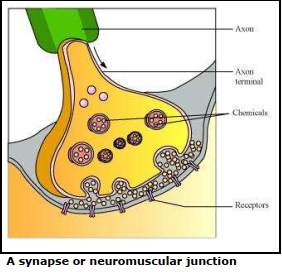
What happens at the synapse between two neurons?
Solution
(N/A) synapse is a microscopic gap between the axon terminal of one neuron and the dendrite of the next neuron.
It functions as a one-way valve,ensuring that nerve impulses travel in only one direction.
This unidirectional transmission occurs because chemical messengers (neurotransmitters) are stored only in the axon terminals of the presynaptic neuron.
When an electrical impulse reaches the axon terminal,these chemicals are released into the synaptic cleft.
They diffuse across the gap and bind to specific receptors on the dendrite of the postsynaptic neuron,where they trigger a new electrical impulse.
0 likes
View Solution3
EasyMCQ
Which part of the brain maintains posture and equilibrium of the body?
A
Cerebrum
B
Cerebellum
C
Medulla
D
Pons
Solution
(B) The $Cerebellum$, which is a part of the $Hindbrain$, is responsible for maintaining the posture, balance, and equilibrium of the body. It also coordinates voluntary muscular movements.
0 likes
View Solution4
DifficultMCQ
How do we detect the smell of an agarbatti (incense stick)?
A
Through the hindbrain
B
Through the forebrain
C
Through the midbrain
D
Through the spinal cord
Solution
(B) The thinking part of our brain is the forebrain.
It has separate areas that are specialized for hearing,smelling,sight,taste,touch,etc.
The forebrain also has regions that collect information or impulses from the various receptors.
When the smell of an incense stick reaches us,our forebrain detects it.
Then,the forebrain interprets it by putting it together with the information received from other receptors and also with the information already stored in the brain.
0 likes
View Solution5
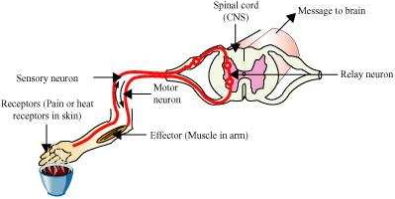
What is the role of the brain in reflex action?
Solution
(N/A) Reflex actions are sudden,involuntary responses to stimuli that do not involve conscious thinking.
For example,when we touch a hot object,we withdraw our hand immediately without thinking,as the time taken for conscious processing could cause severe burns.
The sensory nerves that detect the heat are connected to the motor nerves that move the muscles of the hand.
Such a connection of detecting the signal from the nerves (input) and responding to it quickly (output) is called a reflex arc.
The reflex arcs—connections present between the input and output nerves—meet in a bundle in the spinal cord.
Reflex arcs are formed in the spinal cord,and the information (input) simultaneously reaches the brain.
The brain is only made aware of the signal and the response that has taken place.
However,the brain plays no role in the initiation or creation of the reflex response itself.
0 likes
View Solution6
EasyMCQ
The gap between two neurons is called a
A
impulse
B
axon
C
dendrite
D
synapse
Solution
(D) The gap between two neurons is called a synapse. It is the site where the terminal end of the axon of one neuron comes in close proximity to the dendrite of another neuron,allowing for the transmission of nerve impulses via chemical neurotransmitters.
0 likes
View Solution7
Difficult
What is the function of receptors in our body? Think of situations where receptors do not work properly. What problems are likely to arise?
Solution
(N/A) Receptors are specialized sensory structures (organs,tissues,or cells) present throughout the body. They are either grouped together,as in the case of the eye or ear,or scattered,as in the case of the skin.
Functions of receptors:
$(i)$ They detect external stimuli such as heat,light,sound,or pain.
$(ii)$ They trigger an electrical impulse in the sensory neurons,which transmits the information to the central nervous system (spinal cord or brain).
Problems when receptors do not work properly:
If receptors are damaged,the body fails to perceive external stimuli. For example,if the heat receptors in the skin are damaged,a person might accidentally touch a hot object and suffer severe burns because the brain does not receive the warning signal of pain or heat. This lack of sensory feedback can lead to serious injuries or accidents.
0 likes
View Solution8
Medium
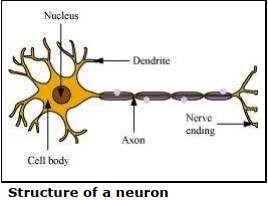
Draw the structure of a neuron and explain its functions.
Solution
(N/A) Neurons are the functional units of the nervous system. The three main parts of a neuron are the axon,dendrite,and cell body.
Functions of the three parts of a neuron:
$1$. Dendrite: It receives information from the axon of another cell and conducts the messages towards the cell body.
$2$. Cell body: It contains the nucleus,mitochondria,and other organelles. It is mainly concerned with the maintenance and growth of the cell.
$3$. Axon: It conducts messages away from the cell body towards the nerve endings.
3 likes
View Solution9
How does phototropism occur in plants?

Solution
(N/A) Phototropism is the directional growth of a plant in response to light.
$1$. When plants are exposed to light coming from one side,a plant hormone called $Auxin$ is synthesized at the shoot tip.
$2$. $Auxin$ helps the cells grow longer.
$3$. When light falls on the shoot from one side,$Auxin$ diffuses towards the shady side of the shoot.
$4$. This concentration of $Auxin$ stimulates the cells on the shady side to grow longer than those on the side receiving light.
$5$. As a result,the plant appears to bend towards the source of light.
1 likes
View Solution10
EasyMCQ
Which signals will get disrupted in case of a spinal cord injury?
A
Signals coming from the brain
B
Signals coming from the receptors
C
Both $(A)$ and $(B)$
D
None of the above
Solution
(C) The reflex arc connections between the input and output nerves meet in a bundle in the spinal cord.
In fact,nerves from all over the body meet in a bundle in the spinal cord on their way to the brain.
In case of any injury to the spinal cord,the signals coming from the nerves as well as the signals coming to the receptors will be disrupted.
In fact,nerves from all over the body meet in a bundle in the spinal cord on their way to the brain.
In case of any injury to the spinal cord,the signals coming from the nerves as well as the signals coming to the receptors will be disrupted.
0 likes
View Solution11
EasyMCQ
Which of the following statements is correct about receptors?
A
Gustatory receptors detect taste while olfactory receptors detect smell
B
Both gustatory and olfactory receptors detect smell
C
Auditory receptors detect smell and olfactory receptors detect taste
D
Olfactory receptors detect taste and gustatory receptors smell
Solution
(A) Receptors are specialized cells or groups of cells that detect stimuli in the environment.
$1$. Gustatory receptors are specialized sensory receptors located in the taste buds of the tongue that detect taste.
$2$. Olfactory receptors are specialized sensory receptors located in the nasal cavity that detect smell.
Therefore,the statement that gustatory receptors detect taste and olfactory receptors detect smell is correct.
0 likes
View Solution12
MediumMCQ
Electrical impulse travels in a neuron from
A
Dendrite $\to$ axon $\to$ axonal end $\to$ cell body
B
Dendrite $\to$ cell body $\to$ axon $\to$ axonal end
C
Cell body $\to$ dendrite $\to$ axon $\to$ axonal end
D
Axonal end $\to$ axon $\to$ cell body $\to$ dendrite
Solution
(B) In a neuron,the electrical impulse is received by the dendrites.
From the dendrites,the impulse travels to the cell body (cyton).
Then,it moves along the axon to the axonal end (nerve ending).
Therefore,the correct sequence is: Dendrite $\to$ cell body $\to$ axon $\to$ axonal end.
From the dendrites,the impulse travels to the cell body (cyton).
Then,it moves along the axon to the axonal end (nerve ending).
Therefore,the correct sequence is: Dendrite $\to$ cell body $\to$ axon $\to$ axonal end.
0 likes
View Solution13
EasyMCQ
In a synapse,chemical signal is transmitted from
A
dendritic end of one neuron to axonal end of another neuron
B
axon to cell body of the same neuron
C
axonal end of one neuron to dendritic end of another neuron
D
cell body to axonal end of the same neuron
Solution
(C) synapse is the junction between two neurons.
In a synapse,the chemical signal (neurotransmitter) is released from the axonal end (axon terminal) of the presynaptic neuron.
These neurotransmitters diffuse across the synaptic cleft and bind to the receptors present on the dendritic end (dendrites) of the postsynaptic neuron.
Therefore,the transmission occurs from the axonal end of one neuron to the dendritic end of another neuron.
0 likes
View Solution14
MediumMCQ
In a neuron,conversion of electrical signal to a chemical signal occurs at/in
A
cell body
B
axon
C
dendritic end
D
axonal end
Solution
(D) In a neuron,the electrical signal (nerve impulse) travels along the axon to the axon terminal (axonal end).
At the axonal end,the electrical signal triggers the release of chemical messengers known as neurotransmitters into the synaptic cleft.
This process effectively converts the electrical signal into a chemical signal,which then diffuses across the synapse to the next neuron or target cell.
Therefore,the conversion occurs at the axonal end.
0 likes
View Solution15
MediumMCQ
Which is the correct sequence of the components of a reflex arc?
A
Receptors $\to$ Sensory neuron $\to$ Spinal cord $\to$ Motor neuron $\to$ Muscle
B
Receptors $\to$ Motor neuron $\to$ Spinal cord $\to$ Sensory neuron $\to$ Muscle
C
Receptors $\to$ Spinal cord $\to$ Sensory neuron $\to$ Motor neuron $\to$ Muscle
D
Receptors $\to$ Muscles $\to$ Sensory neuron $\to$ Motor neuron $\to$ Spinal cord
Solution
(A) reflex arc is the pathway taken by nerve impulses in a reflex action.
$1$. The process begins when receptors detect a stimulus.
$2$. The sensory neuron carries the signal from the receptor to the spinal cord (central nervous system).
$3$. Within the spinal cord,the signal is processed,often involving an interneuron.
$4$. The motor neuron then carries the response signal from the spinal cord to the effector organ (muscle or gland).
$5$. Finally,the muscle contracts or the gland secretes,resulting in the reflex action.
Therefore,the correct sequence is: Receptors $\to$ Sensory neuron $\to$ Spinal cord $\to$ Motor neuron $\to$ Muscle.
0 likes
View Solution16
MediumMCQ
Which of the following statements are true?
$(i)$ Sudden action in response to something in the environment is called reflex action.
$(ii)$ Sensory neurons carry signals from the spinal cord to muscles.
$(iii)$ Motor neurons carry signals from receptors to the spinal cord.
$(iv)$ The path through which signals are transmitted from a receptor to a muscle or a gland is called a reflex arc.
A
$(i)$ and $(ii)$
B
$(i)$ and $(iv)$
C
$(i)$ and $(iii)$
D
$(i), (ii)$ and $(iii)$
Solution
(B) Statement $(i)$ is true: $A$ reflex action is an automatic, rapid, and involuntary response to a stimulus.
Statement $(ii)$ is false: Sensory neurons carry signals from receptors to the central nervous system (spinal cord/brain), not from the spinal cord to muscles.
Statement $(iii)$ is false: Motor neurons carry signals from the central nervous system to effectors (muscles or glands), not from receptors to the spinal cord.
Statement $(iv)$ is true: The pathway taken by nerve impulses in a reflex action is known as a reflex arc, connecting the receptor to the effector.
Therefore, statements $(i)$ and $(iv)$ are correct.
0 likes
View Solution17
MediumMCQ
Which of the following statements are true about the brain?
$(i)$ The main thinking part of the brain is the hindbrain.
$(ii)$ Centres of hearing,smell,memory,sight,etc.,are located in the forebrain.
$(iii)$ Involuntary actions like salivation,vomiting,and blood pressure are controlled by the medulla in the hindbrain.
$(iv)$ Cerebellum does not control posture and balance of the body.
A
$(i)$ and $(ii)$
B
$(i), (ii)$ and $(iii)$
C
$(ii)$ and $(iii)$
D
$(iii)$ and $(iv)$
Solution
(C) Statement $(i)$ is false because the forebrain is the main thinking part of the brain.
Statement $(ii)$ is true because the forebrain (cerebrum) contains specialized regions for sensory processing like hearing,smell,memory,and sight.
Statement $(iii)$ is true because the medulla oblongata,located in the hindbrain,controls involuntary actions such as salivation,vomiting,and blood pressure.
Statement $(iv)$ is false because the cerebellum is specifically responsible for maintaining the posture and balance of the body.
Therefore,statements $(ii)$ and $(iii)$ are correct.
0 likes
View Solution18
EasyMCQ
Posture and balance of the body is controlled by
A
cerebrum
B
medulla
C
pons
D
cerebellum
Solution
(D) The $cerebellum$ is a part of the hindbrain responsible for maintaining the posture and balance of the body.
It also coordinates voluntary muscle movements and ensures precision and accuracy in motor activities.
Therefore, the correct option is $D$.
It also coordinates voluntary muscle movements and ensures precision and accuracy in motor activities.
Therefore, the correct option is $D$.
1 likes
View Solution19
EasyMCQ
The spinal cord originates from:
A
Medulla
B
Cerebrum
C
Pons
D
Cerebellum
Solution
(A) The spinal cord is a long,thin,tubular structure made of nervous tissue that extends from the brain.
Specifically,the spinal cord originates from the medulla oblongata,which is the lower part of the brainstem.
The medulla connects the brain to the spinal cord and controls autonomic functions such as breathing,heart rate,and blood pressure.
Therefore,the correct option is $A$.
Specifically,the spinal cord originates from the medulla oblongata,which is the lower part of the brainstem.
The medulla connects the brain to the spinal cord and controls autonomic functions such as breathing,heart rate,and blood pressure.
Therefore,the correct option is $A$.
0 likes
View Solution20
MediumMCQ
Which of the following statements about the transmission of a nerve impulse is incorrect?
A
At the dendritic end,electrical impulses bring about the release of some chemicals which generate an electrical impulse at the axonal end of another neuron.
B
Nerve impulse travels from the dendritic end towards the axonal end.
C
The chemicals released from the axonal end of one neuron cross the synapse and generate a similar electrical impulse in a dendrite of another neuron.
D
$A$ neuron transmits electrical impulses not only to another neuron but also to muscle and gland cells.
Solution
(A) The correct answer is $A$.
In a neuron,the nerve impulse travels from the dendritic end towards the axonal end.
At the axonal end (synaptic knob),the electrical impulse triggers the release of neurotransmitters (chemicals) into the synapse.
These chemicals diffuse across the synapse and bind to receptors on the dendrite of the next neuron,where they generate a new electrical impulse.
Option $A$ is incorrect because it states that the electrical impulse at the dendritic end releases chemicals to generate an impulse at the axonal end of another neuron,which reverses the actual direction of signal transmission.
0 likes
View Solution21
MediumMCQ
Involuntary actions in the body are controlled by
A
medulla in fore brain
B
medulla in hind brain
C
medulla in mid brain
D
medulla in spinal cord
Solution
(B) Involuntary actions,such as blood pressure,salivation,and vomiting,are controlled by the medulla oblongata.
The medulla oblongata is a part of the hindbrain.
Therefore,the correct option is $B$.
The medulla oblongata is a part of the hindbrain.
Therefore,the correct option is $B$.
0 likes
View Solution22
EasyMCQ
Which of the following is not an involuntary action?
A
Vomiting
B
Salivation
C
Chewing
D
Heart beat
Solution
(C) Involuntary actions are those that occur without conscious control,such as heart beat,salivation,and vomiting. These are controlled by the medulla in the hindbrain.
Chewing (mastication) is a voluntary action because it is controlled by our conscious will and involves the skeletal muscles of the jaw.
Chewing (mastication) is a voluntary action because it is controlled by our conscious will and involves the skeletal muscles of the jaw.
0 likes
View Solution23
EasyMCQ
The junction between two neurons is called:
A
cell junction
B
neuromuscular junction
C
neural joint
D
synapse
Solution
(D) synapse is the specialized junction between two neurons,or between a neuron and a target cell (such as a muscle or gland cell),where information is transmitted from one cell to another.
At the synapse,the plasma membranes of the neurons are separated by a narrow space called the synaptic cleft.
Neurotransmitters are released from the presynaptic neuron into the synaptic cleft to transmit the signal to the postsynaptic neuron.
At the synapse,the plasma membranes of the neurons are separated by a narrow space called the synaptic cleft.
Neurotransmitters are released from the presynaptic neuron into the synaptic cleft to transmit the signal to the postsynaptic neuron.
0 likes
View Solution24
Medium
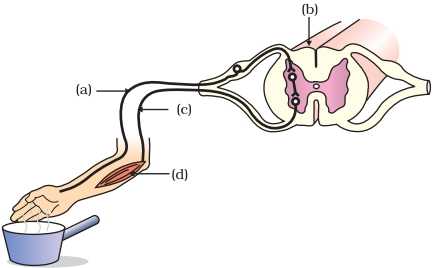
Label the parts $(a)$,$(b)$,$(c)$ and $(d)$ and show the direction of flow of electrical signals in the figure.
Solution
(N/A) The given figure represents a reflex arc,which is the pathway taken by nerve impulses in a reflex action.
$(a)$ Sensory neuron: It carries the electrical signal from the receptor (skin) to the central nervous system.
$(b)$ Spinal cord: It acts as the processing center for the reflex action.
$(c)$ Motor neuron: It carries the response signal from the spinal cord to the effector.
$(d)$ Effector: It is the muscle in the arm that contracts to pull the hand away from the hot object.
The direction of the flow of electrical signals is from the receptor (hand) $\rightarrow$ sensory neuron $(a)$ $\rightarrow$ spinal cord $(b)$ $\rightarrow$ motor neuron $(c)$ $\rightarrow$ effector $(d)$ (muscle).
0 likes
View Solution25
Easy
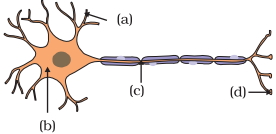
Label the parts of a neuron in the given figure.
Solution
(N/A) Dendrite: These are branch-like structures that receive information from other neurons.
$(b)$ Cell body (Cyton): It contains the nucleus and cytoplasm and is responsible for processing information.
$(c)$ Axon: It is a long fiber that conducts electrical impulses away from the cell body.
$(d)$ Nerve ending (Axon terminal): These are the branched ends of the axon that transmit signals to the next neuron or target cell.
0 likes
View Solution26
Easy
Match the terms of Column $(A)$ with those of Column $(B)$.
| Column $(A)$ | Column $(B)$ |
| $(a)$ Olfactory receptors | $(i)$ Tongue |
| $(b)$ Thermoreceptors (temperature receptors) | $(ii)$ Eye |
| $(c)$ Gustatoreceptors | $(iii)$ Nose |
| $(d)$ Photoreceptors | $(iv)$ Skin |
Solution
(A) The correct matches are as follows:
$(a)$ Olfactory receptors are sensory receptors for smell,located in the $(iii)$ Nose.
$(b)$ Thermoreceptors are sensory receptors for temperature,located in the $(iv)$ Skin.
$(c)$ Gustatoreceptors are sensory receptors for taste,located in the $(i)$ Tongue.
$(d)$ Photoreceptors are sensory receptors for light,located in the $(ii)$ Eye.
Therefore,the correct sequence is: $(a-iii, b-iv, c-i, d-ii)$.
0 likes
View Solution27
MediumMCQ
What happens at the synapse between two neurons?
A
Electrical impulses are converted into chemical signals.
B
Chemical signals are converted into electrical impulses.
C
Both $A$ and $B$.
D
None of the above.
Solution
(C) At the synapse,the electrical impulse reaching the axon terminal of one neuron triggers the release of neurotransmitters (chemical substances).
These chemical substances cross the synaptic cleft and bind to receptors on the dendrite of the next neuron.
This process converts the chemical signal back into an electrical impulse in the next neuron,allowing the signal to propagate through the nervous system.
These chemical substances cross the synaptic cleft and bind to receptors on the dendrite of the next neuron.
This process converts the chemical signal back into an electrical impulse in the next neuron,allowing the signal to propagate through the nervous system.
0 likes
View Solution28
Easy
Draw the structure of a neuron and explain its function.
Solution
(N/A) neuron (nerve cell) is the structural and functional unit of the nervous system. Its structure consists of three main parts:
$1$. Cell Body (Cyton): It contains the nucleus and cytoplasm (Nissl granules). It is responsible for the metabolic activities of the cell.
$2$. Dendrites: These are short,branched extensions that receive electrical impulses from other neurons or sensory receptors and transmit them towards the cell body.
$3$. Axon: This is a long,single fiber that carries electrical impulses away from the cell body to other neurons,muscles,or glands. It is often covered by a myelin sheath for faster signal transmission.
Function: Neurons are specialized to detect,receive,and conduct nerve impulses (electrical signals) throughout the body,enabling communication between different parts of the body and the brain.
0 likes
View Solution29
Medium
What are the major parts of the brain? Mention the functions of different parts.
Solution
(N/A) The human brain is divided into three major parts:
$1$. Forebrain: It is the main thinking part of the brain. It controls voluntary actions,stores information (memory),and processes sensory information like sight,smell,and hearing.
$2$. Midbrain: It connects the forebrain to the hindbrain and controls reflex movements of the head,neck,and eyes in response to visual and auditory stimuli.
$3$. Hindbrain: It consists of the cerebellum,pons,and medulla. The cerebellum controls posture,balance,and precision of voluntary movements. The medulla controls involuntary actions like blood pressure,salivation,and vomiting.
0 likes
View Solution30
Medium
What constitutes the central and peripheral nervous systems? How are the components of the central nervous system protected?
Solution
(N/A) The central nervous system $(CNS)$ is composed of the brain and the spinal cord.
The peripheral nervous system $(PNS)$ consists of all the nerves that branch out from the $CNS$ and connect to the rest of the body,including cranial nerves and spinal nerves.
The components of the $CNS$ are protected as follows:
$1$. The brain is protected by a bony box called the cranium (brain box),which contains cerebrospinal fluid for shock absorption.
$2$. The spinal cord is protected by the vertebral column (backbone).
0 likes
View Solution31
Medium
What are reflex actions? Give two examples. Explain a reflex arc.
Solution
(N/A) Reflex actions are rapid,automatic,and involuntary responses to a stimulus that do not involve conscious thought by the brain.
Examples:
$1$. Sudden withdrawal of the hand upon touching a hot object.
$2$. Blinking of eyes when a bright light or object suddenly approaches them.
Reflex Arc:
$A$ reflex arc is the neural pathway that mediates a reflex action. The pathway consists of the following components:
$1$. Receptor: Detects the stimulus.
$2$. Sensory Neuron: Carries the signal from the receptor to the spinal cord.
$3$. Relay Neuron (Interneuron): Processes the signal within the spinal cord.
$4$. Motor Neuron: Carries the response signal from the spinal cord to the effector.
$5$. Effector: $A$ muscle or gland that performs the action.
0 likes
View Solution32
MediumMCQ
Why is the flow of signals in a synapse from the axonal end of one neuron to the dendritic end of another neuron,but not in the reverse direction?
A
Because dendrites are not capable of releasing chemicals.
B
Because axons are not capable of receiving chemicals.
C
Because neurotransmitters are only present at the axonal end.
D
All of the above.
Solution
(D) When an electrical impulse reaches the axonal end (synaptic knob) of a neuron,it triggers the release of chemical substances known as neurotransmitters into the synaptic cleft.
These chemicals diffuse across the synapse towards the dendritic end of the adjacent neuron.
At the dendritic end,these chemicals bind to specific receptors to generate a new electrical impulse.
Since the neurotransmitters are stored only in the synaptic vesicles at the axonal end and the receptors are located only on the dendritic membrane,the signal can only flow in one direction: from the axon of one neuron to the dendrite of another.
0 likes
View Solution33
Medium
Name two specialised tissues that provide control and coordination in multicellular organisms.
Solution
(N/A) The two specialised tissues that provide control and coordination in multicellular organisms are:
$1$. Nervous tissue: It is responsible for the transmission of electrical impulses and the processing of information.
$2$. Muscular tissue: It is responsible for the movement of body parts in response to the signals received from the nervous system.
$1$. Nervous tissue: It is responsible for the transmission of electrical impulses and the processing of information.
$2$. Muscular tissue: It is responsible for the movement of body parts in response to the signals received from the nervous system.
0 likes
View Solution34
Easy
List two body functions that will be affected if the cerebellum gets damaged.
Solution
(N/A) The cerebellum is responsible for maintaining posture,balance,and the coordination of voluntary muscle movements.
$(i)$ Walking in a straight line: The cerebellum coordinates the precise muscle movements required to maintain balance while walking.
$(ii)$ Picking up an object from the ground: This requires precise coordination between the eyes and the hands,as well as maintaining body balance while bending,which is controlled by the cerebellum.
0 likes
View Solution35
Easy
What is the role of motor areas in the brain?
Solution
(N/A) The motor areas of the brain are responsible for the conscious control and coordination of voluntary muscle movements. These regions receive information from other parts of the brain and send signals through the spinal cord to the skeletal muscles,enabling precise actions such as walking,writing,and speaking.
0 likes
View Solution36
Medium
Give the scientific names of the following regions of the human brain:
$(i)$ Region for sight.
$(ii)$ Region which controls salivation.
$(i)$ Region for sight.
$(ii)$ Region which controls salivation.
Solution
(N/A) $(i)$ The region responsible for sight is the Occipital lobe (located in the cerebrum of the forebrain).
$(ii)$ The region which controls salivation is the Medulla oblongata (located in the hindbrain).
$(ii)$ The region which controls salivation is the Medulla oblongata (located in the hindbrain).
0 likes
View Solution37
Medium
All information from our environment is detected by specialised tips of some nerve cells. Write the name given to such tips and also mention where they are located.
Solution
(N/A) The specialised tips of some nerve cells that detect information from the environment are called $Receptors$.
These $Receptors$ are located in our sense organs,such as the inner ear,the nose,the tongue,the skin,and the eyes.
These $Receptors$ are located in our sense organs,such as the inner ear,the nose,the tongue,the skin,and the eyes.
0 likes
View Solution38
Medium
State the function of: $(i)$ gustatory receptors,and $(ii)$ olfactory receptors.
Solution
(N/A) $(i)$ Gustatory receptors are specialized sensory receptors located in the taste buds of the tongue that function to detect taste.
$(ii)$ Olfactory receptors are specialized sensory receptors located in the nasal cavity that function to detect smell.
$(ii)$ Olfactory receptors are specialized sensory receptors located in the nasal cavity that function to detect smell.
0 likes
View Solution39
EasyMCQ
Which part of the nervous system controls reflex arcs?
A
Brain
B
Spinal cord
C
Cerebellum
D
Medulla oblongata
Solution
(B) The reflex arc is a neural pathway that controls a reflex action. In most cases,the sensory neurons transmit the signal to the spinal cord,which processes the information and sends an immediate response through motor neurons to the effector organ. This process bypasses the brain to ensure a rapid reaction to stimuli,making the spinal cord the primary control center for reflex arcs.
0 likes
View Solution40
EasyMCQ
Which system facilitates the communication between the central nervous system and other parts of the body?
A
Endocrine system
B
Digestive system
C
Respiratory system
D
Excretory system
Solution
(A) The $Peripheral \ Nervous \ System$ $(PNS)$ facilitates communication between the $Central \ Nervous \ System$ $(CNS)$ and other parts of the body. However, in the context of general biological coordination, the $Endocrine \ System$ also plays a crucial role in chemical communication. Given the options provided, the $Endocrine \ System$ is the intended answer for chemical signaling, while the $Peripheral \ Nervous \ System$ is the primary structural link.
0 likes
View Solution41
Easy
Name two tissues that provide control and coordination in multicellular animals.
Solution
(N/A) The two tissues (or systems) that provide control and coordination in multicellular animals are:
$(i)$ Nervous tissue: It consists of neurons that transmit electrical impulses to coordinate body activities rapidly.
$(ii)$ Endocrine tissue (or Glandular tissue): It consists of endocrine glands that secrete hormones directly into the blood to regulate physiological processes slowly and steadily.
$(i)$ Nervous tissue: It consists of neurons that transmit electrical impulses to coordinate body activities rapidly.
$(ii)$ Endocrine tissue (or Glandular tissue): It consists of endocrine glands that secrete hormones directly into the blood to regulate physiological processes slowly and steadily.
0 likes
View Solution42
EasyMCQ
What is a synapse?
A
$A$ junction between two muscles.
B
$A$ junction between two neurons.
C
$A$ type of nerve cell.
D
$A$ chemical released by the brain.
Solution
(B) synapse is the functional junction between two neurons,or between a neuron and an effector cell (like a muscle or gland),where information is transmitted from one cell to another.
0 likes
View Solution43
Easy
Define 'reflex action'.
Solution
(N/A) Reflex action is a sudden,involuntary,and spontaneous response to a stimulus. It is usually helpful in protecting the body from potential harm or injury by bypassing the conscious thought process of the brain.
0 likes
View Solution44
Easy
Name the sensory receptors found in the nose and on the tongue.
Solution
(N/A) The sensory receptors found in the nose are called olfactory receptors,which detect smell.
The sensory receptors found on the tongue are called gustatory receptors,which detect taste.
The sensory receptors found on the tongue are called gustatory receptors,which detect taste.
0 likes
View Solution45
Medium
Define neuron. Name the parts of the neuron where:
$(i)$ information is acquired?
$(ii)$ impulse must be converted into a chemical signal for onward transmission?
$(i)$ information is acquired?
$(ii)$ impulse must be converted into a chemical signal for onward transmission?
Solution
(N/A) neuron is the functional and structural unit of the nervous system,which consists of cells specialized for conducting information via electrical impulses from one part of the body to another.
$(i)$ Information is acquired at the dendrites.
$(ii)$ The impulse is converted into a chemical signal at the axon terminals (end of the axon) to facilitate transmission across the synapse.
$(i)$ Information is acquired at the dendrites.
$(ii)$ The impulse is converted into a chemical signal at the axon terminals (end of the axon) to facilitate transmission across the synapse.
0 likes
View Solution46
Easy
Trace the sequence of events through a reflex arc that occurs when a bright light is focused on your eyes.
Solution
(N/A) When a bright light is focused on the eyes,the following sequence of events occurs in the reflex arc:
$1$. Photo receptors (in the retina of the eye) detect the stimulus (bright light).
$2$. Sensory neurons transmit the nerve impulse from the eye to the central nervous system (spinal cord/brain).
$3$. The relay neuron (interneuron) in the central nervous system processes the signal.
$4$. Motor neurons transmit the response signal from the central nervous system to the effector muscles.
$5$. The effector muscles (eyelid muscles) contract,causing the eye to blink.
Sequence: $\text{Photo receptors} \to \text{Sensory neuron} \to \text{Central nervous system} \to \text{Motor neuron} \to \text{Effector (eyelid muscles)} \to \text{Response (blinking)}$.
0 likes
View Solution47
EasyMCQ
Name the part of the neuron:
$(i)$ where information is acquired.
$(ii)$ through which information travels as an electrical impulse.
$(i)$ where information is acquired.
$(ii)$ through which information travels as an electrical impulse.
A
Dendrite tip,Axon
B
Axon,Dendrite tip
C
Cell body,Axon
D
Dendrite tip,Cell body
Solution
(A) $(i)$ The information is acquired at the end of the dendrite tip of a nerve cell.
$(ii)$ The information travels as an electrical impulse from the dendrite to the cell body and then along the axon to its end.
$(ii)$ The information travels as an electrical impulse from the dendrite to the cell body and then along the axon to its end.
0 likes
View Solution48
Medium
$(a)$ Give the functions of cerebellum. (any two)
$(b)$ Name the components of central nervous system.
$(b)$ Name the components of central nervous system.
Solution
(N/A) $(i)$ Cerebellum is responsible for the precision of voluntary actions.
$(ii)$ It maintains the posture and balance of the body.
$(b)$ The components of the central nervous system are:
$(i)$ Brain
$(ii)$ Spinal cord
$(ii)$ It maintains the posture and balance of the body.
$(b)$ The components of the central nervous system are:
$(i)$ Brain
$(ii)$ Spinal cord
0 likes
View Solution49
Easy
'Brain and spinal cord are two vital organs of our body'. How is our body designed to protect them?
Solution
(N/A) The brain is protected by a bony box called the cranium (skull),which provides a hard outer covering. Inside the skull,the brain is cushioned by a fluid-filled balloon known as the cerebrospinal fluid $(CSF)$,which absorbs mechanical shocks and protects the brain from injury.
The spinal cord is protected by the vertebral column (backbone),which provides structural support and shields it from physical damage.
Additionally,both the brain and the spinal cord are covered by three protective membranes known as the meninges,which provide further insulation and protection.
The spinal cord is protected by the vertebral column (backbone),which provides structural support and shields it from physical damage.
Additionally,both the brain and the spinal cord are covered by three protective membranes known as the meninges,which provide further insulation and protection.
0 likes
View Solution50
Medium
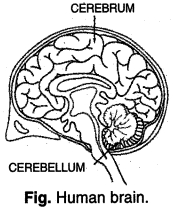
$(a)$ Draw a diagram of the human brain.
$(b)$ Label the Cerebrum and Cerebellum on it.
$(c)$ What is the role of the Cerebellum?
$(b)$ Label the Cerebrum and Cerebellum on it.
$(c)$ What is the role of the Cerebellum?
Solution
(N/A) and $(b)$ Refer to the provided diagram of the human brain.
$(c)$ Role of the Cerebellum: It is responsible for the precision of voluntary actions and for maintaining the posture and balance of the body.
$(c)$ Role of the Cerebellum: It is responsible for the precision of voluntary actions and for maintaining the posture and balance of the body.
0 likes
View SolutionControl and Coordination — Animals - Nervous System · Frequently Asked Questions
1Are these Control and Coordination questions useful for JEE and NEET?
Yes. All questions in this section are mapped to JEE Main and NEET exam patterns. Previous year questions from JEE Main, NEET, GUJCET and state-level exams are included with full solutions.
2Can I switch to Hindi or Gujarati for these questions?
Yes. Use the language tabs in the hero section or the sidebar to view the same questions and solutions in English, Hindi or Gujarati.
3How do I generate a question paper from this subtopic?
Use the Vedclass Exam Paper Generator — select the chapter and subtopic, set difficulty, and generate Sets A, B, C, D automatically. First 3 chapters of every subject are free.
Vedclass Products
For Students
Vedclass Test Series
Mock tests in real JEE/NEET style with performance analysis. 5-day free trial.
Start Free TrialFor Teachers
Exam Paper Generator
Generate Set A/B/C/D papers from this chapter in 2 minutes. 3 chapters free.
Try FreeFor Institutes
Online Exam Module
Live online exams with unlimited students, 360° analytics & white-label branding.
See DemoFor Teachers & Institutes
Generate a Control and Coordination Exam Paper in 2 Minutes
Select subtopic & difficulty — Sets A, B, C, D auto-generated with No Repeat logic.
First 3 chapters of every subject are free — no payment required.