
A English
Coordination in Plants Questions in English
Class 10 Science · Control and Coordination · Coordination in Plants
60+
Questions
English
Language
100%
With Solutions
Showing 50 of 60 questions in English
1
Medium
What are plant hormones?
Solution
(N/A) Plant hormones,also known as phytohormones,are naturally occurring organic substances. They are synthesized in minute quantities in specific parts of the plant body and are translocated to other parts where they are required to regulate physiological processes. The five major types of phytohormones are auxins,gibberellins,cytokinins,abscisic acid,and ethylene.
0 likes
View Solution2
EasyMCQ
How is the movement of leaves of the sensitive plant different from the movement of a shoot towards light?
A
The movement of leaves is growth-dependent,while the movement of the shoot is growth-independent.
B
The movement of leaves is independent of growth,whereas the movement of the shoot is growth-dependent.
C
Both movements are growth-dependent.
D
Both movements are growth-independent.
Solution
(B) The movement of leaves of the sensitive plant,$Mimosa$ $pudica$ (touch-me-not),occurs in response to touch or contact stimuli (thigmonasty). This movement is independent of growth and is reversible.
The movement of a shoot towards light is known as phototropism. This type of movement is directional and is growth-dependent,meaning it involves the differential growth of cells on different sides of the stem.
The movement of a shoot towards light is known as phototropism. This type of movement is directional and is growth-dependent,meaning it involves the differential growth of cells on different sides of the stem.
0 likes
View Solution3
EasyMCQ
Give an example of a plant hormone that promotes growth.
A
Auxin
B
Abscisic acid
C
Ethylene
D
Cytokinin
Solution
(A) Auxin is a primary example of a growth-promoting plant hormone. It is responsible for cell elongation,apical dominance,and root initiation in plants.
0 likes
View Solution4
EasyMCQ
How do auxins promote the growth of a tendril around a support?
A
By inhibiting cell division on the side touching the support.
B
By stimulating faster cell elongation on the side away from the support.
C
By causing the tendril to wither upon contact.
D
By increasing the thickness of the tendril uniformly.
Solution
(B) Auxin is a plant hormone synthesized at the shoot tip that promotes cell elongation.
When a tendril comes in contact with a support,the concentration of auxin decreases on the side touching the support and remains higher on the side away from the support.
This higher concentration of auxin on the side away from the support stimulates faster cell growth and elongation on that side.
As a result,the side away from the support grows longer than the side in contact,causing the tendril to coil around the support.
0 likes
View Solution5
Difficult
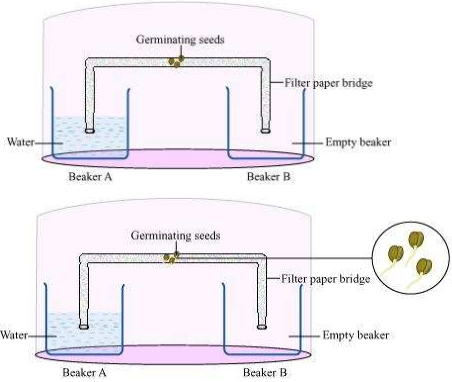
Design an experiment to demonstrate hydrotropism.
Solution
(N/A) $1$. Take two small beakers and label them as $A$ and $B$.
$2$. Fill beaker $A$ with water and leave beaker $B$ empty.
$3$. Make a cylindrical-shaped roll from a filter paper and place it as a bridge between beaker $A$ and beaker $B$.
$4$. Place a few germinating seeds in the middle of the filter paper bridge.
$5$. Cover the entire set-up with a transparent plastic container to maintain humidity.
Observation:
After a few days,it is observed that the roots of the germinating seeds grow towards beaker $A$ (the source of water).
Conclusion:
This growth of plant roots towards water is known as hydrotropism. It demonstrates that roots are positively hydrotropic.
0 likes
View Solution6
EasyMCQ
Which of the following is a plant hormone?
A
Insulin
B
Thyroxin
C
Cytokinin
D
Estrogen
Solution
(C) Cytokinin is a plant hormone that promotes cell division in plants.
Insulin,Thyroxin,and Estrogen are hormones found in animals.
Insulin,Thyroxin,and Estrogen are hormones found in animals.
0 likes
View Solution7
Easy
How does chemical coordination occur in plants?
Solution
(N/A) In animals,control and coordination occur with the help of the nervous system. However,plants do not have a nervous system.
Plants respond to stimuli by showing movements. The growth,development,and responses to the environment in plants are controlled and coordinated by a special class of chemical substances known as hormones or phytohormones.
These hormones are produced in one part of the plant body and are translocated to other parts where they are required.
For example,a hormone produced in the roots is translocated to other parts when needed.
The five major types of phytohormones are auxins,gibberellins,cytokinins,abscisic acid,and ethylene.
These phytohormones are either growth promoters (such as auxins,gibberellins,cytokinins,and ethylene) or growth inhibitors (such as abscisic acid).
0 likes
View Solution8
EasyMCQ
The movement of shoot towards light is
A
geotropism
B
phototropism
C
chemotropism
D
hydrotropism
Solution
(B) The movement of a plant part in response to light is known as phototropism.
Shoots exhibit positive phototropism as they grow towards the light source.
Geotropism is the growth in response to gravity.
Chemotropism is the growth in response to chemical stimuli.
Hydrotropism is the growth in response to water.
Shoots exhibit positive phototropism as they grow towards the light source.
Geotropism is the growth in response to gravity.
Chemotropism is the growth in response to chemical stimuli.
Hydrotropism is the growth in response to water.
0 likes
View Solution9
MediumMCQ
The main function of abscisic acid in plants is to
A
increase the length of cells
B
promote cell division
C
inhibit growth
D
promote growth of stem
Solution
(C) Abscisic acid $(ABA)$ is a plant hormone known as a growth inhibitor.
Its primary functions include inducing dormancy in seeds and buds,promoting the closure of stomata during water stress,and inhibiting overall plant growth.
Unlike auxins or gibberellins,which promote growth,$ABA$ acts to slow down or stop physiological processes to help the plant survive unfavorable conditions.
Therefore,the correct option is $C$.
0 likes
View Solution10
MediumMCQ
Which of the following is not associated with the growth of a plant?
A
Auxin
B
Gibberellins
C
Cytokinins
D
Abscisic acid
Solution
(D) Plant hormones are chemical substances that regulate plant growth and development.
$1$. $Auxin$, $Gibberellins$, and $Cytokinins$ are known as plant growth promoters because they stimulate cell division, cell enlargement, and other growth-related processes.
$2$. $Abscisic$ $acid$ $(ABA)$ is known as a plant growth inhibitor.
$3$. It inhibits plant growth, promotes seed dormancy, and causes the closing of stomata during water stress.
Therefore, $Abscisic$ $acid$ is not associated with the promotion of plant growth.
0 likes
View Solution11
MediumMCQ
The growth of tendril in pea plants is due to
A
rapid cell divisions in tendrillar cells that are away from the support
B
effect of gravity
C
effect of light
D
rapid cell divisions in tendrillar cells in contact with the support
Solution
(A) Tendrils are thigmotropic,meaning they exhibit growth in response to touch. When a pea plant tendril comes into contact with a support,the cells on the side in contact with the support do not grow as rapidly as the cells on the side away from the support. This differential growth rate causes the tendril to coil around the object,providing support to the plant.
0 likes
View Solution12
MediumMCQ
The growth of pollen tubes towards ovules is due to
A
hydrotropism
B
chemotropism
C
geotropism
D
phototropism
Solution
(B) The growth of a pollen tube towards the ovule is a classic example of chemotropism.
This movement occurs because the ovule secretes specific chemical substances that attract the pollen tube.
The pollen tube senses these chemicals and grows towards the source,which is the ovule,to facilitate fertilization.
This movement occurs because the ovule secretes specific chemical substances that attract the pollen tube.
The pollen tube senses these chemicals and grows towards the source,which is the ovule,to facilitate fertilization.
0 likes
View Solution13
EasyMCQ
The movement of sunflower in accordance with the path of sun is due to
A
chemotropism
B
geotropism
C
phototropism
D
hydrotropism
Solution
(C) The movement of plant parts in response to light is known as phototropism.
Sunflower plants exhibit heliotropism,which is a type of phototropism where the flower head tracks the movement of the sun across the sky from east to west during the day.
This movement is caused by the differential growth of cells on the shaded side of the stem compared to the illuminated side,which is mediated by the plant hormone auxin.
Therefore,the correct answer is phototropism.
0 likes
View Solution14
MediumMCQ
The substance that triggers the fall of mature leaves and fruits from plants is due to
A
auxin
B
gibberellin
C
cytokinin
D
abscisic acid
Solution
(D) Abscisic acid $(ABA)$ is a plant hormone that acts as a growth inhibitor.
It is primarily responsible for the abscission of leaves,flowers,and fruits,which is the process of shedding these parts from the plant.
It promotes the formation of an abscission layer at the base of the petiole or fruit stalk,leading to their detachment.
Therefore,the correct option is $D$.
It is primarily responsible for the abscission of leaves,flowers,and fruits,which is the process of shedding these parts from the plant.
It promotes the formation of an abscission layer at the base of the petiole or fruit stalk,leading to their detachment.
Therefore,the correct option is $D$.
0 likes
View Solution15
Easy
Name the plant hormones responsible for the following:
$(a)$ Elongation of cells
$(b)$ Growth of stem
$(c)$ Promotion of cell division
$(d)$ Falling of senescent leaves.
$(a)$ Elongation of cells
$(b)$ Growth of stem
$(c)$ Promotion of cell division
$(d)$ Falling of senescent leaves.
Solution
(N/A) Auxin is responsible for cell elongation.
$(b)$ Gibberellin is responsible for the growth of the stem.
$(c)$ Cytokinin is responsible for the promotion of cell division.
$(d)$ Abscisic acid is responsible for the falling of senescent leaves.
$(b)$ Gibberellin is responsible for the growth of the stem.
$(c)$ Cytokinin is responsible for the promotion of cell division.
$(d)$ Abscisic acid is responsible for the falling of senescent leaves.
0 likes
View Solution16
Easy
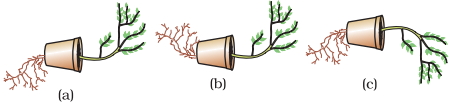
In figures $(a)$,$(b)$ and $(c)$,which appears more accurate and why?
Solution
(A) Figure $(a)$ is the most accurate representation.
This is because plant shoots exhibit negative geotropism (they grow away from the gravitational pull of the Earth,i.e.,upwards).
Conversely,plant roots exhibit positive geotropism (they grow towards the gravitational pull of the Earth,i.e.,downwards).
Therefore,in a horizontally placed pot,the shoot will bend upwards and the roots will bend downwards to align with these natural tropisms.
0 likes
View Solution17
Easy
What is a tropic movement? Explain with an example.
Solution
(N/A) Tropic movement is the directional growth movement of a plant part in response to an external stimulus. These movements are dependent on the direction of the stimulus and can be either towards the stimulus (positive tropism) or away from it (negative tropism).
For example,in phototropism,the shoot of a plant shows positive phototropism by bending towards the light source,whereas the roots show negative phototropism by growing away from the light.
For example,in phototropism,the shoot of a plant shows positive phototropism by bending towards the light source,whereas the roots show negative phototropism by growing away from the light.
0 likes
View Solution18
Medium
Name various plant hormones and describe their physiological effects on plant growth and development.
Solution
(N/A) The major plant hormones (phytohormones) and their physiological effects are as follows:
$1$. $Auxins$: These promote cell enlargement and cell differentiation. They are responsible for apical dominance,root initiation in stem cuttings,and preventing fruit and leaf drop at early stages.
$2$. $Gibberellins$: These promote stem elongation,seed germination,and flowering. They are also involved in breaking seed dormancy and increasing the size of fruits like grapes.
$3$. $Cytokinins$: These promote cell division (cytokinesis). They help in delaying senescence (aging) in leaves,promoting lateral bud growth,and overcoming apical dominance.
$4$. $Abscisic \ acid$ $(ABA)$: This is a growth inhibitor. It promotes dormancy in seeds and buds,induces leaf abscission (falling of leaves),and causes closure of stomata during water stress.
$5$. $Ethylene$: This is a gaseous hormone that promotes fruit ripening and senescence of flowers and leaves.
0 likes
View Solution19
EasyMCQ
What type of movement is shown by $Mimosa$ $pudica$ (touch-me-not) plant leaves when touched with a finger?
A
Thigmonasty
B
Phototropism
C
Geotropism
D
Chemotropism
Solution
(A) The movement shown by $Mimosa$ $pudica$ leaves upon being touched is known as $Thigmonasty$ or $Seismonasty$.
This is a type of $Nastic$ $movement$,which is a non-directional response to a stimulus (in this case,touch).
When the leaves are touched,the cells at the base of the leaflets (pulvini) lose water due to a change in turgor pressure,causing the leaves to fold inward.
This is a type of $Nastic$ $movement$,which is a non-directional response to a stimulus (in this case,touch).
When the leaves are touched,the cells at the base of the leaflets (pulvini) lose water due to a change in turgor pressure,causing the leaves to fold inward.
0 likes
View Solution20
EasyMCQ
Which tropic movement is responsible for the growth of pollen tubes towards ovules?
A
Phototropism
B
Geotropism
C
Chemotropism
D
Hydrotropism
Solution
(C) The growth of pollen tubes towards the ovules is a classic example of chemotropism.
In this process,the pollen tube grows towards the ovule in response to chemical signals (specifically,calcium gradients and other chemical substances) released by the synergid cells within the ovule.
In this process,the pollen tube grows towards the ovule in response to chemical signals (specifically,calcium gradients and other chemical substances) released by the synergid cells within the ovule.
0 likes
View Solution21
Easy
Define 'Chemotropism'.
Solution
(N/A) Chemotropism is the growth or movement of a plant part in response to a chemical stimulus. $A$ classic example is the growth of the pollen tube towards the ovule,which is triggered by chemical substances secreted by the stigma and style.
0 likes
View Solution22
Easy
Give one example of chemotropism.
Solution
(N/A) Chemotropism is the growth or movement of a plant part in response to a chemical stimulus. $A$ classic example is the growth of the pollen tube towards the ovule during fertilization in flowering plants. The ovule secretes specific chemical substances that guide the pollen tube to grow through the style and reach the ovary.
0 likes
View Solution23
Easy
What is meant by hydrotropism? Give an example.
Solution
(N/A) Hydrotropism is the growth or movement of a plant part in response to a water stimulus.
Plants exhibit positive hydrotropism,meaning their roots grow towards the source of water.
Example: When a plant is grown in a pot with a porous pot containing water buried on one side,the roots of the plant will be found to bend towards the source of water.
Plants exhibit positive hydrotropism,meaning their roots grow towards the source of water.
Example: When a plant is grown in a pot with a porous pot containing water buried on one side,the roots of the plant will be found to bend towards the source of water.
0 likes
View Solution24
Easy
Define phototropism and give one example.
Solution
(N/A) Phototropism is defined as the growth or movement of a plant part in response to a light stimulus.
Plants exhibit positive phototropism in their shoots,meaning the stem grows towards the source of light.
Example: The bending of a sunflower or a potted plant stem towards the direction of sunlight.
Plants exhibit positive phototropism in their shoots,meaning the stem grows towards the source of light.
Example: The bending of a sunflower or a potted plant stem towards the direction of sunlight.
0 likes
View Solution25
Medium
Tendrils encircle or coil around the object in contact with it. Elaborate.
Solution
(N/A) Tendrils are sensitive to touch,a phenomenon known as thigmotropism. When they come in contact with any support,the part of the tendril in contact with the object grows more slowly than the part of the tendril away from the object. This differential growth rate causes the tendril to coil around the object,allowing the plant to climb and gain support.
0 likes
View Solution26
Medium
How does chemical coordination occur in plants? Explain with the help of three examples.
Solution
(N/A) In plants,chemical coordination occurs through various phytohormones (plant hormones).
$(i)$ Auxins: These are secreted by growing tissues and promote the growth of plants.
$(ii)$ Gibberellins: These hormones are responsible for stem elongation,seed germination,and flowering.
$(iii)$ Cytokinins: These are present in areas of actively dividing cells,such as fruits and seeds,and they promote cell division.
$(iv)$ Abscisic acid: This hormone inhibits growth and helps the plant respond to environmental stress.
(Any three of the above examples explain chemical coordination in plants.)
0 likes
View Solution27
Medium
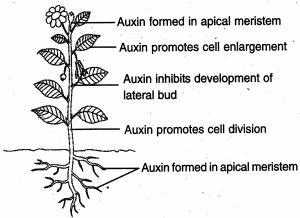
Illustrate with the help of a diagram,the effect of auxins in different parts of a plant.
Solution
(N/A) Auxins are a group of plant hormones that play a crucial role in plant growth and development. Their effects in different parts of a plant are as follows:
$1$. Auxin is synthesized in the apical meristems of both the shoot and the root.
$2$. In the shoot,auxin promotes cell enlargement,which contributes to the elongation of the stem.
$3$. Auxin is responsible for apical dominance,where it inhibits the development of lateral buds,ensuring the plant grows primarily in height.
$4$. Auxin also promotes cell division in certain tissues,facilitating overall plant growth.
[Diagram Description: The diagram shows a plant with labels indicating that auxin is formed in the apical meristems of the shoot and root,promotes cell enlargement and cell division,and inhibits the development of lateral buds.]
0 likes
View Solution28
Medium
$(a)$ How are the movement of leaves of touch-me-not and the growth of a stem towards light different?
$(b)$ What is chemotropism? Give one example.
$(c)$ What is tropism?
$(b)$ What is chemotropism? Give one example.
$(c)$ What is tropism?
Solution
$(N/A)$ The movement of leaves of the touch-me-not plant $(Mimosa \, pudica)$ is a nastic movement, which is fast and non-directional. In contrast, the growth of a stem towards light (phototropism) is a tropic movement, which is slow and directional.
$(b)$ Chemotropism: It is the growth or movement of a plant part in response to a chemical stimulus.
Example: The growth of the pollen tube towards the ovule during fertilization.
$(c)$ Tropism: It is a directional growth movement of a plant part in response to an external stimulus.
$(b)$ Chemotropism: It is the growth or movement of a plant part in response to a chemical stimulus.
Example: The growth of the pollen tube towards the ovule during fertilization.
$(c)$ Tropism: It is a directional growth movement of a plant part in response to an external stimulus.
0 likes
View Solution29
Medium
Name the hormone synthesized at the shoot tips. How does it help the plant to respond to light?
Solution
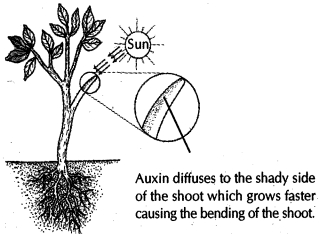
(N/A) The hormone synthesized at the shoot tips is $Auxin$.
When a growing plant detects light,$Auxin$ is produced at the shoot tip and helps the cells to grow longer.
When light falls on the plant from one side,$Auxin$ diffuses towards the shady side of the shoot.
This higher concentration of $Auxin$ on the shady side stimulates the cells to grow longer compared to the cells on the illuminated side.
As a result,the shoot bends towards the light,a phenomenon known as phototropism.
0 likes
View Solution30
Medium
$(a)$ Name one organ each where growth hormone is synthesized in man and plant.
$(b)$ List the sequence of events that occur when a plant is exposed to unidirectional light,leading to bending of a growing shoot. Also,name the hormone and the type of movement.
$(b)$ List the sequence of events that occur when a plant is exposed to unidirectional light,leading to bending of a growing shoot. Also,name the hormone and the type of movement.
Solution
(N/A) In humans,growth hormone is synthesized in the anterior lobe of the $Pituitary$ $gland$. In plants,growth hormones (auxins) are synthesized in the shoot tips (apical meristems).
$(b)$ The sequence of events is as follows:
$1$. When a plant is exposed to unidirectional light,the hormone $Auxin$ is synthesized at the shoot tip.
$2$. $Auxin$ diffuses towards the shaded side of the shoot,away from the light source.
$3$. The higher concentration of $Auxin$ on the shaded side stimulates the cells to elongate more rapidly compared to the cells on the illuminated side.
$4$. This differential growth causes the shoot to bend towards the light source.
$Name$ $of$ $the$ $hormone$: $Auxin$.
$Type$ $of$ $movement$: $Phototropic$ $movement$ (or $Phototropism$).
0 likes
View Solution31
Medium
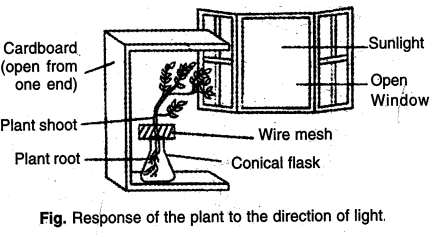
Describe an activity to illustrate the phenomenon of phototropism and explain why this occurs.
Solution
(N/A) Activity:
$(i)$ Take a potted plant and place it in a cardboard box that is open from one side. Position the box such that the open side faces a window,allowing the plant to receive light from one direction.
$(ii)$ Observe the plant for a few days. You will notice that the shoot bends towards the light source.
$(iii)$ Now,rotate the plant so that the shoot is facing away from the light. Leave it undisturbed for a few days.
$(iv)$ Observe the plant again; the shoot will gradually bend back towards the light source.
Explanation:
When growing plants detect light,a hormone called auxin,which is synthesized at the shoot tip,plays a crucial role. Auxin always diffuses towards the shady side of the shoot. This higher concentration of auxin on the shady side stimulates the cells to grow longer than those on the side facing the light. Consequently,the unequal growth causes the plant shoot to bend towards the light,a phenomenon known as phototropism.
0 likes
View Solution32
EasyMCQ
How does the plant detect the touch,and how do the leaves move in response?
A
By using specialized nerve cells.
B
By using electrical-chemical signals to convey information.
C
By using hormonal signals only.
D
By using mechanical pressure sensors.
Solution
(B) Plants use electrical-chemical signals to detect touch and to convey information from cell to cell,despite lacking specialized nervous tissue.
The cells in the leaves change their shape by altering the amount of water within them (turgor pressure).
This change in water content causes the cells to swell or shrink,which results in the movement of the leaves in response to the stimulus.
The cells in the leaves change their shape by altering the amount of water within them (turgor pressure).
This change in water content causes the cells to swell or shrink,which results in the movement of the leaves in response to the stimulus.
0 likes
View Solution33
Medium
State how the concentration of auxin stimulates the cells to grow longer on the side of the shoot that is away from light.
Solution
(N/A) When growing plants detect light,a hormone called auxin,which is synthesized at the shoot tip,helps the cells to grow longer.
When light falls on one side of the plant,auxin diffuses towards the shady side of the shoot.
This higher concentration of auxin on the shady side stimulates the cells to elongate more rapidly compared to the side facing the light,causing the shoot to bend towards the light source.
When light falls on one side of the plant,auxin diffuses towards the shady side of the shoot.
This higher concentration of auxin on the shady side stimulates the cells to elongate more rapidly compared to the side facing the light,causing the shoot to bend towards the light source.
0 likes
View Solution34
Medium
Explain how the movement of leaves of a sensitive plant is different from the movement of shoots towards light.
Solution
(N/A) The movement of the leaves of a sensitive plant (e.g.,$Mimosa$ $pudica$) is known as a nastic movement. This movement is independent of the direction of the stimulus and occurs due to a rapid loss of water (turgor pressure) in the cells upon touch.
In contrast,the movement of a shoot towards light is a phototropic movement. This is a directional growth movement that occurs due to the unequal distribution of plant hormones,specifically auxins,in response to light.
While nastic movements are rapid and reversible,tropic movements are generally slower and involve actual growth of the plant part.
0 likes
View Solution35
MediumMCQ
The growth of tendril in pea plants is due to:
A
Effect of light.
B
Rapid cell divisions in tendrillar cells that are away from the support.
C
Effect of gravity.
D
Rapid cell divisions in tendrillar cells in contact with the support.
Solution
(B) Tendrils in pea plants exhibit thigmotropism,which is a growth response to touch.
When a tendril comes in contact with a support,the cells in contact with the support do not grow as rapidly as the cells on the side away from the support.
This differential growth rate causes the tendril to coil around the support.
Therefore,the rapid cell division occurs in the cells that are away from the support.
0 likes
View Solution36
EasyMCQ
The growth of pollen tubes towards ovules is due to:
A
Hydrotropism
B
Geotropism
C
Chemotropism
D
Phototropism
Solution
(C) The growth of the pollen tube towards the ovule is a classic example of $Chemotropism$.
This occurs because the ovule secretes specific chemical substances (sugars and other compounds) that attract the pollen tube.
The pollen tube senses these chemical gradients and grows towards the source,which is the ovule,to facilitate fertilization.
Therefore,the correct option is $C$.
This occurs because the ovule secretes specific chemical substances (sugars and other compounds) that attract the pollen tube.
The pollen tube senses these chemical gradients and grows towards the source,which is the ovule,to facilitate fertilization.
Therefore,the correct option is $C$.
0 likes
View Solution37
EasyMCQ
State whether the following statement is true or false: Abscisic acid inhibits growth.
A
True
B
False
Solution
(A) The statement is True. Abscisic acid $(ABA)$ is a plant hormone known as a growth inhibitor. It promotes seed dormancy,induces leaf senescence,and causes the closure of stomata to prevent water loss during stress conditions,thereby inhibiting overall plant growth.
0 likes
View Solution38
MediumMCQ
Write true or false for the statement: Growth of pollen tubes towards ovules is due to chemotropism.
A
True
B
False
Solution
(A) The statement is True.
Growth of pollen tubes towards the ovules is a classic example of chemotropism.
Chemotropism is the movement or growth of a plant part in response to a chemical stimulus.
In this process,the ovule releases specific chemical substances that guide the pollen tube to grow towards it,ensuring successful fertilization.
0 likes
View Solution39
EasyMCQ
What is the movement of a plant towards gravity called?
A
Hydrotropism
B
Geotropism
C
Chemotropism
D
Phototropism
Solution
(B) The movement of a plant part in response to gravity is known as $Geotropism$ (also called $Gravitropism$).
Roots typically show positive $Geotropism$ as they grow downwards towards the pull of gravity,while shoots show negative $Geotropism$ as they grow upwards away from it.
Roots typically show positive $Geotropism$ as they grow downwards towards the pull of gravity,while shoots show negative $Geotropism$ as they grow upwards away from it.
0 likes
View Solution40
EasyMCQ
Which plant organ shows negative phototropism?
A
Root
B
Stem
C
Shoot
D
Leaf
Solution
(A) Phototropism is the growth of an organism in response to a light stimulus.
Positive phototropism is growth towards the light source,which is typically observed in the shoot or stem of a plant.
Negative phototropism is growth away from the light source.
Roots exhibit negative phototropism because they grow away from light and towards gravity (geotropism).
Positive phototropism is growth towards the light source,which is typically observed in the shoot or stem of a plant.
Negative phototropism is growth away from the light source.
Roots exhibit negative phototropism because they grow away from light and towards gravity (geotropism).
0 likes
View Solution41
EasyMCQ
What is the movement of a plant shoot towards light called?
A
Geotropism
B
Phototropism
C
Thigmotropism
D
Photonasty
Solution
(B) The movement of a plant part in response to light is known as phototropism.
When the shoot of a plant grows towards a light source,it is called positive phototropism.
Geotropism is the response to gravity,thigmotropism is the response to touch,and photonasty is a non-directional movement in response to light.
When the shoot of a plant grows towards a light source,it is called positive phototropism.
Geotropism is the response to gravity,thigmotropism is the response to touch,and photonasty is a non-directional movement in response to light.
0 likes
View Solution42
EasyMCQ
What is the stimulus involved in the process of thigmotropism?
A
Touch
B
Gravity
C
Light
D
Chemical
Solution
(A) Thigmotropism is the directional growth movement of a plant in response to a touch stimulus or physical contact with a solid object.
For example,tendrils of climbing plants coil around a support when they come into contact with it.
Therefore,the correct stimulus for thigmotropism is touch.
For example,tendrils of climbing plants coil around a support when they come into contact with it.
Therefore,the correct stimulus for thigmotropism is touch.
0 likes
View Solution43
EasyMCQ
The thigmonasty is the nastic movement of a plant in response to
A
gravity
B
water
C
light
D
touch
Solution
(D) Thigmonasty is a type of nastic movement in plants that occurs in response to touch or mechanical stimulation.
For example, the folding of leaves in the sensitive plant $(Mimosa \text{ pudica})$ when touched is a classic example of thigmonasty.
Since the original options provided did not include 'touch', the correct answer is 'touch'.
Gravity-related movement is geotropism, water-related is hydrotropism, and light-related is phototropism or photonasty.
0 likes
View Solution44
EasyMCQ
The response of plants to stimuli is limited because $...$
A
Plants do not have a nervous system like animals.
B
Plants do not exhibit locomotion like animals.
C
Plants do not produce hormones like animals.
D
Plants do not have a circulatory system like animals.
Solution
(A) Plants lack a specialized nervous system and sensory organs,which are present in animals to process and respond to complex stimuli. While plants do produce hormones (phytohormones) to regulate growth and development,their response to external stimuli is primarily chemical and slower compared to the rapid electrical signaling found in animal nervous systems. Therefore,the absence of a nervous system is the primary reason for their limited response.
0 likes
View Solution45
EasyMCQ
Which of the following plant hormones acts as a growth promoter?
A
Auxin
B
Abscisic acid
C
Ethylene
D
Insulin
Solution
(A) Plant hormones are classified into two categories: growth promoters and growth inhibitors.
$1$. Growth promoters include Auxins,Gibberellins,and Cytokinins,which stimulate cell division,cell enlargement,and growth.
$2$. Growth inhibitors include Abscisic acid,which inhibits growth and promotes dormancy.
$3$. Ethylene acts primarily as a growth inhibitor,though it has complex roles in ripening.
$4$. Insulin is a hormone found in animals,not plants.
Therefore,Auxin is the correct answer as it is a well-known plant growth promoter.
0 likes
View Solution46
EasyMCQ
Which hormone acts as a growth inhibitor in plants?
A
Auxin
B
Gibberellin
C
Abscisic acid
D
Cytokinin
Solution
(C) Plant hormones are chemical substances that regulate growth and development.
$Auxin$,$Gibberellin$,and $Cytokinin$ are primarily known as plant growth promoters.
$Abscisic$ $acid$ $(ABA)$ is known as a plant growth inhibitor.
It promotes dormancy in seeds,induces leaf abscission,and helps the plant withstand stress conditions by closing stomata.
$Auxin$,$Gibberellin$,and $Cytokinin$ are primarily known as plant growth promoters.
$Abscisic$ $acid$ $(ABA)$ is known as a plant growth inhibitor.
It promotes dormancy in seeds,induces leaf abscission,and helps the plant withstand stress conditions by closing stomata.
0 likes
View Solution47
EasyMCQ
How do sensitive plants respond to touch?
A
Nervous tissue
B
Hormones
C
Muscular tissue
D
Stomata
Solution
(B) Sensitive plants,such as $Mimosa$ $pudica$ (touch-me-not),respond to touch through a mechanism involving changes in the amount of water in their cells.
When touched,the plant cells at the base of the leaflets lose water,which leads to a loss of turgor pressure.
This change in turgor pressure causes the leaves to fold or droop.
This movement is independent of growth and is regulated by the movement of water,which is a type of plant movement known as thigmonasty.
Since plants do not possess nervous or muscular tissues,they rely on chemical and physical changes (like water movement) to respond to stimuli.
0 likes
View Solution48
EasyMCQ
If the growth of a plant is towards the stimulus, what is it called?
A
Positive tropism
B
Negative tropism
C
Geotropism
D
Chemotropism
Solution
(A) When the growth movement of a plant part is towards the stimulus, it is known as $Positive \ tropism$.
Conversely, if the growth movement is away from the stimulus, it is known as $Negative \ tropism$.
$Geotropism$ refers specifically to growth in response to gravity, and $Chemotropism$ refers to growth in response to chemical stimuli.
Therefore, the general term for growth towards a stimulus is $Positive \ tropism$.
0 likes
View Solution49
EasyMCQ
Sunflowers orient themselves towards the direction of sunlight. What type of tropism is this?
A
Hydrotropism
B
Geotropism
C
Phototropism
D
Chemotropism
Solution
(C) The movement of a plant part in response to light is known as $Phototropism$.
Since sunflowers track the movement of the sun throughout the day, their growth and orientation are influenced by light, which is a classic example of $Phototropism$.
$Hydrotropism$ is the response to water, $Geotropism$ is the response to gravity, and $Chemotropism$ is the response to chemical stimuli.
0 likes
View Solution50
EasyMCQ
Plant roots grow towards water. What type of tropism is this?
A
Positive geotropism
B
Positive hydrotropism
C
Negative geotropism
D
Negative hydrotropism
Solution
(B) Tropism is the growth or movement of a plant part in response to an external stimulus.
Hydrotropism is the growth or turning of plant roots towards or away from moisture or water.
Since the roots grow towards the water, this movement is known as $Positive \ hydrotropism$.
Hydrotropism is the growth or turning of plant roots towards or away from moisture or water.
Since the roots grow towards the water, this movement is known as $Positive \ hydrotropism$.
0 likes
View SolutionControl and Coordination — Coordination in Plants · Frequently Asked Questions
1Are these Control and Coordination questions useful for JEE and NEET?
Yes. All questions in this section are mapped to JEE Main and NEET exam patterns. Previous year questions from JEE Main, NEET, GUJCET and state-level exams are included with full solutions.
2Can I switch to Hindi or Gujarati for these questions?
Yes. Use the language tabs in the hero section or the sidebar to view the same questions and solutions in English, Hindi or Gujarati.
3How do I generate a question paper from this subtopic?
Use the Vedclass Exam Paper Generator — select the chapter and subtopic, set difficulty, and generate Sets A, B, C, D automatically. First 3 chapters of every subject are free.
Vedclass Products
For Students
Vedclass Test Series
Mock tests in real JEE/NEET style with performance analysis. 5-day free trial.
Start Free TrialFor Teachers
Exam Paper Generator
Generate Set A/B/C/D papers from this chapter in 2 minutes. 3 chapters free.
Try FreeFor Institutes
Online Exam Module
Live online exams with unlimited students, 360° analytics & white-label branding.
See DemoFor Teachers & Institutes
Generate a Control and Coordination Exam Paper in 2 Minutes
Select subtopic & difficulty — Sets A, B, C, D auto-generated with No Repeat logic.
First 3 chapters of every subject are free — no payment required.