
A English
Animals - Nervous System Questions in English
Class 10 Science · Control and Coordination · Animals - Nervous System
109+
Questions
English
Language
100%
With Solutions
Showing 50 of 109 questions in English
51
Medium
$(i)$ Differentiate between sensory neurons and motor neurons.
$(ii)$ How is the brain protected in our body?
$(iii)$ Name the part of the brain responsible for the precision of voluntary actions and maintaining body posture and balance of the body.
$(ii)$ How is the brain protected in our body?
$(iii)$ Name the part of the brain responsible for the precision of voluntary actions and maintaining body posture and balance of the body.
Solution
(N/A) $(i)$ Sensory neurons carry impulses from receptors to the central nervous system. Motor neurons carry impulses from the central nervous system to effectors (muscles or glands).
$(ii)$ The brain is protected inside a bony box called the cranium (skull). Inside this skull,the brain is cushioned within a fluid-filled space containing Cerebrospinal Fluid $(CSF)$,which acts as a shock absorber to protect the brain from mechanical injury.
$(iii)$ The part of the hindbrain responsible for the precision of voluntary actions and maintaining body posture and balance is the cerebellum.
0 likes
View Solution52
Medium
$(a)$ What is reflex arc?
$(b)$ What are the components of reflex arc?
$(c)$ How do muscle cells move?
$(b)$ What are the components of reflex arc?
$(c)$ How do muscle cells move?
Solution
(N/A) The pathway taken by nerve impulses in a reflex action is called a reflex arc. It is the process of detecting a signal (stimulus) and responding to it by an output action quickly.
$(b)$ The components of a reflex arc are: $\text{Stimulus} \rightarrow \text{Receptors} \rightarrow \text{Sensory neurons} \rightarrow \text{Spinal cord (Central Nervous System)} \rightarrow \text{Motor neurons} \rightarrow \text{Effector (Muscle/Gland)}$.
$(c)$ Muscle cells contain special contractile proteins that change their shape and arrangement in the cell in response to electrical impulses received from the nervous system. This change causes the muscle cells to shorten,resulting in movement.
0 likes
View Solution53
Medium
$(a)$ If the cerebellum is not functioning properly,what are the activities of our body affected?
$(b)$ How do muscle cells move?
$(b)$ How do muscle cells move?
Solution
(N/A) If the cerebellum is not functioning properly,the voluntary actions of our body will be affected,specifically those related to maintaining the posture and balance of the body.
$(b)$ Muscle cells move by changing their shape through the contraction of specialized proteins,which causes the cells to shorten.
$(b)$ Muscle cells move by changing their shape through the contraction of specialized proteins,which causes the cells to shorten.
0 likes
View Solution54
Medium
$(a)$ Name the part of the brain which controls:
$(i)$ voluntary actions,
$(ii)$ involuntary actions.
$(b)$ What is the significance of the peripheral nervous system? Name the components of this nervous system and distinguish between the origin of the two.
$(i)$ voluntary actions,
$(ii)$ involuntary actions.
$(b)$ What is the significance of the peripheral nervous system? Name the components of this nervous system and distinguish between the origin of the two.
Solution
(N/A) $(i)$ Voluntary actions are controlled by the cerebrum (specifically the motor cortex).
$(ii)$ Involuntary actions (such as blood pressure,salivation,and vomiting) are controlled by the medulla oblongata.
$(b)$ The peripheral nervous system $(PNS)$ facilitates communication between the central nervous system $(CNS)$ and the rest of the body.
The components of the $PNS$ are cranial nerves and spinal nerves.
Distinction in origin:
$1$. Cranial nerves arise directly from the brain.
$2$. Spinal nerves arise from the spinal cord.
0 likes
View Solution55
Medium
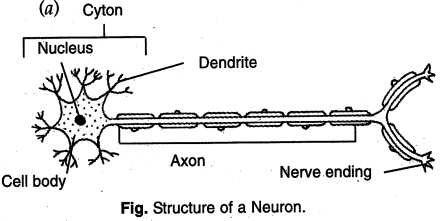
$(a)$ Draw the structure of a neuron and label the following on it:
Nucleus,Dendrite,Cell body,and Axon.
$(b)$ Name the part of the neuron:
$(i)$ Where information is acquired.
$(ii)$ Through which information travels as an electrical impulse.
Nucleus,Dendrite,Cell body,and Axon.
$(b)$ Name the part of the neuron:
$(i)$ Where information is acquired.
$(ii)$ Through which information travels as an electrical impulse.
Solution
(N/A) The structure of a neuron consists of a cell body (cyton) containing the nucleus,dendrites that receive signals,and an axon that transmits electrical impulses.
$(b)$ $(i)$ Dendrite: This part of the neuron acts as the receptor site where information from the environment or other neurons is acquired.
$(ii)$ Axon: This is the long,fiber-like extension of the neuron through which information travels in the form of an electrical impulse toward the nerve endings.
0 likes
View Solution56
Medium
Write the main functions of the following :
$(a)$ Sensory neuron
$(b)$ Cranium
$(c)$ Vertebral column
$(d)$ Motor neuron
$(a)$ Sensory neuron
$(b)$ Cranium
$(c)$ Vertebral column
$(d)$ Motor neuron
Solution
(N/A) Sensory neuron: It carries sensory impulses from receptors,such as the skin,to the central nervous system.
$(b)$ Cranium: It is the bony case surrounding the brain,which protects it from mechanical injury and shock.
$(c)$ Vertebral column: It is the protective bony covering surrounding the spinal cord. It also provides mechanical support to the body.
$(d)$ Motor neuron: It carries motor impulses from the central nervous system to specific effectors,such as muscle fibers or gland cells.
0 likes
View Solution57
Easy
Mention any four reflex actions of the body.
Solution
(N/A) Reflex actions are rapid,involuntary responses to stimuli. Four examples of reflex actions are:
$(i)$ Sneezing: $A$ sudden,involuntary expulsion of air from the nose and mouth.
$(ii)$ Coughing: $A$ rapid expulsion of air from the lungs to clear the airways.
$(iii)$ Knee-jerk reflex: $A$ sudden involuntary kicking movement of the lower leg in response to a sharp tap on the patellar tendon.
$(iv)$ Blinking of eyes: $A$ rapid closing and opening of the eyelids to protect the eyes from foreign objects or bright light.
0 likes
View Solution58
Medium
State in brief how the communication between the central nervous system and the other parts of the body is facilitated.
Solution
(N/A) $(i)$ The brain sends messages to muscles to respond accordingly.
$(ii)$ The communication between the central nervous system and other parts of the body is facilitated by the peripheral nervous system,which consists of cranial nerves arising from the brain and spinal nerves arising from the spinal cord.
$(iii)$ The brain thus allows us to think and take actions accordingly based on that thinking.
0 likes
View Solution59
Medium
What are voluntary and involuntary actions? Give one example of each.
Solution
(N/A) Involuntary actions: These are actions that occur automatically without our conscious control or choice. They are essential for maintaining the internal physiological processes of the body.
Example: The beating of the heart.
Voluntary actions: These are actions that are performed consciously and are under our control. These actions allow us to respond differently to various stimuli based on our decision.
Example: Walking or picking up a book.
Example: The beating of the heart.
Voluntary actions: These are actions that are performed consciously and are under our control. These actions allow us to respond differently to various stimuli based on our decision.
Example: Walking or picking up a book.
0 likes
View Solution60
Medium
Explain the mechanism of reflex action.
Solution
(N/A) $(i)$ Receptor organs like skin receive the stimulus and activate a sensory nerve impulse that travels to the spinal cord.
$(ii)$ The neurons in the spinal cord process this information and transmit the impulse to a motor neuron.
$(iii)$ The motor nerve conducts these impulses to effector organs like muscles,which respond accordingly to the stimulus.
$(ii)$ The neurons in the spinal cord process this information and transmit the impulse to a motor neuron.
$(iii)$ The motor nerve conducts these impulses to effector organs like muscles,which respond accordingly to the stimulus.
0 likes
View Solution61
Medium
Name the system which facilitates communication between the central nervous system and the other parts of the body. Mention two types of nerves it consists of along with their organ of origin.
Solution
(N/A) The system that facilitates communication between the central nervous system and other parts of the body is the Peripheral Nervous System $(PNS)$.
It consists of two types of nerves:
$(i)$ Cranial Nerves: There are $12$ pairs of cranial nerves,which arise from the brain.
$(ii)$ Spinal Nerves: There are $31$ pairs of spinal nerves,which arise from the spinal cord.
It consists of two types of nerves:
$(i)$ Cranial Nerves: There are $12$ pairs of cranial nerves,which arise from the brain.
$(ii)$ Spinal Nerves: There are $31$ pairs of spinal nerves,which arise from the spinal cord.
0 likes
View Solution62
Medium
Which is the main thinking part of the brain? State how it functions.
Solution
(N/A) $(i)$ The forebrain is the main thinking part of the brain,consisting of specialized thinking tissues.
(ii) It contains distinct regions that receive sensory impulses from various receptors,such as the skin,eyes,ears,tongue,and nose.
(iii) It includes separate association areas where sensory information is interpreted by integrating it with data from other receptors and information already stored in the brain. Based on this analysis,a decision is made regarding the appropriate response.
0 likes
View Solution63
Easy
What is cerebrospinal fluid? What is its function?
Solution
(N/A) Cerebrospinal fluid $(CSF)$ is a clear,colorless body fluid found in the brain and spinal cord.
It occupies the subarachnoid space and the ventricular system around and inside the brain and spinal cord.
Function: It acts as a cushion or shock absorber,protecting the brain and spinal cord from mechanical injury and sudden impacts.
It occupies the subarachnoid space and the ventricular system around and inside the brain and spinal cord.
Function: It acts as a cushion or shock absorber,protecting the brain and spinal cord from mechanical injury and sudden impacts.
0 likes
View Solution64
Medium
Define 'nerve impulse'. Which structure in a neuron helps to conduct a nerve impulse:
$(i)$ towards the cell body?
$(ii)$ away from the cell body?
$(i)$ towards the cell body?
$(ii)$ away from the cell body?
Solution
(N/A) nerve impulse is an electrical signal that travels along the membrane of a neuron,facilitating the transmission of information throughout the nervous system.
$(i)$ Dendrites are the branched structures that receive signals and conduct nerve impulses towards the cell body.
$(ii)$ The axon is a long,slender projection of a nerve cell that conducts nerve impulses away from the cell body towards other neurons or effector organs.
$(i)$ Dendrites are the branched structures that receive signals and conduct nerve impulses towards the cell body.
$(ii)$ The axon is a long,slender projection of a nerve cell that conducts nerve impulses away from the cell body towards other neurons or effector organs.
0 likes
View Solution65
MediumMCQ
Which of the following statements about the transmission of a nerve impulse is incorrect?
A
Nerve impulse travels from the dendritic end towards the axonal end.
B
$A$ neuron transmits electrical impulses not only to another neuron but also to muscle and gland cells.
C
The chemicals released from the axonal end of one neuron cross the synapse and generate a similar electrical impulse in a dendrite of another neuron.
D
At the dendritic end,electrical impulses bring about the release of some chemicals which generate an electrical impulse at the axonal end of another neuron.
Solution
(D) The transmission of a nerve impulse follows a specific direction: from the dendrites to the cell body and then along the axon to the axonal terminal. At the synapse,the electrical impulse triggers the release of neurotransmitters (chemicals) from the axonal end of the presynaptic neuron. These chemicals diffuse across the synaptic cleft and bind to receptors on the dendrites of the postsynaptic neuron,where they generate a new electrical impulse. Therefore,statement $D$ is incorrect because it reverses the direction of transmission,claiming that chemicals are released at the dendritic end to trigger an impulse at the axonal end.
0 likes
View Solution66
EasyMCQ
Involuntary actions in the body are controlled by:
A
Medulla in hindbrain.
B
Medulla in midbrain.
C
Medulla in forebrain.
D
Medulla in spinal cord.
Solution
(A) Involuntary actions,such as blood pressure,salivation,and vomiting,are controlled by the medulla oblongata.
The medulla oblongata is a part of the hindbrain.
Therefore,the correct option is $A$.
The medulla oblongata is a part of the hindbrain.
Therefore,the correct option is $A$.
0 likes
View Solution67
EasyMCQ
Which of the following is not an involuntary action?
A
Vomiting
B
Chewing
C
Heartbeat
D
Salivation
Solution
(B) An involuntary action is a movement that occurs without conscious control.
$A$,$C$,and $D$ (Vomiting,Heartbeat,and Salivation) are controlled by the medulla in the hindbrain and occur automatically.
$B$ (Chewing) is a voluntary action because it is under the conscious control of the individual,involving the skeletal muscles of the jaw.
$A$,$C$,and $D$ (Vomiting,Heartbeat,and Salivation) are controlled by the medulla in the hindbrain and occur automatically.
$B$ (Chewing) is a voluntary action because it is under the conscious control of the individual,involving the skeletal muscles of the jaw.
0 likes
View Solution68
MediumMCQ
When a person is suffering from severe cold,he or she cannot :
A
Differentiate the taste of an apple from that of an ice cream.
B
Differentiate red light from green light.
C
Differentiate the smell of a perfume from that of an agarbatti.
D
Differentiate a hot object from a cold object.
Solution
(A) The sense of smell (olfaction) and the sense of taste (gustation) are closely linked. When a person suffers from a severe cold,the nasal passages become congested with mucus. This blockage prevents odor molecules from reaching the olfactory receptors in the nose. Since a significant portion of what we perceive as 'taste' is actually the aroma of food,the inability to smell makes it difficult to distinguish between different flavors,such as an apple and an ice cream. Therefore,the correct option is $A$.
0 likes
View Solution69
MediumMCQ
Which of the following statements are true?
$(i)$ Sudden action in response to something in the environment is called reflex action.
$(ii)$ Sensory neurons carry signals from spinal cord to muscles.
$(iii)$ Motor neurons carry signals from receptors to spinal cord.
$(iv)$ The path through which signals are transmitted from a receptor to a muscle or a gland is called reflex arc.
A
$(i)$ and $(ii)$
B
$(i)$ and $(iii)$
C
$(i), (ii)$ and $(iii)$
D
$(i)$ and $(iv)$
Solution
(D) Statement $(i)$ is true: $A$ reflex action is a rapid,automatic,and involuntary response to a stimulus.
Statement $(ii)$ is false: Sensory neurons carry signals from receptors to the spinal cord,not from the spinal cord to muscles.
Statement $(iii)$ is false: Motor neurons carry signals from the spinal cord to the effectors (muscles or glands),not from receptors to the spinal cord.
Statement $(iv)$ is true: The reflex arc is the neural pathway that controls a reflex action,consisting of a receptor,sensory neuron,integration center (spinal cord),motor neuron,and effector.
Therefore,statements $(i)$ and $(iv)$ are correct.
0 likes
View Solution70
MediumMCQ
Which of the following statements are true about the brain?
$(i)$ The main thinking part of the brain is the hindbrain.
$(ii)$ Centres of hearing,smell,memory,sight,etc.,are located in the forebrain.
$(iii)$ Involuntary actions like salivation,vomiting,and blood pressure are controlled by the medulla in the hindbrain.
$(iv)$ The cerebellum does not control posture and balance of the body.
A
$(ii)$ and $(iii)$
B
$(i), (ii)$ and $(iii)$
C
$(i)$ and $(ii)$
D
$(iii)$ and $(iv)$
Solution
(A) Statement $(i)$ is false because the forebrain is the main thinking part of the brain,not the hindbrain.
Statement $(ii)$ is true because the forebrain contains specialized regions for sensory processing such as hearing,smell,memory,and sight.
Statement $(iii)$ is true because the medulla oblongata,located in the hindbrain,regulates involuntary actions like salivation,vomiting,and blood pressure.
Statement $(iv)$ is false because the cerebellum is specifically responsible for maintaining posture and balance of the body.
Therefore,statements $(ii)$ and $(iii)$ are correct.
0 likes
View Solution71
EasyMCQ
Posture and balance of the body is controlled by:
A
Cerebrum
B
Cerebellum
C
Medulla
D
Pons
Solution
(B) The $Cerebellum$ is a part of the hindbrain responsible for maintaining the posture and balance of the body.
It also coordinates voluntary muscle movements and ensures precision and accuracy in motor activities.
$Cerebrum$ is responsible for thinking and intelligence.
$Medulla$ controls involuntary actions like blood pressure,salivation,and vomiting.
$Pons$ acts as a relay station between different parts of the brain.
0 likes
View Solution72
EasyMCQ
Spinal cord originates from:
A
Cerebrum
B
Pons
C
Medulla
D
Cerebellum
Solution
(C) The spinal cord is a long, thin, tubular structure made of nervous tissue that extends from the brain.
Specifically, the spinal cord originates from the $Medulla$ $oblongata$, which is the lower part of the brainstem.
The $Medulla$ connects the brain to the spinal cord and controls vital autonomic functions such as breathing, heart rate, and blood pressure.
Specifically, the spinal cord originates from the $Medulla$ $oblongata$, which is the lower part of the brainstem.
The $Medulla$ connects the brain to the spinal cord and controls vital autonomic functions such as breathing, heart rate, and blood pressure.
0 likes
View Solution73
EasyMCQ
Which of the following statements is correct about receptors?
A
Olfactory receptors detect taste and gustatory receptors detect smell.
B
Both gustatory and olfactory receptors detect smell.
C
Auditory receptors detect smell and olfactory receptors detect taste.
D
Gustatory receptors detect taste while,olfactory receptors detect smell.
Solution
(D) Receptors are specialized cells or groups of cells that detect stimuli in the environment.
$1$. Gustatory receptors are specialized sensory receptors located in the taste buds of the tongue that detect taste.
$2$. Olfactory receptors are specialized sensory receptors located in the nasal cavity that detect smell.
Therefore,the statement that gustatory receptors detect taste and olfactory receptors detect smell is correct.
0 likes
View Solution74
EasyMCQ
Electrical impulse travels in a neuron from :
A
Dendrite $\rightarrow$ cell body $\rightarrow$ axon $\rightarrow$ axonal end
B
Cell body $\rightarrow$ dendrite $\rightarrow$ axon $\rightarrow$ axonal end
C
Dendrite $\rightarrow$ axon $\rightarrow$ axonal end $\rightarrow$ cell body
D
Axonal end $\rightarrow$ axon $\rightarrow$ cell body $\rightarrow$ dendrite
Solution
(A) In a neuron, the electrical impulse is initiated at the dendrites, which receive information from the environment or other neurons.
From the dendrites, the impulse travels to the cell body (cyton).
Then, it passes through the axon.
Finally, it reaches the axonal end (nerve ending), where it triggers the release of neurotransmitters to pass the signal to the next neuron or effector organ.
Therefore, the correct pathway is: $Dendrite \rightarrow Cell \ body \rightarrow Axon \rightarrow Axonal \ end$.
0 likes
View Solution75
MediumMCQ
In a synapse,chemical signal is transmitted from :
A
Dendritic end of one neuron to axonal end of another neuron.
B
Axonal end of one neuron to dendritic end of another neuron.
C
Cell body to axonal end of the same neuron.
D
Axon to cell body of the same neuron.
Solution
(B) synapse is the junction between two neurons where information is transmitted.
In this process,the electrical impulse reaching the axonal end (axon terminal) of the first neuron triggers the release of chemical messengers called neurotransmitters.
These chemicals diffuse across the synaptic cleft and bind to receptors on the dendritic end of the next neuron.
Therefore,the chemical signal is transmitted from the axonal end of one neuron to the dendritic end of another neuron.
0 likes
View Solution76
MediumMCQ
In a neuron,conversion of electrical signal to a chemical signal occurs at/in:
A
Cell body
B
Dendritic end
C
Axonal end
D
Axon
Solution
(C) In a neuron,the electrical signal travels along the axon towards the axonal end (synaptic knob).
At the axonal end,the electrical impulse triggers the release of neurotransmitters into the synaptic cleft.
These neurotransmitters are chemical substances that carry the signal across the synapse to the next neuron.
Therefore,the conversion of an electrical signal into a chemical signal takes place at the axonal end.
0 likes
View Solution77
EasyMCQ
Which is the correct sequence of the components of a reflex arc?
A
Receptors $\rightarrow$ Muscles $\rightarrow$ Sensory neuron $\rightarrow$ Motor neuron $\rightarrow$ Spinal cord
B
Receptors $\rightarrow$ Motor neuron $\rightarrow$ Spinal cord $\rightarrow$ Sensory neuron $\rightarrow$ Muscles
C
Receptors $\rightarrow$ Spinal cord $\rightarrow$ Sensory neuron $\rightarrow$ Motor neuron $\rightarrow$ Muscles
D
Receptors $\rightarrow$ Sensory neuron $\rightarrow$ Spinal cord $\rightarrow$ Motor neuron $\rightarrow$ Muscles
Solution
(D) reflex arc is the neural pathway that controls a reflex action.
The sequence of components involved in a reflex arc is as follows:
$1$. Receptors: These detect the stimulus.
$2$. Sensory neuron: This carries the signal from the receptor to the central nervous system (spinal cord).
$3$. Spinal cord: This acts as the processing center for the reflex action.
$4$. Motor neuron: This carries the response signal from the spinal cord to the effector.
$5$. Muscles (Effectors): These perform the action in response to the stimulus.
Therefore,the correct sequence is: Receptors $\rightarrow$ Sensory neuron $\rightarrow$ Spinal cord $\rightarrow$ Motor neuron $\rightarrow$ Muscles.
0 likes
View Solution78
EasyMCQ
The junction between two neurons is called:
A
Cell junction
B
Synapse
C
Neural joint
D
Neuromuscular junction
Solution
(B) synapse is the specialized junction between two neurons,or between a neuron and a target cell (such as a muscle or gland cell).
At this junction,the electrical signal (action potential) is converted into a chemical signal via neurotransmitters to bridge the gap between the neurons.
Therefore,the correct term for the junction between two neurons is a synapse.
At this junction,the electrical signal (action potential) is converted into a chemical signal via neurotransmitters to bridge the gap between the neurons.
Therefore,the correct term for the junction between two neurons is a synapse.
0 likes
View Solution79
EasyMCQ
Write true or false for the statement: Many of the involuntary actions are controlled by the midbrain and hindbrain.
A
True
B
False
Solution
(A) The statement is True.
In the human brain,the midbrain and hindbrain (specifically the medulla oblongata) are responsible for regulating various involuntary actions.
For example,the medulla in the hindbrain controls involuntary activities such as blood pressure,salivation,and vomiting.
The midbrain is involved in relaying sensory information and controlling involuntary eye movements and auditory reflexes.
0 likes
View Solution80
EasyMCQ
State whether the following statement is true or false: The cerebellum is a part of the hindbrain.
A
True
B
False
Solution
(A) The statement is True.
The human brain is divided into three main parts: the forebrain,midbrain,and hindbrain.
The hindbrain consists of the pons,medulla oblongata,and cerebellum.
Therefore,the cerebellum is indeed a part of the hindbrain.
The human brain is divided into three main parts: the forebrain,midbrain,and hindbrain.
The hindbrain consists of the pons,medulla oblongata,and cerebellum.
Therefore,the cerebellum is indeed a part of the hindbrain.
0 likes
View Solution81
Easy
State whether the following statement is true or false: Blood pressure,salivation,and vomiting are controlled by the cerebrum.
Solution
(FALSE) The statement is False.
Blood pressure,salivation,and vomiting are involuntary actions known as reflex actions or autonomic functions.
These involuntary activities are controlled by the medulla oblongata,which is a part of the hindbrain,not the cerebrum.
Blood pressure,salivation,and vomiting are involuntary actions known as reflex actions or autonomic functions.
These involuntary activities are controlled by the medulla oblongata,which is a part of the hindbrain,not the cerebrum.
0 likes
View Solution82
Easy
Write true or false for the statement: Forebrain maintains posture and balance of the body.
Solution
(FALSE) The statement is False. The part of the brain responsible for maintaining the posture and balance of the body is the cerebellum,which is a part of the hindbrain,not the forebrain.
0 likes
View Solution83
EasyMCQ
Which of the following helps in maintaining the posture and balance of the human body?
A
Cerebrum
B
Cerebellum
C
Medulla oblongata
D
Pons
Solution
(B) The $Cerebellum$ is a part of the hindbrain located at the back of the skull. Its primary function is to coordinate voluntary muscle movements and maintain the posture and balance of the body. It ensures that movements are smooth and precise.
0 likes
View Solution84
EasyMCQ
How many pairs of spinal nerves arise from the human spinal cord?
A
$21$
B
$31$
C
$41$
D
$51$
Solution
(B) The human spinal cord gives rise to $31$ pairs of spinal nerves.
These nerves are categorized based on the region of the vertebral column from which they emerge:
$8$ pairs of cervical nerves,
$12$ pairs of thoracic nerves,
$5$ pairs of lumbar nerves,
$5$ pairs of sacral nerves,and
$1$ pair of coccygeal nerves.
Therefore,the total number of pairs is $8 + 12 + 5 + 5 + 1 = 31$ pairs.
0 likes
View Solution85
EasyMCQ
The cerebellum,medulla,and pons are parts of which of the following?
A
Midbrain
B
Hindbrain
C
Forebrain
D
Spinal cord
Solution
(B) The human brain is divided into three main parts: the forebrain,midbrain,and hindbrain.
$1$. The forebrain consists of the cerebrum,thalamus,and hypothalamus.
$2$. The midbrain connects the forebrain to the hindbrain.
$3$. The hindbrain consists of three main structures: the cerebellum,the pons,and the medulla oblongata.
Therefore,the cerebellum,medulla,and pons are parts of the hindbrain.
0 likes
View Solution86
EasyMCQ
Where does the spinal cord originate from?
A
Cerebrum
B
Cerebellum
C
Medulla oblongata
D
Pons
Solution
(C) The spinal cord is a long,thin,tubular structure made of nervous tissue that extends from the medulla oblongata in the brainstem and continues down the vertebral column. The medulla oblongata is the lowest part of the brain and serves as the transition point between the brain and the spinal cord.
0 likes
View Solution87
EasyMCQ
In what form is the response to a stimulus generally observed in body parts?
A
Reproduction
B
Transportation
C
Movement
D
Excretion
Solution
(C) Living organisms respond to stimuli in their environment. In animals,this response is typically manifested as movement. For example,when we touch a hot object,we move our hand away. This movement is a result of the coordination between the nervous system and the muscular system.
0 likes
View Solution88
EasyMCQ
What are the small fibers present on the cell body of a neuron called?
A
Dendrites
B
Axon
C
Nerve fiber
D
Synaptic knob
Solution
(A) The neuron consists of three main parts: the cell body (cyton),dendrites,and the axon.
$1$. The cell body contains the nucleus and cytoplasm.
$2$. Dendrites are the short,branched fibers that project out from the cell body.
$3$. These fibers receive impulses and transmit them towards the cell body.
$4$. Therefore,the small fibers on the cell body are known as dendrites.
$1$. The cell body contains the nucleus and cytoplasm.
$2$. Dendrites are the short,branched fibers that project out from the cell body.
$3$. These fibers receive impulses and transmit them towards the cell body.
$4$. Therefore,the small fibers on the cell body are known as dendrites.
0 likes
View Solution89
EasyMCQ
$A$ protective and an insulating sheath of myelin found around the axon is made up of ..........
A
fat and carbohydrate
B
fat and protein
C
protein and minerals
D
protein and carbohydrate
Solution
(B) The myelin sheath is an electrically insulating layer that surrounds the axons of many neurons.
It is primarily composed of lipids (fats) and proteins.
Specifically, the myelin sheath consists of approximately $70-80\%$ lipids and $20-30\%$ proteins by dry weight.
These components provide the necessary insulation to increase the speed of electrical impulses along the nerve fibers.
It is primarily composed of lipids (fats) and proteins.
Specifically, the myelin sheath consists of approximately $70-80\%$ lipids and $20-30\%$ proteins by dry weight.
These components provide the necessary insulation to increase the speed of electrical impulses along the nerve fibers.
0 likes
View Solution90
EasyMCQ
What is the gap between two neurons called?
A
Impulse
B
Synapse
C
Axon
D
Cerebrospinal fluid
Solution
(B) The gap between two neurons is known as a $Synapse$.
At the $Synapse$,electrical signals are converted into chemicals that can cross over to the next neuron and be converted back into electrical signals.
At the $Synapse$,electrical signals are converted into chemicals that can cross over to the next neuron and be converted back into electrical signals.
0 likes
View Solution91
EasyMCQ
Which part of the neuron receives messages from sensory organs?
A
Axon
B
Dendrite
C
Nucleus
D
Nerve ending
Solution
(B) neuron consists of three main parts: the cell body (cyton),dendrites,and the axon.
$1$. Dendrites are the branched,tree-like structures that extend from the cell body.
$2$. They are specialized to receive electrical impulses or chemical signals from sensory receptors or other neurons.
$3$. These signals are then transmitted towards the cell body and subsequently down the axon.
Therefore,the correct part that receives messages is the dendrite.
0 likes
View Solution92
EasyMCQ
What does the central nervous system in humans consist of?
A
Brain and spinal cord
B
Spinal cord and nerves
C
Brain and sensory organs
D
Nerves and sensory organs
Solution
(A) The human nervous system is divided into two main parts: the Central Nervous System $(CNS)$ and the Peripheral Nervous System $(PNS)$.
The Central Nervous System $(CNS)$ acts as the main processing center for the entire nervous system.
It consists of two primary organs: the brain and the spinal cord.
The brain is the control center for all bodily functions,while the spinal cord acts as a pathway for signals between the brain and the rest of the body.
0 likes
View Solution93
EasyMCQ
How much is the weight of an adult human brain in grams (in $\text{ g}$)?
A
$900$
B
$1350$
C
$1500$
D
$2350$
Solution
(B) The average weight of an adult human brain is approximately $1300 \text{ g}$ to $1400 \text{ g}$.
Among the given options, $1350 \text{ g}$ is the most accurate representation of the average weight of an adult human brain.
Among the given options, $1350 \text{ g}$ is the most accurate representation of the average weight of an adult human brain.
0 likes
View Solution94
EasyMCQ
Which is the most complex part of the brain?
A
Cerebrum
B
Hindbrain
C
Midbrain
D
Olfactory lobe
Solution
(A) The $Cerebrum$ is the largest and most complex part of the human brain.
It is responsible for higher-order functions such as thinking,reasoning,memory,intelligence,and voluntary actions.
It consists of two hemispheres and is highly folded to increase the surface area for more neurons.
It is responsible for higher-order functions such as thinking,reasoning,memory,intelligence,and voluntary actions.
It consists of two hemispheres and is highly folded to increase the surface area for more neurons.
0 likes
View Solution95
EasyMCQ
How many lobes does the surface of the cerebral hemisphere possess?
A
Two
B
Three
C
Four
D
Six
Solution
(C) The cerebral hemisphere is divided into four distinct lobes based on the sulci and gyri present on its surface.
These four lobes are the $Frontal$ lobe, $Parietal$ lobe, $Temporal$ lobe, and $Occipital$ lobe.
Therefore, the correct answer is $Four$.
These four lobes are the $Frontal$ lobe, $Parietal$ lobe, $Temporal$ lobe, and $Occipital$ lobe.
Therefore, the correct answer is $Four$.
0 likes
View Solution96
EasyMCQ
What is included in the forebrain?
A
Cerebrum and olfactory lobe
B
Cerebellum and sensory centres
C
Frontal lobe and spinal cord
D
Cerebrum and cerebellum
Solution
(A) The human brain is divided into three main parts: the forebrain,midbrain,and hindbrain.
The forebrain consists primarily of the cerebrum,the olfactory lobes,and the diencephalon (thalamus and hypothalamus).
The cerebrum is the largest part of the brain and is responsible for higher-level functions like thought,memory,and voluntary movement.
The olfactory lobes are involved in the sense of smell.
Therefore,the correct option is $A$.
0 likes
View Solution97
EasyMCQ
How many types of autonomous nervous system are seen?
A
Two
B
Three
C
Four
D
One
Solution
(A) The autonomous nervous system $(ANS)$ is primarily divided into two main divisions based on their functional roles in the body:
$1$. Sympathetic nervous system: This system prepares the body for 'fight-or-flight' responses during stressful situations.
$2$. Parasympathetic nervous system: This system promotes 'rest-and-digest' activities,conserving energy and maintaining homeostasis during calm periods.
Therefore,there are two types of autonomous nervous systems.
0 likes
View Solution98
EasyMCQ
Which lobe of the cerebrum contains the centers for voluntary muscle movement?
A
Temporal lobe
B
Occipital lobe
C
Parietal lobe
D
Frontal lobe
Solution
(D) The cerebrum is divided into four main lobes: the frontal, parietal, temporal, and occipital lobes.
The $Frontal$ $lobe$ is responsible for higher cognitive functions, including decision-making, planning, and the control of voluntary muscle movements through the primary motor cortex.
Therefore, the correct option is $D$.
The $Frontal$ $lobe$ is responsible for higher cognitive functions, including decision-making, planning, and the control of voluntary muscle movements through the primary motor cortex.
Therefore, the correct option is $D$.
0 likes
View Solution99
EasyMCQ
In which lobe of the cerebrum are the centers for temperature,smell,and touch located?
A
Frontal lobe
B
Parietal lobe
C
Temporal lobe
D
Occipital lobe
Solution
(B) The cerebrum is divided into four main lobes: the frontal,parietal,temporal,and occipital lobes.
$1$. The $Frontal$ $lobe$ is primarily responsible for reasoning,motor skills,and expressive language.
$2$. The $Parietal$ $lobe$ is responsible for processing sensory information from the body,including temperature,touch,pressure,and pain.
$3$. The $Temporal$ $lobe$ is involved in processing auditory information and memory,and it also contains centers for smell.
$4$. However,in standard biological context regarding general somatosensory processing (touch and temperature),the $Parietal$ $lobe$ is the primary center. Since the question asks for the combined location of temperature,smell,and touch,it is important to note that while smell is primarily in the $Temporal$ $lobe$,the $Parietal$ $lobe$ is the main site for somatosensory inputs like touch and temperature. Given the standard options,the $Parietal$ $lobe$ is the most appropriate answer for touch and temperature.
0 likes
View Solution100
EasyMCQ
In which lobe of the cerebrum are the auditory and olfactory centers located?
A
Temporal lobe
B
Occipital lobe
C
Parietal lobe
D
Frontal lobe
Solution
(A) The cerebrum is divided into four main lobes: the frontal,parietal,temporal,and occipital lobes.
$1$. The $Temporal$ $lobe$ is primarily responsible for processing auditory information (hearing) and is also involved in the interpretation of olfactory (smell) sensations.
$2$. The $Occipital$ $lobe$ is mainly associated with visual processing.
$3$. The $Parietal$ $lobe$ processes sensory information like touch,pressure,and pain.
$4$. The $Frontal$ $lobe$ is involved in higher cognitive functions such as reasoning,planning,and voluntary movement.
Therefore,the auditory and olfactory centers are located in the $Temporal$ $lobe$.
0 likes
View SolutionControl and Coordination — Animals - Nervous System · Frequently Asked Questions
1Are these Control and Coordination questions useful for JEE and NEET?
Yes. All questions in this section are mapped to JEE Main and NEET exam patterns. Previous year questions from JEE Main, NEET, GUJCET and state-level exams are included with full solutions.
2Can I switch to Hindi or Gujarati for these questions?
Yes. Use the language tabs in the hero section or the sidebar to view the same questions and solutions in English, Hindi or Gujarati.
3How do I generate a question paper from this subtopic?
Use the Vedclass Exam Paper Generator — select the chapter and subtopic, set difficulty, and generate Sets A, B, C, D automatically. First 3 chapters of every subject are free.
Vedclass Products
For Students
Vedclass Test Series
Mock tests in real JEE/NEET style with performance analysis. 5-day free trial.
Start Free TrialFor Teachers
Exam Paper Generator
Generate Set A/B/C/D papers from this chapter in 2 minutes. 3 chapters free.
Try FreeFor Institutes
Online Exam Module
Live online exams with unlimited students, 360° analytics & white-label branding.
See DemoFor Teachers & Institutes
Generate a Control and Coordination Exam Paper in 2 Minutes
Select subtopic & difficulty — Sets A, B, C, D auto-generated with No Repeat logic.
First 3 chapters of every subject are free — no payment required.