
A English
Mix Examples - Periodic Classification of Elements Questions in English
Class 10 Science · Periodic Classification of Elements · Mix Examples - Periodic Classification of Elements
14+
Questions
English
Language
100%
With Solutions
Showing 14 of 14 questions in English
1
DifficultMCQ
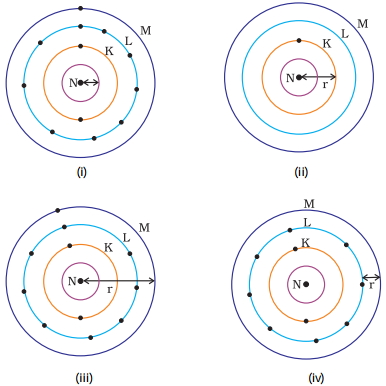
Which one of the following depicts the correct representation of atomic radius $(r)$ of an atom?
A
$(i)$ and $(ii)$
B
$(iii)$ and $(iv)$
C
$(ii)$ and $(iii)$
D
$(i)$ and $(iv)$
Solution
(C) The atomic radius of an atom is defined as the distance from the center of the nucleus to the outermost shell containing electrons.
In the given diagrams:
- Diagram $(ii)$ shows the distance from the nucleus $(N)$ to the first shell $(K)$,which is incorrect for the total atomic radius.
- Diagram $(iii)$ correctly shows the distance from the center of the nucleus $(N)$ to the outermost shell $(M)$,which represents the atomic radius $(r)$.
- Diagram $(iv)$ shows the distance between two shells,which is incorrect.
- Diagram $(i)$ shows the distance from the nucleus to the inner shell,which is incorrect.
However,looking closely at the provided options and the standard definition,diagram $(ii)$ and $(iii)$ are often compared in such problems. Re-evaluating the diagrams: $(ii)$ shows the radius of the $K$ shell,$(iii)$ shows the radius of the $M$ shell. Both are valid representations of the radius of their respective shells. Given the options,$(ii)$ and $(iii)$ represent the distance from the nucleus to a shell,which is the definition of a radius.
0 likes
View Solution2
Difficult
Properties of the elements are given below. Where would you locate the following elements in the periodic table?
$(a)$ $A$ soft metal stored under kerosene.
$(b)$ An element with variable (more than one) valency stored under water.
$(c)$ An element which is tetravalent and forms the basis of organic chemistry.
$(a)$ $A$ soft metal stored under kerosene.
$(b)$ An element with variable (more than one) valency stored under water.
$(c)$ An element which is tetravalent and forms the basis of organic chemistry.
Solution
(N/A) Sodium $(Na)$ is located in Group $1$ and Period $3$,or Potassium $(K)$ is located in Group $1$ and Period $4$. These are soft alkali metals that react vigorously with air and moisture,hence stored under kerosene.
$(b)$ Phosphorus $(P)$ is located in Group $15$ and Period $3$. White phosphorus exhibits variable valency and is highly reactive,catching fire in air,so it is stored under water.
$(c)$ Carbon $(C)$ is located in Group $14$ and Period $2$. It is tetravalent (valency of $4$) and its unique ability to form long chains (catenation) makes it the fundamental element of organic chemistry.
0 likes
View Solution3
Medium
Properties of the elements are given below. Where would you locate the following elements in the periodic table?
$(a)$ An element which is an inert gas with atomic number $2$.
$(b)$ An element whose thin oxide layer is used to make other elements corrosion resistant by the process of 'anodising'.
$(a)$ An element which is an inert gas with atomic number $2$.
$(b)$ An element whose thin oxide layer is used to make other elements corrosion resistant by the process of 'anodising'.
Solution
(N/A) The element with atomic number $2$ is Helium $(He)$. It belongs to Group $18$ and Period $1$ of the periodic table.
$(b)$ The element whose thin oxide layer is used for 'anodising' to prevent corrosion is Aluminium $(Al)$. It belongs to Group $13$ and Period $3$ of the periodic table.
$(b)$ The element whose thin oxide layer is used for 'anodising' to prevent corrosion is Aluminium $(Al)$. It belongs to Group $13$ and Period $3$ of the periodic table.
0 likes
View Solution4
Medium
An element is placed in $2^{nd}$ Group and $3^{rd}$ Period of the Periodic Table. It burns in the presence of oxygen to form a basic oxide.
$(a)$ Write a balanced chemical equation when this oxide is dissolved in water.
$(b)$ Draw the electron dot structure for the formation of this oxide.
$(a)$ Write a balanced chemical equation when this oxide is dissolved in water.
$(b)$ Draw the electron dot structure for the formation of this oxide.
Solution
(N/A) The element in the $2^{nd}$ Group and $3^{rd}$ Period is Magnesium $(Mg)$.
$(a)$ When magnesium oxide $(MgO)$ is dissolved in water,it forms magnesium hydroxide $(Mg(OH)_2)$:
$MgO(s) + H_2O(l) \rightarrow Mg(OH)_2(aq)$
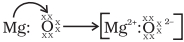
$(b)$ The electron dot structure for the formation of magnesium oxide involves the transfer of $2$ electrons from the magnesium atom to the oxygen atom:
$Mg: + :\ddot{O}: \rightarrow [Mg]^{2+} [: \ddot{O} :]^{2-}$
0 likes
View Solution5
Medium
The atomic numbers of a few elements are given below: $10, 20, 7, 14$.
$(a)$ Identify the elements.
$(b)$ Identify the group number of these elements in the Periodic Table.
$(c)$ Identify the periods of these elements in the Periodic Table.
$(a)$ Identify the elements.
$(b)$ Identify the group number of these elements in the Periodic Table.
$(c)$ Identify the periods of these elements in the Periodic Table.
Solution
(N/A) The elements corresponding to the atomic numbers $10, 20, 7,$ and $14$ are Neon $(Ne)$,Calcium $(Ca)$,Nitrogen $(N)$,and Silicon $(Si)$ respectively.
$(b)$ Group identification:
- Neon $(Z=10)$: Electronic configuration $(2, 8)$,Group $18$ (Noble gas).
- Calcium $(Z=20)$: Electronic configuration $(2, 8, 8, 2)$,Group $2$ (Alkaline earth metal).
- Nitrogen $(Z=7)$: Electronic configuration $(2, 5)$,Group $15$.
- Silicon $(Z=14)$: Electronic configuration $(2, 8, 4)$,Group $14$.
$(c)$ Period identification (based on the number of shells):
- Neon $(Z=10)$: $2$ shells,Period $2$.
- Calcium $(Z=20)$: $4$ shells,Period $4$.
- Nitrogen $(Z=7)$: $2$ shells,Period $2$.
- Silicon $(Z=14)$: $3$ shells,Period $3$.
0 likes
View Solution6
Difficult
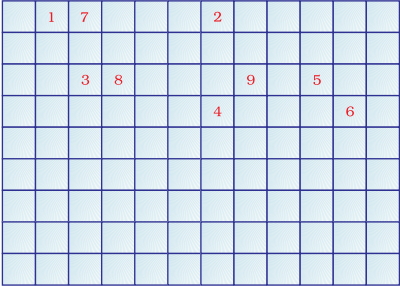
Complete the following crossword puzzle (Figure):
**Across:**
$(1)$ An element with atomic number $12$.
$(3)$ Metal used in making cans and member of Group $14$.
$(4)$ $A$ lustrous non-metal which has $7$ electrons in its outermost shell.
**Down:**
$(2)$ Highly reactive and soft metal which imparts yellow colour when subjected to flame and is kept in kerosene.
$(5)$ The first element of second Period.
$(6)$ An element which is used in making fluorescent bulbs and is second member of Group $18$ in the Modern Periodic Table.
$(7)$ $A$ radioactive element which is the last member of halogen family.
$(8)$ Metal which is an important constituent of steel and forms rust when exposed to moist air.
$(9)$ The first metalloid in Modern Periodic Table whose fibres are used in making bullet-proof vests.
Solution
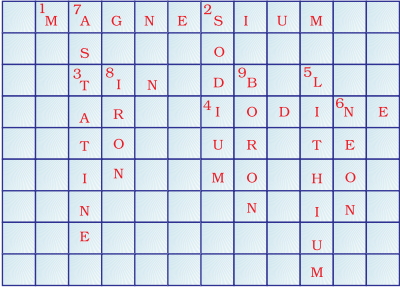
(N/A) The answers to the crossword puzzle are as follows:
**Across:**
$(1)$ Magnesium ($Mg$,atomic number $12$)
$(3)$ Tin ($Sn$,Group $14$)
$(4)$ Iodine ($I$,halogen with $7$ valence electrons)
**Down:**
$(2)$ Sodium ($Na$,highly reactive,yellow flame,stored in kerosene)
$(5)$ Lithium ($Li$,first element of Period $2$)
$(6)$ Neon ($Ne$,used in fluorescent bulbs,second member of Group $18$)
$(7)$ Astatine ($At$,radioactive halogen)
$(8)$ Iron ($Fe$,constituent of steel,forms rust)
$(9)$ Boron ($B$,metalloid,used in bullet-proof vests)
0 likes
View Solution7
Difficult
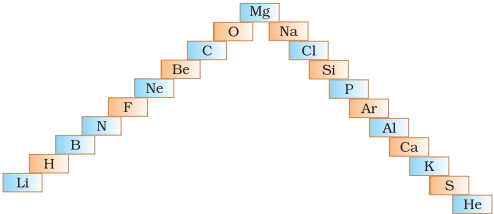
$(a)$ In this ladder (Figure),symbols of elements are jumbled up. Rearrange these symbols of elements in the increasing order of their atomic number in the Periodic Table.
$(b)$ Arrange them in the order of their group also.
$(b)$ Arrange them in the order of their group also.
Solution
(N/A) The elements present in the ladder are: $H, He, Li, Be, B, C, N, O, F, Ne, Na, Mg, Al, Si, P, S, Cl, Ar, K, Ca$.
Arranging them in increasing order of their atomic number $(Z)$:
$H (1), He (2), Li (3), Be (4), B (5), C (6), N (7), O (8), F (9), Ne (10), Na (11), Mg (12), Al (13), Si (14), P (15), S (16), Cl (17), Ar (18), K (19), Ca (20)$.
$(b)$ Arranging them according to their groups:
Group $1: H, Li, Na, K$
Group $2: Be, Mg, Ca$
Group $13: B, Al$
Group $14: C, Si$
Group $15: N, P$
Group $16: O, S$
Group $17: F, Cl$
Group $18: He, Ne, Ar$
0 likes
View Solution8
Medium
Compare and contrast the arrangement of elements in Mendeleev's Periodic Table and the Modern Periodic Table.
Solution
(N/A)
| Mendeleev's Periodic Table | Modern Periodic Table |
|---|---|
| $1$. Elements are arranged in the increasing order of their atomic masses. | $1$. Elements are arranged in the increasing order of their atomic numbers. |
| $2$. There are a total of $7$ groups and $6$ periods. | $2$. There are a total of $18$ groups and $7$ periods. |
| $3$. Elements with similar properties were placed in the same group. | $3$. Elements with the same number of valence electrons are placed in the same group. |
| $4$. The position of hydrogen was ambiguous. | $4$. Hydrogen is placed in group $1$ above alkali metals. |
| $5$. No clear distinction between metals and non-metals. | $5$. Metals are on the left and non-metals are on the right. |
0 likes
View Solution9
Medium
Given below are four elements with their atomic numbers:
$(a)$ Identify the elements which belong to the same group of the Modern Periodic Table.
$(b)$ Arrange the given elements in decreasing order of atomic size.
$(c)$ Write the formula of the oxide of $B$.
$(d)$ Which of the above elements is a metalloid?
| Element | Atomic Number |
|---|---|
| $A$ | $16$ |
| $B$ | $11$ |
| $C$ | $3$ |
| $D$ | $14$ |
$(a)$ Identify the elements which belong to the same group of the Modern Periodic Table.
$(b)$ Arrange the given elements in decreasing order of atomic size.
$(c)$ Write the formula of the oxide of $B$.
$(d)$ Which of the above elements is a metalloid?
Solution
(A-D) Elements $B$ $(Z=11)$ and $C$ $(Z=3)$ belong to the same group (Group $1$,Alkali metals) because their electronic configurations are $2, 8, 1$ and $2, 1$ respectively,both having $1$ valence electron.
$(b)$ Atomic size decreases across a period and increases down a group. The elements are: $C$ ($Z=3$,Period $2$),$B$ ($Z=11$,Period $3$),$D$ ($Z=14$,Period $3$),$A$ ($Z=16$,Period $3$). Comparing sizes: $B$ $(Z=11)$ > $D$ $(Z=14)$ > $A$ $(Z=16)$ and $C$ is in Period $2$,so it is smaller than $B$. The decreasing order is $B > D > A > C$.
$(c)$ Element $B$ has atomic number $11$,so its valency is $1$. Oxygen has a valency of $2$. Thus,the formula of the oxide is $B_2O$.
$(d)$ Element $D$ (Silicon,$Z=14$) is a metalloid.
0 likes
View Solution10
Medium
Given below are some elements of the modern periodic table. Atomic numbers of the elements are given in the parentheses: $A(4), B(9), C(14), D(19), E(20)$.
$(a)$ Select the element that has one electron in the outermost shell. Also,write the electronic configuration of this element.
$(b)$ Which two elements amongst these belong to the same group? Give reason for your answer.
$(c)$ Which two elements amongst these belong to the same period? Which one of the two has a bigger atomic radius?
Solution
(D) The element with one electron in the outermost shell is $D$ (atomic number $19$). Its electronic configuration is $2, 8, 8, 1$.
$(b)$ Elements $A$ (atomic number $4$,configuration $2, 2$) and $E$ (atomic number $20$,configuration $2, 8, 8, 2$) belong to the same group because both have $2$ valence electrons in their outermost shell.
$(c)$ Elements $D$ (atomic number $19$,period $4$) and $E$ (atomic number $20$,period $4$) belong to the same period. Between $D$ and $E$,$D$ has a bigger atomic radius because atomic radius decreases across a period from left to right due to an increase in nuclear charge.
0 likes
View Solution11
Difficult
Study the following table in which positions of six elements $A, B, C, D, E$ and $F$ are shown as they are in the modern periodic table:
On the basis of the above table,answer the following questions:
$(i)$ Name the element which forms only covalent compounds.
$(ii)$ Name the element which is a metal with valency three.
$(iii)$ Name the element which is a non-metal with valency three.
$(iv)$ Out of $D$ and $E$,which is bigger in size and why?
$(v)$ Write the common name for the family to which the elements $C$ and $F$ belong.
| Group $\to$ | $1$ | $2$ | $13$ | $14$ | $15$ | $16$ | $17$ | $18$ |
| Period $2$ | $A$ | - | - | - | $B$ | - | - | $C$ |
| Period $3$ | - | - | $D$ | $E$ | - | - | - | $F$ |
On the basis of the above table,answer the following questions:
$(i)$ Name the element which forms only covalent compounds.
$(ii)$ Name the element which is a metal with valency three.
$(iii)$ Name the element which is a non-metal with valency three.
$(iv)$ Out of $D$ and $E$,which is bigger in size and why?
$(v)$ Write the common name for the family to which the elements $C$ and $F$ belong.
Solution
(N/A) $(i)$ Element $E$ (Carbon group,valency $4$) forms only covalent compounds.
$(ii)$ Element $D$ is in Group $13$ (Period $3$),which is Aluminum $(Al)$. It is a metal with a valency of $3$.
$(iii)$ Element $B$ is in Group $15$ (Period $2$),which is Nitrogen $(N)$. It is a non-metal with a valency of $3$.
$(iv)$ $D$ is bigger in size than $E$. Across a period from left to right,the atomic size decreases due to an increase in effective nuclear charge.
$(v)$ Elements $C$ and $F$ belong to Group $18$,which are known as Noble gases.
0 likes
View Solution12
The electronic configurations of $4$ elements $A, B, C,$ and $D$ are as follows:
$A: 2, 1$
$B: 2, 2$
$C: 2, 8, 2$
$D: 2$
$(a)$ Which of these elements belong to the same group? Name them.
$(b)$ Which of these elements belong to the same period? Name them.
$(c)$ Which of these elements is inert? Name it.
$A: 2, 1$
$B: 2, 2$
$C: 2, 8, 2$
$D: 2$
$(a)$ Which of these elements belong to the same group? Name them.
$(b)$ Which of these elements belong to the same period? Name them.
$(c)$ Which of these elements is inert? Name it.
Solution
(B) Elements $B$ and $C$ belong to the same group (Group $2$) because they both have $2$ valence electrons in their outermost shell. $B$ is Beryllium $(Be)$ and $C$ is Magnesium $(Mg)$.
$(b)$ Elements $A$ and $B$ belong to the same period (Period $2$) because they both have $2$ shells. $A$ is Lithium $(Li)$ and $B$ is Beryllium $(Be)$.
$(c)$ Element $D$ is inert because its outermost shell is completely filled (it is Helium $(He)$).
$(b)$ Elements $A$ and $B$ belong to the same period (Period $2$) because they both have $2$ shells. $A$ is Lithium $(Li)$ and $B$ is Beryllium $(Be)$.
$(c)$ Element $D$ is inert because its outermost shell is completely filled (it is Helium $(He)$).
0 likes
View Solution13
Medium
The position of some elements $A, B, C, D, E, F$ and $G$ in the Modern Periodic Table is given as under:
$(a)$ In which group are inert elements placed?
$(b)$ What type of ions would $B, C, E,$ and $F$ form?
$(c)$ Which element would have chemical properties similar to $C$?
$(d)$ How many shells would $A$ have?
$(e)$ What is the similarity between $A$ and $D$?
$(f)$ Identify the most abundant element in the earth's crust.
| Group $\to$ | $16$ | $17$ | $18$ |
| Period $1$ | $A$ | ||
| Period $2$ | $B$ | $C$ | $D$ |
| Period $3$ | $E$ | $F$ | $G$ |
$(a)$ In which group are inert elements placed?
$(b)$ What type of ions would $B, C, E,$ and $F$ form?
$(c)$ Which element would have chemical properties similar to $C$?
$(d)$ How many shells would $A$ have?
$(e)$ What is the similarity between $A$ and $D$?
$(f)$ Identify the most abundant element in the earth's crust.
Solution
$(a)$ Inert elements (noble gases) are placed in group $18$.
$(b)$ Elements in group $16$ ($B$ and $E$) gain $2$ electrons to form $B^{2-}$ and $E^{2-}$ ions. Elements in group $17$ ($C$ and $F$) gain $1$ electron to form $C^{-}$ and $F^{-}$ ions.
$(c)$ $F$ would have chemical properties similar to $C$ because they belong to the same group $(17)$.
$(d)$ $A$ is Helium $(He)$, which is in period $1$, so it has only $1$ shell ($K$-shell).
$(e)$ Both $A$ and $D$ are inert noble gases belonging to group $18$, meaning they have stable electronic configurations (complete valence shells).
$(f)$ $B$ (Oxygen) is the most abundant element in the earth's crust.
0 likes
View Solution14
Medium
An element $X$ belongs to the $3rd$ period and group $16$ of the Modern Periodic Table.
$(a)$ Determine the number of valence electrons and the valency of $X$.
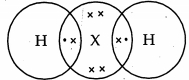
$(b)$ Write the molecular formula of the compound formed when $X$ reacts with hydrogen and draw its electron dot structure.
$(c)$ Name the element $X$ and state whether it is metallic or non-metallic.
$(a)$ Determine the number of valence electrons and the valency of $X$.
$(b)$ Write the molecular formula of the compound formed when $X$ reacts with hydrogen and draw its electron dot structure.
$(c)$ Name the element $X$ and state whether it is metallic or non-metallic.
Solution
(N/A) The electronic configuration of $X$ is $2, 8, 6$.
Number of valence electrons $= 6$.
Valency $= 8 - 6 = 2$.
$(b)$ When $X$ reacts with hydrogen,it forms a compound with the molecular formula $H_2X$. Since $X$ is Sulphur,the formula is $H_2S$. The electron dot structure is shown in the image provided.
$(c)$ The element $X$ is Sulphur $(S)$. It is a non-metal.
0 likes
View SolutionPeriodic Classification of Elements — Mix Examples - Periodic Classification of Elements · Frequently Asked Questions
1Are these Periodic Classification of Elements questions useful for JEE and NEET?
Yes. All questions in this section are mapped to JEE Main and NEET exam patterns. Previous year questions from JEE Main, NEET, GUJCET and state-level exams are included with full solutions.
2Can I switch to Hindi or Gujarati for these questions?
Yes. Use the language tabs in the hero section or the sidebar to view the same questions and solutions in English, Hindi or Gujarati.
3How do I generate a question paper from this subtopic?
Use the Vedclass Exam Paper Generator — select the chapter and subtopic, set difficulty, and generate Sets A, B, C, D automatically. First 3 chapters of every subject are free.
Vedclass Products
For Students
Vedclass Test Series
Mock tests in real JEE/NEET style with performance analysis. 5-day free trial.
Start Free TrialFor Teachers
Exam Paper Generator
Generate Set A/B/C/D papers from this chapter in 2 minutes. 3 chapters free.
Try FreeFor Institutes
Online Exam Module
Live online exams with unlimited students, 360° analytics & white-label branding.
See DemoFor Teachers & Institutes
Generate a Periodic Classification of Elements Exam Paper in 2 Minutes
Select subtopic & difficulty — Sets A, B, C, D auto-generated with No Repeat logic.
First 3 chapters of every subject are free — no payment required.