
A English
Conventional Sources of Energy Questions in English
Class 10 Science · Sources of Energy · Conventional Sources of Energy
34+
Questions
English
Language
100%
With Solutions
Showing 34 of 34 questions in English
1
Medium
Give the names of two energy sources that you would consider to be exhaustible. Give reasons for your choices.
Solution
(N/A) Two exhaustible energy sources are as follows:
$(a)$ Coal: It is produced from the dead remains of plants and animals that have remained buried under the Earth's crust for millions of years. It takes millions of years to form coal. Industrialization has increased the demand for coal. However,coal cannot replenish within a short period of time. Hence,it is a non-renewable or exhaustible source of energy.
$(b)$ Wood: It is obtained from forests. Deforestation at a rapid rate has caused a significant reduction in the number of forests on the Earth. It takes hundreds of years for a forest to grow. If deforestation continues at this rate,there will be no wood left on the Earth. Hence,wood is an exhaustible source of energy.
0 likes
View Solution2
EasyMCQ
Which of the following is a non-renewable source of energy?
A
Fossil fuels
B
Sun
C
Wood
D
Wind
Solution
(A) non-renewable source of energy is one that exists in limited amounts and cannot be replaced once it is consumed,or takes millions of years to form.
Fossil fuels (such as coal,petroleum,and natural gas) are formed from the remains of ancient plants and animals over millions of years.
Once these are exhausted,they cannot be replenished within a human timescale.
In contrast,the Sun,wood (biomass),and wind are considered renewable sources because they are naturally replenished or are continuously available.
0 likes
View Solution3
MediumMCQ
The fuel used in thermal power plants is:
A
Water
B
Uranium
C
Fossil fuels
D
Biomass
Solution
(C) Thermal power plants are designed to generate electricity by heating water to produce steam.
This steam is then used to rotate turbines,which drive generators.
To produce the heat required to boil the water,fossil fuels such as coal,petroleum,or natural gas are burned.
Therefore,fossil fuels are the primary fuel source used in thermal power plants.
This steam is then used to rotate turbines,which drive generators.
To produce the heat required to boil the water,fossil fuels such as coal,petroleum,or natural gas are burned.
Therefore,fossil fuels are the primary fuel source used in thermal power plants.
0 likes
View Solution4
MediumMCQ
In a hydro power plant,
A
Water is converted into steam to produce electricity.
B
Kinetic energy possessed by stored water is converted into potential energy.
C
Electricity is extracted from water.
D
Potential energy possessed by stored water is converted into electricity.
Solution
(D) In a hydro power plant,water is stored at a height in a dam,which gives it a large amount of potential energy.
When this water is allowed to fall,its potential energy is converted into kinetic energy.
This kinetic energy of the flowing water is then used to rotate the turbines of the generator,which ultimately converts the mechanical energy into electricity.
Therefore,the primary energy conversion process involves the conversion of potential energy stored in water into electricity.
0 likes
View Solution5
EasyMCQ
The main constituent of biogas is
A
carbon dioxide
B
methane
C
hydrogen
D
hydrogen sulphide
Solution
(B) Biogas is a mixture of gases produced by the breakdown of organic matter in the absence of oxygen (anaerobic digestion).
It primarily consists of $CH_4$ (methane),which typically accounts for $50-75\%$ of the total volume.
Other components include $CO_2$ (carbon dioxide),$H_2$ (hydrogen),and $H_2S$ (hydrogen sulphide) in smaller quantities.
Therefore,methane is the main constituent of biogas.
It primarily consists of $CH_4$ (methane),which typically accounts for $50-75\%$ of the total volume.
Other components include $CO_2$ (carbon dioxide),$H_2$ (hydrogen),and $H_2S$ (hydrogen sulphide) in smaller quantities.
Therefore,methane is the main constituent of biogas.
0 likes
View Solution6
MediumMCQ
Which process is used to harness nuclear energy these days? Explain it briefly.
A
Nuclear Fission
B
Nuclear Fusion
C
Radioactive Decay
D
Nuclear Transmutation
Solution
(A) The process used to harness nuclear energy in modern power plants is $Nuclear Fission$.
$1$. In this process,the nucleus of a heavy atom like $Uranium-235$ is bombarded with low-energy neutrons.
$2$. The nucleus splits into smaller,lighter nuclei,releasing a tremendous amount of energy in the form of heat.
$3$. This heat is used to boil water into steam,which then drives a turbine to generate electricity.
$4$. The process also releases more neutrons,which sustain a $Chain Reaction$.
$5$. Finally,the radioactive waste generated must be carefully stored and disposed of to prevent environmental contamination.
0 likes
View Solution7
Medium
What is biomass? Explain the principle and working of a biogas plant using a labelled schematic diagram.
Solution
(N/A) Biomass refers to the organic matter produced by plants and animals,such as agricultural residues,cow dung,and wood,which serves as a renewable source of energy.
Principle: $A$ biogas plant operates on the principle of anaerobic fermentation. In the absence of oxygen,microorganisms break down complex organic matter (biomass) into simpler substances,releasing gases like methane $(CH_4)$,carbon dioxide $(CO_2)$,hydrogen $(H_2)$,and hydrogen sulfide $(H_2S)$.
Working:
$1$. $A$ mixture of cow dung and water (slurry) is prepared in the mixing tank and fed into the digester.
$2$. The digester is a sealed,oxygen-free tank where anaerobic bacteria decompose the biomass.
$3$. As decomposition occurs,biogas is produced and collects in the gas holder (dome) above the slurry.
$4$. The pressure of the accumulated gas pushes the spent slurry into the overflow tank,which is then removed and used as high-quality manure.
$5$. The biogas is supplied to homes through pipes for cooking and lighting.
0 likes
View Solution8
Easy
Name any two nuclear fuels used for the process of nuclear fission.
Solution
(N/A) The two common nuclear fuels used for the process of nuclear fission are $Uranium-235$ $(U-235)$ and $Plutonium-239$ $(Pu-239)$. $Thorium-232$ is also used as a fertile material in nuclear reactors.
0 likes
View Solution9
Easy
Compare the energy produced during the fission of a uranium atom with the energy produced due to the combustion of a carbon atom from coal.
Solution
(N/A) The energy released during the nuclear fission of a single uranium atom is approximately $10$ million times greater than the energy released during the combustion of a single carbon atom from coal.
0 likes
View Solution10
Easy
Name two conventional sources of energy.
Solution
(N/A) The two conventional sources of energy are:
$(i)$ Fossil fuels (such as coal,petroleum,and natural gas).
$(ii)$ Hydro power (energy derived from flowing water).
$(i)$ Fossil fuels (such as coal,petroleum,and natural gas).
$(ii)$ Hydro power (energy derived from flowing water).
0 likes
View Solution11
Easy
Name two combustible components of biogas.
Solution
(N/A) The two primary combustible components of biogas are methane $(CH_{4})$ and hydrogen $(H_{2})$. These gases are produced during the anaerobic decomposition of organic matter and contribute significantly to the calorific value of biogas.
0 likes
View Solution12
EasyMCQ
Name the main constituent of biogas.
A
Ethane
B
Methane
C
Propane
D
Butane
Solution
(B) Biogas is a mixture of gases produced by the breakdown of organic matter in the absence of oxygen. The primary component of biogas is $CH_4$ (Methane),which typically accounts for $50-75\%$ of its composition.
0 likes
View Solution13
Easy
Write the full names of $LPG$ and $CNG$.
Solution
(N/A) $LPG$: Liquefied Petroleum Gas
$CNG$: Compressed Natural Gas
$CNG$: Compressed Natural Gas
0 likes
View Solution14
EasyMCQ
What type of energy is utilized by a sailing boat?
A
Solar energy
B
Wind energy
C
Chemical energy
D
Nuclear energy
Solution
(B) sailing boat utilizes the kinetic energy of the wind to move across the water. The wind exerts force on the sails,which is converted into mechanical work to propel the boat.
0 likes
View Solution15
EasyMCQ
In a box-type solar cooker,what is the range of temperature that can be achieved in two or three hours?
A
$50^{\circ}C$ to $80^{\circ}C$
B
$100^{\circ}C$ to $140^{\circ}C$
C
$150^{\circ}C$ to $200^{\circ}C$
D
$200^{\circ}C$ to $250^{\circ}C$
Solution
(B) box-type solar cooker uses the greenhouse effect to trap solar radiation.
When placed in direct sunlight for $2$ to $3$ hours,the internal temperature of the cooker typically reaches a range of $100^{\circ}C$ to $140^{\circ}C$,which is sufficient for cooking most food items.
When placed in direct sunlight for $2$ to $3$ hours,the internal temperature of the cooker typically reaches a range of $100^{\circ}C$ to $140^{\circ}C$,which is sufficient for cooking most food items.
0 likes
View Solution16
Easy
State two merits of hydroelectricity.
Solution
(N/A) $(i)$ Hydroelectricity is a clean and renewable source of energy that does not cause pollution.
$(ii)$ This energy can be stored in high-level reservoirs and utilized as per requirement,unlike wind or solar energy which are intermittent.
$(ii)$ This energy can be stored in high-level reservoirs and utilized as per requirement,unlike wind or solar energy which are intermittent.
0 likes
View Solution17
EasyMCQ
How is the slurry left over after the generation of biogas in a biogas plant used?
A
It is used as a fuel for cooking.
B
It is used as an excellent manure.
C
It is used to generate electricity directly.
D
It is discarded as waste material.
Solution
(B) In a biogas plant,the slurry that remains after the anaerobic digestion of biomass is rich in nitrogenous and phosphorus compounds. Because of this high nutrient content,it serves as an excellent organic manure for crops and improves soil fertility.
0 likes
View Solution18
EasyMCQ
Name the largest component of biogas.
A
Methane
B
Carbon dioxide
C
Hydrogen
D
Hydrogen sulfide
Solution
(A) The largest component of biogas is methane $(CH_4)$.
It constitutes approximately $50 \%$ to $75 \%$ of the total volume of biogas produced.
It constitutes approximately $50 \%$ to $75 \%$ of the total volume of biogas produced.
0 likes
View Solution19
EasyMCQ
Name the process by which energy is produced in a nuclear reactor.
A
Nuclear fission
B
Nuclear fusion
C
Radioactive decay
D
Combustion
Solution
(A) In a nuclear reactor,energy is produced by the process of nuclear fission.
In this process,a heavy nucleus,such as $U-235$,is bombarded with neutrons,causing it to split into smaller nuclei and releasing a large amount of energy.
In this process,a heavy nucleus,such as $U-235$,is bombarded with neutrons,causing it to split into smaller nuclei and releasing a large amount of energy.
0 likes
View Solution20
EasyMCQ
Which type of process is currently used in nuclear electricity generation?
A
Nuclear fusion
B
Nuclear fission
C
Nuclear transmutation
D
Nuclear decay
Solution
(B) Currently,nuclear power plants generate electricity using the process of nuclear fission. In this process,the nucleus of a heavy atom (such as uranium-$235$ or plutonium-$239$) is bombarded with low-energy neutrons,causing it to split into lighter nuclei. This reaction releases a significant amount of energy in the form of heat,which is used to produce steam to drive turbines for electricity generation.
0 likes
View Solution21
EasyMCQ
Name the process responsible for large energy production in the sun?
A
Nuclear fission
B
Nuclear fusion
C
Chemical combustion
D
Radioactive decay
Solution
(B) The process responsible for the massive energy production in the sun is $Nuclear \ fusion$. In this process,lighter nuclei,primarily hydrogen atoms,fuse together at extremely high temperatures and pressures to form heavier nuclei,such as helium,releasing a tremendous amount of energy in the form of heat and light.
0 likes
View Solution22
Medium
Name the agent which decomposes animal dung into biogas. Describe the steps involved in the process.
Solution
(N/A) The agents responsible for decomposing animal dung into biogas are $Anaerobic$ microorganisms (methanogens).
The process involves the following steps:
$1$. Mixing: Animal dung and water are mixed in a $1:1$ ratio to form a slurry in the mixing tank.
$2$. Digestion: The slurry is fed into a digester tank,which is a sealed,oxygen-free chamber. Here,$Anaerobic$ microorganisms break down the organic matter in the dung,producing biogas (primarily methane).
$3$. Collection and Usage: The produced biogas is collected in a gas holder and supplied for use. The remaining slurry,known as spent slurry,is removed and used as a nutrient-rich manure.
0 likes
View Solution23
Easy
Mention any two ways by which water can be used to produce hydroelectricity.
Solution
(N/A) The two ways by which water can be used to produce hydroelectricity are:
$(i)$ Using the potential energy of water stored at a height in dams,which is released to fall on turbines.
$(ii)$ Using the kinetic energy of ocean tides (the rise and fall of sea water) to rotate turbines for electricity generation.
$(i)$ Using the potential energy of water stored at a height in dams,which is released to fall on turbines.
$(ii)$ Using the kinetic energy of ocean tides (the rise and fall of sea water) to rotate turbines for electricity generation.
0 likes
View Solution24
Medium
Name the places of our country where fields of natural gas are found. Why is it called a clean fuel? Give two reasons.
Solution
(N/A) The places where natural gas is found in India are Tripura,Jaisalmer,the off-shore area of Bombay,and the Krishna-Godavari Delta.
Natural gas is called a clean fuel because:
$(i)$ It does not produce harmful gases upon combustion.
$(ii)$ It burns without smoke and does not leave any residue after burning.
Natural gas is called a clean fuel because:
$(i)$ It does not produce harmful gases upon combustion.
$(ii)$ It burns without smoke and does not leave any residue after burning.
0 likes
View Solution25
Medium
$(a)$ Describe the structure of a windmill.
$(b)$ Give one example to illustrate that energy from a windmill was used in the past to do mechanical work.
$(b)$ Give one example to illustrate that energy from a windmill was used in the past to do mechanical work.
Solution
(N/A) windmill consists of a large structure erected at a significant height on a rigid support. At the top,it features blades similar to a fan. To generate electricity,the rotational motion of the windmill is utilized to turn the turbine of an electric generator.
$(b)$ $A$ water-lifting pump is a classic example where the rotational motion of a windmill was historically used to lift water from wells for irrigation or domestic use.
$(b)$ $A$ water-lifting pump is a classic example where the rotational motion of a windmill was historically used to lift water from wells for irrigation or domestic use.
0 likes
View Solution26
Easy
Explain how hydroelectricity is produced.
Solution
(N/A) Hydroelectricity is produced by constructing high-rise dams to obstruct the flow of water.
As the water level rises behind the dam,the kinetic energy of the flowing water is converted into potential energy.
When this water is released from a high level,it is directed through pipes to a turbine.
The falling water strikes the blades of the turbine,causing it to rotate.
This mechanical energy from the rotating turbine is then used to drive a generator,which converts it into electrical energy.
0 likes
View Solution27
Medium
Enlist the energy changes taking place in a hydroelectric power station.
Solution
(N/A) $(i)$ $PE$ of water stored in the reservoir changes into $KE$ as it flows through the tunnel.
$(ii)$ $KE$ of the flowing water is converted into rotational $KE$ of the turbine.
$(iii)$ Rotational $KE$ of the turbine is transferred to the armature of the generator.
$(iv)$ Rotational $KE$ of the armature is converted into electrical energy due to electromagnetic induction as the coils rotate within a magnetic field.
0 likes
View Solution28
Medium
Draw the diagram of the floating gas holder type biogas plant and mark on it the gas outlet.
Solution
(N/A) The floating gas holder type biogas plant consists of a digester tank,an inlet pipe for the slurry (biomass and water mixture),a gas holder (floating drum),and an outlet pipe for the spent slurry. The gas outlet is located at the top of the floating gas holder,which allows the produced biogas to be collected and supplied for use. The diagram is as shown below:

0 likes
View Solution29
Medium
What is a windmill? With the help of a diagram,describe in brief the construction and working of a windmill. Give uses of wind energy.
Solution
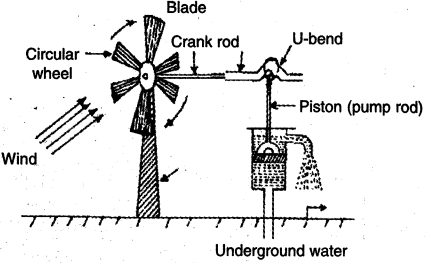
(N/A) windmill is a machine that works using the energy of blowing wind. It can be used to run water pumps (to draw water from the ground) and also for grinding grains.
Construction: It consists of a circular wheel to which blades are attached radially to catch the wind. The center of this circular wheel is connected to one end of a crank rod. The $U$-bend of the crank is connected to the pump rod (piston rod).
Working: When the blowing wind strikes the blades of a windmill,the $KE$ (Kinetic Energy) of the wind rotates the blades continuously,which in turn rotates the attached crank. As the crank rotates,its $U$-bend lifts the pump rod up and down continuously. This pump rod operates the pump,which lifts the underground water.
Uses of wind energy:
$(i)$ Wind energy is used to propel sail boats to transport men and materials from one place to another.
$(ii)$ Wind energy is used to run water pumps to draw out underground water.
$(iii)$ Wind energy is used to run flour-mills to grind the grains.
$(iv)$ Wind energy is used to generate electricity.
0 likes
View Solution30
Medium
What is hydroelectricity? Explain the basic principle involved in the generation of this energy.
Solution
(N/A) The electricity generated by using the energy of flowing water is called hydroelectricity.
The basic principle of the generation of hydroelectricity is as follows:
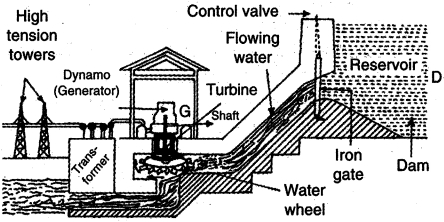
$1$. The water flowing in a river is collected by constructing a high-rise dam $D$ (See Fig.). This water,which has been stored at a high altitude,possesses a significant amount of potential energy.
$2$. The water stored in the high-rise dam is allowed to fall onto a water-turbine $G$ located near the base of the dam.
$3$. When the fast-moving water falls on the blades of the turbine,the kinetic energy of the water rotates the turbine rapidly.
$4$. The shaft of the turbine is connected to the coil of an electricity generator or dynamo. Consequently,when the water-turbine rotates rapidly,the generator coil fixed on its shaft also rotates rapidly,thereby producing electricity.
0 likes
View Solution31
Difficult
Describe the construction and working of a box type solar cooker with the help of a labelled diagram. Give its advantages and limitations.
Solution
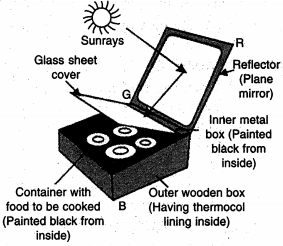
(N/A) solar cooker consists of an insulated metal box $B$ which is painted black from inside. $A$ metal container $C$,painted black from outside,is placed in the solar cooker box. The box and container are painted black because a black surface absorbs more heat rays than any other colour. In order to prevent the loss of absorbed heat in a solar heating device,the black painted metal box is placed inside an insulated (with thermocol or glass wool to prevent heat losses due to conduction,convection and radiation) wooden box $B$ and is covered with a transparent thick glass sheet cover $G$ over the top of the cooker box. $A$ plane mirror reflector $R$ is also attached to the box.
The food material to be cooked is placed in the metal container. The container is covered with a black lid and it is placed in the solar cooker box. The cooker box is then covered with a glass sheet lid. The solar cooker is kept in sunshine and its plane mirror reflector $R$ is adjusted in such a way that a strong beam of sunlight falls over the cooker top. The sunrays pass through the glass sheet cover and get absorbed inside the cooker box. This glass sheet cover does not allow the solar energy to flow out in the form of radiant heat. Thus,it traps more and more heat rays of the Sun thereby producing a greenhouse effect. Within half-an-hour or so the temperature within the solar cooker rises to about $100^{\circ} C$ to $140^{\circ} C$ which is sufficient to cook the food material (like rice or dal) kept inside the cooker container.
Advantages of box type solar cooker:
$(i)$ The cost of cooking food is zero as solar energy comes free of cost.
$(ii)$ It saves other costly fuels and does not cause any environmental pollution.
$(iii)$ It can cook one to four dishes simultaneously.
$(iv)$ It preserves all the nutrients in a food,as food gets cooked in it at a comparatively low temperature.
$(v)$ It has very low installation and maintenance cost.
Limitations (Disadvantages) of box type solar cooker:
$(i)$ It cannot cook food at night or when the sky is cloudy during daytime.
$(ii)$ It takes a long time to cook food.
$(iii)$ The direction of the reflector has to be changed frequently so that it always faces the sun.
$(iv)$ It cannot be used for making chapattis,frying or baking.
$(v)$ Its working is not as effective in winter as it is in the summer.
0 likes
View Solution32
Difficult
Draw a labelled diagram of a floating gas holder type biogas plant and describe its working. Mention any two advantages of using animal dung for making biogas over using it as a fuel in the form of dried dung cakes.
Solution
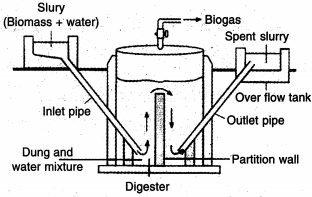
(N/A) Floating gas holder type biogas plant: This type of biogas plant consists of a well-shaped underground tank called a digester tank. The sides of the digester tank are made of bricks and the base is made of concrete. $A$ drum-shaped gas holder made of steel floats in the inverted position over the dung slurry in the digester tank.
The gas collects in the floating gas holder. The gas holder can move up or down,and its movement is controlled by a guide pipe. The biogas comes out from the outlet at the top of the gas holder tank. The digester tank has a partition wall,which divides it into two chambers and also helps in increasing gas pressure. On the left side of the digester tank is an inlet pipe made of cement which is connected to a mixing tank. This inlet pipe brings the fresh dung slurry into the digester tank. On the right side of the digester tank is an outlet pipe made of cement which is connected to an overflow tank. This outlet pipe is for removing the spent dung slurry after the extraction of biogas.
Working: Cattle dung and water are mixed in equal proportions in the mixing tank to prepare the slurry which is fed to the digester tank through an inlet pipe. The slurry is left in the digester tank for $50$ to $60$ days. This dung undergoes anaerobic fermentation and forms biogas which collects in the gas holder. As more and more biogas collects in the gas holder,the pressure of the gas in it increases and it raises the gas holder. Since the gas holder cannot rise up beyond a certain point,the increased gas pressure pushes the spent slurry from the digester tank into the overflow tank. This spent slurry is taken off and used as manure. More fresh slurry is added and thus biogas is produced continuously.
Advantages of using animal dung for making biogas over using it as fuel in the form of dried dung cakes:
$(i)$ Using animal dung in a biogas plant prevents both air and water pollution,whereas burning dung cakes releases smoke and harmful gases.
$(ii)$ The residue left in a biogas plant is excellent manure rich in nitrates and phosphates,which is not obtained when dung is burnt as fuel.
0 likes
View Solution33
Medium
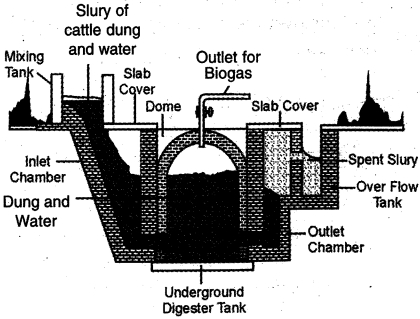
Name the major fuel component of biogas. What are its other combustible components? Draw a simple labelled diagram of a fixed dome type biogas plant. What is the use of the residual slurry and why?
Solution
(N/A) The major fuel component of biogas is Methane $(CH_{4})$.
Other combustible components include Hydrogen $(H_{2})$,Hydrogen Sulphide $(H_{2}S)$,and Carbon Monoxide $(CO)$.
Diagram: (Refer to the provided image of the fixed dome type biogas plant).
The residual slurry (spent slurry) is used as manure because it is rich in nitrogen and phosphorus,which are essential nutrients for plant growth.
0 likes
View Solution34
EasyMCQ
Amount of charcoal produced on the destructive distillation of $1 \, kg$ of wood is about: (in $, kg$)
A
$0.50$
B
$0.75$
C
$0.25$
D
$1$
Solution
(C) Destructive distillation is the process of heating wood in the absence of air to produce charcoal,wood gas,and wood tar.
When $1 \, kg$ of wood undergoes destructive distillation,the yield of charcoal is approximately $25\%$ of the original mass of the wood.
Therefore,the amount of charcoal produced is $0.25 \, kg$.
When $1 \, kg$ of wood undergoes destructive distillation,the yield of charcoal is approximately $25\%$ of the original mass of the wood.
Therefore,the amount of charcoal produced is $0.25 \, kg$.
0 likes
View SolutionSources of Energy — Conventional Sources of Energy · Frequently Asked Questions
1Are these Sources of Energy questions useful for JEE and NEET?
Yes. All questions in this section are mapped to JEE Main and NEET exam patterns. Previous year questions from JEE Main, NEET, GUJCET and state-level exams are included with full solutions.
2Can I switch to Hindi or Gujarati for these questions?
Yes. Use the language tabs in the hero section or the sidebar to view the same questions and solutions in English, Hindi or Gujarati.
3How do I generate a question paper from this subtopic?
Use the Vedclass Exam Paper Generator — select the chapter and subtopic, set difficulty, and generate Sets A, B, C, D automatically. First 3 chapters of every subject are free.
Vedclass Products
For Students
Vedclass Test Series
Mock tests in real JEE/NEET style with performance analysis. 5-day free trial.
Start Free TrialFor Teachers
Exam Paper Generator
Generate Set A/B/C/D papers from this chapter in 2 minutes. 3 chapters free.
Try FreeFor Institutes
Online Exam Module
Live online exams with unlimited students, 360° analytics & white-label branding.
See DemoFor Teachers & Institutes
Generate a Sources of Energy Exam Paper in 2 Minutes
Select subtopic & difficulty — Sets A, B, C, D auto-generated with No Repeat logic.
First 3 chapters of every subject are free — no payment required.