
A English
Water for All (Dams and Water Harvesting) Questions in English
Class 10 Science · Sustainable Management of Natural Resources · Water for All (Dams and Water Harvesting)
36+
Questions
English
Language
100%
With Solutions
Showing 36 of 36 questions in English
1
Easy
Find out about the traditional systems of water harvesting/management in your region.
Solution
(N/A) Traditional systems of water harvesting are ancient techniques used to collect and store rainwater for future use. In many regions, common traditional systems include:
$1$. $Tanks$ (or $Tankas$): Small, underground structures used to store rainwater.
$2$. $Khadins$ and $Johads$: Structures designed to capture runoff water in arid regions.
$3$. $Bawris$ (or $Stepwells$): Deep wells with steps leading down to the water level.
$4$. $Eris$ (or $Tanks$): Large man-made reservoirs used for irrigation.
These systems are sustainable and help in recharging groundwater levels.
0 likes
View Solution2
MediumMCQ
Compare the water harvesting system used in hilly/mountainous areas with those used in plains or plateau regions.
A
Plains use Kulhs,while hills use earthen embankments.
B
Plains use crescent-shaped earthen embankments,while hilly regions use canal irrigation systems called Kulhs.
C
Both regions use the same method of water harvesting.
D
Plateau regions do not require any water harvesting systems.
Solution
(B) In plains,the water harvesting structures typically consist of crescent-shaped earthen embankments or low,straight,concrete check dams to store water.
In hilly or mountainous regions,a traditional system of canal irrigation known as $Kulhs$ is used. This involves diverting the flow of a mountain stream into man-made channels that carry the water down the hillsides to the fields.
In hilly or mountainous regions,a traditional system of canal irrigation known as $Kulhs$ is used. This involves diverting the flow of a mountain stream into man-made channels that carry the water down the hillsides to the fields.
0 likes
View Solution3
Easy
Find out the source of water in your region/locality. Is water from this source available to all people living in that area?
Solution
(N/A) The primary source of water in our region is groundwater,which is extracted through borewells and municipal supply systems.
Yes,water from this source is generally available to all people living in the area,although the accessibility and quantity may vary depending on the infrastructure and socio-economic factors.
Yes,water from this source is generally available to all people living in the area,although the accessibility and quantity may vary depending on the infrastructure and socio-economic factors.
0 likes
View Solution4
MediumMCQ
How can you as an individual contribute or make a difference to the management of water resources?
A
By wasting water
B
By polluting water bodies
C
By practicing rainwater harvesting and fixing leaks
D
By ignoring water conservation
Solution
(C) As an individual,one can contribute to the management of water resources in the following ways:
$(i)$ Turn off the taps while brushing or bathing and repair leaking taps to prevent wastage.
$(ii)$ Practice rainwater harvesting to recharge groundwater levels.
$(iii)$ Avoid the discharge of sewage,industrial effluents,and other wastes into rivers and other water bodies to prevent pollution.
$(i)$ Turn off the taps while brushing or bathing and repair leaking taps to prevent wastage.
$(ii)$ Practice rainwater harvesting to recharge groundwater levels.
$(iii)$ Avoid the discharge of sewage,industrial effluents,and other wastes into rivers and other water bodies to prevent pollution.
0 likes
View Solution5
MediumMCQ
In our country,there are attempts to increase the height of several existing dams like Tehri and Almati,dams across Narmada. Choose the correct statements among the following that are a consequence of raising the height of dams:
$(i)$ Terrestrial flora and fauna of the area is destroyed completely.
$(ii)$ Dislocation of people and domestic animals living in the area.
$(iii)$ Valuable agricultural land may be permanently lost.
$(iv)$ It will generate permanent employment for people.
$(i)$ Terrestrial flora and fauna of the area is destroyed completely.
$(ii)$ Dislocation of people and domestic animals living in the area.
$(iii)$ Valuable agricultural land may be permanently lost.
$(iv)$ It will generate permanent employment for people.
A
$(i), (ii)$ and $(iii)$
B
$(i)$ and $(ii)$
C
$(ii)$ and $(iv)$
D
$(i), (iii)$ and $(iv)$
Solution
(A) Raising the height of dams leads to a larger reservoir area,which results in several negative environmental and social impacts:
$(i)$ The increased water level submerges vast areas of land,leading to the complete destruction of the local terrestrial flora and fauna.
$(ii)$ The submergence forces the displacement (dislocation) of human populations and their domestic animals from their homes and habitats.
$(iii)$ Large tracts of fertile agricultural land are submerged and permanently lost to the reservoir.
$(iv)$ While dam construction might provide temporary employment,it does not guarantee permanent employment for the displaced population,and the environmental/social costs far outweigh such claims. Therefore,$(i), (ii)$ and $(iii)$ are the correct consequences.
0 likes
View Solution6
EasyMCQ
Expand the abbreviation $GAP$.
A
Governmental Agency for Pollution Control
B
Ganga Action Plan
C
Gross Assimilation by Photosynthesis
D
Governmental Agency for Animal Protection
Solution
(B) The abbreviation $GAP$ stands for $Ganga$ $Action$ $Plan$.
It was a major initiative launched by the Government of India in $1985$ to reduce the pollution load on the river $Ganga$ and to improve its water quality.
It was a major initiative launched by the Government of India in $1985$ to reduce the pollution load on the river $Ganga$ and to improve its water quality.
0 likes
View Solution7
EasyMCQ
Ground water will not be depleted due to
A
loss of forest,and decreased rainfall
B
thermal power plants
C
afforestation
D
cropping of high water demanding crops
Solution
(C) Ground water depletion is primarily caused by excessive extraction and reduced recharge of aquifers.
$A$. Loss of forest cover reduces the ability of the soil to absorb rainwater,leading to surface runoff rather than infiltration,which depletes ground water.
$B$. Thermal power plants consume large quantities of water for cooling purposes,contributing to depletion.
$C$. Afforestation involves planting trees,which helps in soil conservation and increases the water-holding capacity of the soil,thereby promoting ground water recharge and preventing depletion.
$D$. Cropping of high water-demanding crops (like sugarcane or rice) requires excessive irrigation,which leads to the over-extraction of ground water.
Therefore,afforestation is the correct answer as it helps in maintaining the ground water level.
0 likes
View Solution8
EasyMCQ
Opposition to the construction of large dams is due to
A
social reasons
B
economic reasons
C
environmental reasons
D
all the above
Solution
(D) The construction of large dams faces opposition due to several factors:
$1$. Social reasons: Large dams often lead to the displacement of a large number of peasants and tribals without adequate compensation or rehabilitation.
$2$. Economic reasons: They involve huge amounts of public money and often do not generate proportionate benefits for the local population.
$3$. Environmental reasons: They cause massive deforestation,loss of biodiversity,and ecological imbalance in the surrounding areas.
Therefore,all the mentioned factors contribute to the opposition.
0 likes
View Solution9
EasyMCQ
Khadins,Bundhis,Ahars and Kattas are ancient structures that are examples for
A
water harvesting
B
wood storage
C
grain storage
D
soil conservation
Solution
(A) Khadins,Bundhis,Ahars,and Kattas are traditional,ancient methods used for water harvesting and management in various parts of India.
These structures were designed to collect and store rainwater or surface runoff,which helps in recharging groundwater and providing water for irrigation and domestic use.
Therefore,they are classic examples of ancient water harvesting systems.
These structures were designed to collect and store rainwater or surface runoff,which helps in recharging groundwater and providing water for irrigation and domestic use.
Therefore,they are classic examples of ancient water harvesting systems.
0 likes
View Solution10
MediumMCQ
It is important to make small check dams across the flooded gullies because they
$(i)$ hold water for irrigation
$(ii)$ hold water and prevent soil erosion
$(iii)$ recharge ground water
$(iv)$ hold water permanently
$(i)$ hold water for irrigation
$(ii)$ hold water and prevent soil erosion
$(iii)$ recharge ground water
$(iv)$ hold water permanently
A
$(i)$ and $(iv)$
B
$(ii)$ and $(iv)$
C
$(iii)$ and $(iv)$
D
$(ii)$ and $(iii)$
Solution
(D) Small check dams are constructed across flooded gullies to manage water resources effectively.
$(i)$ While they may provide some water for irrigation,it is not their primary purpose.
$(ii)$ They hold water for a short period,which helps in reducing the flow velocity of water,thereby preventing soil erosion.
$(iii)$ By holding water,they allow it to percolate into the soil,which helps in recharging the groundwater levels.
$(iv)$ They do not hold water permanently; they are designed to hold water temporarily to facilitate infiltration.
Therefore,statements $(ii)$ and $(iii)$ are correct.
0 likes
View Solution11
Medium
List two advantages associated with water harvesting at the community level.
Solution
(N/A) The advantages of water harvesting at the community level include:
$(a)$ It leads to an increase in the groundwater level due to the recharging of wells and aquifers.
$(b)$ Stored groundwater keeps the soil layers above it moist,which supports vegetation and prevents water loss through evaporation.
$(c)$ It allows for the storage of water during the rainy season,which can be utilized during periods of scarcity or when required.
0 likes
View Solution12
Medium
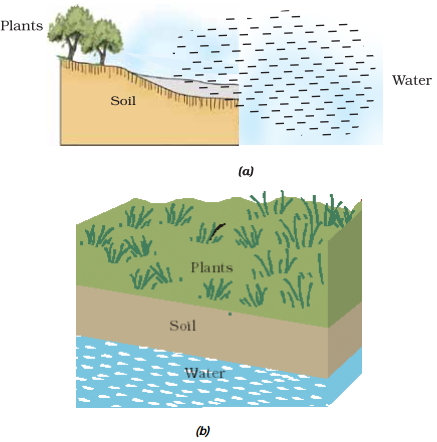
$(a)$ Locate and name the water reservoirs in Figures $(a)$ and $(b)$.
$(b)$ Which has an advantage over the other and why?
$(b)$ Which has an advantage over the other and why?
Solution
(N/A) The water reservoir in Figure $(a)$ is a surface water body (pond/lake),and in Figure $(b)$,it is an underground water body (aquifer).
$(b)$ Figure $(b)$ has an advantage over Figure $(a)$. The advantages of storing water underground are:
$1$. It does not evaporate.
$2$. It spreads out to recharge wells and provides moisture for vegetation over a wide area.
$3$. It is protected from contamination by human and animal wastes.
$4$. It prevents the breeding of insects like mosquitoes.
0 likes
View Solution13
Easy
Is water conservation necessary? Give reasons.
Solution
(N/A) Yes,water conservation is necessary. Although the total amount of fresh water on Earth is theoretically sufficient to meet human needs,it is not readily available for use due to several factors:
$1$. Uneven distribution of water resources across different geographical regions.
$2$. Significant seasonal and annual fluctuations in rainfall patterns,leading to droughts in some areas.
$3$. Excessive wastage,pollution,and mismanagement of water resources.
$4$. Increasing demand due to population growth,industrialization,and agricultural expansion.
Therefore,conservation is essential to ensure a sustainable supply for future generations.
0 likes
View Solution14
Medium
Suggest a few useful ways of utilizing waste water.
Solution
(N/A) Waste water can be utilized in the following ways:
$(a)$ Recharging the groundwater table to prevent depletion.
$(b)$ Using treated waste water for irrigation in agriculture.
$(c)$ Using treated municipal waste water for non-potable purposes such as washing cars,cleaning roads,and watering gardens.
$(d)$ Utilizing organic pollutants present in sewage water as fertilizers for specific crops after proper treatment.
0 likes
View Solution15
Easy
Name two ancient water harvesting structures in Maharashtra.
Solution
(N/A) The two ancient water harvesting structures in Maharashtra are $Bandharas$ and $Tals$. These are traditional methods used for water conservation and irrigation.
0 likes
View Solution16
Easy
Mention any two reasons for the failure to sustain underground water.
Solution
(N/A) Loss of vegetation cover,which reduces the rate of water percolation into the soil.
$(b)$ Diversion of water towards high water-demanding crops,leading to over-extraction.
$(c)$ Pumping out excessive water for irrigation and industrial purposes,which exceeds the natural recharge rate.
$(b)$ Diversion of water towards high water-demanding crops,leading to over-extraction.
$(c)$ Pumping out excessive water for irrigation and industrial purposes,which exceeds the natural recharge rate.
0 likes
View Solution17
Easy
Mention the action taken by the Government to save the river Ganga.
Solution
(N/A) The Government of India launched the $GAP$ ($Ganga$ $Action$ $Plan$) in $1985$. The primary objective of this multi-crore project was to improve the water quality of the river Ganga by intercepting,diverting,and treating domestic sewage and preventing toxic and industrial chemical wastes from entering the river.
0 likes
View Solution18
Easy
Construction of dams submerges large areas of forests,how does this contribute to the greenhouse effect?
Solution
(N/A) When large areas of forests are submerged due to the construction of dams,the vegetation undergoes anaerobic decomposition under water. This process releases large amounts of methane $(CH_4)$,which is a potent greenhouse gas,thereby contributing to the greenhouse effect and global warming.
0 likes
View Solution19
Medium
List two main causes of the pollution of water of the river Ganga. State how pollution and contamination of river water prove harmful for the health of the people of neighbouring areas.
Solution
(N/A) Causes of pollution of the river Ganga:
$(i)$ Disposal of untreated industrial effluents containing toxic chemicals.
$(ii)$ Human activities such as bathing,washing clothes,and the immersion of ashes or religious offerings.
$(iii)$ Discharge of untreated sewage from urban areas directly into the river.
Harmful effects on human health:
$(i)$ It leads to the spread of water-borne diseases such as cholera,typhoid,and dysentery due to the presence of pathogens.
$(ii)$ Consumption of contaminated fish or aquatic life from the river can lead to bioaccumulation of toxins,causing severe health issues in humans.
0 likes
View Solution20
Medium
List any two advantages associated with water stored in the ground.
Solution
(N/A) Advantages of storing water in the ground include:
$(a)$ It does not evaporate.
$(b)$ It spreads out to recharge wells and provides moisture for vegetation over a wide area.
$(c)$ It does not provide breeding grounds for mosquitoes like stagnant water collected in ponds or lakes.
$(d)$ It is relatively protected from contamination by human and animal waste.
0 likes
View Solution21
Easy
State the main purpose of water harvesting management and mention the source which fills the ponds behind harvesting structures.
Solution
(N/A) The main purpose of water harvesting management is to recharge groundwater levels,which helps in maintaining the water table and ensuring water availability during dry seasons.
The source that fills the ponds behind water harvesting structures is monsoon rain.
The source that fills the ponds behind water harvesting structures is monsoon rain.
0 likes
View Solution22
Medium
Water is a valuable resource. List two ways that you would suggest every family member to save this resource.
Solution
(N/A) Water is considered a valuable resource because freshwater constitutes a very small (less than $2 \%$) proportion,while the remaining $98 \%$ of the world's water is in oceans and is not usable without expensive treatment.
$(a)$ Rainwater harvesting: Collecting and storing rainwater for future use.
$(b)$ Minimizing wastage: Preventing water loss by fixing leaking taps,using buckets instead of showers,and avoiding unnecessary water usage during daily activities like brushing teeth or shaving.
$(a)$ Rainwater harvesting: Collecting and storing rainwater for future use.
$(b)$ Minimizing wastage: Preventing water loss by fixing leaking taps,using buckets instead of showers,and avoiding unnecessary water usage during daily activities like brushing teeth or shaving.
0 likes
View Solution23
Medium
List two measures that you would suggest for the better management of water resources.
Solution
(N/A) The following measures are suggested for the better management of water resources:
$(a)$ Rainwater harvesting: Collecting and storing rainwater for future use helps in recharging groundwater levels.
$(b)$ Treatment of wastewater: Treating industrial and domestic sewage before discharging it into water bodies prevents pollution and allows for the reuse of water.
$(c)$ Efficient irrigation: Using techniques like drip irrigation and sprinkler systems in agriculture to minimize water wastage.
0 likes
View Solution24
Medium
List three merits of watershed management.
Solution
(N/A) $(i)$ Watershed management emphasises scientific conservation of soil and water in order to increase the biomass production.
$(ii)$ It produces plant and animal resources for use in a manner which will not cause ecological imbalance.
$(iii)$ It helps in preventing droughts and floods.
$(ii)$ It produces plant and animal resources for use in a manner which will not cause ecological imbalance.
$(iii)$ It helps in preventing droughts and floods.
0 likes
View Solution25
Medium
$(a)$ Mention any two advantages of constructing dams.
$(b)$ Name a dam which was a subject of much opposition from locals as well as $NGOs$.
$(c)$ Mention any three problems which may arise due to the construction of large dams.
$(b)$ Name a dam which was a subject of much opposition from locals as well as $NGOs$.
$(c)$ Mention any three problems which may arise due to the construction of large dams.
Solution
(N/A) Two advantages of constructing dams are:
$1$. They provide water for irrigation.
$2$. They are used for the generation of hydroelectricity.
$(b)$ The Sardar Sarovar Dam on the Narmada River or the Tehri Dam on the Ganga River are examples of dams that faced significant opposition from local communities and $NGOs$.
$(c)$ Three problems that may arise due to the construction of large dams are:
$1$. Social problems: Displacement of large numbers of peasants and tribals without adequate compensation or rehabilitation.
$2$. Environmental problems: Deforestation and loss of biodiversity due to the submergence of large forest areas.
$3$. Economic problems: Huge amounts of public money are spent without the generation of proportionate benefits.
0 likes
View Solution26
Medium
What is water harvesting? How can this technique help in the conservation of water?
Solution
(N/A) Water harvesting is a technique of capturing and storing rainwater where it falls,rather than allowing it to run off.
This technique helps in the conservation of water in the following ways:
$1$. It recharges groundwater levels,which helps in maintaining the water table.
$2$. Stored water remains unpolluted and can be used for various purposes.
$3$. It provides moisture for vegetation over a wide area,reducing soil erosion and promoting plant growth.
0 likes
View Solution27
Medium
Compare the advantages of groundwater over water available from sources on the surface of the earth.
Solution
(N/A) Most of the water sources on the surface of the earth are either saline or polluted.
The water available in the sea is saline and cannot be utilized for cleaning,drinking,or irrigation.
Groundwater is a cleaner source of water compared to surface water.
Most groundwater sources are fresh and can be used for drinking or cleaning purposes after minimal treatment,whereas surface water often requires extensive purification.
0 likes
View Solution28
Medium
Mention any two advantages and two disadvantages of producing hydroelectricity by building dams on rivers.
Solution
(N/A) Advantages:
$(a)$ Production of cheap electricity without causing pollution.
$(b)$ Dams are used for irrigation and flood control.
Disadvantages:
$(a)$ Large land areas get submerged,leading to the loss of biodiversity and displacement of local populations.
$(b)$ It adversely affects the ecosystem of adjoining areas as well as areas downstream by altering natural water flow and sediment transport.
0 likes
View Solution29
Medium
"Electricity generated by the water stored in a dam can be considered to be another form of solar energy." Explain by describing the series of energy transformations in sequence taking place during the process.
Solution
(N/A) The sequence of energy transformations that occur during the generation of electricity from water stored in a dam is as follows:
$(i)$ Solar energy is converted into potential energy $(PE)$ of water vapour as water evaporates from oceans, rivers, and lakes. This vapour forms clouds and eventually falls as rain or snow on mountains.
$(ii)$ When rain falls or snow melts, the potential energy of the water is converted into kinetic energy $(KE)$ as it flows into streams and rivers.
$(iii)$ When this flowing water is collected and stored in a dam, its kinetic energy is converted back into potential energy $(PE)$ due to its height.
$(iv)$ When water is released from the dam, this potential energy is converted into kinetic energy $(KE)$ as the water rushes downwards.
$(v)$ The kinetic energy of the falling water rotates the turbines, which in turn drive a generator to produce electricity. Thus, the original source of this energy is solar energy.
0 likes
View Solution30
MediumMCQ
It is important to make small check dams across the flooded gullies because they
$(i)$ hold water for irrigation
$(ii)$ hold water and prevent soil erosion
$(iii)$ recharge groundwater
$(iv)$ hold water permanently
$(i)$ hold water for irrigation
$(ii)$ hold water and prevent soil erosion
$(iii)$ recharge groundwater
$(iv)$ hold water permanently
A
$(ii)$ and $(iii)$
B
$(i)$ and $(iv)$
C
$(iii)$ and $(iv)$
D
$(ii)$ and $(iv)$
Solution
(A) Small check dams are constructed across flooded gullies to manage water resources effectively.
$(1)$ They hold water for a short duration,which allows it to percolate into the ground,thereby recharging the groundwater level.
$(2)$ By slowing down the flow of water,they prevent soil erosion caused by rapid runoff.
$(3)$ They do not hold water permanently,as they are designed to allow gradual seepage.
Therefore,statements $(ii)$ and $(iii)$ are correct.
0 likes
View Solution31
EasyMCQ
Opposition to the construction of large dams is due to
A
social reasons
B
economic reasons
C
environmental reasons
D
all the above
Solution
(D) The construction of large dams faces opposition due to several factors:
$1$. Social reasons: Large dams often lead to the displacement of a large number of peasants and tribals without adequate compensation or rehabilitation.
$2$. Economic reasons: They involve the consumption of huge amounts of public money without the generation of proportionate benefits for the local population.
$3$. Environmental reasons: They cause massive deforestation,loss of biodiversity,and disruption of local ecosystems and water cycles.
Therefore,all the mentioned reasons contribute to the opposition against large dams.
0 likes
View Solution32
EasyMCQ
Khadins,Bundhis,Ahars and Kattas are ancient structures that are examples for
A
water harvesting
B
grain storage
C
wood storage
D
soil conservation
Solution
(A) Khadins,Bundhis,Ahars,and Kattas are traditional,ancient methods used for water harvesting and water management in various parts of India.
These structures are designed to capture and store rainwater or surface runoff,which helps in recharging groundwater and providing water for irrigation and domestic use.
Therefore,they are classic examples of ancient water harvesting systems.
These structures are designed to capture and store rainwater or surface runoff,which helps in recharging groundwater and providing water for irrigation and domestic use.
Therefore,they are classic examples of ancient water harvesting systems.
0 likes
View Solution33
EasyMCQ
Which of the following dams is constructed in Gujarat?
A
Narmada dam
B
Sardar dam
C
Sardar Sarovar dam
D
Tapi River dam
Solution
(C) The $Sardar$ $Sarovar$ $Dam$ is a concrete gravity dam built on the $Narmada$ river in $Kevadiya$, near $Navagam$, in the state of $Gujarat$, $India$.
It is one of the largest water resource projects in $India$, providing water for irrigation and electricity generation to the states of $Gujarat$, $Madhya$ $Pradesh$, $Maharashtra$, and $Rajasthan$.
It is one of the largest water resource projects in $India$, providing water for irrigation and electricity generation to the states of $Gujarat$, $Madhya$ $Pradesh$, $Maharashtra$, and $Rajasthan$.
0 likes
View Solution34
EasyMCQ
Approximately what percentage of groundwater do we utilize?
A
$9.69$
B
$23.38$
C
$25$
D
$50$
Solution
(B) According to the data provided in the $NCERT$ textbook for the chapter 'Sustainable Management of Natural Resources',the utilization of groundwater in India is approximately $23.38\%$. This figure highlights the significant reliance on groundwater resources for various purposes such as agriculture,industry,and domestic use.
0 likes
View Solution35
EasyMCQ
Which one is useful as a huge water reservoir?
A
Farm pond
B
Dam
C
Canal
D
Pond
Solution
(B) $Dam$ is a barrier that stops or restricts the flow of water or underground streams. Reservoirs created by dams not only suppress floods but also provide water for activities such as irrigation, human consumption, industrial use, aquaculture, and navigability. Due to their massive scale, dams are considered huge water reservoirs compared to farm ponds, canals, or small ponds.
0 likes
View Solution36
EasyMCQ
The $Dharoi$ dam is built on which river?
A
Mahi
B
Tapi
C
Vatrak
D
Sabarmati
Solution
(D) The $Dharoi$ dam is a major irrigation project located in the $Mehsana$ district of $Gujarat$,$India$. It is constructed across the $Sabarmati$ river. Therefore,the correct option is $D$.
0 likes
View SolutionSustainable Management of Natural Resources — Water for All (Dams and Water Harvesting) · Frequently Asked Questions
1Are these Sustainable Management of Natural Resources questions useful for JEE and NEET?
Yes. All questions in this section are mapped to JEE Main and NEET exam patterns. Previous year questions from JEE Main, NEET, GUJCET and state-level exams are included with full solutions.
2Can I switch to Hindi or Gujarati for these questions?
Yes. Use the language tabs in the hero section or the sidebar to view the same questions and solutions in English, Hindi or Gujarati.
3How do I generate a question paper from this subtopic?
Use the Vedclass Exam Paper Generator — select the chapter and subtopic, set difficulty, and generate Sets A, B, C, D automatically. First 3 chapters of every subject are free.
Vedclass Products
For Students
Vedclass Test Series
Mock tests in real JEE/NEET style with performance analysis. 5-day free trial.
Start Free TrialFor Teachers
Exam Paper Generator
Generate Set A/B/C/D papers from this chapter in 2 minutes. 3 chapters free.
Try FreeFor Institutes
Online Exam Module
Live online exams with unlimited students, 360° analytics & white-label branding.
See DemoFor Teachers & Institutes
Generate a Sustainable Management of Natural Resources Exam Paper in 2 Minutes
Select subtopic & difficulty — Sets A, B, C, D auto-generated with No Repeat logic.
First 3 chapters of every subject are free — no payment required.