
A English
Mix Examples - Polynomials Questions in English
Class 9 Mathematics · Polynomials · Mix Examples - Polynomials
18+
Questions
English
Language
100%
With Solutions
Showing 18 of 18 questions in English
1
MediumMCQ
Find the remainder when $x^{3}+3x^{2}+3x+1$ is divided by $x+1$.
A
$0$
B
$3$
C
$8$
D
$2$
Solution
(A) Let $p(x) = x^{3}+3x^{2}+3x+1$.
According to the Remainder Theorem,when a polynomial $p(x)$ is divided by $(x - a)$,the remainder is $p(a)$.
Here,the divisor is $x + 1$,which can be written as $x - (-1)$. Thus,$a = -1$.
To find the remainder,we calculate $p(-1)$:
$p(-1) = (-1)^{3} + 3(-1)^{2} + 3(-1) + 1$
$p(-1) = -1 + 3(1) - 3 + 1$
$p(-1) = -1 + 3 - 3 + 1$
$p(-1) = 0$.
Therefore,the required remainder is $0$.
0 likes
View Solution2
EasyMCQ
If $p(x) = x + 3,$ then $p(x) + p(-x)$ is equal to
A
$3$
B
$2x$
C
$0$
D
$6$
Solution
(D) Given the polynomial $p(x) = x + 3.$
To find $p(-x),$ we substitute $-x$ for $x$ in the expression:
$p(-x) = -x + 3.$
Now,we calculate the sum $p(x) + p(-x)$:
$p(x) + p(-x) = (x + 3) + (-x + 3).$
By simplifying the expression:
$p(x) + p(-x) = x + 3 - x + 3 = 6.$
Therefore,the correct option is $(d)$.
To find $p(-x),$ we substitute $-x$ for $x$ in the expression:
$p(-x) = -x + 3.$
Now,we calculate the sum $p(x) + p(-x)$:
$p(x) + p(-x) = (x + 3) + (-x + 3).$
By simplifying the expression:
$p(x) + p(-x) = x + 3 - x + 3 = 6.$
Therefore,the correct option is $(d)$.
0 likes
View Solution3
EasyMCQ
If $x^{51} + 51$ is divided by $x + 1$,the remainder is
A
$0$
B
$1$
C
$49$
D
$50$
Solution
(D) According to the Remainder Theorem,if a polynomial $p(x)$ is divided by $x + a$,the remainder is $p(-a)$.
Here,$p(x) = x^{51} + 51$ is divided by $x + 1$.
Therefore,the remainder is $p(-1) = (-1)^{51} + 51$.
Since $(-1)$ raised to an odd power is $-1$,we have $p(-1) = -1 + 51 = 50$.
Hence,the correct option is $D$.
Here,$p(x) = x^{51} + 51$ is divided by $x + 1$.
Therefore,the remainder is $p(-1) = (-1)^{51} + 51$.
Since $(-1)$ raised to an odd power is $-1$,we have $p(-1) = -1 + 51 = 50$.
Hence,the correct option is $D$.
0 likes
View Solution4
MediumMCQ
One of the factors of $(25 x^{2}-1)+(1+5 x)^{2}$ is
A
$5+x$
B
$5-x$
C
$10x$
D
$5x-1$
Solution
(C) Given expression: $(25 x^{2}-1)+(1+5 x)^{2}$
Using the identity $a^{2}-b^{2}=(a-b)(a+b)$,we can write $(25 x^{2}-1)$ as $(5 x)^{2}-1^{2}=(5 x-1)(5 x+1)$.
Substituting this into the expression:
$(5 x-1)(5 x+1)+(5 x+1)^{2}$
Taking $(5 x+1)$ as a common factor:
$(5 x+1) \times [(5 x-1)+(5 x+1)]$
Simplifying the terms inside the square bracket:
$(5 x+1) \times (5 x-1+5 x+1) = (5 x+1)(10 x)$
Thus,the factors are $10 x$ and $(5 x+1)$.
Therefore,$(c)$ is the correct answer.
0 likes
View Solution5
Easy
Write whether the statement is True or False. Justify your answer.
The degree of the sum of two polynomials each of degree $5$ is always $5$.
The degree of the sum of two polynomials each of degree $5$ is always $5$.
Solution
(FALSE) The given statement is false.
Justification: The degree of a polynomial is the highest power of the variable in the polynomial.
Consider two polynomials $P(x) = -x^{5} + 3x^{2} + 4$ and $Q(x) = x^{5} + x^{4} + 2x^{3} + 3$.
Both $P(x)$ and $Q(x)$ have a degree of $5$.
Now,find their sum: $P(x) + Q(x) = (-x^{5} + 3x^{2} + 4) + (x^{5} + x^{4} + 2x^{3} + 3) = x^{4} + 2x^{3} + 3x^{2} + 7$.
The degree of the resulting polynomial is $4$,which is not $5$. Thus,the statement is false.
0 likes
View Solution6
Easy
Classify the following polynomial as a polynomial in one variable,two variables,etc.:
$x^{2}-2xy+y^{2}+1$
$x^{2}-2xy+y^{2}+1$
Solution
(B) The given expression is $x^{2}-2xy+y^{2}+1$.
In this expression,the variables present are $x$ and $y$.
Since there are two distinct variables,this is a polynomial in two variables.
In this expression,the variables present are $x$ and $y$.
Since there are two distinct variables,this is a polynomial in two variables.
0 likes
View Solution7
Medium
Give an example of a polynomial,which is:
$(i)$ monomial of degree $1$
$(ii)$ binomial of degree $20$
$(iii)$ trinomial of degree $2$
$(i)$ monomial of degree $1$
$(ii)$ binomial of degree $20$
$(iii)$ trinomial of degree $2$
Solution
(N/A) polynomial having only one term is called a monomial,a polynomial having only two terms is called a binomial,and a polynomial having only three terms is called a trinomial.
$(i)$ $3x$ is a monomial of degree $1$.
$(ii)$ $x^{20} - 7$ is a binomial of degree $20$.
$(iii)$ $5x^2 + 3x - 1$ is a trinomial of degree $2$.
$(i)$ $3x$ is a monomial of degree $1$.
$(ii)$ $x^{20} - 7$ is a binomial of degree $20$.
$(iii)$ $5x^2 + 3x - 1$ is a trinomial of degree $2$.
0 likes
View Solution8
MediumMCQ
If the polynomials $az^{3}+4z^{2}+3z-4$ and $z^{3}-4z+a$ leave the same remainder when divided by $z-3$,find the value of $a$.
A
$1$
B
$-1$
C
$0$
D
$3$
Solution
(B) Let $p(z) = az^{3} + 4z^{2} + 3z - 4$ and $q(z) = z^{3} - 4z + a$.
According to the Remainder Theorem,when a polynomial $f(z)$ is divided by $(z - c)$,the remainder is $f(c)$.
Since both polynomials leave the same remainder when divided by $z - 3$,we have $p(3) = q(3)$.
First,calculate $p(3)$:
$p(3) = a(3)^{3} + 4(3)^{2} + 3(3) - 4$
$p(3) = 27a + 36 + 9 - 4 = 27a + 41$.
Next,calculate $q(3)$:
$q(3) = (3)^{3} - 4(3) + a$
$q(3) = 27 - 12 + a = 15 + a$.
Equating the two remainders:
$27a + 41 = 15 + a$
$27a - a = 15 - 41$
$26a = -26$
$a = -1$.
Thus,the value of $a$ is $-1$.
0 likes
View Solution9
DifficultMCQ
The polynomial $p(x) = x^{4} - 2x^{3} + 3x^{2} - ax + 3a - 7$ when divided by $x + 1$ leaves the remainder $19$. Find the value of $a$. Also,find the remainder when $p(x)$ is divided by $x + 2$.
A
$60$
B
$61$
C
$62$
D
$63$
Solution
(C) According to the Remainder Theorem,if a polynomial $p(x)$ is divided by $(x - c)$,the remainder is $p(c)$.
Given $p(x) = x^{4} - 2x^{3} + 3x^{2} - ax + 3a - 7$ is divided by $x + 1$,the remainder is $p(-1) = 19$.
Substituting $x = -1$ into $p(x)$:
$p(-1) = (-1)^{4} - 2(-1)^{3} + 3(-1)^{2} - a(-1) + 3a - 7 = 19$
$1 - 2(-1) + 3(1) + a + 3a - 7 = 19$
$1 + 2 + 3 + 4a - 7 = 19$
$4a - 1 = 19$
$4a = 20$
$a = 5$
Now,we find the remainder when $p(x)$ is divided by $x + 2$,which is $p(-2)$ with $a = 5$:
$p(x) = x^{4} - 2x^{3} + 3x^{2} - 5x + 3(5) - 7 = x^{4} - 2x^{3} + 3x^{2} - 5x + 8$
$p(-2) = (-2)^{4} - 2(-2)^{3} + 3(-2)^{2} - 5(-2) + 8$
$p(-2) = 16 - 2(-8) + 3(4) + 10 + 8$
$p(-2) = 16 + 16 + 12 + 10 + 8 = 62$.
0 likes
View Solution10
Easy
Which of the following expressions is a polynomial,and state the reason? If an expression is a polynomial,state whether it is a polynomial in one variable or not: $x^{3}+3 x^{2} y+3 x y^{2}+y^{3}$
Solution
(N/A) The expression $x^{3}+3 x^{2} y+3 x y^{2}+y^{3}$ is a polynomial because all the exponents of the variables $x$ and $y$ are non-negative integers. Since it contains two distinct variables,$x$ and $y$,it is a polynomial in two variables,not a polynomial in one variable.
0 likes
View Solution11
Medium
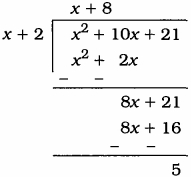
Divide $p(x)=21+10 x+x^{2}$ by $g(x)=2+x$ and find the quotient and the remainder.
Solution
(N/A) $p(x)=21+10 x+x^{2}$
$\therefore p(x)=x^{2}+10 x+21$ and $g(x)=2+x$
$\therefore g(x)=x+2$
$\therefore$ Quotient $=x+8$ and remainder $=5$
Steps of division process:
Step $1:$ We write the dividend $21+10 x+x^{2}$ and the divisor $2+x$ in the standard form,i.e.,after arranging the terms in the descending order of their degrees. So,the dividend is $x^{2}+10 x+21$ and the divisor is $x+2$.
Step $2:$ We divide the first term of the dividend by the first term of the divisor,i.e.,we divide $x^{2}$ by $x$ and get $x$. This gives us the first term of the quotient.
$\frac{x^{2}}{x}=x=$ first term of quotient.
Step $3:$ We multiply the divisor by the first term of the quotient and subtract this product from the dividend,i.e.,we multiply $x+2$ by $x$ and subtract the product $x^{2}+2 x$ from the dividend $x^{2}+10 x+21$. This gives us the remainder as $8 x+21$.
Step $4:$ We treat the remainder $8 x+21$ as the new dividend. The divisor remains the same. We repeat step $2$ to get the next term of the quotient,i.e.,we divide the first term $8 x$ of the (new) dividend by the first term $x$ of the divisor and obtain $8$.
Thus,$8$ is the second term in the quotient.
$\frac{8 x}{x}=8=$ second term of quotient.
New quotient $=x+8$
Step $5:$ We multiply the divisor by the second term of the quotient and subtract the product from the dividend. That is,we multiply $x+2$ by $8$ and subtract the product $8 x+16$ from the dividend $8 x+21$. This gives us $5$ as the remainder.
This process continues till the remainder is $0$ or the degree of the new dividend is less than the degree of the divisor. At this stage,this new dividend becomes the remainder and the sum of the quotients gives us the whole quotient.
Step $6:$ Thus,the quotient in full is $x+8$ and the remainder is $5.$
0 likes
View Solution12
Medium
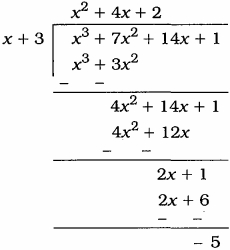
Divide $p(x) = x^{3} + 7x^{2} + 14x + 1$ by $x + 3$ and find the quotient and the remainder.
Solution
(N/A) To divide $p(x) = x^{3} + 7x^{2} + 14x + 1$ by $x + 3$,we use polynomial long division:
$1$. Divide the first term of the dividend $(x^{3})$ by the first term of the divisor $(x)$ to get $x^{2}$.
$2$. Multiply $x^{2}$ by $(x + 3)$ to get $x^{3} + 3x^{2}$. Subtract this from the dividend to get $4x^{2} + 14x + 1$.
$3$. Divide $4x^{2}$ by $x$ to get $4x$. Multiply $4x$ by $(x + 3)$ to get $4x^{2} + 12x$. Subtract this to get $2x + 1$.
$4$. Divide $2x$ by $x$ to get $2$. Multiply $2$ by $(x + 3)$ to get $2x + 6$. Subtract this to get $-5$.
Thus,the quotient is $x^{2} + 4x + 2$ and the remainder is $-5$.
0 likes
View Solution13
Easy
Find the quotient and the remainder when $2x^2 - 7x - 15$ is divided by $x + 1$.
Solution
(N/A) To find the quotient and remainder,we perform polynomial long division of $2x^2 - 7x - 15$ by $x + 1$.
$1$. Divide the first term of the dividend $(2x^2)$ by the first term of the divisor $(x)$: $2x^2 / x = 2x$. This is the first term of the quotient.
$2$. Multiply the divisor $(x + 1)$ by $2x$: $2x(x + 1) = 2x^2 + 2x$.
$3$. Subtract this from the dividend: $(2x^2 - 7x - 15) - (2x^2 + 2x) = -9x - 15$.
$4$. Divide the first term of the new expression $(-9x)$ by the first term of the divisor $(x)$: $-9x / x = -9$. This is the second term of the quotient.
$5$. Multiply the divisor $(x + 1)$ by $-9$: $-9(x + 1) = -9x - 9$.
$6$. Subtract this from the current expression: $(-9x - 15) - (-9x - 9) = -9x - 15 + 9x + 9 = -6$.
Thus,the quotient is $2x - 9$ and the remainder is $-6$.
0 likes
View Solution14
Difficult
On dividing $p(x) = 2x^3 - 3x^2 + ax - 3a + 9$ by $(x + 1)$,if the remainder is $16$,then find the value of $a$. Then,find the remainder on dividing $p(x)$ by $(x + 2)$.
Solution
(A) According to the Remainder Theorem,if $p(x)$ is divided by $(x + 1)$,the remainder is $p(-1)$.
Given $p(-1) = 16$,we have:
$2(-1)^3 - 3(-1)^2 + a(-1) - 3a + 9 = 16$
$-2 - 3 - a - 3a + 9 = 16$
$4 - 4a = 16$
$-4a = 12$
$a = -3$.
Now,substitute $a = -3$ into $p(x)$:
$p(x) = 2x^3 - 3x^2 - 3x - 3(-3) + 9 = 2x^3 - 3x^2 - 3x + 18$.
To find the remainder when $p(x)$ is divided by $(x + 2)$,we calculate $p(-2)$:
$p(-2) = 2(-2)^3 - 3(-2)^2 - 3(-2) + 18$
$p(-2) = 2(-8) - 3(4) + 6 + 18$
$p(-2) = -16 - 12 + 6 + 18 = -4$.
Thus,$a = -3$ and the remainder is $-4$.
0 likes
View Solution15
Difficult
On dividing $p(x) = x^{3} + 2x^{2} - 5ax - 7$ by $(x + 1)$,the remainder is $R_{1}$ and on dividing $q(x) = x^{3} + ax^{2} - 12x + 6$ by $(x - 2)$,the remainder is $R_{2}$. If $2R_{1} + R_{2} = 6$,then find the value of $a$.
Solution
(A) According to the Remainder Theorem,if a polynomial $f(x)$ is divided by $(x - c)$,the remainder is $f(c)$.
For $p(x) = x^{3} + 2x^{2} - 5ax - 7$ divided by $(x + 1)$,$R_{1} = p(-1) = (-1)^{3} + 2(-1)^{2} - 5a(-1) - 7 = -1 + 2 + 5a - 7 = 5a - 6$.
For $q(x) = x^{3} + ax^{2} - 12x + 6$ divided by $(x - 2)$,$R_{2} = q(2) = (2)^{3} + a(2)^{2} - 12(2) + 6 = 8 + 4a - 24 + 6 = 4a - 10$.
Given $2R_{1} + R_{2} = 6$,substitute the expressions for $R_{1}$ and $R_{2}$:
$2(5a - 6) + (4a - 10) = 6$
$10a - 12 + 4a - 10 = 6$
$14a - 22 = 6$
$14a = 28$
$a = 2$.
0 likes
View Solution16
DifficultMCQ
If the polynomials $ax^3 + 4x^2 + 3x - 4$ and $x^3 - 4x + a$ leave the same remainder when each is divided by $x - 3$,find the value of $a$.
A
$11$
B
$3$
C
$-1$
D
$4$
Solution
(C) Let $p(x) = ax^3 + 4x^2 + 3x - 4$ and $q(x) = x^3 - 4x + a$.
According to the Remainder Theorem,when a polynomial $f(x)$ is divided by $x - c$,the remainder is $f(c)$.
Here,$c = 3$. Therefore,the remainder for $p(x)$ is $p(3)$ and for $q(x)$ is $q(3)$.
$p(3) = a(3)^3 + 4(3)^2 + 3(3) - 4 = 27a + 36 + 9 - 4 = 27a + 41$.
$q(3) = (3)^3 - 4(3) + a = 27 - 12 + a = 15 + a$.
Since the remainders are equal,$p(3) = q(3)$.
$27a + 41 = 15 + a$.
$27a - a = 15 - 41$.
$26a = -26$.
$a = -1$.
0 likes
View Solution17
Difficult
If $p(x) = x^{4} - 2x^{3} + 3x^{2} - ax + 3a - 7$ is divided by $(x + 1)$,the remainder is $19$. Find the value of $a$. Also,find the remainder when $p(x)$ is divided by $(x + 2)$.
Solution
(A) According to the Remainder Theorem,if $p(x)$ is divided by $(x + 1)$,the remainder is $p(-1)$.
Given $p(-1) = 19$.
$p(-1) = (-1)^{4} - 2(-1)^{3} + 3(-1)^{2} - a(-1) + 3a - 7 = 19$
$1 + 2 + 3 + a + 3a - 7 = 19$
$4a - 1 = 19$
$4a = 20 \implies a = 5$.
Now,$p(x) = x^{4} - 2x^{3} + 3x^{2} - 5x + 3(5) - 7 = x^{4} - 2x^{3} + 3x^{2} - 5x + 8$.
To find the remainder when $p(x)$ is divided by $(x + 2)$,we calculate $p(-2)$.
$p(-2) = (-2)^{4} - 2(-2)^{3} + 3(-2)^{2} - 5(-2) + 8$
$p(-2) = 16 - 2(-8) + 3(4) + 10 + 8$
$p(-2) = 16 + 16 + 12 + 10 + 8 = 62$.
Thus,$a = 5$ and the remainder is $62$.
0 likes
View Solution18
EasyMCQ
Dividing $x^{3} + 125$ by $(x - 5)$,the remainder is $\ldots \ldots \ldots .$
A
$250$
B
$0$
C
$-125$
D
$125$
Solution
(A) To find the remainder when $p(x) = x^{3} + 125$ is divided by $(x - 5)$,we use the Remainder Theorem.
According to the Remainder Theorem,if a polynomial $p(x)$ is divided by $(x - a)$,the remainder is $p(a)$.
Here,$a = 5$.
So,the remainder is $p(5) = (5)^{3} + 125$.
$p(5) = 125 + 125 = 250$.
Therefore,the remainder is $250$.
According to the Remainder Theorem,if a polynomial $p(x)$ is divided by $(x - a)$,the remainder is $p(a)$.
Here,$a = 5$.
So,the remainder is $p(5) = (5)^{3} + 125$.
$p(5) = 125 + 125 = 250$.
Therefore,the remainder is $250$.
1 likes
View SolutionPolynomials — Mix Examples - Polynomials · Frequently Asked Questions
1Are these Polynomials questions useful for JEE and NEET?
Yes. All questions in this section are mapped to JEE Main and NEET exam patterns. Previous year questions from JEE Main, NEET, GUJCET and state-level exams are included with full solutions.
2Can I switch to Hindi or Gujarati for these questions?
Yes. Use the language tabs in the hero section or the sidebar to view the same questions and solutions in English, Hindi or Gujarati.
3How do I generate a question paper from this subtopic?
Use the Vedclass Exam Paper Generator — select the chapter and subtopic, set difficulty, and generate Sets A, B, C, D automatically. First 3 chapters of every subject are free.
Vedclass Products
For Students
Vedclass Test Series
Mock tests in real JEE/NEET style with performance analysis. 5-day free trial.
Start Free TrialFor Teachers
Exam Paper Generator
Generate Set A/B/C/D papers from this chapter in 2 minutes. 3 chapters free.
Try FreeFor Institutes
Online Exam Module
Live online exams with unlimited students, 360° analytics & white-label branding.
See DemoFor Teachers & Institutes
Generate a Polynomials Exam Paper in 2 Minutes
Select subtopic & difficulty — Sets A, B, C, D auto-generated with No Repeat logic.
First 3 chapters of every subject are free — no payment required.