
A English
Balanced and Unbalanced Forces Questions in English
Class 9 Science · FORCE AND LAWS OF MOTION · Balanced and Unbalanced Forces
11+
Questions
English
Language
100%
With Solutions
Showing 11 of 11 questions in English
1
EasyMCQ
$A$ $8000 \,kg$ engine pulls a train of $5$ wagons,each of $2000 \,kg$,along a horizontal track. If the engine exerts a force of $40000 \,N$ and the track offers a friction force of $5000 \,N$,then calculate the net accelerating force (in $N$).
A
$30000$
B
$53000$
C
$35000$
D
$32000$
Solution
(C) Force exerted by the engine,$F = 40000 \,N$.
Frictional force offered by the track,$F_f = 5000 \,N$.
The net accelerating force is the difference between the applied force and the opposing frictional force.
Net accelerating force,$F_a = F - F_f$.
$F_a = 40000 \,N - 5000 \,N = 35000 \,N$.
Hence,the net accelerating force is $35000 \,N$.
Frictional force offered by the track,$F_f = 5000 \,N$.
The net accelerating force is the difference between the applied force and the opposing frictional force.
Net accelerating force,$F_a = F - F_f$.
$F_a = 40000 \,N - 5000 \,N = 35000 \,N$.
Hence,the net accelerating force is $35000 \,N$.
0 likes
View Solution2
MCQ
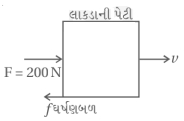
Using a horizontal force of $200\, N$,we intend to move a wooden cabinet across a floor at a constant velocity. What is the friction force (in $N$) that will be exerted on the cabinet?
A
$100$
B
$400$
C
$200$
D
$300$
Solution
(C) When an object moves at a constant velocity,the net force acting on it is zero.
This means that the applied force must be perfectly balanced by the opposing frictional force.
Given that the applied horizontal force is $200\, N$,the frictional force must also be $200\, N$ in the opposite direction to maintain a constant velocity.
Therefore,the friction force exerted on the cabinet is $200\, N$.
0 likes
View Solution3
Medium
Soni says that the acceleration in an object could be zero even when several forces are acting on it. Do you agree with her? Why?
Solution
(A) Yes,$I$ agree with Soni.
According to Newton's second law of motion,the acceleration $(a)$ of an object is directly proportional to the net force $(F_{net})$ acting on it,given by the formula $F_{net} = ma$,where $m$ is the mass of the object.
If several forces act on an object such that their vector sum (resultant force) is zero,then the net force $F_{net} = 0$.
Since $F_{net} = ma$,if $F_{net} = 0$ and $m \neq 0$,then $a = 0$.
Therefore,an object can have zero acceleration even when multiple forces are acting on it,provided they balance each other out.
0 likes
View Solution4
Easy
Define $(i)$ force $(ii)$ dyne $(iii)$ newton.
Solution
(N/A) $(i)$ Force is an external push or pull that changes or tends to change the state of rest or uniform motion of a body in a straight line.
$(ii)$ Dyne is the absolute unit of force in the $CGS$ system. One dyne is defined as the force that produces an acceleration of $1 \ cm \ s^{-2}$ when acting on a body of mass $1 \ g$.
$(iii)$ Newton is the absolute unit of force in the $SI$ system. One newton is defined as the force that produces an acceleration of $1 \ m \ s^{-2}$ when acting on a body of mass $1 \ kg$.
0 likes
View Solution5
EasyMCQ
Name the force which is responsible for change in position or state of an object.
A
Balanced force
B
Unbalanced force
C
Frictional force
D
Gravitational force
Solution
(B) An object remains in its state of rest or uniform motion unless acted upon by an external unbalanced force.
According to Newton's first law of motion,an unbalanced force is required to change the state of rest or the state of uniform motion of an object.
Therefore,the force responsible for the change in position or state of an object is the unbalanced force.
According to Newton's first law of motion,an unbalanced force is required to change the state of rest or the state of uniform motion of an object.
Therefore,the force responsible for the change in position or state of an object is the unbalanced force.
0 likes
View Solution6
Easy
Name the physical quantity whose $SI$ unit is "newton".
Solution
$(FORCE)$ The physical quantity whose $SI$ unit is "newton" $(N)$ is force. Force is defined as a push or pull acting on an object, which can cause an object to accelerate, decelerate, or change its shape.
0 likes
View Solution7
EasyMCQ
Name the unbalanced force which slows down a moving bicycle when we stop pedalling it.
A
Gravitational force
B
Magnetic force
C
Frictional force
D
Electrostatic force
Solution
(C) When we stop pedalling a moving bicycle,it gradually slows down and eventually comes to a stop. This happens because of the force of friction acting between the road surface and the bicycle tyres. Friction is an unbalanced force that opposes the motion of the bicycle,causing it to decelerate.
0 likes
View Solution8
Medium
What are the changes possible on an object at rest if we apply on it:
$(a)$ a balanced force?
$(b)$ an unbalanced force?
$(a)$ a balanced force?
$(b)$ an unbalanced force?
Solution
(N/A) balanced force does not change the state of rest or motion of an object,but it may change the shape or size of the body.
$(b)$ An unbalanced force will change the state of rest of the object by producing acceleration in the direction of the applied force.
$(b)$ An unbalanced force will change the state of rest of the object by producing acceleration in the direction of the applied force.
0 likes
View Solution9
Easy
State whether the following statement is true or false:
Force may or may not produce any motion in a body.
Force may or may not produce any motion in a body.
Solution
(A) The statement is $True$.
$A$ force is defined as a push or a pull acting on an object. While a force can cause an object to accelerate,change its speed,or change its direction,it does not always result in motion.
For example,if you push against a heavy wall,you are applying a force,but the wall does not move because the frictional force or the structural resistance balances your applied force. Therefore,force does not always produce motion in a body.
0 likes
View Solution10
EasyMCQ
$A$ force can be completely described by
A
its magnitude
B
its direction
C
neither magnitude nor direction
D
its magnitude and direction
Solution
(D) force is a vector quantity. $A$ vector quantity is defined as a physical quantity that has both magnitude (size) and direction. Therefore,to completely describe a force,one must specify both how strong the push or pull is (magnitude) and the direction in which it is applied.
0 likes
View Solution11
EasyMCQ
When balanced forces act on a body,the body is
A
moving with variable speed
B
either at rest or moving with constant velocity
C
moving with variable velocity
D
accelerating
Solution
(B) According to Newton's $1^{st}$ Law of Motion,if the net external force acting on a body is zero (i.e.,balanced forces),the body will maintain its state of rest or uniform motion in a straight line.
Balanced forces do not change the state of motion of an object,meaning the acceleration of the body is zero.
Therefore,the body is either at rest or moving with a constant velocity.
Balanced forces do not change the state of motion of an object,meaning the acceleration of the body is zero.
Therefore,the body is either at rest or moving with a constant velocity.
0 likes
View SolutionFORCE AND LAWS OF MOTION — Balanced and Unbalanced Forces · Frequently Asked Questions
1Are these FORCE AND LAWS OF MOTION questions useful for JEE and NEET?
Yes. All questions in this section are mapped to JEE Main and NEET exam patterns. Previous year questions from JEE Main, NEET, GUJCET and state-level exams are included with full solutions.
2Can I switch to Hindi or Gujarati for these questions?
Yes. Use the language tabs in the hero section or the sidebar to view the same questions and solutions in English, Hindi or Gujarati.
3How do I generate a question paper from this subtopic?
Use the Vedclass Exam Paper Generator — select the chapter and subtopic, set difficulty, and generate Sets A, B, C, D automatically. First 3 chapters of every subject are free.
Vedclass Products
For Students
Vedclass Test Series
Mock tests in real JEE/NEET style with performance analysis. 5-day free trial.
Start Free TrialFor Teachers
Exam Paper Generator
Generate Set A/B/C/D papers from this chapter in 2 minutes. 3 chapters free.
Try FreeFor Institutes
Online Exam Module
Live online exams with unlimited students, 360° analytics & white-label branding.
See DemoFor Teachers & Institutes
Generate a FORCE AND LAWS OF MOTION Exam Paper in 2 Minutes
Select subtopic & difficulty — Sets A, B, C, D auto-generated with No Repeat logic.
First 3 chapters of every subject are free — no payment required.