
A English
Third Law of Motion Questions in English
Class 9 Science · FORCE AND LAWS OF MOTION · Third Law of Motion
39+
Questions
English
Language
100%
With Solutions
Showing 39 of 39 questions in English
1
EasyMCQ
If action is always equal to the reaction,explain how a horse can pull a cart.
A
The horse pulls the cart with a force greater than the reaction force.
B
The horse pushes the ground backward,and the reaction force from the ground moves the horse forward.
C
The cart moves because the horse is stronger than the cart.
D
The friction between the cart and the ground is zero.
Solution
(B) According to Newton's third law of motion,for every action,there is an equal and opposite reaction.
When a horse pulls a cart,it pushes the ground backward with its feet at an angle.
This action force exerted by the horse on the ground results in an equal and opposite reaction force exerted by the ground on the horse in the forward direction.
This reaction force allows the horse to move forward,and since the cart is attached to the horse,the cart is pulled along with it.
0 likes
View Solution2
Medium
Explain,why is it difficult for a fireman to hold a hose,which ejects large amounts of water at a high velocity.
Solution
(N/A) The difficulty arises due to the backward reaction force of the water being ejected.
When a fireman holds a hose that ejects a large volume of water at a high velocity,the water exerts an equal and opposite reaction force on the hose in the backward direction,according to $Newton's$ third law of motion.
This backward force pushes the fireman,making it difficult for him to maintain his balance and stability while holding the hose.
0 likes
View Solution3
MediumMCQ
From a rifle of mass $4\, kg$,a bullet of mass $50\, g$ is fired with an initial velocity of $35\, m\, s^{-1}$. Calculate the initial recoil velocity (in $m/s$) of the rifle.
A
$0.8375$
B
$0.1023$
C
$0.4375$
D
$0.6523$
Solution
(C) Mass of the rifle,$m_1 = 4\, kg$.
Mass of the bullet,$m_2 = 50\, g = 0.05\, kg$.
Initial velocity of the bullet,$v_2 = 35\, m/s$.
Let the recoil velocity of the rifle be $v_1$.
Initially,the system is at rest,so the initial momentum is $0$.
According to the law of conservation of momentum,the total momentum after firing must be equal to the total momentum before firing.
$m_1 v_1 + m_2 v_2 = 0$.
$4(v_1) + (0.05 \times 35) = 0$.
$4 v_1 + 1.75 = 0$.
$4 v_1 = -1.75$.
$v_1 = -1.75 / 4 = -0.4375\, m/s$.
The negative sign indicates that the rifle recoils in the direction opposite to the bullet,with a magnitude of $0.4375\, m/s$.
1 likes
View Solution4
Medium
According to the third law of motion,when we push on an object,the object pushes back on us with an equal and opposite force. If the object is a massive truck parked along the roadside,it will probably not move. $A$ student justifies this by answering that the two opposite and equal forces cancel each other. Comment on this logic and explain why the truck does not move.
Solution
(N/A) The truck has a large mass,which results in a very high static friction between the tires and the road.
To move the truck,the applied force must exceed the maximum static frictional force.
When a person pushes the truck and it does not move,the applied force is balanced by the static frictional force acting in the opposite direction.
Therefore,the student's logic is correct in the context that the net force on the truck is zero because the applied force and the frictional force cancel each other out.
0 likes
View Solution5
EasyMCQ
According to the third law of motion,action and reaction
A
always act on the same body
B
always act on different bodies in opposite directions
C
have same magnitude and directions
D
act on either body at normal to each other
Solution
(B) According to Newton's third law of motion,for every action,there is an equal and opposite reaction.
These two forces always act on two different bodies.
They are equal in magnitude and opposite in direction.
These two forces always act on two different bodies.
They are equal in magnitude and opposite in direction.
0 likes
View Solution6
EasyMCQ
$A$ rocket works on the principle of conservation of
A
mass
B
energy
C
momentum
D
velocity
Solution
(C) rocket operates based on Newton's $3^{rd}$ law of motion and the principle of conservation of linear momentum.
As the fuel burns,the rocket expels hot gases at high velocity in the downward direction.
According to the law of conservation of momentum,the total momentum of the system (rocket + gases) remains constant in the absence of external forces.
Since the gases gain momentum in the downward direction,the rocket gains an equal and opposite momentum in the upward direction,which provides the necessary thrust for the rocket to lift off.
0 likes
View Solution7
MediumMCQ
Two identical bullets are fired,one by a light rifle and another by a heavy rifle with the same force. Which rifle will hurt the shoulder more and why?
A
Light rifle
B
Heavy rifle
C
Both will hurt equally
D
None of these
Solution
(A) According to the law of conservation of momentum,the momentum of the bullet is equal to the momentum of the rifle $(p = mv)$.
Since the force applied is the same,the impulse $(F \times t)$ imparted to both rifles is the same,resulting in the same change in momentum.
For a light rifle,the mass $(m)$ is smaller,so to achieve the same momentum,the recoil velocity $(v)$ must be significantly higher.
For a heavy rifle,the mass $(m)$ is larger,resulting in a lower recoil velocity $(v)$.
Since the kinetic energy of recoil $(KE = \frac{1}{2}mv^2)$ is proportional to the square of the velocity,the lighter rifle experiences a higher recoil velocity,which causes a greater impact force on the shoulder. Therefore,the lighter rifle will hurt the shoulder more.
0 likes
View Solution8
Medium
Two friends on roller-skates are standing $5\, m$ apart facing each other. One of them throws a ball of $2\, kg$ towards the other,who catches it. How will this activity affect the position of the two? Explain your answer.
Solution
(N/A) The separation between them will increase.
Initially,the momentum of both friends is zero as they are at rest.
According to the law of conservation of momentum,when the first person throws the ball,they must move in the opposite direction to the ball to conserve momentum.
When the second person catches the ball,they receive the momentum of the ball,which causes them to move backward in the direction of the ball's motion.
Consequently,both friends move away from each other,increasing the distance between them.
0 likes
View Solution9
Medium
$A$ water sprinkler used for grass lawns begins to rotate as soon as the water is supplied. Explain the principle on which it works.
Solution
(N/A) The rotation of the water sprinkler is based on Newton's $Third$ Law of Motion.
When water is supplied, it rushes out through the nozzles of the sprinkler at a high velocity.
According to Newton's $Third$ Law of Motion, for every action, there is an equal and opposite reaction.
The water exerts an action force on the nozzle in the backward direction, and the nozzle exerts an equal and opposite reaction force on the water.
Due to this reaction force, the sprinkler arm experiences a torque that causes it to rotate in the opposite direction of the water flow.
0 likes
View Solution10
EasyMCQ
If a man jumps out from a boat to the bank of the river,the boat moves backwards. Identify the action and reaction in this situation.
A
Action: Man pushing the boat; Reaction: Boat pushing the man.
B
Action: Boat moving backwards; Reaction: Man jumping forward.
C
Action: Man jumping forward; Reaction: Boat moving backwards.
D
Action: Gravity acting on the man; Reaction: Buoyancy acting on the boat.
Solution
(A) According to Newton's $3^{rd}$ Law of Motion,every action has an equal and opposite reaction.
In this scenario,when the man jumps forward,he exerts a backward force on the boat,which is the action.
The boat simultaneously exerts an equal and opposite forward force on the man,which is the reaction.
Therefore,the push of the man on the boat is the action,and the force exerted by the boat on the man is the reaction.
0 likes
View Solution11
EasyMCQ
You are hurt when you kick a stone. Why?
A
Due to inertia of rest.
B
Due to Newton's third law of motion.
C
Due to Newton's first law of motion.
D
Due to gravitational force.
Solution
(B) According to Newton's third law of motion,for every action,there is an equal and opposite reaction.
When you kick a stone,your foot exerts a force on the stone (action).
Simultaneously,the stone exerts an equal and opposite force on your foot (reaction).
This reaction force from the hard surface of the stone causes the pain in your foot.
When you kick a stone,your foot exerts a force on the stone (action).
Simultaneously,the stone exerts an equal and opposite force on your foot (reaction).
This reaction force from the hard surface of the stone causes the pain in your foot.
0 likes
View Solution12
EasyMCQ
An apple falls from a tree because of gravitational attraction between the earth and the apple. If $F_1$ is the magnitude of force exerted by the earth on the apple and $F_2$ is the magnitude of force exerted by the apple on the earth,then:
A
$F_1$ is very much greater than $F_2$
B
$F_2$ is very much greater than $F_1$
C
$F_1$ and $F_2$ are equal
D
$F_1$ is only a little greater than $F_2$
Solution
(C) According to Newton's Third Law of Motion,for every action,there is an equal and opposite reaction.
Since the gravitational force is a mutual interaction between two bodies,the force exerted by the Earth on the apple $(F_1)$ is equal in magnitude to the force exerted by the apple on the Earth $(F_2)$.
Therefore,$F_1 = F_2$.
Since the gravitational force is a mutual interaction between two bodies,the force exerted by the Earth on the apple $(F_1)$ is equal in magnitude to the force exerted by the apple on the Earth $(F_2)$.
Therefore,$F_1 = F_2$.
1 likes
View Solution13
Easy
State Newton's third law of motion.
Solution
(N/A) Newton's third law of motion states that to every action,there is always an equal and opposite reaction. This means that when one object exerts a force on a second object,the second object simultaneously exerts a force equal in magnitude and opposite in direction on the first object.
0 likes
View Solution14
Easy
Give an example to show that friction is an important factor in satisfying Newton's third law of motion.
Solution
(N/A) Walking is a classic example. When a person walks,they push the ground backward with their feet (action). According to Newton's third law,the ground exerts an equal and opposite force on the feet (reaction). This reaction force is provided by the friction between the soles of the shoes and the surface of the ground. Without friction,the feet would slip,and it would be impossible to exert the necessary backward force to move forward.
0 likes
View Solution15
EasyMCQ
Which Newton's law of motion is applied in the flight of a bird?
A
Newton's first law of motion
B
Newton's second law of motion
C
Newton's third law of motion
D
Newton's law of gravitation
Solution
(C) Newton's third law of motion is applied in the flight of a bird.
For flight,a bird applies force on the air in the backward direction by flapping its wings (action).
In response,the air exerts an equal and opposite force on the bird in the forward direction (reaction),which helps the bird to fly.
For flight,a bird applies force on the air in the backward direction by flapping its wings (action).
In response,the air exerts an equal and opposite force on the bird in the forward direction (reaction),which helps the bird to fly.
0 likes
View Solution16
MediumMCQ
Write the relation for the collision of two balls $A$ and $B$ and state the related law.
A
Conservation of Energy
B
Conservation of Momentum
C
Newton's Second Law
D
Newton's Third Law
Solution
(B) The relation for the collision of two balls $A$ and $B$ is given by the principle of conservation of momentum:
$m_A u_A + m_B u_B = m_A v_A + m_B v_B$
Where:
$m_A, m_B$ are the masses of balls $A$ and $B$.
$u_A, u_B$ are the initial velocities of balls $A$ and $B$ before collision.
$v_A, v_B$ are the final velocities of balls $A$ and $B$ after collision.
The related law is the $\text{Law}$ $\text{of}$ $\text{Conservation}$ $\text{of}$ $\text{Momentum}$, which states that if no external unbalanced force acts on a system of two interacting objects, then the total momentum of the system remains conserved (constant).
0 likes
View Solution17
Medium
State Newton's third law of motion. Give two examples.
Solution
(N/A) Newton's third law of motion states that to every action,there is an equal and opposite reaction.
Examples are:
$(i)$ When we exert a force (action) on a wall by pushing it with the palm of our hand,we experience a force (reaction) exerted by the wall on our palm.
$(ii)$ When a bullet is fired from a gun,the recoil of the gun is the reaction produced by the bullet on the gun.
Examples are:
$(i)$ When we exert a force (action) on a wall by pushing it with the palm of our hand,we experience a force (reaction) exerted by the wall on our palm.
$(ii)$ When a bullet is fired from a gun,the recoil of the gun is the reaction produced by the bullet on the gun.
0 likes
View Solution18
Medium
State the law of conservation of momentum. How does conservation of momentum take place in each of the following?
$(i)$ $A$ rocket taking off from ground.
$(ii)$ Flying of a jet aeroplane.
$(i)$ $A$ rocket taking off from ground.
$(ii)$ Flying of a jet aeroplane.
Solution
(N/A) Law of conservation of momentum:
It states that in an isolated system,the total momentum of the system remains conserved (constant) if no external unbalanced force acts on it.
$(i)$ $A$ rocket taking off from ground: The chemicals inside the rocket burn and produce a high-velocity blast of hot gases. These gases are ejected through the tail nozzle in the downward direction. According to the law of conservation of momentum,the rocket gains an equal and opposite momentum in the upward direction,causing it to lift off.
$(ii)$ Flying of a jet aeroplane: In jet aeroplanes,a large volume of gases produced by the combustion of fuel is ejected through a jet in the backward direction at high velocity. The backward momentum of these gases results in an equal and opposite forward momentum for the aeroplane,which provides the necessary thrust for flight.
0 likes
View Solution19
Medium
Explain the following:
$(i)$ Why does a boatman push the river bank backward with a long bamboo pole when launching his boat into the water?
$(ii)$ Why does a boat tend to leave the shore when passengers are alighting from it? How does the boatman overcome this difficulty?
$(iii)$ Why does a gun recoil when fired?
$(iv)$ How do rockets operate in space?
Solution
(N/A) $(i)$ While launching his boat into the water,the boatman pushes the river bank backward with a long pole. In accordance with Newton's third law of motion,the bank applies an equal and opposite reaction force on the pole,thereby pushing the boat forward.
$(ii)$ When passengers alight from the boat,they push the boat in the backward direction. As a result,the boat tends to move away from the shore. The boatman overcomes this by tying the boat to a rigid support on the bank.
$(iii)$ When a bullet is fired,the gun exerts a forward force on the bullet. According to Newton's third law,the bullet exerts an equal and opposite force on the gun,causing it to recoil.
$(iv)$ Rockets operate in space by ejecting burnt gases at high velocity from the rear. According to Newton's third law,the gases exert an equal and opposite reaction force on the rocket,propelling it forward.
0 likes
View Solution20
Medium
Name and state the action and reaction in the following cases:
$(i)$ Firing of a bullet from a gun.
$(ii)$ Hammering a nail.
$(iii)$ $A$ book lying on a table.
$(iv)$ Moving rocket.
$(v)$ $A$ person moving on the floor.
$(vi)$ $A$ moving train colliding with a stationary train.
$(i)$ Firing of a bullet from a gun.
$(ii)$ Hammering a nail.
$(iii)$ $A$ book lying on a table.
$(iv)$ Moving rocket.
$(v)$ $A$ person moving on the floor.
$(vi)$ $A$ moving train colliding with a stationary train.
Solution
(N/A) $(i)$ When a bullet is fired from a gun,the force exerted on the bullet is the action,and the recoil force experienced by the gun is the reaction.
$(ii)$ When a nail is hammered,the force exerted by the hammer on the nail is the action,and the force exerted by the nail on the hammer is the reaction.
$(iii)$ When a book is placed on a table,the weight of the book acting downwards on the table is the action,and the normal force exerted by the table upwards on the book is the reaction.
$(iv)$ In a moving rocket,the force exerted by the rocket on the exhaust gases is the action,and the force exerted by the gases on the rocket is the reaction.
$(v)$ When a person walks,the force exerted by the person's foot pushing the ground backwards is the action,and the frictional force exerted by the ground on the foot in the forward direction is the reaction.
$(vi)$ When a moving train collides with a stationary train,the force exerted by the moving train on the stationary train is the action,and the force exerted by the stationary train on the moving train is the reaction.
0 likes
View Solution21
Medium
If action is always equal to the reaction,explain,why a cart pulled by a horse can be moved.
Solution
(D) The motion of the horse and cart system is governed by the following forces:
$(i)$ The weight of the horse and cart acting vertically downward.
$(ii)$ The normal reaction of the ground acting vertically upward,which balances the weight.
$(iii)$ The force exerted by the horse's feet on the ground in the backward direction (Action).
$(iv)$ The reaction force of the ground on the horse's feet in the forward direction (Reaction).
$(v)$ The force of friction acting on the cart wheels in the backward direction.
Forces $(i)$ and $(ii)$ are balanced and do not contribute to horizontal motion. The horse pushes the ground backward with force $(iii)$,and the ground exerts an equal and opposite reaction force $(iv)$ on the horse in the forward direction. The cart moves forward because the forward reaction force $(iv)$ is greater than the backward frictional force $(v)$ acting on the cart. Thus,the system moves due to the net unbalanced force in the forward direction.
0 likes
View Solution22
EasyMCQ
If someone jumps to the shore from a boat,the boat moves in the opposite direction. Explain.
A
Due to inertia of rest
B
Due to Newton's first law of motion
C
Due to Newton's third law of motion
D
Due to conservation of momentum
Solution
(C) This phenomenon is based on $Newton's$ third law of motion,which states that for every action,there is an equal and opposite reaction.
When a person jumps from a boat towards the shore,they exert a muscular force on the boat in the backward direction (action).
In response,the boat exerts an equal and opposite force on the person,propelling them forward towards the shore.
Simultaneously,due to the action force applied by the person,the boat moves in the opposite direction,i.e.,away from the shore (reaction).
0 likes
View Solution23
Medium
Two friends,Girish and Neeraj,were discussing Newton's third law. They were perplexed about how action and reaction are equal and opposite. They could not think of an experiment by which they could ascertain this fact. Pushkar,who was their friend,told them that he would set up an experiment to prove this to them. By performing an experiment,Pushkar demonstrated the law.
$(a)$ Can you think of an experiment by which you can demonstrate this law?
$(b)$ What values do you think Pushkar has?
$(a)$ Can you think of an experiment by which you can demonstrate this law?
$(b)$ What values do you think Pushkar has?
Solution
(N/A) Consider two spring balances connected together as shown in the figure.
The fixed end of balance $B$ is attached to the wall. When a force is applied through the free end of spring balance $A$,it is observed that both the spring balances show the same readings on their scales. It means that the force exerted by spring balance $A$ on spring balance $B$ is equal but opposite in direction to the force exerted by balance $B$ on balance $A$.
$(b)$ Pushkar exhibits an experimental mindset and a helpful nature.

0 likes
View Solution24
DifficultMCQ
$A$ girl of mass $50\, kg$ jumps out of a moving boat of mass $300\, kg$ on to the bank with a horizontal velocity of $3\, m s^{-1}$. With what velocity does the boat begin to move backwards (in $, m s^{-1}$)?
A
$0.5$
B
$0.25$
C
$1.0$
D
$0.75$
Solution
(A) According to the law of conservation of momentum,the total momentum before the jump is equal to the total momentum after the jump.
Initially,the boat and the girl are moving together,so the initial momentum is $0$ (assuming the system starts from rest or considering the relative change).
Let $m_1 = 50\, kg$ be the mass of the girl and $v_1 = 3\, m s^{-1}$ be her velocity.
Let $m_2 = 300\, kg$ be the mass of the boat and $v_2$ be the velocity of the boat.
Using the principle of conservation of linear momentum: $m_1 v_1 + m_2 v_2 = 0$.
Substituting the values: $(50 \times 3) + (300 \times v_2) = 0$.
$150 + 300 v_2 = 0$.
$300 v_2 = -150$.
$v_2 = -\frac{150}{300} = -0.5\, m s^{-1}$.
The negative sign indicates that the boat moves in the opposite direction (backwards) with a velocity of $0.5\, m s^{-1}$.
0 likes
View Solution25
Medium
$(a)$ Define momentum. Write its $SI$ unit.
$(b)$ $A$ bullet of mass $0.02 \ kg$ is fired from a gun weighing $7.5 \ kg$. If the initial velocity of the bullet is $200 \ m \ s^{-1}$,calculate the speed with which the gun recoils.
$(b)$ $A$ bullet of mass $0.02 \ kg$ is fired from a gun weighing $7.5 \ kg$. If the initial velocity of the bullet is $200 \ m \ s^{-1}$,calculate the speed with which the gun recoils.
Solution
(N/A) Momentum is defined as the total quantity of motion possessed by a body. It is equal to the product of the mass and velocity of the body. Its $SI$ unit is $kg \ m \ s^{-1}$.
$(b)$ Given:
Mass of bullet $(m) = 0.02 \ kg$
Mass of gun $(M) = 7.5 \ kg$
Velocity of bullet $(v) = 200 \ m \ s^{-1}$
Recoil velocity of gun $(V) = ?$
According to the law of conservation of momentum,the total momentum before firing is equal to the total momentum after firing:
$m \times v + M \times V = 0$
$0.02 \times 200 + 7.5 \times V = 0$
$4 + 7.5 \times V = 0$
$7.5 \times V = -4$
$V = -4 / 7.5 = -0.533 \ m \ s^{-1}$
The negative sign indicates that the gun recoils in the direction opposite to the bullet. The speed of recoil is $0.533 \ m \ s^{-1}$.
0 likes
View Solution26
Medium
$A$ bullet of mass $m$ is fired from a gun of mass $M$. If the velocity of the bullet is $v$,derive an expression for the recoil velocity of the gun. On which principle is this based?
Solution
(N/A) When a bullet is fired from a gun,the gun experiences a backward jerk,which is known as the recoil of the gun.
This phenomenon is based on the Law of Conservation of Momentum.
According to this law,if no external force acts on a system,the total momentum of the system remains conserved.
Initially,both the gun and the bullet are at rest,so the initial momentum of the system is $0$.
Let $m$ be the mass of the bullet,$v$ be the velocity of the bullet,$M$ be the mass of the gun,and $V$ be the recoil velocity of the gun.
According to the law of conservation of momentum:
Initial Momentum = Final Momentum
$0 = mv + MV$
$MV = -mv$
$V = -\frac{mv}{M}$
The negative sign indicates that the direction of the recoil velocity of the gun is opposite to the direction of the bullet's velocity.
0 likes
View Solution27
Medium
Look at the diagram below and answer the following questions:
$(i)$ When a force is applied through the free end of the spring balance $A$,the reading on the spring balance $A$ is $20 \ g \ wt$. What will be the reading shown by the spring balance $B$?
$(ii)$ Write the reason for your answer.
$(b)$ If a balloon is filled with air and its mouth is untied,air is released from its mouth in the downward direction. Write the other observations made by you and justify your answer.
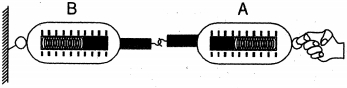
Solution
(N/A) $(a) (i)$ Spring balance $B$ will show $20 \ g \ wt$.
$(ii)$ This is due to Newton's third law of motion. When spring balance $A$ exerts a force on balance $B$,balance $B$ exerts an equal and opposite force of reaction on balance $A$. Since the force applied is $20 \ g \ wt$,the reaction force is also $20 \ g \ wt$.
$(b)$ It is observed that the balloon moves in the upward direction. Air rushes out from the balloon in the downward direction (action). As a result,there is an equal and opposite reaction in the form of upward motion of the balloon,which is in accordance with Newton's third law of motion.
0 likes
View Solution28
Medium
$m_{1}$ and $m_{2}$ masses of two blocks are connected by a light spring on a smooth horizontal surface. The two masses are pulled apart and then released. Prove that the ratio of their acceleration is inversely proportional to their masses.
Solution
(N/A) According to Newton's third law of motion,the spring exerts equal and opposite forces on both masses.
Let $F_{1}$ be the force on mass $m_{1}$ and $F_{2}$ be the force on mass $m_{2}$.
Since the forces are equal in magnitude and opposite in direction,we have $F_{1} = -F_{2}$.
Using Newton's second law,$F = ma$,we can write:
$m_{1} a_{1} = -m_{2} a_{2}$
Here,$a_{1}$ and $a_{2}$ are the accelerations of the masses $m_{1}$ and $m_{2}$ respectively.
The negative sign indicates that the accelerations are in opposite directions.
Taking the magnitude of the ratio of accelerations:
$\frac{|a_{1}|}{|a_{2}|} = \frac{m_{2}}{m_{1}}$
This proves that the ratio of their accelerations is inversely proportional to their masses.
0 likes
View Solution29
Easy
Air is blown onto a sail attached to a boat from an electric fan placed on the boat. Will the boat start moving?
Solution
(B) No,the boat will not move. According to Newton's $3^{rd}$ Law of Motion,when the air from the fan pushes the sail,the sail exerts an equal and opposite force on the fan. Since the fan is attached to the boat,the system (fan + boat) experiences internal forces that cancel each other out. Motion occurs only when an external unbalanced force acts on a body. Since the fan is part of the boat,no net external force is applied to the system,and therefore,the boat will not move.
0 likes
View Solution30
Easy
According to Newton's third law,every force is accompanied by an equal and opposite force. How then can anything move?
Solution
(N/A) Newton's third law states that for every action,there is an equal and opposite reaction. However,these two forces act on different bodies,not the same body. Since the forces do not cancel each other out on a single object,the net force acting on a body can be non-zero,thereby allowing the body to move.
0 likes
View Solution31
MediumMCQ
$A$ girl of mass $50 \, kg$ jumps out of a moving boat of mass $300 \, kg$ onto the bank with a horizontal velocity of $3 \, m s^{-1}$. With what velocity will the boat begin to move backwards (in $, m s^{-1}$)?
A
$0.5$
B
$0.25$
C
$1.0$
D
$0.75$
Solution
(A) According to the Law of Conservation of Momentum,the total momentum before the jump is equal to the total momentum after the jump.
Since the system (girl + boat) is initially at rest,the initial momentum is $0$.
Let $m_1 = 50 \, kg$ be the mass of the girl and $v_1 = 3 \, m s^{-1}$ be her velocity.
Let $m_2 = 300 \, kg$ be the mass of the boat and $v_2$ be the velocity of the boat.
Using the formula: $m_1 v_1 + m_2 v_2 = 0$.
Substituting the values: $(50 \times 3) + (300 \times v_2) = 0$.
$150 + 300 v_2 = 0$.
$300 v_2 = -150$.
$v_2 = -\frac{150}{300} = -0.5 \, m s^{-1}$.
The negative sign indicates that the boat moves in the opposite direction (backwards) with a velocity of $0.5 \, m s^{-1}$.
0 likes
View Solution32
MediumMCQ
$A$ bullet of mass $10 \, g$ is fired with a velocity of $400 \, m s^{-1}$ from a gun of mass $4 \, kg$. What is the recoil velocity of the gun (in $, m s^{-1}$)?
A
$1$
B
$-1$
C
$0.1$
D
$-0.1$
Solution
(B) According to the law of conservation of linear momentum,the total momentum before firing is equal to the total momentum after firing.
Initial momentum of the system (gun + bullet) = $0$ (since both are at rest).
Final momentum of the system = $m \times v + M \times V$,where $m = 0.01 \, kg$ (mass of bullet),$v = 400 \, m s^{-1}$ (velocity of bullet),$M = 4 \, kg$ (mass of gun),and $V$ is the recoil velocity of the gun.
Setting the initial momentum equal to the final momentum:
$0 = (0.01 \, kg \times 400 \, m s^{-1}) + (4 \, kg \times V)$
$0 = 4 + 4V$
$4V = -4$
$V = -1 \, m s^{-1}$.
The negative sign indicates that the gun recoils in the direction opposite to the bullet.
0 likes
View Solution33
Easy
State whether the following statement is true or false:
Action and reaction act on the same body.
Action and reaction act on the same body.
Solution
(B) The statement is False.
According to Newton's $Third$ Law of Motion, for every action, there is an equal and opposite reaction. These two forces always act on two different bodies, not on the same body. Therefore, they cannot cancel each other out.
According to Newton's $Third$ Law of Motion, for every action, there is an equal and opposite reaction. These two forces always act on two different bodies, not on the same body. Therefore, they cannot cancel each other out.
0 likes
View Solution34
Easy
State whether the following statement is true or false:
In any interaction,there are always at least two forces in play.
In any interaction,there are always at least two forces in play.
Solution
(TRUE) The statement is True.
According to Newton's Third Law of Motion,forces always exist in pairs. Whenever one object exerts a force on a second object,the second object simultaneously exerts a force equal in magnitude and opposite in direction on the first object. Thus,an interaction between two bodies always involves a pair of forces.
According to Newton's Third Law of Motion,forces always exist in pairs. Whenever one object exerts a force on a second object,the second object simultaneously exerts a force equal in magnitude and opposite in direction on the first object. Thus,an interaction between two bodies always involves a pair of forces.
0 likes
View Solution35
EasyMCQ
$A$ man is at rest in the middle of a pond on perfectly smooth ice. He can get himself to the shore by making use of Newton's:
A
first law
B
third law
C
second law
D
all the laws
Solution
(B) On a perfectly smooth ice surface, there is no friction. To move, the man must exert a force on an object and throw it in the opposite direction of the shore.
According to Newton's $third$ law of motion, for every action, there is an equal and opposite reaction.
By throwing an object away from the shore, the man experiences a reaction force in the direction of the shore, which allows him to move towards it.
According to Newton's $third$ law of motion, for every action, there is an equal and opposite reaction.
By throwing an object away from the shore, the man experiences a reaction force in the direction of the shore, which allows him to move towards it.
0 likes
View Solution36
EasyMCQ
$A$ jet engine works on the principle of Newton's:
A
first law of motion
B
second law of motion
C
none of these
D
third law of motion
Solution
(D) jet engine operates by expelling high-speed exhaust gases out of the back of the engine.
According to Newton's $third$ law of motion, for every action, there is an equal and opposite reaction.
The high-speed ejection of gases (action) creates an equal and opposite force (reaction) that pushes the jet engine forward, known as thrust.
According to Newton's $third$ law of motion, for every action, there is an equal and opposite reaction.
The high-speed ejection of gases (action) creates an equal and opposite force (reaction) that pushes the jet engine forward, known as thrust.
0 likes
View Solution37
EasyMCQ
Action-reaction forces act
A
on different bodies
B
on the same body
C
along different lines
D
in the same direction
Solution
(A) According to $Newton's$ $third$ $law$ of motion, for every action, there is an equal and opposite reaction.
These two forces always act on two different bodies.
For example, if a person pushes a wall, the person exerts a force on the wall (action), and the wall exerts an equal and opposite force on the person (reaction).
Since they act on different bodies, they do not cancel each other out.
These two forces always act on two different bodies.
For example, if a person pushes a wall, the person exerts a force on the wall (action), and the wall exerts an equal and opposite force on the person (reaction).
Since they act on different bodies, they do not cancel each other out.
0 likes
View Solution38
EasyMCQ
The action-reaction forces:
A
must act on the same object
B
must act on different objects
C
may act on same object
D
may act on different objects
Solution
(B) According to $Newton's$ $third$ $law$ of motion, for every action, there is an equal and opposite reaction.
These two forces always act on two different bodies.
If they acted on the same body, the net force would be zero, and no motion would be possible.
Therefore, action and reaction forces must act on different objects.
These two forces always act on two different bodies.
If they acted on the same body, the net force would be zero, and no motion would be possible.
Therefore, action and reaction forces must act on different objects.
0 likes
View Solution39
EasyMCQ
$A$ gun recoils after firing to conserve
A
velocity
B
force
C
momentum
D
speed
Solution
(C) According to the Law of Conservation of Momentum,the total momentum of an isolated system remains constant if no external force acts on it.
Before firing,the gun and the bullet are at rest,so the total initial momentum is $0$.
When the gun is fired,the bullet moves forward with a certain momentum. To keep the total momentum at $0$,the gun must move backward with an equal and opposite momentum.
This backward movement of the gun is known as recoil,which ensures that the total linear momentum of the system is conserved.
0 likes
View SolutionFORCE AND LAWS OF MOTION — Third Law of Motion · Frequently Asked Questions
1Are these FORCE AND LAWS OF MOTION questions useful for JEE and NEET?
Yes. All questions in this section are mapped to JEE Main and NEET exam patterns. Previous year questions from JEE Main, NEET, GUJCET and state-level exams are included with full solutions.
2Can I switch to Hindi or Gujarati for these questions?
Yes. Use the language tabs in the hero section or the sidebar to view the same questions and solutions in English, Hindi or Gujarati.
3How do I generate a question paper from this subtopic?
Use the Vedclass Exam Paper Generator — select the chapter and subtopic, set difficulty, and generate Sets A, B, C, D automatically. First 3 chapters of every subject are free.
Vedclass Products
For Students
Vedclass Test Series
Mock tests in real JEE/NEET style with performance analysis. 5-day free trial.
Start Free TrialFor Teachers
Exam Paper Generator
Generate Set A/B/C/D papers from this chapter in 2 minutes. 3 chapters free.
Try FreeFor Institutes
Online Exam Module
Live online exams with unlimited students, 360° analytics & white-label branding.
See DemoFor Teachers & Institutes
Generate a FORCE AND LAWS OF MOTION Exam Paper in 2 Minutes
Select subtopic & difficulty — Sets A, B, C, D auto-generated with No Repeat logic.
First 3 chapters of every subject are free — no payment required.