
A English
Biogeochemical Cycles Questions in English
Class 9 Science · NATURAL RESOURCES · Biogeochemical Cycles
48+
Questions
English
Language
100%
With Solutions
Showing 48 of 48 questions in English
1
DifficultMCQ
The process of nitrogen-fixation by bacteria does not take place in the presence of
A
molecular form of hydrogen
B
elemental form of oxygen
C
water
D
elemental form of nitrogen
Solution
(B) The enzyme responsible for nitrogen fixation is $Nitrogenase$.
$Nitrogenase$ is highly sensitive to the presence of oxygen $(O_2)$.
Oxygen inactivates the $Nitrogenase$ enzyme,thereby inhibiting the process of biological nitrogen fixation.
Therefore,nitrogen-fixing bacteria,such as $Rhizobium$,create an anaerobic (oxygen-free) environment (often using $Leghemoglobin$) to protect the enzyme and allow the fixation process to occur.
0 likes
View Solution2
MediumMCQ
The nitrogen molecules present in air can be converted into nitrates and nitrites by:
A
a biological process of nitrogen-fixing bacteria present in soil
B
a biological process of carbon-fixing factors present in soil
C
any of the industries manufacturing nitrogenous compounds
D
the plants used as cereal crops in the field
Solution
(A) Nitrogen fixation is the process of converting atmospheric nitrogen $(N_2)$ into ammonia or other nitrogenous compounds like nitrates and nitrites.
This process is primarily carried out by nitrogen-fixing bacteria (such as $Rhizobium$) present in the soil or in the root nodules of leguminous plants.
Cereal crops themselves do not fix nitrogen; they rely on soil nitrogen.
Industrial processes typically use the Haber-Bosch process,which requires high pressure and temperature,not direct atmospheric nitrogen conversion as described in biological contexts.
Therefore,the correct mechanism is the biological process performed by nitrogen-fixing bacteria in the soil.
0 likes
View Solution3
EasyMCQ
Which of the following processes is not a step involved in the water cycle operating in nature?
A
Evaporation
B
Photosynthesis
C
Precipitation
D
Transpiration
Solution
(B) The water cycle involves the continuous movement of water on,above,and below the surface of the Earth. Key processes include evaporation,transpiration,condensation,and precipitation.
Photosynthesis is a biological process in which plants use water,carbon dioxide,and sunlight to produce glucose and oxygen. While water is a reactant in photosynthesis,the process itself is primarily a component of the carbon cycle and the energy flow in ecosystems,not a fundamental step of the global water cycle.
Photosynthesis is a biological process in which plants use water,carbon dioxide,and sunlight to produce glucose and oxygen. While water is a reactant in photosynthesis,the process itself is primarily a component of the carbon cycle and the energy flow in ecosystems,not a fundamental step of the global water cycle.
0 likes
View Solution4
EasyMCQ
Which step is not involved in the carbon cycle?
A
Transpiration
B
Photosynthesis
C
Respiration
D
Burning of fossil fuels
Solution
(A) Transpiration is a process involved in the water cycle,where plants release water vapor into the atmosphere. It is not a part of the carbon cycle. Photosynthesis,respiration,and the burning of fossil fuels are all key processes that regulate the movement of carbon through the biosphere,atmosphere,and geosphere.
0 likes
View Solution5
MediumMCQ
Choose the correct sequence for the carbon cycle.
A
$CO_2$ in atmosphere $\to$ decomposers $\to$ organic carbon in animals $\to$ organic carbon in plants
B
Inorganic carbonates in water $\to$ organic carbon in plants $\to$ organic carbon in animals $\to$ scavengers
C
$CO_2$ in atmosphere $\to$ organic carbon in plants $\to$ organic carbon in animals $\to$ inorganic carbon in soil
D
Organic carbon in animals $\to$ decomposers $\to$ $CO_2$ in atmosphere $\to$ organic carbon in plants
Solution
(C) The carbon cycle involves the movement of carbon through the biosphere.
$1$. $CO_2$ in the atmosphere is absorbed by plants during photosynthesis to form organic carbon compounds.
$2$. These organic compounds are transferred to animals when they consume plants.
$3$. Upon the death of plants and animals,decomposers break down the organic matter,releasing carbon back into the soil as inorganic carbon or into the atmosphere as $CO_2$.
0 likes
View Solution6
EasyMCQ
Oxygen is returned to the atmosphere mainly by
A
burning of fossil fuel
B
respiration
C
fungi
D
photosynthesis
Solution
(D) Photosynthesis is a biological process in which green plants,algae,and some bacteria use sunlight,water,and carbon dioxide to produce food (glucose) and release oxygen as a byproduct into the atmosphere.
Respiration,burning of fossil fuels,and decomposition by fungi consume oxygen and release carbon dioxide into the atmosphere.
Respiration,burning of fossil fuels,and decomposition by fungi consume oxygen and release carbon dioxide into the atmosphere.
0 likes
View Solution7
Medium
All living organisms are basically made up of $C, N, S, P, H$ and $O$. How do they enter the living forms? Discuss.
Solution
(N/A) $C, N, S, P, H$ and $O$ are the fundamental components of various biomolecules. Living organisms are composed of numerous biomolecules.
Most of these elements enter the living world through plants.
$1$. Carbon enters through the process of photosynthesis,where plants fix atmospheric $CO_2$ into organic compounds.
$2$. Nitrogen is fixed in the soil by nitrogen-fixing bacteria,allowing plants to absorb it in the form of nitrates or ammonium compounds.
$3$. Sulphur and phosphorus are present as minerals in the soil and are absorbed by plant roots along with water.
$4$. Hydrogen and oxygen enter plants primarily when they absorb water $(H_2O)$ from the soil.
$5$. Animals obtain these elements by consuming plants or other animals. Additionally,animals obtain hydrogen and oxygen through drinking water,and oxygen is taken up directly from the atmosphere during respiration.
0 likes
View Solution8
EasyMCQ
Why does the percentage of gases like oxygen,nitrogen,and carbon dioxide remain almost the same in the atmosphere?
A
Due to the absence of biological activities.
B
Due to the continuous recycling of these elements through biogeochemical cycles.
C
Because these gases are not consumed by living organisms.
D
Because the atmosphere is a closed system.
Solution
(B) These elements are continuously utilized by living organisms for various metabolic processes.
However,these elements undergo a cyclic process known as the biogeochemical cycle,which ensures they are returned to the atmosphere through various natural processes such as respiration,decomposition,and nitrogen fixation.
Because of this constant recycling,the concentration of gases like oxygen,nitrogen,and carbon dioxide remains balanced and almost constant in the atmosphere.
0 likes
View Solution9
EasyMCQ
Why are root nodules useful for the plants?
A
They help in water absorption.
B
They help in nitrogen fixation.
C
They provide structural support.
D
They store excess starch.
Solution
(B) Root nodules contain symbiotic nitrogen-fixing bacteria,such as $Rhizobium$.
These bacteria convert atmospheric nitrogen into ammonia,which the plant can use for protein synthesis and growth.
This process is essential for plant nutrition,especially in nitrogen-deficient soils.
These bacteria convert atmospheric nitrogen into ammonia,which the plant can use for protein synthesis and growth.
This process is essential for plant nutrition,especially in nitrogen-deficient soils.
0 likes
View Solution10
EasyMCQ
What is the conversion of ammonia into nitrates called?
A
Nitrogen fixation
B
Nitrification
C
Denitrification
D
Ammonification
Solution
(B) The process of converting ammonia $(NH_3)$ into nitrites $(NO_2^-)$ and subsequently into nitrates $(NO_3^-)$ by soil bacteria is known as Nitrification.
0 likes
View Solution11
Easy
Write the names of two biologically important compounds that contain both nitrogen and oxygen.
Solution
(N/A) Two biologically important compounds that contain both nitrogen and oxygen are nitrates $(NO_3^-)$ and nitrites $(NO_2^-)$.
These compounds are essential components of the nitrogen cycle,where they are utilized by plants for protein synthesis and are crucial for soil fertility.
These compounds are essential components of the nitrogen cycle,where they are utilized by plants for protein synthesis and are crucial for soil fertility.
0 likes
View Solution12
Easy
Mention one way by which oxygen is released into the atmosphere.
Solution
(N/A) Photosynthesis is the primary biological process by which green plants,algae,and cyanobacteria release $O_{2}$ into the atmosphere as a byproduct of converting light energy into chemical energy.
0 likes
View Solution13
Easy
Organisms play an important role in nitrogen fixation. Write two names of such organisms.
Solution
(N/A) The two organisms that play an important role in nitrogen fixation are:
$1$. $Rhizobium$ bacteria (found in the root nodules of leguminous plants).
$2$. Blue-green algae (such as $Anabaena$ and $Nostoc$).
$1$. $Rhizobium$ bacteria (found in the root nodules of leguminous plants).
$2$. Blue-green algae (such as $Anabaena$ and $Nostoc$).
0 likes
View Solution14
Easy
Give two examples of decomposers.
Solution
(N/A) Decomposers are organisms that break down dead or decaying organic matter. Two common examples of decomposers are:
$1$. Bacteria
$2$. Fungi
$1$. Bacteria
$2$. Fungi
0 likes
View Solution15
Easy
What are the biogeochemical cycles? Name the gas that is incorporated into life forms through photosynthesis.
Solution
(N/A) $(i)$ The cyclic flow of nutrients and energy between the biotic (living) and abiotic (non-living) components of the biosphere is known as the biogeochemical cycle.
$(ii)$ The gas incorporated into life forms through the process of photosynthesis is carbon dioxide $(CO_2)$.
$(ii)$ The gas incorporated into life forms through the process of photosynthesis is carbon dioxide $(CO_2)$.
0 likes
View Solution16
EasyMCQ
What makes the biosphere a dynamic but stable system?
A
Constant interaction between biotic and abiotic components
B
Presence of only living organisms
C
Lack of energy transfer
D
Static nature of the environment
Solution
(A) The biosphere is a dynamic yet stable system due to the constant interaction between its biotic (living) and abiotic (non-living) components.
This interaction involves the continuous cycling of matter and the flow of energy through various trophic levels and ecosystems,which maintains the balance of the biosphere.
This interaction involves the continuous cycling of matter and the flow of energy through various trophic levels and ecosystems,which maintains the balance of the biosphere.
0 likes
View Solution17
Easy
Write the names of three processes in which oxygen is used and one process by which it returns to the atmosphere.
Solution
(N/A) Three processes in which oxygen is used are:
$1$. Respiration: Living organisms consume oxygen to break down glucose and release energy.
$2$. Combustion: Burning of fuels requires oxygen.
$3$. Formation of oxides: Oxygen reacts with various elements (like metals and non-metals) to form oxides.
The process by which oxygen returns to the atmosphere is:
$1$. Photosynthesis: Green plants release oxygen as a byproduct during the process of food synthesis.
0 likes
View Solution18
Medium
$(i)$ In what form do plants utilize nitrogen?
$(ii)$ Why do they need nitrogen?
$(ii)$ Why do they need nitrogen?
Solution
(N/A) $(i)$ Plants primarily utilize nitrogen in the form of nitrates $(NO_3^-)$ and nitrites $(NO_2^-)$,which are absorbed from the soil through their roots.
$(ii)$ Nitrogen is an essential element for plants because it is a fundamental component of amino acids,which are the building blocks of proteins. Additionally,it is required for the synthesis of nucleic acids $(DNA$ and $RNA)$,chlorophyll,and various enzymes necessary for plant growth and development.
$(ii)$ Nitrogen is an essential element for plants because it is a fundamental component of amino acids,which are the building blocks of proteins. Additionally,it is required for the synthesis of nucleic acids $(DNA$ and $RNA)$,chlorophyll,and various enzymes necessary for plant growth and development.
0 likes
View Solution19
EasyMCQ
How is carbon dioxide fixed in our atmosphere in two ways?
A
By photosynthesis and respiration
B
By photosynthesis and formation of carbonate shells by marine animals
C
By combustion and respiration
D
By volcanic activity and photosynthesis
Solution
(B) $(i)$ Through the process of photosynthesis,green plants convert atmospheric $CO_2$ into glucose,thereby fixing carbon into organic compounds.
$(ii)$ Many marine organisms use carbonates dissolved in sea water to construct their shells and skeletons,effectively sequestering carbon from the environment.
$(ii)$ Many marine organisms use carbonates dissolved in sea water to construct their shells and skeletons,effectively sequestering carbon from the environment.
0 likes
View Solution20
Easy
What is nitrogen fixation? Why do plants need to fix nitrogen?
Solution
(N/A) Nitrogen fixation is the process of converting atmospheric nitrogen $(N_2)$ into usable forms like ammonia $(NH_3)$ or oxides of nitrogen $(NO_x)$.
Plants require nitrogen to synthesize essential biological molecules such as proteins,nucleic acids ($DNA$ and $RNA$),and chlorophyll.
Although nitrogen is abundant in the atmosphere,plants cannot absorb it directly in its gaseous form $(N_2)$ because the triple covalent bond between nitrogen atoms is extremely stable and difficult to break. Therefore,they rely on nitrogen fixation to convert it into a form that can be assimilated by their roots.
0 likes
View Solution21
Medium
Simran and Ria were enjoying dancing in the rain. Suddenly, a question struck Ria's mind: "How does rain fall on Earth?" To this, her elder sister Simran explained the water cycle: how clouds are formed when water evaporates due to the heating of water bodies, rises, expands, and cools to form tiny droplets that grow larger to form clouds, which then sprinkle rainwater onto the Earth. Simran also told Ria that this rainwater is essential and precious and must be conserved.
$(a)$ Which values are displayed by Simran?
$(b)$ Why is water conservation necessary?
$(a)$ Which values are displayed by Simran?
$(b)$ Why is water conservation necessary?
Solution
(N/A)
$(i)$ Love and concern for her sister.
$(ii)$ In-depth knowledge.
$(iii)$ Environmental concern.
$(iv)$ Social responsibility.
$(b)$ Water must be conserved because all life processes are dependent on water, and it makes up about $70\%$ of the body weight of all living organisms. Moreover, due to industrialization, water is becoming polluted, and only a small percentage of freshwater remains available for use.
0 likes
View Solution22
Medium
What is the difference between nitrification and denitrification?
Solution
(N/A)
| Nitrification | Denitrification |
|---|---|
| $(i)$ The process of conversion of ammonia to nitrites and then to nitrates. | $(i)$ The process of converting nitrates into free nitrogen gas $(N_2)$. |
| $(ii)$ This is an oxidative process where nitrogen is converted into a more usable form for plants. e.g.,Nitrosomonas and Nitrobacter. | $(ii)$ This is a reductive process in which nitrogen is released back into the atmosphere. e.g.,Pseudomonas and Clostridium. |
0 likes
View Solution23
Medium
Mention the three processes in which oxygen is used up from the atmosphere and the only process in which it is returned to the atmosphere.
Solution
(N/A) The three processes in which oxygen is consumed from the atmosphere are:
$1$. Combustion (burning of fuels).
$2$. Respiration (by living organisms).
$3$. Formation of oxides (e.g.,rusting of metals).
The only process by which oxygen is returned to the atmosphere is:
$1$. Photosynthesis (carried out by green plants).
$1$. Combustion (burning of fuels).
$2$. Respiration (by living organisms).
$3$. Formation of oxides (e.g.,rusting of metals).
The only process by which oxygen is returned to the atmosphere is:
$1$. Photosynthesis (carried out by green plants).
0 likes
View Solution24
Easy
What is meant by biogeochemical cycle? Name the two essentials which are transferred between different components of the biosphere.
Solution
(N/A) biogeochemical cycle is the cyclic flow or movement of nutrients and chemical elements between the living (biotic) and non-living (abiotic) components of the biosphere.
The two essentials that are transferred between different components of the biosphere are:
$1$. Matter (nutrients/chemical elements)
$2$. Energy
The two essentials that are transferred between different components of the biosphere are:
$1$. Matter (nutrients/chemical elements)
$2$. Energy
0 likes
View Solution25
Medium
Describe the role of photosynthesis and respiration in the carbon cycle.
Solution
(N/A) Photosynthesis:
$1$. $CO_{2}$ is absorbed from the atmosphere and incorporated into organic compounds by plants.
$2$. It converts $CO_{2}$ and water into glucose $(C_{6}H_{12}O_{6})$ using solar energy.
Respiration:
$1$. Living organisms break down glucose through cellular respiration to obtain energy.
$2$. This process releases $CO_{2}$ back into the atmosphere as a byproduct,completing the carbon cycle.
0 likes
View Solution26
Medium
What are the two ways in which carbon dioxide is fixed in the environment?
Solution
(N/A) $(i)$ Conversion of $CO_{2}$ into glucose by green plants in the presence of sunlight during photosynthesis.
$(ii)$ Usage of carbonates dissolved in the sea water by marine animals to make their shells.
$(ii)$ Usage of carbonates dissolved in the sea water by marine animals to make their shells.
0 likes
View Solution27
Medium
$(a)$ What makes the biosphere a stable system?
$(b)$ What happens when the components of the biosphere interact with each other?
$(b)$ What happens when the components of the biosphere interact with each other?
Solution
(N/A) The biosphere is a stable system due to the constant and balanced interaction between its biotic (living) and abiotic (non-living) components,which maintains a state of dynamic equilibrium.
$(b)$ When the components of the biosphere interact,there is a continuous transfer of matter (nutrients) and energy between them,which supports life processes and maintains the balance of the ecosystem.
$(b)$ When the components of the biosphere interact,there is a continuous transfer of matter (nutrients) and energy between them,which supports life processes and maintains the balance of the ecosystem.
0 likes
View Solution28
Medium
What are decomposers? Give their role in the ecosystem.
Solution
(N/A) Decomposers are organisms that break down the complex organic matter found in dead remains of plants and animals into simpler inorganic substances.
Role of decomposers in the ecosystem:
$(i)$ They act as nature's scavengers by cleaning the environment through the decomposition of dead organic matter.
$(ii)$ They play a crucial role in nutrient cycling by releasing essential minerals back into the soil,which are then reused by producers (plants).
$(iii)$ They help in maintaining the balance of nutrients in the biosphere by converting complex organic compounds into a usable form.
0 likes
View Solution29
Medium
$(i)$ Name two biologically important compounds that contain both oxygen and nitrogen.
$(ii)$ What is the role of nitrogen-fixing bacteria?
$(ii)$ What is the role of nitrogen-fixing bacteria?
Solution
(N/A) $(i)$ Two biologically important compounds containing both oxygen and nitrogen are:
$(a)$ Nucleic acids ($DNA$ and $RNA$): These contain nitrogenous bases,sugars,and phosphate groups.
$(b)$ Proteins: These are polymers of amino acids,which contain both amino groups (nitrogen) and carboxyl groups (oxygen).
$(ii)$ Nitrogen-fixing bacteria (such as $Rhizobium$) live in the root nodules of leguminous plants. They convert atmospheric nitrogen $(N_2)$ into soluble forms like nitrates $(NO_3^-)$ and nitrites $(NO_2^-)$,which plants can easily absorb and utilize for the synthesis of proteins and other nitrogenous compounds.
0 likes
View Solution30
Medium
Describe the various steps and processes involved in the nitrogen cycle. Also,explain the cycling of nitrogenous compounds in this cycle.
Solution
(N/A) $(i)$ Nitrogen fixation: It is the conversion of atmospheric nitrogen into water-soluble compounds (nitrates and nitrites) either by free-living bacteria or by $Rhizobium$ bacteria,which are found in the roots of legumes in special structures called root nodules. Atmospheric nitrogen also gets converted into nitrates and nitrites during lightning.
$(ii)$ Ammonification: The death and decay of plant bodies release ammonia. Animals excrete ammonia,urea,and uric acid as waste products. These nitrogenous compounds are converted into ammonia by putrefying bacteria,and this process is known as ammonification.
$(iii)$ Nitrification: Ammonia is converted first into nitrites and then into nitrates by nitrifying bacteria; this process is called nitrification. Plants generally take up nitrates and nitrites and convert them into amino acids,which are used to synthesize proteins.
$(iv)$ Denitrification: When plants or animals die,bacteria in the soil convert various nitrogenous compounds back into nitrates and nitrites. $A$ different type of bacteria,such as $Pseudomonas$,converts these nitrates and nitrites back into elemental nitrogen gas. This process is called denitrification. In this way,the cycle repeats continuously.
0 likes
View Solution31
Medium
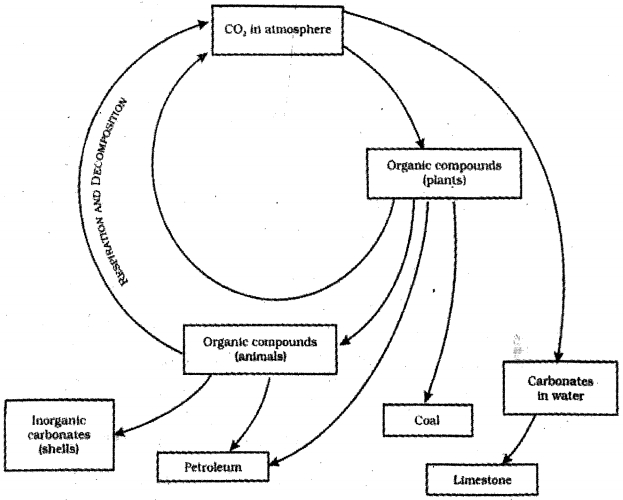
With the help of a labelled diagram,show the carbon cycle in nature. Describe the two ways in which carbon dioxide is fixed in the environment.
Solution
(N/A) The carbon cycle in nature is depicted in the provided diagram.
The two primary ways in which carbon dioxide $(CO_2)$ is fixed in the environment are:
$(i)$ Photosynthesis: Green plants absorb atmospheric $CO_2$ and convert it into glucose $(C_6H_{12}O_6)$ in the presence of sunlight and chlorophyll.
$(ii)$ Formation of Carbonates: Many marine animals use carbonates dissolved in sea water to synthesize their shells and skeletons,thereby fixing carbon in a solid form.
0 likes
View Solution32
Medium
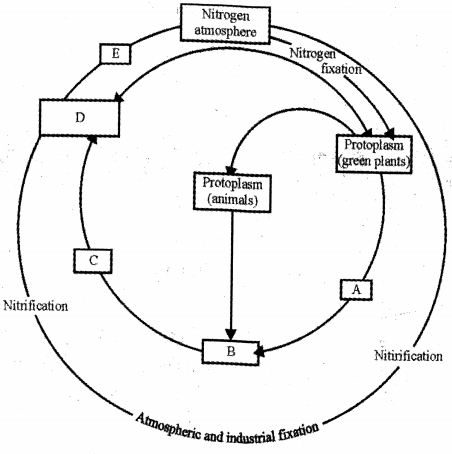
$(a)$ Study the given figure of the nitrogen cycle and mention what $A, B, C, D,$ and $E$ represent.
$(b)$ What will happen if step $A$ does not occur?
$(c)$ Write the role of nitrogen-fixing bacteria in the biosphere.
$(d)$ Name two biologically important compounds that contain both $O_2$ and $N_2$.
$(b)$ What will happen if step $A$ does not occur?
$(c)$ Write the role of nitrogen-fixing bacteria in the biosphere.
$(d)$ Name two biologically important compounds that contain both $O_2$ and $N_2$.
Solution
(A) Based on the nitrogen cycle diagram:
$A$ - Ammonification
$B$ - Ammonia $(NH_3)$
$C$ - Nitrites $(NO_2^-)$
$D$ - Nitrates $(NO_3^-)$
$E$ - Denitrification
$(b)$ If step $A$ (Ammonification) does not occur,the organic nitrogen present in dead plants and animals will not be converted into ammonia. Consequently,nitrogen will not be recycled back into the soil,leading to a deficiency of nitrogenous compounds for plants.
$(c)$ Nitrogen-fixing bacteria (e.g.,Rhizobium) play a crucial role in the biosphere by converting atmospheric nitrogen $(N_2)$ into nitrogenous compounds like ammonia,which can be easily absorbed and utilized by plants for protein synthesis.
$(d)$ Two biologically important compounds that contain both oxygen and nitrogen are proteins (amino acids) and nucleic acids ($DNA$ and $RNA$).
0 likes
View Solution33
Medium
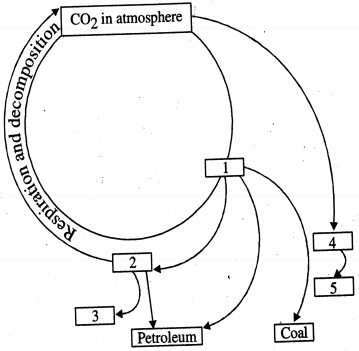
$(a)$ What do the blanks $1, 2, 3, 4$ and $5$ in the given cycle stand for?
$(b)$ Name two natural and one man-made process by which $CO_2$ returns to the atmosphere.
$(c)$ Carbon dioxide is necessary for plants but it is also a pollutant. Justify your answer.
$(b)$ Name two natural and one man-made process by which $CO_2$ returns to the atmosphere.
$(c)$ Carbon dioxide is necessary for plants but it is also a pollutant. Justify your answer.
Solution
(N/A) Based on the carbon cycle diagram:
$1$ - Organic compounds (plants)
$2$ - Organic compounds (animals)
$3$ - Inorganic carbonates (shells)
$4$ - Carbonates in water
$5$ - Limestone
$(b)$ Two natural processes: Respiration and Decomposition. One man-made process: Combustion of fossil fuels.
$(c)$ $CO_2$ is necessary for plants for photosynthesis to produce food. However,it is a pollutant because:
$(i)$ It is a greenhouse gas that traps heat,leading to an increase in the average global temperature.
$(ii)$ Excessive $CO_2$ is the primary driver of global warming and climate change.
0 likes
View Solution34
Medium
$(a)$ In what ways does the water cycle help marine organisms?
$(b)$ 'The biosphere is a dynamic but stable system'. Justify this statement.
$(b)$ 'The biosphere is a dynamic but stable system'. Justify this statement.
Solution
(N/A) - Water is capable of dissolving a large number of substances.
- Water flows through or over rocks containing soluble minerals.
- Some of these minerals dissolve in the water.
- Consequently,rivers carry many nutrients from the land to the sea.
- These minerals are essential for the survival and growth of marine organisms.
$(b)$ - The biosphere is characterized by a constant interaction between biotic (living) and abiotic (non-living) components.
- These interactions involve the continuous transfer of matter and energy between the different components of the biosphere.
- This cycle of matter and energy flow maintains the balance of the ecosystem,making it a dynamic yet stable system.
0 likes
View Solution35
Easy
What is the importance of the carbon cycle?
Solution
(N/A) The carbon cycle is essential for maintaining a constant level of $CO_{2}$ in the Earth's atmosphere. This balance is crucial for regulating the Earth's temperature through the greenhouse effect,which keeps the planet habitable for life.
0 likes
View Solution36
Medium
What are the three ways by which $CO_{2}$ is returned back into the atmosphere?
Solution
(N/A) The three ways by which $CO_{2}$ is returned back into the atmosphere are:
$(i)$ By the decomposition of dead organic matter by microorganisms.
$(ii)$ As a byproduct of cellular respiration by both plants and animals.
$(iii)$ As a gaseous waste product formed by the combustion of fossil fuels like coal,wood,petrol,and natural gas.
$(i)$ By the decomposition of dead organic matter by microorganisms.
$(ii)$ As a byproduct of cellular respiration by both plants and animals.
$(iii)$ As a gaseous waste product formed by the combustion of fossil fuels like coal,wood,petrol,and natural gas.
0 likes
View Solution37
Medium
Name the various organisms involved in the nitrogen cycle.
Solution
(N/A) $(i)$ Nitrogen-fixing bacteria,$e.g.$,$Rhizobium$,$Azotobacter$.
$(ii)$ Bacteria that convert complex nitrogenous organic compounds (proteins) into ammonia,$e.g.$,$Actinomyces$.
$(iii)$ Nitrifying bacteria that convert ammonia into nitrates,$e.g.$,$Nitrosomonas$ and $Nitrobacter$.
$(iv)$ Denitrifying bacteria,$e.g.$,$Pseudomonas$.
$(ii)$ Bacteria that convert complex nitrogenous organic compounds (proteins) into ammonia,$e.g.$,$Actinomyces$.
$(iii)$ Nitrifying bacteria that convert ammonia into nitrates,$e.g.$,$Nitrosomonas$ and $Nitrobacter$.
$(iv)$ Denitrifying bacteria,$e.g.$,$Pseudomonas$.
0 likes
View Solution38
MediumMCQ
The nitrogen molecules present in air can be converted into nitrates and nitrites by:
A
Any of the industries manufacturing nitrogenous compounds
B
$A$ biological process of carbon fixing factor present in soil
C
The plants used as cereal crops in field
D
$A$ biological process of nitrogen fixing bacteria present in soil
Solution
(D) Nitrogen fixation is the process by which atmospheric nitrogen $(N_2)$ is converted into ammonia or other nitrogenous compounds like nitrates and nitrites.
This process is primarily carried out by nitrogen-fixing bacteria,such as $Rhizobium$,which live in the root nodules of leguminous plants or freely in the soil.
These bacteria possess the enzyme nitrogenase,which facilitates the conversion of inert atmospheric nitrogen into forms that plants can assimilate.
Therefore,the correct mechanism is a biological process involving nitrogen-fixing bacteria present in the soil.
0 likes
View Solution39
MediumMCQ
One of the following processes is not a step involved in the water cycle operating in nature:
A
Photosynthesis
B
Transpiration
C
Precipitation
D
Evaporation
Solution
(A) The water cycle is the continuous movement of water on,above,and below the surface of the Earth.
Key processes involved in the water cycle include:
$1$. Evaporation: Water changes from liquid to gas (water vapor) due to heat from the sun.
$2$. Transpiration: Plants release water vapor into the atmosphere through their leaves.
$3$. Precipitation: Water falls back to the Earth's surface in the form of rain,snow,or hail.
$4$. Condensation: Water vapor cools and turns back into liquid water droplets,forming clouds.
Photosynthesis is a biological process used by plants to convert light energy into chemical energy (glucose) using water and carbon dioxide. While water is consumed in this process,it is not a stage of the global water cycle.
0 likes
View Solution40
MediumMCQ
Choose the correct sequence of the carbon cycle:
A
$CO_{2}$ in atmosphere $\rightarrow$ decomposers $\rightarrow$ organic carbon in animals $\rightarrow$ organic carbon in plants
B
Inorganic carbonates in water $\rightarrow$ organic carbon in plants $\rightarrow$ organic carbon in animals $\rightarrow$ scavengers
C
$CO_{2}$ in atmosphere $\rightarrow$ organic carbon in plants $\rightarrow$ organic carbon in animals $\rightarrow$ inorganic carbon in soil
D
Organic carbon in animals $\rightarrow$ decomposers $\rightarrow$ $CO_{2}$ in atmosphere $\rightarrow$ organic carbon in plants
Solution
(D) The carbon cycle describes the movement of carbon through the biosphere.
$1$. Plants take up $CO_{2}$ from the atmosphere through photosynthesis to produce organic carbon (glucose).
$2$. Animals consume these plants, incorporating the organic carbon into their own tissues.
$3$. When animals die, decomposers break down the organic matter.
$4$. During decomposition and respiration, carbon is released back into the atmosphere as $CO_{2}$, which can then be used again by plants.
Therefore, the sequence $Organic carbon in animals \rightarrow decomposers \rightarrow CO_{2} in atmosphere \rightarrow organic carbon in plants$ represents a correct cycle.
0 likes
View Solution41
EasyMCQ
The process of nitrogen-fixation by bacteria does not take place in the presence of
A
Molecular form of hydrogen
B
Elemental form of nitrogen
C
Water
D
Elemental form of oxygen
Solution
(D) The process of biological nitrogen fixation is carried out by the enzyme nitrogenase.
This enzyme is highly sensitive to oxygen and is inactivated in its presence.
Therefore,nitrogen-fixing bacteria,such as Rhizobium,require an anaerobic (oxygen-free) environment to function effectively.
In root nodules of leguminous plants,this environment is maintained by the protein leghemoglobin,which acts as an oxygen scavenger.
0 likes
View Solution42
EasyMCQ
Which step is not involved in the carbon cycle?
A
Photosynthesis
B
Transpiration
C
Respiration
D
Burning of fossil fuels
Solution
(B) The carbon cycle is the biogeochemical cycle by which carbon is exchanged among the biosphere,pedosphere,geosphere,hydrosphere,and atmosphere of the Earth.
Photosynthesis involves the uptake of $CO_2$ by plants to produce organic compounds.
Respiration involves the release of $CO_2$ by living organisms back into the atmosphere.
Burning of fossil fuels releases stored carbon back into the atmosphere as $CO_2$.
Transpiration is the process of water movement through a plant and its evaporation from aerial parts,such as leaves,stems,and flowers. It is a part of the water cycle,not the carbon cycle.
0 likes
View Solution43
EasyMCQ
Oxygen is returned to the atmosphere mainly by:
A
Photosynthesis
B
Respiration
C
Burning of fossil fuel
D
Fungi
Solution
(A) Photosynthesis is the biological process by which green plants,algae,and certain bacteria convert light energy into chemical energy.
During this process,carbon dioxide and water are consumed to produce glucose,and oxygen is released as a byproduct into the atmosphere.
This process is the primary source of atmospheric oxygen,which is essential for the survival of aerobic organisms.
During this process,carbon dioxide and water are consumed to produce glucose,and oxygen is released as a byproduct into the atmosphere.
This process is the primary source of atmospheric oxygen,which is essential for the survival of aerobic organisms.
0 likes
View Solution44
Easy
State whether the following statement is true or false:
Oxygen is returned to the atmosphere in only one major process,that is,respiration.
Oxygen is returned to the atmosphere in only one major process,that is,respiration.
Solution
(B) The statement is False.
Oxygen is primarily returned to the atmosphere through the process of photosynthesis,where green plants consume carbon dioxide and release oxygen as a byproduct. Respiration is a process that consumes oxygen and releases carbon dioxide,which is the opposite of the process described.
Oxygen is primarily returned to the atmosphere through the process of photosynthesis,where green plants consume carbon dioxide and release oxygen as a byproduct. Respiration is a process that consumes oxygen and releases carbon dioxide,which is the opposite of the process described.
0 likes
View Solution45
Easy
State whether the following statement is true or false:
The process of nitrogen fixation is carried out by bacteria in the presence of oxygen.
The process of nitrogen fixation is carried out by bacteria in the presence of oxygen.
Solution
(B) False.
Nitrogen fixation is carried out by nitrogen-fixing bacteria such as $Rhizobium$ and $Azotobacter$. The enzyme responsible for this process,nitrogenase,is highly sensitive to oxygen and is inactivated by it. Therefore,these bacteria perform nitrogen fixation under anaerobic (oxygen-free) conditions or by creating a specialized environment (like leghemoglobin in root nodules) to protect the enzyme from oxygen.
Nitrogen fixation is carried out by nitrogen-fixing bacteria such as $Rhizobium$ and $Azotobacter$. The enzyme responsible for this process,nitrogenase,is highly sensitive to oxygen and is inactivated by it. Therefore,these bacteria perform nitrogen fixation under anaerobic (oxygen-free) conditions or by creating a specialized environment (like leghemoglobin in root nodules) to protect the enzyme from oxygen.
0 likes
View Solution46
Easy
State whether the following statement is True or False:
Plants generally take up nitrates and nitrites and convert them into amino acids which are used to make carbohydrates.
Plants generally take up nitrates and nitrites and convert them into amino acids which are used to make carbohydrates.
Solution
(FALSE) The statement is False.
Plants take up nitrates and nitrites and convert them into amino acids,which are then used to synthesize proteins and other nitrogenous compounds,not carbohydrates.
Carbohydrates are synthesized by plants through the process of photosynthesis using carbon dioxide and water.
Plants take up nitrates and nitrites and convert them into amino acids,which are then used to synthesize proteins and other nitrogenous compounds,not carbohydrates.
Carbohydrates are synthesized by plants through the process of photosynthesis using carbon dioxide and water.
0 likes
View Solution47
Medium
State whether the following statement is True or False:
Nitrogen gas makes up $78 \%$ of our atmosphere and nitrogen is also a part of many molecules essential to life like proteins,nucleic acids ($DNA$ and $RNA$) and some vitamins.
Nitrogen gas makes up $78 \%$ of our atmosphere and nitrogen is also a part of many molecules essential to life like proteins,nucleic acids ($DNA$ and $RNA$) and some vitamins.
Solution
(TRUE) The statement is True.
Nitrogen gas constitutes approximately $78 \%$ of the Earth's atmosphere.
It is a vital element for living organisms as it is a fundamental component of amino acids (which form proteins),nucleic acids ($DNA$ and $RNA$),and various vitamins.
Nitrogen gas constitutes approximately $78 \%$ of the Earth's atmosphere.
It is a vital element for living organisms as it is a fundamental component of amino acids (which form proteins),nucleic acids ($DNA$ and $RNA$),and various vitamins.
0 likes
View Solution48
EasyMCQ
State whether the following statement is True or False:
Nitrogen is also found in other biologically important compounds such as alkaloids and urea.
Nitrogen is also found in other biologically important compounds such as alkaloids and urea.
A
True
B
False
Solution
(A) The statement is True.
Nitrogen is a fundamental element in living organisms.
It is a key component of amino acids,which form proteins,as well as nucleic acids ($DNA$ and $RNA$).
Beyond these,nitrogen is also present in various other biologically significant compounds,including alkaloids (nitrogenous organic compounds found in plants) and urea (a nitrogen-containing waste product of protein metabolism in animals).
0 likes
View SolutionNATURAL RESOURCES — Biogeochemical Cycles · Frequently Asked Questions
1Are these NATURAL RESOURCES questions useful for JEE and NEET?
Yes. All questions in this section are mapped to JEE Main and NEET exam patterns. Previous year questions from JEE Main, NEET, GUJCET and state-level exams are included with full solutions.
2Can I switch to Hindi or Gujarati for these questions?
Yes. Use the language tabs in the hero section or the sidebar to view the same questions and solutions in English, Hindi or Gujarati.
3How do I generate a question paper from this subtopic?
Use the Vedclass Exam Paper Generator — select the chapter and subtopic, set difficulty, and generate Sets A, B, C, D automatically. First 3 chapters of every subject are free.
Vedclass Products
For Students
Vedclass Test Series
Mock tests in real JEE/NEET style with performance analysis. 5-day free trial.
Start Free TrialFor Teachers
Exam Paper Generator
Generate Set A/B/C/D papers from this chapter in 2 minutes. 3 chapters free.
Try FreeFor Institutes
Online Exam Module
Live online exams with unlimited students, 360° analytics & white-label branding.
See DemoFor Teachers & Institutes
Generate a NATURAL RESOURCES Exam Paper in 2 Minutes
Select subtopic & difficulty — Sets A, B, C, D auto-generated with No Repeat logic.
First 3 chapters of every subject are free — no payment required.