
A English
Mix Examples - NATURAL RESOURCES Questions in English
Class 9 Science · NATURAL RESOURCES · Mix Examples - NATURAL RESOURCES
17+
Questions
English
Language
100%
With Solutions
Showing 17 of 17 questions in English
1
Medium
We know that many human activities lead to increasing levels of pollution of the air,water-bodies,and soil. Do you think that isolating these activities to specific and limited areas would help in reducing pollution?
Solution
(A) Yes,isolating human activities to specific and limited areas would help in reducing pollution.
$1$. By concentrating industrial activities in designated zones,we can implement centralized waste management and pollution control measures.
$2$. This prevents the widespread contamination of natural resources such as water bodies,agricultural land,and fertile soil.
$3$. It allows for better monitoring and regulation of pollutants,thereby minimizing the overall environmental impact on human health and ecosystems.
0 likes
View Solution2
Medium
Write a note on how forests influence the quality of our air,soil,and water resources.
Solution
(N/A) Forests influence the quality of air,soil,and water resources in the following ways:
$A.$ Influence of forests on air:
Forests help to maintain the balance of $O_2$ and $CO_2$ in the atmosphere. They reduce the level of $CO_2$ in the air,thereby helping to mitigate the greenhouse effect.
They regulate the temperature of the environment and increase the rate of photosynthesis in the surrounding region.
$B.$ Influence of forests on soil quality:
Trees spread their roots deep into the Earth and bind soil particles firmly,which significantly reduces soil erosion.
Forests play a crucial role in maintaining nutrient cycles (biogeochemical cycles) in the ecosystem.
$C.$ Influence of forests on water quality:
The water cycle is maintained through the process of transpiration from trees. Forests help in water conservation and ensure the availability of water on the Earth's surface through various water sources.
0 likes
View Solution3
EasyMCQ
The biotic component of the biosphere is not constituted by:
A
producers
B
air
C
decomposers
D
consumers
Solution
(B) The biosphere consists of both biotic and abiotic components.
Biotic components include all living organisms such as producers (plants),consumers (animals),and decomposers (microorganisms).
Abiotic components include non-living physical and chemical factors such as air,water,soil,and sunlight.
Since air is a non-living physical factor,it is an abiotic component and not a biotic one.
0 likes
View Solution4
Easy
Differentiate between biodegradable and non-biodegradable pollutants.
Solution
(N/A) $1$. Biodegradable pollutants: These are substances that can be broken down into simpler,harmless substances by the action of natural biological agents such as bacteria and fungi. Examples include cow dung,vegetable peels,and paper.
$2$. Non-biodegradable pollutants: These are substances that cannot be decomposed or broken down by natural biological agents. They persist in the environment for a very long time and cause pollution. Examples include plastic,glass,and heavy metals.
$2$. Non-biodegradable pollutants: These are substances that cannot be decomposed or broken down by natural biological agents. They persist in the environment for a very long time and cause pollution. Examples include plastic,glass,and heavy metals.
0 likes
View Solution5
Medium
"Excessive use of chemicals such as insecticides and pesticides causes a threat to ecology." Explain with reason.
Solution
(N/A) $(i)$ Excessive use of fertilizers and pesticides, when washed away by rain or irrigation, causes water pollution.
$(ii)$ These chemicals can be toxic to many non-target plant and animal species, leading to a loss of biodiversity and environmental pollution.
$(iii)$ Runoff containing high levels of nutrients from fertilizers may lead to eutrophication in water bodies, causing oxygen depletion.
$(iv)$ These chemicals often accumulate in the food chain, resulting in biological magnification, which poses severe health risks to higher trophic levels, including humans.
0 likes
View Solution6
Medium
Raman lives in a coastal village. He is the son of a fisherman. Whenever any unwanted animal comes in the net,instead of killing it,he puts it back in the sea.
$(a)$ What would have happened,had he killed those animals?
$(b)$ Give one reason to justify that Raman's action is environment-friendly.
$(c)$ How can you contribute to the preservation of flora and fauna around you? Mention any two steps.
$(a)$ What would have happened,had he killed those animals?
$(b)$ Give one reason to justify that Raman's action is environment-friendly.
$(c)$ How can you contribute to the preservation of flora and fauna around you? Mention any two steps.
Solution
(N/A) Killing those animals would have disturbed the ecological balance and disrupted the food chain.
$(b)$ Raman's action is environment-friendly because he is conserving biodiversity by allowing organisms to survive in their natural habitat.
$(c)$ We can contribute to the preservation of flora and fauna by:
$1$. Spreading awareness among community members about the importance of biodiversity.
$2$. Developing empathy and love for all living organisms and avoiding the use of products derived from endangered species.
0 likes
View Solution7
Medium
State any two harmful effects each of:
$(a)$ Air pollution,and
$(b)$ Water pollution.
$(a)$ Air pollution,and
$(b)$ Water pollution.
Solution
(N/A) Two harmful effects of air pollution:
$(i)$ Respiratory problems like asthma and bronchitis.
$(ii)$ Acid rain,which damages buildings and aquatic life.
$(b)$ Two harmful effects of water pollution:
$(i)$ Spread of water-borne diseases such as typhoid,cholera,and jaundice.
$(ii)$ Eutrophication,which leads to oxygen depletion and death of aquatic organisms.
0 likes
View Solution8
Medium
Differentiate between renewable and non-renewable natural resources with examples.
Solution
(N/A)
| Renewable Resources | Non-renewable Resources |
|---|---|
| $(i)$ These resources can replenish themselves through quick natural cycles or human intervention within a reasonable time frame. | $(i)$ These resources cannot replenish themselves through recycling or replacement once they are consumed. |
| $(ii)$ They are inexhaustible if managed sustainably,e.g.,solar energy,wind energy,forests,and water. | $(ii)$ They are exhaustible and finite in quantity,e.g.,minerals,coal,petroleum,and natural gas. |
0 likes
View Solution9
Medium
Distinguish between biodegradable and non-biodegradable natural resources.
Solution
(N/A)
| Biodegradable resources | Non-biodegradable resources |
| $1.$ The substances which get degraded into their simpler and harmless forms over a period of time by biological processes are known as biodegradable. | $1.$ The substances which do not get degraded into their simpler and harmless forms over a period of time by biological processes are known as non-biodegradable. |
| $2.$ They are generally not harmful to the environment; e.g.,cow dung,leaves,paper,etc. | $2.$ They are often harmful to plants and animals as they accumulate in the environment; e.g.,$DDT$,plastic,polyethylene,etc. |
0 likes
View Solution10
Medium
"It is necessary to conserve natural resources". Explain.
Solution
(N/A) The conservation of natural resources is essential for the following reasons:
$1$. Natural resources are finite gifts from nature that sustain all life forms on Earth.
$2$. There is a deep interdependence between natural resources and living organisms; the depletion of one affects the survival of the other.
$3$. Resources must be used judiciously and sustainably to ensure they are available for future generations.
$4$. It is crucial to protect these resources from pollution and degradation to maintain ecological balance.
$5$. Promoting the recycling of waste materials helps reduce the pressure on raw natural resources.
$6$. Shifting towards alternative and renewable sources of energy is necessary to reduce the over-exploitation of non-renewable resources.
0 likes
View Solution11
Medium
$(a)$ Use of fertilizers for a long period causes soil pollution. Explain it.
$(b)$ Water pollution leads to soil pollution. Justify this statement.
$(b)$ Water pollution leads to soil pollution. Justify this statement.
Solution
(N/A) Excessive use of fertilizers and pesticides over a long period leads to soil pollution in the following ways:
$(i)$ It kills useful soil microorganisms,such as nitrogen-fixing bacteria and earthworms,which are essential for maintaining soil fertility.
$(ii)$ It destroys the natural soil structure and alters the soil $pH$,making it either too acidic or too alkaline,which is harmful to plant growth.
$(iii)$ It leads to the accumulation of toxic chemicals,causing biological magnification in the food chain.
$(b)$ Water pollution leads to soil pollution through the following processes:
$(i)$ Irrigation with contaminated water: When water bodies are polluted with industrial waste or sewage,using this water for irrigation deposits toxic heavy metals and chemicals directly into the soil.
$(ii)$ Run-off and leaching: Pollutants present in water bodies can seep into the groundwater or be deposited on land during floods,thereby contaminating the soil profile.
0 likes
View Solution12
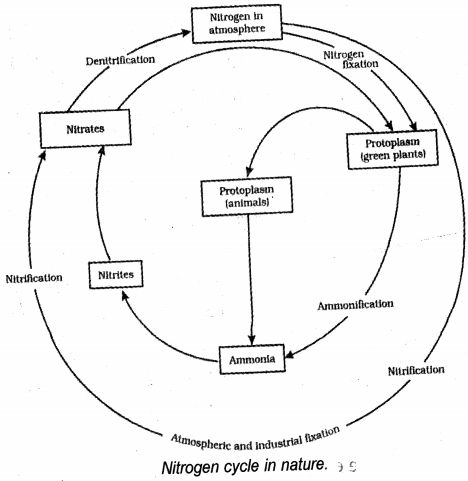
Describe the steps and process involved in the nitrogen cycle. Also,show the cycling of various nutrients in this cycle.
Solution
(N/A) The nitrogen cycle involves several key processes:
$1$. Nitrogen Fixation: Atmospheric $N_2$ is converted into ammonia or nitrates by nitrogen-fixing bacteria (e.g.,Rhizobium in root nodules of legumes) or through atmospheric and industrial processes.
$2$. Assimilation: Plants absorb these nitrogenous compounds to synthesize proteins and other organic molecules,which then enter the food chain as protoplasm in plants and animals.
$3$. Ammonification: Decomposers break down dead organic matter and waste products from plants and animals,releasing nitrogen back into the soil as ammonia.
$4$. Nitrification: Ammonia is converted into nitrites and then into nitrates by specific nitrifying bacteria in the soil.
$5$. Denitrification: Finally,certain bacteria convert nitrates back into atmospheric $N_2$ gas,completing the cycle.
0 likes
View Solution13
Medium
$(a)$ How do forests influence the following?
$(i)$ Air
$(ii)$ Soil
$(iii)$ Water
$(b)$ Is the atmosphere on Venus and Mars different from our atmosphere? How?
$(i)$ Air
$(ii)$ Soil
$(iii)$ Water
$(b)$ Is the atmosphere on Venus and Mars different from our atmosphere? How?
Solution
(N/A)
$(i)$ Air: Forests act as a sink for $CO_{2}$ through photosynthesis. The absence of trees leads to an increase in $CO_{2}$ levels,contributing to global warming.
$(ii)$ Soil: Tree roots bind the soil particles together,preventing erosion. $A$ reduction in forest cover increases the risk of soil erosion caused by wind and floods.
$(iii)$ Water: Forests increase the water-holding capacity of the soil and facilitate groundwater recharge by slowing down surface runoff.
$(b)$ Yes,the atmosphere on Venus and Mars is significantly different from Earth's atmosphere.
Earth's atmosphere is composed mainly of nitrogen $(78\%)$ and oxygen $(21\%)$,which supports life. In contrast,the atmospheres of Venus and Mars are composed primarily of carbon dioxide $(CO_{2})$,which accounts for about $95-97\%$ of their atmospheric composition,making them inhospitable to life as we know it.
0 likes
View Solution14
Medium
State reasons for the following:
$(i)$ Excess burning of coal causes greenhouse effect.
$(ii)$ Soil is a mixture.
$(iii)$ Temperature ranges from $-190^{\circ} C$ to $110^{\circ} C$ on the surface of the moon.
$(i)$ Excess burning of coal causes greenhouse effect.
$(ii)$ Soil is a mixture.
$(iii)$ Temperature ranges from $-190^{\circ} C$ to $110^{\circ} C$ on the surface of the moon.
Solution
(N/A) $(i)$ Excess burning of coal releases greenhouse gases such as carbon dioxide $(CO_2)$ and hydrocarbons into the atmosphere.
These gases have the property of trapping solar heat,which leads to the greenhouse effect and global warming.
$(ii)$ Soil is considered a mixture because it is composed of various substances including weathered rock particles of different sizes,organic matter (humus) from decayed living organisms,microscopic life forms,air,and water (moisture).
$(iii)$ The moon lacks an atmosphere. An atmosphere acts as a blanket that regulates surface temperature by preventing extreme fluctuations.
In the absence of an atmosphere on the moon,there is no mechanism to trap heat during the day or retain it at night,causing the temperature to fluctuate drastically from $-190^{\circ} C$ to $110^{\circ} C$.
0 likes
View Solution15
EasyMCQ
The large-scale deforestation that is happening all over the world is causing:
A
Loss of biodiversity
B
All of these
C
Global warming
D
Soil erosion
Solution
(B) Deforestation refers to the large-scale removal of forest cover.
$1$. Loss of biodiversity: Forests are habitats for millions of species; their destruction leads to the extinction of flora and fauna.
$2$. Global warming: Trees absorb $CO_2$ through photosynthesis. Fewer trees mean more $CO_2$ in the atmosphere,which enhances the greenhouse effect and leads to global warming.
$3$. Soil erosion: Tree roots bind the soil together. Without trees,the topsoil is easily washed away by rain or blown away by wind.
Since all these consequences are direct results of deforestation,the correct option is $B$.
0 likes
View Solution16
EasyMCQ
Biotic component of biosphere is not constituted by:
A
Air
B
Consumers
C
Decomposer
D
Producers
Solution
(A) The biosphere consists of both biotic (living) and abiotic (non-living) components.
Biotic components include all living organisms such as producers (plants),consumers (animals),and decomposers (bacteria and fungi).
Abiotic components include non-living factors such as air,water,soil,sunlight,and temperature.
Since air is a non-living factor,it is an abiotic component,not a biotic one.
0 likes
View Solution17
EasyMCQ
Which of the following is a recently originated problem of environment?
A
Ozone layer depletion
B
Greenhouse effect
C
All of these
D
Global warming
Solution
(C) Environmental problems like $Ozone$ layer depletion,$Greenhouse$ effect,and $Global$ warming are all significant issues that have gained prominence due to human activities in the recent past.
$1$. $Ozone$ layer depletion is caused by the release of $CFCs$ (chlorofluorocarbons).
$2$. $Greenhouse$ effect is the trapping of heat by gases like $CO_2$ and $CH_4$.
$3$. $Global$ warming is the gradual increase in the Earth's average temperature.
Since all these phenomena are contemporary environmental concerns,the correct option is $C$.
0 likes
View SolutionNATURAL RESOURCES — Mix Examples - NATURAL RESOURCES · Frequently Asked Questions
1Are these NATURAL RESOURCES questions useful for JEE and NEET?
Yes. All questions in this section are mapped to JEE Main and NEET exam patterns. Previous year questions from JEE Main, NEET, GUJCET and state-level exams are included with full solutions.
2Can I switch to Hindi or Gujarati for these questions?
Yes. Use the language tabs in the hero section or the sidebar to view the same questions and solutions in English, Hindi or Gujarati.
3How do I generate a question paper from this subtopic?
Use the Vedclass Exam Paper Generator — select the chapter and subtopic, set difficulty, and generate Sets A, B, C, D automatically. First 3 chapters of every subject are free.
Vedclass Products
For Students
Vedclass Test Series
Mock tests in real JEE/NEET style with performance analysis. 5-day free trial.
Start Free TrialFor Teachers
Exam Paper Generator
Generate Set A/B/C/D papers from this chapter in 2 minutes. 3 chapters free.
Try FreeFor Institutes
Online Exam Module
Live online exams with unlimited students, 360° analytics & white-label branding.
See DemoFor Teachers & Institutes
Generate a NATURAL RESOURCES Exam Paper in 2 Minutes
Select subtopic & difficulty — Sets A, B, C, D auto-generated with No Repeat logic.
First 3 chapters of every subject are free — no payment required.