
A English
Mix Examples - TISSUES Questions in English
Class 9 Science · TISSUES · Mix Examples - TISSUES
19+
Questions
English
Language
100%
With Solutions
Showing 19 of 19 questions in English
1
EasyMCQ
What is a tissue?
A
$A$ group of different types of cells performing different functions.
B
$A$ group of cells similar in structure and organized to perform a specific function.
C
$A$ single cell performing all life processes.
D
$A$ collection of organs working together.
Solution
(B) group of cells that are similar in structure and are organized together to achieve a particular function is called a tissue.
In multicellular organisms,tissues are specialized to perform specific tasks efficiently.
In multicellular organisms,tissues are specialized to perform specific tasks efficiently.
0 likes
View Solution2
Easy
What is the utility of tissues in multicellular organisms?
Solution
(N/A) In multicellular organisms,the body system is based on the division of labour (e.g.,muscle cells form muscular tissue,which helps in movement).
This means that cells performing a specific function are grouped together to form a particular tissue.
The different tissues are organized in a way to provide the highest efficiency in the functioning of the body.
This means that cells performing a specific function are grouped together to form a particular tissue.
The different tissues are organized in a way to provide the highest efficiency in the functioning of the body.
0 likes
View Solution3
Medium
Name the following:
$(a)$ Tissue that forms the inner lining of our mouth.
$(b)$ Tissue that connects muscle to bone in humans.
$(c)$ Tissue that transports food in plants.
$(d)$ Tissue that stores fat in our body.
$(e)$ Connective tissue with a fluid matrix.
$(f)$ Tissue present in the brain.
$(a)$ Tissue that forms the inner lining of our mouth.
$(b)$ Tissue that connects muscle to bone in humans.
$(c)$ Tissue that transports food in plants.
$(d)$ Tissue that stores fat in our body.
$(e)$ Connective tissue with a fluid matrix.
$(f)$ Tissue present in the brain.
Solution
(N/A) The inner lining of the mouth is formed by Squamous Epithelium.
$(b)$ Tendons are the fibrous connective tissues that connect muscle to bone.
$(c)$ Phloem is the vascular tissue responsible for the transport of food in plants.
$(d)$ Adipose tissue is the specialized connective tissue that stores fat in our body.
$(e)$ Blood is a connective tissue that has a fluid matrix called plasma.
$(f)$ Nervous tissue is the primary tissue present in the brain,composed of neurons.
0 likes
View Solution4
Medium
Identify the type of tissue in the following: skin,bark of tree,bone,lining of kidney tubule,vascular bundle. Name the regions in which parenchyma tissue is present.
Solution
(N/A) The classification of the given tissues is as follows:
$1$. Skin: Epithelial tissue (specifically stratified squamous epithelium).
$2$. Bark of tree: Cork (protective tissue).
$3$. Bone: Connective tissue.
$4$. Lining of kidney tubule: Cuboidal epithelial tissue.
$5$. Vascular bundle: Complex permanent tissue (xylem and phloem).
Parenchyma tissue is present in the following regions:
- It is found in the soft parts of plants such as the cortex of roots,ground tissue of stems,and mesophyll of leaves.
- It is also present in the pith and the pericycle of stems and roots.
0 likes
View Solution5
MediumMCQ
Match the column $(A)$ with the column $(B)$:
| Column $(A)$ | Column $(B)$ |
| $(a)$ Fluid connective tissue | $(i)$ Subcutaneous layer |
| $(b)$ Filling of space inside the organs | $(ii)$ Cartilage |
| $(c)$ Striated muscle | $(iii)$ Skeletal muscle |
| $(d)$ Adipose tissue | $(iv)$ Areolar tissue |
| $(e)$ Surface of joints | $(v)$ Blood |
| $(f)$ Stratified squamous epithelium | $(vi)$ Skin |
A
$a-(v), b-(iv), c-(i), d-(ii), e-(iii), f-(vi)$
B
$a-(iv), b-(vi), c-(iii), d-(i), e-(ii), f-(v)$
C
$a-(vi), b-(iv), c-(ii), d-(i), e-(iii), f-(v)$
D
$a-(v), b-(iv), c-(iii), d-(i), e-(ii), f-(vi)$
Solution
(D) The correct matches are as follows:
$(a)$ Fluid connective tissue is Blood $(v)$.
$(b)$ Filling of space inside the organs is Areolar tissue $(iv)$.
$(c)$ Striated muscle is Skeletal muscle $(iii)$.
$(d)$ Adipose tissue is found in the Subcutaneous layer $(i)$.
$(e)$ Surface of joints is covered by Cartilage $(ii)$.
$(f)$ Stratified squamous epithelium is found in the Skin $(vi)$.
Thus, the correct sequence is $a-(v), b-(iv), c-(iii), d-(i), e-(ii), f-(vi)$.
0 likes
View Solution6
MediumMCQ
Match the column $(A)$ with the column $(B)$:
| Column $(A)$ | Column $(B)$ |
| $(a)$ Parenchyma | $(i)$ Thin walled,packing cells |
| $(b)$ Photosynthesis | $(ii)$ Carbon fixation |
| $(c)$ Aerenchyma | $(iii)$ Localized thickenings |
| $(d)$ Collenchyma | $(iv)$ Buoyancy |
| $(e)$ Permanent tissue | $(v)$ Sclerenchyma |
A
$a-(i), b-(ii), c-(iv), d-(iii), e-(v)$
B
$a-(i), b-(ii), c-(v), d-(iii), e-(iv)$
C
$a-(ii), b-(iii), c-(iv), d-(i), e-(v)$
D
$a-(iii), b-(i), c-(iv), d-(ii), e-(v)$
Solution
(A) The correct matches are as follows:
$(a)$ Parenchyma: $(i)$ Thin-walled,packing cells. Parenchyma cells are simple,living,and thin-walled,serving as packing tissue.
$(b)$ Photosynthesis: $(ii)$ Carbon fixation. Photosynthesis is the process by which plants fix atmospheric carbon dioxide into organic compounds.
$(c)$ Aerenchyma: $(iv)$ Buoyancy. Aerenchyma is a modified parenchyma tissue with large air cavities that provide buoyancy to aquatic plants.
$(d)$ Collenchyma: $(iii)$ Localized thickenings. Collenchyma cells are characterized by uneven cell wall thickenings,primarily at the corners,due to cellulose and pectin deposition.
$(e)$ Permanent tissue: $(v)$ Sclerenchyma. Sclerenchyma is a type of permanent tissue that provides mechanical strength to plants.
Therefore,the correct sequence is $a-(i), b-(ii), c-(iv), d-(iii), e-(v)$.
0 likes
View Solution7
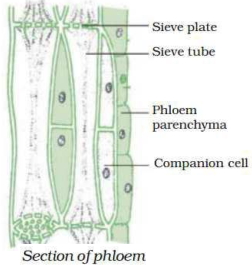
Draw and identify different elements of phloem.
Solution
(N/A) Phloem is a complex permanent tissue that transports food in plants. It is composed of four main types of elements:
$1$. Sieve tubes: These are tubular cells with perforated walls (sieve plates) that facilitate the transport of food.
$2$. Companion cells: These are specialized parenchyma cells that assist the sieve tubes in their functions.
$3$. Phloem parenchyma: These are living cells that store food and provide structural support.
$4$. Phloem fibres: These are dead,thick-walled sclerenchyma cells that provide mechanical strength to the plant.
0 likes
View Solution8
Medium
Name the following tissues:
$(a)$ The connective tissue found between the skin and muscles.
$(b)$ The tissue which connects two bones.
$(c)$ The epithelial tissue which forms the lining of the kidney tubules.
$(d)$ The tissue which is present in the veins of leaves.
$(a)$ The connective tissue found between the skin and muscles.
$(b)$ The tissue which connects two bones.
$(c)$ The epithelial tissue which forms the lining of the kidney tubules.
$(d)$ The tissue which is present in the veins of leaves.
Solution
(N/A) Areolar tissue: It is a loose connective tissue that acts as a supporting and packing tissue between the skin and muscles.
$(b)$ Ligament: It is a fibrous connective tissue that connects two bones together.
$(c)$ Cuboidal epithelium: This tissue consists of cube-shaped cells and is found in the lining of kidney tubules and ducts of salivary glands,providing mechanical support.
$(d)$ Sclerenchyma: This is a permanent plant tissue composed of dead cells with thick lignified walls,providing structural strength to the veins of leaves.
0 likes
View Solution9
Medium
Name the tissue that:
$(a)$ connects muscle to the bone in humans
$(b)$ forms the inner lining of alveoli
$(c)$ stores fat in our body
$(d)$ transports water and minerals in plants.
$(a)$ connects muscle to the bone in humans
$(b)$ forms the inner lining of alveoli
$(c)$ stores fat in our body
$(d)$ transports water and minerals in plants.
Solution
(N/A) Tendons: These are fibrous connective tissues that attach skeletal muscle to bone.
$(b)$ Squamous epithelium: Specifically,simple squamous epithelium forms the delicate inner lining of the alveoli in the lungs to facilitate gas exchange.
$(c)$ Adipose tissue: This is a specialized connective tissue that stores fat in the form of fat globules.
$(d)$ Xylem: This is a complex permanent tissue in plants responsible for the conduction of water and dissolved minerals from the roots to the rest of the plant.
0 likes
View Solution10
Medium
Animal tissues are different from plant tissues. State the reasons.
Solution
(N/A) Animal tissues differ from plant tissues due to their distinct structural and functional requirements. The primary differences are summarized below:
| Characteristic | Plant Tissues vs Animal Tissues |
|---|---|
| $1$. Living/Dead | Most plant tissues are dead,providing structural strength,whereas most animal tissues are living. |
| $2$. Growth | Plant growth is restricted to specific regions (meristematic),while animal growth is generally uniform throughout the body. |
| $3$. Classification | Plant tissues are classified as meristematic and permanent tissues. Animal tissues are classified as epithelial,connective,muscular,and nervous tissues. |
0 likes
View Solution11
Medium
Identify the tissues present in the following and give one specific feature of each:
$(i)$ Leaf stalks below epidermis.
$(ii)$ In stem,around vascular bundles.
$(iii)$ At root and shoot tip.
$(i)$ Leaf stalks below epidermis.
$(ii)$ In stem,around vascular bundles.
$(iii)$ At root and shoot tip.
Solution
(N/A)
| Location | Tissue Present | Specific Feature |
|---|---|---|
| $(i)$ Leaf stalks below epidermis | Collenchyma | Provides mechanical support and allows easy bending without breaking. |
| $(ii)$ In stem,around vascular bundles | Sclerenchyma | Provides strength and makes the plant part hard and stiff. |
| $(iii)$ At root and shoot tip | Meristematic tissue (Apical meristem) | Cells are actively dividing,leading to the primary growth of the plant. |
0 likes
View Solution12
Easy
State whether the following statement is true or false:
The tissues make up physiological systems or organ systems that carry out body functions.
The tissues make up physiological systems or organ systems that carry out body functions.
Solution
(TRUE) The statement is True.
In biological organization,cells combine to form tissues,tissues organize into organs,and organs work together to form physiological systems or organ systems. These systems are responsible for performing specific life processes and body functions,such as digestion,respiration,and circulation,which are essential for maintaining homeostasis.
In biological organization,cells combine to form tissues,tissues organize into organs,and organs work together to form physiological systems or organ systems. These systems are responsible for performing specific life processes and body functions,such as digestion,respiration,and circulation,which are essential for maintaining homeostasis.
0 likes
View Solution13
Medium
$A$ lion and a mango tree are both complex living organisms with specialised yet different tissue systems to perform basic life processes. Give two reasons for possessing different tissues to perform similar functions.
Solution
(N/A) lion is an animal,whereas a mango tree is a plant.
Plants and animals have different types of tissues because:
$(i)$ Plants are stationary and do not show locomotion,while most animals move from one place to another to search for food,shelter,and mates.
$(ii)$ They have different patterns of growth. Plant growth is limited to certain regions (meristematic tissues),whereas animal growth is more or less uniform throughout the body.
0 likes
View Solution14
Medium
Name the following and give one characteristic of each:
$(a)$ Living tissue that provides mechanical support in plants.
$(b)$ Highly specialised cells for being stimulated and then transmitting the stimulus very rapidly within the body of animals.
$(c)$ Animal tissue with elongated cells and contractile proteins responsible for movement.
$(a)$ Living tissue that provides mechanical support in plants.
$(b)$ Highly specialised cells for being stimulated and then transmitting the stimulus very rapidly within the body of animals.
$(c)$ Animal tissue with elongated cells and contractile proteins responsible for movement.
Solution
(N/A) Collenchyma: It is a living mechanical tissue characterized by irregular thickenings of cellulose and pectin at the corners of the cells.
$(b)$ Nervous tissue (Neurons): These are highly specialized cells capable of receiving stimuli and transmitting impulses rapidly throughout the body.
$(c)$ Striated (Skeletal) muscles: These tissues consist of long,cylindrical,unbranched fibers that contain contractile proteins (actin and myosin) and exhibit characteristic light and dark bands (striations).
0 likes
View Solution15
Medium
$(i)$ Define tissue. What is the utility of tissues in multicellular organisms?
$(ii)$ Are plants and animals made of the same types of tissues? If no, then write three points of difference.
$(ii)$ Are plants and animals made of the same types of tissues? If no, then write three points of difference.
Solution
(N/A) $(i)$ Tissue: $A$ group of cells that are similar in structure and work together to achieve a particular function is called a tissue. In multicellular organisms, the division of labour is due to the presence of tissues. Each tissue performs a specific function efficiently.
$(ii)$ No, plants and animals are not made of the same types of tissues.
$(ii)$ No, plants and animals are not made of the same types of tissues.
| Plant tissues | Animal tissues |
| $(a)$ Most of the plant tissues are dead. | $(a)$ Mostly animal tissues are living. |
| $(b)$ In plants, cell growth is limited to certain regions. | $(b)$ In animals, cell growth is more uniform. |
| $(c)$ These are classified as meristematic and permanent tissues. | $(c)$ These are classified as epithelial, connective, muscular, and nervous tissues. |
0 likes
View Solution16
DifficultMCQ
Note the relationship between the first pair of words and accordingly fill in the blank.
$(a)$ Salivary Gland : Glandular Epithelium : : Respiratory tract : . . . . . .
$(b)$ Flexibility : Collenchyma : : Hardness : . . . . . .
$(c)$ Cutin : Epidermis : : Suberin : . . . . . .
$(d)$ Plasma : Blood : : Axon : . . . . . .
$(a)$ Salivary Gland : Glandular Epithelium : : Respiratory tract : . . . . . .
$(b)$ Flexibility : Collenchyma : : Hardness : . . . . . .
$(c)$ Cutin : Epidermis : : Suberin : . . . . . .
$(d)$ Plasma : Blood : : Axon : . . . . . .
A
Salivary Gland : Glandular Epithelium : : Respiratory tract : . . . . . .
B
Flexibility : Collenchyma : : Hardness : . . . . . .
C
Cutin : Epidermis : : Suberin : . . . . . .
D
Plasma : Blood : : Axon : . . . . . .
Solution
(N/A) The respiratory tract is lined with ciliated epithelium,which helps in moving mucus and trapped particles out of the airways.
$(b)$ Sclerenchyma provides mechanical strength and hardness to plant parts due to its thick,lignified cell walls.
$(c)$ Suberin is a waxy substance found in the cell walls of cork cells,providing protection and preventing water loss.
$(d)$ An axon is a specialized part of a neuron (nerve cell) that transmits electrical impulses away from the cell body.
0 likes
View Solution17
Medium
Identify the following tissues:
$(a)$ The epithelial tissue which has pillar-like tall cells.
$(b)$ The cells of this tissue are filled with fat globules.
$(c)$ The movement of this tissue pushes the mucus forward to clear the respiratory tract.
$(d)$ It gives buoyancy to the lotus to help it float.
$(e)$ This tissue is present in lung alveoli.
Solution
(A-D) Columnar epithelial tissue: These are tall,pillar-like cells often found in the lining of the stomach and intestine.
$(b)$ Adipose tissue: These cells are specialized to store fats in the form of fat globules.
$(c)$ Ciliated columnar epithelium: These cells possess hair-like projections called cilia that move to push mucus and other substances forward.
$(d)$ Aerenchyma: This is a type of parenchyma tissue with large air cavities that provides buoyancy to aquatic plants like the lotus.
$(e)$ Squamous epithelial tissue: These are thin,flat,and delicate cells found in the walls of lung alveoli where exchange of gases occurs.
0 likes
View Solution18
Medium
$(a)$ Why are complex tissues called so?
$(b)$ Why is connective tissue called so?
$(c)$ What is the function of the tissue present in the lining of kidney tubules?
$(b)$ Why is connective tissue called so?
$(c)$ What is the function of the tissue present in the lining of kidney tubules?
Solution
(N/A) Tissues that are made up of more than one type of cell,which work together to perform a common function,are called complex tissues.
$(b)$ Connective tissue is named so because its primary function is to bind,support,and connect different tissues and organs of the body together.
$(c)$ The lining of kidney tubules is composed of cuboidal epithelium,which provides mechanical support and helps in absorption and secretion.
$(b)$ Connective tissue is named so because its primary function is to bind,support,and connect different tissues and organs of the body together.
$(c)$ The lining of kidney tubules is composed of cuboidal epithelium,which provides mechanical support and helps in absorption and secretion.
0 likes
View Solution19
Medium
$(a)$ What is the function of the tissue present in the bark of a tree?
$(b)$ Which substance is present in the adipocyte? How does it help?
$(b)$ Which substance is present in the adipocyte? How does it help?
Solution
(N/A) $(i)$ The bark of a tree consists of dead cells that are compactly arranged without intercellular spaces.
$(ii)$ Their cell walls contain a chemical substance called suberin,which makes them impervious to gases and water.
$(iii)$ It serves as an outer protective layer for the plant.
$(b)$ Adipocytes are fat-storing cells.
$(i)$ These cells are found below the skin and between internal organs.
$(ii)$ The cytoplasm of these cells is filled with fat globules.
$(iii)$ They act as an insulator because they store fat,which helps in conserving body heat.
0 likes
View SolutionTISSUES — Mix Examples - TISSUES · Frequently Asked Questions
1Are these TISSUES questions useful for JEE and NEET?
Yes. All questions in this section are mapped to JEE Main and NEET exam patterns. Previous year questions from JEE Main, NEET, GUJCET and state-level exams are included with full solutions.
2Can I switch to Hindi or Gujarati for these questions?
Yes. Use the language tabs in the hero section or the sidebar to view the same questions and solutions in English, Hindi or Gujarati.
3How do I generate a question paper from this subtopic?
Use the Vedclass Exam Paper Generator — select the chapter and subtopic, set difficulty, and generate Sets A, B, C, D automatically. First 3 chapters of every subject are free.
Vedclass Products
For Students
Vedclass Test Series
Mock tests in real JEE/NEET style with performance analysis. 5-day free trial.
Start Free TrialFor Teachers
Exam Paper Generator
Generate Set A/B/C/D papers from this chapter in 2 minutes. 3 chapters free.
Try FreeFor Institutes
Online Exam Module
Live online exams with unlimited students, 360° analytics & white-label branding.
See DemoFor Teachers & Institutes
Generate a TISSUES Exam Paper in 2 Minutes
Select subtopic & difficulty — Sets A, B, C, D auto-generated with No Repeat logic.
First 3 chapters of every subject are free — no payment required.