
A English
Law of Conservation of Energy Questions in English
Class 9 Science · WORK AND ENERGY · Law of Conservation of Energy
14+
Questions
English
Language
100%
With Solutions
Showing 14 of 14 questions in English
1
Easy
$A$ battery lights a bulb. Describe the energy changes involved in the process.
Solution
(N/A) The process involves the following energy transformations:
$1$. Inside the battery,chemical energy is converted into electrical energy.
$2$. As the current flows through the bulb,this electrical energy is converted into light energy (which illuminates the bulb) and heat energy (which warms the bulb).
$1$. Inside the battery,chemical energy is converted into electrical energy.
$2$. As the current flows through the bulb,this electrical energy is converted into light energy (which illuminates the bulb) and heat energy (which warms the bulb).
0 likes
View Solution2
Easy
The potential energy of a freely falling object decreases progressively. Does this violate the law of conservation of energy? Why?
Solution
(N/A) The potential energy of a freely falling object decreases as it falls,while its kinetic energy increases progressively due to the increase in its velocity.
According to the law of conservation of energy,the total mechanical energy of an object,which is the sum of its kinetic energy and potential energy,remains constant at all points during its fall.
Therefore,the decrease in potential energy is exactly compensated by an equal increase in kinetic energy,meaning the law of conservation of energy is not violated.
0 likes
View Solution3
Difficult
Illustrate the law of conservation of energy by discussing the energy changes which occur when we draw a pendulum bob to one side and allow it to oscillate. Why does the bob eventually come to rest? What happens to its energy eventually? Is it a violation of the law of conservation of energy?
Solution
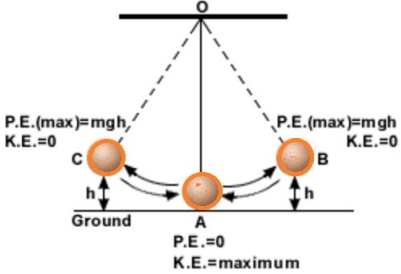
(N/A) When a pendulum bob is displaced to one side (point $B$ or $C$) and released,it oscillates about its mean position $(A)$.
At the extreme positions ($B$ and $C$),the bob is at its maximum height,so its potential energy $(P.E.)$ is maximum and kinetic energy $(K.E.)$ is zero. As it moves towards the mean position $(A)$,$P.E.$ decreases and $K.E.$ increases. At the mean position $(A)$,the bob is at its lowest point,so $P.E.$ is zero and $K.E.$ is maximum. Throughout the motion,the total mechanical energy $(P.E. + K.E.)$ remains constant,illustrating the law of conservation of energy.
The bob eventually comes to rest because of air resistance,which opposes its motion and does work against it.
Its energy is eventually dissipated into the surroundings as heat energy due to friction with air molecules.
No,this is not a violation of the law of conservation of energy. The energy is not lost; it is merely transformed into other forms (heat and sound) in the surroundings,keeping the total energy of the system and its surroundings constant.
0 likes
View Solution4
MediumMCQ
$A$ freely falling object eventually stops on reaching the ground. What happens to its kinetic energy?
A
It is destroyed.
B
It is converted into other forms of energy.
C
It remains constant.
D
It increases.
Solution
(B) When a freely falling body eventually stops on reaching the ground,its kinetic energy is transformed into other forms of energy.
$1$. Heat energy: The collision between the object and the ground generates heat,warming both surfaces.
$2$. Sound energy: The impact produces a sound.
$3$. Potential energy: Some energy may be used in the deformation or change of shape of the object upon impact.
$1$. Heat energy: The collision between the object and the ground generates heat,warming both surfaces.
$2$. Sound energy: The impact produces a sound.
$3$. Potential energy: Some energy may be used in the deformation or change of shape of the object upon impact.
0 likes
View Solution5
EasyMCQ
When a body falls freely towards the earth,then its total energy
A
remains constant
B
decreases
C
increases
D
first increases and then decreases
Solution
(A) When a body falls freely towards the earth,it obeys the law of conservation of energy.
As the body falls,its potential energy decreases and its kinetic energy increases by the same amount.
Therefore,the sum of potential energy and kinetic energy,which is the total mechanical energy,remains constant throughout the motion.
As the body falls,its potential energy decreases and its kinetic energy increases by the same amount.
Therefore,the sum of potential energy and kinetic energy,which is the total mechanical energy,remains constant throughout the motion.
0 likes
View Solution6
Easy
State the law of conservation of energy.
Solution
(N/A) The law of conservation of energy states that energy can neither be created nor destroyed. It can only be transformed from one form to another. The total energy of an isolated system remains constant.
0 likes
View Solution7
Easy
State the energy conversions in a dry cell.
Solution
(N/A) In a dry cell,the chemical energy stored in the electrolytes and electrodes is converted into electrical energy through redox reactions.
0 likes
View Solution8
Medium
$(a)$ Name two forms of energy involved while a pendulum oscillates.
$(b)$ Show with the help of a diagram that when does each type of energy attain its maximum value.
$(c)$ How do these energies vary while the pendulum oscillates?
$(d)$ Name and state the law involved.
$(b)$ Show with the help of a diagram that when does each type of energy attain its maximum value.
$(c)$ How do these energies vary while the pendulum oscillates?
$(d)$ Name and state the law involved.
Solution
(N/A) The two forms of energy involved are Kinetic Energy $(KE)$ and Potential Energy $(PE)$.
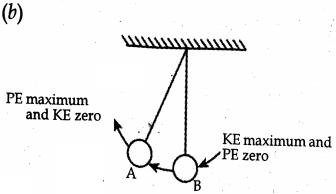
$(b)$ In the diagram,point $A$ represents the extreme position where $PE$ is maximum and $KE$ is zero. Point $B$ represents the mean position where $KE$ is maximum and $PE$ is zero.
$(c)$ As the pendulum moves from the mean position $(B)$ to the extreme position $(A)$,$KE$ is converted into $PE$,so $KE$ decreases and $PE$ increases. Conversely,as it moves from the extreme position $(A)$ to the mean position $(B)$,$PE$ is converted into $KE$,so $PE$ decreases and $KE$ increases.
$(d)$ The law involved is the Law of Conservation of Energy. It states that energy can neither be created nor destroyed,only transformed from one form to another. In an isolated system,the total energy remains constant.
0 likes
View Solution9
Medium
An object of mass $10 \ kg$ is made to fall freely from a height of $10 \ m$. Complete the table:
Hence,state the law of conservation of energy.
| Height of object $(m)$ | $PE$ $(J)$ | $KE$ $(J)$ | Mechanical Energy $(J)$ |
| $10$ | ... | ... | ... |
| $8$ | ... | ... | ... |
| $5$ | ... | ... | ... |
| Just above ground | ... | ... | ... |
Hence,state the law of conservation of energy.
Solution
(N/A) Given: Mass $(m) = 10 \ kg$,Height $(h) = 10 \ m$,Acceleration due to gravity $(g) = 10 \ m/s^2$.
Potential Energy $(PE) = mgh$,Kinetic Energy $(KE) = \frac{1}{2}mv^2$,Mechanical Energy $(ME) = PE + KE$.
Law of Conservation of Energy: Energy can neither be created nor destroyed; it can only be transformed from one form to another. The total energy in an isolated system remains constant.
Potential Energy $(PE) = mgh$,Kinetic Energy $(KE) = \frac{1}{2}mv^2$,Mechanical Energy $(ME) = PE + KE$.
| Height $(m)$ | $PE$ $(J)$ | $KE$ $(J)$ | $ME$ $(J)$ |
| $10$ | $1000$ | $0$ | $1000$ |
| $8$ | $800$ | $200$ | $1000$ |
| $5$ | $500$ | $500$ | $1000$ |
| $0$ | $0$ | $1000$ | $1000$ |
Law of Conservation of Energy: Energy can neither be created nor destroyed; it can only be transformed from one form to another. The total energy in an isolated system remains constant.
0 likes
View Solution10
Difficult
$(i)$ State the law of conservation of energy.
$(ii)$ Show that the total mechanical energy of a freely falling body is conserved.
$(ii)$ Show that the total mechanical energy of a freely falling body is conserved.
Solution
(N/A) $(i)$ The law of conservation of energy states that energy can neither be created nor destroyed,it can only be transformed from one form to another. For a system,the total energy remains constant if no external non-conservative forces act on it.
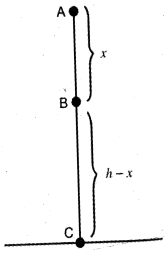
$(ii)$ Consider a body of mass $m$ falling freely under gravity from a height $h$ above the ground. Let the body be at point $A$ at height $h$,point $B$ at height $(h-x)$ after falling a distance $x$,and point $C$ just before hitting the ground.
At point $A$ (Height $h$): The body is at rest,so velocity $v = 0$.
Kinetic Energy $(T) = 1/2 mv^2 = 0$.
Potential Energy $(U) = mgh$.
Total Energy $(E) = T + U = 0 + mgh = mgh$ $....(i)$
At point $B$ (Height $h-x$): The body has fallen distance $x$. Using $v^2 - u^2 = 2as$,where $u=0, a=g, s=x$,we get $v^2 = 2gx$.
Kinetic Energy $(T) = 1/2 m(2gx) = mgx$.
Potential Energy $(U) = mg(h-x) = mgh - mgx$.
Total Energy $(E) = T + U = mgx + mgh - mgx = mgh$ $....(ii)$
At point $C$ (Height $0$): The body has fallen distance $h$. Using $v^2 - u^2 = 2as$,where $u=0, a=g, s=h$,we get $V^2 = 2gh$.
Kinetic Energy $(T) = 1/2 mV^2 = 1/2 m(2gh) = mgh$.
Potential Energy $(U) = mg(0) = 0$.
Total Energy $(E) = T + U = mgh + 0 = mgh$ $....(iii)$
From equations $(i), (ii),$ and $(iii)$,it is clear that the total mechanical energy of a freely falling body remains constant at all points.
0 likes
View Solution11
Medium
$A$ man drops a $10\, kg$ rock from the top of a $5\, m$ ladder. What is its kinetic energy when it reaches the ground? What is its speed just before it hits the ground?
Solution
(N/A) Given: Mass,$m = 10\, kg$,Height,$h = 5\, m$,Acceleration due to gravity,$g = 9.8\, m/s^2$.
$1$. Potential Energy $(PE)$ at the top:
$PE = mgh = 10 \times 9.8 \times 5 = 490\, J$.
$2$. Kinetic Energy $(KE)$ at the ground:
According to the law of conservation of energy,the potential energy at the top is converted into kinetic energy at the ground.
$KE = PE = 490\, J$.
$3$. Speed just before hitting the ground:
Using the equation of motion $v^2 - u^2 = 2gh$,where initial velocity $u = 0\, m/s$:
$v^2 - 0 = 2 \times 9.8 \times 5$
$v^2 = 98$
$v = \sqrt{98} \approx 9.9\, m/s$.
0 likes
View Solution12
EasyMCQ
When a ball is lifted to a height of $h$ and then dropped,what is the kinetic energy of the ball just before it touches the ground?
A
$mgh$
B
$1/2 mgh$
C
$2mgh$
D
$0$
Solution
(A) According to the Law of Conservation of Energy,the total mechanical energy of an object remains constant in the absence of air resistance.
At the maximum height $h$,the ball possesses potential energy equal to $mgh$ and its kinetic energy is $0$.
As the ball falls,its potential energy is converted into kinetic energy.
Just before touching the ground,the entire potential energy is converted into kinetic energy.
Therefore,the kinetic energy of the ball just before touching the ground is equal to $mgh$.
0 likes
View Solution13
Easy
State whether the following statement is true or false:
When energy changes from one form to another,the energy that disappears from one form reappears in an exactly equivalent amount in the other form.
When energy changes from one form to another,the energy that disappears from one form reappears in an exactly equivalent amount in the other form.
Solution
(TRUE) The statement is True.
This is a fundamental principle known as the Law of Conservation of Energy.
According to this law,energy can neither be created nor destroyed,only transformed from one form to another.
Therefore,the total energy of an isolated system remains constant,meaning the amount of energy lost by one form is exactly gained by the other form.
0 likes
View Solution14
Easy
State whether the following statement is true or false:
When a body falls on the ground and stops,the principle of conservation of energy is violated.
When a body falls on the ground and stops,the principle of conservation of energy is violated.
Solution
(FALSE) The statement is False.
According to the law of conservation of energy,energy can neither be created nor destroyed,only transformed from one form to another.
When a body falls and hits the ground,its kinetic energy is converted into other forms of energy such as sound energy,heat energy,and potential energy of deformation (if the body or ground is deformed).
Therefore,the total energy of the system remains conserved,and the principle is not violated.
0 likes
View SolutionWORK AND ENERGY — Law of Conservation of Energy · Frequently Asked Questions
1Are these WORK AND ENERGY questions useful for JEE and NEET?
Yes. All questions in this section are mapped to JEE Main and NEET exam patterns. Previous year questions from JEE Main, NEET, GUJCET and state-level exams are included with full solutions.
2Can I switch to Hindi or Gujarati for these questions?
Yes. Use the language tabs in the hero section or the sidebar to view the same questions and solutions in English, Hindi or Gujarati.
3How do I generate a question paper from this subtopic?
Use the Vedclass Exam Paper Generator — select the chapter and subtopic, set difficulty, and generate Sets A, B, C, D automatically. First 3 chapters of every subject are free.
Vedclass Products
For Students
Vedclass Test Series
Mock tests in real JEE/NEET style with performance analysis. 5-day free trial.
Start Free TrialFor Teachers
Exam Paper Generator
Generate Set A/B/C/D papers from this chapter in 2 minutes. 3 chapters free.
Try FreeFor Institutes
Online Exam Module
Live online exams with unlimited students, 360° analytics & white-label branding.
See DemoFor Teachers & Institutes
Generate a WORK AND ENERGY Exam Paper in 2 Minutes
Select subtopic & difficulty — Sets A, B, C, D auto-generated with No Repeat logic.
First 3 chapters of every subject are free — no payment required.