
$A$ conducting loop of finite resistance lies on the $x-y$ plane. There is a constant magnetic field in the $z$ direction. The area of the loop varies with time $t$, as $A = A_0 (1 + \sin t)$ in appropriate units. The figure that correctly indicates the qualitative behaviour of the power $P$ dissipated in the loop as a function of time is :
- A
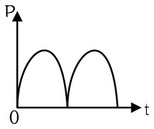
- B
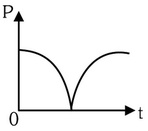
- C
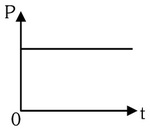
- D
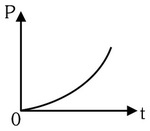
Explore More
Similar Questions
$A$ metallic ring of mass $m$ and radius $l$ (ring being horizontal) is falling under gravity in a region having a magnetic field. If $z$ is the vertical direction,the $z$-component of the magnetic field is $B_z = B_0(1 + \lambda z)$. If $R$ is the resistance of the ring and the ring falls with a velocity $v$,find the energy lost in the resistance per unit time. If the ring has reached a constant velocity,use the conservation of energy to determine $v$ in terms of $m, B_0, l, \lambda, R$ and acceleration due to gravity $g$.
Difficult
View Solution$A$ special metal $S$ conducts electricity without any resistance. $A$ closed wire loop,made of $S$,does not allow any change in flux through itself by inducing a suitable current to generate a compensating flux. The induced current in the loop cannot decay due to its zero resistance. This current gives rise to a magnetic moment which in turn repels the source of magnetic field or flux. Consider such a loop,of radius $a$,with its center at the origin. $A$ magnetic dipole of moment $m$ is brought along the axis of this loop from infinity to a point at distance $r \gg a$ from the center of the loop with its north pole always facing the loop,as shown in the figure.
The magnitude of the magnetic field of a dipole $m$,at a point on its axis at distance $r$,is $\frac{\mu_0}{2 \pi} \frac{m}{r^3}$,where $\mu_0$ is the permeability of free space. The magnitude of the force between two magnetic dipoles with moments $m_1$ and $m_2$,separated by a distance $r$ on the common axis,with their north poles facing each other,is $\frac{k m_1 m_2}{r^4}$,where $k$ is a constant of appropriate dimensions. The direction of this force is along the line joining the two dipoles.
$(1)$ When the dipole $m$ is placed at a distance $r$ from the center of the loop (as shown in the figure),the current induced in the loop will be proportional to
$(A) \frac{m}{r^3} \quad (B) \frac{m^2}{r^2} \quad (C) \frac{m}{r^2} \quad (D) \frac{m^2}{r}$
$(2)$ The work done in bringing the dipole from infinity to a distance $r$ from the center of the loop by the given process is proportional to
$(A) \frac{m}{r^5} \quad (B) \frac{m^2}{r^5} \quad (C) \frac{m^2}{r^6} \quad (D) \frac{m^2}{r^7}$
The magnitude of the magnetic field of a dipole $m$,at a point on its axis at distance $r$,is $\frac{\mu_0}{2 \pi} \frac{m}{r^3}$,where $\mu_0$ is the permeability of free space. The magnitude of the force between two magnetic dipoles with moments $m_1$ and $m_2$,separated by a distance $r$ on the common axis,with their north poles facing each other,is $\frac{k m_1 m_2}{r^4}$,where $k$ is a constant of appropriate dimensions. The direction of this force is along the line joining the two dipoles.
$(1)$ When the dipole $m$ is placed at a distance $r$ from the center of the loop (as shown in the figure),the current induced in the loop will be proportional to
$(A) \frac{m}{r^3} \quad (B) \frac{m^2}{r^2} \quad (C) \frac{m}{r^2} \quad (D) \frac{m^2}{r}$
$(2)$ The work done in bringing the dipole from infinity to a distance $r$ from the center of the loop by the given process is proportional to
$(A) \frac{m}{r^5} \quad (B) \frac{m^2}{r^5} \quad (C) \frac{m^2}{r^6} \quad (D) \frac{m^2}{r^7}$
$A$ conducting loop having a capacitor is moving outward from the magnetic field. Which plate of the capacitor will be positive?
Easy
View Solution$A$ current $I = 10 \ A$ is passed through the part of a circuit shown in the figure. What will be the potential difference between $A$ and $B$ when $I$ is decreased at a constant rate of $10^2 \ A \ s^{-1}$ (in $V$)?
DifficultAP EAMCET 2020
View SolutionIn an $L-R$ circuit connected to a battery,the rate at which energy is stored in the inductor is plotted against time during the growth of the current in the circuit. Which of the following best represents the resulting curve?
Medium
View SolutionVedclass Products
For Students
Vedclass Test Series
Mock tests in real JEE/NEET style with performance analysis. 5-day free trial.
Start Free TrialFor Teachers
Exam Paper Generator
Generate Set A/B/C/D exam papers from 7.5L+ questions in 2 minutes. 3 chapters free.
Try FreeFor Institutes
Online Exam Module
Live online exams with unlimited students, 360° analytics & white-label branding.
See Demo