
In an $L-R$ circuit connected to a battery,the rate at which energy is stored in the inductor is plotted against time during the growth of the current in the circuit. Which of the following best represents the resulting curve?
- A
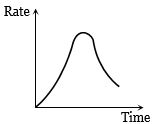
- B
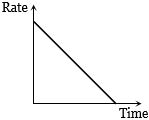
- C
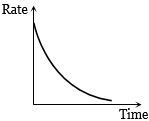
- D
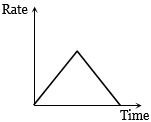
Explore More
Similar Questions
If an iron rod is placed inside a coil, what happens to the induced current?
Medium
View Solution$A$ conducting loop of finite resistance lies on the $x-y$ plane. There is a constant magnetic field in the $z$ direction. The area of the loop varies with time $t$, as $A = A_0 (1 + \sin t)$ in appropriate units. The figure that correctly indicates the qualitative behaviour of the power $P$ dissipated in the loop as a function of time is :
DifficultNEET 2026
View SolutionTwo metallic rings $A$ and $B$,identical in shape and size but having different resistivities $\rho_A$ and $\rho_B$,are kept on top of two identical solenoids as shown in the figure. When current $I$ is switched on in both the solenoids in an identical manner,the rings $A$ and $B$ jump to heights $h_A$ and $h_B$,respectively,with $h_A > h_B$. The possible relation$(s)$ between their resistivities and their masses $m_A$ and $m_B$ is(are):
$(A)$ $\rho_A > \rho_B$ and $m_A = m_B$
$(B)$ $\rho_A < \rho_B$ and $m_A = m_B$
$(C)$ $\rho_A > \rho_B$ and $m_A > m_B$
$(D)$ $\rho_A < \rho_B$ and $m_A < m_B$
$(A)$ $\rho_A > \rho_B$ and $m_A = m_B$
$(B)$ $\rho_A < \rho_B$ and $m_A = m_B$
$(C)$ $\rho_A > \rho_B$ and $m_A > m_B$
$(D)$ $\rho_A < \rho_B$ and $m_A < m_B$
DifficultIIT 2009
View SolutionThe figure shows a part of a complete circuit. The potential difference $V_B - V_A$ when the current $I$ is $5 \ A$ and is decreasing at a rate of $10^3 \ A \ s^{-1}$ is given by ........ $V$.
Difficult
View Solution$A$ small circular loop of area $A$ and resistance $R$ is fixed on a horizontal $xy$-plane with the center of the loop always on the axis $\hat{n}$ of a long solenoid. The solenoid has $m$ turns per unit length and carries current $I$ counterclockwise as shown in the figure. The magnetic field due to the solenoid is in $\hat{n}$ direction. $List-I$ gives time dependences of $\hat{n}$ in terms of a constant angular frequency $\omega$. $List-II$ gives the torques experienced by the circular loop at time $t=\frac{\pi}{6\omega}$. Let $\alpha=\frac{A^2 \mu_0^2 m^2 I^2 \omega}{2R}$.
$List-I$ $List-II$ $(I)$ $\frac{1}{\sqrt{2}}(\sin \omega t \hat{j}+\cos \omega t \hat{k})$ $(P)$ $0$ $(II)$ $\frac{1}{\sqrt{2}}(\sin \omega t \hat{i}+\cos \omega t \hat{j})$ $(Q)$ $-\frac{\alpha}{4} \hat{i}$ $(III)$ $\frac{1}{\sqrt{2}}(\sin \omega t \hat{i}+\cos \omega t \hat{k})$ $(R)$ $\frac{3\alpha}{4} \hat{i}$ $(IV)$ $\frac{1}{\sqrt{2}}(\cos \omega t \hat{j}+\sin \omega t \hat{k})$ $(S)$ $\frac{\alpha}{4} \hat{j}$
Which one of the following options is correct?
| $List-I$ | $List-II$ |
| $(I)$ $\frac{1}{\sqrt{2}}(\sin \omega t \hat{j}+\cos \omega t \hat{k})$ | $(P)$ $0$ |
| $(II)$ $\frac{1}{\sqrt{2}}(\sin \omega t \hat{i}+\cos \omega t \hat{j})$ | $(Q)$ $-\frac{\alpha}{4} \hat{i}$ |
| $(III)$ $\frac{1}{\sqrt{2}}(\sin \omega t \hat{i}+\cos \omega t \hat{k})$ | $(R)$ $\frac{3\alpha}{4} \hat{i}$ |
| $(IV)$ $\frac{1}{\sqrt{2}}(\cos \omega t \hat{j}+\sin \omega t \hat{k})$ | $(S)$ $\frac{\alpha}{4} \hat{j}$ |
Which one of the following options is correct?
Vedclass Products
For Students
Vedclass Test Series
Mock tests in real JEE/NEET style with performance analysis. 5-day free trial.
Start Free TrialFor Teachers
Exam Paper Generator
Generate Set A/B/C/D exam papers from 7.5L+ questions in 2 minutes. 3 chapters free.
Try FreeFor Institutes
Online Exam Module
Live online exams with unlimited students, 360° analytics & white-label branding.
See Demo