
Class 11PhysicsSystem of Particles and Rotational MotionMix Example - System of Particles and Rotational Motion
Difficult$A$ circular platform is situated in a horizontal plane and can rotate about a vertical axis passing through its center. $A$ tortoise is sitting at one edge of the platform,and the platform is rotating with a constant angular velocity $\omega_0$. If the tortoise starts moving with a uniform speed along a chord of the circular platform,how will the angular velocity of the platform change with time $t$?
- AThe angular velocity remains constant.
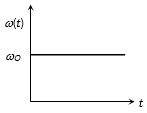
- BThe angular velocity first increases and then decreases.
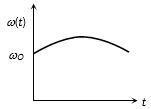
- CThe angular velocity first decreases and then increases.
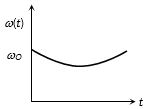
- DThe angular velocity increases linearly and then decreases linearly.
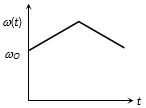
Explore More
Similar Questions
If the Earth suddenly stops rotating about its own axis,the increase in its temperature will be
Medium
View SolutionTwo flywheels are connected by a non-slipping belt as shown in the figure. $I_1 = 4 \ kg \ m^2$,$r_1 = 20 \ cm$,$I_2 = 20 \ kg \ m^2$,and $r_2 = 30 \ cm$. $A$ torque of $10 \ Nm$ is applied on the smaller wheel. Match the entries of column $I$ with appropriate entries of column $II$.
Quantities Their numerical values (in $SI$ units) a. Angular acceleration of smaller wheel $1$. $5/3$ b. Torque on the larger wheel $2$. $100/3$ c. Angular acceleration of larger wheel $3$. $5/2$
| Quantities | Their numerical values (in $SI$ units) |
| a. Angular acceleration of smaller wheel | $1$. $5/3$ |
| b. Torque on the larger wheel | $2$. $100/3$ |
| c. Angular acceleration of larger wheel | $3$. $5/2$ |
MediumKCET 2025
View Solution$A$ rigid uniform bar $AB$ of length $L$ is slipping from its vertical position on a frictionless floor (as shown in the figure). At some instant of time,the angle made by the bar with the vertical is $\theta$. Which of the following statements about its motion is/are correct?
$[A]$ The midpoint of the bar will fall vertically downward
$[B]$ The trajectory of the point $A$ is a parabola
$[C]$ Instantaneous torque about the point in contact with the floor is proportional to $\sin \theta$
$[D]$ When the bar makes an angle $\theta$ with the vertical,the displacement of its midpoint from the initial position is proportional to $(1-\cos \theta)$
$[A]$ The midpoint of the bar will fall vertically downward
$[B]$ The trajectory of the point $A$ is a parabola
$[C]$ Instantaneous torque about the point in contact with the floor is proportional to $\sin \theta$
$[D]$ When the bar makes an angle $\theta$ with the vertical,the displacement of its midpoint from the initial position is proportional to $(1-\cos \theta)$
$A$ pulley is hinged at the centre and a massless thread is wrapped around it. The thread is pulled with a constant force $F$ starting from rest. As the time increases,
Medium
View Solution$A$ rod of mass $M$ and length $l$ is at rest on a smooth horizontal surface. $A$ particle of the same mass $M$ strikes one end of the rod with velocity $u$ perpendicular to the rod,elastically. Just after the collision,what is the kinetic energy of the upper half part of the rod?
Difficult
View SolutionVedclass Products
For Students
Vedclass Test Series
Mock tests in real JEE/NEET style with performance analysis. 5-day free trial.
Start Free TrialFor Teachers
Exam Paper Generator
Generate Set A/B/C/D exam papers from 7.5L+ questions in 2 minutes. 3 chapters free.
Try FreeFor Institutes
Online Exam Module
Live online exams with unlimited students, 360° analytics & white-label branding.
See Demo