
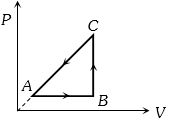
$A$ cyclic process $ABCA$ is shown in the $V-T$ diagram. The corresponding process on the $P-V$ diagram is:
- A
- B
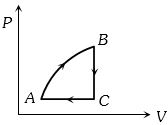
- C
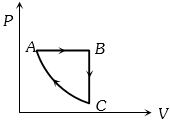
- D
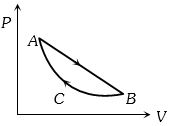
Explore More
Similar Questions
One mole of a diatomic ideal gas undergoes a process shown in $P-V$ diagram. The total heat given to the gas $(\ln 2 = 0.7)$ is (in $P_0 V_0$)
DifficultWBJEE 2022
View SolutionAn engine (consisting of one mole of an ideal gas in a cylinder with a piston) follows the cycle shown in the figure. Find the heat exchanged by the engine with the surroundings in each part of the cycle. Given $C_V = \frac{3}{2}R$.
$(a)$ $A$ to $B$: Constant volume
$(b)$ $B$ to $C$: Constant pressure
$(c)$ $C$ to $D$: Adiabatic expansion
$(d)$ $D$ to $A$: Constant pressure
$(a)$ $A$ to $B$: Constant volume
$(b)$ $B$ to $C$: Constant pressure
$(c)$ $C$ to $D$: Adiabatic expansion
$(d)$ $D$ to $A$: Constant pressure
Difficult
View SolutionTwo cylinders $A$ and $B$ fitted with pistons contain equal number of moles of an ideal monoatomic gas at $400 \,K$. The piston of $A$ is free to move while that of $B$ is held fixed. The same amount of heat energy is given to the gas in each cylinder. If the rise in temperature of the gas in $A$ is $42 \,K$, what is the rise in temperature of the gas in $B$ (in $\,K$)? (Given $\gamma = 5/3$)
DifficultTS EAMCET 2007
View SolutionThe $P-V$ diagram of a certain process (Carnot cycle) is as shown. The process is also represented as:
Two samples $A$ and $B$ of gas are initially at the same pressure and temperature. They are compressed from volume $V$ to $\frac{V}{2}$ ($A$ isothermally and $B$ adiabatically). The relation between the pressure of gas $A$ $(P_A)$ and the pressure of gas $B$ $(P_B)$ is:
DifficultMHT CET 2026
View SolutionVedclass Products
For Students
Vedclass Test Series
Mock tests in real JEE/NEET style with performance analysis. 5-day free trial.
Start Free TrialFor Teachers
Exam Paper Generator
Generate Set A/B/C/D exam papers from 7.5L+ questions in 2 minutes. 3 chapters free.
Try FreeFor Institutes
Online Exam Module
Live online exams with unlimited students, 360° analytics & white-label branding.
See Demo