
Difficult
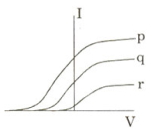
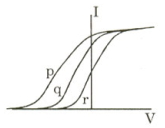
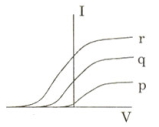
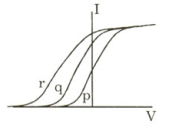
Photoelectric effect experiments are performed using three different metal plates $p, q$ and $r$ having work functions $\phi_p=2.0 \ eV, \phi_q=2.5 \ eV$ and $\phi_r=3.0 \ eV$,respectively. $A$ light beam containing wavelengths of $550 \ nm, 450 \ nm$ and $350 \ nm$ with equal intensities illuminates each of the plates. The correct $I-V$ graph for the experiment is:
- A
- B
- C
- D
Explore More
Similar Questions
In a photoelectric experiment,light of wavelength $800 \ nm$ produces photoelectrons with the smallest de Broglie wavelength of $1 \ nm$. Then the work function of the metal used in the experiment is nearly (in $eV$)
The anode voltage of a photocell is kept fixed. The wavelength $\lambda$ of the light falling on the cathode is gradually changed. The plate current $I$ of the photocell varies as follows:
$A$ monochromatic light is incident on a metallic plate having work function $\phi$. An electron,emitted normally to the plate from a point $A$ with maximum kinetic energy,enters a constant magnetic field,perpendicular to the initial velocity of electron. The electron passes through a curve and hits back the plate at a point $B$. The distance between $A$ and $B$ is (Given: The magnitude of charge of an electron is $e$ and mass is $m$,$h$ is Planck's constant,and $c$ is velocity of light. Take the magnetic field exists throughout the path of electron).
DifficultJEE MAIN 2025
View SolutionAn electron moving with speed $v$ and a photon moving with speed $c$ have the same de Broglie wavelength. The ratio of the kinetic energy of the electron to that of the photon is -
Answer the following questions:
$(a)$ Quarks inside protons and neutrons are thought to carry fractional charges $[(+2/3)e, (-1/3)e]$. Why do they not show up in Millikan's oil-drop experiment?
$(b)$ What is so special about the combination $e/m$? Why do we not simply talk of $e$ and $m$ separately?
$(c)$ Why should gases be insulators at ordinary pressures and start conducting at very low pressures?
$(d)$ Every metal has a definite work function. Why do all photoelectrons not come out with the same energy if incident radiation is monochromatic? Why is there an energy distribution of photoelectrons?
$(e)$ The energy and momentum of an electron are related to the frequency and wavelength of the associated matter wave by the relations:
$E = h\nu, p = \frac{h}{\lambda}$
But while the value of $\lambda$ is physically significant,the value of $\nu$ (and therefore,the value of the phase speed $\nu\lambda$) has no physical significance. Why?
Medium
View SolutionVedclass Products
For Students
Vedclass Test Series
Mock tests in real JEE/NEET style with performance analysis. 5-day free trial.
Start Free TrialFor Teachers
Exam Paper Generator
Generate Set A/B/C/D exam papers from 7.5L+ questions in 2 minutes. 3 chapters free.
Try FreeFor Institutes
Online Exam Module
Live online exams with unlimited students, 360° analytics & white-label branding.
See Demo