
The insulated plates of a charged parallel plate capacitor (with small separation between the plates) are approaching each other due to electrostatic attraction. Assuming no other force to be operative and no radiation taking place, which of the following graphs approximately shows the variation with time $(t)$ of the potential difference $(V)$ between the plates?
- A
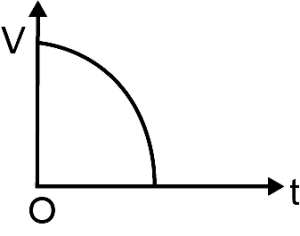
- B
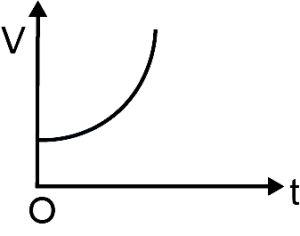
- C
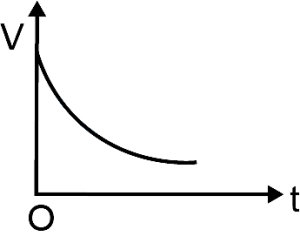
- D
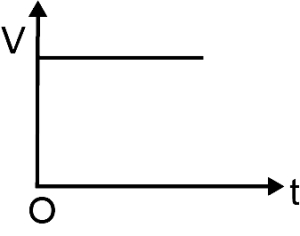
Explore More
Similar Questions
$A$ parallel plate capacitor has circular plates of $10\, cm$ radius separated by an air-gap of $1\, mm$. It is charged by connecting the plates to a $100\, V$ battery. The change in energy stored in the capacitor when the plates are moved to a distance of $1\, cm$ while remaining connected to the battery is:
Medium
View SolutionThe graph shows the variation of voltage $(V)$ across the plates of two parallel plate capacitors $A$ and $B$ versus the charge $(Q)$ stored in them. Then
Calculate the capacitance of two plates of equal area of $1 \ m^2$ separated by a distance of $1 \ mm$.
Easy
View SolutionThe capacitance of a parallel plate capacitor is $12\,\mu F$. If the distance between the plates is doubled and the area is halved,then the new capacitance will be.........$\mu F$.
Easy
View SolutionTwo identical metal plates are given charges $q_1$ and $q_2$ $(q_2 < q_1)$ respectively. If they are now brought close together to form a parallel plate capacitor with capacitance $C$,the potential difference $V$ between the plates is
Vedclass Products
For Students
Vedclass Test Series
Mock tests in real JEE/NEET style with performance analysis. 5-day free trial.
Start Free TrialFor Teachers
Exam Paper Generator
Generate Set A/B/C/D exam papers from 7.5L+ questions in 2 minutes. 3 chapters free.
Try FreeFor Institutes
Online Exam Module
Live online exams with unlimited students, 360° analytics & white-label branding.
See Demo