
A English
Mix Examples - Polynomials Questions in English
Class 10 Mathematics · Polynomials · Mix Examples - Polynomials
72+
Questions
English
Language
100%
With Solutions
Showing 50 of 72 questions in English
1
Difficult
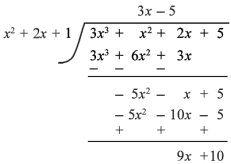
Divide $3x^{3}+x^{2}+2x+5$ by $1+2x+x^{2}$.
Solution
(N/A) We first arrange the terms of the dividend and the divisor in the decreasing order of their degrees. This is called writing the polynomials in standard form. The dividend is already in standard form,and the divisor,in standard form,is $x^{2}+2x+1$.
Step $1$: To obtain the first term of the quotient,divide the highest degree term of the dividend $(3x^{3})$ by the highest degree term of the divisor $(x^{2})$. This gives $3x$. Multiplying the divisor by $3x$,we get $3x(x^{2}+2x+1) = 3x^{3}+6x^{2}+3x$. Subtracting this from the dividend,we get $(3x^{3}+x^{2}+2x+5) - (3x^{3}+6x^{2}+3x) = -5x^{2}-x+5$.
Step $2$: To obtain the second term of the quotient,divide the highest degree term of the new dividend $(-5x^{2})$ by the highest degree term of the divisor $(x^{2})$. This gives $-5$. Multiplying the divisor by $-5$,we get $-5(x^{2}+2x+1) = -5x^{2}-10x-5$. Subtracting this from the current dividend,we get $(-5x^{2}-x+5) - (-5x^{2}-10x-5) = 9x+10$.
Step $3$: The degree of the remainder $9x+10$ is $1$,which is less than the degree of the divisor $(2)$. Thus,the division process stops.
Therefore,the quotient is $3x-5$ and the remainder is $9x+10$.
0 likes
View Solution2
Difficult
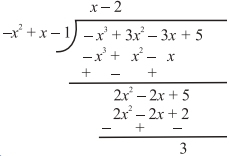
Divide $3x^{2}-x^{3}-3x+5$ by $x-1-x^{2}$ and verify the division algorithm.
Solution
(N/A) Note that the given polynomials are not in standard form. To carry out division,we first write both the dividend and divisor in decreasing order of their degrees.
So,dividend $= -x^{3}+3x^{2}-3x+5$ and divisor $= -x^{2}+x-1$.
Performing the division:
$(-x^{2}+x-1) \overline{) -x^{3}+3x^{2}-3x+5}$
$1$. Divide the first term of the dividend $-x^{3}$ by the first term of the divisor $-x^{2}$ to get $x$. This is the first term of the quotient.
$2$. Multiply the divisor $(-x^{2}+x-1)$ by $x$ to get $-x^{3}+x^{2}-x$. Subtract this from the dividend to get $2x^{2}-2x+5$.
$3$. Divide the first term of the new dividend $2x^{2}$ by the first term of the divisor $-x^{2}$ to get $-2$. This is the second term of the quotient.
$4$. Multiply the divisor $(-x^{2}+x-1)$ by $-2$ to get $2x^{2}-2x+2$. Subtract this from the current dividend to get $3$.
We stop here since the degree of the remainder $(3)$ is $0$,which is less than the degree of the divisor $(-x^{2}+x-1)$,which is $2$.
So,quotient $= x-2$,remainder $= 3$.
Verification:
Divisor $\times$ Quotient $+$ Remainder
$= (-x^{2}+x-1)(x-2)+3$
$= -x^{3}+2x^{2}+x^{2}-2x-x+2+3$
$= -x^{3}+3x^{2}-3x+5$
$= \text{Dividend}$.
Thus,the division algorithm is verified.
0 likes
View Solution3
Difficult
Divide the polynomial $p(x)$ by the polynomial $g(x)$ and find the quotient and remainder in each of the following:
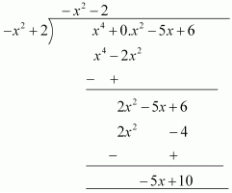
$p(x) = x^{4} - 5x + 6, \quad g(x) = 2 - x^{2}$
$p(x) = x^{4} - 5x + 6, \quad g(x) = 2 - x^{2}$
Solution
(N/A) To divide $p(x) = x^{4} - 5x + 6$ by $g(x) = -x^{2} + 2$,we arrange the terms in descending order of their degrees:
$p(x) = x^{4} + 0x^{3} + 0x^{2} - 5x + 6$
$g(x) = -x^{2} + 2$
Performing long division:
$1$. Divide the first term of $p(x)$ by the first term of $g(x)$: $x^{4} / (-x^{2}) = -x^{2}$. This is the first term of the quotient.
$2$. Multiply $-x^{2}$ by $(-x^{2} + 2)$ to get $x^{4} - 2x^{2}$. Subtract this from $p(x)$ to get $2x^{2} - 5x + 6$.
$3$. Divide the first term of the new polynomial $(2x^{2})$ by the first term of $g(x)$ $(-x^{2})$: $2x^{2} / (-x^{2}) = -2$. This is the second term of the quotient.
$4$. Multiply $-2$ by $(-x^{2} + 2)$ to get $2x^{2} - 4$. Subtract this from $2x^{2} - 5x + 6$ to get $-5x + 10$.
Thus,the quotient is $-x^{2} - 2$ and the remainder is $-5x + 10$.
0 likes
View Solution4
Easy
Check whether the first polynomial is a factor of the second polynomial by dividing the second polynomial by the first polynomial:
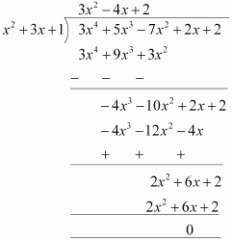
$x^{2}+3x+1, 3x^{4}+5x^{3}-7x^{2}+2x+2$
$x^{2}+3x+1, 3x^{4}+5x^{3}-7x^{2}+2x+2$
Solution
(A) To check if the first polynomial is a factor of the second,we perform long division of $3x^{4}+5x^{3}-7x^{2}+2x+2$ by $x^{2}+3x+1$.
Step $1$: Divide $3x^{4}$ by $x^{2}$ to get $3x^{2}$. Multiply $3x^{2}(x^{2}+3x+1) = 3x^{4}+9x^{3}+3x^{2}$. Subtracting this from the dividend gives $-4x^{3}-10x^{2}+2x+2$.
Step $2$: Divide $-4x^{3}$ by $x^{2}$ to get $-4x$. Multiply $-4x(x^{2}+3x+1) = -4x^{3}-12x^{2}-4x$. Subtracting this gives $2x^{2}+6x+2$.
Step $3$: Divide $2x^{2}$ by $x^{2}$ to get $2$. Multiply $2(x^{2}+3x+1) = 2x^{2}+6x+2$. Subtracting this gives a remainder of $0$.
Since the remainder is $0$,the first polynomial is a factor of the second polynomial.
0 likes
View Solution5
Difficult
Check whether the first polynomial is a factor of the second polynomial by dividing the second polynomial by the first polynomial:
$x^{3}-3x+1, x^{5}-4x^{3}+x^{2}+3x+1$
$x^{3}-3x+1, x^{5}-4x^{3}+x^{2}+3x+1$
Solution
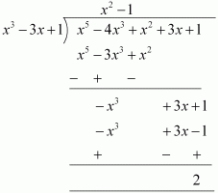
(N/A) To check if the first polynomial is a factor of the second,we perform polynomial long division.
Dividing $x^{5}-4x^{3}+x^{2}+3x+1$ by $x^{3}-3x+1$:
$1$. Divide the first term of the dividend $(x^{5})$ by the first term of the divisor $(x^{3})$ to get $x^{2}$.
$2$. Multiply $x^{2}$ by $(x^{3}-3x+1)$ to get $x^{5}-3x^{3}+x^{2}$.
$3$. Subtract this from the dividend: $(x^{5}-4x^{3}+x^{2}+3x+1) - (x^{5}-3x^{3}+x^{2}) = -x^{3}+3x+1$.
$4$. Divide the first term of the new polynomial $(-x^{3})$ by the first term of the divisor $(x^{3})$ to get $-1$.
$5$. Multiply $-1$ by $(x^{3}-3x+1)$ to get $-x^{3}+3x-1$.
$6$. Subtract this from the current remainder: $(-x^{3}+3x+1) - (-x^{3}+3x-1) = 2$.
Since the remainder is $2$ (which is $\neq 0$),the first polynomial is not a factor of the second polynomial.
0 likes
View Solution6
Medium
On dividing $x^{3}-3 x^{2}+x+2$ by a polynomial $g(x)$,the quotient and remainder were $x-2$ and $-2 x+4$,respectively. Find $g(x)$.
Solution
(N/A) Given:
Dividend $p(x) = x^{3}-3 x^{2}+x+2$
Quotient $q(x) = x-2$
Remainder $r(x) = -2 x+4$
Divisor $g(x) = ?$
Using the division algorithm for polynomials:
$p(x) = g(x) \cdot q(x) + r(x)$
$x^{3}-3 x^{2}+x+2 = g(x) \cdot (x-2) + (-2 x+4)$
Rearranging the terms to isolate $g(x) \cdot (x-2)$:
$g(x) \cdot (x-2) = (x^{3}-3 x^{2}+x+2) - (-2 x+4)$
$g(x) \cdot (x-2) = x^{3}-3 x^{2}+x+2+2 x-4$
$g(x) \cdot (x-2) = x^{3}-3 x^{2}+3 x-2$
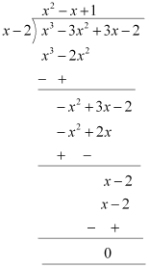
Now,divide $(x^{3}-3 x^{2}+3 x-2)$ by $(x-2)$ to find $g(x)$:
By performing polynomial long division:
$(x^{3}-3 x^{2}+3 x-2) \div (x-2) = x^{2}-x+1$
Therefore,$g(x) = x^{2}-x+1$.
0 likes
View Solution7
Medium
Give examples of polynomials $p(x), g(x), q(x)$ and $r(x),$ which satisfy the division algorithm and $\operatorname{deg} p(x)=\operatorname{deg} q(x).$
Solution
(N/A) According to the division algorithm,if $p(x)$ and $g(x)$ are two polynomials with $g(x) \neq 0,$ then we can find polynomials $q(x)$ and $r(x)$ such that $p(x) = g(x) \cdot q(x) + r(x),$ where $r(x) = 0$ or $\operatorname{deg} r(x) < \operatorname{deg} g(x).$
The degree of a polynomial is the highest power of the variable in the polynomial.
To satisfy $\operatorname{deg} p(x) = \operatorname{deg} q(x),$ the degree of the quotient must be equal to the degree of the dividend. This occurs when the divisor $g(x)$ is a constant.
Let us assume the division of $p(x) = 6x^2 + 2x + 2$ by $g(x) = 2.$
Here,$p(x) = 6x^2 + 2x + 2,$
$g(x) = 2,$
$q(x) = 3x^2 + x + 1,$
$r(x) = 0.$
The degree of $p(x)$ is $2$ and the degree of $q(x)$ is $2,$ so $\operatorname{deg} p(x) = \operatorname{deg} q(x).$
Checking the division algorithm:
$p(x) = g(x) \cdot q(x) + r(x)$
$6x^2 + 2x + 2 = 2(3x^2 + x + 1) + 0$
$6x^2 + 2x + 2 = 6x^2 + 2x + 2.$
Thus,the division algorithm is satisfied.
0 likes
View Solution8
EasyMCQ
Which of the following is not the graph of a quadratic polynomial?
A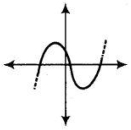
B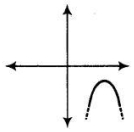
C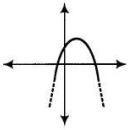
D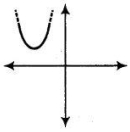
Solution
(A) For any quadratic polynomial $ax^{2} + bx + c$ $(a \neq 0)$,the graph of the corresponding equation $y = ax^{2} + bx + c$ is a parabola,which is either open upwards (if $a > 0$) or open downwards (if $a < 0$).
$1$. $A$ quadratic polynomial graph can intersect the $X$-axis at most at two points.
$2$. The graph in option $(A)$ shows a curve that intersects the $X$-axis at three distinct points,which is characteristic of a cubic polynomial,not a quadratic polynomial.
$3$. Therefore,the graph in option $(A)$ is not the graph of a quadratic polynomial.
0 likes
View Solution9
EasyMCQ
Can $x-1$ be the remainder on division of a polynomial $p(x)$ by $2x+3$? Justify your answer.
A
Yes
B
No
C
Depends on $p(x)$
D
Cannot be determined
Solution
(B) No,$x-1$ cannot be the remainder.
According to the Division Algorithm for polynomials,if a polynomial $p(x)$ is divided by a divisor $g(x)$,the remainder $r(x)$ must satisfy the condition that either $r(x) = 0$ or the degree of $r(x)$ is strictly less than the degree of $g(x)$.
Here,the divisor is $g(x) = 2x+3$,which has a degree of $1$.
The proposed remainder is $r(x) = x-1$,which also has a degree of $1$.
Since the degree of the remainder is not less than the degree of the divisor,$x-1$ cannot be the remainder.
0 likes
View Solution10
Medium
Answer the following and justify: Can $x^{2}-1$ be the quotient on division of $x^{6}+2 x^{3}+x-1$ by a polynomial in $x$ of degree $5$?
Solution
(B) No. According to the division algorithm for polynomials,if $p(x)$ is the dividend and $g(x)$ is the divisor,then $p(x) = g(x) \cdot q(x) + r(x)$,where $\text{deg}(r(x)) < \text{deg}(g(x))$.
Given,$\text{deg}(p(x)) = 6$ and $\text{deg}(g(x)) = 5$.
If the quotient $q(x) = x^{2}-1$,then $\text{deg}(q(x)) = 2$.
The degree of the product $g(x) \cdot q(x)$ would be $\text{deg}(g(x)) + \text{deg}(q(x)) = 5 + 2 = 7$.
Since the degree of the dividend $p(x)$ is $6$,and the degree of the product $g(x) \cdot q(x)$ is $7$,it is impossible for $x^{2}-1$ to be the quotient because the degree of the product cannot exceed the degree of the dividend (assuming the remainder is zero or has a lower degree).
Therefore,$x^{2}-1$ cannot be the quotient.
0 likes
View Solution11
Medium
Answer the following and justify: What will be the quotient and remainder on division of $ax^{2} + bx + c$ by $px^{3} + qx^{2} + nx + s$,where $p \neq 0$?
Solution
(N/A) Given that,the divisor is $px^{3} + qx^{2} + nx + s$ (where $p \neq 0$) and the dividend is $ax^{2} + bx + c$.
We observe that the degree of the divisor is $3$ and the degree of the dividend is $2$.
According to the division algorithm for polynomials,if the degree of the divisor is greater than the degree of the dividend,the division cannot be performed in the standard sense of obtaining a non-zero quotient.
Therefore,the quotient is $0$ and the remainder is equal to the dividend itself,which is $ax^{2} + bx + c$.
0 likes
View Solution12
Medium
Answer the following and justify: If on division of a non-zero polynomial $p(x)$ by a polynomial $g(x)$,the remainder is zero,what is the relation between the degrees of $p(x)$ and $g(x)$?
Solution
(N/A) If a non-zero polynomial $p(x)$ is divided by a polynomial $g(x)$ and the remainder is zero,it implies that $g(x)$ is a factor of $p(x)$. According to the division algorithm for polynomials,$p(x) = g(x) \cdot q(x) + r(x)$,where $r(x) = 0$. Since $p(x)$ and $g(x)$ are non-zero polynomials,the degree of the product $g(x) \cdot q(x)$ must equal the degree of $p(x)$. Therefore,the degree of $g(x)$ must be less than or equal to the degree of $p(x)$,i.e.,$\text{deg}(g(x)) \le \text{deg}(p(x))$.
0 likes
View Solution13
Difficult
If the remainder on division of $x^{3}+2 x^{2}+k x+3$ by $x-3$ is $21$,find the quotient and the value of $k$. Hence,find the zeroes of the cubic polynomial $x^{3}+2 x^{2}+k x-18$.
Solution
(A) Let $p(x) = x^{3}+2 x^{2}+k x+3$.
By the Remainder Theorem,since $p(x)$ is divided by $x-3$,the remainder is $p(3)$.
Given $p(3) = 21$,we have:
$3^{3}+2(3)^{2}+k(3)+3 = 21$
$27 + 18 + 3k + 3 = 21$
$48 + 3k = 21$
$3k = 21 - 48 = -27$
$k = -9$.
Now,dividing $x^{3}+2 x^{2}-9 x+3$ by $x-3$ using long division:
$x^{3}+2 x^{2}-9 x+3 = (x-3)(x^{2}+5x+6) + 21$.
The quotient is $x^{2}+5x+6$.
To find the zeroes of $x^{3}+2 x^{2}-9 x-18$,we factorize it:
$x^{3}+2 x^{2}-9 x-18 = x^{2}(x+2) - 9(x+2)$
$= (x^{2}-9)(x+2)$
$= (x-3)(x+3)(x+2)$.
Setting the polynomial to $0$,the zeroes are $x = 3, -3, -2$.
0 likes
View Solution14
Medium
Give examples of polynomials $p(x), g(x), q(x)$ and $r(x)$ which satisfy the division algorithm and $\operatorname{deg} q(x) = \operatorname{deg} r(x)$.
Solution
(N/A) According to the division algorithm,if $p(x)$ and $g(x)$ are two polynomials with $g(x) \neq 0$,then we can find polynomials $q(x)$ and $r(x)$ such that $p(x) = g(x) \cdot q(x) + r(x)$,where $r(x) = 0$ or $\operatorname{deg} r(x) < \operatorname{deg} g(x)$.
We need to find examples such that $\operatorname{deg} q(x) = \operatorname{deg} r(x)$.
Let us consider $p(x) = x^3 + x$ and $g(x) = x^2$.
Performing the division:
$x^3 + x = (x^2) \cdot x + x$.
Here,$q(x) = x$ and $r(x) = x$.
Checking the conditions:
$1$. $\operatorname{deg} q(x) = \operatorname{deg}(x) = 1$.
$2$. $\operatorname{deg} r(x) = \operatorname{deg}(x) = 1$.
Since $1 = 1$,the condition $\operatorname{deg} q(x) = \operatorname{deg} r(x)$ is satisfied.
$3$. $\operatorname{deg} r(x) < \operatorname{deg} g(x)$ is $1 < 2$,which is true.
Thus,the division algorithm is satisfied.
0 likes
View Solution15
Medium
Give examples of polynomials $p(x), g(x), q(x)$ and $r(x)$ which satisfy the division algorithm and $\operatorname{deg} r(x) = 0$.
Solution
(A) According to the division algorithm,if $p(x)$ and $g(x)$ are two polynomials with $g(x) \neq 0$,then we can find polynomials $q(x)$ and $r(x)$ such that $p(x) = g(x) \times q(x) + r(x)$,where $r(x) = 0$ or $\operatorname{deg} r(x) < \operatorname{deg} g(x)$.
The degree of a polynomial is the highest power of the variable in the polynomial.
For $\operatorname{deg} r(x) = 0$,the remainder must be a non-zero constant.
Let us consider the division of $x^3 + 1$ by $x^2$.
Here,$p(x) = x^3 + 1$,$g(x) = x^2$.
Performing the division: $(x^3 + 1) \div x^2$ gives quotient $q(x) = x$ and remainder $r(x) = 1$.
Clearly,the degree of $r(x) = 1$ is $0$.
Checking the division algorithm:
$p(x) = g(x) \times q(x) + r(x)$
$x^3 + 1 = (x^2) \times x + 1$
$x^3 + 1 = x^3 + 1$
Thus,the division algorithm is satisfied.
0 likes
View Solution16
Difficult
If the polynomial $x^{4}-6x^{3}+16x^{2}-25x+10$ is divided by another polynomial $x^{2}-2x+k$,the remainder is $x+a$. Find the values of $k$ and $a$.
Solution
(A) By the division algorithm,we have:
Dividend $=$ Divisor $\times$ Quotient $+$ Remainder
Therefore,Dividend $-$ Remainder $=$ Divisor $\times$ Quotient.
Subtracting the remainder $(x+a)$ from the dividend:
$(x^{4}-6x^{3}+16x^{2}-25x+10) - (x+a) = x^{4}-6x^{3}+16x^{2}-26x+10-a$.
This resulting polynomial must be perfectly divisible by $x^{2}-2x+k$.
Performing long division of $(x^{4}-6x^{3}+16x^{2}-26x+10-a)$ by $(x^{2}-2x+k)$:
$1$. Dividing $x^{4}$ by $x^{2}$ gives $x^{2}$. Multiplying $(x^{2}-2x+k)$ by $x^{2}$ gives $x^{4}-2x^{3}+kx^{2}$. Subtracting this from the dividend leaves $-4x^{3}+(16-k)x^{2}-26x$.
$2$. Dividing $-4x^{3}$ by $x^{2}$ gives $-4x$. Multiplying $(x^{2}-2x+k)$ by $-4x$ gives $-4x^{3}+8x^{2}-4kx$. Subtracting this leaves $(8-k)x^{2}+(4k-26)x+(10-a)$.
$3$. Dividing $(8-k)x^{2}$ by $x^{2}$ gives $(8-k)$. Multiplying $(x^{2}-2x+k)$ by $(8-k)$ gives $(8-k)x^{2}-2(8-k)x+k(8-k)$.
Subtracting this from the previous remainder,we get the final remainder as $[(4k-26) + 2(8-k)]x + [10-a - k(8-k)] = 0$.
Simplifying the coefficient of $x$: $4k-26+16-2k = 2k-10$. Setting $2k-10=0$ gives $k=5$.
Simplifying the constant term: $10-a-8k+k^{2} = 0$. Substituting $k=5$: $10-a-8(5)+25 = 10-a-40+25 = -5-a = 0$,which gives $a=-5$.
Thus,$k=5$ and $a=-5$.
0 likes
View Solution17
Advanced
Find $k$ such that $x^{2}+2x+k$ is a factor of $2x^{4}+x^{3}-14x^{2}+5x+6$. Also,find all the zeroes of the two polynomials.
Solution
(C) Given that $(x^{2}+2x+k)$ is a factor of $2x^{4}+x^{3}-14x^{2}+5x+6$,the remainder must be zero when we perform polynomial division.
Performing long division of $2x^{4}+x^{3}-14x^{2}+5x+6$ by $(x^{2}+2x+k)$:
$1$. Divide $2x^{4}$ by $x^{2}$ to get $2x^{2}$. Multiply $(x^{2}+2x+k)$ by $2x^{2}$ to get $2x^{4}+4x^{3}+2kx^{2}$. Subtracting this from the dividend gives $-3x^{3}-(2k+14)x^{2}+5x+6$.
$2$. Divide $-3x^{3}$ by $x^{2}$ to get $-3x$. Multiply $(x^{2}+2x+k)$ by $-3x$ to get $-3x^{3}-6x^{2}-3kx$. Subtracting this gives $(6-2k-14)x^{2}+(3k+5)x+6 = (-8-2k)x^{2}+(3k+5)x+6$.
$3$. Divide $(-8-2k)x^{2}$ by $x^{2}$ to get $(-8-2k)$. Multiply $(x^{2}+2x+k)$ by $(-8-2k)$ to get $(-8-2k)x^{2} + 2(-8-2k)x + k(-8-2k)$.
Subtracting this from the previous remainder gives the final remainder: $(3k+5+16+4k)x + (6+8k+2k^{2}) = (7k+21)x + (2k^{2}+8k+6)$.
For the remainder to be zero,both coefficients must be zero:
$7k+21=0 \Rightarrow k=-3$.
$2k^{2}+8k+6=0 \Rightarrow 2(k^{2}+4k+3)=0 \Rightarrow 2(k+1)(k+3)=0 \Rightarrow k=-1$ or $k=-3$.
Since $k$ must satisfy both,$k=-3$.
With $k=-3$,the divisor is $x^{2}+2x-3 = (x+3)(x-1)$,so its zeroes are $x=-3, 1$.
The quotient is $2x^{2}-3x-2 = 2x^{2}-4x+x-2 = 2x(x-2)+1(x-2) = (2x+1)(x-2)$,so its zeroes are $x=-1/2, 2$.
Thus,the zeroes of $x^{2}+2x-3$ are $1, -3$ and the zeroes of $2x^{4}+x^{3}-14x^{2}+5x+6$ are $1, -3, 2, -1/2$.
0 likes
View Solution18
AdvancedMCQ
Given that $x-\sqrt{5}$ is a factor of the cubic polynomial $x^{3}-3 \sqrt{5} x^{2}+13 x-3 \sqrt{5}$. Find all the zeroes of the polynomial.
A
$\sqrt{5}, (\sqrt{5}+\sqrt{3})$ and $(\sqrt{5}-\sqrt{3})$
B
$\sqrt{5}, (\sqrt{6}+\sqrt{2})$ and $(\sqrt{7}-\sqrt{2})$
C
$\sqrt{6}, (\sqrt{5}+\sqrt{2})$ and $(\sqrt{5}-\sqrt{2})$
D
$\sqrt{5}, (\sqrt{5}+\sqrt{2})$ and $(\sqrt{5}-\sqrt{2})$
Solution
(D) Let $f(x) = x^{3}-3 \sqrt{5} x^{2}+13 x-3 \sqrt{5}$.
Since $(x-\sqrt{5})$ is a factor,we divide $f(x)$ by $(x-\sqrt{5})$ to find the quotient.
Performing polynomial long division:
$x^{3}-3 \sqrt{5} x^{2}+13 x-3 \sqrt{5} = (x-\sqrt{5})(x^{2}-2 \sqrt{5} x+3)$.
Now,we find the roots of the quadratic factor $x^{2}-2 \sqrt{5} x+3 = 0$.
Using the quadratic formula $x = \frac{-b \pm \sqrt{b^{2}-4ac}}{2a}$:
$x = \frac{2 \sqrt{5} \pm \sqrt{(-2 \sqrt{5})^{2}-4(1)(3)}}{2(1)}$
$x = \frac{2 \sqrt{5} \pm \sqrt{20-12}}{2} = \frac{2 \sqrt{5} \pm \sqrt{8}}{2} = \frac{2 \sqrt{5} \pm 2 \sqrt{2}}{2} = \sqrt{5} \pm \sqrt{2}$.
Thus,the zeroes are $\sqrt{5}, (\sqrt{5}+\sqrt{2})$,and $(\sqrt{5}-\sqrt{2})$.
0 likes
View Solution19
Difficult
For which values of $a$ and $b$ are the zeroes of $q(x) = x^{3} + 2x^{2} + a$ also the zeroes of the polynomial $p(x) = x^{5} - x^{4} - 4x^{3} + 3x^{2} + 3x + b$? Which zeroes of $p(x)$ are not the zeroes of $q(x)$?
Solution
(A) Given that the zeroes of $q(x) = x^{3} + 2x^{2} + a$ are also the zeroes of $p(x) = x^{5} - x^{4} - 4x^{3} + 3x^{2} + 3x + b$,it implies that $q(x)$ is a factor of $p(x)$.
Performing polynomial long division of $p(x)$ by $q(x)$:
Dividing $x^{5} - x^{4} - 4x^{3} + 3x^{2} + 3x + b$ by $x^{3} + 2x^{2} + a$ yields a quotient of $x^{2} - 3x + 2$ and a remainder of $-(1+a)x^{2} + (3+3a)x + (b-2a)$.
Since $q(x)$ is a factor,the remainder must be zero for all $x$,so the coefficients must be zero:
$-(1+a) = 0 \Rightarrow a = -1$
$3+3a = 0 \Rightarrow 3+3(-1) = 0$ (Consistent)
$b-2a = 0 \Rightarrow b = 2(-1) = -2$.
Thus,$a = -1$ and $b = -2$.
Substituting these values,$p(x) = (x^{3} + 2x^{2} - 1)(x^{2} - 3x + 2)$.
Factoring the quotient: $x^{2} - 3x + 2 = (x-1)(x-2)$.
The zeroes of $p(x)$ are the zeroes of $q(x)$ along with the zeroes of the quotient,which are $x=1$ and $x=2$. Therefore,the zeroes of $p(x)$ that are not zeroes of $q(x)$ are $1$ and $2$.
0 likes
View Solution20
EasyMCQ
Identify the type of the given polynomial based on its degree: $p(x) = (x - 1)(2 - x)$
A
Linear polynomial
B
Quadratic polynomial
C
Cubic polynomial
D
Constant polynomial
Solution
(B) Given the polynomial $p(x) = (x - 1)(2 - x)$.
Expanding the expression: $p(x) = x(2) - x(x) - 1(2) + 1(x) = 2x - x^2 - 2 + x$.
Combining like terms: $p(x) = -x^2 + 3x - 2$.
The highest power (degree) of the variable $x$ in this polynomial is $2$.
$A$ polynomial of degree $2$ is known as a quadratic polynomial.
Expanding the expression: $p(x) = x(2) - x(x) - 1(2) + 1(x) = 2x - x^2 - 2 + x$.
Combining like terms: $p(x) = -x^2 + 3x - 2$.
The highest power (degree) of the variable $x$ in this polynomial is $2$.
$A$ polynomial of degree $2$ is known as a quadratic polynomial.
0 likes
View Solution21
Medium
Find the value of $p(x) = 2x^3 + x^2 - x - 1$ at $x = 0$ and $x = -2$.
Solution
(N/A) Given polynomial: $p(x) = 2x^3 + x^2 - x - 1$
Step $1$: Find the value at $x = 0$.
$p(0) = 2(0)^3 + (0)^2 - (0) - 1$
$p(0) = 0 + 0 - 0 - 1$
$p(0) = -1$
Step $2$: Find the value at $x = -2$.
$p(-2) = 2(-2)^3 + (-2)^2 - (-2) - 1$
$p(-2) = 2(-8) + 4 + 2 - 1$
$p(-2) = -16 + 4 + 2 - 1$
$p(-2) = -11$
Thus,the values are $p(0) = -1$ and $p(-2) = -11$.
0 likes
View Solution22
EasyMCQ
State the degree of the following polynomial: $p(x) = x^{15} - (x^5)^6 + x^3 - 7$.
A
$39$
B
$33$
C
$30$
D
$42$
Solution
(C) To find the degree of the polynomial $p(x) = x^{15} - (x^5)^6 + x^3 - 7$,we first simplify the expression.
Using the power rule of exponents $(a^m)^n = a^{m \times n}$,we simplify the term $(x^5)^6$:
$(x^5)^6 = x^{5 \times 6} = x^{30}$.
Now,substitute this back into the polynomial:
$p(x) = x^{15} - x^{30} + x^3 - 7$.
The degree of a polynomial is defined as the highest power of the variable $x$ present in the expression.
Comparing the powers of $x$ in the terms $x^{15}$,$x^{30}$,and $x^3$,the highest power is $30$.
Therefore,the degree of the polynomial is $30$.
0 likes
View Solution23
EasyMCQ
Obtain the value of the following polynomial at the given value of $x$: $p(x) = x^{4} + 2x^{3} - x + 2$; at $x = 2$.
A
$28$
B
$30$
C
$23$
D
$32$
Solution
(D) To find the value of the polynomial $p(x) = x^{4} + 2x^{3} - x + 2$ at $x = 2$,substitute $2$ for every $x$ in the expression:
$p(2) = (2)^{4} + 2(2)^{3} - (2) + 2$
Calculate each term:
$(2)^{4} = 16$
$2(2)^{3} = 2(8) = 16$
Substitute these values back into the expression:
$p(2) = 16 + 16 - 2 + 2$
$p(2) = 32 - 2 + 2$
$p(2) = 32$
Therefore,the value of the polynomial at $x = 2$ is $32$.
$p(2) = (2)^{4} + 2(2)^{3} - (2) + 2$
Calculate each term:
$(2)^{4} = 16$
$2(2)^{3} = 2(8) = 16$
Substitute these values back into the expression:
$p(2) = 16 + 16 - 2 + 2$
$p(2) = 32 - 2 + 2$
$p(2) = 32$
Therefore,the value of the polynomial at $x = 2$ is $32$.
0 likes
View Solution24
EasyMCQ
Obtain the value of the following polynomial at the given value of $x$: $p(x) = 2x^4 - x^2 + 5x - 8$ at $x = -3$.
A
$130$
B
$160$
C
$154$
D
$230$
Solution
(A) To find the value of the polynomial $p(x) = 2x^4 - x^2 + 5x - 8$ at $x = -3$,we substitute $-3$ for $x$ in the expression:
$p(-3) = 2(-3)^4 - (-3)^2 + 5(-3) - 8$
Calculate each term:
$(-3)^4 = 81$,so $2(81) = 162$
$(-3)^2 = 9$,so $-(9) = -9$
$5(-3) = -15$
Now,combine these values:
$p(-3) = 162 - 9 - 15 - 8$
$p(-3) = 153 - 15 - 8$
$p(-3) = 138 - 8$
$p(-3) = 130$
Therefore,the value of the polynomial at $x = -3$ is $130$.
0 likes
View Solution25
EasyMCQ
Obtain the value of the following polynomial at the given values of $x$: $p(x) = 10 - 5x + 3x^2 - x^3$; at $x = 2$ and $x = -2$.
A
$9, 8$
B
$4, 40$
C
$14, 6$
D
$7, 23$
Solution
(B) To find the value of the polynomial $p(x) = 10 - 5x + 3x^2 - x^3$ at $x = 2$:
$p(2) = 10 - 5(2) + 3(2)^2 - (2)^3$
$p(2) = 10 - 10 + 3(4) - 8$
$p(2) = 0 + 12 - 8 = 4$
To find the value of the polynomial at $x = -2$:
$p(-2) = 10 - 5(-2) + 3(-2)^2 - (-2)^3$
$p(-2) = 10 + 10 + 3(4) - (-8)$
$p(-2) = 20 + 12 + 8 = 40$
Thus,the values are $4$ and $40$.
$p(2) = 10 - 5(2) + 3(2)^2 - (2)^3$
$p(2) = 10 - 10 + 3(4) - 8$
$p(2) = 0 + 12 - 8 = 4$
To find the value of the polynomial at $x = -2$:
$p(-2) = 10 - 5(-2) + 3(-2)^2 - (-2)^3$
$p(-2) = 10 + 10 + 3(4) - (-8)$
$p(-2) = 20 + 12 + 8 = 40$
Thus,the values are $4$ and $40$.
0 likes
View Solution26
EasyMCQ
Factorize the following polynomial: $p(x) = x^{3} - 4x^{2} + 5x - 20$.
A
$(x - 4)(x^{2} + 5)$
B
$(x + 5)(x^{2} + 4)$
C
$(x - 2)(x^{2} - 3)$
D
$(x - 3)(x^{3} + 3)$
Solution
(A) To factorize the polynomial $p(x) = x^{3} - 4x^{2} + 5x - 20$,we group the terms:
$p(x) = (x^{3} - 4x^{2}) + (5x - 20)$
Now,factor out the common terms from each group:
$p(x) = x^{2}(x - 4) + 5(x - 4)$
Finally,factor out the common binomial $(x - 4)$:
$p(x) = (x - 4)(x^{2} + 5)$
$p(x) = (x^{3} - 4x^{2}) + (5x - 20)$
Now,factor out the common terms from each group:
$p(x) = x^{2}(x - 4) + 5(x - 4)$
Finally,factor out the common binomial $(x - 4)$:
$p(x) = (x - 4)(x^{2} + 5)$
0 likes
View Solution27
Easy
Obtain the cubic polynomial in the standard form with the following coefficients: $a=2, b=5, c=1, d=2$.
Solution
(N/A) cubic polynomial in standard form is given by the expression $P(x) = ax^{3} + bx^{2} + cx + d$.
Given the coefficients $a=2, b=5, c=1, d=2$,we substitute these values into the standard form.
Thus,the polynomial is $2x^{3} + 5x^{2} + x + 2$.
Given the coefficients $a=2, b=5, c=1, d=2$,we substitute these values into the standard form.
Thus,the polynomial is $2x^{3} + 5x^{2} + x + 2$.
0 likes
View Solution28
Medium
Divide $x^{2}+8x+12$ by $x+2$.
Solution
(A) Given dividend $p(x) = x^{2}+8x+12$ and divisor $s(x) = x+2$.
To divide $x^{2}+8x+12$ by $x+2$,we perform long division:
$1$. Divide the first term of the dividend $(x^{2})$ by the first term of the divisor $(x)$ to get $x$.
$2$. Multiply $x$ by $(x+2)$ to get $x^{2}+2x$.
$3$. Subtract $(x^{2}+2x)$ from $(x^{2}+8x+12)$ to get $6x+12$.
$4$. Divide the first term of the new polynomial $(6x)$ by the first term of the divisor $(x)$ to get $6$.
$5$. Multiply $6$ by $(x+2)$ to get $6x+12$.
$6$. Subtract $(6x+12)$ from $(6x+12)$ to get $0$.
Thus,the quotient is $x+6$ and the remainder is $0$.
0 likes
View Solution29
Medium
Divide $x^{3}-3x^{2}+5x-3$ by $x^{2}-2$.
Solution
(N/A) Given dividend $p(x) = x^{3}-3x^{2}+5x-3$ and divisor $s(x) = x^{2}-2$.
Step $1$: Divide the first term of the dividend $(x^{3})$ by the first term of the divisor $(x^{2})$ to get $x$. Multiply $x$ by $(x^{2}-2)$ to get $x^{3}-2x$. Subtract this from the dividend: $(x^{3}-3x^{2}+5x-3) - (x^{3}-2x) = -3x^{2}+7x-3$.
Step $2$: Divide the first term of the new polynomial $(-3x^{2})$ by the first term of the divisor $(x^{2})$ to get $-3$. Multiply $-3$ by $(x^{2}-2)$ to get $-3x^{2}+6$. Subtract this from the current polynomial: $(-3x^{2}+7x-3) - (-3x^{2}+6) = 7x-9$.
Thus,the quotient is $q(x) = x-3$ and the remainder is $r(x) = 7x-9$.
0 likes
View Solution30
Difficult
Divide $x^{4}-3 x^{2}+4 x+5$ by $x^{2}-x+1$.
Solution
(N/A) The dividend polynomial is $p(x) = x^{4} + 0x^{3} - 3x^{2} + 4x + 5$ and the divisor polynomial is $s(x) = x^{2} - x + 1$.
Performing polynomial long division:
$1$. Divide the first term of the dividend $(x^{4})$ by the first term of the divisor $(x^{2})$ to get $x^{2}$.
$2$. Multiply $x^{2}$ by $(x^{2} - x + 1)$ to get $x^{4} - x^{3} + x^{2}$. Subtract this from the dividend to get $x^{3} - 4x^{2} + 4x + 5$.
$3$. Divide the first term of the new polynomial $(x^{3})$ by $x^{2}$ to get $x$. Multiply $x$ by $(x^{2} - x + 1)$ to get $x^{3} - x^{2} + x$. Subtract to get $-3x^{2} + 3x + 5$.
$4$. Divide the first term $(-3x^{2})$ by $x^{2}$ to get $-3$. Multiply $-3$ by $(x^{2} - x + 1)$ to get $-3x^{2} + 3x - 3$. Subtract to get the remainder $8$.
Thus,the quotient is $q(x) = x^{2} + x - 3$ and the remainder is $r(x) = 8$.
0 likes
View Solution31
Difficult
Divide $2 t^{4}+3 t^{3}-2 t^{2}-9 t-12$ by $t^{2}-3$.
Solution
(A) The dividend is $p(t) = 2t^4 + 3t^3 - 2t^2 - 9t - 12$ and the divisor is $s(t) = t^2 - 3$.
Step $1$: Divide the first term of the dividend $(2t^4)$ by the first term of the divisor $(t^2)$ to get $2t^2$. Multiply $2t^2$ by $(t^2 - 3)$ to get $2t^4 - 6t^2$. Subtract this from the dividend.
Step $2$: The result is $3t^3 + 4t^2 - 9t - 12$. Divide $3t^3$ by $t^2$ to get $3t$. Multiply $3t$ by $(t^2 - 3)$ to get $3t^3 - 9t$. Subtract this from the current expression.
Step $3$: The result is $4t^2 - 12$. Divide $4t^2$ by $t^2$ to get $4$. Multiply $4$ by $(t^2 - 3)$ to get $4t^2 - 12$. Subtract this to get a remainder of $0$.
Thus,the quotient is $2t^2 + 3t + 4$ and the remainder is $0$.
0 likes
View Solution32
Difficult
Divide $x^{3}-6x^{2}+11x-6$ by $x^{2}-8x+27$.
Solution
(N/A) To divide $x^{3}-6x^{2}+11x-6$ by $x^{2}-8x+27$,we use polynomial long division:
$1$. Divide the first term of the dividend $(x^{3})$ by the first term of the divisor $(x^{2})$: $x^{3} / x^{2} = x$.
$2$. Multiply the divisor $(x^{2}-8x+27)$ by $x$: $x(x^{2}-8x+27) = x^{3}-8x^{2}+27x$.
$3$. Subtract this from the dividend: $(x^{3}-6x^{2}+11x-6) - (x^{3}-8x^{2}+27x) = 2x^{2}-16x-6$.
$4$. Divide the first term of the new polynomial $(2x^{2})$ by the first term of the divisor $(x^{2})$: $2x^{2} / x^{2} = 2$.
$5$. Multiply the divisor $(x^{2}-8x+27)$ by $2$: $2(x^{2}-8x+27) = 2x^{2}-16x+54$.
$6$. Subtract this from the current polynomial: $(2x^{2}-16x-6) - (2x^{2}-16x+54) = -60$.
Thus,the quotient is $x+2$ and the remainder is $-60$.
0 likes
View Solution33
Difficult
Divide $x^{4}+4 x^{3}-2 x^{2}-12 x+9$ by $x^{2}-2 x+1$.
Solution
(N/A) To divide $x^{4}+4 x^{3}-2 x^{2}-12 x+9$ by $x^{2}-2 x+1$,we use long division:
$1$. Divide the first term of the dividend $(x^4)$ by the first term of the divisor $(x^2)$ to get $x^2$.
$2$. Multiply $x^2$ by $(x^2-2x+1)$ to get $x^4-2x^3+x^2$. Subtract this from the dividend to get $6x^3-3x^2-12x+9$.
$3$. Divide $6x^3$ by $x^2$ to get $6x$. Multiply $6x$ by $(x^2-2x+1)$ to get $6x^3-12x^2+6x$. Subtract this to get $9x^2-18x+9$.
$4$. Divide $9x^2$ by $x^2$ to get $9$. Multiply $9$ by $(x^2-2x+1)$ to get $9x^2-18x+9$. Subtract this to get a remainder of $0$.
Thus,the quotient is $x^{2}+6 x+9$ and the remainder is $0$.
0 likes
View Solution34
Medium
Divide $x^{4}-5x+6$ by $2-x^{2}$.
Solution
(N/A) To divide $x^{4}-5x+6$ by $2-x^{2}$,we first rewrite the polynomials in descending order of their degrees:
Dividend: $x^{4}+0x^{3}+0x^{2}-5x+6$
Divisor: $-x^{2}+2$
Step $1$: Divide the first term of the dividend $(x^{4})$ by the first term of the divisor $(-x^{2})$: $x^{4} / (-x^{2}) = -x^{2}$. This is the first term of the quotient.
Step $2$: Multiply $-x^{2}$ by the divisor $(-x^{2}+2)$: $-x^{2}(-x^{2}+2) = x^{4}-2x^{2}$.
Step $3$: Subtract this from the dividend: $(x^{4}+0x^{3}+0x^{2}-5x+6) - (x^{4}-2x^{2}) = 2x^{2}-5x+6$.
Step $4$: Divide the first term of the new dividend $(2x^{2})$ by the first term of the divisor $(-x^{2})$: $2x^{2} / (-x^{2}) = -2$. This is the second term of the quotient.
Step $5$: Multiply $-2$ by the divisor $(-x^{2}+2)$: $-2(-x^{2}+2) = 2x^{2}-4$.
Step $6$: Subtract this from the current dividend: $(2x^{2}-5x+6) - (2x^{2}-4) = -5x+10$.
Thus,the quotient is $-x^{2}-2$ and the remainder is $-5x+10$.
0 likes
View Solution35
Medium
Divide $14x^3 - 5x^2 + 9x - 1$ by $2x - 1$.
Solution
(N/A) To divide $14x^3 - 5x^2 + 9x - 1$ by $2x - 1$,we use polynomial long division:
$1$. Divide the first term of the dividend $(14x^3)$ by the first term of the divisor $(2x)$: $14x^3 / 2x = 7x^2$. This is the first term of the quotient.
$2$. Multiply $7x^2$ by $(2x - 1)$ to get $14x^3 - 7x^2$. Subtract this from the dividend: $(14x^3 - 5x^2) - (14x^3 - 7x^2) = 2x^2$. Bring down the next term $(9x)$ to get $2x^2 + 9x$.
$3$. Divide the first term of the new expression $(2x^2)$ by the first term of the divisor $(2x)$: $2x^2 / 2x = x$. This is the second term of the quotient.
$4$. Multiply $x$ by $(2x - 1)$ to get $2x^2 - x$. Subtract this from the current expression: $(2x^2 + 9x) - (2x^2 - x) = 10x$. Bring down the last term $(-1)$ to get $10x - 1$.
$5$. Divide the first term $(10x)$ by the first term of the divisor $(2x)$: $10x / 2x = 5$. This is the third term of the quotient.
$6$. Multiply $5$ by $(2x - 1)$ to get $10x - 5$. Subtract this from the current expression: $(10x - 1) - (10x - 5) = 4$.
Thus,the quotient is $7x^2 + x + 5$ and the remainder is $4$.
0 likes
View Solution36
Medium
Divide : $3x^{2} - x^{3} - 3x + 5$ by $x - 1 - x^{2}$.
Solution
(N/A) To divide the polynomial $p(x) = -x^{3} + 3x^{2} - 3x + 5$ by $g(x) = -x^{2} + x - 1$:
Step $1$: Divide the first term of the dividend $(-x^{3})$ by the first term of the divisor $(-x^{2})$,which gives $x$.
Step $2$: Multiply $x$ by the divisor $(-x^{2} + x - 1)$ to get $-x^{3} + x^{2} - x$. Subtract this from the dividend: $(-x^{3} + 3x^{2} - 3x + 5) - (-x^{3} + x^{2} - x) = 2x^{2} - 2x + 5$.
Step $3$: Divide the first term of the new dividend $(2x^{2})$ by the first term of the divisor $(-x^{2})$,which gives $-2$.
Step $4$: Multiply $-2$ by the divisor $(-x^{2} + x - 1)$ to get $2x^{2} - 2x + 2$. Subtract this from the current dividend: $(2x^{2} - 2x + 5) - (2x^{2} - 2x + 2) = 3$.
Thus,the quotient is $x - 2$ and the remainder is $3$.
0 likes
View Solution37
Medium
Divide $x^{3}-6 x^{2}+11 x-6$ by $x^{2}+x+1$.
Solution
(N/A) To divide $x^{3}-6 x^{2}+11 x-6$ by $x^{2}+x+1$,we use the long division method:
$1$. Divide the first term of the dividend $(x^{3})$ by the first term of the divisor $(x^{2})$ to get $x$.
$2$. Multiply $x$ by the divisor $(x^{2}+x+1)$ to get $x^{3}+x^{2}+x$.
$3$. Subtract this from the dividend: $(x^{3}-6 x^{2}+11 x-6) - (x^{3}+x^{2}+x) = -7 x^{2}+10 x-6$.
$4$. Divide the first term of the new polynomial $(-7 x^{2})$ by the first term of the divisor $(x^{2})$ to get $-7$.
$5$. Multiply $-7$ by the divisor $(x^{2}+x+1)$ to get $-7 x^{2}-7 x-7$.
$6$. Subtract this from the current polynomial: $(-7 x^{2}+10 x-6) - (-7 x^{2}-7 x-7) = 17 x+1$.
Thus,the quotient is $x-7$ and the remainder is $17 x+1$.
0 likes
View Solution38
Difficult
Divide $x^{4}+2x^{3}+3x^{2}+2x+20$ by $x^{2}+2x+2$.
Solution
(A) To divide $x^{4}+2x^{3}+3x^{2}+2x+20$ by $x^{2}+2x+2$,we use long division:
$1$. Divide the first term of the dividend $(x^{4})$ by the first term of the divisor $(x^{2})$ to get $x^{2}$.
$2$. Multiply $x^{2}$ by $(x^{2}+2x+2)$ to get $x^{4}+2x^{3}+2x^{2}$.
$3$. Subtract this from the dividend: $(x^{4}+2x^{3}+3x^{2}+2x+20) - (x^{4}+2x^{3}+2x^{2}) = x^{2}+2x+20$.
$4$. Divide the first term of the new polynomial $(x^{2})$ by the first term of the divisor $(x^{2})$ to get $1$.
$5$. Multiply $1$ by $(x^{2}+2x+2)$ to get $x^{2}+2x+2$.
$6$. Subtract this from the current remainder: $(x^{2}+2x+20) - (x^{2}+2x+2) = 18$.
Thus,the quotient is $x^{2}+1$ and the remainder is $18$.
0 likes
View Solution39
Difficult
Divide $x^{3}-3x^{2}-3x+1$ by $x+1$.
Solution
(N/A) To divide $x^{3}-3x^{2}-3x+1$ by $x+1$,we use polynomial long division:
$1$. Divide the first term of the dividend $(x^{3})$ by the first term of the divisor $(x)$ to get $x^{2}$.
$2$. Multiply $x^{2}$ by $(x+1)$ to get $x^{3}+x^{2}$. Subtract this from the dividend: $(x^{3}-3x^{2}-3x+1) - (x^{3}+x^{2}) = -4x^{2}-3x+1$.
$3$. Divide $-4x^{2}$ by $x$ to get $-4x$. Multiply $-4x$ by $(x+1)$ to get $-4x^{2}-4x$. Subtract this: $(-4x^{2}-3x+1) - (-4x^{2}-4x) = x+1$.
$4$. Divide $x$ by $x$ to get $1$. Multiply $1$ by $(x+1)$ to get $x+1$. Subtract this: $(x+1) - (x+1) = 0$.
Thus,the quotient is $x^{2}-4x+1$ and the remainder is $0$.
0 likes
View Solution40
Difficult
Divide $3 x^{4}+5 x^{3}-7 x^{2}+2 x+2$ by $x^{2}+3 x+1$.
Solution
(N/A) To divide $3 x^{4}+5 x^{3}-7 x^{2}+2 x+2$ by $x^{2}+3 x+1$,we use long division:
$1$. Divide the first term of the dividend $(3 x^{4})$ by the first term of the divisor $(x^{2})$ to get $3 x^{2}$.
$2$. Multiply $3 x^{2}$ by $(x^{2}+3 x+1)$ to get $3 x^{4}+9 x^{3}+3 x^{2}$.
$3$. Subtract this from the dividend: $(3 x^{4}+5 x^{3}-7 x^{2}+2 x+2) - (3 x^{4}+9 x^{3}+3 x^{2}) = -4 x^{3}-10 x^{2}+2 x+2$.
$4$. Divide the first term of the new polynomial $(-4 x^{3})$ by $x^{2}$ to get $-4 x$.
$5$. Multiply $-4 x$ by $(x^{2}+3 x+1)$ to get $-4 x^{3}-12 x^{2}-4 x$.
$6$. Subtract this: $(-4 x^{3}-10 x^{2}+2 x+2) - (-4 x^{3}-12 x^{2}-4 x) = 2 x^{2}+6 x+2$.
$7$. Divide $2 x^{2}$ by $x^{2}$ to get $2$.
$8$. Multiply $2$ by $(x^{2}+3 x+1)$ to get $2 x^{2}+6 x+2$.
$9$. Subtracting this results in a remainder of $0$.
Thus,the quotient is $3 x^{2}-4 x+2$ and the remainder is $0$.
0 likes
View Solution41
Medium
Divide $x^{6}+5 x^{3}+7 x+3$ by $x^{2}+2$.
Solution
(N/A) To divide $x^{6}+5 x^{3}+7 x+3$ by $x^{2}+2$,we use long division:
$1$. Divide the first term $x^{6}$ by $x^{2}$ to get $x^{4}$. Multiply $x^{4}(x^{2}+2) = x^{6}+2 x^{4}$. Subtracting this from the dividend gives $-2 x^{4}+5 x^{3}+7 x+3$.
$2$. Divide $-2 x^{4}$ by $x^{2}$ to get $-2 x^{2}$. Multiply $-2 x^{2}(x^{2}+2) = -2 x^{4}-4 x^{2}$. Subtracting this gives $5 x^{3}+4 x^{2}+7 x+3$.
$3$. Divide $5 x^{3}$ by $x^{2}$ to get $5 x$. Multiply $5 x(x^{2}+2) = 5 x^{3}+10 x$. Subtracting this gives $4 x^{2}-3 x+3$.
$4$. Divide $4 x^{2}$ by $x^{2}$ to get $4$. Multiply $4(x^{2}+2) = 4 x^{2}+8$. Subtracting this gives $-3 x-5$.
Thus,the quotient is $x^{4}-2 x^{2}+5 x+4$ and the remainder is $-3 x-5$.
0 likes
View Solution42
DifficultMCQ
The product of two polynomials is $x^{3}-3x^{2}-x+3$ and one of the polynomials is $x+1$. Find the other polynomial.
A
$x^{2}-4x+3$
B
$(5x-4)^{2}$
C
$2x^{3}+3x^{2}-5x$
D
$6x^{2}-7x-3$
Solution
(A) Let the given polynomial be $P(x) = x^{3}-3x^{2}-x+3$ and the known factor be $g(x) = x+1$. To find the other polynomial $q(x)$,we divide $P(x)$ by $g(x)$.
Using polynomial long division:
$1$. Divide $x^{3}$ by $x$ to get $x^{2}$.
$2$. Multiply $x^{2}(x+1) = x^{3}+x^{2}$.
$3$. Subtract $(x^{3}-3x^{2}-x+3) - (x^{3}+x^{2}) = -4x^{2}-x+3$.
$4$. Divide $-4x^{2}$ by $x$ to get $-4x$.
$5$. Multiply $-4x(x+1) = -4x^{2}-4x$.
$6$. Subtract $(-4x^{2}-x+3) - (-4x^{2}-4x) = 3x+3$.
$7$. Divide $3x$ by $x$ to get $3$.
$8$. Multiply $3(x+1) = 3x+3$.
$9$. Subtract $(3x+3) - (3x+3) = 0$.
The quotient is $x^{2}-4x+3$.
0 likes
View Solution43
MediumMCQ
The product of two polynomials is $3x^3 - x^2 - 3x + 1$ and one of the polynomials is $3x^2 + 2x - 1$. Find the other polynomial.
A
$x+1$
B
$x-1$
C
$3x-7$
D
$x^2-8$
Solution
(B) Let the given product be $P(x) = 3x^3 - x^2 - 3x + 1$ and one polynomial be $A(x) = 3x^2 + 2x - 1$.
To find the other polynomial $B(x)$,we divide $P(x)$ by $A(x)$:
$B(x) = \frac{3x^3 - x^2 - 3x + 1}{3x^2 + 2x - 1}$
Performing polynomial long division:
$1$. Divide $3x^3$ by $3x^2$ to get $x$.
$2$. Multiply $x$ by $(3x^2 + 2x - 1)$ to get $3x^3 + 2x^2 - x$.
$3$. Subtract this from $P(x)$: $(3x^3 - x^2 - 3x + 1) - (3x^3 + 2x^2 - x) = -3x^2 - 2x + 1$.
$4$. Divide $-3x^2$ by $3x^2$ to get $-1$.
$5$. Multiply $-1$ by $(3x^2 + 2x - 1)$ to get $-3x^2 - 2x + 1$.
$6$. Subtracting this gives a remainder of $0$.
Thus,the other polynomial is $x - 1$.
0 likes
View Solution44
Difficult
There are $x^{2}-2$ students in the class. $x^{3}-3x^{2}+5x-3$ chocolates are distributed between them. Each student should get the maximum possible number of chocolates. Find the number of chocolates received by each student and the number of chocolates left undistributed $(x \in N)$.
Solution
(N/A) To find the number of chocolates received by each student and the remainder,we perform polynomial division of $(x^{3}-3x^{2}+5x-3)$ by $(x^{2}-2)$.
Step $1$: Divide $x^{3}$ by $x^{2}$ to get $x$.
Step $2$: Multiply $x$ by $(x^{2}-2)$ to get $x^{3}-2x$.
Step $3$: Subtract $(x^{3}-2x)$ from $(x^{3}-3x^{2}+5x-3)$ to get $-3x^{2}+7x-3$.
Step $4$: Divide $-3x^{2}$ by $x^{2}$ to get $-3$.
Step $5$: Multiply $-3$ by $(x^{2}-2)$ to get $-3x^{2}+6$.
Step $6$: Subtract $(-3x^{2}+6)$ from $(-3x^{2}+7x-3)$ to get $7x-9$.
Thus,each student receives $x-3$ chocolates,and the number of chocolates left undistributed is $7x-9$.
0 likes
View Solution45
MediumMCQ
$A$ dealer bought $x^{2}+2x+3$ pieces of mobiles for Rs. $x^{3}+6x^{2}+11x+12$. Find the price of one mobile.
A
$x+4$
B
$x-3$
C
$-x^{2}-2$
D
$x+2$
Solution
(A) To find the price of one mobile,we divide the total cost by the number of pieces bought.
Price of one mobile = $\frac{x^{3}+6x^{2}+11x+12}{x^{2}+2x+3}$.
Performing polynomial long division:
$1$. Divide the first term of the dividend $(x^3)$ by the first term of the divisor $(x^2)$ to get $x$.
$2$. Multiply $x$ by the divisor: $x(x^{2}+2x+3) = x^{3}+2x^{2}+3x$.
$3$. Subtract this from the dividend: $(x^{3}+6x^{2}+11x+12) - (x^{3}+2x^{2}+3x) = 4x^{2}+8x+12$.
$4$. Divide the first term of the remainder $(4x^2)$ by the first term of the divisor $(x^2)$ to get $4$.
$5$. Multiply $4$ by the divisor: $4(x^{2}+2x+3) = 4x^{2}+8x+12$.
$6$. Subtract this from the remainder: $(4x^{2}+8x+12) - (4x^{2}+8x+12) = 0$.
Therefore,the price of one mobile is $x+4$.
0 likes
View Solution46
Medium
Divide the following by the synthetic division method: $p(x) = x^{3} - 3x^{2} - 3x + 1$ by $x + 1$.
Solution
(N/A) To divide $p(x) = x^{3} - 3x^{2} - 3x + 1$ by $x + 1$ using synthetic division:
$1$. Identify the coefficients of the dividend $p(x)$: $1, -3, -3, 1$.
$2$. Determine the root of the divisor $x + 1 = 0$,which gives $x = -1$.
$3$. Perform the synthetic division:
$\begin{array}{c|cccc} -1 & 1 & -3 & -3 & 1 \\ & & -1 & 4 & -1 \\ \hline & 1 & -4 & 1 & 0 \end{array}$
$4$. The bottom row represents the coefficients of the quotient and the remainder. The quotient is $q(x) = x^{2} - 4x + 1$ and the remainder is $r(x) = 0$.
0 likes
View Solution47
Medium
There are $x^{3}-3x^{2}+4x-4$ pens to be distributed in a class of $x-2$ students. Each student should get the maximum possible number of pens. Find the number of pens received by each student and the number of pens left undistributed $(x \in N)$.
Solution
(A) To find the number of pens received by each student and the remainder,we divide the polynomial $p(x) = x^{3}-3x^{2}+4x-4$ by the divisor $s(x) = x-2$ using synthetic division.
Setting the divisor $x-2 = 0$ gives $x = 2$.
Using synthetic division:
$\begin{array}{c|cccc} 2 & 1 & -3 & 4 & -4 \\ & & 2 & -2 & 4 \\ \hline & 1 & -1 & 2 & 0 \end{array}$
The quotient is $q(x) = x^{2}-x+2$ and the remainder is $0$.
Therefore,each student receives $x^{2}-x+2$ pens,and there are $0$ pens left undistributed.
0 likes
View Solution48
MediumMCQ
Find the division of the following by synthetic division method: $p(x) = x^{4} + 1$ by $x + 1$.
A
Quotient: $x^{3} - x^{2} + x - 1$,Remainder: $2$
B
Quotient: $x^{3} + x^{2} + x + 1$,Remainder: $0$
C
Quotient: $x^{3} - x^{2} + x + 1$,Remainder: $2$
D
Quotient: $x^{3} + x^{2} - x + 1$,Remainder: $0$
Solution
(A) To divide $p(x) = x^{4} + 0x^{3} + 0x^{2} + 0x + 1$ by $x + 1$,we use the synthetic division method.
The zero of the divisor $x + 1$ is $x = -1$.
Setting up the synthetic division table:
$-1$ | $1$ $0$ $0$ $0$ $1$
| $-1$ $1$ $-1$ $1$
-----------------------
$1$ $-1$ $1$ $-1$ $2$
The coefficients of the quotient are $1, -1, 1, -1$,which corresponds to the polynomial $x^{3} - x^{2} + x - 1$.
The remainder is the last value,which is $2$.
Thus,the quotient is $x^{3} - x^{2} + x - 1$ and the remainder is $2$.
0 likes
View Solution49
MediumMCQ
Find the division of the following by synthetic division method: $p(x) = x^{4} - a^{4}$ by $x - a$.
A
Quotient: $x^{3} + ax^{2} + a^{2}x + a^{3}$,Remainder: $0$
B
Quotient: $x^{3} - ax^{2} + a^{2}x - a^{3}$,Remainder: $0$
C
Quotient: $x^{3} + ax^{2} + a^{2}x + a^{3}$,Remainder: $a^{4}$
D
Quotient: $x^{3} - ax^{2} + a^{2}x - a^{3}$,Remainder: $a^{4}$
Solution
(A) To divide $p(x) = x^{4} - a^{4}$ by $x - a$ using synthetic division:
$1$. The coefficients of $p(x) = 1x^{4} + 0x^{3} + 0x^{2} + 0x - a^{4}$ are $1, 0, 0, 0, -a^{4}$.
$2$. The divisor is $x - a$,so we use $a$ for synthetic division.
$3$. Setting up the synthetic division table:
$a$ | $1$ $0$ $0$ $0$ $-a^{4}$
| $a$ $a^{2}$ $a^{3}$ $a^{4}$
---------------------------
$1$ $a$ $a^{2}$ $a^{3}$ $0$
$4$. The quotient coefficients are $1, a, a^{2}, a^{3}$,which corresponds to the polynomial $x^{3} + ax^{2} + a^{2}x + a^{3}$.
$5$. The remainder is $0$.
0 likes
View Solution50
Medium
Find the division of the following by synthetic division method: $p(x) = x^{3} - 2x^{2} + x - 2$ by $x + 1$.
Solution
(N/A) To divide $p(x) = x^{3} - 2x^{2} + x - 2$ by $x + 1$ using synthetic division,we identify the root of the divisor $x + 1 = 0$,which is $x = -1$.
The coefficients of $p(x)$ are $1, -2, 1, -2$.
Setting up the synthetic division:
$-1$ | $1$ $-2$ $1$ $-2$
| $-1$ $3$ $-4$
-------------------
$1$ $-3$ $4$ $-6$
The coefficients of the quotient polynomial are $1, -3, 4$,which corresponds to $x^{2} - 3x + 4$.
The remainder is $-6$.
The coefficients of $p(x)$ are $1, -2, 1, -2$.
Setting up the synthetic division:
$-1$ | $1$ $-2$ $1$ $-2$
| $-1$ $3$ $-4$
-------------------
$1$ $-3$ $4$ $-6$
The coefficients of the quotient polynomial are $1, -3, 4$,which corresponds to $x^{2} - 3x + 4$.
The remainder is $-6$.
0 likes
View SolutionPolynomials — Mix Examples - Polynomials · Frequently Asked Questions
1Are these Polynomials questions useful for JEE and NEET?
Yes. All questions in this section are mapped to JEE Main and NEET exam patterns. Previous year questions from JEE Main, NEET, GUJCET and state-level exams are included with full solutions.
2Can I switch to Hindi or Gujarati for these questions?
Yes. Use the language tabs in the hero section or the sidebar to view the same questions and solutions in English, Hindi or Gujarati.
3How do I generate a question paper from this subtopic?
Use the Vedclass Exam Paper Generator — select the chapter and subtopic, set difficulty, and generate Sets A, B, C, D automatically. First 3 chapters of every subject are free.
Vedclass Products
For Students
Vedclass Test Series
Mock tests in real JEE/NEET style with performance analysis. 5-day free trial.
Start Free TrialFor Teachers
Exam Paper Generator
Generate Set A/B/C/D papers from this chapter in 2 minutes. 3 chapters free.
Try FreeFor Institutes
Online Exam Module
Live online exams with unlimited students, 360° analytics & white-label branding.
See DemoFor Teachers & Institutes
Generate a Polynomials Exam Paper in 2 Minutes
Select subtopic & difficulty — Sets A, B, C, D auto-generated with No Repeat logic.
First 3 chapters of every subject are free — no payment required.