
A English
Mix Examples - Probability Questions in English
Class 10 Mathematics · Probability · Mix Examples - Probability
15+
Questions
English
Language
100%
With Solutions
Showing 15 of 15 questions in English
1
Medium
$A$ bag contains $3$ red balls and $5$ black balls. $A$ ball is drawn at random from the bag. What is the probability that the ball drawn is
$(i)$ red?
$(ii)$ not red?
$(i)$ red?
$(ii)$ not red?
Solution
(A) $(i)$ Total number of balls in the bag $= 3 + 5 = 8$.
The probability of drawing a red ball is given by the formula: $P(\text{red}) = \frac{\text{Number of favourable outcomes}}{\text{Total number of possible outcomes}}$.
$P(\text{red}) = \frac{3}{8}$.
$(ii)$ The probability of not drawing a red ball is the complement of drawing a red ball.
$P(\text{not red}) = 1 - P(\text{red})$.
$P(\text{not red}) = 1 - \frac{3}{8} = \frac{8 - 3}{8} = \frac{5}{8}$.
0 likes
View Solution2
DifficultMCQ
$A$ box contains $5$ red marbles,$8$ white marbles and $4$ green marbles. One marble is taken out of the box at random. What is the probability that the marble taken out will be
$(i)$ red?
$(ii)$ white?
$(iii)$ not green?
$(i)$ red?
$(ii)$ white?
$(iii)$ not green?
A
$\frac{5}{17}, \frac{8}{17}, \frac{13}{17}$
B
$\frac{8}{17}, \frac{5}{17}, \frac{13}{17}$
C
$\frac{5}{17}, \frac{4}{17}, \frac{8}{17}$
D
$\frac{13}{17}, \frac{5}{17}, \frac{8}{17}$
Solution
(A) Total number of marbles $= 5 + 8 + 4 = 17$.
$(i)$ Number of red marbles $= 5$.
Probability of getting a red marble $= \frac{\text{Number of favourable outcomes}}{\text{Number of total possible outcomes}} = \frac{5}{17}$.
$(ii)$ Number of white marbles $= 8$.
Probability of getting a white marble $= \frac{\text{Number of favourable outcomes}}{\text{Number of total possible outcomes}} = \frac{8}{17}$.
$(iii)$ Number of green marbles $= 4$.
Probability of getting a green marble $= \frac{4}{17}$.
Probability of not getting a green marble $= 1 - P(\text{green}) = 1 - \frac{4}{17} = \frac{13}{17}$.
0 likes
View Solution3
Medium
$(i)$ $A$ lot of $20$ bulbs contains $4$ defective ones. One bulb is drawn at random from the lot. What is the probability that this bulb is defective?
$(ii)$ Suppose the bulb drawn in $(i)$ is not defective and is not replaced. Now one bulb is drawn at random from the rest. What is the probability that this bulb is not defective?
$(ii)$ Suppose the bulb drawn in $(i)$ is not defective and is not replaced. Now one bulb is drawn at random from the rest. What is the probability that this bulb is not defective?
Solution
(C) $(i)$ Total number of bulbs $= 20$.
Total number of defective bulbs $= 4$.
$P(\text{defective bulb}) = \frac{\text{Number of favourable outcomes}}{\text{Total number of outcomes}} = \frac{4}{20} = \frac{1}{5}$.
$(ii)$ After drawing one non-defective bulb,the remaining total number of bulbs $= 20 - 1 = 19$.
The number of non-defective bulbs remaining $= (20 - 4) - 1 = 15$.
$P(\text{non-defective bulb}) = \frac{\text{Number of non-defective bulbs}}{\text{Remaining total bulbs}} = \frac{15}{19}$.
0 likes
View Solution4
Difficult
$A$ box contains $90$ discs which are numbered from $1$ to $90$. If one disc is drawn at random from the box, find the probability that it bears:
$(i)$ a two-digit number
$(ii)$ a perfect square number
$(iii)$ a number divisible by $5$.
$(i)$ a two-digit number
$(ii)$ a perfect square number
$(iii)$ a number divisible by $5$.
Solution
(N/A) Total number of discs $= 90$.
$(i)$ The two-digit numbers from $1$ to $90$ are $10, 11, \dots, 90$. The total count is $90 - 9 = 81$.
$P(\text{two-digit number}) = \frac{81}{90} = \frac{9}{10}$.
$(ii)$ The perfect square numbers between $1$ and $90$ are $1^2=1, 2^2=4, 3^2=9, 4^2=16, 5^2=25, 6^2=36, 7^2=49, 8^2=64, 9^2=81$. Total count is $9$.
$P(\text{perfect square}) = \frac{9}{90} = \frac{1}{10}$.
$(iii)$ The numbers between $1$ and $90$ divisible by $5$ are $5, 10, 15, 20, 25, 30, 35, 40, 45, 50, 55, 60, 65, 70, 75, 80, 85, 90$. Total count is $18$.
$P(\text{divisible by } 5) = \frac{18}{90} = \frac{1}{5}$.
0 likes
View Solution5
Medium
Which of the following arguments are correct and which are not correct? Give reasons for your answer.
$(i)$ If two coins are tossed simultaneously,there are three possible outcomes - two heads,two tails,or one of each. Therefore,for each of these outcomes,the probability is $\frac{1}{3}$.
$(ii)$ If a die is thrown,there are two possible outcomes - an odd number or an even number. Therefore,the probability of getting an odd number is $\frac{1}{2}$.
Solution
(A) $(i)$ $Incorrect$
When two coins are tossed,the possible outcomes are $(H, H), (H, T), (T, H),$ and $(T, T)$.
It can be observed that there can be one of each in two possible ways: $(H, T)$ and $(T, H)$.
Therefore,the probability of getting two heads is $\frac{1}{4}$,the probability of getting two tails is $\frac{1}{4},$ and the probability of getting one of each is $\frac{2}{4} = \frac{1}{2}$.
Thus,the probability for each of these outcomes is not $\frac{1}{3}$.
$(ii)$ $Correct$
When a die is thrown,the possible outcomes are $1, 2, 3, 4, 5,$ and $6$. Out of these,$1, 3, 5$ are $odd$ and $2, 4, 6$ are $even$ numbers.
Since there are $3$ odd numbers out of $6$ total outcomes,the probability of getting an odd number is $\frac{3}{6} = \frac{1}{2}$.
0 likes
View Solution6
Medium
$A$ box contains $12$ balls out of which $x$ are black. If one ball is drawn at random from the box,what is the probability that it will be a black ball?
If $6$ more black balls are put in the box,the probability of drawing a black ball is now double of what it was before. Find $x$.
If $6$ more black balls are put in the box,the probability of drawing a black ball is now double of what it was before. Find $x$.
Solution
(3) Total number of balls $= 12$.
Total number of black balls $= x$.
The probability of drawing a black ball is $P_1 = \frac{x}{12}$.
If $6$ more black balls are added,the new total number of balls $= 12 + 6 = 18$.
The new number of black balls $= x + 6$.
The new probability of drawing a black ball is $P_2 = \frac{x+6}{18}$.
According to the problem,$P_2 = 2 \times P_1$.
Therefore,$\frac{x+6}{18} = 2 \times \frac{x}{12}$.
$\frac{x+6}{18} = \frac{x}{6}$.
Multiplying both sides by $18$,we get $x + 6 = 3x$.
$2x = 6$,which gives $x = 3$.
0 likes
View Solution7
Medium
The king,queen,and jack of clubs are removed from a deck of $52$ playing cards and then well shuffled. Now,one card is drawn at random from the remaining cards. Determine the probability that the card is:
$(i)$ a heart
$(ii)$ a king
$(i)$ a heart
$(ii)$ a king
Solution
(A) Total number of cards in a deck = $52$.
After removing the king,queen,and jack of clubs,the number of remaining cards is $n(S) = 52 - 3 = 49$.
$(i)$ Let $E_1$ be the event of getting a heart.
Since there are $13$ hearts in a deck and none were removed,$n(E_1) = 13$.
Therefore,the probability $P(E_1) = \frac{n(E_1)}{n(S)} = \frac{13}{49}$.
$(ii)$ Let $E_2$ be the event of getting a king.
There are $4$ kings in a deck. Since the king of clubs was removed,the number of remaining kings is $n(E_2) = 4 - 1 = 3$.
Therefore,the probability $P(E_2) = \frac{n(E_2)}{n(S)} = \frac{3}{49}$.
0 likes
View Solution8
MediumMCQ
Cards with numbers $2$ to $101$ are placed in a box. $A$ card is selected at random. Find the probability that the card has
$(i)$ an even number
$(ii)$ a square number
$(i)$ an even number
$(ii)$ a square number
A
$\frac{1}{2} , \frac{9}{100}$
B
$\frac{1}{3} , \frac{91}{100}$
C
$\frac{1}{4} , \frac{9}{100}$
D
$\frac{1}{2} , \frac{81}{100}$
Solution
(A) Total number of outcomes with numbers $2$ to $101$ is $n(S) = 101 - 2 + 1 = 100$.
$(i)$ Let $E_1$ be the event of selecting a card which is an even number. The even numbers are $\{2, 4, 6, \dots, 100\}$.
This is an arithmetic progression where $a = 2$,$d = 2$,and $l = 100$.
Using $l = a + (n - 1)d$,we get $100 = 2 + (n - 1)2$,which implies $98 = 2(n - 1)$,so $n - 1 = 49$,and $n = 50$.
Thus,$n(E_1) = 50$.
The probability $P(E_1) = \frac{n(E_1)}{n(S)} = \frac{50}{100} = \frac{1}{2}$.
$(ii)$ Let $E_2$ be the event of selecting a card which is a square number.
The square numbers between $2$ and $101$ are $\{4, 9, 16, 25, 36, 49, 64, 81, 100\}$.
These correspond to $\{2^2, 3^2, 4^2, 5^2, 6^2, 7^2, 8^2, 9^2, 10^2\}$.
Thus,$n(E_2) = 9$.
The probability $P(E_2) = \frac{n(E_2)}{n(S)} = \frac{9}{100}$.
0 likes
View Solution9
MediumMCQ
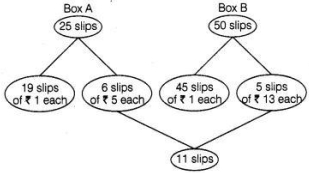
Box $A$ contains $25$ slips of which $19$ are marked $Rs. 1$ and others are marked $Rs. 5$ each. Box $B$ contains $50$ slips of which $45$ are marked $Rs. 1$ each and others are marked $Rs. 13$ each. Slips of both boxes are poured into a third box and reshuffled. $A$ slip is drawn at random. What is the probability that it is marked other than $Rs. 1$?
A
$\frac{45}{75}$
B
$\frac{35}{75}$
C
$\frac{15}{75}$
D
$\frac{11}{75}$
Solution
(D) Total number of slips in the third box,$n(S) = 25 + 50 = 75$.
From the given information:
Number of slips marked $Rs. 1$ in Box $A = 19$.
Number of slips marked $Rs. 5$ in Box $A = 25 - 19 = 6$.
Number of slips marked $Rs. 1$ in Box $B = 45$.
Number of slips marked $Rs. 13$ in Box $B = 50 - 45 = 5$.
Total number of slips marked other than $Rs. 1 = 6 + 5 = 11$.
Therefore,the required probability $= \frac{\text{Number of slips marked other than } Rs. 1}{\text{Total number of slips}} = \frac{11}{75}$.
0 likes
View Solution10
Easy
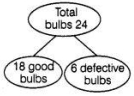
$A$ carton of $24$ bulbs contains $6$ defective bulbs. One bulb is drawn at random. What is the probability that the bulb is not defective? If the bulb selected is defective and it is not replaced, and a second bulb is selected at random from the rest, what is the probability that the second bulb is defective?
Solution
(N/A) Total number of bulbs, $n(S) = 24$.
Number of defective bulbs $= 6$.
Number of non-defective (good) bulbs $= 24 - 6 = 18$.
Part $1$: Probability that the bulb is not defective:
$P(\text{not defective}) = \frac{\text{Number of good bulbs}}{\text{Total number of bulbs}} = \frac{18}{24} = \frac{3}{4}$.
Part $2$: If the first bulb selected is defective and not replaced:
Remaining total number of bulbs $= 24 - 1 = 23$.
Remaining number of defective bulbs $= 6 - 1 = 5$.
Probability that the second bulb is defective $= \frac{\text{Remaining defective bulbs}}{\text{Remaining total bulbs}} = \frac{5}{23}$.
0 likes
View Solution11
Medium
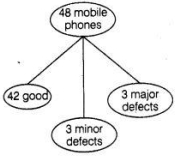
$A$ lot consists of $48$ mobile phones of which $42$ are good,$3$ have only minor defects,and $3$ have major defects. Varnika will buy a phone if it is good,but the trader will only buy a mobile if it has no major defect. One phone is selected at random from the lot. What is the probability that it is
$(i)$ acceptable to Varnika?
$(ii)$ acceptable to the trader?
$(i)$ acceptable to Varnika?
$(ii)$ acceptable to the trader?
Solution
(N/A) Given,total number of mobile phones $n(S) = 48$.
$(i)$ Let $E_{1}$ be the event that Varnika will buy a mobile phone.
Varnika buys only if it is a good mobile.
Therefore,$n(E_{1}) = 42$.
$P(E_{1}) = \frac{n(E_{1})}{n(S)} = \frac{42}{48} = \frac{7}{8}$.
$(ii)$ Let $E_{2}$ be the event that the trader will buy a mobile phone.
The trader will buy only if it has no major defects.
This means the trader will buy the $42$ good phones and the $3$ phones with minor defects.
Therefore,$n(E_{2}) = 42 + 3 = 45$.
$P(E_{2}) = \frac{n(E_{2})}{n(S)} = \frac{45}{48} = \frac{15}{16}$.
0 likes
View Solution12
MediumMCQ
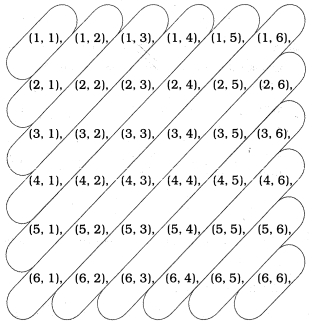
Two unbiased dice are thrown once. Write all the possible outcomes of this experiment. What is the probability that the sum of numbers on two dice is a multiple of $3$ or $4$?
A
$\frac{5}{7}$
B
$\frac{1}{9}$
C
$\frac{7}{9}$
D
$\frac{5}{9}$
Solution
(D) When two unbiased dice are thrown,the total number of possible outcomes is $6 \times 6 = 36$. The sample space $S$ is given by:
$S = \{(1,1), (1,2), (1,3), (1,4), (1,5), (1,6), (2,1), (2,2), (2,3), (2,4), (2,5), (2,6), (3,1), (3,2), (3,3), (3,4), (3,5), (3,6), (4,1), (4,2), (4,3), (4,4), (4,5), (4,6), (5,1), (5,2), (5,3), (5,4), (5,5), (5,6), (6,1), (6,2), (6,3), (6,4), (6,5), (6,6)\}$
Let $E$ be the event that the sum of the numbers on the two dice is a multiple of $3$ or $4$. The possible sums range from $2$ to $12$. Multiples of $3$ are $3, 6, 9, 12$. Multiples of $4$ are $4, 8, 12$.
Thus,we need the sum to be in the set $\{3, 4, 6, 8, 9, 12\}$.
Outcomes with sum $3$: $(1,2), (2,1)$
Outcomes with sum $4$: $(1,3), (2,2), (3,1)$
Outcomes with sum $6$: $(1,5), (2,4), (3,3), (4,2), (5,1)$
Outcomes with sum $8$: $(2,6), (3,5), (4,4), (5,3), (6,2)$
Outcomes with sum $9$: $(3,6), (4,5), (5,4), (6,3)$
Outcomes with sum $12$: $(6,6)$
Total favorable outcomes = $2 + 3 + 5 + 5 + 4 + 1 = 20$.
Probability $P(E) = \frac{\text{Number of favorable outcomes}}{\text{Total number of outcomes}} = \frac{20}{36} = \frac{5}{9}$.
0 likes
View Solution13
MediumMCQ
Two unbiased dice are thrown once. Write all the possible outcomes of this experiment. What is the probability that the sum of numbers on two dice is a factor of $18$?
A
$\frac{2}{3}$
B
$\frac{1}{7}$
C
$\frac{1}{3}$
D
$\frac{1}{5}$
Solution
(C) When two unbiased dice are thrown,the total number of possible outcomes is $6 \times 6 = 36$.
The possible outcomes are:
$(1,1), (1,2), (1,3), (1,4), (1,5), (1,6)$
$(2,1), (2,2), (2,3), (2,4), (2,5), (2,6)$
$(3,1), (3,2), (3,3), (3,4), (3,5), (3,6)$
$(4,1), (4,2), (4,3), (4,4), (4,5), (4,6)$
$(5,1), (5,2), (5,3), (5,4), (5,5), (5,6)$
$(6,1), (6,2), (6,3), (6,4), (6,5), (6,6)$
Let $H$ be the event that the sum of the numbers on the two dice is a factor of $18$. The factors of $18$ are $1, 2, 3, 6, 9, 18$. Since the minimum sum is $2$ and the maximum sum is $12$,the possible sums that are factors of $18$ are $2, 3, 6, 9$.
Favorable outcomes for each sum:
Sum $= 2: (1,1)$
Sum $= 3: (1,2), (2,1)$
Sum $= 6: (1,5), (2,4), (3,3), (4,2), (5,1)$
Sum $= 9: (3,6), (4,5), (5,4), (6,3)$
Total number of favorable outcomes $= 1 + 2 + 5 + 4 = 12$.
Probability $P(H) = \frac{\text{Number of favorable outcomes}}{\text{Total number of outcomes}} = \frac{12}{36} = \frac{1}{3}$.
0 likes
View Solution14
DifficultMCQ
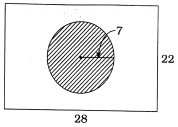
$A$ circle with radius $7 \, cm$ is drawn at the centre of a rectangle $28 \, cm$ long and $22 \, cm$ broad. Find the probability that a ball hitting the rectangle hits the circle.
A
$\frac{1}{11}$
B
$\frac{1}{2}$
C
$\frac{1}{3}$
D
$\frac{1}{4}$
Solution
(D) Area of the rectangle $=$ Length $\times$ Breadth
$= 28 \, cm \times 22 \, cm = 616 \, cm^2$
For the circle,radius $r = 7 \, cm$
Area of the circle $= \pi r^2 = \frac{22}{7} \times 7 \times 7 = 154 \, cm^2$
The probability that a ball hitting the rectangle hits the circle is given by the ratio of the area of the circle to the area of the rectangle.
Required Probability $= \frac{\text{Area of the circle}}{\text{Area of the rectangle}}$
$= \frac{154}{616} = \frac{1}{4}$
Thus,the probability is $\frac{1}{4}$.
0 likes
View Solution15
MediumMCQ
Two balanced dice are rolled. Find the probability that the sum of numbers on two dice lies between $5$ and $9$.
A
$\frac{2}{9}$
B
$\frac{4}{9}$
C
$\frac{4}{5}$
D
$\frac{4}{7}$
Solution
(B) When two dice are rolled,the total number of possible outcomes is $6 \times 6 = 36$.
We need to find the probability that the sum $S$ of the numbers on the two dice lies between $5$ and $9$,which means $5 < S < 9$.
This implies the sum $S$ can be $6, 7,$ or $8$.
- For $S = 6$,the possible outcomes are $(1, 5), (2, 4), (3, 3), (4, 2), (5, 1)$,which are $5$ outcomes.
- For $S = 7$,the possible outcomes are $(1, 6), (2, 5), (3, 4), (4, 3), (5, 2), (6, 1)$,which are $6$ outcomes.
- For $S = 8$,the possible outcomes are $(2, 6), (3, 5), (4, 4), (5, 3), (6, 2)$,which are $5$ outcomes.
Total favorable outcomes = $5 + 6 + 5 = 16$.
Probability = $\frac{\text{Favorable outcomes}}{\text{Total outcomes}} = \frac{16}{36} = \frac{4}{9}$.
0 likes
View SolutionProbability — Mix Examples - Probability · Frequently Asked Questions
1Are these Probability questions useful for JEE and NEET?
Yes. All questions in this section are mapped to JEE Main and NEET exam patterns. Previous year questions from JEE Main, NEET, GUJCET and state-level exams are included with full solutions.
2Can I switch to Hindi or Gujarati for these questions?
Yes. Use the language tabs in the hero section or the sidebar to view the same questions and solutions in English, Hindi or Gujarati.
3How do I generate a question paper from this subtopic?
Use the Vedclass Exam Paper Generator — select the chapter and subtopic, set difficulty, and generate Sets A, B, C, D automatically. First 3 chapters of every subject are free.
Vedclass Products
For Students
Vedclass Test Series
Mock tests in real JEE/NEET style with performance analysis. 5-day free trial.
Start Free TrialFor Teachers
Exam Paper Generator
Generate Set A/B/C/D papers from this chapter in 2 minutes. 3 chapters free.
Try FreeFor Institutes
Online Exam Module
Live online exams with unlimited students, 360° analytics & white-label branding.
See DemoFor Teachers & Institutes
Generate a Probability Exam Paper in 2 Minutes
Select subtopic & difficulty — Sets A, B, C, D auto-generated with No Repeat logic.
First 3 chapters of every subject are free — no payment required.