
A English
Mix Examples - Some Applications of Trigonometry Questions in English
Class 10 Mathematics · Some Applications of Trigonometry · Mix Examples - Some Applications of Trigonometry
4+
Questions
English
Language
100%
With Solutions
Showing 4 of 4 questions in English
1
DifficultMCQ
Watching from the top of a building $40 \, m$ high,the angle of depression of a moving car increases from $30^{\circ}$ to $45^{\circ}$ in some interval of time. Find the distance covered by the car in that interval of time. (in $m$)
A
$30.4$
B
$29.2$
C
$19.6$
D
$33.3$
Solution
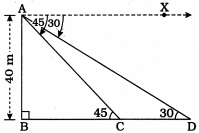
(B) Let $\overline{AB}$ be the building of height $40 \, m$. Let $C$ and $D$ be the two positions of the moving car.
From the figure,$AB = 40 \, m$ and $\angle B = 90^{\circ}$.
The angles of depression are $\angle XAC = 45^{\circ}$ and $\angle XAD = 30^{\circ}$.
Since the line $AX$ is parallel to $BD$,the alternate interior angles are equal:
$\angle ACB = \angle XAC = 45^{\circ}$ and $\angle ADB = \angle XAD = 30^{\circ}$.
In right-angled $\triangle ABC$:
$\tan(45^{\circ}) = \frac{AB}{BC} \implies 1 = \frac{40}{BC} \implies BC = 40 \, m$.
In right-angled $\triangle ABD$:
$\tan(30^{\circ}) = \frac{AB}{BD} \implies \frac{1}{\sqrt{3}} = \frac{40}{BD} \implies BD = 40\sqrt{3} \, m$.
Using $\sqrt{3} \approx 1.73$,we get $BD = 40 \times 1.73 = 69.2 \, m$.
The distance covered by the car is $CD = BD - BC$.
$CD = 69.2 - 40 = 29.2 \, m$.
Thus,the distance covered by the car is $29.2 \, m$.
0 likes
View Solution2
DifficultMCQ
The distance between two poles of equal height is $200 \, m$. From a point situated on the line segment joining their bases,the angles of elevation of their tops are found to be $60^{\circ}$ and $30^{\circ}$. Find the height of the pole in $m$.
A
$88.5$
B
$76.3$
C
$86.5$
D
$80.8$
Solution
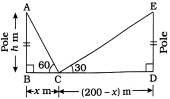
(C) Let $\overline{AB}$ and $\overline{ED}$ be two poles of equal height $h \, m$ and $C$ be the point of observation on the line segment $\overline{BD}$ joining the bases of the poles.
Given $BD = 200 \, m$. Let $BC = x \, m$,then $CD = (200 - x) \, m$.
The angles of elevation are $\angle ACB = 60^{\circ}$ and $\angle ECD = 30^{\circ}$.
In $\triangle ABC$,$\tan 60^{\circ} = \frac{AB}{BC} \implies \sqrt{3} = \frac{h}{x} \implies x = \frac{h}{\sqrt{3}} \quad \dots(1)$
In $\triangle EDC$,$\tan 30^{\circ} = \frac{ED}{CD} \implies \frac{1}{\sqrt{3}} = \frac{h}{200 - x} \implies 200 - x = \sqrt{3}h \implies x = 200 - \sqrt{3}h \quad \dots(2)$
Equating $(1)$ and $(2)$:
$\frac{h}{\sqrt{3}} = 200 - \sqrt{3}h$
$h = 200\sqrt{3} - 3h$
$4h = 200\sqrt{3}$
$h = 50\sqrt{3} \approx 50 \times 1.732 = 86.6 \, m$ (Using $\sqrt{3} \approx 1.732$,the closest option is $86.5 \, m$).
0 likes
View Solution3
MediumMCQ
The height of a tower is $50 \, m$ and the height of a building is $30 \, m$. Watching from the midpoint of the line segment joining their bases,the angle of elevation of the top of the tower is $\alpha$ and that of the building is $\beta$. Then,which of the following holds true?
A
$\alpha = \beta$
B
$\alpha > \beta$
C
$\alpha \leqslant \beta$
D
$\alpha < \beta$
Solution
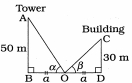
(B) Let the distance between the base of the tower and the midpoint be $a$,and the distance between the base of the building and the midpoint be $a$.
In the right-angled triangle formed by the tower,we have $\tan \alpha = \frac{50}{a}$.
In the right-angled triangle formed by the building,we have $\tan \beta = \frac{30}{a}$.
Taking the ratio,we get $\frac{\tan \alpha}{\tan \beta} = \frac{50/a}{30/a} = \frac{50}{30} = \frac{5}{3}$.
Since $\frac{5}{3} > 1$,it follows that $\tan \alpha > \tan \beta$.
Since the tangent function is strictly increasing in the interval $(0, 90^\circ)$,$\tan \alpha > \tan \beta$ implies $\alpha > \beta$.
0 likes
View Solution4
MediumMCQ
$A$ person is watching from a point $A$ on the ground,which is $x \ m$ away from the base of a building. The height of the building is $y \ m$ and the angle of elevation of the top of the building is found to be $70^\circ$. Then:
A
$x = y$
B
$x < y$
C
$x > y$
D
$x = 2y$
Solution
(B) In the right-angled triangle formed,the height of the building is $y$ (opposite side) and the distance from the base is $x$ (adjacent side).
Using the trigonometric ratio,$\tan(70^\circ) = \frac{\text{opposite}}{\text{adjacent}} = \frac{y}{x}$.
We know that $\tan(45^\circ) = 1$.
Since the tangent function is increasing in the interval $(0^\circ, 90^\circ)$,and $70^\circ > 45^\circ$,it follows that $\tan(70^\circ) > \tan(45^\circ)$.
Therefore,$\tan(70^\circ) > 1$.
Substituting the ratio,$\frac{y}{x} > 1$.
Since $x$ and $y$ are lengths (positive values),we can multiply both sides by $x$ to get $y > x$,which is equivalent to $x < y$.

0 likes
View SolutionSome Applications of Trigonometry — Mix Examples - Some Applications of Trigonometry · Frequently Asked Questions
1Are these Some Applications of Trigonometry questions useful for JEE and NEET?
Yes. All questions in this section are mapped to JEE Main and NEET exam patterns. Previous year questions from JEE Main, NEET, GUJCET and state-level exams are included with full solutions.
2Can I switch to Hindi or Gujarati for these questions?
Yes. Use the language tabs in the hero section or the sidebar to view the same questions and solutions in English, Hindi or Gujarati.
3How do I generate a question paper from this subtopic?
Use the Vedclass Exam Paper Generator — select the chapter and subtopic, set difficulty, and generate Sets A, B, C, D automatically. First 3 chapters of every subject are free.
Vedclass Products
For Students
Vedclass Test Series
Mock tests in real JEE/NEET style with performance analysis. 5-day free trial.
Start Free TrialFor Teachers
Exam Paper Generator
Generate Set A/B/C/D papers from this chapter in 2 minutes. 3 chapters free.
Try FreeFor Institutes
Online Exam Module
Live online exams with unlimited students, 360° analytics & white-label branding.
See DemoFor Teachers & Institutes
Generate a Some Applications of Trigonometry Exam Paper in 2 Minutes
Select subtopic & difficulty — Sets A, B, C, D auto-generated with No Repeat logic.
First 3 chapters of every subject are free — no payment required.