
A English
Mix Examples - Surface Areas and Volumes Questions in English
Class 10 Mathematics · Surface Areas and Volumes · Mix Examples - Surface Areas and Volumes
15+
Questions
English
Language
100%
With Solutions
Showing 15 of 15 questions in English
1
EasyMCQ
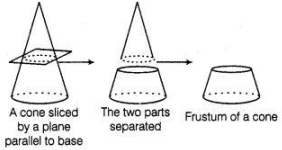
$A$ cone is cut by a plane parallel to its base and the smaller cone formed on the upper side of the plane is removed. The remaining part on the other side of the plane is called:
A
sphere
B
cylinder
C
cone
D
a frustum of a cone
Solution
(D) When a cone is cut by a plane parallel to its base,it is divided into two parts: a smaller cone at the top and a remaining part at the bottom. The remaining part,which has two circular bases of different radii,is known as the frustum of a cone.
2 likes
View Solution2
MediumMCQ
Volumes of two spheres are in the ratio $64: 27$. The ratio of their surface areas is
A
$16:9$
B
$9:16$
C
$4:3$
D
$3:4$
Solution
(A) Let the radii of the two spheres be $r_1$ and $r_2$,respectively.
The volume of a sphere is given by $V = \frac{4}{3} \pi r^3$.
Given the ratio of volumes $V_1 : V_2 = 64 : 27$,we have:
$\frac{\frac{4}{3} \pi r_1^3}{\frac{4}{3} \pi r_2^3} = \frac{64}{27}$
$\frac{r_1^3}{r_2^3} = \frac{64}{27} = \left(\frac{4}{3}\right)^3$
Taking the cube root on both sides,we get:
$\frac{r_1}{r_2} = \frac{4}{3}$
The surface area of a sphere is given by $A = 4 \pi r^2$.
The ratio of their surface areas is:
$\frac{A_1}{A_2} = \frac{4 \pi r_1^2}{4 \pi r_2^2} = \left(\frac{r_1}{r_2}\right)^2$
Substituting the value of $\frac{r_1}{r_2}$:
$\frac{A_1}{A_2} = \left(\frac{4}{3}\right)^2 = \frac{16}{9}$
Thus,the ratio of their surface areas is $16:9$.
0 likes
View Solution3
Difficult
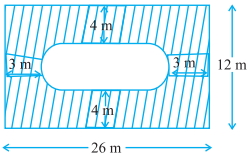
Find the area of the shaded region in the given figure.
Solution
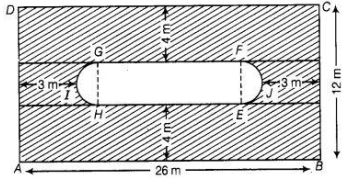
(N/A) The outer rectangle $ABCD$ has length $L = 26 \, m$ and breadth $B = 12 \, m$.
Area of outer rectangle $= L \times B = 26 \times 12 = 312 \, m^2$.
The inner unshaded region consists of a rectangle and two semi-circles.
The breadth of the inner rectangle is $12 - (4 + 4) = 4 \, m$. This is also the diameter of the two semi-circles.
Radius of each semi-circle $r = 4 / 2 = 2 \, m$.
The length of the inner rectangle is $26 - (3 + 3 + 2 + 2) = 16 \, m$ (subtracting the $3 \, m$ gaps and the two radii of the semi-circles).
Area of inner rectangle $= 16 \times 4 = 64 \, m^2$.
Area of two semi-circles $= 2 \times (\frac{1}{2} \pi r^2) = \pi r^2 = \pi (2)^2 = 4\pi \, m^2$.
Total unshaded area $= 64 + 4\pi \, m^2$.
Area of shaded region $=$ Area of outer rectangle $-$ Total unshaded area
$= 312 - (64 + 4\pi) = (248 - 4\pi) \, m^2$.
0 likes
View Solution4
DifficultMCQ
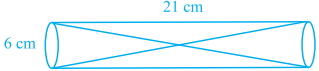
Two solid cones $A$ and $B$ are placed in a cylindrical tube as shown in the figure. The ratio of their capacities is $2:1$. Find the heights and capacities of the cones. Also,find the volume of the remaining portion of the cylinder (in $cm^{3}$).
A
$594$
B
$234$
C
$396$
D
$132$
Solution
(C) Let the volume of cone $A$ be $2V$ and the volume of cone $B$ be $V$. Let the height of cone $A$ be $h_1 \, cm$,then the height of cone $B$ is $(21 - h_1) \, cm$.
Given,the diameter of the cones $= 6 \, cm$.
Therefore,the radius of the cones $r = \frac{6}{2} = 3 \, cm$.
Volume of cone $A = 2V = \frac{1}{3} \pi r^2 h_1 = \frac{1}{3} \pi (3)^2 h_1 = 3 \pi h_1$.
Thus,$V = \frac{3}{2} \pi h_1$ ...... $(i)$
Volume of cone $B = V = \frac{1}{3} \pi r^2 (21 - h_1) = \frac{1}{3} \pi (3)^2 (21 - h_1) = 3 \pi (21 - h_1)$ ...... $(ii)$
Equating $(i)$ and $(ii)$:
$\frac{3}{2} \pi h_1 = 3 \pi (21 - h_1)$
$\frac{1}{2} h_1 = 21 - h_1$
$\frac{3}{2} h_1 = 21$
$h_1 = 14 \, cm$.
Height of cone $A = 14 \, cm$,Height of cone $B = 21 - 14 = 7 \, cm$.
Volume of cone $A = 3 \pi (14) = 3 \times \frac{22}{7} \times 14 = 132 \, cm^3$.
Volume of cone $B = 3 \pi (7) = 3 \times \frac{22}{7} \times 7 = 66 \, cm^3$.
Volume of the cylinder $= \pi r^2 H = \frac{22}{7} \times (3)^2 \times 21 = 22 \times 9 \times 3 = 594 \, cm^3$.
Volume of the remaining portion $=$ Volume of cylinder $-$ (Volume of cone $A$ $+$ Volume of cone $B$)
$= 594 - (132 + 66) = 594 - 198 = 396 \, cm^3$.
0 likes
View Solution5
Difficult
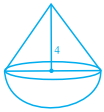
$A$ solid toy is in the form of a hemisphere surmounted by a right circular cone. The height of the cone is $4\, cm$ and the diameter of the base is $8\, cm$. Determine the volume of the toy. If a cube circumscribes the toy,then find the difference of the volumes of cube and the toy. Also,find the total surface area of the toy.
Solution
(N/A) Let $r$ be the radius of the hemisphere and the cone,and $h$ be the height of the cone. Given $h = 4\, cm$ and diameter $d = 8\, cm$,so $r = 4\, cm$.
Volume of the toy $=$ Volume of the hemisphere $+$ Volume of the cone
$= \frac{2}{3} \pi r^3 + \frac{1}{3} \pi r^2 h = \frac{1}{3} \pi r^2 (2r + h)$
$= \frac{1}{3} \times \frac{22}{7} \times 4^2 \times (2 \times 4 + 4) = \frac{1}{3} \times \frac{22}{7} \times 16 \times 12 = \frac{1408}{7} \approx 201.14\, cm^3$.
$A$ cube circumscribes the toy. The height of the toy is $h + r = 4 + 4 = 8\, cm$ and the width is $8\, cm$. Thus,the edge of the cube is $a = 8\, cm$.
Volume of the cube $= a^3 = 8^3 = 512\, cm^3$.
Difference in volumes $= 512 - 201.14 = 310.86\, cm^3$.
Total surface area of the toy $=$ Curved surface area of cone $+$ Curved surface area of hemisphere
$= \pi r l + 2 \pi r^2$,where slant height $l = \sqrt{h^2 + r^2} = \sqrt{4^2 + 4^2} = 4\sqrt{2}\, cm$.
$= \pi r (l + 2r) = \frac{22}{7} \times 4 \times (4\sqrt{2} + 8) = \frac{88}{7} \times 4(\sqrt{2} + 2) = \frac{352}{7} (1.414 + 2) \approx 171.68\, cm^2$.
0 likes
View Solution6
Medium
$A$ heap of rice is in the form of a cone of diameter $9 \, m$ and height $3.5 \, m$. Find the volume of the rice. How much canvas cloth is required to just cover the heap?
Solution
(N/A) Given that,a heap of rice is in the form of a cone.
Height of the cone $(h) = 3.5 \, m$.
Diameter of the cone $= 9 \, m$,so the radius $(r) = \frac{9}{2} = 4.5 \, m$.
Volume of the rice $= \frac{1}{3} \pi r^2 h = \frac{1}{3} \times \frac{22}{7} \times (4.5)^2 \times 3.5 = \frac{1}{3} \times \frac{22}{7} \times 20.25 \times 3.5 = 74.25 \, m^3$.
To cover the heap,we need the curved surface area of the cone,which is $\pi r l$,where $l = \sqrt{r^2 + h^2}$.
$l = \sqrt{(4.5)^2 + (3.5)^2} = \sqrt{20.25 + 12.25} = \sqrt{32.5} \approx 5.70 \, m$.
Curved surface area $= \frac{22}{7} \times 4.5 \times 5.70 \approx 80.61 \, m^2$.
Thus,the volume is $74.25 \, m^3$ and the required canvas cloth is $80.61 \, m^2$.
0 likes
View Solution7
Difficult
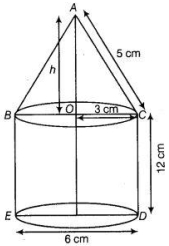
$A$ rocket is in the form of a right circular cylinder closed at the lower end and surmounted by a cone with the same radius as that of the cylinder. The diameter and height of the cylinder are $6 \, cm$ and $12 \, cm$,respectively. If the slant height of the conical portion is $5 \, cm$,find the total surface area and volume of the rocket. [Use $\pi = 3.14$]
Solution
(N/A) The rocket is a combination of a right circular cylinder and a cone.
Given: Diameter of the cylinder $= 6 \, cm$.
Radius of the cylinder $(r) = \frac{6}{2} = 3 \, cm$.
Height of the cylinder $(H) = 12 \, cm$.
Volume of the cylinder $= \pi r^2 H = 3.14 \times (3)^2 \times 12 = 3.14 \times 9 \times 12 = 339.12 \, cm^3$.
Curved surface area of the cylinder $= 2 \pi r H = 2 \times 3.14 \times 3 \times 12 = 226.08 \, cm^2$.
For the cone,slant height $(l) = 5 \, cm$ and radius $(r) = 3 \, cm$.
Height of the cone $(h) = \sqrt{l^2 - r^2} = \sqrt{5^2 - 3^2} = \sqrt{25 - 9} = \sqrt{16} = 4 \, cm$.
Volume of the cone $= \frac{1}{3} \pi r^2 h = \frac{1}{3} \times 3.14 \times (3)^2 \times 4 = 3.14 \times 3 \times 4 = 37.68 \, cm^3$.
Curved surface area of the cone $= \pi r l = 3.14 \times 3 \times 5 = 47.1 \, cm^2$.
Total volume of the rocket $= \text{Volume of cylinder} + \text{Volume of cone} = 339.12 + 37.68 = 376.8 \, cm^3$.
Total surface area of the rocket $= \text{CSA of cone} + \text{CSA of cylinder} + \text{Area of base of cylinder} = 47.1 + 226.08 + (\pi r^2) = 47.1 + 226.08 + (3.14 \times 3^2) = 47.1 + 226.08 + 28.26 = 301.44 \, cm^2$.
0 likes
View Solution8
MediumMCQ
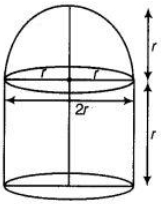
$A$ building is in the form of a cylinder surmounted by a hemispherical vaulted dome and contains $41 \frac{19}{21} \, m^3$ of air. If the internal diameter of the dome is equal to its total height above the floor,find the height of the building? (in $m$)
A
$2$
B
$20$
C
$4$
D
$40$
Solution
(C) Let the total height of the building be equal to the internal diameter of the dome,which is $2r \, m$.
Therefore,the radius of the building (or dome) is $\frac{2r}{2} = r \, m$.
The height of the cylindrical part is $2r - r = r \, m$.
Volume of the cylinder $= \pi r^2 h = \pi r^2 (r) = \pi r^3 \, m^3$.
Volume of the hemispherical dome $= \frac{2}{3} \pi r^3 \, m^3$.
Total volume of the building $=$ Volume of the cylinder $+$ Volume of the hemispherical dome.
Total volume $= \pi r^3 + \frac{2}{3} \pi r^3 = \frac{5}{3} \pi r^3 \, m^3$.
Given that the volume of air inside is $41 \frac{19}{21} \, m^3 = \frac{880}{21} \, m^3$.
Equating the volumes: $\frac{5}{3} \pi r^3 = \frac{880}{21}$.
Using $\pi = \frac{22}{7}$,we get $\frac{5}{3} \times \frac{22}{7} \times r^3 = \frac{880}{21}$.
$\frac{110}{21} r^3 = \frac{880}{21}$.
$r^3 = \frac{880}{110} = 8$.
$r = \sqrt[3]{8} = 2 \, m$.
Total height of the building $= 2r = 2 \times 2 = 4 \, m$.
0 likes
View Solution9
DifficultMCQ
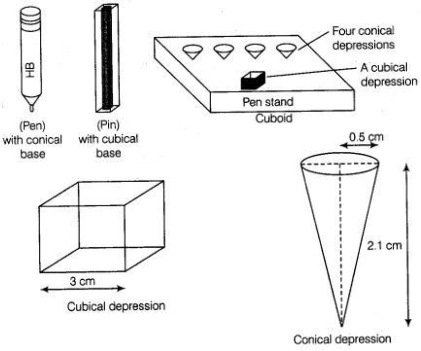
$A$ pen stand made of wood is in the shape of a cuboid with four conical depressions and a cubical depression to hold the pens and pins,respectively. The dimensions of the cuboid are $10 \, cm$,$5 \, cm$,and $4 \, cm$. The radius of each of the conical depressions is $0.5 \, cm$ and the depth is $2.1 \, cm$. The edge of the cubical depression is $3 \, cm$. Find the volume of the wood in the entire stand. (in $, cm^3$)
A
$188.8$
B
$172.6$
C
$175.2$
D
$170.8$
Solution
(D) Given:
Length of the cuboid $(l) = 10 \, cm$,breadth $(b) = 5 \, cm$,and height $(h) = 4 \, cm$.
Volume of the cuboid $= l \times b \times h = 10 \times 5 \times 4 = 200 \, cm^3$.
Radius of each conical depression $(r) = 0.5 \, cm$ and depth $(h_1) = 2.1 \, cm$.
Volume of one conical depression $= \frac{1}{3} \pi r^2 h_1 = \frac{1}{3} \times \frac{22}{7} \times (0.5)^2 \times 2.1 = \frac{1}{3} \times \frac{22}{7} \times 0.25 \times 2.1 = 0.55 \, cm^3$.
Volume of $4$ conical depressions $= 4 \times 0.55 = 2.2 \, cm^3$.
Edge of the cubical depression $(a) = 3 \, cm$.
Volume of the cubical depression $= a^3 = 3^3 = 27 \, cm^3$.
Volume of wood in the stand $=$ Volume of cuboid $-$ (Volume of $4$ conical depressions $+$ Volume of cubical depression)
$= 200 - (2.2 + 27) = 200 - 29.2 = 170.8 \, cm^3$.
0 likes
View Solution10
Difficult
The radii of a frustum of a cone are $14 \,cm$ and $7 \,cm$. If its height is $24 \,cm$,find its curved surface area,total surface area,and volume.
Solution
(N/A) For the given frustum of a cone,
bigger radius $r_{1} = 14 \,cm$,smaller radius $r_{2} = 7 \,cm$,and height $h = 24 \,cm$.
Slant height of the frustum of a cone $l = \sqrt{h^{2} + (r_{1} - r_{2})^{2}}$
$= \sqrt{24^{2} + (14 - 7)^{2}}$
$= \sqrt{576 + 49}$
$= \sqrt{625} = 25 \,cm$.
Curved Surface Area $(CSA)$ $= \pi l(r_{1} + r_{2})$
$= \frac{22}{7} \times 25 \times (14 + 7)$
$= \frac{22}{7} \times 25 \times 21 = 22 \times 25 \times 3 = 1650 \,cm^{2}$.
Total Surface Area $(TSA)$ $= \pi l(r_{1} + r_{2}) + \pi r_{1}^{2} + \pi r_{2}^{2}$
$= 1650 + \frac{22}{7} \times (14^{2} + 7^{2})$
$= 1650 + \frac{22}{7} \times (196 + 49)$
$= 1650 + \frac{22}{7} \times 245$
$= 1650 + 22 \times 35 = 1650 + 770 = 2420 \,cm^{2}$.
Volume $= \frac{1}{3} \pi h(r_{1}^{2} + r_{2}^{2} + r_{1}r_{2})$
$= \frac{1}{3} \times \frac{22}{7} \times 24 \times (196 + 49 + 98)$
$= \frac{22 \times 8}{7} \times 343$
$= 22 \times 8 \times 49 = 8624 \,cm^{3}$.
Thus,the $CSA$ is $1650 \,cm^{2}$,$TSA$ is $2420 \,cm^{2}$,and volume is $8624 \,cm^{3}$.
0 likes
View Solution11
Medium
The radii of a frustum of a cone are $35 \, cm$ and $21 \, cm$ and its height is $48 \, cm$. Find the curved surface area,the total surface area,and the volume of the frustum of a cone.
Solution
(N/A) Given: $R = 35 \, cm$,$r = 21 \, cm$,$h = 48 \, cm$.
First,calculate the slant height $l = \sqrt{h^2 + (R - r)^2} = \sqrt{48^2 + (35 - 21)^2} = \sqrt{2304 + 196} = \sqrt{2500} = 50 \, cm$.
Curved Surface Area $(CSA)$ $= \pi(R + r)l = \frac{22}{7} \times (35 + 21) \times 50 = \frac{22}{7} \times 56 \times 50 = 22 \times 8 \times 50 = 8800 \, cm^2$.
Total Surface Area $(TSA)$ $= \pi l(R + r) + \pi R^2 + \pi r^2 = 8800 + \frac{22}{7} \times (35^2 + 21^2) = 8800 + \frac{22}{7} \times (1225 + 441) = 8800 + \frac{22}{7} \times 1666 = 8800 + 22 \times 238 = 8800 + 5236 = 14036 \, cm^2$.
Volume $V = \frac{1}{3} \pi h (R^2 + r^2 + Rr) = \frac{1}{3} \times \frac{22}{7} \times 48 \times (35^2 + 21^2 + 35 \times 21) = \frac{22 \times 16}{7} \times (1225 + 441 + 735) = \frac{352}{7} \times 2401 = 352 \times 343 = 120736 \, cm^3$.
0 likes
View Solution12
MediumMCQ
$A$ cylinder with radius $8 \, cm$ and height $9 \, cm$ is surmounted by a cone of height $15 \, cm$. Find the total surface area and the volume of the combined solid.
A
$880 \, cm^2, 2816 \, cm^3$
B
$900 \, cm^2, 2500 \, cm^3$
C
$850 \, cm^2, 2700 \, cm^3$
D
$920 \, cm^2, 3000 \, cm^3$
Solution
(A) Given: Radius of cylinder $(r)$ = $8 \, cm$,Height of cylinder $(h_1)$ = $9 \, cm$,Height of cone $(h_2)$ = $15 \, cm$.
Slant height of cone $(l)$ = $\sqrt{r^2 + h_2^2} = \sqrt{8^2 + 15^2} = \sqrt{64 + 225} = \sqrt{289} = 17 \, cm$.
Total Surface Area = Curved surface area of cylinder + Curved surface area of cone + Base area of cylinder.
$= 2\pi rh_1 + \pi rl + \pi r^2 = \pi r(2h_1 + l + r) = \frac{22}{7} \times 8 \times (2 \times 9 + 17 + 8) = \frac{176}{7} \times (18 + 17 + 8) = \frac{176}{7} \times 43 \approx 1081.14 \, cm^2$.
(Note: Using $\pi = 3.14$,Area $\approx 3.14 \times 8 \times 43 = 1079.68 \, cm^2$).
Volume = Volume of cylinder + Volume of cone = $\pi r^2 h_1 + \frac{1}{3} \pi r^2 h_2 = \pi r^2 (h_1 + \frac{h_2}{3}) = \frac{22}{7} \times 8^2 \times (9 + \frac{15}{3}) = \frac{22}{7} \times 64 \times 14 = 22 \times 64 \times 2 = 2816 \, cm^3$.
1 likes
View Solution13
Medium
$A$ container is made by closing one end of a cylinder with radius $35 \,cm$ and height $52 \,cm$ by a cone with height $12 \,cm$. How many litres of water can it store? Find the total surface area of this closed container.
Solution
(N/A) $1$. Volume of the container: The container consists of a cylinder and a cone. The radius $r = 35 \,cm$,height of cylinder $h_1 = 52 \,cm$,and height of cone $h_2 = 12 \,cm$.
Volume of cylinder $V_1 = \pi r^2 h_1 = \frac{22}{7} \times 35 \times 35 \times 52 = 200,200 \,cm^3$.
Volume of cone $V_2 = \frac{1}{3} \pi r^2 h_2 = \frac{1}{3} \times \frac{22}{7} \times 35 \times 35 \times 12 = 15,400 \,cm^3$.
Total volume $V = V_1 + V_2 = 200,200 + 15,400 = 215,600 \,cm^3$.
Since $1,000 \,cm^3 = 1 \,litre$,the volume is $215.6 \,litres$.
$2$. Total Surface Area: The surface area includes the base of the cylinder,the curved surface area of the cylinder,and the curved surface area of the cone.
Slant height of cone $l = \sqrt{r^2 + h_2^2} = \sqrt{35^2 + 12^2} = \sqrt{1225 + 144} = \sqrt{1369} = 37 \,cm$.
Base area of cylinder $= \pi r^2 = \frac{22}{7} \times 35 \times 35 = 3,850 \,cm^2$.
Curved surface area of cylinder $= 2 \pi r h_1 = 2 \times \frac{22}{7} \times 35 \times 52 = 11,440 \,cm^2$.
Curved surface area of cone $= \pi r l = \frac{22}{7} \times 35 \times 37 = 4,070 \,cm^2$.
Total surface area $= 3,850 + 11,440 + 4,070 = 19,360 \,cm^2$.
0 likes
View Solution14
Medium
The base of a cone with radius $21 \, cm$ and height $20 \, cm$ is hemispherical. Find its curved surface area and volume.
Solution
(N/A) $1$. Slant height $(l)$ of the cone: $l = \sqrt{r^2 + h^2} = \sqrt{21^2 + 20^2} = \sqrt{441 + 400} = \sqrt{841} = 29 \, cm$.
$2$. Curved Surface Area $(CSA)$ of the cone: $CSA_{cone} = \pi rl = \frac{22}{7} \times 21 \times 29 = 22 \times 3 \times 29 = 1914 \, cm^2$.
$3$. Curved Surface Area $(CSA)$ of the hemisphere: $CSA_{hemi} = 2\pi r^2 = 2 \times \frac{22}{7} \times 21 \times 21 = 2 \times 22 \times 3 \times 21 = 2772 \, cm^2$.
$4$. Total Curved Surface Area: $1914 + 2772 = 4686 \, cm^2$.
$5$. Volume of the cone $(V_{cone})$: $V_{cone} = \frac{1}{3} \pi r^2 h = \frac{1}{3} \times \frac{22}{7} \times 21 \times 21 \times 20 = 22 \times 21 \times 20 = 9240 \, cm^3$.
$6$. Volume of the hemisphere $(V_{hemi})$: $V_{hemi} = \frac{2}{3} \pi r^3 = \frac{2}{3} \times \frac{22}{7} \times 21 \times 21 \times 21 = 2 \times 22 \times 21 \times 21 = 19404 \, cm^3$.
$7$. Total Volume: $9240 + 19404 = 28644 \, cm^3$.
0 likes
View Solution15
MediumMCQ
Which of the following correctly matches the information given in Part $I$ and Part $II$?
| Part $I$ | Part $II$ |
|---|---|
| $1.$ $CSA$ of a cylinder | $a.$ $3\pi r^2$ |
| $2.$ $CSA$ of a sphere | $b.$ $2\pi rh$ |
| $3.$ $CSA$ of a cone | $c.$ $4\pi r^2$ |
| $4.$ $TSA$ of a hemisphere | $d.$ $\pi rl$ |
A
$(1-a), (2-b), (3-c), (4-d)$
B
$(1-b), (2-c), (3-d), (4-a)$
C
$(1-c), (2-d), (3-a), (4-b)$
D
$(1-d), (2-a), (3-b), (4-c)$
Solution
(B) To match the given parts,we identify the formulas for surface areas:
$1$. The Curved Surface Area $(CSA)$ of a cylinder is $2\pi rh$. Thus,$1-b$.
$2$. The Curved Surface Area $(CSA)$ of a sphere is $4\pi r^2$. Thus,$2-c$.
$3$. The Curved Surface Area $(CSA)$ of a cone is $\pi rl$. Thus,$3-d$.
$4$. The Total Surface Area $(TSA)$ of a hemisphere is $3\pi r^2$. Thus,$4-a$.
Therefore,the correct matching is $(1-b), (2-c), (3-d), (4-a)$.
0 likes
View SolutionSurface Areas and Volumes — Mix Examples - Surface Areas and Volumes · Frequently Asked Questions
1Are these Surface Areas and Volumes questions useful for JEE and NEET?
Yes. All questions in this section are mapped to JEE Main and NEET exam patterns. Previous year questions from JEE Main, NEET, GUJCET and state-level exams are included with full solutions.
2Can I switch to Hindi or Gujarati for these questions?
Yes. Use the language tabs in the hero section or the sidebar to view the same questions and solutions in English, Hindi or Gujarati.
3How do I generate a question paper from this subtopic?
Use the Vedclass Exam Paper Generator — select the chapter and subtopic, set difficulty, and generate Sets A, B, C, D automatically. First 3 chapters of every subject are free.
Vedclass Products
For Students
Vedclass Test Series
Mock tests in real JEE/NEET style with performance analysis. 5-day free trial.
Start Free TrialFor Teachers
Exam Paper Generator
Generate Set A/B/C/D papers from this chapter in 2 minutes. 3 chapters free.
Try FreeFor Institutes
Online Exam Module
Live online exams with unlimited students, 360° analytics & white-label branding.
See DemoFor Teachers & Institutes
Generate a Surface Areas and Volumes Exam Paper in 2 Minutes
Select subtopic & difficulty — Sets A, B, C, D auto-generated with No Repeat logic.
First 3 chapters of every subject are free — no payment required.