
A English
Reproduction in Human Beings Questions in English
Class 10 Science · How do Organisms Reproduce? · Reproduction in Human Beings
96+
Questions
English
Language
100%
With Solutions
Showing 50 of 96 questions in English
1
EasyMCQ
What is the role of the seminal vesicles and the prostate gland?
A
They produce sperms.
B
They provide nutrition and a fluid medium for sperm transport.
C
They are responsible for the maturation of sperms.
D
They prevent the entry of pathogens into the reproductive tract.
Solution
(B) The secretions from the seminal vesicles and prostate glands serve two primary functions:
$1$. They provide a fluid medium that facilitates the easy transport of sperms.
$2$. They provide essential nutrients to the sperms,including fructose,calcium,and various enzymes,which help in their survival and motility.
$1$. They provide a fluid medium that facilitates the easy transport of sperms.
$2$. They provide essential nutrients to the sperms,including fructose,calcium,and various enzymes,which help in their survival and motility.
0 likes
View Solution2
Medium
What are the changes seen in girls at the time of puberty?
Solution
(N/A) During puberty,girls undergo several physical and physiological changes due to the secretion of hormones like estrogen and progesterone:
$1$. Breast development: There is an increase in breast size and the skin of the nipples becomes darker.
$2$. Hair growth: Appearance of hair in the genital area and other parts of the body such as underarms,face,hands,and legs.
$3$. Reproductive system maturation: Increase in the size of the uterus and ovaries.
$4$. Menstruation: The beginning of the menstrual cycle (menarche).
$5$. Skin changes: Increased secretion of oil from the skin glands,which often leads to the appearance of pimples.
0 likes
View Solution3
Medium
How does the embryo get nourishment inside the mother's body?
Solution
(N/A) The embryo develops inside the mother's body for about nine months. Inside the uterus,the outer tissue surrounding the embryo develops finger-like projections called villi. These villi are surrounded by uterine tissue and maternal blood. They provide a large surface area for the exchange of oxygen and nutrients. Also,there is a special tissue called the placenta,which is embedded in the uterine wall. The embryo receives oxygen and nutrients from the mother's blood via the placenta. The waste materials produced by the embryo are also removed through the placenta.
0 likes
View Solution4
EasyMCQ
Which of the following is not a part of the female reproductive system in human beings?
A
Ovary
B
Vas deferens
C
Uterus
D
Fallopian tube
Solution
(B) The female reproductive system in humans consists of the ovaries, fallopian tubes, uterus, cervix, and vagina.
Vas deferens is a part of the male reproductive system, which transports sperm from the epididymis to the ejaculatory duct.
Therefore, $Vas \text{ } deferens$ is not a part of the female reproductive system.
Vas deferens is a part of the male reproductive system, which transports sperm from the epididymis to the ejaculatory duct.
Therefore, $Vas \text{ } deferens$ is not a part of the female reproductive system.
0 likes
View Solution5
Easy
What are the functions performed by the testis in human beings?
Solution
(N/A) The testes are the primary male reproductive organs located outside the abdominal cavity within a pouch called the $scrotum$.
Functions of the testes:
$1$. $Spermatogenesis$: The testes are responsible for the production of male gametes, known as $sperms$.
$2$. Hormone production: The testes secrete the male sex hormone, $testosterone$. This hormone is responsible for the development of secondary sexual characteristics in boys during puberty, such as the deepening of the voice, growth of facial hair, and increased muscle mass.
0 likes
View Solution6
EasyMCQ
Why does menstruation occur?
A
To release excess hormones.
B
Because the egg is not fertilized and the uterine lining is shed.
C
To prepare the body for menopause.
D
To remove waste products from the blood.
Solution
(B) Menstruation is a process in which blood and mucous flow out every month through the vagina.
This process occurs because one egg is released from the ovary every month,and simultaneously,the uterus (womb) prepares itself to receive a fertilized egg.
The inner lining of the uterus becomes thick and is supplied with blood to nourish the potential embryo.
If the egg is not fertilized,the thickened lining of the uterus is no longer needed,so it breaks down and is released in the form of blood and mucous through the vagina.
0 likes
View Solution7
MediumMCQ
Dramatic changes of body features associated with puberty are mainly because of the secretion of:
A
oestrogen from testes and testosterone from ovary
B
estrogen from adrenal gland and testosterone from pituitary gland
C
testosterone from thyroid gland and estrogen from pituitary gland
D
testosterone from testes and estrogen from ovary
Solution
(D) Puberty is the period during which adolescents reach sexual maturity and become capable of reproduction.
These changes are primarily driven by sex hormones.
In males,the testes secrete $testosterone$,which is responsible for the development of secondary sexual characteristics such as facial hair,deepening of the voice,and muscle growth.
In females,the ovaries secrete $estrogen$ (and progesterone),which is responsible for the development of secondary sexual characteristics such as breast development and the onset of the menstrual cycle.
Therefore,the correct answer is $D$.
0 likes
View Solution8
MediumMCQ
The number of chromosomes in parents and offsprings of a particular species remains constant due to
A
doubling of chromosomes after zygote formation
B
doubling of chromosomes after gamete formation
C
halving of chromosomes during gamete formation
D
halving of chromosomes after gamete formation
Solution
(C) In sexually reproducing organisms,the process of meiosis occurs during gamete formation.
Meiosis is a reductional division that reduces the chromosome number to half $(n)$ in the gametes compared to the parent cell $(2n)$.
When the male gamete $(n)$ and female gamete $(n)$ fuse during fertilization,the diploid chromosome number $(2n)$ is restored in the zygote.
This ensures that the chromosome number remains constant across generations in a particular species.
0 likes
View Solution9
MediumMCQ
Offspring formed as a result of sexual reproduction exhibit more variations because
A
sexual reproduction is a lengthy process
B
genetic material comes from many parents
C
genetic material comes from two parents of different species
D
genetic material comes from two parents of the same species
Solution
(D) Sexual reproduction involves the fusion of male and female gametes,which are produced by two parents of the same species.
During the formation of gametes,the process of meiosis occurs,which includes recombination and crossing over of genetic material.
This results in new combinations of genes in the offspring,leading to genetic variation.
Since the genetic material is contributed by two different individuals of the same species,the offspring possess a unique combination of traits,which is different from both parents.
0 likes
View Solution10
EasyMCQ
During adolescence,several changes occur in the human body. Mark one change associated with sexual maturation in boys.
A
Loss of milk teeth
B
Cracking of voice
C
Increase in height
D
Weight gain
Solution
(B) During adolescence,the human body undergoes significant physical and hormonal changes.
Sexual maturation in boys is characterized by specific secondary sexual characteristics.
$A$. Loss of milk teeth occurs during childhood,not adolescence.
$B$. Cracking of voice (deepening of the voice) is a primary secondary sexual characteristic in boys caused by the enlargement of the larynx under the influence of testosterone.
$C$. Increase in height occurs in both boys and girls during adolescence,but it is a general growth spurt rather than a specific sign of sexual maturation.
$D$. Weight gain is a general physiological change associated with overall growth and development,not specifically sexual maturation.
Therefore,the correct option is $B$.
0 likes
View Solution11
EasyMCQ
In human females,an event that reflects the onset of the reproductive phase is
A
growth of body
B
changes in hair pattern
C
menstruation
D
change in voice
Solution
(C) In human females,the onset of the reproductive phase is marked by the beginning of the menstrual cycle,which is known as menarche.
This process involves the periodic shedding of the uterine lining and is a clear indicator that the female reproductive system has become functional.
While body growth,changes in hair pattern,and voice changes are secondary sexual characteristics that occur during puberty,they do not specifically mark the onset of the reproductive phase as clearly as the first menstruation.
0 likes
View Solution12
EasyMCQ
In human males,the testes lie in the scrotum,because it helps in the
A
process of mating
B
all the above
C
easy transfer of gametes
D
formation of sperm
Solution
(D) In human males,the testes are located outside the abdominal cavity in a pouch-like structure called the scrotum.
This is because the process of spermatogenesis (formation of sperm) requires a temperature that is $2-2.5^{\circ}C$ lower than the normal body temperature.
The scrotum provides this cooler environment,which is essential for the healthy development and survival of sperm.
This is because the process of spermatogenesis (formation of sperm) requires a temperature that is $2-2.5^{\circ}C$ lower than the normal body temperature.
The scrotum provides this cooler environment,which is essential for the healthy development and survival of sperm.
0 likes
View Solution13
MediumMCQ
Which among the following is not the function of testes at puberty?
$(i)$ formation of germ cells
$(ii)$ secretion of testosterone
$(iii)$ development of placenta
$(iv)$ secretion of estrogen
$(i)$ formation of germ cells
$(ii)$ secretion of testosterone
$(iii)$ development of placenta
$(iv)$ secretion of estrogen
A
$(iii)$ and $(iv)$
B
$(ii)$ and $(iii)$
C
$(i)$ and $(ii)$
D
$(i)$ and $(iv)$
Solution
(A) The testes are the primary male reproductive organs. Their main functions at puberty include:
$1$. Formation of germ cells (spermatozoa),which is the process of spermatogenesis.
$2$. Secretion of the male sex hormone,testosterone,which is responsible for secondary sexual characteristics in males.
Conversely,the development of the placenta is a function associated with the female reproductive system during pregnancy,and the secretion of estrogen is primarily a function of the ovaries in females.
Therefore,$(iii)$ and $(iv)$ are not functions of the testes.
0 likes
View Solution14
MediumMCQ
The correct sequence of organs in the male reproductive system for the transport of sperms is:
A
Testis $\to$ Ureter $\to$ Urethra
B
Testis $\to$ Vas deferens $\to$ Urethra
C
Testis $\to$ Urethra $\to$ Ureter
D
Testis $\to$ Vas deferens $\to$ Ureter
Solution
(B) In the male reproductive system,sperms are produced in the $Testis$.
From the $Testis$,sperms are transported through the $Vas$ $deferens$ (also known as the sperm duct).
The $Vas$ $deferens$ then joins the $Urethra$,which acts as a common passage for both urine and sperms.
Therefore,the correct sequence is $Testis \to Vas$ $deferens \to Urethra$.
From the $Testis$,sperms are transported through the $Vas$ $deferens$ (also known as the sperm duct).
The $Vas$ $deferens$ then joins the $Urethra$,which acts as a common passage for both urine and sperms.
Therefore,the correct sequence is $Testis \to Vas$ $deferens \to Urethra$.
0 likes
View Solution15
Medium
Explain how offspring and parents of organisms reproducing sexually have the same number of chromosomes?
Solution
(N/A) During sexual reproduction,the process of meiosis (reduction division) occurs during gamete formation. This process reduces the chromosome number to half in both male and female gametes. When these two haploid gametes fuse during the process of fertilization,the diploid number of chromosomes,which is identical to that of the parents,is restored in the zygote and subsequently in the offspring.
0 likes
View Solution16
Easy
Is the chromosome number of the zygote,embryonal cells,and adult of a particular organism always constant? How is the constancy maintained in these three stages?
Solution
(N/A) Yes,the chromosome number remains constant in the zygote,embryonal cells,and the adult of a particular organism.
This constancy is maintained because all these cells are formed through mitotic cell division.
In mitosis,the parent cell divides to produce two daughter cells that have the same number of chromosomes as the parent cell,ensuring genetic stability across these developmental stages.
This constancy is maintained because all these cells are formed through mitotic cell division.
In mitosis,the parent cell divides to produce two daughter cells that have the same number of chromosomes as the parent cell,ensuring genetic stability across these developmental stages.
0 likes
View Solution17
MediumMCQ
How are general growth and sexual maturation different from each other?
A
General growth involves physical changes like height and weight,while sexual maturation involves hormonal changes.
B
General growth occurs throughout life,while sexual maturation is limited to puberty.
C
General growth is related to body size,while sexual maturation is related to reproductive capability.
D
All of the above.
Solution
(D) General growth refers to the overall developmental processes in the body,such as an increase in height,weight gain,and changes in the shape and size of the body.
Sexual maturation is specific to the changes that occur during puberty,such as the cracking of the voice,the appearance of new hair patterns,and the development of breasts in females.
While general growth is a continuous process of physical development,sexual maturation marks the transition toward reproductive maturity.
0 likes
View Solution18
Easy
Trace the path of sperm during ejaculation and mention the glands and their functions associated with the male reproductive system.
Solution
(N/A) The path of sperm during ejaculation is as follows: $Testis \rightarrow Epididymis \rightarrow Vas \ deferens \rightarrow Urethra \rightarrow Penis$.
Associated glands and their functions:
$1$. $Seminal \ vesicles$: They secrete a fluid that provides nutrition to the sperms and makes their transport easier.
$2$. $Prostate \ gland$: It secretes a fluid that nourishes the sperms and helps in their motility.
$3$. $Bulbourethral \ glands$: They secrete a lubricating fluid that neutralizes the acidity of the urethra.
0 likes
View Solution19
EasyMCQ
What changes are observed in the uterus if fertilisation does not occur?
A
The uterine lining thickens further.
B
The uterine lining breaks down and is discharged as blood and mucus.
C
The uterus produces more hormones.
D
The uterus prepares for implantation.
Solution
(B) If fertilisation does not occur,the egg dies and the thick,spongy lining of the uterus,which was prepared to nourish the embryo,is no longer needed. Consequently,this lining slowly breaks down and is discharged from the body through the vagina in the form of blood and mucus,a process known as menstruation.
0 likes
View Solution20
MediumMCQ
What changes are observed in the uterus subsequent to implantation of the young embryo?
A
The uterine wall becomes thin and loses blood supply.
B
The uterine wall thickens and becomes richly supplied with blood.
C
The uterus shrinks to accommodate the embryo.
D
No significant changes occur in the uterus.
Solution
(B) Following the implantation of the embryo,the uterine wall undergoes significant changes to support the developing fetus.
$1$. The uterine lining (endometrium) thickens and becomes highly vascularized,meaning it is richly supplied with blood to provide nourishment.
$2$. $A$ specialized tissue called the $placenta$ develops,which acts as a structural and functional connection between the embryo and the mother's uterine wall.
$3$. The $placenta$ facilitates the exchange of nutrients,oxygen,and waste products between the maternal blood and the fetal blood.
0 likes
View Solution21
Easy
In the given figure,label the parts and mention their functions:
$(a)$ Production of egg
$(b)$ Site of fertilisation
$(c)$ Site of implantation
$(d)$ Entry of the sperms
$(a)$ Production of egg
$(b)$ Site of fertilisation
$(c)$ Site of implantation
$(d)$ Entry of the sperms
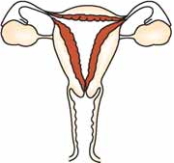
Solution
(N/A) Ovary: It is responsible for the production of the egg (ovum).
$(b)$ Oviduct (Fallopian tube): It is the site where fertilisation occurs.
$(c)$ Uterus: It is the site of implantation where the embryo develops.
$(d)$ Vagina: It serves as the passage for the entry of sperms into the female reproductive tract.
$(b)$ Oviduct (Fallopian tube): It is the site where fertilisation occurs.
$(c)$ Uterus: It is the site of implantation where the embryo develops.
$(d)$ Vagina: It serves as the passage for the entry of sperms into the female reproductive tract.
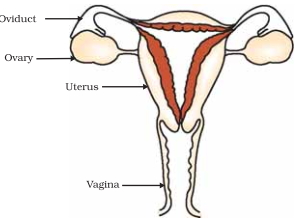
0 likes
View Solution22
Medium
Distinguish between a gamete and zygote. Explain their roles in sexual reproduction.
Solution
(N/A) $gamete$ is a specialized sex cell or germ cell involved in sexual reproduction. There are two types of gametes: male and female.
$A$ $zygote$ is the diploid cell formed as a result of fertilization, where a male gamete and a female gamete fuse together.
The two fusing gametes carry genetic information from their respective parents in their $DNA$. Fertilization combines the genetic material of both parents into a single $zygote$ cell.
The $zygote$ serves as the first cell of the next generation. It undergoes repeated mitotic divisions to form an embryo, which subsequently develops into a new individual.
0 likes
View Solution23
Medium
What is the placenta? Mention its role during pregnancy.
Solution
(N/A) The placenta is a special disc-like tissue embedded in the uterine wall that connects the developing embryo to the mother.
Its roles during pregnancy are:
$1$. It possesses villi on the embryo's side of the tissue,which increases the surface area for glucose and oxygen transfer from the mother to the embryo.
$2$. It facilitates the passage of essential nutrients and oxygen from the mother's blood to the embryo.
$3$. It acts as an excretory organ by removing waste substances and carbon dioxide produced by the embryo into the mother's blood for excretion.
0 likes
View Solution24
Medium
How does fertilization take place? Fertilization occurs once in a month. Comment.
Solution
(N/A) During sexual intercourse,sperm enters through the vaginal passage and moves upwards into the fallopian tube (oviduct).
$(b)$ An egg is released from the ovary and reaches the oviduct.
$(c)$ The sperm encounters the egg in the oviduct,where fusion occurs,resulting in fertilization.
$(d)$ Fertilization occurs once a month because the ovary releases only one egg every month during the menstrual cycle.
$(b)$ An egg is released from the ovary and reaches the oviduct.
$(c)$ The sperm encounters the egg in the oviduct,where fusion occurs,resulting in fertilization.
$(d)$ Fertilization occurs once a month because the ovary releases only one egg every month during the menstrual cycle.
0 likes
View Solution25
EasyMCQ
At the time of puberty,both boys and girls show many changes in their appearance. Name the hormones responsible for these changes.
A
Testosterone and Oestrogen
B
Insulin and Glucagon
C
Thyroxine and Adrenaline
D
Growth Hormone and Prolactin
Solution
(A) At the time of puberty,the body undergoes significant developmental changes.
In boys,the testes begin to secrete the hormone $Testosterone$,which is responsible for the development of secondary sexual characteristics such as facial hair,deepening of the voice,and muscle growth.
In girls,the ovaries begin to secrete the hormone $Oestrogen$,which is responsible for the development of secondary sexual characteristics such as breast development,widening of the pelvis,and the onset of the menstrual cycle.
0 likes
View Solution26
Medium
Differentiate between estrogen and testosterone.
Solution
(N/A)
| Estrogen | Testosterone |
|---|---|
| $(i)$ It is the female sex hormone. | $(i)$ It is the male sex hormone. |
| $(ii)$ It is secreted by female gonads (ovaries). | $(ii)$ It is secreted by male gonads (testes). |
| $(iii)$ It helps in the development of female reproductive organs and also imparts female secondary sexual characteristics. | $(iii)$ It helps in the development of male reproductive organs and also imparts male secondary sexual characteristics. |
0 likes
View Solution27
MediumMCQ
Dramatic changes of body features associated with puberty are mainly because of the secretion of:
A
Testosterone from testes and estrogen from ovary.
B
Estrogen from adrenal gland and testosterone from pituitary gland.
C
Oestrogen from testes and testosterone from ovary.
D
Testosterone from thyroid gland and estrogen from pituitary gland.
Solution
(A) During puberty,the human body undergoes significant physiological and physical changes.
These changes are primarily regulated by sex hormones.
In males,the testes secrete $Testosterone$,which is responsible for the development of secondary sexual characteristics such as facial hair,deepening of the voice,and muscle growth.
In females,the ovaries secrete $Estrogen$,which is responsible for the development of secondary sexual characteristics such as breast development and the onset of the menstrual cycle.
Therefore,the correct combination is $Testosterone$ from the testes and $Estrogen$ from the ovary.
0 likes
View Solution28
Easy
List two functions of the ovary in the human female reproductive system.
Solution
(N/A) $(i)$ Production of female gametes (ova).
$(ii)$ Secretion of female sex hormones (estrogen and progesterone).
$(ii)$ Secretion of female sex hormones (estrogen and progesterone).
0 likes
View Solution29
EasyMCQ
How can the chromosomes be identified?
A
By observing the cell during interphase.
B
By observing the cell during cell division.
C
By staining the cell with iodine.
D
By observing the cell in a dormant state.
Solution
(B) Chromosomes are composed of $DNA$ and proteins. During the interphase of the cell cycle,the genetic material exists as a loose network called chromatin. However,when the cell enters the process of cell division (mitosis or meiosis),the chromatin condenses into highly organized,thread-like structures known as chromosomes. Therefore,chromosomes can be clearly identified and observed under a microscope only during the phase of cell division.
0 likes
View Solution30
EasyMCQ
Why is the temperature of the scrotal sac $2\,^{\circ}C$ less than the body temperature?
A
To protect the testes from injury.
B
To facilitate the process of spermatogenesis.
C
To store sperms at a lower temperature.
D
To prevent the formation of testosterone.
Solution
(B) The testes are located outside the abdominal cavity in the scrotal sac because the process of spermatogenesis (the production of sperms) requires a temperature that is approximately $2\,^{\circ}C$ to $2.5\,^{\circ}C$ lower than the normal internal body temperature. This lower temperature is essential for the survival and maturation of sperm cells.
0 likes
View Solution31
EasyMCQ
What happens if the egg is not fertilized?
A
The egg continues to live in the uterus.
B
The uterine lining thickens further.
C
The uterine lining breaks down and is discharged as menstruation.
D
The egg is immediately reabsorbed by the ovary.
Solution
(C) If the egg is not fertilized,the thick and spongy lining of the uterus is no longer needed. Consequently,this lining slowly breaks down and comes out through the vagina as blood and mucus. This process is known as menstruation.
0 likes
View Solution32
Easy
Why does the lining of the uterus become thick and spongy every month?
Solution
(N/A) The lining of the uterus becomes thick and spongy every month to prepare itself to receive and nurture the growing embryo in case fertilization occurs. This rich,vascularized lining provides the necessary blood supply and nutrients to support the development of the zygote.
0 likes
View Solution33
Medium
$(a)$ What is the location of the following :
$(i)$ $DNA$ in a cell
$(ii)$ Gene
$(b)$ Expand $DNA$.
$(i)$ $DNA$ in a cell
$(ii)$ Gene
$(b)$ Expand $DNA$.
Solution
(N/A) $(i)$ $DNA$ is primarily located within the nucleus of a cell,specifically within the chromosomes.
$(ii)$ Genes are segments of $DNA$ located on the chromosomes.
$(b)$ The expansion of $DNA$ is Deoxyribonucleic Acid.
$(ii)$ Genes are segments of $DNA$ located on the chromosomes.
$(b)$ The expansion of $DNA$ is Deoxyribonucleic Acid.
0 likes
View Solution34
Medium
What is the main difference between sperms and eggs of humans? Write the importance of this difference.
Solution
(N/A) The primary difference is that sperms are motile,while eggs are non-motile.
The importance of this difference is that the motility of the sperm allows it to travel through the female reproductive tract to reach the egg for fertilization.
Alternatively,another significant difference is in their chromosomal content:
Sperms contain either an $X$ or a $Y$ chromosome.
Eggs contain only an $X$ chromosome.
The importance of this difference is that it determines the sex of the offspring upon fertilization:
If an $X$-bearing sperm fertilizes the egg,the zygote becomes $XX$ (female).
If a $Y$-bearing sperm fertilizes the egg,the zygote becomes $XY$ (male).
0 likes
View Solution35
Medium
"The chromosomal number of the sexually reproducing parents and their offspring is the same." Justify this statement.
Solution
(N/A) $(i)$ In sexual reproduction, the fusion of male and female gametes takes place. These germ cells/gametes contain half the number of chromosomes compared to the somatic (body) cells.
$(ii)$ When male and female gametes fuse during fertilization, the zygote formed receives one set of chromosomes from each parent, which restores the original diploid number of chromosomes, thereby ensuring the stability of the species.
$(ii)$ When male and female gametes fuse during fertilization, the zygote formed receives one set of chromosomes from each parent, which restores the original diploid number of chromosomes, thereby ensuring the stability of the species.
0 likes
View Solution36
Easy
Give two differences between a male and a female gamete.
Solution
(N/A)
| Male gamete | Female gamete |
| $(i)$ It is smaller in size compared to the female gamete. | $(i)$ It is larger in size. |
| $(ii)$ It is generally motile. | $(ii)$ It is generally non-motile. |
0 likes
View Solution37
Medium
Mention the functions of $(a)$ placenta and $(b)$ fallopian tube in the human female reproductive system.
Solution
(N/A) Placenta: $(i)$ It facilitates the transport of glucose,oxygen,and nutrients from the mother to the developing embryo. $(ii)$ It helps in the removal of waste products generated by the embryo by transferring them into the mother's blood.
$(b)$ Fallopian tube: $(i)$ It acts as a pathway for the egg (ovum) to travel from the ovary to the uterus. $(ii)$ It is the site where fertilization of the egg by the sperm typically occurs.
$(b)$ Fallopian tube: $(i)$ It acts as a pathway for the egg (ovum) to travel from the ovary to the uterus. $(ii)$ It is the site where fertilization of the egg by the sperm typically occurs.
0 likes
View Solution38
Medium
State one function each performed by the following organs in human beings:
$(a)$ Testes
$(b)$ Prostate gland
$(a)$ Testes
$(b)$ Prostate gland
Solution
(N/A) Testes: They are the primary male reproductive organs responsible for the production of sperms (spermatogenesis) and the secretion of the male sex hormone,testosterone.
$(b)$ Prostate gland: It is an accessory reproductive gland that secretes a milky,alkaline fluid which forms a significant part of the semen,helping to nourish and transport the sperms.
$(b)$ Prostate gland: It is an accessory reproductive gland that secretes a milky,alkaline fluid which forms a significant part of the semen,helping to nourish and transport the sperms.
0 likes
View Solution39
Medium
$(a)$ Trace the path of sperms from where they are produced in the human body to the exterior.
$(b)$ Write the functions of secretions of the prostate gland and seminal vesicles in humans.
$(b)$ Write the functions of secretions of the prostate gland and seminal vesicles in humans.
Solution
(N/A) The path of sperm is as follows: $\text{Testes} \rightarrow \text{Epididymis} \rightarrow \text{Vas deferens} \rightarrow \text{Ejaculatory duct} \rightarrow \text{Urethra} \rightarrow \text{Exterior}$.
$(b)$ The secretions of the prostate gland and seminal vesicles provide a fluid medium for the sperm,which makes their transport easier. Additionally,these secretions provide nutrition to the sperm and contain enzymes that help in the activation and survival of the sperm.
$(b)$ The secretions of the prostate gland and seminal vesicles provide a fluid medium for the sperm,which makes their transport easier. Additionally,these secretions provide nutrition to the sperm and contain enzymes that help in the activation and survival of the sperm.
0 likes
View Solution40
Medium
Give two examples each of the following:
$(a)$ Plants having unisexual flowers
$(b)$ Agents of pollination
$(c)$ Physical changes on puberty that are common to both boys and girls.
$(a)$ Plants having unisexual flowers
$(b)$ Agents of pollination
$(c)$ Physical changes on puberty that are common to both boys and girls.
Solution
(N/A) Papaya,Watermelon
$(b)$ Insects,Wind (Air)
$(c)$ $(i)$ Appearance of pubic hair.
$(ii)$ Skin becomes oily and may develop pimples.
$(b)$ Insects,Wind (Air)
$(c)$ $(i)$ Appearance of pubic hair.
$(ii)$ Skin becomes oily and may develop pimples.
0 likes
View Solution41
Medium
Why are the testes located outside the abdominal cavity? Mention the endocrine and exocrine function of the testes.
Solution
(N/A) The testes are located outside the abdominal cavity within the scrotum because the process of spermatogenesis (sperm formation) requires a temperature that is $1-3\,^{\circ}C$ lower than the normal internal body temperature.
Endocrine function: The testes act as an endocrine gland by secreting the male sex hormone,$testosterone$,directly into the bloodstream.
Exocrine function: The testes act as an exocrine gland by producing and releasing male gametes,known as $sperms$,through the duct system.
Endocrine function: The testes act as an endocrine gland by secreting the male sex hormone,$testosterone$,directly into the bloodstream.
Exocrine function: The testes act as an exocrine gland by producing and releasing male gametes,known as $sperms$,through the duct system.
0 likes
View Solution42
Medium
What are chromosomes? Explain how in sexually reproducing organisms,the number of chromosomes in the progeny is maintained?
Solution
(N/A) Chromosomes are thread-like structures composed of $DNA$ and proteins,found within the nucleus of a cell.
In sexually reproducing organisms,the process of meiosis occurs during gamete formation. This process reduces the number of chromosomes to half $(n)$ in the gametes compared to the parent cell $(2n)$.
When fertilization occurs,the male gamete $(n)$ and the female gamete $(n)$ fuse to form a zygote $(2n)$. This fusion restores the original diploid number of chromosomes in the progeny,ensuring the stability of the species across generations.
0 likes
View Solution43
MediumMCQ
What is the effect of $DNA$ copying,which is not perfectly accurate,on the reproduction process? How does the amount of $DNA$ remain constant though each new generation is a combination of $DNA$ copies of two individuals?
A
It leads to variations; $DNA$ is halved via meiosis.
B
It leads to mutations; $DNA$ is doubled via mitosis.
C
It leads to stability; $DNA$ is constant via cloning.
D
It leads to death; $DNA$ is lost via fertilization.
Solution
(A) $(i)$ $DNA$ copying that is not perfectly accurate leads to variations in the offspring,which is the basis of evolution.
$(ii)$ In sexually reproducing organisms,specialized germ cells (gametes) are produced through meiosis,which contain only half the amount of $DNA$ or half the number of chromosomes compared to the parent cell.
$(iii)$ When these haploid germ cells fuse during fertilization,the resulting zygote restores the original amount of $DNA$ characteristic of the species,ensuring the amount remains constant across generations.
0 likes
View Solution44
Medium
$A$ part of the male reproductive system is shown below. Study the diagram and answer the questions that follow.
$(a)$ Two parts have been incorrectly labelled. Identify them.
$(b)$ Give the function of urethra.
$(c)$ Which hormone is released by testis?
$(a)$ Two parts have been incorrectly labelled. Identify them.
$(b)$ Give the function of urethra.
$(c)$ Which hormone is released by testis?
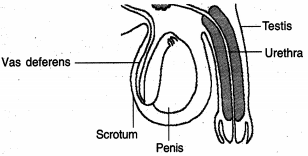
Solution
(N/A) In the provided diagram,the labels for 'Testis' and 'Penis' are swapped. The structure labeled as 'Testis' is actually the 'Penis',and the structure labeled as 'Penis' is actually the 'Testis' (within the scrotum).
$(b)$ The urethra serves as a common passage for both sperms and urine in the male reproductive system.
$(c)$ The testis releases the hormone 'Testosterone',which is responsible for the development of secondary sexual characteristics in males.
$(b)$ The urethra serves as a common passage for both sperms and urine in the male reproductive system.
$(c)$ The testis releases the hormone 'Testosterone',which is responsible for the development of secondary sexual characteristics in males.
0 likes
View Solution45
Medium
Mention one function each of the following parts with respect to the female reproductive system:
$(a)$ Vagina
$(b)$ Ovary
$(a)$ Vagina
$(b)$ Ovary
Solution
(N/A) Vagina: It serves as the birth canal and the passage for the entry of sperms into the female reproductive tract during sexual intercourse.
$(b)$ Ovary: It is responsible for the production of female gametes (ova or eggs) and the secretion of female sex hormones like estrogen and progesterone.
$(b)$ Ovary: It is responsible for the production of female gametes (ova or eggs) and the secretion of female sex hormones like estrogen and progesterone.
0 likes
View Solution46
Medium
$(a)$ Give the functions of the following :
$(i)$ Pollen Tube
$(ii)$ Ovary
$(b)$ List any two changes observed in the body of a female during puberty.
$(i)$ Pollen Tube
$(ii)$ Ovary
$(b)$ List any two changes observed in the body of a female during puberty.
Solution
(N/A) $(i)$ The function of the pollen tube is to provide a pathway for the male gametes to travel from the stigma to the ovule for fertilization.
$(ii)$ The function of the ovary is the production of female gametes (ova) and the secretion of female sex hormones like estrogen and progesterone.
$(b)$ Two changes observed in the body of a female during puberty are:
$(i)$ Development and enlargement of mammary glands (breasts).
$(ii)$ Onset of the menstrual cycle (menarche).
0 likes
View Solution47
Medium
In the diagram of the human male reproductive system given below:
$(a)$ Label parts $A$ and $B$.
$(b)$ Name the hormone produced by organ $X$. What is the role of this hormone in the human male?
$(c)$ Mention the name of substances that are transported by tubes:
$(i)$ $C$ and $(ii)$ $D$.
$(a)$ Label parts $A$ and $B$.
$(b)$ Name the hormone produced by organ $X$. What is the role of this hormone in the human male?
$(c)$ Mention the name of substances that are transported by tubes:
$(i)$ $C$ and $(ii)$ $D$.
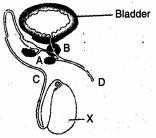
Solution
(N/A) is the Seminal vesicle,and $B$ is the Prostate gland.
$(b)$ The hormone produced by organ $X$ (testis) is Testosterone. Its role is to control the formation of gametes (sperms) and regulate the development of secondary sexual characteristics in human males.
$(c)$ $(i)$ Tube $C$ (Vas deferens) transports sperms.
$(ii)$ Tube $D$ (Urethra) transports both sperms (semen) and urine.
0 likes
View Solution48
Medium
$(a)$ Name the human male reproductive organ that produces sperms and also secretes a hormone. Write the functions of the secreted hormone.
$(b)$ Name the parts of the human female reproductive system where:
$(i)$ fertilisation takes place.
$(ii)$ implantation of the fertilised egg occurs. Explain how the embryo gets nourishment inside the mother's body?
$(b)$ Name the parts of the human female reproductive system where:
$(i)$ fertilisation takes place.
$(ii)$ implantation of the fertilised egg occurs. Explain how the embryo gets nourishment inside the mother's body?
Solution
(N/A) The human male reproductive organ is the $Testis$. It secretes the hormone $Testosterone$.
Functions of $Testosterone$:
$(i)$ It regulates the production of sperms.
$(ii)$ It brings about the development of secondary sexual characteristics in males during puberty.
$(b)$ $(i)$ Fertilisation takes place in the $Fallopian tube$ (or $Oviduct$).
$(ii)$ Implantation occurs in the $Uterus$.
Nourishment of the embryo: The embryo receives nourishment from the mother's blood through a special tissue called the $Placenta$. The $Placenta$ is a disc-like structure embedded in the uterine wall. It provides a large surface area for the transfer of glucose, oxygen, and other essential nutrients from the mother's blood to the developing embryo, and also facilitates the removal of waste products produced by the embryo.
0 likes
View Solution49
Medium
$(a)$ Draw a sectional view of the human female reproductive system and label the parts where:
$(i)$ eggs develop.
$(ii)$ fertilization takes place.
$(iii)$ the fertilized egg gets implanted.
$(b)$ Describe,in brief,the changes the uterus undergoes:
$(i)$ to receive the zygote.
$(ii)$ if the zygote is not formed.
$(i)$ eggs develop.
$(ii)$ fertilization takes place.
$(iii)$ the fertilized egg gets implanted.
$(b)$ Describe,in brief,the changes the uterus undergoes:
$(i)$ to receive the zygote.
$(ii)$ if the zygote is not formed.
Solution
(N/A) Diagram: Refer to the sectional view of the human female reproductive system in the textbook.
Labels:
$(i)$ Ovary: The site where eggs (ova) develop.
$(ii)$ Fallopian tube (Oviduct): The site where fertilization takes place.
$(iii)$ Uterus: The site where the fertilized egg (embryo) gets implanted.
$(b)$ $(i)$ To receive the zygote,the inner lining of the uterus (endometrium) becomes thick,soft,and richly supplied with blood vessels to nourish the developing embryo.
$(ii)$ If the zygote is not formed,the thickened uterine lining is no longer needed. It breaks down and is shed along with blood and mucus through the vagina,a process known as menstruation.
0 likes
View Solution50
Medium
What is placenta? Describe its structure. State its functions in case of a pregnant human female.
Solution
(N/A) Placenta: It is a specialized structural and functional unit that connects the developing embryo to the uterine wall of the mother.
Structure: It is a disc-like tissue embedded in the uterine wall. On the embryo's side,it possesses finger-like projections called villi. On the mother's side,there are blood spaces (lacunae) that surround these villi,allowing for the exchange of materials.
Functions:
$1$. It provides a large surface area for the transfer of nutrients like glucose and respiratory gases like oxygen from the mother's blood to the embryo.
$2$. It facilitates the removal of metabolic waste products and carbon dioxide produced by the developing embryo by transferring them into the mother's blood.
0 likes
View SolutionHow do Organisms Reproduce? — Reproduction in Human Beings · Frequently Asked Questions
1Are these How do Organisms Reproduce? questions useful for JEE and NEET?
Yes. All questions in this section are mapped to JEE Main and NEET exam patterns. Previous year questions from JEE Main, NEET, GUJCET and state-level exams are included with full solutions.
2Can I switch to Hindi or Gujarati for these questions?
Yes. Use the language tabs in the hero section or the sidebar to view the same questions and solutions in English, Hindi or Gujarati.
3How do I generate a question paper from this subtopic?
Use the Vedclass Exam Paper Generator — select the chapter and subtopic, set difficulty, and generate Sets A, B, C, D automatically. First 3 chapters of every subject are free.
Vedclass Products
For Students
Vedclass Test Series
Mock tests in real JEE/NEET style with performance analysis. 5-day free trial.
Start Free TrialFor Teachers
Exam Paper Generator
Generate Set A/B/C/D papers from this chapter in 2 minutes. 3 chapters free.
Try FreeFor Institutes
Online Exam Module
Live online exams with unlimited students, 360° analytics & white-label branding.
See DemoFor Teachers & Institutes
Generate a How do Organisms Reproduce? Exam Paper in 2 Minutes
Select subtopic & difficulty — Sets A, B, C, D auto-generated with No Repeat logic.
First 3 chapters of every subject are free — no payment required.