
A English
Sexual Reproduction in Flowering Plants Questions in English
Class 10 Science · How do Organisms Reproduce? · Sexual Reproduction in Flowering Plants
39+
Questions
English
Language
100%
With Solutions
Showing 39 of 39 questions in English
1
Easy
How is the process of pollination different from fertilization?
Solution
(N/A) Pollination is the process of transfer of pollen grains from the anther to the stigma of a flower. It is an external process that occurs with the help of agents like wind,water,birds,or insects.
Fertilization,on the other hand,is the biological process involving the fusion of the male gamete with the female gamete. It occurs internally within the ovule and leads to the formation of a diploid zygote.
Fertilization,on the other hand,is the biological process involving the fusion of the male gamete with the female gamete. It occurs internally within the ovule and leads to the formation of a diploid zygote.
0 likes
View Solution2
EasyMCQ
The anther contains
A
ovules
B
sepals
C
pollen grains
D
pistil
Solution
(C) The anther is the part of the stamen (the male reproductive organ of a flower) that produces and contains pollen grains. Pollen grains are the male gametophytes that carry the male gametes necessary for fertilization.
0 likes
View Solution3
Easy
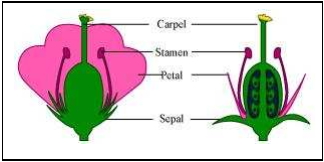
Draw a labelled diagram of the longitudinal section of a flower.
Solution
(N/A) The longitudinal section of a flower consists of the following main parts:
$1$. Sepal: The outermost green,leaf-like structures that protect the flower in the bud stage.
$2$. Petal: The brightly colored parts that attract insects for pollination.
$3$. Stamen: The male reproductive part of the flower,consisting of an anther and a filament.
$4$. Carpel (Pistil): The female reproductive part of the flower,consisting of the stigma,style,and ovary.
0 likes
View Solution4
EasyMCQ
In a flower, the parts that produce male and female gametes (germ cells) are
A
stamen and anther
B
anther and ovary
C
filament and stigma
D
stamen and style
Solution
(B) In a flowering plant, the reproductive parts are located within the flower.
- The male reproductive part is the $stamen$, which consists of an $anther$ and a $filament$. The $anther$ produces pollen grains, which contain the male gametes.
- The female reproductive part is the $pistil$ (or $carpel$), which consists of the $stigma$, $style$, and $ovary$. The $ovary$ contains ovules, which produce the female gametes (egg cells).
- Therefore, the $anther$ produces male gametes and the $ovary$ produces female gametes.
0 likes
View Solution5
EasyMCQ
Which of the following is the correct sequence of events of sexual reproduction in a flower?
A
pollination,fertilisation,seedling,embryo
B
seedling,embryo,fertilisation,pollination
C
pollination,fertilisation,embryo,seedling
D
embryo,seedling,pollination,fertilisation
Solution
(C) The process of sexual reproduction in a flower follows a specific biological order:
$1$. $Pollination$: The transfer of pollen grains from the anther to the stigma of a flower.
$2$. $Fertilisation$: The fusion of the male gamete with the female gamete (egg) to form a zygote.
$3$. $Embryo$: The zygote develops into an embryo within the seed.
$4$. $Seedling$: Upon germination, the seed develops into a new plant or seedling.
Therefore, the correct sequence is $Pollination \rightarrow Fertilisation \rightarrow Embryo \rightarrow Seedling$.
0 likes
View Solution6
MediumMCQ
The correct sequence of reproductive stages seen in flowering plants is
A
zygote,gametes,embryo,seedling
B
gametes,zygote,embryo,seedling
C
seedling,embryo,zygote,gametes
D
gametes,embryo,zygote,seedling
Solution
(B) In flowering plants, the reproductive process follows a specific sequence:
$1$. Gametes: The process begins with the formation of male and female gametes (pollen grains and egg cells).
$2$. Zygote: Fertilization occurs when the male and female gametes fuse to form a single-celled $zygote$.
$3$. Embryo: The $zygote$ undergoes repeated cell divisions to develop into an $embryo$ within the seed.
$4$. Seedling: Upon germination, the $embryo$ grows into a young plant known as a $seedling$.
Therefore, the correct sequence is: $gametes \rightarrow zygote \rightarrow embryo \rightarrow seedling$.
0 likes
View Solution7
EasyMCQ
Length of pollen tube depends on the distance between
A
pollen grain and upper surface of stigma
B
pollen grain in anther and upper surface of stigma
C
pollen grain on upper surface of stigma and ovule
D
upper surface of stigma and lower part of style
Solution
(C) The pollen tube is a tubular structure produced by the male gametophyte (pollen grain) after it lands on the stigma of a flower.
Its primary function is to transport the male gametes from the pollen grain to the ovule located within the ovary.
Therefore,the growth of the pollen tube must continue until it reaches the ovule.
Consequently,the total length of the pollen tube is determined by the distance it must travel from the point of germination (the upper surface of the stigma) to the target (the ovule).
0 likes
View Solution8
MediumMCQ
Which of the following statements are true for flowers?
$(i)$ Flowers are always bisexual
$(ii)$ They are the sexual reproductive organs
$(iii)$ They are produced in all groups of plants
$(iv)$ After fertilisation they give rise to fruits
$(i)$ Flowers are always bisexual
$(ii)$ They are the sexual reproductive organs
$(iii)$ They are produced in all groups of plants
$(iv)$ After fertilisation they give rise to fruits
A
$(i)$ and $(iv)$
B
$(ii)$ and $(iii)$
C
$(i)$ and $(iii)$
D
$(ii)$ and $(iv)$
Solution
(D) Statement $(i)$ is false because flowers can be unisexual (staminate or pistillate) or bisexual.
Statement $(ii)$ is true because flowers are the reproductive structures in angiosperms.
Statement $(iii)$ is false because flowers are only produced by angiosperms (flowering plants),not by all plant groups like algae,bryophytes,or pteridophytes.
Statement $(iv)$ is true because after fertilisation,the ovary develops into a fruit and the ovules develop into seeds.
Therefore,statements $(ii)$ and $(iv)$ are correct.
0 likes
View Solution9
MediumMCQ
Which among the following statements are true for unisexual flowers?
$(i)$ They possess both stamen and pistil
$(ii)$ They possess either stamen or pistil
$(iii)$ They exhibit cross pollination
$(iv)$ Unisexual flowers possessing only stamens cannot produce fruits
$(i)$ They possess both stamen and pistil
$(ii)$ They possess either stamen or pistil
$(iii)$ They exhibit cross pollination
$(iv)$ Unisexual flowers possessing only stamens cannot produce fruits
A
$(ii), (iii)$ and $(iv)$
B
$(i)$ and $(iv)$
C
$(iii)$ and $(iv)$
D
$(i), (iii)$ and $(iv)$
Solution
(A) Unisexual flowers are those that contain either only stamens (male reproductive part) or only pistils (female reproductive part),but not both.
Statement $(i)$ is false because unisexual flowers do not possess both stamen and pistil.
Statement $(ii)$ is true as they contain either stamen or pistil.
Statement $(iii)$ is true because unisexual flowers often require cross-pollination to transfer pollen from the male flower to the female flower.
Statement $(iv)$ is true because fruits are formed from the ovary of the pistil. Flowers possessing only stamens (staminate flowers) lack an ovary and therefore cannot produce fruits.
Thus,statements $(ii), (iii),$ and $(iv)$ are correct.
0 likes
View Solution10
MediumMCQ
Which among the following statements are true for sexual reproduction in flowering plants?
$(i)$ It requires two types of gametes
$(ii)$ Fertilisation is a compulsory event
$(iii)$ It always results in formation of zygote
$(iv)$ Offspring formed are clones
$(i)$ It requires two types of gametes
$(ii)$ Fertilisation is a compulsory event
$(iii)$ It always results in formation of zygote
$(iv)$ Offspring formed are clones
A
$(i)$ and $(iv)$
B
$(i), (ii)$ and $(iii)$
C
$(i), (ii)$ and $(iv)$
D
$(i), (iii)$ and $(iv)$
Solution
(B) Sexual reproduction in flowering plants involves the fusion of male and female gametes,making statement $(i)$ true.
Fertilisation,which is the fusion of these gametes,is a compulsory event in sexual reproduction,making statement $(ii)$ true.
The product of the fusion of male and female gametes is a zygote,making statement $(iii)$ true.
Offspring produced through sexual reproduction are genetically different from their parents due to meiosis and recombination,meaning they are not clones. Clones are produced through asexual reproduction. Thus,statement $(iv)$ is false.
Therefore,statements $(i), (ii),$ and $(iii)$ are correct.
0 likes
View Solution11
MediumMCQ
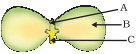
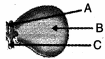
In the given figure,the parts $A, B$,and $C$ are sequentially:
A
cotyledon,plumule and radicle
B
plumule,radicle and cotyledon
C
plumule,cotyledon and radicle
D
radicle,cotyledon and plumule
Solution
(C) The provided figure shows the internal structure of a germinating seed.
$A$ represents the plumule,which is the part of the embryo that develops into the shoot system.
$B$ represents the cotyledon,which is the seed leaf that provides nourishment to the developing embryo.
$C$ represents the radicle,which is the part of the embryo that develops into the root system.
Therefore,the parts $A, B$,and $C$ are sequentially plumule,cotyledon,and radicle.
0 likes
View Solution12
EasyMCQ
The pistil is intact. Cross-pollination has occurred,leading to fertilization and the formation of fruit. In a bisexual flower,despite the young stamens being removed artificially,the flower produces fruit. Provide a suitable explanation for the above situation.
A
Self-pollination occurred.
B
Cross-pollination occurred from another flower.
C
The flower was already pollinated before emasculation.
D
Parthenocarpy occurred.
Solution
(B) The process of removing stamens from a bisexual flower is known as emasculation.
If a flower produces fruit after the removal of its own stamens,it indicates that cross-pollination has occurred.
Cross-pollination is the transfer of pollen grains from the anther of one flower to the stigma of another flower of the same or a different plant.
Since the pistil (stigma,style,and ovary) remains intact,it is capable of receiving pollen grains from an external source (another flower).
Once the pollen grains land on the stigma,they germinate to form a pollen tube,which travels down the style to reach the ovary,resulting in fertilization and subsequent fruit formation.
0 likes
View Solution13
Easy
In a tobacco plant,the male gametes have $24$ chromosomes. What is the number of chromosomes in the female gamete? What is the number of chromosomes in the zygote?
Solution
(N/A) In a tobacco plant,the male gamete is a haploid cell $(n)$ containing $24$ chromosomes.
Since the female gamete is also a haploid cell $(n)$,it will also contain $24$ chromosomes.
The zygote is formed by the fusion of the male and female gametes,making it a diploid cell $(2n)$.
Therefore,the number of chromosomes in the zygote is $24 + 24 = 48$.
Since the female gamete is also a haploid cell $(n)$,it will also contain $24$ chromosomes.
The zygote is formed by the fusion of the male and female gametes,making it a diploid cell $(2n)$.
Therefore,the number of chromosomes in the zygote is $24 + 24 = 48$.
0 likes
View Solution14
Easy
Why cannot fertilisation take place in flowers if pollination does not occur?
Solution
(N/A) Fertilisation is the process of fusion of male and female gametes. In flowering plants,the male gametes are contained within the pollen grains. Pollination is the transfer of pollen grains from the anther to the stigma of a flower. If pollination does not occur,the male gametes cannot reach the female gametes present in the ovary. Therefore,without the presence of male gametes,fertilisation cannot take place.
0 likes
View Solution15
EasyMCQ
Where is the zygote located in the flower after fertilization?
A
Inside the ovary
B
Inside the ovule
C
Inside the stigma
D
Inside the style
Solution
(B) After fertilization,the male gamete fuses with the female gamete (egg cell) to form a zygote. This process occurs within the ovule. The ovule is located inside the ovary of the flower. Therefore,the zygote is located inside the ovule.
0 likes
View Solution16
EasyMCQ
Exchange of genetic material takes place in
A
sexual reproduction
B
asexual reproduction
C
vegetative reproduction
D
budding
Solution
(A) The exchange of genetic material,also known as genetic recombination,occurs during sexual reproduction.
In sexual reproduction,two parents contribute gametes (sperm and egg) which fuse during fertilization.
This process involves meiosis,where crossing over occurs between homologous chromosomes,leading to new combinations of genes.
This variation is a hallmark of sexual reproduction,whereas asexual reproduction (including vegetative reproduction and budding) typically produces clones with identical genetic material.
0 likes
View Solution17
Medium
Distinguish between pollination and fertilisation. Mention the site and product of fertilisation in a flower.
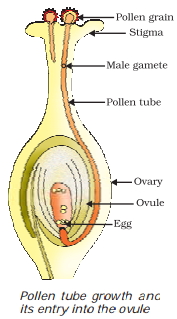
Draw a neat,labelled diagram of a pistil showing pollen tube growth and its entry into the ovule.
Draw a neat,labelled diagram of a pistil showing pollen tube growth and its entry into the ovule.
Solution
(N/A) Pollination is the process of transfer of pollen grains from the anther to the stigma of a flower.
Fertilisation is the process of fusion of the male gamete with the female gamete (egg) to form a zygote.
The site of fertilisation in a flower is the ovule.
The product of fertilisation is the zygote.
Fertilisation is the process of fusion of the male gamete with the female gamete (egg) to form a zygote.
The site of fertilisation in a flower is the ovule.
The product of fertilisation is the zygote.
0 likes
View Solution18
Medium
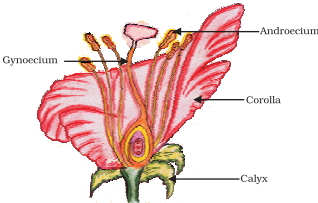
Draw the diagram of a flower and label the four whorls. Write the names of gamete-producing organs in the flower.
Solution
(N/A) The four whorls of a flower are:
$1$. Calyx (Sepals)
$2$. Corolla (Petals)
$3$. Androecium (Stamens)
$4$. Gynoecium (Pistil/Carpel)
Gamete-producing organs:
- Male gamete-producing organ: The stamen (specifically the anther,which produces pollen grains containing male gametes).
- Female gamete-producing organ: The pistil (specifically the ovary,which contains ovules that produce the egg cell/female gamete).
0 likes
View Solution19
Easy
What are those organisms called which bear both the sex organs in the same individual? Give one example of such an organism.
Solution
(N/A) Organisms that possess both male and female sex organs in the same individual are called bisexual or hermaphrodite organisms.
Example: $Hydra$,Earthworm,Mustard,or Hibiscus.
Example: $Hydra$,Earthworm,Mustard,or Hibiscus.
0 likes
View Solution20
Easy
Differentiate between pollen grain and ovule.
Solution
(N/A) Pollen grains are the male reproductive units in flowering plants that contain the male gametes. They are typically produced in the anther.
Ovules are the female reproductive structures in flowering plants that contain the female gamete (egg cell). They are located within the ovary and develop into seeds after fertilization.
Ovules are the female reproductive structures in flowering plants that contain the female gamete (egg cell). They are located within the ovary and develop into seeds after fertilization.
0 likes
View Solution21
Medium
List any two differences between pollination and fertilization.
Solution
(N/A)
| Pollination | Fertilization |
| $(i)$ It is the transfer of pollen grains from the anther to the stigma of a flower. | $(i)$ It is the fusion of the male gamete with the female gamete (egg). |
| $(ii)$ It is achieved by agents like wind,water,or animals. | $(ii)$ It is achieved by the growth of the pollen tube so that the male gamete reaches the female germ cells. |
| $(iii)$ It leads to fertilization. | $(iii)$ It leads to the formation of seeds. |
| $(iv)$ It is an external process. | $(iv)$ It is an internal process. |
0 likes
View Solution22
Easy
Differentiate between plumule and radicle.
Solution
(N/A)
| Plumule | Radicle |
| $(i)$ The part of the growing embryo which later forms the shoot of the young plant. | $(i)$ The part of the growing embryo which later forms the root of the young plant. |
| $(ii)$ It is positively phototrophic and negatively geotrophic. | $(ii)$ It is positively geotrophic and negatively phototrophic. |
0 likes
View Solution23
Easy
What happens to the following parts of a flower after fertilization?
$(i)$ Ovum (Egg cell)
$(ii)$ Ovary
$(iii)$ Ovule
$(iv)$ Sepals and petals
$(i)$ Ovum (Egg cell)
$(ii)$ Ovary
$(iii)$ Ovule
$(iv)$ Sepals and petals
Solution
(N/A) $(i)$ The ovum (egg cell) fuses with the male gamete to form a zygote.
$(ii)$ The ovary ripens and develops into the fruit.
$(iii)$ The ovule develops into the seed.
$(iv)$ The sepals and petals usually wither,shrivel,and fall off.
$(ii)$ The ovary ripens and develops into the fruit.
$(iii)$ The ovule develops into the seed.
$(iv)$ The sepals and petals usually wither,shrivel,and fall off.
0 likes
View Solution24
Medium
Differentiate between self-pollination and cross-pollination.
Solution
(N/A)
| Self-pollination | Cross-pollination |
| $(i)$ It is the transfer of pollen grains from the anther to the stigma of the same flower or another flower on the same plant. | $(i)$ It is the transfer of pollen grains from the anther of one flower to the stigma of another flower on a different plant of the same species. |
| $(ii)$ It does not require external agents like insects, wind, or water. | $(ii)$ It requires external agents like insects, wind, or water for pollination. |
| $(iii)$ It results in less genetic variation in the offspring. | $(iii)$ It results in greater genetic variation in the offspring. |
0 likes
View Solution25
Medium
$(a)$ Give the functions of $(i)$ Stigma $(ii)$ Ovary. $(b)$ State in brief the formation of seed in a flower.
Solution
(N/A) $(i)$ The stigma is the sticky terminal part of the carpel that serves as a landing platform for pollen grains.
$(ii)$ The ovary is the swollen basal part of the carpel that contains ovules. It protects the female germ cells and develops into a fruit after fertilization.
$(b)$ After fertilization,the zygote divides several times to form an embryo within the ovule. The ovule develops a tough seed coat and is gradually converted into a seed.
0 likes
View Solution26
Medium
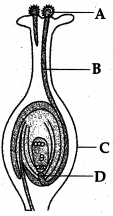
$(a)$ Name the parts labelled as $A, B, C$ and $D$ in the diagram given below:
$(b)$ What is pollination? State its significance.
$(c)$ How does fertilization occur in flowers? Name the parts of the flower that develop into $(i)$ seed,and $(ii)$ fruit after fertilization.
$(b)$ What is pollination? State its significance.
$(c)$ How does fertilization occur in flowers? Name the parts of the flower that develop into $(i)$ seed,and $(ii)$ fruit after fertilization.
Solution
(N/A) The labels are as follows:
$A -$ Pollen grain
$B -$ Pollen tube
$C -$ Ovary
$D -$ Female germ cell (Egg cell)
$(b)$ Pollination is the process of transfer of pollen grains from the anther to the stigma of a flower.
Significance: It is essential for fertilization,as it brings the male gametes to the female reproductive part.
$(c)$ Fertilization in flowers occurs when a pollen grain lands on a suitable stigma and germinates to form a pollen tube. This tube grows through the style,carrying the male germ cell,and reaches the ovary. The male germ cell then fuses with the female germ cell present in the ovule to form a zygote.
$(i)$ Seed develops from the ovule.
$(ii)$ Fruit develops from the ovary.
0 likes
View Solution27
Medium
$(a)$ List two reasons for the appearance of variations among the progeny formed by sexual reproduction.
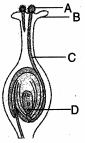
$(b)$ $(i)$ Name the part marked '$A$' in the diagram.
$(ii)$ How does '$A$' reach part '$B$'?
$(iii)$ State the importance of the part '$C$'.
$(iv)$ What happens to the part marked '$D$' after fertilisation is over?
$(b)$ $(i)$ Name the part marked '$A$' in the diagram.
$(ii)$ How does '$A$' reach part '$B$'?
$(iii)$ State the importance of the part '$C$'.
$(iv)$ What happens to the part marked '$D$' after fertilisation is over?
Solution
(N/A) Two reasons for variations in sexual reproduction are:
$(i)$ Involvement of two different individuals (parents) with different genetic makeups.
$(ii)$ Creation of new combinations of gene variants due to the process of meiosis and recombination during gamete formation.
$(b)$ $(i)$ '$A$' represents the Pollen grain.
$(ii)$ '$A$' reaches part '$B$' (stigma) through the process of pollination,which is facilitated by various agents like wind,water,insects,or animals.
$(iii)$ '$C$' is the Pollen tube. Its importance lies in providing a pathway for the male gametes to travel from the stigma to the ovule for fertilisation.
$(iv)$ '$D$' represents the Ovule. After fertilisation,the ovule develops into a seed.
0 likes
View Solution28
Easy
Name the parts of a flower that serve the same function as the following parts in animals:
$(i)$ Testis
$(ii)$ Ovary
$(iii)$ Eggs
$(iv)$ Sperms
$(i)$ Testis
$(ii)$ Ovary
$(iii)$ Eggs
$(iv)$ Sperms
Solution
(N/A) $(i)$ Testis: The $Anther$ produces pollen grains, similar to how the testis produces sperm.
$(ii)$ Ovary: The $Ovary$ in a flower contains ovules, similar to how the ovary in animals produces eggs.
$(iii)$ Eggs: The $Ovule$ (or the egg cell within the embryo sac) serves the same function as the egg in animals.
$(iv)$ Sperms: The $Male \text{ } gametes$ contained within the pollen grains serve the same function as sperms in animals.
0 likes
View Solution29
Medium
Define the term 'double fertilization in plants'. After fertilization,name the part in each case which develops into $(i)$ the fruit,(ii) the seeds.
Solution
(N/A) Double fertilization: It occurs when one male gamete fuses with the egg cell to form a $zygote$ and the other male gamete fuses with two polar nuclei to form the primary endosperm nucleus (triple fusion).
Since these two processes occur simultaneously in the embryo sac,it is known as double fertilization.
After fertilization:
$(i)$ The ovary develops into the fruit.
(ii) The ovules develop into the seeds.
Since these two processes occur simultaneously in the embryo sac,it is known as double fertilization.
After fertilization:
$(i)$ The ovary develops into the fruit.
(ii) The ovules develop into the seeds.
0 likes
View Solution30
MediumMCQ
Which among the following statements are true for sexual reproduction in flowering plants?
A
$(i)$ and $(iv)$
B
$(i), (ii)$ and $(iii)$
C
$(i), (ii)$ and $(iv)$
D
$(ii), (iii)$ and $(iv)$
Solution
(B) Sexual reproduction in flowering plants involves the following characteristics:
$(i)$ It requires two types of gametes (male and female gametes),which is true.
$(ii)$ Fertilization (fusion of gametes) is a compulsory event in sexual reproduction,which is true.
$(iii)$ The fusion of gametes always results in the formation of a zygote,which is true.
$(iv)$ Offspring formed through sexual reproduction are not clones because they show genetic variation due to the fusion of gametes from two different parents. Therefore,this statement is false.
Thus,statements $(i), (ii),$ and $(iii)$ are correct.
0 likes
View Solution31
EasyMCQ
In the figure,the parts $A$,$B$,and $C$ are sequentially:
A
cotyledon,plumule and radicle
B
plumule,radicle and cotyledon
C
plumule,cotyledon and radicle
D
radicle,cotyledon and plumule
Solution
(C) The figure shows the structure of a germinating seed (specifically a dicot seed embryo).
$A$ points to the plumule,which is the part of the embryo that develops into the shoot system.
$B$ points to the cotyledon,which stores food for the developing embryo.
$C$ points to the radicle,which is the part of the embryo that develops into the root system.
Therefore,the parts $A$,$B$,and $C$ are sequentially plumule,cotyledon,and radicle.
0 likes
View Solution32
MediumMCQ
Length of pollen tube depends on the distance between :
A
pollen grain and upper surface of stigma
B
pollen grain in anther and upper surface of stigma
C
pollen grain on upper surface of stigma and ovule
D
upper surface of stigma and lower part of style
Solution
(C) The pollen tube is a tubular structure that develops from the pollen grain after it lands on the stigma of a flower.
Its primary function is to transport the male gametes from the pollen grain to the ovule located within the ovary.
Therefore,the length of the pollen tube must be sufficient to cover the distance from the point of germination (the upper surface of the stigma) to the target (the ovule).
Thus,the length of the pollen tube depends on the distance between the pollen grain on the upper surface of the stigma and the ovule.
0 likes
View Solution33
MediumMCQ
Which of the following statements are true for flowers?
$(i)$ Flowers are always bisexual
$(ii)$ They are the sexual reproductive organs
$(iii)$ They are produced in all groups of plants
$(iv)$ After fertilization they give rise to fruits
$(i)$ Flowers are always bisexual
$(ii)$ They are the sexual reproductive organs
$(iii)$ They are produced in all groups of plants
$(iv)$ After fertilization they give rise to fruits
A
$(i)$ and $(iv)$
B
$(ii)$ and $(iii)$
C
$(i)$ and $(iii)$
D
$(ii)$ and $(iv)$
Solution
(D) Statement $(i)$ is false because flowers can be unisexual (staminate or pistillate) or bisexual.
Statement $(ii)$ is true because flowers contain the reproductive parts (stamens and carpels) of angiosperms.
Statement $(iii)$ is false because flowers are only produced by angiosperms (flowering plants),not by algae,bryophytes,pteridophytes,or gymnosperms.
Statement $(iv)$ is true because after fertilization,the ovary develops into a fruit and the ovules develop into seeds.
Therefore,statements $(ii)$ and $(iv)$ are correct.
0 likes
View Solution34
MediumMCQ
Which among the following statements are true for unisexual flowers?
$(i)$ They possess both stamen and pistil.
$(ii)$ They possess either stamen or pistil.
$(iii)$ They exhibit cross-pollination.
$(iv)$ Unisexual flowers possessing only stamens cannot produce fruits.
$(i)$ They possess both stamen and pistil.
$(ii)$ They possess either stamen or pistil.
$(iii)$ They exhibit cross-pollination.
$(iv)$ Unisexual flowers possessing only stamens cannot produce fruits.
A
$(ii), (iii)$ and $(iv)$
B
$(i)$ and $(iv)$
C
$(iii)$ and $(iv)$
D
$(i), (iii)$ and $(iv)$
Solution
(A) Unisexual flowers are those that contain either only stamens (male reproductive part) or only pistils (female reproductive part),but not both. Therefore,statement $(ii)$ is true and statement $(i)$ is false.
Because they lack one of the reproductive organs,they typically require cross-pollination to achieve fertilization,making statement $(iii)$ true.
Since fruits develop from the ovary (part of the pistil) after fertilization,flowers that possess only stamens (staminate flowers) lack an ovary and therefore cannot produce fruits. Thus,statement $(iv)$ is true.
Combining these,statements $(ii), (iii),$ and $(iv)$ are correct.
0 likes
View Solution35
EasyMCQ
The correct sequence of reproductive stages seen in flowering plants is
A
gametes,embryo,zygote,seedling
B
zygote,gametes,embryo,seedling
C
seedling,embryo,zygote,gametes
D
gametes,zygote,embryo,seedling
Solution
(D) In flowering plants, the reproductive process follows a specific sequence:
$1$. Gametes: The process begins with the formation of male and female gametes.
$2$. Zygote: Fertilization occurs when the male and female gametes fuse to form a diploid zygote.
$3$. Embryo: The zygote undergoes repeated cell divisions to develop into an embryo within the seed.
$4$. Seedling: Upon germination, the embryo grows into a young plant known as a seedling.
Therefore, the correct sequence is $gametes \rightarrow zygote \rightarrow embryo \rightarrow seedling$.
0 likes
View Solution36
EasyMCQ
What is the reason for the growth of the pollen tube towards the ovule?
A
Phototropism
B
Hydrotropism
C
Geotropism
D
Chemotropism
Solution
(D) The growth of the pollen tube towards the ovule is a classic example of $Chemotropism$.
This occurs because the ovule releases specific chemical substances that act as a signal for the pollen tube.
The pollen tube senses these chemicals and grows in the direction of the higher concentration of these substances,which leads it directly to the ovule for fertilization.
This occurs because the ovule releases specific chemical substances that act as a signal for the pollen tube.
The pollen tube senses these chemicals and grows in the direction of the higher concentration of these substances,which leads it directly to the ovule for fertilization.
0 likes
View Solution37
EasyMCQ
Which part of the plant is the reproductive organ?
A
Root
B
Stem
C
Leaf
D
Flower
Solution
(D) In angiosperms (flowering plants),the flower is the specialized reproductive structure.
It contains the male reproductive parts (stamen) and the female reproductive parts (pistil/carpel).
These organs are responsible for sexual reproduction,leading to the formation of seeds and fruits.
It contains the male reproductive parts (stamen) and the female reproductive parts (pistil/carpel).
These organs are responsible for sexual reproduction,leading to the formation of seeds and fruits.
0 likes
View Solution38
EasyMCQ
Most of the flowers in plants are of which type?
A
Asexual
B
Bisexual
C
Unisexual
D
Polygamous
Solution
(B) In the majority of flowering plants,the flowers are bisexual (also known as hermaphrodite).
This means that both the male reproductive part (stamen) and the female reproductive part (pistil/carpel) are present within the same flower.
This arrangement facilitates self-pollination and ensures reproductive success in many species.
This means that both the male reproductive part (stamen) and the female reproductive part (pistil/carpel) are present within the same flower.
This arrangement facilitates self-pollination and ensures reproductive success in many species.
0 likes
View Solution39
EasyMCQ
Where are the female germ cells located in a flower?
A
In the stamen
B
In the pollen grain
C
In the ovary
D
In the pollen tube
Solution
(C) In a flower,the female reproductive part is the carpel or pistil.
The carpel consists of three parts: the stigma,the style,and the ovary.
The ovary contains the ovules,and inside each ovule,the female germ cell (egg cell) is present.
Therefore,the female germ cells are located in the ovary.
The carpel consists of three parts: the stigma,the style,and the ovary.
The ovary contains the ovules,and inside each ovule,the female germ cell (egg cell) is present.
Therefore,the female germ cells are located in the ovary.
0 likes
View SolutionHow do Organisms Reproduce? — Sexual Reproduction in Flowering Plants · Frequently Asked Questions
1Are these How do Organisms Reproduce? questions useful for JEE and NEET?
Yes. All questions in this section are mapped to JEE Main and NEET exam patterns. Previous year questions from JEE Main, NEET, GUJCET and state-level exams are included with full solutions.
2Can I switch to Hindi or Gujarati for these questions?
Yes. Use the language tabs in the hero section or the sidebar to view the same questions and solutions in English, Hindi or Gujarati.
3How do I generate a question paper from this subtopic?
Use the Vedclass Exam Paper Generator — select the chapter and subtopic, set difficulty, and generate Sets A, B, C, D automatically. First 3 chapters of every subject are free.
Vedclass Products
For Students
Vedclass Test Series
Mock tests in real JEE/NEET style with performance analysis. 5-day free trial.
Start Free TrialFor Teachers
Exam Paper Generator
Generate Set A/B/C/D papers from this chapter in 2 minutes. 3 chapters free.
Try FreeFor Institutes
Online Exam Module
Live online exams with unlimited students, 360° analytics & white-label branding.
See DemoFor Teachers & Institutes
Generate a How do Organisms Reproduce? Exam Paper in 2 Minutes
Select subtopic & difficulty — Sets A, B, C, D auto-generated with No Repeat logic.
First 3 chapters of every subject are free — no payment required.