
A English
Mix Examples - Light – Reflection and Refraction Questions in English
Class 10 Science · Light – Reflection and Refraction · Mix Examples - Light – Reflection and Refraction
36+
Questions
English
Language
100%
With Solutions
Showing 36 of 36 questions in English
1
EasyMCQ
$A$ spherical mirror and a thin spherical lens have each a focal length of $-15\,cm$. The mirror and the lens are likely to be
A
both convex
B
both concave
C
the mirror is concave and the lens is convex
D
the mirror is convex,but the lens is concave
Solution
(B) According to the sign convention for spherical mirrors and lenses:
$1$. The focal length of a concave mirror is always negative.
$2$. The focal length of a concave lens is always negative.
Since both the spherical mirror and the thin spherical lens have a focal length of $-15\,cm$ (which is negative),both must be concave in nature.
$1$. The focal length of a concave mirror is always negative.
$2$. The focal length of a concave lens is always negative.
Since both the spherical mirror and the thin spherical lens have a focal length of $-15\,cm$ (which is negative),both must be concave in nature.
0 likes
View Solution2
MediumMCQ
No matter how far you stand from a mirror,your image appears erect. The mirror is likely to be
A
concave
B
convex
C
either plane or convex
D
plane
Solution
(C) convex mirror always forms a virtual and erect image of an object,regardless of its distance from the mirror.
Similarly,a plane mirror also always forms a virtual and erect image of an object,regardless of the distance.
Since both plane and convex mirrors produce erect images for all positions of the object,the mirror is likely to be either plane or convex.
Similarly,a plane mirror also always forms a virtual and erect image of an object,regardless of the distance.
Since both plane and convex mirrors produce erect images for all positions of the object,the mirror is likely to be either plane or convex.
0 likes
View Solution3
MediumMCQ
Which of the following can make a parallel beam of light when light from a point source is incident on it?
A
Concave mirror as well as convex lens
B
Convex mirror as well as concave lens
C
Two plane mirrors placed at $90^o$ to each other
D
Concave mirror as well as concave lens
Solution
(A) point source of light placed at the focus of a concave mirror produces a parallel beam of light after reflection.
Similarly,a point source of light placed at the focus of a convex lens produces a parallel beam of light after refraction.
Therefore,both a concave mirror and a convex lens can produce a parallel beam of light from a point source.
Similarly,a point source of light placed at the focus of a convex lens produces a parallel beam of light after refraction.
Therefore,both a concave mirror and a convex lens can produce a parallel beam of light from a point source.
0 likes
View Solution4
MediumMCQ
Under which of the following conditions can a concave mirror form an image larger than the actual object?
A
When the object is kept at a distance equal to its radius of curvature
B
When the object is kept at a distance less than its focal length
C
When the object is placed between the focus and the centre of curvature
D
When the object is kept at a distance greater than its radius of curvature
Solution
(B, C) concave mirror can form a magnified (larger) image in two specific cases:
$1$. When the object is placed between the focus $(F)$ and the pole $(P)$ of the mirror (i.e.,at a distance less than its focal length $f$). In this case,the image formed is virtual,erect,and magnified.
$2$. When the object is placed between the focus $(F)$ and the centre of curvature $(C)$. In this case,the image formed is real,inverted,and magnified.
Since both options $B$ and $C$ describe conditions where a magnified image is formed,and typically in multiple-choice questions of this nature,both are valid. However,if only one must be chosen,both represent valid physical scenarios. Given the standard options provided,both $B$ and $C$ result in a magnified image.
0 likes
View Solution5
EasyMCQ
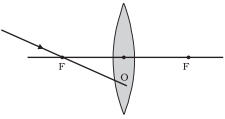
Which of the following ray diagrams is correct for the ray of light incident on a lens shown in the figure?
A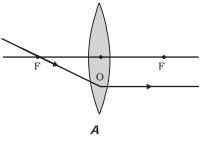
B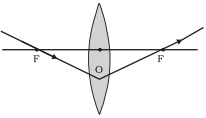
C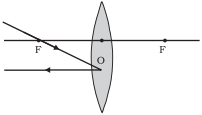
D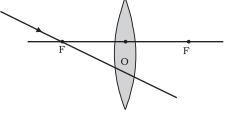
Solution
(A) According to the rules of refraction for a convex lens,a ray of light passing through the principal focus $(F)$ of a convex lens becomes parallel to the principal axis after refraction.
In the given figure,the incident ray is passing through the principal focus $(F)$ before hitting the lens.
Therefore,after refraction through the convex lens,this ray must emerge parallel to the principal axis.
Comparing this with the given options,diagram $A$ correctly depicts this behavior where the ray becomes parallel to the principal axis after passing through the lens.
0 likes
View Solution6
MediumMCQ
In which of the following,the image of an object placed at infinity will be highly diminished and point-sized?
A
Concave mirror only
B
Convex mirror only
C
Concave mirror,convex mirror,concave lens and convex lens
D
Convex lens only
Solution
(C) When an object is placed at infinity,the rays of light coming from it are parallel to the principal axis.
In a concave mirror,these rays converge at the focus $(F)$,forming a highly diminished,point-sized,real,and inverted image.
In a convex mirror,these rays appear to diverge from the focus $(F)$ behind the mirror,forming a highly diminished,point-sized,virtual,and erect image.
In a concave lens,these rays appear to diverge from the focus $(F)$ on the same side,forming a highly diminished,point-sized,virtual,and erect image.
In a convex lens,these rays converge at the focus $(F)$ on the other side,forming a highly diminished,point-sized,real,and inverted image.
Therefore,all four optical elements produce a highly diminished and point-sized image for an object at infinity.
0 likes
View Solution7
Medium
Identify the device used as a spherical mirror or lens in the following cases,where the image formed is virtual and erect in each case.
$(a)$ Object is placed between the device and its focus,image formed is enlarged and behind it.
$(b)$ Object is placed between the focus and the device,image formed is enlarged and on the same side as that of the object.
$(c)$ Object is placed between infinity and the device,image formed is diminished and between the focus and optical centre on the same side as that of the object.
$(d)$ Object is placed between infinity and the device,image formed is diminished and between the pole and focus,behind it.
Solution
(A-D) Concave mirror: When an object is placed between the pole and the focus of a concave mirror,a virtual,erect,and enlarged image is formed behind the mirror.
$(b)$ Convex lens: When an object is placed between the optical centre and the focus of a convex lens,a virtual,erect,and enlarged image is formed on the same side as the object.
$(c)$ Concave lens: $A$ concave lens always forms a virtual,erect,and diminished image between the optical centre and the focus,regardless of the object's position (between infinity and the lens).
$(d)$ Convex mirror: $A$ convex mirror always forms a virtual,erect,and diminished image between the pole and the focus,behind the mirror,for any object position between infinity and the pole.
0 likes
View Solution8
Medium
Draw ray diagrams showing the image formation by a convex lens when an object is placed:
$(a)$ Between optical centre and focus of the lens.
$(b)$ Between focus and twice the focal length of the lens.
$(c)$ At twice the focal length of the lens.
$(d)$ At infinity.
$(e)$ At the focus of the lens.
$(a)$ Between optical centre and focus of the lens.
$(b)$ Between focus and twice the focal length of the lens.
$(c)$ At twice the focal length of the lens.
$(d)$ At infinity.
$(e)$ At the focus of the lens.
Solution
(N/A) To draw the ray diagrams for a convex lens,follow these steps for each case:
$(a)$ When the object is between the optical centre $(O)$ and focus $(F_1)$: The image is virtual,erect,and magnified,formed on the same side as the object.
$(b)$ When the object is between $F_1$ and $2F_1$: The image is real,inverted,and magnified,formed beyond $2F_2$ on the other side.
$(c)$ When the object is at $2F_1$: The image is real,inverted,and of the same size as the object,formed at $2F_2$.
$(d)$ When the object is at infinity: The image is real,inverted,and highly diminished (point-sized),formed at the focus $F_2$.
$(e)$ When the object is at the focus $F_1$: The image is real,inverted,and highly magnified,formed at infinity.
0 likes
View Solution9
Easy
Write down the equation connecting the object distance,image distance,and focal length of lenses and mirrors.
Solution
(N/A) For lenses,the lens formula is given by $\frac{1}{f} = \frac{1}{v} - \frac{1}{u}$,where $f$ is the focal length,$v$ is the image distance,and $u$ is the object distance.
For mirrors,the mirror formula is given by $\frac{1}{f} = \frac{1}{v} + \frac{1}{u}$,where $f$ is the focal length,$v$ is the image distance,and $u$ is the object distance.
For mirrors,the mirror formula is given by $\frac{1}{f} = \frac{1}{v} + \frac{1}{u}$,where $f$ is the focal length,$v$ is the image distance,and $u$ is the object distance.
0 likes
View Solution10
EasyMCQ
$A$ concave mirror and a convex lens are held in water. What changes, if any, do you expect in their focal length?
A
Focal length of both will increase.
B
Focal length of both will decrease.
C
Focal length of the mirror will remain the same, while the focal length of the lens will increase.
D
Focal length of the mirror will change, while the focal length of the lens will remain the same.
Solution
(C) The focal length of a mirror depends only on its radius of curvature $(f = R/2)$ and is independent of the surrounding medium.
Therefore, the focal length of the concave mirror remains unchanged when placed in water.
However, the focal length of a lens is determined by the Lens Maker's Formula: $1/f = (n_g/n_m - 1)(1/R_1 - 1/R_2)$, where $n_g$ is the refractive index of the lens material and $n_m$ is the refractive index of the medium.
Since the refractive index of water $(n_m \approx 1.33)$ is greater than that of air $(n_m \approx 1.0)$, the term $(n_g/n_m - 1)$ decreases, causing the focal length $(f)$ of the convex lens to increase.
0 likes
View Solution11
Medium
An object is placed at the following distances from a concave mirror of focal length $15 \, cm$.
$(a)$ $10 \, cm$ $(b)$ $20 \, cm$ $(c)$ $30 \, cm$ $(d)$ $40 \, cm$
Which position of the object will produce:
$(1)$ Virtual image
$(2)$ $A$ diminished real image
$(3)$ An enlarged real image
$(4)$ An image of same size
$(a)$ $10 \, cm$ $(b)$ $20 \, cm$ $(c)$ $30 \, cm$ $(d)$ $40 \, cm$
Which position of the object will produce:
$(1)$ Virtual image
$(2)$ $A$ diminished real image
$(3)$ An enlarged real image
$(4)$ An image of same size
Solution
(A-10, B-20, C-30, D-40) For a concave mirror with focal length $f = 15 \, cm$:
$(1)$ $A$ virtual image is formed when the object is placed between the pole and the focus $(u < 15 \, cm)$. Thus,the position is $10 \, cm$.
$(2)$ $A$ diminished real image is formed when the object is placed beyond the center of curvature $(u > 30 \, cm)$. Thus,the position is $40 \, cm$.
$(3)$ An enlarged real image is formed when the object is placed between the focus and the center of curvature $(15 \, cm < u < 30 \, cm)$. Thus,the position is $20 \, cm$.
$(4)$ An image of the same size is formed when the object is placed at the center of curvature $(u = 2R = 30 \, cm)$. Thus,the position is $30 \, cm$.
0 likes
View Solution12
Medium
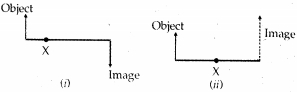
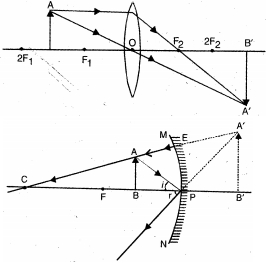
The nature,size,and position of the image of an object produced by a lens or mirror are as shown below. Identify the lens/mirror $(X)$ used in each case and draw the corresponding complete ray diagram.
Solution
(N/A) $(i)$ It is a convex lens. The image is real,inverted,and magnified,which occurs when the object is placed between $F_1$ and $2F_1$.
$(ii)$ It is a concave mirror. The image is virtual,erect,and magnified,which occurs when the object is placed between the focus $(F)$ and the pole $(P)$.
$(ii)$ It is a concave mirror. The image is virtual,erect,and magnified,which occurs when the object is placed between the focus $(F)$ and the pole $(P)$.
0 likes
View Solution13
MediumMCQ
How will you decide whether a given piece of glass is a convex lens,concave lens,or a plane glass plate?
A
By observing the image of printed matter through the glass.
B
By measuring the thickness of the glass.
C
By checking the weight of the glass.
D
By checking the color of the glass.
Solution
(A) To identify the type of glass,hold the given piece of glass over some printed matter and observe the letters:
$(i)$ If the letters appear magnified,the given piece is a convex lens.
$(ii)$ If the letters appear diminished,the given piece is a concave lens.
$(iii)$ If the letters appear to be of the same size as they are,then it is a plane glass plate.
$(i)$ If the letters appear magnified,the given piece is a convex lens.
$(ii)$ If the letters appear diminished,the given piece is a concave lens.
$(iii)$ If the letters appear to be of the same size as they are,then it is a plane glass plate.
0 likes
View Solution14
Medium
$(a)$ Why does a ray of light passing through the centre of curvature of a concave mirror after reflection get reflected back along the same path?
$(b)$ Why are convex mirrors commonly used as rear-view mirrors in vehicles?
$(c)$ $A$ pencil partly immersed in water in a glass tumbler appears to be displaced at the interface of air and water. Name the phenomenon of light responsible for it.
$(b)$ Why are convex mirrors commonly used as rear-view mirrors in vehicles?
$(c)$ $A$ pencil partly immersed in water in a glass tumbler appears to be displaced at the interface of air and water. Name the phenomenon of light responsible for it.
Solution
(N/A) ray of light passing through the centre of curvature of a concave mirror strikes the mirror surface at an angle of $90^{\circ}$ (normal incidence). According to the laws of reflection,when a ray falls normally on a surface,it reflects back along the same path.
$(b)$ Convex mirrors are used as rear-view mirrors because they always form an erect,virtual,and diminished image of objects. This provides a wider field of view,allowing the driver to see a much larger area behind the vehicle.
$(c)$ The phenomenon responsible for the apparent displacement of the pencil is the refraction of light.
0 likes
View Solution15
Difficult
$(a)$ Write the relation between $u, v, f$ for lenses and for mirrors,where $u, v, f$ are object distance,image distance,and focal length respectively.
$(b)$ The magnification produced by a concave mirror is $m = +4$. Write the information about the image given by this statement.
$(c)$ Draw a ray diagram for the following and show the formation of the images in the case of a concave mirror when the object is placed:
$(i)$ Between the pole and the focus point.
$(ii)$ At the centre of curvature.
Solution
(N/A) $(a) (i)$ For lenses,the lens formula is $\frac{1}{f} = \frac{1}{v} - \frac{1}{u}$.
$(ii)$ For mirrors,the mirror formula is $\frac{1}{f} = \frac{1}{v} + \frac{1}{u}$.
$(b)$ Since the magnification $m = +4$ is positive,the image is virtual and erect. Since the magnitude of $m$ is $4$ (which is greater than $1$),the image is magnified (enlarged).
$(c)$ $(i)$ When the object is placed between the pole $(P)$ and the focus $(F)$ of a concave mirror,a virtual,erect,and magnified image is formed behind the mirror.
$(ii)$ When the object is placed at the centre of curvature $(C)$ of a concave mirror,a real,inverted image of the same size as the object is formed at the centre of curvature $(C)$.
0 likes
View Solution16
Medium
$(a)$ Define absolute refractive index.
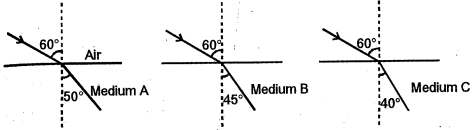
$(b)$ The path of a light ray from three different media $A, B$ and $C$ for a given angle of incidence is shown below. Study the diagrams and answer the following questions.
$(i)$ Which of the three media $A, B$ or $C$ has maximum optical density?
$(ii)$ Through which of the three media,will the speed of light be maximum?
$(iii)$ Will the light travelling from $A$ to $B$ bend towards or away from the normal?
$(iv)$ Will the refractive index of $B$ relative to $C$ be more than unity or less than unity?
Solution
(D) The absolute refractive index of a medium is defined as the ratio of the speed of light in vacuum (or air) to the speed of light in that medium. Mathematically,$n = c/v$,where $c$ is the speed of light in vacuum and $v$ is the speed of light in the medium.
$(b)$ $(i)$ Optical density is directly related to the refractive index. $A$ higher refractive index means higher optical density. Since the angle of refraction is smallest in medium $C$ $(40^{\circ})$,it has the highest refractive index and thus the maximum optical density.
$(ii)$ The speed of light is inversely proportional to the refractive index. Since medium $A$ has the largest angle of refraction $(50^{\circ})$,it has the lowest refractive index,meaning the speed of light will be maximum in medium $A$.
$(iii)$ Light travelling from $A$ to $B$: Since the angle of refraction in $A$ $(50^{\circ})$ is greater than in $B$ $(45^{\circ})$,medium $B$ is optically denser than medium $A$. Therefore,light will bend towards the normal.
$(iv)$ Refractive index of $B$ relative to $C$ $(n_{BC})$ is given by $n_B / n_C$. Since the angle of refraction in $B$ $(45^{\circ})$ is greater than in $C$ $(40^{\circ})$,medium $C$ is optically denser than $B$ $(n_C > n_B)$. Thus,$n_{BC} = n_B / n_C < 1$,which is less than unity.
0 likes
View Solution17
Difficult
One half of a convex lens of focal length $10\, cm$ is covered with a black paper. Can such a lens produce an image of a complete object placed at a distance of $30\, cm$ from the lens? Draw a ray diagram to justify your answer.
$A$ $4\, cm$ tall object is placed perpendicular to the principal axis of a convex lens of focal length $20\, cm$. The distance of the object from the lens is $15\, cm$. Find the nature,position and size of the image.
$A$ $4\, cm$ tall object is placed perpendicular to the principal axis of a convex lens of focal length $20\, cm$. The distance of the object from the lens is $15\, cm$. Find the nature,position and size of the image.
Solution
(N/A) $(i)$ Yes,the lens can produce an image of the complete object. Although the intensity of the image will be reduced because less light passes through the lens,the image will still be formed at the same position.
$(ii)$ The ray diagram shows the object placed beyond $2F_1$. The image is formed between $F_2$ and $2F_2$ on the other side of the lens.
$(iii)$ Given: Height of object $h = 4\, cm$,focal length $f = +20\, cm$,object distance $u = -15\, cm$.
Using the lens formula: $\frac{1}{f} = \frac{1}{v} - \frac{1}{u}$
$\frac{1}{v} = \frac{1}{f} + \frac{1}{u} = \frac{1}{20} + \frac{1}{-15} = \frac{3 - 4}{60} = \frac{-1}{60}$
Therefore,$v = -60\, cm$.
The negative sign indicates that the image is formed on the same side as the object.
Nature: Virtual and erect.
Size of the image: $m = \frac{v}{u} = \frac{-60}{-15} = +4$.
$h' = m \times h = 4 \times 4\, cm = +16\, cm$. The image is magnified and erect.
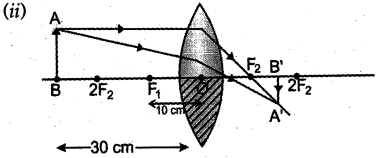
0 likes
View Solution18
Difficult
$(a)$ State the relation between object distance,image distance and the focal length of a spherical mirror.
$(b)$ Draw a ray diagram to show the image formed by a concave mirror when an object is placed between the pole and focus of the mirror.
$(c)$ $A$ concave mirror of focal length $15\, cm$ forms an image of an object kept at a distance of $10\, cm$ from the mirror. Find the position,nature and size of the image formed by it.
Solution
(N/A) The mirror formula is given by $\frac{1}{f} = \frac{1}{v} + \frac{1}{u}$,where $f$ is the focal length,$v$ is the image distance,and $u$ is the object distance.
$(b)$ The ray diagram shows the object placed between the pole $(P)$ and the focus $(F)$ of a concave mirror,resulting in a virtual,erect,and magnified image behind the mirror.
$(c)$ Given:
Focal length of concave mirror,$f = -15\, cm$
Object distance,$u = -10\, cm$
Using the mirror formula: $\frac{1}{f} = \frac{1}{v} + \frac{1}{u}$
$\frac{1}{v} = \frac{1}{f} - \frac{1}{u} = \frac{1}{-15} - \frac{1}{-10} = -\frac{1}{15} + \frac{1}{10} = \frac{-2 + 3}{30} = \frac{1}{30}$
Therefore,$v = +30\, cm$.
Since $v$ is positive,the image is formed $30\, cm$ behind the mirror.
The image is virtual,erect,and magnified (as magnification $m = -\frac{v}{u} = -\frac{30}{-10} = +3$).
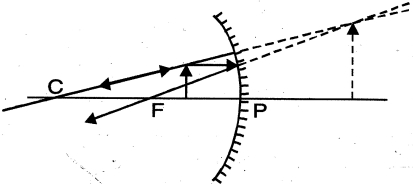
0 likes
View Solution19
Medium
Name the type of mirror used in the following:
$(a)$ Solar furnace.
$(b)$ Side/rear-view mirror of a vehicle.
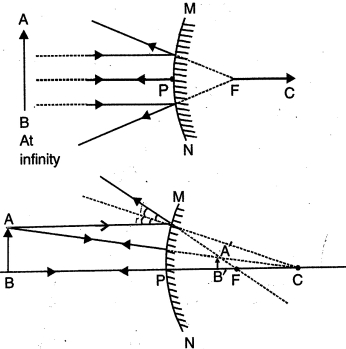
Draw a labelled ray diagram to show the formation of image in each of the above two cases.
Which of these mirrors could also form a magnified and virtual image of an object? Illustrate with the help of a ray diagram.
$(a)$ Solar furnace.
$(b)$ Side/rear-view mirror of a vehicle.
Draw a labelled ray diagram to show the formation of image in each of the above two cases.
Which of these mirrors could also form a magnified and virtual image of an object? Illustrate with the help of a ray diagram.
Solution
(A-D) Concave mirror is used in a solar furnace because it converges parallel rays of sunlight to a single point (focus),producing high heat.
$(b)$ Convex mirror is used as a side/rear-view mirror in vehicles because it provides a wider field of view and always forms a virtual,erect,and diminished image.
Concave mirror can form a magnified and virtual image when the object is placed between the pole $(P)$ and the focus $(F)$ of the mirror.
The ray diagram for the magnified and virtual image is as follows: When an object is placed between $P$ and $F$,the reflected rays appear to diverge from a point behind the mirror,forming a virtual,erect,and magnified image.
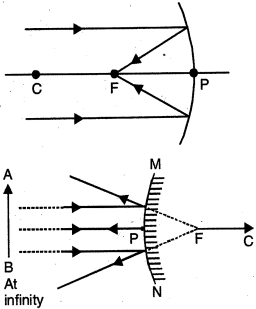
0 likes
View Solution20
Medium
$(a)$ Draw a ray diagram in each of the following cases to show the position and nature of the image formed when the object is placed:
$(i)$ between optical centre and principal focus $(F)$ of a convex lens.
$(ii)$ between $F$ and $2F$ of a convex lens.
$(iii)$ at $2F$ of a convex lens.
$(b)$ How will the nature and position of the image formed change in case $(i)$ and $(ii)$ in part $(a)$ of this question if the lens is replaced by a concave lens? Draw the corresponding ray diagram.
Solution
(N/A) For the ray diagrams of a convex lens:
$(i)$ When the object is between the optical centre and the principal focus $(F)$,the image formed is virtual,erect,and magnified,and it is formed on the same side of the lens as the object.
$(ii)$ When the object is between $F$ and $2F$,the image formed is real,inverted,and magnified,and it is formed beyond $2F$ on the other side of the lens.
$(iii)$ When the object is at $2F$,the image formed is real,inverted,and of the same size as the object,and it is formed at $2F$ on the other side of the lens.
$(b)$ If the convex lens is replaced by a concave lens,the nature and position of the image will change as follows:
In both cases $(i)$ and $(ii)$,the concave lens will always form a virtual,erect,and diminished image. The image will always be formed between the optical centre and the principal focus $(F)$ on the same side as the object,regardless of the object's position.
0 likes
View Solution21
Medium
$(a)$ Define principal focus of a spherical mirror.
$(b)$ For what position of the object does a concave mirror form a real,inverted and diminished image of the object? Draw the ray diagram.
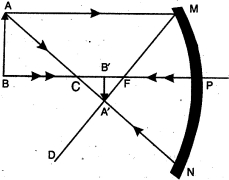
$(c)$ An object $4 \,cm$ high is placed at a distance of $6 \,cm$ in front of a concave mirror of focal length $12 \,cm$. Find the position of the image formed.
$(b)$ For what position of the object does a concave mirror form a real,inverted and diminished image of the object? Draw the ray diagram.
$(c)$ An object $4 \,cm$ high is placed at a distance of $6 \,cm$ in front of a concave mirror of focal length $12 \,cm$. Find the position of the image formed.
Solution
(C) The principal focus is a point on the principal axis where rays parallel to the principal axis converge (in a concave mirror) or appear to diverge from (in a convex mirror) after reflection.
$(b)$ $A$ concave mirror forms a real,inverted,and diminished image when the object is placed beyond the center of curvature $(C)$.
$(c)$ Given: Object height $h = 4 \,cm$,object distance $u = -6 \,cm$,focal length $f = -12 \,cm$.
Using the mirror formula: $\frac{1}{f} = \frac{1}{v} + \frac{1}{u}$
$\frac{1}{-12} = \frac{1}{v} + \frac{1}{-6}$
$\frac{1}{v} = \frac{1}{6} - \frac{1}{12} = \frac{2-1}{12} = \frac{1}{12}$
$v = 12 \,cm$.
The image is formed at a distance of $12 \,cm$ behind the mirror (virtual image).
0 likes
View Solution22
Difficult
$(a)$ Define the optical centre of a spherical lens.
$(b)$ You are given a convex lens of focal length $30 \, cm$. Where would you place an object to get a real,inverted,and highly enlarged image of the object? Draw a ray diagram showing the image formation.
$(c)$ $A$ concave lens has a focal length of $20 \, cm$. At what distance from the lens should an object be placed so that it forms an image at $15 \, cm$ away from the lens?
Solution
(N/A) The optical centre is the central point of a lens through which a ray of light passes without undergoing any deviation.
$(b)$ To obtain a real,inverted,and highly enlarged image with a convex lens,the object must be placed at the principal focus $(F_1)$. The image will be formed at infinity.
$(c)$ Given: Focal length of concave lens $f = -20 \, cm$,Image distance $v = -15 \, cm$.
Using the lens formula: $\frac{1}{f} = \frac{1}{v} - \frac{1}{u}$
$\frac{1}{-20} = \frac{1}{-15} - \frac{1}{u}$
$\frac{1}{u} = \frac{1}{-15} - \frac{1}{-20} = -\frac{1}{15} + \frac{1}{20}$
$\frac{1}{u} = \frac{-4 + 3}{60} = -\frac{1}{60}$
$u = -60 \, cm$.
Thus,the object should be placed at a distance of $60 \, cm$ in front of the lens.
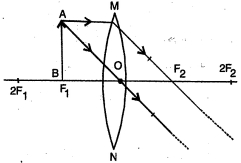
0 likes
View Solution23
Medium
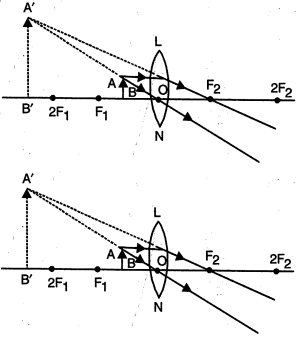
Which lens can be used as a magnifying glass? For which position of the object does a convex lens form:
$(a)$ a virtual and erect image?
$(b)$ a real and inverted image of the same size as that of the object?
Draw labelled ray diagrams to show the formation of the required image in each of the above two cases.
$(a)$ a virtual and erect image?
$(b)$ a real and inverted image of the same size as that of the object?
Draw labelled ray diagrams to show the formation of the required image in each of the above two cases.
Solution
(N/A) convex lens can be used as a magnifying glass.
$(a)$ When the object is placed between the optical centre $O$ and the principal focus $F_{1}$,the convex lens forms a virtual,erect,and magnified image on the same side as the object.
$(b)$ When the object is placed at $2F_{1}$,the convex lens forms a real,inverted image of the same size as the object at $2F_{2}$ on the other side of the lens.
[Refer to the provided ray diagrams for the visual representation of these cases.]
0 likes
View Solution24
Medium
$(i)$ Describe an activity to find the approximate value of the focal length of a concave mirror.
$(ii)$ What happens to the size of the image of an object when it is moved gradually away from a convex mirror?
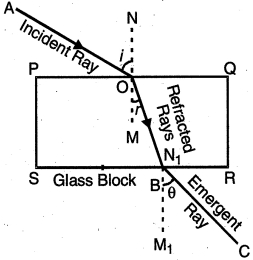
$(iii)$ In an experiment to study refraction through a glass slab,it is observed that a ray of light undergoing refraction emerges parallel to the direction of the incident ray. Why does it happen so? Explain with the help of a diagram.
Solution
(N/A) $(i)$ Activity: Hold a concave mirror in your hand and direct it towards a distant object (like a window or a tree). Direct the light reflected by the mirror onto a sheet of paper held close to the mirror. Move the sheet back and forth slowly until a bright,sharp spot of light is seen on the paper. The distance of this image from the position of the mirror gives the approximate value of the focal length of the mirror.
$(ii)$ As an object is moved gradually away from a convex mirror,the size of the image becomes smaller and it shifts towards the focus.
$(iii)$ When a light ray passes through a rectangular glass slab,it undergoes refraction at two parallel surfaces,$PQ$ (air-glass interface) and $SR$ (glass-air interface). The extent of bending of the ray of light at the first surface is equal and opposite to the bending at the second surface. Thus,the emergent ray is parallel to the incident ray,but it is laterally displaced. This is shown in the diagram below.
0 likes
View Solution25
Medium
$(i)$ Define the principal focus of a concave mirror.
$(ii)$ Why do we prefer a convex mirror as a rear-view mirror in vehicles?
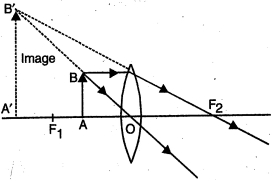
$(iii)$ We wish to obtain an erect image of an object using a convex lens. Draw a ray diagram to show the image formation in this case.
$(ii)$ Why do we prefer a convex mirror as a rear-view mirror in vehicles?
$(iii)$ We wish to obtain an erect image of an object using a convex lens. Draw a ray diagram to show the image formation in this case.
Solution
(N/A) $(i)$ Principal focus: $A$ number of rays parallel to the principal axis,after reflection from a concave mirror,meet at a point on the principal axis which is called the principal focus.
$(ii)$ $A$ convex mirror always forms an erect and diminished image. It provides a wider field of view because it is curved outwards,allowing the driver to see a much larger area behind the vehicle.
$(iii)$ To obtain an erect image with a convex lens,the object must be placed between the optical center $(O)$ and the principal focus $(F_1)$. The image formed is virtual,erect,and magnified,as shown in the diagram.
0 likes
View Solution26
Medium
$(a)$ The refractive index of diamond is $2.42$. What is the meaning of this statement?
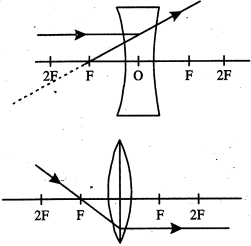
$(b)$ Redraw the diagram given below in your answer book and complete the path of the ray.
$(c)$ What is the difference between virtual images produced by concave and convex mirrors?
$(d)$ What does the negative sign in the value of magnification produced by a mirror indicate about an image?
$(b)$ Redraw the diagram given below in your answer book and complete the path of the ray.
$(c)$ What is the difference between virtual images produced by concave and convex mirrors?
$(d)$ What does the negative sign in the value of magnification produced by a mirror indicate about an image?
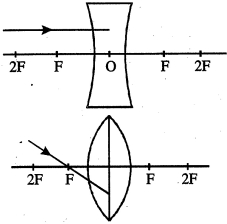
Solution
(N/A) This means that the ratio of the speed of light in air/vacuum to the speed of light in diamond is $2.42$.
$(b)$ The two figures are shown below,completing the path of the light rays.
$(c)$ $A$ virtual image produced by a concave mirror is magnified,whereas a virtual image produced by a convex mirror is always diminished. $A$ virtual image produced by a plane mirror is of the same size as the object.
$(d)$ The negative sign in the magnification value indicates that the image formed is real and inverted.
0 likes
View Solution27
Medium
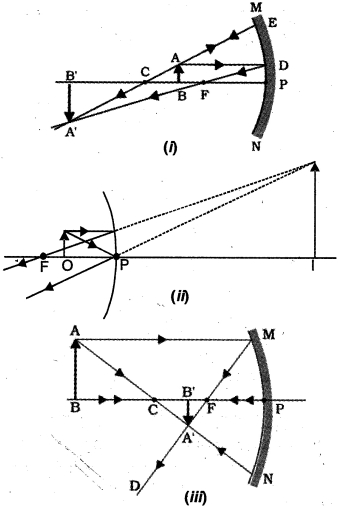
$(a)$ Draw a ray diagram in each of the following cases to show the position and nature of the image formed when an object is placed:
$(i)$ Between the focus and the centre of curvature of a concave mirror.
$(ii)$ Between the focus and the pole of a concave mirror.
$(iii)$ Between the centre of curvature and infinity for a concave mirror.
$(b)$ Give mathematical formulae for determining the magnification produced by a spherical mirror. What does $m = -1$ signify? Identify the mirror that can produce it.
Solution
(N/A) The ray diagrams are as shown in the provided image.
$(b)$ Magnification $(m)$ is defined as the ratio of the height of the image $(h')$ to the height of the object $(h)$,which is also equal to $-\frac{v}{u}$,where $v$ is the image distance and $u$ is the object distance.
$m = \frac{h'}{h} = -\frac{v}{u}$
$m = -1$ signifies:
$(i)$ The size of the image is equal to the size of the object.
$(ii)$ The negative sign indicates that the image is real and inverted.
This magnification is produced by a concave mirror when the object is placed at the centre of curvature $(C)$.
0 likes
View Solution28
Medium
Draw the ray diagram in each case to show the position,nature,and size of the image formed when the object is placed:
$(i)$ At the centre of curvature of a concave mirror.
$(ii)$ Within the focal length of a convex lens.
$(iii)$ Between the pole and focus of a concave mirror.
$(iv)$ In front of a convex mirror.
$(v)$ In front of a concave lens.
$(i)$ At the centre of curvature of a concave mirror.
$(ii)$ Within the focal length of a convex lens.
$(iii)$ Between the pole and focus of a concave mirror.
$(iv)$ In front of a convex mirror.
$(v)$ In front of a concave lens.
Solution
(N/A) $(i)$ At the centre of curvature $(C)$ of a concave mirror: The image is formed at $C$,is real,inverted,and of the same size as the object.
$(ii)$ Within the focal length $(f)$ of a convex lens: The image is formed on the same side as the object,is virtual,erect,and magnified.
$(iii)$ Between the pole $(P)$ and focus $(F)$ of a concave mirror: The image is formed behind the mirror,is virtual,erect,and magnified.
$(iv)$ In front of a convex mirror: The image is formed behind the mirror between the pole and focus,is virtual,erect,and diminished.
$(v)$ In front of a concave lens: The image is formed between the optical centre and focus on the same side as the object,is virtual,erect,and diminished.
0 likes
View Solution29
Medium
$(a)$ $A$ concave mirror produces a three times enlarged real image of an object placed at $10\, cm$ in front of it. Calculate the focal length of the mirror.
$(b)$ Show the formation of the image with the help of a ray diagram when an object is placed $6\, cm$ away from the pole of a convex mirror.
$(b)$ Show the formation of the image with the help of a ray diagram when an object is placed $6\, cm$ away from the pole of a convex mirror.
Solution
(N/A) Given: Magnification $m = -3$ (for a real image),Object distance $u = -10\, cm$. We need to find the focal length $f$.
Using the magnification formula: $m = -v/u$
$-3 = -v / (-10)$
$-3 = v / 10$
$v = -30\, cm$
Using the mirror formula: $1/f = 1/v + 1/u$
$1/f = 1/(-30) + 1/(-10)$
$1/f = (-1 - 3) / 30 = -4 / 30$
$f = -30 / 4 = -7.5\, cm$
Thus,the focal length of the concave mirror is $-7.5\, cm$.
$(b)$ The ray diagram for an object placed $6\, cm$ in front of a convex mirror is shown below.
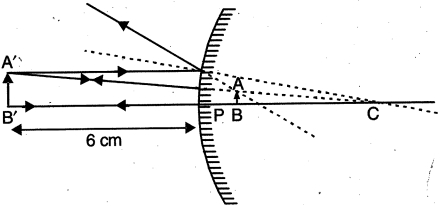
0 likes
View Solution30
EasyMCQ
$A$ concave mirror and a convex lens are held in water. What changes, if any, do you expect in their focal length?
A
Focal length of both will increase.
B
Focal length of both will decrease.
C
Focal length of the mirror remains unchanged, while the focal length of the lens increases.
D
Focal length of the mirror changes, while the focal length of the lens remains unchanged.
Solution
(C) The focal length of a mirror depends only on its radius of curvature $(f = R/2)$ and is independent of the refractive index of the surrounding medium. Therefore, the focal length of the concave mirror remains unchanged in water.
However, the focal length of a lens is determined by the Lens Maker's Formula: $1/f = (n_g/n_m - 1)(1/R_1 - 1/R_2)$, where $n_g$ is the refractive index of the lens material and $n_m$ is the refractive index of the medium. Since the refractive index of water $(n_m \approx 1.33)$ is greater than that of air $(n_m \approx 1.0)$, the relative refractive index $(n_g/n_m - 1)$ decreases, causing the focal length of the convex lens to increase.
However, the focal length of a lens is determined by the Lens Maker's Formula: $1/f = (n_g/n_m - 1)(1/R_1 - 1/R_2)$, where $n_g$ is the refractive index of the lens material and $n_m$ is the refractive index of the medium. Since the refractive index of water $(n_m \approx 1.33)$ is greater than that of air $(n_m \approx 1.0)$, the relative refractive index $(n_g/n_m - 1)$ decreases, causing the focal length of the convex lens to increase.
0 likes
View Solution31
EasyMCQ
Which of the following always form a virtual image?
A
Concave mirror and convex lens
B
Convex mirror and concave lens
C
Convex mirror and convex lens
D
Concave mirror and concave lens
Solution
(B) $1$. A Convex mirror always forms a virtual, erect, and diminished image for any position of the object in front of it.
$2$. A Concave lens always forms a virtual, erect, and diminished image for any position of the object in front of it.
$3$. In contrast, Concave mirrors and Convex lenses can form both real and virtual images depending on the position of the object.
$4$. Therefore, the correct combination is Convex mirror and Concave lens.
0 likes
View Solution32
EasyMCQ
Which of the following statements is true for light waves?
A
They are mechanical waves.
B
They are of very long wavelength.
C
They require a medium for their propagation.
D
They are electromagnetic waves.
Solution
(D) Light waves are electromagnetic waves because they consist of oscillating electric and magnetic fields.
Unlike mechanical waves (such as sound waves),light waves do not require a material medium for their propagation and can travel through a vacuum.
Therefore,the statement that light waves are electromagnetic waves is correct.
Unlike mechanical waves (such as sound waves),light waves do not require a material medium for their propagation and can travel through a vacuum.
Therefore,the statement that light waves are electromagnetic waves is correct.
0 likes
View Solution33
EasyMCQ
For which type of mirror will the image always be erect,regardless of the distance at which the object is placed?
A
Plane mirror only
B
Concave mirror only
C
Convex mirror only
D
Plane or convex mirror
Solution
(D) plane mirror always forms a virtual and erect image of an object,regardless of its distance from the mirror.
$A$ convex mirror also always forms a virtual and erect image of an object,regardless of its distance from the mirror.
$A$ concave mirror can form both real and virtual images depending on the object's position.
Therefore,both plane and convex mirrors always produce an erect image for any object distance.
0 likes
View Solution34
EasyMCQ
Which type of mirror can produce a virtual image?
A
Plane, concave, and convex mirrors
B
Only plane mirrors
C
Only convex mirrors
D
Only concave mirrors
Solution
A virtual image is an image that cannot be projected onto a screen and is formed when light rays appear to diverge from a point.
$1$. A Plane mirror always forms a virtual, erect, and same-sized image.
$2$. A Convex mirror always forms a virtual, erect, and diminished image.
$3$. A Concave mirror forms a virtual, erect, and magnified image when the object is placed between the pole $(P)$ and the focus $(F)$.
Therefore, all three types of mirrors can produce a virtual image under specific conditions.
0 likes
View Solution35
MCQ
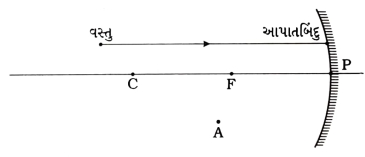
$A$ point object emits rays in all directions. Consider a ray emitted from the object that is parallel to the principal axis of the mirror. One of the points required to trace the reflected ray is the point of incidence itself,as shown in the figure. Select a point from the given figure through which the reflected ray passes.
A
$C$
B
$F$
C
$A$
D
$P$
Solution
(B) According to the rules of reflection for a concave mirror,any light ray that is parallel to the principal axis will pass through the principal focus $(F)$ after reflection from the mirror.
In the given figure,the incident ray is parallel to the principal axis.
Therefore,after reflection,this ray must pass through the principal focus,which is marked as point $F$.
In the given figure,the incident ray is parallel to the principal axis.
Therefore,after reflection,this ray must pass through the principal focus,which is marked as point $F$.
0 likes
View Solution36
EasyMCQ
Both a spherical mirror and a thin spherical lens have a focal length of $-15 \; cm$. What type of mirror and lens are they?
A
Both are concave
B
Both are convex
C
The mirror is concave and the lens is convex
D
The mirror is convex and the lens is concave
Solution
(A) According to the sign convention for spherical mirrors,the focal length of a concave mirror is negative,while that of a convex mirror is positive.
According to the sign convention for spherical lenses,the focal length of a concave lens is negative,while that of a convex lens is positive.
Since the focal length is given as $-15 \; cm$ for both,the mirror must be concave and the lens must also be concave.
Therefore,both the mirror and the lens are concave.
0 likes
View SolutionLight – Reflection and Refraction — Mix Examples - Light – Reflection and Refraction · Frequently Asked Questions
1Are these Light – Reflection and Refraction questions useful for JEE and NEET?
Yes. All questions in this section are mapped to JEE Main and NEET exam patterns. Previous year questions from JEE Main, NEET, GUJCET and state-level exams are included with full solutions.
2Can I switch to Hindi or Gujarati for these questions?
Yes. Use the language tabs in the hero section or the sidebar to view the same questions and solutions in English, Hindi or Gujarati.
3How do I generate a question paper from this subtopic?
Use the Vedclass Exam Paper Generator — select the chapter and subtopic, set difficulty, and generate Sets A, B, C, D automatically. First 3 chapters of every subject are free.
Vedclass Products
For Students
Vedclass Test Series
Mock tests in real JEE/NEET style with performance analysis. 5-day free trial.
Start Free TrialFor Teachers
Exam Paper Generator
Generate Set A/B/C/D papers from this chapter in 2 minutes. 3 chapters free.
Try FreeFor Institutes
Online Exam Module
Live online exams with unlimited students, 360° analytics & white-label branding.
See DemoFor Teachers & Institutes
Generate a Light – Reflection and Refraction Exam Paper in 2 Minutes
Select subtopic & difficulty — Sets A, B, C, D auto-generated with No Repeat logic.
First 3 chapters of every subject are free — no payment required.