
A English
Reflection of Light and Spherical Mirrors Questions in English
Class 10 Science · Light – Reflection and Refraction · Reflection of Light and Spherical Mirrors
147+
Questions
English
Language
100%
With Solutions
Showing 50 of 147 questions in English
1
Easy
Define the principal focus of a concave mirror.
Solution
(N/A) Light rays that are parallel to the principal axis of a concave mirror converge at a specific point on its principal axis after reflecting from the mirror. This point is known as the principal focus of the concave mirror.
0 likes
View Solution2
EasyMCQ
The radius of curvature of a spherical mirror is $20\, cm$. What is its focal length (in $cm$)?
A
$5$
B
$10$
C
$20$
D
$40$
Solution
(B) Radius of curvature,$R = 20\, cm$.
The relationship between the radius of curvature $(R)$ and the focal length $(f)$ of a spherical mirror is given by the formula: $R = 2f$.
To find the focal length $(f)$,we rearrange the formula: $f = \frac{R}{2}$.
Substituting the given value: $f = \frac{20\, cm}{2} = 10\, cm$.
Therefore,the focal length of the given spherical mirror is $10\, cm$.
0 likes
View Solution3
EasyMCQ
Name the mirror that can give an erect and enlarged image of an object.
A
Concave mirror
B
Convex mirror
C
Plane mirror
D
None of the above
Solution
(A) concave mirror produces an erect and enlarged image when the object is placed between the pole $(P)$ and the principal focus $(F)$ of the mirror.
In this position,the light rays appear to diverge from behind the mirror,forming a virtual image that is larger than the actual object.
In this position,the light rays appear to diverge from behind the mirror,forming a virtual image that is larger than the actual object.
0 likes
View Solution4
MediumMCQ
Why do we prefer a convex mirror as a rear-view mirror in vehicles?
A
It produces a real and inverted image.
B
It produces a virtual,erect,and diminished image with a wider field of view.
C
It produces a magnified image of the objects.
D
It is cheaper than other mirrors.
Solution
(B) Convex mirrors are preferred as rear-view mirrors in vehicles for the following reasons:
$1$. They always form a virtual,erect,and diminished image of the objects placed in front of them.
$2$. They have a wider field of view compared to plane mirrors,which allows the driver to see a larger area of the traffic behind the vehicle.
$3$. This helps the driver in safe driving by providing a better perspective of the vehicles approaching from the rear.
0 likes
View Solution5
EasyMCQ
Find the focal length (in $cm$) of a convex mirror whose radius of curvature is $32\, cm$.
A
$16$
B
$8$
C
$32$
D
$4$
Solution
(A) The radius of curvature $(R)$ of the convex mirror is given as $32\, cm$.
The relationship between the radius of curvature $(R)$ and the focal length $(f)$ of a spherical mirror is given by the formula: $R = 2f$.
To find the focal length $(f)$,we rearrange the formula: $f = \frac{R}{2}$.
Substituting the given value: $f = \frac{32\, cm}{2} = 16\, cm$.
Therefore,the focal length of the given convex mirror is $16\, cm$.
0 likes
View Solution6
MediumMCQ
The image formed by a concave mirror is observed to be virtual,erect and larger than the object. Where should be the position of the object?
A
Between the principal focus and the centre of curvature
B
At the centre of curvature
C
Beyond the centre of curvature
D
Between the pole of the mirror and its principal focus.
Solution
(D) concave mirror forms a virtual,erect,and magnified image only when the object is placed between the pole $(P)$ and the principal focus $(F)$ of the mirror.
In this position,the light rays appear to diverge from behind the mirror,creating a virtual image that is larger than the object.
In this position,the light rays appear to diverge from behind the mirror,creating a virtual image that is larger than the object.
0 likes
View Solution7
Medium
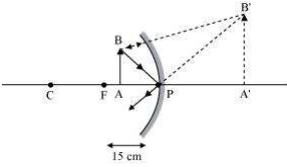
We wish to obtain an erect image of an object,using a concave mirror of focal length $15\, cm$. What should be the range of distance of the object from the mirror? What is the nature of the image? Is the image larger or smaller than the object? Draw a ray diagram to show the image formation in this case.
Solution
(N/A) The range of the object distance should be between $0\, cm$ and $15\, cm$ (i.e.,between the pole $P$ and the principal focus $F$).
$A$ concave mirror produces an erect image only when the object is placed between its pole $(P)$ and the principal focus $(F)$.
The nature of the image formed is virtual and erect.
The image is larger (magnified) than the object.
The ray diagram showing the image formation is provided in the image below.
1 likes
View Solution8
Name the type of mirror used in the following situation.
Support your answer with a reason.
$(a)$ Headlights of a car
Support your answer with a reason.
$(a)$ Headlights of a car

Solution
(N/A) Concave mirror.
$A$ concave mirror is used in the headlights of a car. This is because when a light source (bulb) is placed at the principal focus of a concave mirror,the light rays after reflection travel as a powerful parallel beam of light,which helps in illuminating the road at a long distance.
$A$ concave mirror is used in the headlights of a car. This is because when a light source (bulb) is placed at the principal focus of a concave mirror,the light rays after reflection travel as a powerful parallel beam of light,which helps in illuminating the road at a long distance.
0 likes
View Solution9
Easy
Name the type of mirror used as a side/rear-view mirror in a vehicle. Support your answer with a reason.
Solution
(CONVEX) The type of mirror used is a $Convex$ mirror.
Reason:
$1$. $Convex$ mirrors always form a virtual,erect,and diminished image of the objects placed in front of them.
$2$. They have a wider field of view compared to plane or concave mirrors,which allows the driver to see a larger area of the traffic behind the vehicle.
$3$. This helps the driver in safe driving by providing a better view of the road conditions behind.
0 likes
View Solution10
Medium
Name the type of mirror used in the following situation and support your answer with a reason:
$(a)$ Solar furnace
$(a)$ Solar furnace
Solution
(CONCAVE MIRROR) Concave mirror.
Concave mirrors are converging mirrors. They are used in solar furnaces because they converge the parallel rays of sunlight incident on them to a single point,known as the principal focus. This concentration of light energy produces a large amount of heat at that point,which is useful for heating purposes.
Concave mirrors are converging mirrors. They are used in solar furnaces because they converge the parallel rays of sunlight incident on them to a single point,known as the principal focus. This concentration of light energy produces a large amount of heat at that point,which is useful for heating purposes.
0 likes
View Solution11
Medium
What kind of mirror - concave,convex,or plain - would be best suited for use in a solar cooker? Why?
Solution
(A) solar cooker uses the heat of sunlight to cook and heat food. $A$ mirror is used to reflect and focus sunlight at a single point. $A$ concave mirror is best suited for this purpose. The concave mirror converges all the incident parallel rays of sunlight at its focus. This concentration of light energy significantly increases the temperature at that point,which is used to cook or heat the food placed there.
0 likes
View Solution12
MediumMCQ
Rays from the Sun converge at a point $15 \, cm$ in front of a concave mirror. Where should an object be placed so that the size of its image is equal to the size of the object?
A
$15 \, cm$ in front of the mirror
B
$30 \, cm$ in front of the mirror
C
Between $15 \, cm$ and $30 \, cm$ in front of the mirror
D
More than $30 \, cm$ in front of the mirror
Solution
(B) The rays from the Sun are parallel to the principal axis and converge at the focus $(F)$ of the concave mirror. Therefore,the focal length $(f)$ of the mirror is $15 \, cm$.
For a concave mirror,the image size is equal to the object size when the object is placed at the center of curvature $(C)$.
The center of curvature is at a distance equal to twice the focal length $(R = 2f)$.
Thus,$R = 2 \times 15 \, cm = 30 \, cm$.
Therefore,the object should be placed at $30 \, cm$ in front of the mirror.
0 likes
View Solution13
EasyMCQ
$A$ full-length image of a distant tall building can definitely be seen by using:
A
a concave mirror
B
a plane mirror
C
a convex mirror
D
both concave as well as plane mirror
Solution
(C) convex mirror is used to see a full-length image of a distant tall building because it always forms a virtual,erect,and diminished image of objects placed in front of it. Due to its outward-curved surface,it has a wider field of view,allowing it to capture the entire image of a large object within a small mirror area. Plane mirrors would require a mirror of at least half the height of the building to see the full image,which is impractical for a distant tall building.
0 likes
View Solution14
MediumMCQ
In torches,searchlights,and headlights of vehicles,the bulb is placed:
A
between the pole and the focus of the reflector
B
at the centre of curvature of the reflector
C
between the focus and centre of curvature of the reflector
D
very near to the focus of the reflector
Solution
(D) In torches,searchlights,and vehicle headlights,a concave mirror is used as a reflector.
According to the properties of a concave mirror,when a light source (bulb) is placed at the focus $(F)$,the light rays emanating from it strike the mirror and are reflected as a parallel beam of light.
This parallel beam of light travels over a long distance,which is essential for these devices to illuminate distant objects.
Therefore,the bulb is placed very near to the focus of the reflector.
0 likes
View Solution15
EasyMCQ
The laws of reflection hold good for
A
all mirrors irrespective of their shape
B
concave mirrors only
C
convex mirrors only
D
plane mirrors only
Solution
(A) The laws of reflection state that:
$1$. The angle of incidence is equal to the angle of reflection $(i = r)$.
$2$. The incident ray,the reflected ray,and the normal to the mirror surface at the point of incidence all lie in the same plane.
These laws are universal and apply to all types of reflecting surfaces,including plane mirrors,concave mirrors,and convex mirrors,regardless of their shape or curvature.
0 likes
View Solution16
EasyMCQ
Which of the following ray diagrams is correct for the ray of light incident on a concave mirror as shown in Figure?
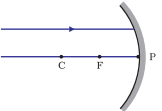
A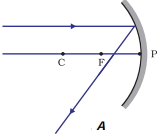
B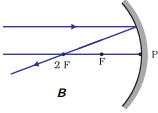
C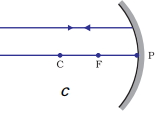
D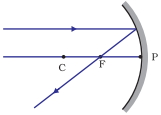
Solution
(D) According to the rules of reflection for a concave mirror,a ray of light parallel to the principal axis,after reflection,passes through the principal focus $(F)$ of the mirror.
In the given figure,the incident ray is parallel to the principal axis.
Therefore,after reflection,it must pass through the principal focus $(F)$.
Looking at the options,option $D$ correctly shows the reflected ray passing through the principal focus $(F)$.
Thus,the correct ray diagram is $D$.
In the given figure,the incident ray is parallel to the principal axis.
Therefore,after reflection,it must pass through the principal focus $(F)$.
Looking at the options,option $D$ correctly shows the reflected ray passing through the principal focus $(F)$.
Thus,the correct ray diagram is $D$.
0 likes
View Solution17
MediumMCQ
$A$ child is standing in front of a magic mirror. She finds the image of her head bigger, the middle portion of her body of the same size, and that of the legs smaller. What is the order of combinations for the magic mirror from the top?
A
Plane, convex and concave
B
Concave, plane and convex
C
Convex, concave and plane
D
Convex, plane and concave
Solution
(B) $1$. $A$ concave mirror produces a magnified image when the object is placed close to it. Since the head appears bigger, the top part of the mirror is concave.
$2$. $A$ plane mirror produces an image of the same size as the object. Since the middle portion appears of the same size, the middle part of the mirror is plane.
$3$. $A$ convex mirror always produces a diminished (smaller) image. Since the legs appear smaller, the bottom part of the mirror is convex.
$4$. Therefore, the order of the mirrors from top to bottom is concave, plane, and convex.
0 likes
View Solution18
Difficult
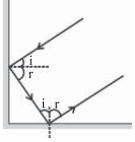
Under what condition in an arrangement of two plane mirrors,will the incident ray and the final reflected ray always be parallel to each other,regardless of the angle of incidence? Show the same with the help of a diagram.
Solution
(N/A) When two plane mirrors are placed at an angle of $90^{\circ}$ to each other,the incident ray and the final reflected ray will always be parallel to each other,regardless of the angle of incidence.
Explanation:
$1$. Let the two mirrors be $M_1$ and $M_2$ placed at $90^{\circ}$.
$2$. The incident ray strikes $M_1$ at an angle of incidence $i$. According to the law of reflection,the angle of reflection $r = i$.
$3$. The reflected ray from $M_1$ acts as the incident ray for $M_2$. By geometry,the angle of incidence at $M_2$ will be $(90^{\circ} - i)$.
$4$. The final angle of reflection at $M_2$ will also be $(90^{\circ} - i)$.
$5$. By calculating the total deviation or the angles with the normal,it can be shown that the final reflected ray is parallel to the initial incident ray.
0 likes
View Solution19
Medium
Draw ray diagrams showing the image formation by a concave mirror when an object is placed:
$(a)$ Between pole $(P)$ and focus $(F)$ of the mirror.
$(b)$ Between focus $(F)$ and centre of curvature $(C)$ of the mirror.
$(c)$ At centre of curvature $(C)$ of the mirror.
$(d)$ $A$ little beyond centre of curvature $(C)$ of the mirror.
$(e)$ At infinity.
$(a)$ Between pole $(P)$ and focus $(F)$ of the mirror.
$(b)$ Between focus $(F)$ and centre of curvature $(C)$ of the mirror.
$(c)$ At centre of curvature $(C)$ of the mirror.
$(d)$ $A$ little beyond centre of curvature $(C)$ of the mirror.
$(e)$ At infinity.
Solution
(N/A) To draw the ray diagrams for a concave mirror,follow these steps for each case:
$(a)$ Between $P$ and $F$: The image is virtual,erect,and magnified,formed behind the mirror.
$(b)$ Between $F$ and $C$: The image is real,inverted,and magnified,formed beyond $C$.
$(c)$ At $C$: The image is real,inverted,and of the same size as the object,formed at $C$.
$(d)$ Beyond $C$: The image is real,inverted,and diminished,formed between $F$ and $C$.
$(e)$ At infinity: The image is real,inverted,and highly diminished (point-sized),formed at the focus $F$.
0 likes
View Solution20
Medium
Draw ray diagrams showing the image formation by a convex mirror when an object is placed:
$(a)$ at infinity
$(b)$ at a finite distance from the mirror
$(a)$ at infinity
$(b)$ at a finite distance from the mirror
Solution
(N/A) For a convex mirror:
$(a)$ When the object is at infinity,the incident rays are parallel to the principal axis. After reflection,they appear to diverge from the principal focus $(F)$ behind the mirror. The image formed is virtual,erect,highly diminished,and located at the principal focus $(F)$ behind the mirror.
$(b)$ When the object is at a finite distance from the mirror,the image formed is always virtual,erect,and diminished. It is located between the pole $(P)$ and the principal focus $(F)$ behind the mirror,regardless of the object's distance.
0 likes
View Solution21
Easy
Define the term reflection.
Solution
(N/A) The phenomenon of bouncing back of light rays when they strike a smooth or polished surface is known as reflection of light. When light hits a surface,it changes its direction and returns to the same medium.
0 likes
View Solution22
Easy
Define the following terms:
$(i)$ Angle of incidence
$(ii)$ Angle of reflection
$(iii)$ Plane of incidence
$(i)$ Angle of incidence
$(ii)$ Angle of reflection
$(iii)$ Plane of incidence
Solution
(N/A) $(i)$ Angle of incidence: It is the angle between the incident ray and the normal at the point of incidence.
$(ii)$ Angle of reflection: It is the angle between the reflected ray and the normal at the point of incidence.
$(iii)$ Plane of incidence: It is the plane that contains the incident ray,the reflected ray,and the normal at the point of incidence.
$(ii)$ Angle of reflection: It is the angle between the reflected ray and the normal at the point of incidence.
$(iii)$ Plane of incidence: It is the plane that contains the incident ray,the reflected ray,and the normal at the point of incidence.
0 likes
View Solution23
Easy
State the laws of reflection.
Solution
(N/A) $(i)$ The angle of incidence $(i)$ is equal to the angle of reflection $(r)$,i.e.,$i = r$.
$(ii)$ The incident ray,the normal to the mirror at the point of incidence,and the reflected ray all lie in the same plane.
$(ii)$ The incident ray,the normal to the mirror at the point of incidence,and the reflected ray all lie in the same plane.
0 likes
View Solution24
MediumMCQ
Explain why the word $AMBULANCE$ is written in reverse on the front of some vehicles.
A
To make it look attractive.
B
Due to lateral inversion in the rear-view mirror of the vehicle ahead.
C
To warn the driver ahead to move aside.
D
It is a standard practice for all emergency vehicles.
Solution
(B) The image formed by a plane mirror undergoes lateral inversion,which means the left side of the object appears as the right side in the image.
When a driver looks into their rear-view mirror,they see the word $AMBULANCE$ written in reverse on the vehicle behind them.
Due to the lateral inversion caused by the rear-view mirror,the word appears correctly oriented to the driver.
This allows the driver to quickly identify the vehicle as an $AMBULANCE$ and give way.
0 likes
View Solution25
EasyMCQ
What type of image is formed by a plane mirror?
A
Real,inverted and magnified
B
Virtual,erect and same size
C
Real,erect and diminished
D
Virtual,inverted and same size
Solution
(B) plane mirror always forms a virtual and erect image.
The size of the image is equal to the size of the object (unmagnified).
The image formed is laterally inverted,meaning it exhibits right-left reversal.
Therefore,the image is virtual,erect,and of the same size as the object.
The size of the image is equal to the size of the object (unmagnified).
The image formed is laterally inverted,meaning it exhibits right-left reversal.
Therefore,the image is virtual,erect,and of the same size as the object.
0 likes
View Solution26
EasyMCQ
Can a plane mirror be called a spherical mirror?
A
Yes
B
No
C
Sometimes
D
Cannot be determined
Solution
(A) Yes,a plane mirror can be considered a spherical mirror with an infinite radius of curvature $(R = \infty)$.
Since the focal length $(f)$ is half of the radius of curvature $(f = R/2)$,the focal length of a plane mirror is also infinite $(f = \infty)$.
Since the focal length $(f)$ is half of the radius of curvature $(f = R/2)$,the focal length of a plane mirror is also infinite $(f = \infty)$.
0 likes
View Solution27
EasyMCQ
What is the radius of curvature of a plane mirror?
A
Zero
B
Infinity
C
One meter
D
Equal to the focal length
Solution
(B) plane mirror can be considered as a part of a spherical mirror with an infinitely large radius of curvature. Since the surface of a plane mirror is perfectly flat,it does not curve at any point. Mathematically,the radius of curvature $(R)$ is related to the focal length $(f)$ by the formula $R = 2f$. For a plane mirror,the focal length is considered to be infinity,therefore the radius of curvature is also infinity.
0 likes
View Solution28
EasyMCQ
How many images are formed by two parallel mirrors?
A
One
B
Two
C
Infinite
D
Zero
Solution
(C) When two plane mirrors are placed parallel to each other,the light rays reflect back and forth between the two mirrors repeatedly. Each reflection creates a new image of the previous image. Since the mirrors are parallel,the angle between them is $0^{\circ}$. The formula for the number of images formed is $n = (360^{\circ} / \theta) - 1$. Substituting $\theta = 0^{\circ}$,we get $n = (360^{\circ} / 0^{\circ}) - 1$,which approaches infinity. Therefore,an infinite number of images are formed.
0 likes
View Solution29
EasyMCQ
$A$ ray of light is incident on a plane mirror normally. What are the angle of incidence and the angle of reflection?
A
Angle of incidence = $0^{\circ}$,Angle of reflection = $0^{\circ}$
B
Angle of incidence = $90^{\circ}$,Angle of reflection = $90^{\circ}$
C
Angle of incidence = $0^{\circ}$,Angle of reflection = $90^{\circ}$
D
Angle of incidence = $90^{\circ}$,Angle of reflection = $0^{\circ}$
Solution
(A) When a ray of light is incident normally (perpendicularly) on a plane mirror,it strikes the surface along the normal.
By definition,the angle of incidence $(i)$ is the angle between the incident ray and the normal at the point of incidence.
Since the ray is incident along the normal,the angle between them is $0^{\circ}$,so $i = 0^{\circ}$.
According to the laws of reflection,the angle of incidence is equal to the angle of reflection $(i = r)$.
Therefore,the angle of reflection $(r)$ is also $0^{\circ}$.
0 likes
View Solution30
Easy
Write down four important characteristics of the image formed by a plane mirror.
Solution
(N/A) $(i)$ The image is of the same size as the object (unmagnified).
(ii) The image is virtual,meaning it cannot be caught on a screen.
(iii) The image is erect (upright).
(iv) The image exhibits lateral inversion (right-left reversal).
(ii) The image is virtual,meaning it cannot be caught on a screen.
(iii) The image is erect (upright).
(iv) The image exhibits lateral inversion (right-left reversal).
0 likes
View Solution31
Easy
Describe a spherical mirror.
Solution
(N/A) spherical mirror is a mirror whose reflecting surface is a part of a hollow sphere of glass.
There are two main types of spherical mirrors:
$1$. Concave mirror: $A$ spherical mirror whose reflecting surface is curved inwards,i.e.,faces towards the center of the sphere.
$2$. Convex mirror: $A$ spherical mirror whose reflecting surface is curved outwards,i.e.,faces away from the center of the sphere.
0 likes
View Solution32
Medium
Define the following terms in relation to a concave spherical mirror (any five):
$(i)$ Pole
$(ii)$ Centre of curvature
$(iii)$ Radius of curvature
$(iv)$ Principal axis
$(v)$ Principal focus
$(vi)$ Aperture
$(vii)$ Focal length
$(i)$ Pole
$(ii)$ Centre of curvature
$(iii)$ Radius of curvature
$(iv)$ Principal axis
$(v)$ Principal focus
$(vi)$ Aperture
$(vii)$ Focal length
Solution
(N/A) $(i)$ Pole (Vertex): The central point of the reflecting surface of a spherical mirror is called its pole.
$(ii)$ Centre of curvature: The centre of the sphere of which the mirror is a part is called the centre of curvature.
$(iii)$ Radius of curvature: The radius of the sphere of which the mirror is a part is called the radius of curvature.
$(iv)$ Principal axis: The straight line passing through the pole and the centre of curvature of the mirror is called the principal axis.
$(v)$ Principal focus: It is a point on the principal axis where light rays parallel to the principal axis converge or appear to diverge after reflection.
$(vi)$ Aperture: The effective diameter of the light-reflecting area of the spherical mirror is called its aperture.
$(vii)$ Focal length: The distance between the pole and the principal focus of a spherical mirror is called the focal length,represented by $f$.
0 likes
View Solution33
Easy
Define the term principal focus for a convex mirror.
Solution
(N/A) The principal focus of a convex mirror is a point on its principal axis. When rays of light parallel to the principal axis strike the convex mirror,they diverge after reflection. If these reflected rays are extended backwards,they appear to meet at this specific point on the principal axis. This point is known as the principal focus of the convex mirror.
0 likes
View Solution34
EasyMCQ
What is the focal length of a plane mirror?
A
Zero
B
Infinity
C
Equal to the radius of curvature
D
Half of the radius of curvature
Solution
(B) The focal length $(f)$ of a spherical mirror is related to its radius of curvature $(R)$ by the formula $f = R/2$.
For a plane mirror, the surface is flat, which means it can be considered as a part of a sphere with an infinite radius of curvature $(R = \infty)$.
Substituting this into the formula, we get $f = \infty / 2 = \infty$.
Therefore, the focal length of a plane mirror is infinity.
For a plane mirror, the surface is flat, which means it can be considered as a part of a sphere with an infinite radius of curvature $(R = \infty)$.
Substituting this into the formula, we get $f = \infty / 2 = \infty$.
Therefore, the focal length of a plane mirror is infinity.
0 likes
View Solution35
Medium
What do you understand by the terms
$(i)$ Real image?
$(ii)$ Virtual image?
$(i)$ Real image?
$(ii)$ Virtual image?
Solution
(N/A) $(i)$ Real image: When the rays of light,after reflection from a mirror,actually meet at a point,the image formed by these rays is called a real image. Real images can be obtained on a screen.
$(ii)$ Virtual image: When the rays of light,after reflection from a mirror,appear to meet at a point,the image formed by these rays is called a virtual image. Virtual images cannot be obtained on a screen.
$(ii)$ Virtual image: When the rays of light,after reflection from a mirror,appear to meet at a point,the image formed by these rays is called a virtual image. Virtual images cannot be obtained on a screen.
0 likes
View Solution36
EasyMCQ
If the radius of curvature of a concave mirror is $36\, cm$,what is its focal length (in $, cm$)?
A
$18$
B
$36$
C
$72$
D
$9$
Solution
(A) The relationship between the focal length $(f)$ and the radius of curvature $(R)$ of a spherical mirror is given by the formula $f = R / 2$.
Given that the radius of curvature $R = 36\, cm$.
Substituting the value into the formula: $f = 36\, cm / 2 = 18\, cm$.
Therefore,the focal length of the concave mirror is $18\, cm$.
Given that the radius of curvature $R = 36\, cm$.
Substituting the value into the formula: $f = 36\, cm / 2 = 18\, cm$.
Therefore,the focal length of the concave mirror is $18\, cm$.
0 likes
View Solution37
EasyMCQ
What type of mirror is used to obtain a real image?
A
Concave mirror
B
Convex mirror
C
Plane mirror
D
None of the above
Solution
(A) concave mirror is capable of forming a real image when the object is placed at a distance greater than the focal length $(f)$ of the mirror.
In contrast,a convex mirror and a plane mirror always form virtual and erect images for real objects.
In contrast,a convex mirror and a plane mirror always form virtual and erect images for real objects.
0 likes
View Solution38
EasyMCQ
The image formed by a concave mirror is real and of the same size. Where is the object placed?
A
At the focus $(F)$
B
Between the pole $(P)$ and the focus $(F)$
C
At the centre of curvature $(C)$
D
Beyond the centre of curvature $(C)$
Solution
(C) For a concave mirror,when an object is placed at the centre of curvature $(C)$,the light rays originating from the object reflect off the mirror and converge at the same point $(C)$.
This results in the formation of a real,inverted image that is exactly the same size as the object.
Therefore,the object is placed at the centre of curvature $(C)$.
This results in the formation of a real,inverted image that is exactly the same size as the object.
Therefore,the object is placed at the centre of curvature $(C)$.
0 likes
View Solution39
EasyMCQ
$A$ ray is incident along $ACB$ on a spherical mirror,where $C$ is the centre of curvature. In which direction will the ray be reflected?
A
Along the same path $BCA$
B
Parallel to the principal axis
C
Through the focus
D
Perpendicular to the principal axis
Solution
(A) ray of light passing through the centre of curvature $(C)$ of a spherical mirror strikes the mirror surface normally (at an angle of $90^{\circ}$ to the tangent at the point of incidence).
According to the laws of reflection,when a ray strikes a surface normally,the angle of incidence $(i)$ is $0^{\circ}$.
Therefore,the angle of reflection $(r)$ is also $0^{\circ}$.
As a result,the ray reflects back along the same path,i.e.,$BCA$.
According to the laws of reflection,when a ray strikes a surface normally,the angle of incidence $(i)$ is $0^{\circ}$.
Therefore,the angle of reflection $(r)$ is also $0^{\circ}$.
As a result,the ray reflects back along the same path,i.e.,$BCA$.
0 likes
View Solution40
Easy
If you want to see an enlarged image of your face, which type of mirror will you use? Where will you place your face?
Solution
(N/A) To see an enlarged image of your face, you should use a $Concave$ mirror.
The face must be placed between the pole $(P)$ and the principal focus $(F)$ of the mirror.
When an object is placed between the pole and the focus of a $Concave$ mirror, the image formed is virtual, erect, and magnified (enlarged).
The face must be placed between the pole $(P)$ and the principal focus $(F)$ of the mirror.
When an object is placed between the pole and the focus of a $Concave$ mirror, the image formed is virtual, erect, and magnified (enlarged).
0 likes
View Solution41
EasyMCQ
For what position of the object does a concave mirror form a real and diminished image?
A
Between the pole and the focus
B
At the centre of curvature
C
Beyond the centre of curvature
D
At the focus
Solution
(C) concave mirror forms a real and diminished image when the object is placed beyond the centre of curvature $(C)$.
When the object is placed beyond $C$,the image is formed between the focus $(F)$ and the centre of curvature $(C)$.
The image formed is real,inverted,and diminished in size.
When the object is placed beyond $C$,the image is formed between the focus $(F)$ and the centre of curvature $(C)$.
The image formed is real,inverted,and diminished in size.
0 likes
View Solution42
EasyMCQ
Which mirror has a large field of view?
A
Concave mirror
B
Convex mirror
C
Plane mirror
D
None of these
Solution
(B) convex mirror is a spherical mirror whose reflecting surface is curved outwards.
Due to its shape,it always forms a virtual,diminished,and erect image of objects placed in front of it.
Because the image formed is smaller than the object,a convex mirror can cover a much wider area than a plane or concave mirror.
Therefore,it provides a large field of view,which is why it is commonly used as a rear-view mirror in vehicles.
0 likes
View Solution43
EasyMCQ
Which mirror is used by dentists?
A
Concave mirror
B
Convex mirror
C
Plane mirror
D
Cylindrical mirror
Solution
(A) Dentists use a concave mirror to examine teeth because it can produce an enlarged and virtual image of the object when the object is placed between the pole and the focus of the mirror. This helps in getting a clearer view of the tooth cavity or decay.
0 likes
View Solution44
MediumMCQ
Write two important applications of $(i)$ concave mirror and $(ii)$ convex mirror.
A
Concave: Shaving mirror,Dentist mirror; Convex: Rear view mirror,Streetlight reflector.
B
Concave: Solar furnace,Headlights; Convex: Magnifying glass,Security mirror.
C
Concave: Rear view mirror,Streetlight; Convex: Shaving mirror,Dentist mirror.
D
Concave: Security mirror,Magnifying glass; Convex: Solar furnace,Headlights.
Solution
(A) $(i)$ Applications of concave mirror:
$1$. They are used as shaving mirrors to see a larger image of the face.
$2$. They are used by dentists to see enlarged images of teeth.
$3$. They are used as reflectors in torches,searchlights,and vehicle headlights to get powerful parallel beams of light.
$(ii)$ Applications of convex mirror:
$1$. They are used as rear-view mirrors in vehicles because they always give an erect,diminished image and have a wider field of view.
$2$. They are used as reflectors in streetlights to diverge light over a larger area.
0 likes
View Solution45
EasyMCQ
Explain why drivers prefer to use a convex mirror as a rearview mirror in automobiles.
A
It produces a real and inverted image.
B
It produces an erect and diminished image,providing a wider field of view.
C
It produces a virtual and magnified image.
D
It produces an image that is always at the same distance as the object.
Solution
(B) Drivers prefer convex mirrors as rearview mirrors because they always form a virtual,erect,and diminished image of the objects placed in front of them.
Due to the diminished size of the image,a convex mirror covers a much wider field of view compared to a plane mirror of the same size.
This allows the driver to see a larger area of the traffic behind the vehicle,which significantly enhances safety while driving.
Due to the diminished size of the image,a convex mirror covers a much wider field of view compared to a plane mirror of the same size.
This allows the driver to see a larger area of the traffic behind the vehicle,which significantly enhances safety while driving.
0 likes
View Solution46
Medium
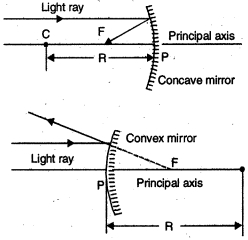
In a diagram,show the following for both a convex mirror and a concave mirror:
$(i)$ Principal axis
$(ii)$ Pole
$(iii)$ Focus
$(iv)$ Centre of curvature
$(v)$ Radius of curvature
$(i)$ Principal axis
$(ii)$ Pole
$(iii)$ Focus
$(iv)$ Centre of curvature
$(v)$ Radius of curvature
Solution
(N/A) The diagram illustrates the key components of spherical mirrors:
$1$. Principal axis: The straight line passing through the pole and the centre of curvature of a spherical mirror.
$2$. Pole $(P)$: The centre of the reflecting surface of a spherical mirror.
$3$. Focus $(F)$: The point on the principal axis where light rays parallel to the principal axis converge (in a concave mirror) or appear to diverge (in a convex mirror) after reflection.
$4$. Centre of curvature $(C)$: The centre of the sphere of which the reflecting surface of the spherical mirror forms a part.
$5$. Radius of curvature $(R)$: The radius of the sphere of which the reflecting surface of the spherical mirror forms a part. It is the distance between the pole $(P)$ and the centre of curvature $(C)$.
0 likes
View Solution47
Easy
What are the advantages and disadvantages of using a convex mirror for seeing traffic at the rear?
Solution
(N/A) Advantage: $A$ convex mirror provides a wider field of view compared to a plane mirror,allowing the driver to see a larger area of the traffic behind.
Disadvantage: It does not show the correct distance of the vehicle at the rear; objects appear smaller and farther away than they actually are.
Disadvantage: It does not show the correct distance of the vehicle at the rear; objects appear smaller and farther away than they actually are.
0 likes
View Solution48
Easy
State the sign convention used to measure distances from a mirror.
Solution
(N/A) According to the New Cartesian Sign Convention for spherical mirrors:
$1$. The object is always placed to the left of the mirror,so light travels from left to right.
$2$. All distances parallel to the principal axis are measured from the pole $(P)$ of the mirror.
$3$. Distances measured in the direction of incident light are taken as positive $(+)$.
$4$. Distances measured opposite to the direction of incident light are taken as negative $(-)$.
$5$. Distances measured perpendicular to and above the principal axis are taken as positive $(+)$.
$6$. Distances measured perpendicular to and below the principal axis are taken as negative $(-)$.
0 likes
View Solution49
Easy
State the sign convention used to measure the length of the image and the object.
Solution
(N/A) According to the Cartesian sign convention for spherical mirrors and lenses:
$1$. All distances measured perpendicular to the principal axis and in the upward direction (above the principal axis) are taken as positive (+).
$2$. All distances measured perpendicular to the principal axis and in the downward direction (below the principal axis) are taken as negative (-).
$1$. All distances measured perpendicular to the principal axis and in the upward direction (above the principal axis) are taken as positive (+).
$2$. All distances measured perpendicular to the principal axis and in the downward direction (below the principal axis) are taken as negative (-).
0 likes
View Solution50
EasyMCQ
Where will the image be formed by a concave mirror when an object is placed between the pole and the focus point of the mirror?
A
At the focus
B
At the center of curvature
C
Behind the mirror
D
At infinity
Solution
(C) When an object is placed between the pole $(P)$ and the focus $(F)$ of a concave mirror,the light rays diverge after reflection.
These rays appear to meet behind the mirror when extended backwards.
Therefore,the image formed is virtual,erect,and magnified,and it is located behind the mirror.
These rays appear to meet behind the mirror when extended backwards.
Therefore,the image formed is virtual,erect,and magnified,and it is located behind the mirror.
0 likes
View SolutionLight – Reflection and Refraction — Reflection of Light and Spherical Mirrors · Frequently Asked Questions
1Are these Light – Reflection and Refraction questions useful for JEE and NEET?
Yes. All questions in this section are mapped to JEE Main and NEET exam patterns. Previous year questions from JEE Main, NEET, GUJCET and state-level exams are included with full solutions.
2Can I switch to Hindi or Gujarati for these questions?
Yes. Use the language tabs in the hero section or the sidebar to view the same questions and solutions in English, Hindi or Gujarati.
3How do I generate a question paper from this subtopic?
Use the Vedclass Exam Paper Generator — select the chapter and subtopic, set difficulty, and generate Sets A, B, C, D automatically. First 3 chapters of every subject are free.
Vedclass Products
For Students
Vedclass Test Series
Mock tests in real JEE/NEET style with performance analysis. 5-day free trial.
Start Free TrialFor Teachers
Exam Paper Generator
Generate Set A/B/C/D papers from this chapter in 2 minutes. 3 chapters free.
Try FreeFor Institutes
Online Exam Module
Live online exams with unlimited students, 360° analytics & white-label branding.
See DemoFor Teachers & Institutes
Generate a Light – Reflection and Refraction Exam Paper in 2 Minutes
Select subtopic & difficulty — Sets A, B, C, D auto-generated with No Repeat logic.
First 3 chapters of every subject are free — no payment required.