
A English
Reflection of Light and Spherical Mirrors Questions in English
Class 10 Science · Light – Reflection and Refraction · Reflection of Light and Spherical Mirrors
147+
Questions
English
Language
100%
With Solutions
Showing 50 of 147 questions in English
51
EasyMCQ
Where does an object and its image coincide in a concave mirror?
A
At the focus $(F)$
B
At the centre of curvature $(C)$
C
Between the pole $(P)$ and focus $(F)$
D
Beyond the centre of curvature $(C)$
Solution
(B) In a concave mirror,when an object is placed at the centre of curvature $(C)$,the light rays originating from the object strike the mirror and reflect back through the centre of curvature itself. As a result,the image is formed at the same position as the object. Therefore,the object and its image coincide at the centre of curvature $(C)$.
0 likes
View Solution52
EasyMCQ
$A$ ray of light is incident normally on a reflecting surface. What are the $(i)$ angle of incidence and $(ii)$ angle of reflection?
A
$0^{\circ}, 0^{\circ}$
B
$90^{\circ}, 90^{\circ}$
C
$0^{\circ}, 90^{\circ}$
D
$90^{\circ}, 0^{\circ}$
Solution
(A) When a ray of light is incident normally (perpendicularly) on a reflecting surface,it travels along the normal.
Since the angle of incidence is the angle between the incident ray and the normal,and the ray itself lies on the normal,the angle of incidence is $0^{\circ}$.
According to the law of reflection,the angle of incidence is equal to the angle of reflection.
Therefore,the angle of reflection is also $0^{\circ}$.
0 likes
View Solution53
EasyMCQ
$A$ ray of light is incident on a concave mirror after passing through the centre of curvature. What is the angle of incidence (in $°$)?
A
$0$
B
$45$
C
$90$
D
$180$
Solution
(A) When a ray of light passes through the centre of curvature $(C)$ of a concave mirror, it strikes the mirror surface normally (perpendicularly).
Since the ray travels along the normal to the surface at the point of incidence, the angle between the incident ray and the normal is $0^\circ$.
Therefore, the angle of incidence is $0^\circ$.
Since the ray travels along the normal to the surface at the point of incidence, the angle between the incident ray and the normal is $0^\circ$.
Therefore, the angle of incidence is $0^\circ$.
0 likes
View Solution54
MediumMCQ
For driving a car,what type of mirror would you prefer to see the traffic at your back?
A
Plane mirror
B
Concave mirror
C
Convex mirror
D
Concave lens
Solution
(C) We prefer a convex mirror for observing the traffic behind us because its field of view is much larger than that of a plane mirror.
It forms a virtual,erect,and diminished image of the objects behind the vehicle.
Although it gives an erroneous idea about the distance and speed of the vehicles behind us,the advantage of a wider field of view makes it the preferred choice for rear-view mirrors.
It forms a virtual,erect,and diminished image of the objects behind the vehicle.
Although it gives an erroneous idea about the distance and speed of the vehicles behind us,the advantage of a wider field of view makes it the preferred choice for rear-view mirrors.
0 likes
View Solution55
Easy
$A$ plane mirror as well as a convex mirror can produce a real image if the object is virtual. How?
Solution
(N/A) real image is formed when reflected rays actually intersect at a point.
For a plane or convex mirror,this occurs when a converging beam of light is directed towards the mirror.
The point where these rays would have met behind the mirror acts as a virtual object.
Since the reflected rays converge in front of the mirror,they form a real image at that location.
For a plane or convex mirror,this occurs when a converging beam of light is directed towards the mirror.
The point where these rays would have met behind the mirror acts as a virtual object.
Since the reflected rays converge in front of the mirror,they form a real image at that location.
0 likes
View Solution56
MediumMCQ
The image formed by a concave mirror is observed to be virtual,erect and larger than the object. Then the position of the object should be
A
Between the focus and the centre of curvature.
B
At the centre of curvature.
C
Beyond the centre of curvature.
D
Between the pole of the mirror and the focus.
Solution
(D) For a concave mirror,when an object is placed between the pole $(P)$ and the focus $(F)$,the light rays diverge after reflection.
When these reflected rays are extended backwards,they appear to meet behind the mirror.
This results in the formation of a virtual,erect,and magnified (larger than the object) image.
Therefore,the correct position of the object is between the pole and the focus.
When these reflected rays are extended backwards,they appear to meet behind the mirror.
This results in the formation of a virtual,erect,and magnified (larger than the object) image.
Therefore,the correct position of the object is between the pole and the focus.
0 likes
View Solution57
Medium
How can you identify the three types of mirrors without touching them?
Solution
(N/A) We can identify the three types of mirrors by observing the image formed when we look into them from a close distance:
$(i)$ If the image is of the same size and erect, it is a $Plane$ mirror.
$(ii)$ If the image is magnified (bigger size) and erect, it is a $Concave$ mirror.
$(iii)$ If the image is diminished (smaller size) and erect, it is a $Convex$ mirror.
$(i)$ If the image is of the same size and erect, it is a $Plane$ mirror.
$(ii)$ If the image is magnified (bigger size) and erect, it is a $Concave$ mirror.
$(iii)$ If the image is diminished (smaller size) and erect, it is a $Convex$ mirror.
0 likes
View Solution58
Medium
$(a)$ What should be the position of the object,when a concave mirror is to be used $(i)$ as a shaving mirror,and $(ii)$ in torches producing a parallel beam of light? $(b)$ $A$ man standing in front of a mirror finds his image having a very small head and legs of normal size. What type of mirror is used in designing such a mirror?
Solution
(N/A) $(i)$ For a shaving mirror,the object (face) should be placed between the pole $(P)$ and the principal focus $(F)$ of the concave mirror to obtain an enlarged,erect,and virtual image.
$(ii)$ In torches,the source of light (bulb) should be placed at the principal focus $(F)$ of the concave mirror to produce a parallel beam of light.
$(b)$ The mirror is a combination of different types of mirrors. $A$ convex mirror is used for the upper part to produce a small head (diminished image),and a plane mirror is used for the lower part to produce an image of normal size.
0 likes
View Solution59
Medium
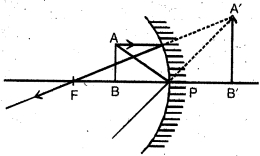
What is the minimum number of rays required for locating the image formed by a concave mirror for an object? Draw a ray diagram to show the formation of a virtual image by a concave mirror.
Solution
(N/A) To locate the image of an object formed by a concave mirror,a minimum of two rays are required.
Ray diagram: $A$ concave mirror forms a virtual,erect,and magnified image of an object when it is placed between the focus $(F)$ and the pole $(P)$ of the mirror. The rays appear to diverge from behind the mirror,forming a virtual image as shown in the diagram.
Ray diagram: $A$ concave mirror forms a virtual,erect,and magnified image of an object when it is placed between the focus $(F)$ and the pole $(P)$ of the mirror. The rays appear to diverge from behind the mirror,forming a virtual image as shown in the diagram.
0 likes
View Solution60
Medium
Name the spherical mirror used as:
$(a)$ $1.$ Shaving mirror,
$2.$ Rear-view mirror in vehicles,
$3.$ Reflector in searchlights.
$(b)$ Write any three differences between a real and virtual image.
$(a)$ $1.$ Shaving mirror,
$2.$ Rear-view mirror in vehicles,
$3.$ Reflector in searchlights.
$(b)$ Write any three differences between a real and virtual image.
Solution
(N/A) $1.$ Concave mirror
$2.$ Convex mirror
$3.$ Concave mirror
$(b)$ Differences between a real and virtual image:
$2.$ Convex mirror
$3.$ Concave mirror
$(b)$ Differences between a real and virtual image:
| Real image | Virtual image |
| $1.$ It is formed when light rays actually meet at a point after reflection or refraction. | $1.$ It is formed when light rays appear to meet at a point after reflection or refraction. |
| $2.$ It can be obtained on a screen. | $2.$ It cannot be obtained on a screen. |
| $3.$ It is always inverted. | $3.$ It is always erect. |
0 likes
View Solution61
Easy
What is meant by the radius of curvature of a spherical mirror? How is it related to the focal length of the mirror?
Solution
(N/A) The radius of curvature of a spherical mirror is defined as the radius of the hollow sphere of glass of which the mirror is a part.
It is denoted by the symbol $R$.
The relationship between the radius of curvature $(R)$ and the focal length $(f)$ of a spherical mirror is given by the formula $R = 2f$,which means the radius of curvature is twice the focal length.
It is denoted by the symbol $R$.
The relationship between the radius of curvature $(R)$ and the focal length $(f)$ of a spherical mirror is given by the formula $R = 2f$,which means the radius of curvature is twice the focal length.
0 likes
View Solution62
Medium
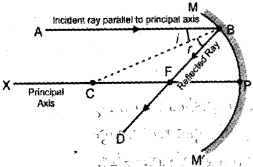
With the help of a ray diagram,show that the angle of incidence is equal to the angle of reflection when a ray is incident on a concave mirror.
Solution
(N/A) In the provided ray diagram,$AB$ is the incident ray parallel to the principal axis.
$B$ is the point of incidence on the concave mirror.
$CB$ is the normal to the surface at point $B$,as the line joining the center of curvature $C$ to any point on the mirror is normal to the surface at that point.
According to the laws of reflection,the angle of incidence $(i)$ is equal to the angle of reflection $(r)$.
Thus,$\angle i = \angle r$,where $\angle i$ is the angle between the incident ray $AB$ and the normal $CB$,and $\angle r$ is the angle between the reflected ray $BD$ and the normal $CB$.
0 likes
View Solution63
Medium
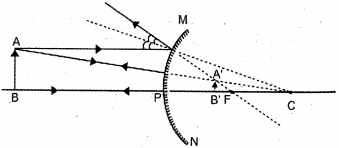
If the image formed by a mirror for all positions of the object placed in front of it is always erect and diminished,what type of mirror is it? Draw a ray diagram to justify your answer. Where and why do we generally use this type of mirror?
Solution
(N/A) The mirror is a convex mirror.
Ray Diagram: The provided image shows the ray diagram for a convex mirror where an object $AB$ is placed in front of it,and a virtual,erect,and diminished image $A'B'$ is formed between the pole $P$ and the principal focus $F$.
Usage: Convex mirrors are generally used as rear-view mirrors in vehicles.
Reason: They are used because they always form an erect image and provide a much wider field of view,allowing the driver to see a larger area of the traffic behind the vehicle.
0 likes
View Solution64
Medium
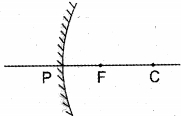
$(a)$ Define radius of curvature and focal length of a spherical mirror and show it on a figure.
$(b)$ Write the relation between the radius of curvature and the focal length of a spherical mirror.
$(b)$ Write the relation between the radius of curvature and the focal length of a spherical mirror.
Solution
(N/A) Radius of curvature: The radius of the hollow sphere of which the reflecting surface of the spherical mirror forms a part is called the radius of curvature. It is denoted by $R$.
Focal length: The distance between the pole $(P)$ and the principal focus $(F)$ of a spherical mirror is called its focal length. It is denoted by $f$.
In the figure,$P$ is the pole,$F$ is the principal focus,and $C$ is the center of curvature. The distance $PC$ represents the radius of curvature $(R)$,and the distance $PF$ represents the focal length $(f)$.
$(b)$ Relation: For a spherical mirror of small aperture,the radius of curvature is twice the focal length. The mathematical relation is given by:
$f = \frac{R}{2}$ or $R = 2f$
0 likes
View Solution65
Medium
How can you distinguish between a plane mirror,a convex mirror,and a concave mirror by merely looking at the image formed in each case?
Solution
(N/A) To distinguish between a plane mirror,a convex mirror,and a concave mirror,the mirror is held near the face and the image is observed.
$1$. If the image is upright,of the same size as the object,and does not change in size when the mirror is moved,the mirror is a plane mirror.
$2$. If the image is upright and magnified,and it becomes inverted when the mirror is moved away from the face,the mirror is a concave mirror.
$3$. If the image is upright and diminished,and it remains upright even when the mirror is moved away from the face,the mirror is a convex mirror.
0 likes
View Solution66
Medium
Discuss the position and nature of the image formed by a concave mirror when the object is moved from infinity towards the pole of the mirror.
Solution
(N/A) When an object is moved from infinity towards the pole of a concave mirror,the image shifts from the focus to infinity and then behind the mirror.
$1$. At infinity: The image is formed at the principal focus $(F)$,real,inverted,and highly diminished.
$2$. Beyond the centre of curvature $(C)$: The image is formed between $F$ and $C$,real,inverted,and diminished.
$3$. At $C$: The image is formed at $C$,real,inverted,and of the same size as the object.
$4$. Between $C$ and $F$: The image is formed beyond $C$,real,inverted,and magnified.
$5$. At $F$: The image is formed at infinity,real,inverted,and highly magnified.
$6$. Between $F$ and the pole $(P)$: The image is formed behind the mirror,virtual,erect,and magnified.
0 likes
View Solution67
Easy
Give one advantage of a spherical reflector over a plane reflector.
Solution
(N/A) spherical reflector (such as a concave mirror) can focus parallel rays of light onto a single point (the focus). This concentration of solar energy allows it to generate high temperatures,reaching up to $1500 ^{\circ}C$,which is not possible with a plane reflector.
0 likes
View Solution68
Medium
Name two spherical mirrors. Define them. Write any three points of difference between them.
Solution
(N/A) The two spherical mirrors are: $(i)$ Concave mirror and $(ii)$ Convex mirror.
$(i)$ Concave mirror: $A$ spherical mirror whose reflecting surface is curved inwards,i.e.,faces towards the center of the sphere,is called a concave mirror.
$(ii)$ Convex mirror: $A$ spherical mirror whose reflecting surface is curved outwards is called a convex mirror.
Points of difference:
$(1)$ The reflecting surface of a concave mirror is curved inwards,whereas the reflecting surface of a convex mirror is curved outwards.
$(2)$ $A$ concave mirror can produce both real and virtual images,whereas a convex mirror always produces virtual and erect images.
$(3)$ The image formed by a concave mirror can be enlarged,diminished,or of the same size as the object. The image formed by a convex mirror is always diminished.
0 likes
View Solution69
Medium
$(a)$ Write any three differences between concave and convex mirror.
$(b)$ Draw ray diagram to show what happens to a ray of light after reflection from a convex mirror,if it
$(i)$ is incident parallel to principal axis.
$(ii)$ incident at the pole.
$(b)$ Draw ray diagram to show what happens to a ray of light after reflection from a convex mirror,if it
$(i)$ is incident parallel to principal axis.
$(ii)$ incident at the pole.
Solution
(N/A) Differences between concave and convex mirror:
$1$. Concave mirror: The reflecting surface is curved inwards. Convex mirror: The reflecting surface is curved outwards.
$2$. Concave mirror: It can form both real and virtual images. Convex mirror: It always forms virtual,erect,and diminished images.
$3$. Concave mirror: It is a converging mirror. Convex mirror: It is a diverging mirror.
$(b)$ Ray diagrams for a convex mirror:
$(i)$ $A$ ray of light incident parallel to the principal axis appears to diverge from the principal focus $(F)$ after reflection.
$(ii)$ $A$ ray of light incident at the pole $(P)$ is reflected back such that the angle of incidence equals the angle of reflection $(i = r)$ with respect to the principal axis.
0 likes
View Solution70
Medium
$(i)$ Define a real image of an object.
$(ii)$ Name the mirror that:
$(a)$ can give a real as well as a virtual image of an object.
$(b)$ will always give a virtual image of the same size as the object.
$(c)$ will always give a virtual and diminished image of an object.
$(d)$ is used by a doctor in examining teeth.
$(iii)$ With the help of a ray diagram,explain the use of a concave mirror as a solar concentrator.
Solution
(N/A) $(i)$ $A$ real image is an image formed when the reflected light rays actually intersect at a point. It can be obtained on a screen.
$(ii)$ $(a)$ Concave mirror
$(b)$ Plane mirror
$(c)$ Convex mirror
$(d)$ Concave mirror
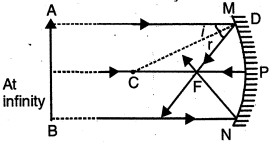
$(iii)$ $A$ concave mirror acts as a solar concentrator because it converges parallel rays of light coming from the sun at its principal focus. This concentration of light energy at the focus produces intense heat,which is used for solar heating applications. The ray diagram shows parallel rays from infinity incident on the concave mirror,which reflect and converge at the focus $F$.
0 likes
View Solution71
Difficult
$(i)$ Under what condition does a concave mirror produce a virtual and magnified image? Draw a labelled ray diagram to show the formation of the image in the above case. Also,state the position of the object to produce a magnified and real image.
$(ii)$ $A$ ray of light moving along the principal axis is falling on a concave mirror. Draw the path of the reflected ray. Also,state the values of the angle of incidence and reflection in this case.
$(ii)$ $A$ ray of light moving along the principal axis is falling on a concave mirror. Draw the path of the reflected ray. Also,state the values of the angle of incidence and reflection in this case.
Solution
(N/A) $(i)$ $A$ concave mirror produces a virtual and magnified image when the object is placed between the pole $(P)$ and the focus $(F)$ of the mirror.
To produce a magnified and real image,the object must be placed between the center of curvature $(C)$ and the focus $(F)$.
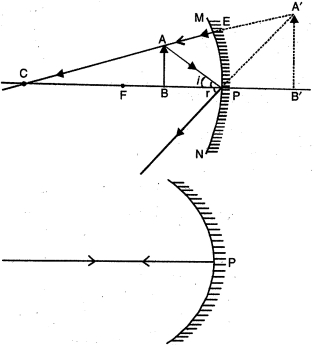
$(ii)$ When a ray of light moves along the principal axis,it strikes the mirror at the pole $(P)$ normally. According to the laws of reflection,the reflected ray will retrace its path along the same principal axis.
In this case,the angle of incidence $(i)$ is $0^{\circ}$ and the angle of reflection $(r)$ is $0^{\circ}$ because the ray is incident normally to the surface.
0 likes
View Solution72
Medium
$(a)$ Write one use of a concave mirror as well as a convex mirror.
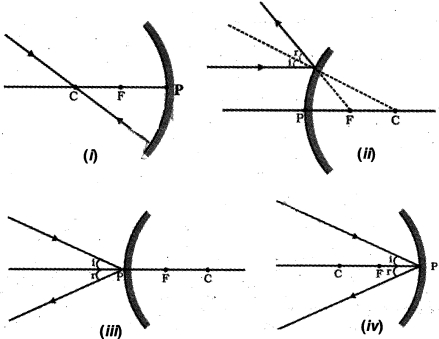
$(b)$ Draw ray diagrams for the following cases when a ray of light:
$(i)$ passing through the centre of curvature of a concave mirror is incident on it.
$(ii)$ parallel to the principal axis is incident on a convex mirror.
$(iii)$ is incident at the pole of a convex mirror.
$(iv)$ passing through the focus of a concave mirror is incident on it.
Solution
(N/A) Concave mirrors are commonly used in torches,searchlights,and vehicle headlights to obtain a powerful parallel beam of light. Convex mirrors are commonly used as rear-view mirrors in vehicles.
$(b)$ The ray diagrams are shown in the image provided.
$(b)$ The ray diagrams are shown in the image provided.
0 likes
View Solution73
DifficultMCQ
An object is placed $15\, cm$ from a convex mirror of radius of curvature $60\, cm$. Find the position of the image and its magnification.
A
$v = 10\, cm, m = 0.67$
B
$v = -10\, cm, m = 0.67$
C
$v = 10\, cm, m = -0.67$
D
$v = -10\, cm, m = -0.67$
Solution
(A) Given: Object distance $u = -15\, cm$, Radius of curvature $R = +60\, cm$.
Focal length $f = R / 2 = +60 / 2 = +30\, cm$.
Using the mirror formula: $\frac{1}{v} + \frac{1}{u} = \frac{1}{f}$.
Substituting the values: $\frac{1}{v} + \frac{1}{-15} = \frac{1}{30}$.
$\frac{1}{v} = \frac{1}{30} + \frac{1}{15} = \frac{1 + 2}{30} = \frac{3}{30} = \frac{1}{10}$.
Therefore, $v = +10\, cm$.
Magnification $m = -\frac{v}{u} = -\frac{10}{-15} = \frac{2}{3} \approx 0.67$.
The image is virtual, erect, and diminished.
0 likes
View Solution74
Medium
An object is placed at a distance of $25 \, cm$ away from a converging mirror of focal length $20 \, cm$. Discuss the effect on the nature and position of the image if the position of the object changes from $25 \, cm$ to $15 \, cm$. Justify your answer without using the mirror formula.
Solution
(N/A) converging mirror is a concave mirror. The focal length $f$ is $20 \, cm$.
Initially,the object is at $25 \, cm$,which is between the center of curvature $(C = 40 \, cm)$ and the focus $(F = 20 \, cm)$. In this position,the image formed is real,inverted,and magnified,located beyond the center of curvature.
As the object is moved from $25 \, cm$ to $20 \, cm$ (the focus),the image shifts further away from the mirror and its size increases.
When the object is at the focus ($15 \, cm$ is between the focus and the pole),the image is formed at infinity.
When the object is moved from $20 \, cm$ to $15 \, cm$,it is now placed between the focus and the pole.
In this new position,the image becomes virtual,erect,and magnified,and it is formed behind the mirror.
0 likes
View Solution75
Difficult
For driving a car,what type of mirror would you prefer to see the traffic at your back and why?
Solution
(N/A) We prefer a convex mirror for observing the traffic behind us because its field of view is much larger than that of a plane mirror.
Although it gives an erroneous idea about the speed of the vehicles behind us,we still prefer it due to its wider field of view.
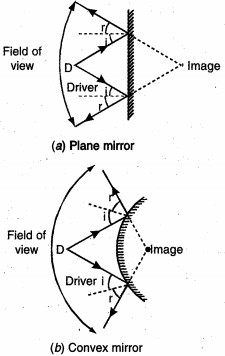
The view shown by a plane mirror and a convex mirror is as shown in the figure. It is clear from the figure that the view produced by a convex mirror is wider than that produced by a plane mirror.
0 likes
View Solution76
MediumMCQ
The mirror outside the driver's side of a vehicle is usually a convex mirror. Printed on such a mirror is usually the warning "Vehicles in this mirror are closer than they appear". What is the reason for this warning?
A
Convex mirrors produce real and inverted images.
B
Convex mirrors produce virtual, diminished, and erect images, making distant objects appear smaller and further away.
C
Convex mirrors produce magnified images, making objects appear closer.
D
Convex mirrors have a very small field of view.
Solution
(B) The reason for this warning is that a convex mirror forms a virtual, erect, and diminished image of the objects behind the vehicle.
Because the image is diminished in size, the driver may perceive the object as being further away than it actually is.
This optical illusion can lead a driver to believe that the vehicle behind is at a safe distance when it is actually closer, potentially causing an accident if the driver changes lanes without caution.
0 likes
View Solution77
EasyMCQ
In the case of a convex mirror,if the object is moved away from the surface of the mirror,how do the position and size of the image change?
A
The image moves towards the pole and its size increases.
B
The image moves towards the focus and its size decreases.
C
The image moves towards the pole and its size decreases.
D
The image moves towards the focus and its size increases.
Solution
(B) As the object is moved away from a convex mirror,the distance of the virtual image,formed behind the mirror,increases (the image remains between the pole $P$ and the focus $F$).
Specifically,the image shifts from the pole $P$ towards the focus $F$ as the object distance increases.
Simultaneously,the size of the image gradually decreases.
When the object is at infinity,the image is formed at the focus $F$ and is highly diminished in size.
Specifically,the image shifts from the pole $P$ towards the focus $F$ as the object distance increases.
Simultaneously,the size of the image gradually decreases.
When the object is at infinity,the image is formed at the focus $F$ and is highly diminished in size.
0 likes
View Solution78
Easy
An object is brought towards a concave mirror. How does the position and size of the image change?
Solution
(N/A) $1$. When the object is at infinity,the image is formed at the focus $(F)$,and it is highly diminished and inverted.
$2$. As the object moves from infinity towards the centre of curvature $(C)$,the image moves from the focus $(F)$ towards the centre of curvature $(C)$,and its size increases.
$3$. When the object is at the centre of curvature $(C)$,the image is formed at the centre of curvature $(C)$,and its size is equal to the size of the object.
$4$. As the object moves from the centre of curvature $(C)$ towards the focus $(F)$,the image moves away from the centre of curvature $(C)$ towards infinity,and its size becomes magnified.
$5$. When the object is at the focus $(F)$,the image is formed at infinity.
$6$. When the object is placed between the focus $(F)$ and the pole $(P)$,the image is formed behind the mirror,and it becomes virtual,erect,and magnified.
0 likes
View Solution79
Medium
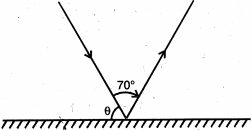
The angle between an incident ray and the reflected ray is $70^{\circ}$ as shown in the figure. What is the value of $\theta$?
Solution
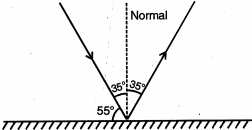
$(55^{\circ})$ According to the law of reflection, the angle of incidence $(i)$ is equal to the angle of reflection $(r)$.
Given that the total angle between the incident ray and the reflected ray is $70^{\circ}$, we have $i + r = 70^{\circ}$.
Since $i = r$, we can write $2i = 70^{\circ}$, which gives $i = 35^{\circ}$.
The normal to the mirror surface makes an angle of $90^{\circ}$ with the mirror.
Therefore, the angle $\theta$ between the incident ray and the mirror surface is $\theta = 90^{\circ} - i$.
Substituting the value of $i$, we get $\theta = 90^{\circ} - 35^{\circ} = 55^{\circ}$.
0 likes
View Solution80
Medium
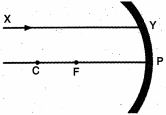
$A$ ray of light $XY$ is incident on a mirror as shown in the figure. The angle of incidence for this ray is the angle between it and the line joining two other points in the figure. Name these two points and show the course of rays after reflection.
Solution
(N/A) The angle of incidence is the angle between the incident ray and the normal at the point of incidence.
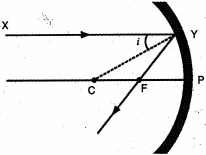
$A$ line joining the centre of curvature $(C)$ and the point of incidence $(Y)$ acts as a normal to the spherical mirror at that point.
Therefore,the two points are $C$ and $Y$.
After reflection,a ray of light incident parallel to the principal axis of a concave mirror passes through its principal focus $(F)$. The course of the reflected ray is shown in the figure.
0 likes
View Solution81
Medium
$A$ ray of light $XY$ is incident on a spherical mirror as shown in the diagram. Redraw the diagram and mark the normal,angle of incidence and angle of reflection.
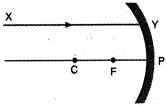
Solution
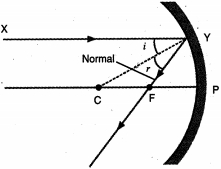
(N/A) The incident ray $XY$,which is parallel to the principal axis,after reflection from the concave mirror will pass through the principal focus $F$.
To mark the normal,we draw a line from the center of curvature $C$ to the point of incidence $Y$.
The angle between the incident ray $XY$ and the normal $CY$ is the angle of incidence $(i)$.
The angle between the reflected ray and the normal $CY$ is the angle of reflection $(r)$.
According to the laws of reflection,the angle of incidence is equal to the angle of reflection $(i = r)$.
0 likes
View Solution82
EasyMCQ
You have a spherical mirror. The image of an object placed in front of the mirror is virtual. If the position of the object is changed,the image remains virtual and erect. Is the spherical mirror concave or convex?
A
Concave
B
Convex
C
Plane
D
Cannot be determined
Solution
(B) convex mirror always produces a virtual and erect image,regardless of the position of the object in front of the mirror.
In contrast,a concave mirror produces a virtual and erect image only when the object is placed between the pole $(P)$ and the focus $(F)$.
Since the image remains virtual and erect for any position of the object,the spherical mirror must be convex.
In contrast,a concave mirror produces a virtual and erect image only when the object is placed between the pole $(P)$ and the focus $(F)$.
Since the image remains virtual and erect for any position of the object,the spherical mirror must be convex.
0 likes
View Solution83
Easy
Copy the figure and show the image formation with the help of rays.
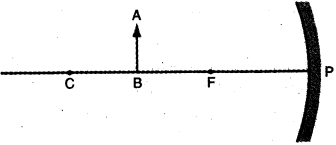
Solution
(N/A) The object is placed between the center of curvature $(C)$ and the principal focus $(F)$ of a concave mirror.
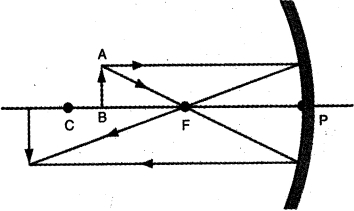
To find the image,we consider two rays:
$1$. $A$ ray parallel to the principal axis,after reflection,passes through the principal focus $(F)$.
$2$. $A$ ray passing through the principal focus $(F)$,after reflection,becomes parallel to the principal axis.
The intersection of these two reflected rays gives the position of the image.
The image formed is real,inverted,and magnified,and it is located beyond the center of curvature $(C)$.
0 likes
View Solution84
MediumMCQ
Multiple images are formed by a thick plane mirror. Which of the following is the brightest of all the images?
A
First
B
Third
C
Second
D
Fourth
Solution
(C) thick plane mirror consists of a silvered back surface and a front glass surface.
When light falls on the mirror,a small portion of it is reflected from the front surface (first reflection),while the majority of the light enters the glass,reflects from the silvered back surface,and exits through the front surface (second reflection).
Because the reflection from the silvered back surface involves a much larger amount of light compared to the partial reflection from the front glass surface,the second image is the brightest of all the images formed.
0 likes
View Solution85
MediumMCQ
$A$ plane mirror is placed vertically facing due north. An arrow pointing north-east is kept in front of the mirror. In which direction will the arrow point in this image?
A
north-east
B
south-west
C
north-west
D
south-east
Solution
(C) plane mirror produces a lateral inversion of the object.
When an object is placed in front of a mirror facing north,the mirror reflects the image such that the east-west component is reversed while the north-south component remains the same.
An arrow pointing north-east has a northward component and an eastward component.
In the mirror image,the northward component remains pointing north,but the eastward component is reversed to point west.
Therefore,the arrow in the image will point north-west.
0 likes
View Solution86
MediumMCQ
When a plane mirror is rotated through a certain angle,the reflected ray turns through twice as much and the size of the image
A
remains same
B
is doubled
C
is halved
D
becomes infinite
Solution
(A) When a plane mirror is rotated by an angle $\theta$,the reflected ray rotates by an angle $2\theta$.
However,the size of the image formed by a plane mirror depends only on the size of the object.
Since the rotation of the mirror does not change the size of the object or the distance of the object from the mirror,the magnification remains $1$.
Therefore,the size of the image remains the same.
However,the size of the image formed by a plane mirror depends only on the size of the object.
Since the rotation of the mirror does not change the size of the object or the distance of the object from the mirror,the magnification remains $1$.
Therefore,the size of the image remains the same.
0 likes
View Solution87
EasyMCQ
$A$ beam of light incident on a plane mirror forms a real image on reflection. The incident beam is
A
parallel
B
divergent
C
convergent
D
not certain
Solution
(C) plane mirror typically forms a virtual image for a real object because the reflected rays diverge.
However,if the incident beam is convergent,the rays are directed towards a point behind the mirror.
In this case,the mirror intercepts these rays before they can meet,reflecting them to a point in front of the mirror.
Since the reflected rays actually meet at this point,a real image is formed.
Therefore,the incident beam must be convergent.
0 likes
View Solution88
MediumMCQ
If an object is placed symmetrically between two plane mirrors, inclined at an angle of $72^{\circ},$ then the total number of images formed is
A
$5$
B
$2$
C
infinite
D
$4$
Solution
(D) The formula for the number of images $(n)$ formed by two plane mirrors inclined at an angle $(\theta)$ is given by $n = (360^{\circ} / \theta) - 1$.
Given the angle $\theta = 72^{\circ}$.
First, calculate the value of $360^{\circ} / \theta = 360^{\circ} / 72^{\circ} = 5$.
Since the result is an odd integer, the number of images formed is $n = 5 - 1 = 4$.
This formula applies regardless of whether the object is placed symmetrically or asymmetrically when the result of $360^{\circ} / \theta$ is an odd integer.
0 likes
View Solution89
EasyMCQ
$A$ plane mirror produces a magnification of
A
$+1$
B
$-1$
C
zero
D
between $0$ and infinity
Solution
(A) The magnification $(m)$ of a mirror is defined as the ratio of the height of the image $(h_i)$ to the height of the object $(h_o)$,given by $m = h_i / h_o$.
For a plane mirror,the image formed is virtual,erect,and of the same size as the object.
Since the image is erect,the magnification is positive $(+)$.
Since the size of the image is equal to the size of the object $(h_i = h_o)$,the ratio $h_i / h_o = 1$.
Therefore,the magnification produced by a plane mirror is $+1$.
0 likes
View Solution90
MediumMCQ
$A$ dice is placed with one of its edges parallel to the principal axis between the principal focus $(F)$ and the centre of curvature $(C)$ of a concave mirror. Then the final image has the shape of
A
cube
B
rectangular parallelepiped
C
barrel shape
D
spherical
Solution
(C) When an object is placed between the principal focus $(F)$ and the centre of curvature $(C)$ of a concave mirror,the image formed is real,inverted,and magnified.
Since the magnification $(m)$ of a concave mirror depends on the distance of the object from the mirror,different parts of the dice are at different distances from the mirror.
The part of the dice closer to the focus $(F)$ will have a larger magnification compared to the part closer to the centre of curvature $(C)$.
Because the magnification varies along the axis,the edges of the dice parallel to the principal axis will be magnified differently,resulting in a shape that is wider at one end and narrower at the other,resembling a barrel shape.
0 likes
View Solution91
MediumMCQ
Two adjacent walls and the ceiling of a rectangular room are mirror surfaced. The number of images of himself that an observer sees is
A
$3$
B
$9$
C
$6$
D
$8$
Solution
(D) In this scenario, we have three mirrors arranged mutually perpendicular to each other (two walls and the ceiling).
Let the position of the observer be $(x, y, z)$.
The images are formed by reflections in the $XY$, $YZ$, and $ZX$ planes.
The total number of images formed by three mutually perpendicular mirrors is given by the formula $N = 2^n - 1$, where $n$ is the number of mirrors.
Here, $n = 3$, so $N = 2^3 - 1 = 8 - 1 = 7$.
However, the observer is inside the room, and one of these images is the observer's own position or is obscured by the observer's body.
Specifically, for three mutually perpendicular mirrors, the images are located at $(\pm x, \pm y, \pm z)$ excluding the original position $(x, y, z)$.
There are $2^3 = 8$ total positions including the object.
Subtracting the object itself, we get $8 - 1 = 7$ images.
Since the observer is part of the system, they see $7$ images of themselves.
0 likes
View Solution92
EasyMCQ
The image formed by a convex spherical mirror is always:
A
inverted
B
enlarged
C
real
D
virtual
Solution
(D) convex mirror is a spherical mirror whose reflecting surface is curved outwards.
When an object is placed in front of a convex mirror,the light rays diverge after reflection.
These reflected rays appear to meet behind the mirror when extended backwards.
Therefore,the image formed by a convex mirror is always virtual,erect,and diminished in size,regardless of the position of the object.
0 likes
View Solution93
EasyMCQ
$A$ diminished virtual image can be obtained only in
A
convex mirror
B
plane mirror
C
concave mirror
D
all of these
Solution
(A) virtual image is formed when light rays appear to diverge from a point behind the mirror.
In a plane mirror,the image formed is always virtual,erect,and of the same size as the object.
In a concave mirror,a virtual and erect image is formed only when the object is placed between the pole $(P)$ and the focus $(F)$,but this image is always magnified (larger than the object).
In a convex mirror,the image formed is always virtual,erect,and diminished (smaller than the object) for any position of the object in front of the mirror.
Therefore,a diminished virtual image can be obtained only in a convex mirror.
0 likes
View Solution94
EasyMCQ
$A$ light ray incident normally on a plane mirror suffers a deviation of
A
zero
B
$90^{\circ}$
C
$180^{\circ}$
D
$360^{\circ}$
Solution
(C) When a light ray is incident normally (perpendicularly) on a plane mirror, the angle of incidence $(i)$ is $0^{\circ}$.
According to the law of reflection, the angle of reflection $(r)$ is also $0^{\circ}$.
The light ray reflects back along the same path.
The deviation $(\delta)$ produced by a mirror is given by the formula $\delta = 180^{\circ} - 2i$.
Substituting $i = 0^{\circ}$, we get $\delta = 180^{\circ} - 2(0^{\circ}) = 180^{\circ}$.
Therefore, the light ray suffers a deviation of $180^{\circ}$.
0 likes
View Solution95
EasyMCQ
$A$ convex mirror is used to form the image of a real object. Then tick the wrong statement.
A
Image lies between the pole and the focus.
B
Image is diminished in size.
C
Image is erect.
D
Image is real.
Solution
(D) convex mirror always forms a virtual,erect,and diminished image for any real object placed in front of it.
$1$. The image is always formed behind the mirror between the pole $(P)$ and the focus $(F)$.
$2$. Since the image is formed by the apparent intersection of reflected rays,it is always virtual.
$3$. Therefore,the statement that the image is real is incorrect.
$1$. The image is always formed behind the mirror between the pole $(P)$ and the focus $(F)$.
$2$. Since the image is formed by the apparent intersection of reflected rays,it is always virtual.
$3$. Therefore,the statement that the image is real is incorrect.
0 likes
View Solution96
EasyMCQ
Two plane mirrors are at right angles to each other. $A$ man stands between them and combs his hair with his right hand. In how many images will he be seen using his left hand?
A
none
B
$1$
C
$2$
D
$3$
Solution
(C) When two plane mirrors are placed at an angle of $90^{\circ}$,the number of images formed is given by the formula $n = (360^{\circ} / \theta) - 1$.
Substituting $\theta = 90^{\circ}$,we get $n = (360^{\circ} / 90^{\circ}) - 1 = 4 - 1 = 3$ images.
Let the man be standing in the first quadrant. The three images are formed at:
$1$. Image $I_1$ in the first mirror (lateral inversion occurs).
$2$. Image $I_2$ in the second mirror (lateral inversion occurs).
$3$. Image $I_3$ which is the image of $I_1$ (or $I_2$) in the other mirror (double lateral inversion occurs).
In $I_1$ and $I_2$,the man appears to use his left hand due to single lateral inversion.
In $I_3$,the image undergoes two lateral inversions,so the left-right orientation is restored to the original state (he appears to use his right hand).
Therefore,in $2$ images,he will be seen using his left hand.
0 likes
View Solution97
EasyMCQ
The laws of reflection are true only for plane mirrors and not for curved mirrors.
A
True
B
False
Solution
(B) The statement is $False$. The laws of reflection,which state that the angle of incidence equals the angle of reflection $(i = r)$ and that the incident ray,the reflected ray,and the normal all lie in the same plane,are universal. They apply to all reflecting surfaces,including plane mirrors,spherical mirrors (concave and convex),and even irregular surfaces at the point of incidence.
0 likes
View Solution98
EasyMCQ
The radius of curvature of a spherical mirror is half of the focal length.
A
True
B
False
Solution
(B) The relationship between the radius of curvature $(R)$ and the focal length $(f)$ of a spherical mirror is given by the formula $R = 2f$.
This means that the radius of curvature is twice the focal length,not half.
Therefore,the given statement is false.
This means that the radius of curvature is twice the focal length,not half.
Therefore,the given statement is false.
0 likes
View Solution99
EasyMCQ
The rays travelling parallel to the principal axis after reflecting from the concave mirror pass or appear to pass through the focus.
A
True
B
False
Solution
(A) According to the rules of image formation by spherical mirrors,any light ray travelling parallel to the principal axis of a concave mirror will reflect and pass through its principal focus $(F)$.
This is a fundamental property used to define the focal point of a concave mirror.
This is a fundamental property used to define the focal point of a concave mirror.
0 likes
View Solution100
EasyMCQ
$A$ convex mirror can be used to see a large image of a small object.
A
True
B
False
Solution
(B) convex mirror always forms a virtual,erect,and diminished image of an object placed in front of it,regardless of the distance of the object.
Since the image formed is always smaller than the object,it cannot be used to see a large image of a small object.
Therefore,the given statement is False.
Since the image formed is always smaller than the object,it cannot be used to see a large image of a small object.
Therefore,the given statement is False.
0 likes
View SolutionLight – Reflection and Refraction — Reflection of Light and Spherical Mirrors · Frequently Asked Questions
1Are these Light – Reflection and Refraction questions useful for JEE and NEET?
Yes. All questions in this section are mapped to JEE Main and NEET exam patterns. Previous year questions from JEE Main, NEET, GUJCET and state-level exams are included with full solutions.
2Can I switch to Hindi or Gujarati for these questions?
Yes. Use the language tabs in the hero section or the sidebar to view the same questions and solutions in English, Hindi or Gujarati.
3How do I generate a question paper from this subtopic?
Use the Vedclass Exam Paper Generator — select the chapter and subtopic, set difficulty, and generate Sets A, B, C, D automatically. First 3 chapters of every subject are free.
Vedclass Products
For Students
Vedclass Test Series
Mock tests in real JEE/NEET style with performance analysis. 5-day free trial.
Start Free TrialFor Teachers
Exam Paper Generator
Generate Set A/B/C/D papers from this chapter in 2 minutes. 3 chapters free.
Try FreeFor Institutes
Online Exam Module
Live online exams with unlimited students, 360° analytics & white-label branding.
See DemoFor Teachers & Institutes
Generate a Light – Reflection and Refraction Exam Paper in 2 Minutes
Select subtopic & difficulty — Sets A, B, C, D auto-generated with No Repeat logic.
First 3 chapters of every subject are free — no payment required.