
A English
Occurrence and Extraction of Metals Questions in English
Class 10 Science · Metals and Non-metals · Occurrence and Extraction of Metals
94+
Questions
English
Language
100%
With Solutions
Showing 50 of 94 questions in English
1
Medium
Define the following terms:
$(i)$ Mineral
$(ii)$ Ore
$(iii)$ Gangue
$(i)$ Mineral
$(ii)$ Ore
$(iii)$ Gangue
Solution
(N/A) $(i)$ Mineral: Most elements occur in nature in a combined state as minerals. The chemical composition of minerals is fixed.
$(ii)$ Ore: Minerals from which metals can be extracted profitably are known as ores.
$(iii)$ Gangue: The impurities (sand,silt,soil,gravel,etc.) present in the ore are called gangue.
$(ii)$ Ore: Minerals from which metals can be extracted profitably are known as ores.
$(iii)$ Gangue: The impurities (sand,silt,soil,gravel,etc.) present in the ore are called gangue.
0 likes
View Solution2
EasyMCQ
Name two metals which are found in nature in the free state.
A
Gold and Silver
B
Sodium and Potassium
C
Iron and Aluminum
D
Magnesium and Calcium
Solution
(A) Metals that are at the bottom of the reactivity series are least reactive and are found in nature in the free (native) state because they do not react easily with oxygen,moisture,or other chemicals in the atmosphere.
Examples of such metals include $Gold$ $(Au)$,$Silver$ $(Ag)$,and $Platinum$ $(Pt)$.
Examples of such metals include $Gold$ $(Au)$,$Silver$ $(Ag)$,and $Platinum$ $(Pt)$.
0 likes
View Solution3
DifficultMCQ
What chemical process is used for obtaining a metal from its oxide?
A
Oxidation
B
Reduction
C
Electrolysis
D
Calcination
Solution
(B) The chemical process used for obtaining a metal from its oxide is reduction. In this process,metal oxides are reduced by using suitable reducing agents such as carbon or by highly reactive metals to displace the metals from their oxides.
For example,zinc oxide is reduced to metallic zinc by heating with carbon:
$ZnO_{(s)} + C_{(s)} \xrightarrow{\Delta} Zn_{(s)} + CO_{(g)}$
Manganese dioxide is reduced to manganese by treating it with aluminium powder. In this case,aluminium acts as a reducing agent and displaces manganese from its oxide:
$3MnO_{2(s)} + 4Al_{(s)} \to 3Mn_{(l)} + 2Al_2O_{3(s)} + \text{Heat}$
Oxides of highly reactive metals are reduced by electrolytic reduction.
0 likes
View Solution4
MediumMCQ
In the electrolytic refining of a metal $M$,what would you take as the anode,the cathode,and the electrolyte?
A
Anode: Pure metal $M$,Cathode: Impure metal $M$,Electrolyte: Salt solution of metal $M$
B
Anode: Impure metal $M$,Cathode: Pure metal $M$,Electrolyte: Salt solution of metal $M$
C
Anode: Impure metal $M$,Cathode: Impure metal $M$,Electrolyte: Pure metal $M$
D
Anode: Pure metal $M$,Cathode: Pure metal $M$,Electrolyte: Impure metal $M$
Solution
(B) In the electrolytic refining of a metal $M$:
$1$. Anode: $A$ block of impure metal $M$ is used as the anode.
$2$. Cathode: $A$ thin strip of pure metal $M$ is used as the cathode.
$3$. Electrolyte: An aqueous solution of a soluble salt of the metal $M$ is used as the electrolyte.
During electrolysis,the pure metal from the anode dissolves into the electrolyte,and an equivalent amount of pure metal from the electrolyte deposits on the cathode.
0 likes
View Solution5
MediumMCQ
Which of the following metals exist in their native state in nature?
$(i)$ $Cu$
$(ii)$ $Au$
$(iii)$ $Zn$
$(iv)$ $Ag$
$(i)$ $Cu$
$(ii)$ $Au$
$(iii)$ $Zn$
$(iv)$ $Ag$
A
$(i)$ and $(ii)$
B
$(ii)$ and $(iii)$
C
$(ii)$ and $(iv)$
D
$(iii)$ and $(iv)$
Solution
(C) Metals that are very low in the reactivity series are found in their native (free) state in nature because they are highly unreactive.
$Au$ (Gold) and $Ag$ (Silver) are noble metals and are found in their native state.
$Cu$ (Copper) can be found in its native state,but it is more commonly found in combined states (like sulfides or oxides).
$Zn$ (Zinc) is moderately reactive and is always found in combined states (like $ZnS$ or $ZnO$).
Therefore,among the given options,$Au$ and $Ag$ are the metals that primarily exist in their native state.
0 likes
View Solution6
MediumMCQ
Metals are refined by using different methods. Which of the following metals are refined by electrolytic refining?
$(i)$ $Au$
$(ii)$ $Cu$
$(iii)$ $Na$
$(iv)$ $K$
$(i)$ $Au$
$(ii)$ $Cu$
$(iii)$ $Na$
$(iv)$ $K$
A
$(iii)$ and $(iv)$
B
$(i)$ and $(iii)$
C
$(ii)$ and $(iii)$
D
$(i)$ and $(ii)$
Solution
(D) Electrolytic refining is a process used to purify metals that are obtained from their ores.
Many metals like $Cu$,$Zn$,$Sn$,$Ni$,$Ag$,and $Au$ are refined electrolytically.
In this process,the impure metal is made the anode and a thin strip of pure metal is made the cathode.
Highly reactive metals like $Na$,$K$,$Ca$,and $Mg$ are obtained by the electrolytic reduction of their molten chlorides or oxides,not by electrolytic refining of the impure metal.
Therefore,among the given options,$Cu$ and $Au$ are refined by electrolytic refining.
Thus,the correct pair is $(i)$ and $(ii)$.
0 likes
View Solution7
MediumMCQ
Which of the following metals are obtained by electrolysis of their chlorides in molten state?
$(i)$ $Na$
$(ii)$ $Ca$
$(iii)$ $Fe$
$(iv)$ $Cu$
$(i)$ $Na$
$(ii)$ $Ca$
$(iii)$ $Fe$
$(iv)$ $Cu$
A
$(i)$ and $(iv)$
B
$(i)$ and $(ii)$
C
$(i)$ and $(iii)$
D
$(iii)$ and $(iv)$
Solution
(B) Highly reactive metals like sodium $(Na)$ and calcium $(Ca)$ are placed at the top of the reactivity series.
These metals have a very high affinity for oxygen and cannot be reduced by carbon or other common reducing agents.
Therefore,they are extracted from their ores (usually chlorides) by the process of electrolytic reduction in the molten state.
Sodium is obtained by the electrolysis of molten sodium chloride $(NaCl)$,and calcium is obtained by the electrolysis of molten calcium chloride $(CaCl_2)$.
Iron $(Fe)$ and copper $(Cu)$ are less reactive and are typically extracted by reduction with carbon or by other metallurgical processes.
Thus,the correct metals obtained by the electrolysis of their molten chlorides are $(i)$ and $(ii)$.
0 likes
View Solution8
MediumMCQ
During the electrolytic refining of zinc,it gets
A
remains in the solution
B
deposited on anode
C
deposited on cathode as well as anode
D
deposited on cathode
Solution
(D) In the electrolytic refining of metals like zinc,an impure metal rod is used as the anode and a pure metal strip is used as the cathode.
An electrolyte solution containing a salt of the metal (e.g.,zinc sulfate) is used.
When an electric current is passed through the electrolyte,the metal from the impure anode dissolves into the solution as metal ions $(Zn^{2+})$.
These metal ions then migrate towards the cathode,where they gain electrons and get reduced to form pure metal,which deposits on the cathode.
Therefore,during the electrolytic refining of zinc,pure zinc is deposited on the cathode.
0 likes
View Solution9
Medium
During the extraction of metals,electrolytic refining is used to obtain pure metals.
$(a)$ Which material will be used as the anode and cathode for the refining of silver metal by this process?
$(b)$ Suggest a suitable electrolyte as well.
$(c)$ In this electrolytic cell,where do we get pure silver after passing an electric current?
$(a)$ Which material will be used as the anode and cathode for the refining of silver metal by this process?
$(b)$ Suggest a suitable electrolyte as well.
$(c)$ In this electrolytic cell,where do we get pure silver after passing an electric current?
Solution
(N/A) Anode: Impure silver rod.
Cathode: Pure silver strip.
$(b)$ Electrolyte: An aqueous solution of a silver salt,such as silver nitrate $(AgNO_{3})$ acidified with dilute nitric acid $(HNO_{3})$.
$(c)$ After passing an electric current,pure silver is deposited at the cathode.
Cathode: Pure silver strip.
$(b)$ Electrolyte: An aqueous solution of a silver salt,such as silver nitrate $(AgNO_{3})$ acidified with dilute nitric acid $(HNO_{3})$.
$(c)$ After passing an electric current,pure silver is deposited at the cathode.
0 likes
View Solution10
EasyMCQ
Why should metal sulphides and carbonates be converted to metal oxides during the process of metal extraction?
A
Metal oxides are more stable than sulphides and carbonates.
B
It is easier to reduce metal oxides to pure metal than to reduce sulphides or carbonates.
C
Metal oxides are more reactive than sulphides and carbonates.
D
Metal oxides are easier to purify by electrolysis.
Solution
(B) In the process of metal extraction,it is thermodynamically and chemically easier to reduce metal oxides to pure metal using reducing agents like carbon or through electrolytic reduction compared to reducing metal sulphides or carbonates directly. Therefore,sulphides are converted to oxides by roasting,and carbonates are converted to oxides by calcination before the final reduction step.
0 likes
View Solution11
Medium
$A$ metal that exists as a liquid at room temperature is obtained by heating its sulphide in the presence of air. Identify the metal and its ore and give the reaction involved.
Solution
(N/A) Mercury is the only metal that exists as a liquid at room temperature. It is obtained from its sulphide ore,known as cinnabar $(HgS)$,by heating it in the presence of air (roasting).
The chemical reactions involved are as follows:
$1$. Heating cinnabar in air to form mercury$(II)$ oxide:
$2HgS + 3O_2 \xrightarrow{\text{Heat}} 2HgO + 2SO_2$
$2$. Further heating of mercury$(II)$ oxide to obtain mercury metal:
$2HgO \xrightarrow{\text{Heat}} 2Hg + O_2$
The chemical reactions involved are as follows:
$1$. Heating cinnabar in air to form mercury$(II)$ oxide:
$2HgS + 3O_2 \xrightarrow{\text{Heat}} 2HgO + 2SO_2$
$2$. Further heating of mercury$(II)$ oxide to obtain mercury metal:
$2HgO \xrightarrow{\text{Heat}} 2Hg + O_2$
0 likes
View Solution12
Medium
What happens when
$(a)$ $ZnCO_{3}$ is heated in the absence of oxygen?
$(b)$ $A$ mixture of $Cu_{2}O$ and $Cu_{2}S$ is heated?
$(a)$ $ZnCO_{3}$ is heated in the absence of oxygen?
$(b)$ $A$ mixture of $Cu_{2}O$ and $Cu_{2}S$ is heated?
Solution
(N/A) It undergoes calcination. The chemical reaction is:
$ZnCO_{3} \xrightarrow{\text{Heat}} ZnO + CO_{2}$
$(b)$ It undergoes auto-reduction,forming copper metal and sulphur dioxide gas:
$2Cu_{2}O + Cu_{2}S \xrightarrow{\text{Heat}} 6Cu + SO_{2}$
$ZnCO_{3} \xrightarrow{\text{Heat}} ZnO + CO_{2}$
$(b)$ It undergoes auto-reduction,forming copper metal and sulphur dioxide gas:
$2Cu_{2}O + Cu_{2}S \xrightarrow{\text{Heat}} 6Cu + SO_{2}$
0 likes
View Solution13
EasyMCQ
Give reasons: Carbonate and sulphide ores are usually converted into oxides during the process of extraction.
A
Oxides are more stable than carbonates and sulphides.
B
Metals can be easily extracted from their oxides rather than from their carbonates and sulphides.
C
Carbonates and sulphides are highly reactive.
D
Oxides are easier to transport.
Solution
(B) Carbonate and sulphide ores are usually converted into oxides during the process of extraction because it is thermodynamically and chemically easier to reduce metal oxides to pure metals using reducing agents like carbon or through electrolysis compared to reducing carbonates or sulphides directly. Metal oxides are more amenable to reduction processes.
0 likes
View Solution14
Medium
Give the reactions involved during the extraction of zinc from its ore by:
$(a)$ Roasting of zinc ore
$(b)$ Calcination of zinc ore
$(a)$ Roasting of zinc ore
$(b)$ Calcination of zinc ore
Solution
(N/A) Roasting is the process of heating a sulphide ore in the presence of excess air. The reaction for zinc sulphide $(ZnS)$ is:
$2ZnS(s) + 3O_2(g) \xrightarrow{\text{Heat}} 2ZnO(s) + 2SO_2(g)$
$(b)$ Calcination is the process of heating a carbonate ore in the absence or limited supply of air. The reaction for zinc carbonate $(ZnCO_3)$ is:
$ZnCO_3(s) \xrightarrow{\text{Heat}} ZnO(s) + CO_2(g)$
$2ZnS(s) + 3O_2(g) \xrightarrow{\text{Heat}} 2ZnO(s) + 2SO_2(g)$
$(b)$ Calcination is the process of heating a carbonate ore in the absence or limited supply of air. The reaction for zinc carbonate $(ZnCO_3)$ is:
$ZnCO_3(s) \xrightarrow{\text{Heat}} ZnO(s) + CO_2(g)$
0 likes
View Solution15
Medium
Give the steps involved in the extraction of metals of low and medium reactivity from their respective sulphide ores.
Solution
(N/A) For metals of low reactivity:
Sulphide ore $\xrightarrow{\text{Roasting}}$ Metal $\xrightarrow{\text{Refining}}$ Pure metal
For metals of medium reactivity:
Sulphide ore $\xrightarrow{\text{Roasting}}$ Metal oxide $\xrightarrow{\text{Reduction}}$ Metal $\xrightarrow{\text{Refining}}$ Pure metal
$1$. Roasting: The sulphide ore is heated strongly in the presence of excess air to convert it into metal oxide (for medium reactivity) or directly into metal (for low reactivity).
$2$. Reduction: The metal oxide obtained is reduced to metal using a suitable reducing agent like carbon.
$3$. Refining: The crude metal obtained is purified through various methods like electrolytic refining.
0 likes
View Solution16
Medium
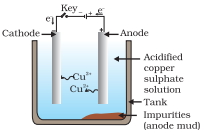
$(i)$ Given below are the steps for the extraction of copper from its ore. Write the reactions involved:
$(a)$ Roasting of copper $(I)$ sulphide
$(b)$ Reduction of copper $(I)$ oxide with copper $(I)$ sulphide
$(c)$ Electrolytic refining
$(ii)$ Draw a neat and well-labelled diagram for the electrolytic refining of copper.
$(a)$ Roasting of copper $(I)$ sulphide
$(b)$ Reduction of copper $(I)$ oxide with copper $(I)$ sulphide
$(c)$ Electrolytic refining
$(ii)$ Draw a neat and well-labelled diagram for the electrolytic refining of copper.
Solution
(N/A) $(i)$ $(a)$ Roasting of sulphide ore:
$2Cu_2S(s) + 3O_2(g) \xrightarrow{\Delta} 2Cu_2O(s) + 2SO_2(g)$
$(b)$ Reduction of copper $(I)$ oxide:
$2Cu_2O(s) + Cu_2S(s) \xrightarrow{\Delta} 6Cu(s) + SO_2(g)$
This reaction is known as auto-reduction.
$(c)$ Reaction for electrolytic refining:
At cathode: $Cu^{2+}(aq) + 2e^- \rightarrow Cu(s)$
At anode: $Cu(s) \rightarrow Cu^{2+}(aq) + 2e^-$
$(ii)$ The diagram for the electrolytic refining of copper shows an electrolytic tank containing acidified copper sulphate solution,an impure copper anode,a pure copper cathode,and the collection of anode mud at the bottom.
0 likes
View Solution17
Difficult
Two ores $A$ and $B$ were taken. On heating, ore $A$ gives $CO_2$, whereas ore $B$ gives $SO_2$. What steps will you take to convert them into metals?
Solution
(N/A) Since ore $A$ releases $CO_2$ upon heating, it is a carbonate ore. Carbonate ores are converted into metal oxides by the process of $Calcination$ (heating in limited supply of air).
$MCO_3 \xrightarrow{Calcination} MO + CO_2$
Then, the metal oxide is reduced to metal using a reducing agent like carbon:
$MO + C \xrightarrow{Reduction} M + CO$
Since ore $B$ releases $SO_2$ upon heating, it is a sulfide ore. Sulfide ores are converted into metal oxides by the process of $Roasting$ (heating in excess supply of air).
$2MS + 3O_2 \xrightarrow{Roasting} 2MO + 2SO_2$
Then, the metal oxide is reduced to metal using a reducing agent like carbon:
$MO + C \rightarrow M + CO$
0 likes
View Solution18
Easy
Why can oxides of highly reactive metals not be reduced by carbon?
Solution
(N/A) Highly reactive metals (such as $Na, Mg, Ca, Al$) have a much stronger affinity for oxygen than carbon does. Because their bond with oxygen is significantly more stable,carbon is unable to displace the metal from its oxide. Therefore,these metals are extracted from their ores by electrolytic reduction rather than carbon reduction.
0 likes
View Solution19
EasyMCQ
Why are sulphide and carbonate ores converted into oxides?
A
Oxides are more stable than sulphides and carbonates.
B
It is easier to reduce metal oxides to pure metal than their sulphides or carbonates.
C
Sulphide and carbonate ores are highly reactive.
D
Oxides are easier to mine from the earth.
Solution
(B) The extraction of metals from their sulphide and carbonate ores is difficult because these compounds are chemically stable and do not easily release the metal.
However,metal oxides are much easier to reduce to pure metal using reducing agents like carbon or through electrolytic reduction.
Therefore,sulphide ores are first converted into oxides by roasting (heating in the presence of excess air),and carbonate ores are converted into oxides by calcination (heating in the absence or limited supply of air).
0 likes
View Solution20
Medium
Differentiate between roasting and calcination and give examples.
Solution
(N/A)
| Roasting | Calcination |
| $1.$ In this,the ore is heated in the presence of excess air. | $1.$ In this,the ore is heated in the absence or limited supply of air. |
| $2.$ It is primarily done for sulphide ores. | $2.$ It is primarily done for carbonate ores. |
| $3.$ $SO_2$ gas is evolved. | $3.$ $CO_2$ gas is evolved. |
| $4.$ Example: $2ZnS + 3O_2 \xrightarrow{\text{heat}} 2ZnO + 2SO_2$ | $4.$ Example: $ZnCO_3 \xrightarrow{\text{heat}} ZnO + CO_2$ |
0 likes
View Solution21
Medium
Name the ore of mercury. How is mercury extracted from its ore?
Solution
(N/A) The primary ore of mercury is $HgS$,known as Cinnabar.
Extraction process:
$1$. Roasting: The ore $HgS$ is first heated in the presence of excess air to convert it into mercuric oxide $(HgO)$.
$2HgS + 3O_2 \xrightarrow{\Delta} 2HgO + 2SO_2$
$2$. Reduction: Mercuric oxide $(HgO)$ is then reduced to metallic mercury $(Hg)$ by further heating,as it is unstable at high temperatures.
$2HgO \xrightarrow{\Delta} 2Hg + O_2$
0 likes
View Solution22
Medium
How is copper obtained from $Cu_{2}S$? Give reactions.
Solution
(N/A) Copper is obtained from copper$(I)$ sulfide $(Cu_{2}S)$ through a process known as self-reduction or auto-reduction by heating it in the presence of air.
First,a portion of the copper$(I)$ sulfide is converted into copper$(I)$ oxide by heating it in air:
$2Cu_{2}S + 3O_{2} \xrightarrow{\Delta} 2Cu_{2}O + 2SO_{2}$
Then,the remaining copper$(I)$ sulfide reacts with the copper$(I)$ oxide formed to produce metallic copper:
$2Cu_{2}O + Cu_{2}S \xrightarrow{\Delta} 6Cu + SO_{2}$
0 likes
View Solution23
Medium
$(a)$ 'Sodium is a highly reactive metal and it cannot be obtained from its oxide by heating with carbon'. Give reason.
$(b)$ How can sodium be obtained from sodium chloride?
$(b)$ How can sodium be obtained from sodium chloride?
Solution
(N/A) Sodium is a highly reactive metal with a very high affinity for oxygen. Carbon is a weaker reducing agent than sodium,so it cannot reduce sodium oxide to sodium metal.
$(b)$ Sodium is obtained from molten sodium chloride $(NaCl)$ by the process of electrolytic reduction (electrolysis). During this process,sodium ions $(Na^+)$ are reduced at the cathode to form metallic sodium $(Na)$.
$(b)$ Sodium is obtained from molten sodium chloride $(NaCl)$ by the process of electrolytic reduction (electrolysis). During this process,sodium ions $(Na^+)$ are reduced at the cathode to form metallic sodium $(Na)$.
0 likes
View Solution24
Medium
$(i)$ Define the term 'anode mud'. Name the electrode made of pure metal.
$(ii)$ Give the reactions taking place at cathode and at anode during the electrolytic refining of copper.
$(ii)$ Give the reactions taking place at cathode and at anode during the electrolytic refining of copper.
Solution
(N/A) $(i)$ The insoluble impurities that settle down at the bottom of the anode during electrolytic refining are known as 'anode mud'. The cathode is made of a thin strip of pure metal.
$(ii)$ During the electrolytic refining of copper:
At anode: $Cu(s) \rightarrow Cu^{2+}(aq) + 2e^-$
At cathode: $Cu^{2+}(aq) + 2e^- \rightarrow Cu(s)$
$(ii)$ During the electrolytic refining of copper:
At anode: $Cu(s) \rightarrow Cu^{2+}(aq) + 2e^-$
At cathode: $Cu^{2+}(aq) + 2e^- \rightarrow Cu(s)$
0 likes
View Solution25
Medium
Name two metals which are purified by electrolytic refining. Mention the anode,cathode and the electrolyte used in the refining process. At which electrode would the pure metal be deposited?
Solution
(N/A) Two metals purified by electrolytic refining are $Copper$ $(Cu)$ and $Zinc$ $(Zn)$.
In the electrolytic refining process:
$1$. The $Anode$ is made of an impure block of the metal.
$2$. The $Cathode$ is made of a thin strip of pure metal.
$3$. The $Electrolyte$ is an aqueous solution of a salt of the metal being refined.
The pure metal is deposited on the $Cathode$.
In the electrolytic refining process:
$1$. The $Anode$ is made of an impure block of the metal.
$2$. The $Cathode$ is made of a thin strip of pure metal.
$3$. The $Electrolyte$ is an aqueous solution of a salt of the metal being refined.
The pure metal is deposited on the $Cathode$.
0 likes
View Solution26
Medium
$(a)$ What type of ores are calcined? Illustrate by giving a suitable example.
$(b)$ In what form is the calcined ore obtained,and how can it be reduced? Give chemical equations of the reduction process involved for the example provided by you.
$(c)$ Name two metals used as reducing agents by displacing metals of lower reactivity from their compounds.
$(b)$ In what form is the calcined ore obtained,and how can it be reduced? Give chemical equations of the reduction process involved for the example provided by you.
$(c)$ Name two metals used as reducing agents by displacing metals of lower reactivity from their compounds.
Solution
(N/A) Carbonate ores are subjected to calcination.
Example: Zinc carbonate $(ZnCO_{3})$ is calcined to form zinc oxide $(ZnO)$.
$ZnCO_{3}(s) \xrightarrow{\text{Heat}} ZnO(s) + CO_{2}(g)$
$(b)$ The calcined ore is obtained in the form of a metal oxide. It can be reduced to the metal using a reducing agent like carbon (coke) or by electrolytic reduction.
For the example of zinc oxide $(ZnO)$:
$ZnO(s) + C(s) \rightarrow Zn(s) + CO(g)$
$(c)$ Two metals used as reducing agents are Aluminum $(Al)$ and Sodium $(Na)$.
0 likes
View Solution27
Difficult
$A$ metal $E$ is stored under kerosene oil. When a small piece of it is left open in the air,it catches fire. When the product formed is dissolved in water,it turns red litmus blue.
$(i)$ Name the metal $E$.
$(ii)$ Write the chemical equations for the reaction when it is exposed to air and when the product is dissolved in water.
$(iii)$ Explain the process by which the metal is obtained from its molten chloride.
$(i)$ Name the metal $E$.
$(ii)$ Write the chemical equations for the reaction when it is exposed to air and when the product is dissolved in water.
$(iii)$ Explain the process by which the metal is obtained from its molten chloride.
Solution
(A) $(i)$ The metal $E$ is Sodium $(Na)$.
$(ii)$ Reaction with air: $4Na + O_{2} \rightarrow 2Na_{2}O$.
Reaction with water: $Na_{2}O + H_{2}O \rightarrow 2NaOH$.
$(iii)$ Sodium is obtained from molten sodium chloride $(NaCl)$ by the process of electrolytic reduction (electrolysis). In this process,an electric current is passed through the molten salt.
At cathode: $Na^{+} + e^{-} \rightarrow Na$ (Reduction).
At anode: $2Cl^{-} \rightarrow Cl_{2} + 2e^{-}$ (Oxidation).
0 likes
View Solution28
Medium
$(i)$ Explain the steps for extraction of copper from its sulphide ore. Write the balanced equations involved in the process.
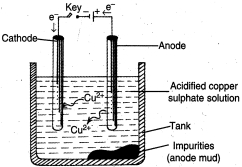
$(ii)$ What is meant by refining of metals? Draw a diagram of electrolytic refining of copper and name the substances used as cathode, anode, and the electrolyte.
$(ii)$ What is meant by refining of metals? Draw a diagram of electrolytic refining of copper and name the substances used as cathode, anode, and the electrolyte.
Solution
(N/A) $(i)$ Extraction of copper from its sulphide ore $(Cu_2S)$:
$(a)$ Roasting: The sulphide ore is heated in the presence of excess air to convert it into copper$(I)$ oxide.
$2Cu_2S(s) + 3O_2(g) \xrightarrow{\text{heat}} 2Cu_2O(s) + 2SO_2(g)$
$(b)$ Reduction: The copper$(I)$ oxide is then heated with more copper$(I)$ sulphide to obtain copper metal.
$2Cu_2O(s) + Cu_2S(s) \xrightarrow{\text{heat}} 6Cu(s) + SO_2(g)$
$(ii)$ Refining of metals: It is the process of removing impurities from the crude metal obtained after reduction to get pure metal.
Electrolytic refining of copper:
Anode: Impure copper block.
Cathode: Pure copper strip.
Electrolyte: Acidified copper sulphate solution $(CuSO_4 + H_2SO_4)$.
0 likes
View Solution29
Medium
$(a)$ List two differences between calcination and roasting in tabular form.
$(b)$ Which method will you use to reduce the following? Explain by giving a suitable example.
$(i)$ Oxides of less reactive metals.
$(ii)$ Oxides of moderately reactive metals.
$(iii)$ Oxides of highly reactive metals.
$(b)$ Which method will you use to reduce the following? Explain by giving a suitable example.
$(i)$ Oxides of less reactive metals.
$(ii)$ Oxides of moderately reactive metals.
$(iii)$ Oxides of highly reactive metals.
Solution
(N/A)
$(b)$ $(i)$ Self-reduction: Less reactive metals like mercury $(Hg)$ or copper $(Cu)$ can be reduced by heating alone.
$2HgO \xrightarrow{\text{heat}} 2Hg + O_2$
$2Cu_2O + Cu_2S \xrightarrow{\text{heat}} 6Cu + SO_2$
$(ii)$ Reduction using carbon or displacement: Moderately reactive metals are reduced by heating with carbon or using highly reactive metals like aluminum $(Al)$ in thermite reactions.
$ZnO + C \rightarrow Zn + CO$
$Fe_2O_3 + 2Al \rightarrow 2Fe + Al_2O_3 + \text{Heat}$
$(iii)$ Electrolytic reduction: Highly reactive metals (e.g.,$Na, Mg, Ca$) are extracted by the electrolysis of their molten chlorides because they have a high affinity for oxygen.
| Roasting | Calcination |
|---|---|
| Heating in the presence of excess air. Done for sulphide ores. | Heating in a limited supply of air. Done for carbonate ores. |
$(b)$ $(i)$ Self-reduction: Less reactive metals like mercury $(Hg)$ or copper $(Cu)$ can be reduced by heating alone.
$2HgO \xrightarrow{\text{heat}} 2Hg + O_2$
$2Cu_2O + Cu_2S \xrightarrow{\text{heat}} 6Cu + SO_2$
$(ii)$ Reduction using carbon or displacement: Moderately reactive metals are reduced by heating with carbon or using highly reactive metals like aluminum $(Al)$ in thermite reactions.
$ZnO + C \rightarrow Zn + CO$
$Fe_2O_3 + 2Al \rightarrow 2Fe + Al_2O_3 + \text{Heat}$
$(iii)$ Electrolytic reduction: Highly reactive metals (e.g.,$Na, Mg, Ca$) are extracted by the electrolysis of their molten chlorides because they have a high affinity for oxygen.
0 likes
View Solution30
Medium
Distinguish between the following:
$(i)$ Electrolytic reduction and electrolytic refining
$(ii)$ Mineral and ore
$(iii)$ Alloys and amalgams
$(i)$ Electrolytic reduction and electrolytic refining
$(ii)$ Mineral and ore
$(iii)$ Alloys and amalgams
Solution
(N/A) $(i)$
$(ii)$ Minerals are naturally occurring elements or compounds in the Earth's crust. Ores are those minerals from which metals can be extracted profitably and conveniently.
$(iii)$ An alloy is a homogeneous mixture of two or more metals or a metal and a non-metal. An amalgam is a specific type of alloy in which one of the components is mercury $(Hg)$.
| Electrolytic reduction | Electrolytic refining |
| It is a process of obtaining metals from their molten chlorides or oxides by electrolysis. The metals are deposited at the cathode,whereas chlorine or oxygen is liberated at the anode. | It is a process of refining impure metals obtained by any reduction process. The impure metal is taken as the anode,pure metal as the cathode,and a metal salt solution as the electrolyte. |
$(ii)$ Minerals are naturally occurring elements or compounds in the Earth's crust. Ores are those minerals from which metals can be extracted profitably and conveniently.
$(iii)$ An alloy is a homogeneous mixture of two or more metals or a metal and a non-metal. An amalgam is a specific type of alloy in which one of the components is mercury $(Hg)$.
0 likes
View Solution31
EasyMCQ
Which kind of impurities are present in the ores? What are these impurities collectively known as?
A
Soil and sand; Gangue
B
Metals and non-metals; Alloy
C
Minerals and rocks; Ore
D
Salts and acids; Slag
Solution
(A) Ores are naturally occurring minerals from which metals can be extracted profitably.
These ores are usually contaminated with earthy impurities such as soil,sand,and rocky materials.
These unwanted impurities present in the ore are collectively known as $Gangue$.
These ores are usually contaminated with earthy impurities such as soil,sand,and rocky materials.
These unwanted impurities present in the ore are collectively known as $Gangue$.
0 likes
View Solution32
MediumMCQ
Which of the following metals are obtained by electrolysis of their molten chlorides?
$(i) Na, (ii) Ca, (iii) Fe, (iv) Cu$
$(i) Na, (ii) Ca, (iii) Fe, (iv) Cu$
A
$(i)$ and $(iv)$
B
$(i)$ and $(ii)$
C
$(i)$ and $(iii)$
D
$(iii)$ and $(iv)$
Solution
(B) Highly reactive metals such as Sodium $(Na)$ and Calcium $(Ca)$ are placed at the top of the reactivity series.
These metals have a very high affinity for oxygen and cannot be reduced by carbon or other common reducing agents.
Therefore,they are extracted by the electrolytic reduction of their molten chloride salts (e.g.,$NaCl$ and $CaCl_2$).
Metals like Iron $(Fe)$ and Copper $(Cu)$ are less reactive and are typically extracted by reduction with carbon or other chemical methods.
Thus,only $(i)$ and $(ii)$ are obtained by the electrolysis of their molten chlorides.
0 likes
View Solution33
MediumMCQ
During the electrolytic refining of zinc,it gets :
A
Deposited on cathode
B
Deposited on anode
C
Deposited on cathode as well as anode
D
Remains in the solution.
Solution
(A) In the process of electrolytic refining of metals like zinc,an impure metal rod is used as the anode and a thin strip of pure metal is used as the cathode.
When an electric current is passed through the electrolyte (a salt solution of the metal),the impure metal from the anode dissolves into the electrolyte.
Simultaneously,an equivalent amount of pure metal from the electrolyte is deposited on the cathode.
Therefore,during the electrolytic refining of zinc,pure zinc gets deposited on the cathode.
0 likes
View Solution34
MediumMCQ
Which of the following metals exist in their native state in nature?
$(i)$ $Au$
$(ii)$ $Cu$
$(iii)$ $Ag$
$(iv)$ $Fe$
$(i)$ $Au$
$(ii)$ $Cu$
$(iii)$ $Ag$
$(iv)$ $Fe$
A
$(i)$ and $(ii)$
B
$(ii)$ and $(iii)$
C
$(i)$ and $(iii)$
D
$(ii)$ and $(iv)$
Solution
(C) Metals that are very low in the reactivity series are found in their native (free) state in nature because they are highly unreactive.
These metals include gold $(Au)$,silver $(Ag)$,and platinum $(Pt)$.
In the given list:
$(i)$ $Au$ (Gold) is a noble metal and exists in a native state.
$(ii)$ $Cu$ (Copper) is found in both native and combined states (as sulfides or oxides).
$(iii)$ $Ag$ (Silver) is a noble metal and exists in a native state.
$(iv)$ $Fe$ (Iron) is highly reactive and is always found in a combined state (as oxides,carbonates,or sulfides).
Therefore,$(i)$ and $(iii)$ are the correct metals that exist in their native state.
0 likes
View Solution35
MediumMCQ
Metals are refined by using different methods. Which of the following metals are refined by electrolytic refining?
$(i)$ $Au$
$(ii)$ $Cu$
$(iii)$ $Na$
$(iv)$ $K$
$(i)$ $Au$
$(ii)$ $Cu$
$(iii)$ $Na$
$(iv)$ $K$
A
$(i)$ and $(ii)$
B
$(i)$ and $(iii)$
C
$(ii)$ and $(iii)$
D
$(iii)$ and $(iv)$
Solution
(A) Electrolytic refining is a process used to purify metals that are obtained from their ores.
Metals like copper $(Cu)$,gold $(Au)$,silver $(Ag)$,and zinc $(Zn)$ are commonly refined using the electrolytic refining method.
In this process,an impure metal is made the anode,and a pure strip of the same metal is made the cathode.
Metals like sodium $(Na)$ and potassium $(K)$ are highly reactive and are extracted by the electrolytic reduction of their molten chlorides,not by electrolytic refining of the metal itself.
Therefore,$(i)$ $Au$ and $(ii)$ $Cu$ are the metals refined by electrolytic refining.
0 likes
View Solution36
Easy
State whether the following statement is true or false:
The elements or compounds,which occur naturally in the earth's crust,are known as minerals.
The elements or compounds,which occur naturally in the earth's crust,are known as minerals.
Solution
(TRUE) The statement is True.
Minerals are naturally occurring inorganic substances found in the earth's crust. They have a definite chemical composition and a crystalline structure. Elements or compounds that occur naturally in the earth's crust are indeed defined as minerals.
Minerals are naturally occurring inorganic substances found in the earth's crust. They have a definite chemical composition and a crystalline structure. Elements or compounds that occur naturally in the earth's crust are indeed defined as minerals.
0 likes
View Solution37
Easy
State whether the following statement is true or false:
Those minerals which contain a very high percentage of a particular metal and from which the metal can be profitably extracted are called ores.
Those minerals which contain a very high percentage of a particular metal and from which the metal can be profitably extracted are called ores.
Solution
(TRUE) True.
An ore is a type of rock that contains sufficient minerals with important elements,including metals,that can be economically extracted from the rock.
While all ores are minerals,not all minerals are ores,because some minerals may contain a metal but it may not be profitable or feasible to extract it.
0 likes
View Solution38
EasyMCQ
What is the chemical formula of alumina?
A
$Al_{2}O_{3}$
B
$Al_{2}O_{3} \cdot 2H_{2}O$
C
$Al_{2}O_{3} \cdot H_{2}O$
D
$NaAlO_{2}$
Solution
(A) Alumina is the common name for aluminum oxide.
Its chemical formula is $Al_{2}O_{3}$.
It is a naturally occurring oxide of aluminum and is the primary ore of aluminum, known as bauxite when impure.
Its chemical formula is $Al_{2}O_{3}$.
It is a naturally occurring oxide of aluminum and is the primary ore of aluminum, known as bauxite when impure.
0 likes
View Solution39
EasyMCQ
Which of the following reactions is called roasting?
A
$ZnCO_{3(s)} \xrightarrow{\Delta} ZnO_{(s)} + CO_{2(g)}$
B
$2ZnS_{(s)} + 3O_{2(g)} \xrightarrow{\Delta} 2ZnO_{(s)} + 2SO_{2(g)}$
C
$ZnO_{(s)} + C_{(s)} \xrightarrow{\Delta} Zn_{(s)} + CO_{(g)}$
D
$Zn_{(s)} + H_2O_{(g)} \xrightarrow{\Delta} ZnO_{(s)} + H_{2(g)}$
Solution
(B) Roasting is a metallurgical process in which a sulfide ore is heated strongly in the presence of excess air to convert it into its oxide form.
In the reaction $2ZnS_{(s)} + 3O_{2(g)} \xrightarrow{\Delta} 2ZnO_{(s)} + 2SO_{2(g)}$,zinc sulfide $(ZnS)$ is heated in the presence of oxygen to form zinc oxide $(ZnO)$ and sulfur dioxide $(SO_2)$.
Therefore,this reaction represents roasting.
Option $A$ represents calcination (heating carbonate ore in limited air).
Option $C$ represents reduction of metal oxide using carbon.
Option $D$ represents the reaction of metal with steam.
0 likes
View Solution40
EasyMCQ
Which process is used to obtain metal from metal oxide?
A
Liquation
B
Reduction
C
Calcination
D
Roasting
Solution
(B) The process of obtaining a metal from its metal oxide is known as reduction.
Metal oxides are compounds where metal is in an oxidized state.
To extract the pure metal,oxygen must be removed from the metal oxide.
This removal of oxygen is chemically defined as reduction.
Common reducing agents like carbon (coke),carbon monoxide,or more reactive metals (like aluminum in the thermite process) are used to perform this reduction.
0 likes
View Solution41
EasyMCQ
Generally,in what forms are the elements present in the lithosphere?
A
Chloride
B
Oxide or sulphide
C
Bromide
D
Hydride
Solution
(B) The Earth's crust is the largest source of metals. Many metals are found in the Earth's crust in the form of minerals.
Most of the metals are found in the form of oxides or sulphides because these are the most stable forms of metals in the presence of oxygen and sulphur in the Earth's crust.
Therefore,the correct answer is $B$.
Most of the metals are found in the form of oxides or sulphides because these are the most stable forms of metals in the presence of oxygen and sulphur in the Earth's crust.
Therefore,the correct answer is $B$.
0 likes
View Solution42
EasyMCQ
Which of the following metals is obtained in free state in nature?
A
$Fe$
B
$Al$
C
$Au$
D
$Ca$
Solution
(C) Metals that are at the bottom of the reactivity series are the least reactive.
These metals are often found in a free or native state in nature because they do not react easily with oxygen,moisture,or other substances in the environment.
Gold $(Au)$,silver $(Ag)$,and platinum $(Pt)$ are examples of such metals.
Iron $(Fe)$,Aluminum $(Al)$,and Calcium $(Ca)$ are more reactive and are typically found in the form of oxides,sulfides,or carbonates (ores).
0 likes
View Solution43
EasyMCQ
What is the chemical formula of copper pyrites?
A
$Cu_{2}S$
B
$CuFeS_{2}$
C
$Cu_{2}O$
D
$Cu(OH)_{2} \cdot CuCO_{3}$
Solution
(B) Copper pyrites,also known as chalcopyrite,is the most important ore of copper.
Its chemical formula is $CuFeS_{2}$.
- $Cu_{2}S$ is Chalcocite.
- $Cu_{2}O$ is Cuprite.
- $Cu(OH)_{2} \cdot CuCO_{3}$ is Malachite.
Its chemical formula is $CuFeS_{2}$.
- $Cu_{2}S$ is Chalcocite.
- $Cu_{2}O$ is Cuprite.
- $Cu(OH)_{2} \cdot CuCO_{3}$ is Malachite.
0 likes
View Solution44
EasyMCQ
What is an ore of aluminium?
A
Siderite
B
Horn silver
C
Cuprite
D
Bauxite
Solution
(D) The primary ore of aluminium is $Bauxite$ $(Al_2O_3 \cdot 2H_2O)$.
$Siderite$ is an ore of iron $(FeCO_3)$.
$Horn \text{ } silver$ is an ore of silver $(AgCl)$.
$Cuprite$ is an ore of copper $(Cu_2O)$.
Therefore, the correct option is $D$.
$Siderite$ is an ore of iron $(FeCO_3)$.
$Horn \text{ } silver$ is an ore of silver $(AgCl)$.
$Cuprite$ is an ore of copper $(Cu_2O)$.
Therefore, the correct option is $D$.
0 likes
View Solution45
EasyMCQ
What is the chemical formula of bauxite?
A
$Al_{2}O_{3} \cdot 2H_{2}O$
B
$Fe_{2}O_{3} \cdot xH_{2}O$
C
$Al_{2}O_{3}$
D
$NaAlO_{2}$
Solution
(A) Bauxite is the primary ore of aluminum.
Its chemical composition is primarily hydrated aluminum oxide.
The general chemical formula for bauxite is $Al_{2}O_{3} \cdot 2H_{2}O$ (or sometimes represented as $Al_{2}O_{3} \cdot nH_{2}O$ where $n$ is between $1$ and $3$).
Therefore,the correct option is $A$.
Its chemical composition is primarily hydrated aluminum oxide.
The general chemical formula for bauxite is $Al_{2}O_{3} \cdot 2H_{2}O$ (or sometimes represented as $Al_{2}O_{3} \cdot nH_{2}O$ where $n$ is between $1$ and $3$).
Therefore,the correct option is $A$.
0 likes
View Solution46
EasyMCQ
Malachite is an ore of which metal?
A
Iron
B
Copper
C
Calcium
D
Aluminum
Solution
(B) Malachite is a green-colored carbonate mineral with the chemical formula $Cu_2CO_3(OH)_2$.
It is a significant ore of the metal Copper $(Cu)$.
Therefore,the correct option is $B$.
It is a significant ore of the metal Copper $(Cu)$.
Therefore,the correct option is $B$.
0 likes
View Solution47
EasyMCQ
Dolomite is an ore of which metal?
A
Iron
B
Aluminum
C
Calcium
D
Silver
Solution
(C) Dolomite is a sedimentary carbonate rock that contains a high proportion of the mineral dolomite,$CaMg(CO_3)_2$.
It is primarily considered an important source of $Calcium$ and $Magnesium$.
Among the given options,$Calcium$ is the correct metal associated with dolomite.
It is primarily considered an important source of $Calcium$ and $Magnesium$.
Among the given options,$Calcium$ is the correct metal associated with dolomite.
0 likes
View Solution48
EasyMCQ
Which of the following ores is in the form of oxide?
A
Dolomite
B
Siderite
C
Horn silver
D
Bauxite
Solution
(D) The chemical formulas for the given ores are:
$1$. Dolomite: $CaCO_3 \cdot MgCO_3$ (Carbonate ore)
$2$. Siderite: $FeCO_3$ (Carbonate ore)
$3$. Horn silver: $AgCl$ (Halide ore)
$4$. Bauxite: $Al_2O_3 \cdot 2H_2O$ (Oxide ore)
Since Bauxite contains aluminum oxide, it is classified as an oxide ore. Therefore, the correct option is $D$.
$1$. Dolomite: $CaCO_3 \cdot MgCO_3$ (Carbonate ore)
$2$. Siderite: $FeCO_3$ (Carbonate ore)
$3$. Horn silver: $AgCl$ (Halide ore)
$4$. Bauxite: $Al_2O_3 \cdot 2H_2O$ (Oxide ore)
Since Bauxite contains aluminum oxide, it is classified as an oxide ore. Therefore, the correct option is $D$.
0 likes
View Solution49
EasyMCQ
Which of the following ores is in the form of sulphide?
A
Copper glance
B
Cuprite
C
Haematite
D
Malachite
Solution
(A) The chemical formula for Copper glance is $Cu_2S$,which is a sulphide ore.
Cuprite is $Cu_2O$ (oxide ore).
Haematite is $Fe_2O_3$ (oxide ore).
Malachite is $Cu(OH)_2 \cdot CuCO_3$ (carbonate/hydroxide ore).
Therefore,the correct option is $A$.
Cuprite is $Cu_2O$ (oxide ore).
Haematite is $Fe_2O_3$ (oxide ore).
Malachite is $Cu(OH)_2 \cdot CuCO_3$ (carbonate/hydroxide ore).
Therefore,the correct option is $A$.
0 likes
View Solution50
EasyMCQ
Which of the following ores is in the form of carbonate?
A
Bauxite
B
Siderite
C
Copper pyrites
D
Cuprite
Solution
(B) The chemical formula for Siderite is $FeCO_3$, which is an iron carbonate ore.
Bauxite is an oxide ore of aluminum $(Al_2O_3 \cdot 2H_2O)$.
Copper pyrites is a sulfide ore of copper $(CuFeS_2)$.
Cuprite is an oxide ore of copper $(Cu_2O)$.
Therefore, Siderite is the correct answer as it is a carbonate ore.
Bauxite is an oxide ore of aluminum $(Al_2O_3 \cdot 2H_2O)$.
Copper pyrites is a sulfide ore of copper $(CuFeS_2)$.
Cuprite is an oxide ore of copper $(Cu_2O)$.
Therefore, Siderite is the correct answer as it is a carbonate ore.
0 likes
View SolutionMetals and Non-metals — Occurrence and Extraction of Metals · Frequently Asked Questions
1Are these Metals and Non-metals questions useful for JEE and NEET?
Yes. All questions in this section are mapped to JEE Main and NEET exam patterns. Previous year questions from JEE Main, NEET, GUJCET and state-level exams are included with full solutions.
2Can I switch to Hindi or Gujarati for these questions?
Yes. Use the language tabs in the hero section or the sidebar to view the same questions and solutions in English, Hindi or Gujarati.
3How do I generate a question paper from this subtopic?
Use the Vedclass Exam Paper Generator — select the chapter and subtopic, set difficulty, and generate Sets A, B, C, D automatically. First 3 chapters of every subject are free.
Vedclass Products
For Students
Vedclass Test Series
Mock tests in real JEE/NEET style with performance analysis. 5-day free trial.
Start Free TrialFor Teachers
Exam Paper Generator
Generate Set A/B/C/D papers from this chapter in 2 minutes. 3 chapters free.
Try FreeFor Institutes
Online Exam Module
Live online exams with unlimited students, 360° analytics & white-label branding.
See DemoFor Teachers & Institutes
Generate a Metals and Non-metals Exam Paper in 2 Minutes
Select subtopic & difficulty — Sets A, B, C, D auto-generated with No Repeat logic.
First 3 chapters of every subject are free — no payment required.