
A English
Physical Properties of Metals and Non-metals Questions in English
Class 10 Science · Metals and Non-metals · Physical Properties of Metals and Non-metals
54+
Questions
English
Language
100%
With Solutions
Showing 50 of 54 questions in English
1
Medium
Give an example of a metal which:
$(i)$ is a liquid at room temperature.
$(ii)$ can be easily cut with a knife.
$(iii)$ is the best conductor of heat.
$(iv)$ is a poor conductor of heat.
$(i)$ is a liquid at room temperature.
$(ii)$ can be easily cut with a knife.
$(iii)$ is the best conductor of heat.
$(iv)$ is a poor conductor of heat.
Solution
(N/A) $(i)$ Metal that exists in a liquid state at room temperature $\to$ Mercury $(Hg)$.
$(ii)$ Metal that can be easily cut with a knife $\to$ Sodium $(Na)$ or Potassium $(K)$.
$(iii)$ Metal that is the best conductor of heat $\to$ Silver $(Ag)$.
$(iv)$ Metals that are poor conductors of heat $\to$ Mercury $(Hg)$ and Lead $(Pb)$.
$(ii)$ Metal that can be easily cut with a knife $\to$ Sodium $(Na)$ or Potassium $(K)$.
$(iii)$ Metal that is the best conductor of heat $\to$ Silver $(Ag)$.
$(iv)$ Metals that are poor conductors of heat $\to$ Mercury $(Hg)$ and Lead $(Pb)$.
0 likes
View Solution2
Easy
Explain the meanings of malleable and ductile.
Solution
(N/A) Malleable: Substances that can be beaten into thin sheets are called malleable. For example,most metals are malleable.
Ductile: Substances that can be drawn into thin wires are called ductile. For example,most metals are ductile.
Ductile: Substances that can be drawn into thin wires are called ductile. For example,most metals are ductile.
0 likes
View Solution3
You are given a hammer,a battery,a bulb,wires,and a switch.
$(a)$ How could you use them to distinguish between samples of metals and non-metals?
$(b)$ Assess the usefulness of these tests in distinguishing between metals and non-metals.
$(a)$ How could you use them to distinguish between samples of metals and non-metals?
$(b)$ Assess the usefulness of these tests in distinguishing between metals and non-metals.
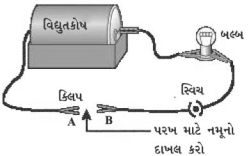
Solution
(N/A) With the hammer,we can beat the sample. If it can be beaten into thin sheets (i.e.,it is malleable),then it is a metal; otherwise,it is a non-metal.
Similarly,we can use the battery,bulb,wires,and a switch to set up an electrical circuit with the sample. If the sample conducts electricity,the bulb will glow,indicating it is a metal; otherwise,it is a non-metal.
$(b)$ These tests are useful in distinguishing between metals and non-metals because they are based on fundamental physical properties such as malleability and electrical conductivity. These tests are simple,quick,and do not involve any complex chemical reactions.
0 likes
View Solution4
Easy
Give reasons: Platinum,gold,and silver are used to make jewellery.
Solution
(N/A) Platinum,gold,and silver are used to make jewellery due to the following reasons:
$1$. Lustre: These metals possess a high degree of metallic lustre,which makes them attractive and suitable for ornaments.
$2$. Low Reactivity: They are noble metals and are very less reactive. They do not react with air,water,or acids under normal conditions,which prevents them from corroding or tarnishing easily.
$3$. Malleability and Ductility: These metals are highly malleable and ductile,allowing them to be easily shaped into intricate designs.
0 likes
View Solution5
EasyMCQ
Which of the following properties is generally not shown by metals?
A
Dullness
B
Sonorous in nature
C
Electrical conduction
D
Ductility
Solution
(A) Metals are elements that typically exhibit properties such as luster (shininess),high electrical and thermal conductivity,ductility (ability to be drawn into wires),and malleability (ability to be beaten into sheets).
They are also sonorous,meaning they produce a ringing sound when struck.
Dullness is a characteristic property of non-metals,not metals.
Therefore,metals generally do not show dullness.
They are also sonorous,meaning they produce a ringing sound when struck.
Dullness is a characteristic property of non-metals,not metals.
Therefore,metals generally do not show dullness.
0 likes
View Solution6
EasyMCQ
The ability of metals to be drawn into thin wire is known as
A
malleability
B
ductility
C
sonorousity
D
conductivity
Solution
(B) The property of metals by which they can be drawn into thin wires is called $ductility$.
$Malleability$ is the property of being beaten into thin sheets.
$Sonorousity$ refers to the property of producing a ringing sound when struck.
$Conductivity$ refers to the ability to conduct heat or electricity.
Therefore, the correct option is $B$.
$Malleability$ is the property of being beaten into thin sheets.
$Sonorousity$ refers to the property of producing a ringing sound when struck.
$Conductivity$ refers to the ability to conduct heat or electricity.
Therefore, the correct option is $B$.
0 likes
View Solution7
MediumMCQ
Aluminium is used for making cooking utensils. Which of the following properties of aluminium are responsible for the same?
$(i)$ Good thermal conductivity
$(ii)$ Good electrical conductivity
$(iii)$ Ductility
$(iv)$ High melting point
$(i)$ Good thermal conductivity
$(ii)$ Good electrical conductivity
$(iii)$ Ductility
$(iv)$ High melting point
A
$(i)$ and $(ii)$
B
$(i)$ and $(iii)$
C
$(i)$ and $(iv)$
D
$(ii)$ and $(iii)$
Solution
(C) Aluminium is widely used for making cooking utensils due to the following reasons:
$1$. Good thermal conductivity: It allows heat to pass through the utensil quickly and evenly,which is essential for cooking food.
$2$. High melting point: It ensures that the utensil does not melt or deform when exposed to the high temperatures required for cooking.
Therefore,properties $(i)$ and $(iv)$ are responsible for its use in cooking utensils.
0 likes
View Solution8
EasyMCQ
Generally,metals are solid in nature. Which one of the following metals is found in liquid state at room temperature?
A
$Hg$
B
$Fe$
C
$Cr$
D
$Na$
Solution
(A) Most metals exist as solids at room temperature due to their strong metallic bonding.
However,Mercury $(Hg)$ is a unique metal that exists in a liquid state at room temperature $(25^{\circ}C)$.
This is due to the weak metallic bonding between mercury atoms,which allows them to move past each other easily at room temperature.
However,Mercury $(Hg)$ is a unique metal that exists in a liquid state at room temperature $(25^{\circ}C)$.
This is due to the weak metallic bonding between mercury atoms,which allows them to move past each other easily at room temperature.
0 likes
View Solution9
EasyMCQ
Generally,non-metals are not lustrous. Which of the following non-metal is lustrous?
A
Sulphur
B
Oxygen
C
Iodine
D
Nitrogen
Solution
(C) Most non-metals are dull in appearance and do not possess metallic luster.
However,$Iodine$ is an exception among non-metals.
Although it is a non-metal,it exhibits a characteristic shiny or lustrous appearance in its solid state.
Therefore,the correct option is $C$.
However,$Iodine$ is an exception among non-metals.
Although it is a non-metal,it exhibits a characteristic shiny or lustrous appearance in its solid state.
Therefore,the correct option is $C$.
0 likes
View Solution10
DifficultMCQ
The electronic configurations of three elements $X$, $Y$, and $Z$ are $X: {2, 8}$, $Y: {2, 8, 7}$, and $Z: {2, 8, 2}$. Which of the following is correct?
A
$X$ is a metal
B
$Y$ is a non-metal and $Z$ is a metal
C
$Z$ is a non-metal
D
$Y$ is a metal
Solution
(B) $1$. Analyze the electronic configuration of each element:
- $X$ has $2, 8$ electrons. Its valence shell is full (octet complete), so $X$ is a noble gas (Neon).
- $Y$ has $2, 8, 7$ electrons. It has $7$ valence electrons, meaning it needs $1$ electron to complete its octet. Elements that gain electrons are non-metals (Chlorine).
- $Z$ has $2, 8, 2$ electrons. It has $2$ valence electrons, which it can easily lose to achieve a stable configuration. Elements that lose electrons are metals (Magnesium).
$2$. Evaluate the options:
- Option $A$: $X$ is a noble gas, not a metal.
- Option $B$: $Y$ is a non-metal and $Z$ is a metal. This is correct.
- Option $C$: $Z$ is a metal, not a non-metal.
- Option $D$: $Y$ is a non-metal, not a metal.
Therefore, the correct statement is that $Y$ is a non-metal and $Z$ is a metal.
0 likes
View Solution11
MediumMCQ
Generally,non-metals are not conductors of electricity. Which of the following is a good conductor of electricity?
A
Diamond
B
Fullerene
C
Sulphur
D
Graphite
Solution
(D) Non-metals are typically poor conductors of electricity because they lack free electrons.
However,$Graphite$,an allotrope of carbon,is an exception.
In $Graphite$,each carbon atom is bonded to three other carbon atoms in the same plane,leaving one valence electron free per carbon atom.
These free electrons allow $Graphite$ to conduct electricity effectively.
Therefore,$Graphite$ is a good conductor of electricity.
0 likes
View Solution12
MediumMCQ
Which of the following non-metals is a liquid?
A
Carbon
B
Bromine
C
Phosphorus
D
Sulphur
Solution
(B) Most non-metals exist as solids or gases at room temperature.
Bromine is the only non-metal that exists in a liquid state at room temperature.
Carbon,phosphorus,and sulphur are all solid non-metals under standard conditions.
Bromine is the only non-metal that exists in a liquid state at room temperature.
Carbon,phosphorus,and sulphur are all solid non-metals under standard conditions.
0 likes
View Solution13
Medium
Identify and name the metals from the following elements whose electronic configurations are given below:
$(a)$ $2, 8, 2$
$(b)$ $2, 8, 1$
$(c)$ $2, 8, 7$
$(d)$ $2, 1$
$(a)$ $2, 8, 2$
$(b)$ $2, 8, 1$
$(c)$ $2, 8, 7$
$(d)$ $2, 1$
Solution
(A, B, D) Metals are elements that typically have $1, 2,$ or $3$ electrons in their outermost shell.
$(a)$ Electronic configuration $2, 8, 2$: The valence shell has $2$ electrons. This is Magnesium $(Mg)$.
$(b)$ Electronic configuration $2, 8, 1$: The valence shell has $1$ electron. This is Sodium $(Na)$.
$(c)$ Electronic configuration $2, 8, 7$: The valence shell has $7$ electrons. This is a non-metal (Chlorine,$Cl$).
$(d)$ Electronic configuration $2, 1$: The valence shell has $1$ electron. This is Lithium $(Li)$.
Therefore,the metals are $(a)$,$(b)$,and $(d)$.
0 likes
View Solution14
Easy
Explain the following.
$(a)$ Why are copper and aluminium wires usually employed for electricity transmission?
$(a)$ Why are copper and aluminium wires usually employed for electricity transmission?
Solution
(N/A) Copper and aluminium are metals that possess very low electrical resistivity,which means they offer minimal resistance to the flow of electric current.
Because of this property,they act as excellent conductors of electricity.
Consequently,they are widely used in electrical wiring and transmission lines to ensure efficient power delivery with minimal energy loss as heat.
Because of this property,they act as excellent conductors of electricity.
Consequently,they are widely used in electrical wiring and transmission lines to ensure efficient power delivery with minimal energy loss as heat.
0 likes
View Solution15
Easy
Give two examples each of metals that are good conductors and poor conductors of heat,respectively.
Solution
(N/A) Good conductors of heat: Silver $(Ag)$ and Copper $(Cu)$.
$(b)$ Poor conductors of heat: Lead $(Pb)$ and Mercury $(Hg)$.
$(b)$ Poor conductors of heat: Lead $(Pb)$ and Mercury $(Hg)$.
0 likes
View Solution16
Medium
Name one metal and one non-metal that exist in liquid state at room temperature. Also,name two metals having a melting point less than $310\ K$ $(37\ ^\circ C)$.
Solution
(N/A) The metal that exists in a liquid state at room temperature is Mercury $(Hg)$.
The non-metal that exists in a liquid state at room temperature is Bromine $(Br)$.
Two metals that have a melting point less than $310\ K$ $(37\ ^\circ C)$ are Cesium $(Cs)$ and Gallium $(Ga)$.
The non-metal that exists in a liquid state at room temperature is Bromine $(Br)$.
Two metals that have a melting point less than $310\ K$ $(37\ ^\circ C)$ are Cesium $(Cs)$ and Gallium $(Ga)$.
0 likes
View Solution17
Easy
Name one metal and one non-metal that are found in a liquid state at room temperature.
Solution
(N/A) The metal that exists in a liquid state at room temperature is $Mercury$ $(Hg)$.
The non-metal that exists in a liquid state at room temperature is $Bromine$ $(Br_2)$.
The non-metal that exists in a liquid state at room temperature is $Bromine$ $(Br_2)$.
0 likes
View Solution18
Easy
Name two metals which have very low melting points.
Solution
(N/A) The two metals that have very low melting points are:
$(i)$ Caesium $(Cs)$
$(ii)$ Gallium $(Ga)$
These metals are so sensitive to heat that they can melt in the palm of a human hand.
$(i)$ Caesium $(Cs)$
$(ii)$ Gallium $(Ga)$
These metals are so sensitive to heat that they can melt in the palm of a human hand.
0 likes
View Solution19
Easy
Name a non-metal which is lustrous and a metal which is non-lustrous.
Solution
(N/A) Iodine is a non-metal that exhibits luster (lustrous).
Sodium or Potassium are examples of metals that appear dull (non-lustrous) when exposed to air due to the formation of an oxide layer,or more commonly,metals like Iron in its powdered or oxidized form are considered non-lustrous.
Sodium or Potassium are examples of metals that appear dull (non-lustrous) when exposed to air due to the formation of an oxide layer,or more commonly,metals like Iron in its powdered or oxidized form are considered non-lustrous.
0 likes
View Solution20
Medium
Give reasons for the following:
$(a)$ School bells are made of metals.
$(b)$ Electrical wires are made of copper.
$(a)$ School bells are made of metals.
$(b)$ Electrical wires are made of copper.
Solution
(N/A) Metals are sonorous,meaning they produce a ringing sound when struck. Therefore,they are used to make school bells.
$(b)$ Copper is an excellent conductor of electricity with low electrical resistance. Therefore,it is used for making electrical wires.
$(b)$ Copper is an excellent conductor of electricity with low electrical resistance. Therefore,it is used for making electrical wires.
0 likes
View Solution21
Medium
Name the following:
$(a)$ $A$ metal which is preserved in kerosene.
$(b)$ $A$ lustrous coloured non-metal.
$(c)$ $A$ metal which can melt while kept on palm.
$(d)$ $A$ metal which is a poor conductor of heat.
$(a)$ $A$ metal which is preserved in kerosene.
$(b)$ $A$ lustrous coloured non-metal.
$(c)$ $A$ metal which can melt while kept on palm.
$(d)$ $A$ metal which is a poor conductor of heat.
Solution
(N/A) Sodium $(Na)$ is a highly reactive metal that reacts vigorously with oxygen and moisture in the air,so it is stored in kerosene to prevent reaction.
$(b)$ Iodine $(I_2)$ is a non-metal that possesses a characteristic lustrous appearance and is purple-black in colour.
$(c)$ Gallium $(Ga)$ and Caesium $(Cs)$ have very low melting points and melt when held in the palm of a human hand.
$(d)$ Lead $(Pb)$ and Mercury $(Hg)$ are metals that are poor conductors of heat compared to other metals like copper or silver.
0 likes
View Solution22
Medium
List three properties of sodium in which it differs from the general physical properties of most metals.
Solution
(N/A) $(i)$ Sodium is so soft that it can be cut with a knife.
$(ii)$ It has a low density compared to most metals.
$(iii)$ It has a low melting point.
$(ii)$ It has a low density compared to most metals.
$(iii)$ It has a low melting point.
0 likes
View Solution23
Medium
Provide one exception for each of the following general statements:
$(i)$ Metals are lustrous.
$(ii)$ Metals are solids at room temperature.
$(iii)$ Metals have high melting points.
$(iv)$ Non-metals are non-lustrous.
$(v)$ Non-metals are insulators or non-conductors of electricity.
$(i)$ Metals are lustrous.
$(ii)$ Metals are solids at room temperature.
$(iii)$ Metals have high melting points.
$(iv)$ Non-metals are non-lustrous.
$(v)$ Non-metals are insulators or non-conductors of electricity.
Solution
(N/A) $(i)$ Lead is a metal that is not lustrous.
$(ii)$ Mercury is a metal that exists as a liquid at room temperature.
$(iii)$ Gallium and Caesium are metals that have very low melting points.
$(iv)$ Iodine is a non-metal that is lustrous.
$(v)$ Graphite (an allotrope of carbon) is a non-metal that is a good conductor of electricity.
$(ii)$ Mercury is a metal that exists as a liquid at room temperature.
$(iii)$ Gallium and Caesium are metals that have very low melting points.
$(iv)$ Iodine is a non-metal that is lustrous.
$(v)$ Graphite (an allotrope of carbon) is a non-metal that is a good conductor of electricity.
0 likes
View Solution24
Medium
State three reasons for the following fact:
$(a)$ Sulphur is a non-metal.
One of the reasons must be supported with a chemical equation.
$(a)$ Sulphur is a non-metal.
One of the reasons must be supported with a chemical equation.
Solution
(N/A) Sulphur $(S)$ is a non-metal because:
$1.$ It is brittle in its solid state and possesses low melting and boiling points.
$2.$ It is an electronegative element that forms anions $(S^{2-})$ and acts as a poor conductor of heat and electricity.
$3.$ It reacts with oxygen to form acidic oxides,which dissolve in water to produce acids.
Chemical equation:
$(a) S(s) + O_2(g) \rightarrow SO_2(g)$
$(b) SO_2(g) + H_2O(l) \rightarrow H_2SO_3(aq)$
These properties are characteristic of non-metals,confirming that sulphur is a non-metal.
0 likes
View Solution25
Easy
Write the atomic numbers of two elements $X$ and $Y$ having electronic configurations $2, 8, 2$ and $2, 8, 6$ respectively.
Solution
(N/A) The atomic number of an element is equal to the total number of electrons present in its neutral atom.
For element $X$,the electronic configuration is $2, 8, 2$. The total number of electrons is $2 + 8 + 2 = 12$. Therefore,the atomic number of $X$ is $12$.
For element $Y$,the electronic configuration is $2, 8, 6$. The total number of electrons is $2 + 8 + 6 = 16$. Therefore,the atomic number of $Y$ is $16$.
0 likes
View Solution26
Easy
What is a metalloid? Name any two of them.
Solution
(N/A) Elements that exhibit properties intermediate between those of metals and non-metals are known as metalloids.
Examples: $Silicon$ $(Si)$ and $Boron$ $(B)$.
Examples: $Silicon$ $(Si)$ and $Boron$ $(B)$.
0 likes
View Solution27
Medium
Name the following:
$(a)$ $A$ metal that can be cut with a knife.
$(b)$ $A$ metal that is liquid at room temperature.
$(c)$ $A$ metal that has $3$ valence electrons.
$(a)$ $A$ metal that can be cut with a knife.
$(b)$ $A$ metal that is liquid at room temperature.
$(c)$ $A$ metal that has $3$ valence electrons.
Solution
(N/A) Sodium $(Na)$ or Potassium $(K)$ are soft metals that can be easily cut with a knife.
$(b)$ Mercury $(Hg)$ is the only metal that exists in a liquid state at room temperature.
$(c)$ Aluminum $(Al)$ has an atomic number of $13$. Its electronic configuration is $(2, 8, 3)$,meaning it has $3$ valence electrons. Boron $(B)$ also has $3$ valence electrons with configuration $(2, 3)$.
$(b)$ Mercury $(Hg)$ is the only metal that exists in a liquid state at room temperature.
$(c)$ Aluminum $(Al)$ has an atomic number of $13$. Its electronic configuration is $(2, 8, 3)$,meaning it has $3$ valence electrons. Boron $(B)$ also has $3$ valence electrons with configuration $(2, 3)$.
0 likes
View Solution28
Easy
Give an example of a metal which is the best conductor of heat.
Solution
(A) Silver $(Ag)$ is considered the best conductor of heat among all metals. Copper $(Cu)$ is also an excellent conductor of heat and is widely used in cooking utensils and electrical wiring.
0 likes
View Solution29
EasyMCQ
$A$ metal has a very large number of free electrons and a non-metal has a very small number of free electrons.
A
True
B
False
Solution
(A) Metals are good conductors of electricity because they possess a large number of free electrons that can move freely throughout the material.
In contrast,non-metals are insulators because they have very few or no free electrons,which prevents the flow of electric current.
In contrast,non-metals are insulators because they have very few or no free electrons,which prevents the flow of electric current.
0 likes
View Solution30
EasyMCQ
Silicon is $......$
A
a semiconductor
B
an insulator
C
a superconductor
D
a conductor
Solution
(A) Silicon $(Si)$ is a chemical element with atomic number $14$.
It belongs to group $14$ of the periodic table.
Its electrical conductivity lies between that of a conductor and an insulator.
Materials with such properties are classified as semiconductors.
Therefore,silicon is a semiconductor.
It belongs to group $14$ of the periodic table.
Its electrical conductivity lies between that of a conductor and an insulator.
Materials with such properties are classified as semiconductors.
Therefore,silicon is a semiconductor.
0 likes
View Solution31
EasyMCQ
Which of the following is a semiconductor element?
A
Zinc
B
Copper
C
Germanium
D
Silver
Solution
(C) semiconductor is a material that has electrical conductivity between that of a conductor (like copper) and an insulator (like glass).
Germanium $(Ge)$ and Silicon $(Si)$ are the most common examples of semiconductor elements used in electronic devices.
Zinc $(Zn)$,Copper $(Cu)$,and Silver $(Ag)$ are all metals and act as good conductors of electricity.
Therefore,the correct option is $C$.
Germanium $(Ge)$ and Silicon $(Si)$ are the most common examples of semiconductor elements used in electronic devices.
Zinc $(Zn)$,Copper $(Cu)$,and Silver $(Ag)$ are all metals and act as good conductors of electricity.
Therefore,the correct option is $C$.
0 likes
View Solution32
EasyMCQ
Which metal is available in the highest proportion on the earth's crust?
A
Iron
B
Copper
C
Aluminium
D
Silver
Solution
(C) The earth's crust is composed of various elements. Among all metals, $Aluminium$ is the most abundant metal, accounting for approximately $8.1\%$ of the earth's crust by weight. $Iron$ is the second most abundant metal, making up about $5.0\%$ of the crust. Therefore, the correct answer is $Aluminium$.
0 likes
View Solution33
EasyMCQ
Which metal is used in thermometers?
A
Silver
B
Mercury
C
Sodium
D
Copper
Solution
(B) Mercury $(Hg)$ is the metal used in thermometers.
It is a liquid at room temperature and has a high coefficient of thermal expansion,which allows it to expand and contract uniformly with temperature changes.
Additionally,it has a high boiling point and does not stick to the glass walls of the thermometer,making it ideal for measuring temperature accurately.
0 likes
View Solution34
EasyMCQ
Which of the following metals is the lightest?
A
Copper
B
Silver
C
Lead
D
Magnesium
Solution
(D) To determine which metal is the lightest, we compare their densities:
$1$. Copper $(Cu)$: Density $\approx 8.96 \, g/cm^3$
$2$. Silver $(Ag)$: Density $\approx 10.49 \, g/cm^3$
$3$. Lead $(Pb)$: Density $\approx 11.34 \, g/cm^3$
$4$. Magnesium $(Mg)$: Density $\approx 1.74 \, g/cm^3$
Comparing these values, Magnesium has the lowest density among the given options, making it the lightest metal.
0 likes
View Solution35
EasyMCQ
Which of the following metals is used for making jewelry?
A
Platinum
B
Aluminum
C
Lead
D
Magnesium
Solution
(A) Platinum is a noble metal,which means it is highly resistant to corrosion and oxidation. Due to its lustrous appearance,durability,and malleability,it is widely used in the manufacturing of jewelry. Aluminum,lead,and magnesium are not typically used for jewelry because they are either too reactive,too soft,or lack the aesthetic appeal required for fine jewelry.
0 likes
View Solution36
EasyMCQ
Which metal exists in a liquid state at room temperature?
A
Sodium
B
Mercury
C
Magnesium
D
Lead
Solution
(B) Most metals are solids at room temperature. However, $\text{Mercury}$ $(Hg)$ is a unique metal that exists in a liquid state at room temperature. Sodium is a soft solid, Magnesium is a solid, and Lead is a solid metal.
0 likes
View Solution37
EasyMCQ
Which of the following elements is a semiconductor?
A
Aluminium
B
Magnesium
C
Germanium
D
Lead
Solution
(C) semiconductor is a material that has electrical conductivity between that of a conductor (like copper) and an insulator (like glass).
Germanium $(Ge)$ is a well-known metalloid that acts as a semiconductor.
Aluminium,Magnesium,and Lead are metals that act as good conductors of electricity.
Therefore,the correct option is $C$.
Germanium $(Ge)$ is a well-known metalloid that acts as a semiconductor.
Aluminium,Magnesium,and Lead are metals that act as good conductors of electricity.
Therefore,the correct option is $C$.
0 likes
View Solution38
EasyMCQ
Which of the following is not a metalloid?
A
Silicon
B
Tin
C
Boron
D
Germanium
Solution
(B) Metalloids are elements that possess properties intermediate between those of metals and non-metals.
Common metalloids include Boron $(B)$,Silicon $(Si)$,Germanium $(Ge)$,Arsenic $(As)$,Antimony $(Sb)$,and Tellurium $(Te)$.
Tin $(Sn)$ is a chemical element with atomic number $50$ and is classified as a post-transition metal,not a metalloid.
Therefore,Tin is the correct answer.
Common metalloids include Boron $(B)$,Silicon $(Si)$,Germanium $(Ge)$,Arsenic $(As)$,Antimony $(Sb)$,and Tellurium $(Te)$.
Tin $(Sn)$ is a chemical element with atomic number $50$ and is classified as a post-transition metal,not a metalloid.
Therefore,Tin is the correct answer.
0 likes
View Solution39
EasyMCQ
Which of the following metals exists in nature in liquid state?
A
Copper
B
Iron
C
Aluminium
D
Gallium
Solution
(D) Most metals are solid at room temperature. However,there are exceptions.
$1$. Mercury $(Hg)$ is a metal that is liquid at room temperature.
$2$. Gallium $(Ga)$ and Caesium $(Cs)$ have very low melting points ($29.76 \ ^\circ C$ and $28.44 \ ^\circ C$ respectively),which means they can melt in the palm of a human hand.
Among the given options,Gallium is the metal that exists in a liquid state near room temperature.
0 likes
View Solution40
EasyMCQ
Which of the following metals is soft enough to be cut easily with a knife?
A
Silicon
B
Sodium
C
Copper
D
Aluminium
Solution
(B) Most metals are hard,but alkali metals like $Sodium$ $(Na)$ and $Potassium$ $(K)$ are exceptions.
These metals have low density and low melting points.
Due to their weak metallic bonding,they are soft enough to be cut easily with a knife.
These metals have low density and low melting points.
Due to their weak metallic bonding,they are soft enough to be cut easily with a knife.
0 likes
View Solution41
EasyMCQ
Which of the following metals is relatively light in weight?
A
Lead
B
Tin
C
Aluminium
D
Mercury
Solution
(C) Density is defined as mass per unit volume $(d = m/V)$.
Comparing the densities of the given metals:
$1$. Lead $(Pb)$: $\approx 11.34 \ g/cm^3$
$2$. Tin $(Sn)$: $\approx 7.31 \ g/cm^3$
$3$. Aluminium $(Al)$: $\approx 2.70 \ g/cm^3$
$4$. Mercury $(Hg)$: $\approx 13.53 \ g/cm^3$
Among the given options,Aluminium has the lowest density,making it the lightest metal relative to its volume.
0 likes
View Solution42
EasyMCQ
Which of the following metals is a poor conductor of heat and electricity?
A
Aluminium
B
Silver
C
Copper
D
Lead
Solution
(D) Metals are generally good conductors of heat and electricity. However,$Lead$ $(Pb)$ and $Mercury$ $(Hg)$ are known to be comparatively poor conductors of heat and electricity among metals. Therefore,among the given options,$Lead$ is the correct answer.
0 likes
View Solution43
EasyMCQ
Which metal can be beaten into very thin foils?
A
Lead
B
Iron
C
Silver
D
Zinc
Solution
(C) The property of a metal by which it can be beaten into thin sheets is known as malleability.
Gold and silver are the most malleable metals.
Silver is commonly used to make very thin foils,often used for decorative purposes in food items (like silver leaf or 'vark').
Therefore,silver is the correct answer.
Gold and silver are the most malleable metals.
Silver is commonly used to make very thin foils,often used for decorative purposes in food items (like silver leaf or 'vark').
Therefore,silver is the correct answer.
0 likes
View Solution44
EasyMCQ
Which non-metal element exists in a liquid state at room temperature?
A
Carbon
B
Hydrogen
C
Bromine
D
Phosphorus
Solution
(C) The only non-metal that exists in a liquid state at room temperature is $Bromine$ $(Br)$.
$Carbon$, $Hydrogen$, and $Phosphorus$ are typically found as solids or gases under standard conditions.
$Carbon$, $Hydrogen$, and $Phosphorus$ are typically found as solids or gases under standard conditions.
0 likes
View Solution45
EasyMCQ
Out of the $114$ elements discovered so far,how many elements do not behave as metals?
A
$11$
B
$12$
C
$18$
D
$22$
Solution
(D) In the periodic table,elements are broadly classified into metals,non-metals,and metalloids.
Out of the $114$ elements discovered,$22$ elements are classified as non-metals.
These elements do not exhibit metallic properties such as luster,malleability,ductility,or high electrical conductivity.
Therefore,the correct answer is $22$.
Out of the $114$ elements discovered,$22$ elements are classified as non-metals.
These elements do not exhibit metallic properties such as luster,malleability,ductility,or high electrical conductivity.
Therefore,the correct answer is $22$.
0 likes
View Solution46
EasyMCQ
Which non-metal element is found in a gaseous state at room temperature?
A
Chlorine
B
Sulfur
C
Phosphorus
D
Bromine
Solution
(A) At room temperature,most non-metals are either solids or gases.
Among the given options,$Chlorine$ $(Cl_2)$ is a non-metal that exists as a gas.
$Sulfur$ and $Phosphorus$ are solids at room temperature.
$Bromine$ is a non-metal that exists as a liquid at room temperature.
Therefore,the correct option is $A$.
Among the given options,$Chlorine$ $(Cl_2)$ is a non-metal that exists as a gas.
$Sulfur$ and $Phosphorus$ are solids at room temperature.
$Bromine$ is a non-metal that exists as a liquid at room temperature.
Therefore,the correct option is $A$.
0 likes
View Solution47
EasyMCQ
Which of the following non-metals exists in a solid state at room temperature?
A
Bromine
B
Chlorine
C
Sulfur
D
Hydrogen
Solution
(C) Non-metals can exist in solid,liquid,or gaseous states at room temperature.
$1$. Bromine $(Br_2)$ is the only non-metal that exists in a liquid state at room temperature.
$2$. Chlorine $(Cl_2)$ and Hydrogen $(H_2)$ exist in a gaseous state at room temperature.
$3$. Sulfur $(S_8)$ is a non-metal that exists in a solid state at room temperature.
Therefore,the correct option is $C$.
0 likes
View Solution48
EasyMCQ
In which state does the element phosphorus exist at room temperature?
A
Solid
B
Liquid
C
Gas
D
Solution
Solution
(A) Phosphorus is a non-metal that exists in a solid state at room temperature. It is commonly found in different allotropic forms such as white phosphorus and red phosphorus,both of which are solids.
0 likes
View Solution49
EasyMCQ
Which non-metal element possesses luster?
A
Carbon
B
Sulfur
C
Phosphorus
D
Iodine
Solution
(D) Generally,non-metals are non-lustrous and appear dull. However,$Iodine$ is an exception among non-metals as it possesses a characteristic metallic luster. Therefore,the correct option is $D$.
0 likes
View Solution50
EasyMCQ
Which non-metal element is a conductor of electricity?
A
Sulfur
B
Graphite
C
Iodine
D
Chlorine
Solution
(B) Most non-metals are poor conductors of electricity because they lack free electrons.
However,$Graphite$,an allotrope of carbon,contains free electrons in its structure due to its hexagonal layered arrangement.
These free electrons allow $Graphite$ to conduct electricity,making it an exception among non-metals.
However,$Graphite$,an allotrope of carbon,contains free electrons in its structure due to its hexagonal layered arrangement.
These free electrons allow $Graphite$ to conduct electricity,making it an exception among non-metals.
0 likes
View SolutionMetals and Non-metals — Physical Properties of Metals and Non-metals · Frequently Asked Questions
1Are these Metals and Non-metals questions useful for JEE and NEET?
Yes. All questions in this section are mapped to JEE Main and NEET exam patterns. Previous year questions from JEE Main, NEET, GUJCET and state-level exams are included with full solutions.
2Can I switch to Hindi or Gujarati for these questions?
Yes. Use the language tabs in the hero section or the sidebar to view the same questions and solutions in English, Hindi or Gujarati.
3How do I generate a question paper from this subtopic?
Use the Vedclass Exam Paper Generator — select the chapter and subtopic, set difficulty, and generate Sets A, B, C, D automatically. First 3 chapters of every subject are free.
Vedclass Products
For Students
Vedclass Test Series
Mock tests in real JEE/NEET style with performance analysis. 5-day free trial.
Start Free TrialFor Teachers
Exam Paper Generator
Generate Set A/B/C/D papers from this chapter in 2 minutes. 3 chapters free.
Try FreeFor Institutes
Online Exam Module
Live online exams with unlimited students, 360° analytics & white-label branding.
See DemoFor Teachers & Institutes
Generate a Metals and Non-metals Exam Paper in 2 Minutes
Select subtopic & difficulty — Sets A, B, C, D auto-generated with No Repeat logic.
First 3 chapters of every subject are free — no payment required.