
A English
Reaction of Metals and Non-metals (Ionic Compounds) Questions in English
Class 10 Science · Metals and Non-metals · Reaction of Metals and Non-metals (Ionic Compounds)
31+
Questions
English
Language
100%
With Solutions
Showing 31 of 31 questions in English
1
Medium
$(i)$ Write the electron-dot structures for sodium,oxygen,and magnesium.
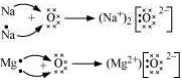
$(ii)$ Show the formation of $Na_{2}O$ and $MgO$ by the transfer of electrons.
$(iii)$ What are the ions present in these compounds?
$(ii)$ Show the formation of $Na_{2}O$ and $MgO$ by the transfer of electrons.
$(iii)$ What are the ions present in these compounds?
Solution
(N/A) $(i)$ The representation of elements with valence electrons as dots around the element symbol is referred to as the electron-dot structure.
$(a)$ Sodium $(2, 8, 1) = Na^{\bullet}$
$(b)$ Oxygen $(2, 6) = :\ddot{O}:$
$(c)$ Magnesium $(2, 8, 2) = Mg^{\bullet\bullet}$
$(ii)$ Formation of $Na_{2}O$:
$2Na^{\bullet} + :\ddot{O}: \rightarrow (Na^{+})_{2}[:\ddot{O}:]^{2-}$
Formation of $MgO$:
$Mg^{\bullet\bullet} + :\ddot{O}: \rightarrow (Mg^{2+})[:\ddot{O}:]^{2-}$
$(iii)$ The ions present in $Na_{2}O$ are $Na^{+}$ and $O^{2-}$ ions,and in $MgO$ are $Mg^{2+}$ and $O^{2-}$ ions.
0 likes
View Solution2
Easy
Why do ionic compounds have high melting points?
Solution
(N/A) Ionic compounds are formed by the transfer of electrons between atoms,resulting in the formation of positively charged cations and negatively charged anions.
These oppositely charged ions are held together by strong electrostatic forces of attraction.
To melt an ionic compound,a significant amount of energy is required to overcome these strong inter-ionic forces.
Consequently,ionic compounds exhibit high melting points.
These oppositely charged ions are held together by strong electrostatic forces of attraction.
To melt an ionic compound,a significant amount of energy is required to overcome these strong inter-ionic forces.
Consequently,ionic compounds exhibit high melting points.
0 likes
View Solution3
MediumMCQ
An element reacts with oxygen to give a compound with a high melting point. This compound is also soluble in water. The element is likely to be
A
carbon
B
calcium
C
silicon
D
iron
Solution
(B) The element is likely to be calcium $(Ca)$.
Calcium reacts with oxygen to form calcium oxide $(CaO)$,which is an ionic compound.
Ionic compounds typically have high melting points due to strong electrostatic forces of attraction between ions.
Calcium oxide $(CaO)$ reacts with water to form calcium hydroxide $(Ca(OH)_2)$,which is soluble in water.
0 likes
View Solution4
EasyMCQ
Element $X$ forms a chloride with the formula $XCl_2$,which is a solid with a high melting point. $X$ would most likely be in the same group of the Periodic Table as
A
$Na$
B
$Al$
C
$Si$
D
$Mg$
Solution
(D) The formula $XCl_2$ indicates that the element $X$ has a valency of $2$ (since chlorine has a valency of $1$). Elements that form chlorides with the formula $XCl_2$ are typically alkaline earth metals belonging to Group $2$ of the Periodic Table. Among the given options,$Mg$ (Magnesium) belongs to Group $2$. Therefore,$X$ would most likely be in the same group as $Mg$.
0 likes
View Solution5
MediumMCQ
Which of the following are not ionic compounds?
$(i)$ $KCl$
$(ii)$ $HCl$
$(iii)$ $CCl_4$
$(iv)$ $NaCl$
$(i)$ $KCl$
$(ii)$ $HCl$
$(iii)$ $CCl_4$
$(iv)$ $NaCl$
A
$(ii)$ and $(iii)$
B
$(i)$ and $(ii)$
C
$(iii)$ and $(iv)$
D
$(i)$ and $(iii)$
Solution
(A) Ionic compounds are formed by the transfer of electrons from a metal to a non-metal, resulting in strong electrostatic forces of attraction between ions.
$(i)$ $KCl$ ($\text{Potassium}$ $\text{Chloride}$) is an ionic compound because it consists of $K^+$ and $Cl^-$ ions.
$(ii)$ $HCl$ ($\text{Hydrogen}$ $\text{Chloride}$) is a covalent compound because it is formed by the sharing of electrons between $H$ and $Cl$ atoms.
$(iii)$ $CCl_4$ ($\text{Carbon}$ $\text{Tetrachloride}$) is a covalent compound because it is formed by the sharing of electrons between $C$ and $Cl$ atoms.
$(iv)$ $NaCl$ ($\text{Sodium}$ $\text{Chloride}$) is an ionic compound because it consists of $Na^+$ and $Cl^-$ ions.
Therefore, $(ii)$ and $(iii)$ are not ionic compounds.
0 likes
View Solution6
EasyMCQ
Which one of the following properties is not generally exhibited by ionic compounds?
A
Solubility in water
B
Electrical conductivity in solid state
C
High melting and boiling points
D
Electrical conductivity in molten state
Solution
(B) Ionic compounds are formed by the strong electrostatic force of attraction between oppositely charged ions.
In the solid state,these ions are held in a rigid crystal lattice structure and are not free to move.
Therefore,ionic compounds do not conduct electricity in the solid state.
However,when dissolved in water or in a molten state,the crystal lattice breaks down,allowing the ions to move freely,which enables them to conduct electricity.
Additionally,ionic compounds generally have high melting and boiling points due to the strong inter-ionic forces and are typically soluble in water.
0 likes
View Solution7
MediumMCQ
An electrolytic cell consists of
$(i)$ positively charged cathode
$(ii)$ negatively charged anode
$(iii)$ positively charged anode
$(iv)$ negatively charged cathode
$(i)$ positively charged cathode
$(ii)$ negatively charged anode
$(iii)$ positively charged anode
$(iv)$ negatively charged cathode
A
$(i)$ and $(ii)$
B
$(i)$ and $(iii)$
C
$(iii)$ and $(iv)$
D
$(ii)$ and $(iv)$
Solution
(C) In an electrolytic cell,electrical energy is converted into chemical energy.
By definition,the electrode connected to the positive terminal of the battery is the anode,which is positively charged.
The electrode connected to the negative terminal of the battery is the cathode,which is negatively charged.
Therefore,an electrolytic cell consists of a positively charged anode $(iii)$ and a negatively charged cathode $(iv)$.
0 likes
View Solution8
MediumMCQ
Reaction between $X$ and $Y$ forms compound $Z$. $X$ loses an electron and $Y$ gains an electron. Which of the following properties is not shown by $Z$?
A
Has low melting point
B
Has high melting point
C
Conducts electricity in molten state
D
Occurs as solid
Solution
(A) When $X$ loses an electron and $Y$ gains an electron,an ionic bond is formed between them,resulting in an ionic compound $Z$.
Ionic compounds are characterized by strong electrostatic forces of attraction between oppositely charged ions.
Due to these strong forces,ionic compounds typically have high melting and boiling points.
They exist as solids at room temperature and are generally hard.
They conduct electricity when dissolved in water or in a molten state because the ions become free to move.
Therefore,the property 'Has low melting point' is not shown by ionic compound $Z$.
0 likes
View Solution9
Medium
Give the formulae of the stable binary compounds that would be formed by the combination of the following pairs of elements:
$(a)$ $Mg$ and $N_{2}$
$(b)$ $Li$ and $O_{2}$
$(c)$ $Al$ and $Cl_{2}$
$(d)$ $K$ and $O_{2}$
$(a)$ $Mg$ and $N_{2}$
$(b)$ $Li$ and $O_{2}$
$(c)$ $Al$ and $Cl_{2}$
$(d)$ $K$ and $O_{2}$
Solution
(A) To determine the formula of a binary compound,we balance the valencies of the combining elements:
$(a)$ $Mg$ has a valency of $+2$ and $N$ has a valency of $-3$. By criss-crossing the valencies,we get $Mg_{3}N_{2}$ (Magnesium nitride).
$(b)$ $Li$ has a valency of $+1$ and $O$ has a valency of $-2$. By criss-crossing the valencies,we get $Li_{2}O$ (Lithium oxide).
$(c)$ $Al$ has a valency of $+3$ and $Cl$ has a valency of $-1$. By criss-crossing the valencies,we get $AlCl_{3}$ (Aluminium chloride).
$(d)$ $K$ has a valency of $+1$ and $O$ has a valency of $-2$. By criss-crossing the valencies,we get $K_{2}O$ (Potassium oxide).
0 likes
View Solution10
Medium
Write the formula of the product formed when the element $A$ (atomic number $19$) combines with the element $B$ (atomic number $17$). Draw its electronic dot structure. What is the nature of the bond formed?
Solution
(N/A) $1$. Identification of elements: Element $A$ has atomic number $19$, which is Potassium $(K)$. Its electronic configuration is $2, 8, 8, 1$. Element $B$ has atomic number $17$, which is Chlorine $(Cl)$. Its electronic configuration is $2, 8, 7$.
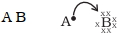
$2$. Formation of the product: Element $A$ loses $1$ electron to achieve a stable octet, forming $A^+$ ion. Element $B$ gains $1$ electron to achieve a stable octet, forming $B^-$ ion. The formula of the product is $AB$ (Potassium Chloride, $KCl$).
$3$. Electronic dot structure: $A \cdot + \cdot \dot{B} \cdot \rightarrow [A]^+ [:\ddot{B}:]^-$.
$4$. Nature of the bond: Since the bond is formed by the complete transfer of electrons from a metal to a non-metal, it is an ionic bond.
0 likes
View Solution11
Medium
An element $X$ (atomic number $17$) reacts with an element $Y$ (atomic number $20$) to form a divalent halide.
$(a)$ Where in the periodic table are elements $X$ and $Y$ placed?
$(b)$ Classify $X$ and $Y$ as metal$(s)$,non-metal$(s)$,or metalloid$(s)$.
$(a)$ Where in the periodic table are elements $X$ and $Y$ placed?
$(b)$ Classify $X$ and $Y$ as metal$(s)$,non-metal$(s)$,or metalloid$(s)$.
Solution
(A-D) The electronic configuration of element $X$ $(Z=17)$ is $2, 8, 7$. Since it has $7$ valence electrons,it belongs to Group $17$ and the $3^{rd}$ period.
The electronic configuration of element $Y$ $(Z=20)$ is $2, 8, 8, 2$. Since it has $2$ valence electrons,it belongs to Group $2$ and the $4^{th}$ period.
$(b)$ Element $X$ is a non-metal because it gains electrons to complete its octet. Element $Y$ is a metal because it loses $2$ electrons to form a stable cation.
0 likes
View Solution12
Medium
An element $X$ (atomic number $17$) reacts with an element $Y$ (atomic number $20$) to form a divalent halide.
$(a)$ What will be the nature of oxide of element $Y$? Identify the nature of bonding in the compound formed.
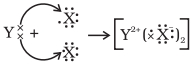
$(b)$ Draw the electron dot structure of the divalent halide.
$(a)$ What will be the nature of oxide of element $Y$? Identify the nature of bonding in the compound formed.
$(b)$ Draw the electron dot structure of the divalent halide.
Solution
(N/A) Element $Y$ has an atomic number of $20$,which corresponds to Calcium $(Ca)$. Its electronic configuration is $2, 8, 8, 2$. Since it is a metal,its oxide ($YO$ or $CaO$) will be basic in nature.
The compound formed is $YX_2$ $(CaCl_2)$. Since $Y$ is a metal and $X$ is a non-metal (Chlorine,atomic number $17$),the bonding between them is ionic.
$(b)$ The electron dot structure involves the transfer of two electrons from the outermost shell of $Y$ to two atoms of $X$:
$Y_{\times}^{\times} + 2[\cdot X : ] \rightarrow [Y^{2+} (\times \cdot X : ^{-})_2]$
0 likes
View Solution13
EasyMCQ
Why do ionic compounds not conduct electricity in the solid state?
A
They have a rigid crystal structure.
B
Ions are not free to move.
C
Both $A$ and $B$.
D
They are covalent in nature.
Solution
(C) Ionic compounds consist of ions held together by strong electrostatic forces of attraction in a rigid crystal lattice.
In the solid state,these ions are fixed in their positions and are not free to move.
Since the conduction of electricity requires the movement of charged particles (ions),ionic compounds cannot conduct electricity in the solid state.
They only conduct electricity when molten or dissolved in water,as the ions become free to move in these states.
0 likes
View Solution14
Medium
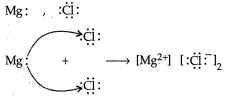
Write the electron dot structures of magnesium and chlorine and show the formation of magnesium chloride by the transfer of electrons.
Solution
(N/A) The atomic number of magnesium $(Mg)$ is $12$, and its electronic configuration is $2, 8, 2$. It has $2$ valence electrons.
The atomic number of chlorine $(Cl)$ is $17$, and its electronic configuration is $2, 8, 7$. It has $7$ valence electrons.
To form magnesium chloride $(MgCl_2)$, the magnesium atom loses $2$ electrons to achieve a stable octet configuration, forming a $Mg^{2+}$ ion.
Each of the two chlorine atoms gains $1$ electron from the magnesium atom to complete their octets, forming two $Cl^-$ ions.
The electron dot structure and transfer process are as follows:
$Mg: + 2 \cdot \ddot{Cl}: \rightarrow [Mg^{2+}] [: \ddot{Cl}:^-]_2$
0 likes
View Solution15
EasyMCQ
Why is sodium chloride soluble in water but not soluble in kerosene?
A
Water is a polar solvent,while kerosene is a non-polar solvent.
B
Sodium chloride is a covalent compound.
C
Kerosene is a polar solvent.
D
Sodium chloride does not dissociate in water.
Solution
(A) Sodium chloride $(NaCl)$ is an ionic compound consisting of $Na^+$ and $Cl^-$ ions held together by strong electrostatic forces of attraction.
Water is a polar solvent with a high dielectric constant,which helps in overcoming the electrostatic forces of attraction between the ions,allowing $NaCl$ to dissociate and dissolve.
Conversely,kerosene is a non-polar organic solvent.
It lacks the ability to provide the necessary energy to break the strong ionic bonds in $NaCl$,and therefore,$NaCl$ remains insoluble in it.
0 likes
View Solution16
Medium
$A$ compound $Z$ is formed by the transfer of electrons from a metal $X$ to a non-metal $Y$. Identify the type of bond formed in the compound. List three general properties of the compounds formed by such type of bonds.
Solution
(IONIC BOND) The bond formed by the transfer of electrons from a metal to a non-metal is an $Ionic$ bond.
The general properties of ionic compounds are:
$(i)$ They are usually crystalline solids due to strong electrostatic forces of attraction.
$(ii)$ They have high melting and boiling points.
$(iii)$ They are generally soluble in water but insoluble in organic solvents like kerosene or petrol.
$(iv)$ They conduct electricity in their molten state or in aqueous solution because the ions become free to move.
0 likes
View Solution17
Easy
Why do ionic compounds have high melting points? State the reason.
Solution
(N/A) Ionic compounds are formed by the transfer of electrons between atoms,resulting in the formation of positively charged cations and negatively charged anions.
These oppositely charged ions are held together by very strong electrostatic forces of attraction.
Because of these strong inter-ionic forces,a significant amount of energy is required to break the crystal lattice and overcome these forces,which results in high melting and boiling points.
These oppositely charged ions are held together by very strong electrostatic forces of attraction.
Because of these strong inter-ionic forces,a significant amount of energy is required to break the crystal lattice and overcome these forces,which results in high melting and boiling points.
0 likes
View Solution18
Medium
Describe ionic compounds on the basis of the following properties:
$(i)$ Strong force of attraction between positive and negative ions:
$(ii)$ Solubility of compounds in water.
$(iii)$ Electrical conductivity.
$(i)$ Strong force of attraction between positive and negative ions:
$(ii)$ Solubility of compounds in water.
$(iii)$ Electrical conductivity.
Solution
(N/A) $(i)$ Due to the strong electrostatic force of attraction between the oppositely charged ions,ionic compounds exist as solids. They are generally brittle and break into pieces when pressure is applied.
$(ii)$ Ionic compounds are generally soluble in water because the polar water molecules break the ionic bonds.
$(iii)$ Ionic compounds do not conduct electricity in the solid state because the ions are held in a fixed lattice. However,they conduct electricity in the aqueous or molten state because the ions become free to move.
0 likes
View Solution19
Medium
$(a)$ Show the formation of $MgO$ by the transfer of electrons.
$(b)$ Name the cation and anion.
$(c)$ Write three properties of ionic compounds.
$(b)$ Name the cation and anion.
$(c)$ Write three properties of ionic compounds.
Solution
(N/A) Formation of $MgO$:
$Mg (2, 8, 2) \to Mg^{2+} + 2e^-$
$O (2, 6) + 2e^- \to O^{2-}$
$Mg^{2+} + O^{2-} \to MgO$
$(b)$ $(i)$ Cation: Magnesium ion $(Mg^{2+})$.
$(ii)$ Anion: Oxide ion $(O^{2-})$.
$(c)$ Properties of ionic compounds:
$(i)$ They are generally crystalline solids and are soluble in water.
$(ii)$ They have high melting and boiling points due to strong electrostatic forces of attraction.
$(iii)$ They conduct electricity in the molten state or in aqueous solution because the ions are free to move.
0 likes
View Solution20
Medium
Give reasons for the following:
$(i)$ Ionic compounds have high melting and boiling points.
$(ii)$ Ionic compounds are soluble in water.
$(iii)$ Ionic compounds are solid and somewhat hard.
$(iv)$ Ionic compounds conduct electricity in the molten state.
$(v)$ Metals have a tendency to lose electrons.
$(i)$ Ionic compounds have high melting and boiling points.
$(ii)$ Ionic compounds are soluble in water.
$(iii)$ Ionic compounds are solid and somewhat hard.
$(iv)$ Ionic compounds conduct electricity in the molten state.
$(v)$ Metals have a tendency to lose electrons.
Solution
(N/A) $(i)$ Ionic compounds have high melting and boiling points because a considerable amount of energy is required to break the strong inter-ionic electrostatic forces of attraction.
$(ii)$ Ionic compounds are soluble in water because the polar water molecules interact with the ions,overcoming the lattice energy and causing them to dissociate.
$(iii)$ They are solids and somewhat hard because of the strong electrostatic force of attraction between the oppositely charged ions,which holds them in a rigid crystal lattice structure.
$(iv)$ Ionic compounds conduct electricity in the molten state because the heat overcomes the electrostatic forces,allowing the ions to become free to move and carry charge.
$(v)$ Metals have a tendency to lose electrons to attain a stable,completely filled valence shell configuration (noble gas configuration).
0 likes
View Solution21
Medium
$(a)$ Amongst the following elements,identify the ones that would form anions:
$K, O, Na, F, Ca, Cl, Mg$
$(b)$ Write the electronic configuration of the anions identified above.
$K, O, Na, F, Ca, Cl, Mg$
$(b)$ Write the electronic configuration of the anions identified above.
Solution
(A) Elements that form anions are those that gain electrons to complete their valence shell. Among the given elements,$O$ (Oxygen),$F$ (Fluorine),and $Cl$ (Chlorine) are non-metals that gain electrons to form anions.
$(b)$ The electronic configurations of the identified anions are:
$O^{2-}$ (Oxide ion): Atomic number $8$,configuration $2, 6$. By gaining $2$ electrons,it becomes $2, 8$.
$F^{-}$ (Fluoride ion): Atomic number $9$,configuration $2, 7$. By gaining $1$ electron,it becomes $2, 8$.
$Cl^{-}$ (Chloride ion): Atomic number $17$,configuration $2, 8, 7$. By gaining $1$ electron,it becomes $2, 8, 8$.
0 likes
View Solution22
Medium
$(a)$ Predict which of the following will form anions and which will form cations:
$(i)$ $Na$ $(ii)$ $Al$ $(iii)$ $Cl$ $(iv)$ $O$
$(b)$ Name two elements that are inert.
$(i)$ $Na$ $(ii)$ $Al$ $(iii)$ $Cl$ $(iv)$ $O$
$(b)$ Name two elements that are inert.
Solution
(A-D) $Cl$ and $O$ are non-metals with high electronegativity and will gain electrons to form anions ($Cl^-$ and $O^{2-}$).
$Na$ and $Al$ are metals with low ionization energy and will lose electrons to form cations ($Na^+$ and $Al^{3+}$).
$(b)$ Inert elements are those that have a stable valence shell configuration (octet or duplet) and do not react under normal conditions. Examples include $He$ (Helium) and $Ne$ (Neon).
0 likes
View Solution23
Medium
Which of the following elements would form anions? Why?
$(i)$ $Na$ $(ii)$ $O$ $(iii)$ $Mg$ $(iv)$ $Al$ $(v)$ $Cl$
$(i)$ $Na$ $(ii)$ $O$ $(iii)$ $Mg$ $(iv)$ $Al$ $(v)$ $Cl$
Solution
(II, V) Oxygen $(O)$ and chlorine $(Cl)$ would form anions.
$O + 2e^- \rightarrow O^{2-}$ (Oxide ion)
$Cl + e^- \rightarrow Cl^-$ (Chloride ion)
Reason: Anions are negatively charged ions formed by the gain of electrons. Non-metals like oxygen and chlorine gain electrons to achieve a stable noble gas electronic configuration (octet rule).
$O + 2e^- \rightarrow O^{2-}$ (Oxide ion)
$Cl + e^- \rightarrow Cl^-$ (Chloride ion)
Reason: Anions are negatively charged ions formed by the gain of electrons. Non-metals like oxygen and chlorine gain electrons to achieve a stable noble gas electronic configuration (octet rule).
0 likes
View Solution24
Medium
Two elements $X$ and $Y$ have atomic numbers $11$ and $16$ respectively.
$(a)$ Write the electronic configuration of both.
$(b)$ Which type of bond will they form?
$(c)$ Write the formula of the compound formed by their combination (in terms of $X$ and $Y$).
$(a)$ Write the electronic configuration of both.
$(b)$ Which type of bond will they form?
$(c)$ Write the formula of the compound formed by their combination (in terms of $X$ and $Y$).
Solution
(C) Electronic configuration:
$(b)$ They will form an ionic bond.
Reason: $X$ has $1$ valence electron and will lose it to form $X^+$ ion. $Y$ has $6$ valence electrons and will gain $2$ electrons to form $Y^{2-}$ ion. The bond formed by the transfer of valence electrons from a metal $(X)$ to a non-metal $(Y)$ is called an ionic or electrovalent bond.
$(c)$ Formula of the compound:
By criss-cross method,the formula is $X_2Y$.
| Element | $K$ | $L$ | $M$ |
| $X_{11}$ | $2$ | $8$ | $1$ |
| $Y_{16}$ | $2$ | $8$ | $6$ |
$(b)$ They will form an ionic bond.
Reason: $X$ has $1$ valence electron and will lose it to form $X^+$ ion. $Y$ has $6$ valence electrons and will gain $2$ electrons to form $Y^{2-}$ ion. The bond formed by the transfer of valence electrons from a metal $(X)$ to a non-metal $(Y)$ is called an ionic or electrovalent bond.
$(c)$ Formula of the compound:
| Symbol | Valency |
| $X$ | $+1$ |
| $Y$ | $-2$ |
By criss-cross method,the formula is $X_2Y$.
0 likes
View Solution25
Medium
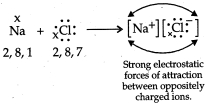
Write the electron-dot structure for sodium and chlorine atoms. How do these form a chemical bond? Name the type of bond so formed. Why does a compound so formed have a high melting point?
Solution
(N/A) Electron-dot structure of sodium: $Na \cdot$
Electron-dot structure of chlorine atom: $: \ddot{Cl} \cdot$
Sodium $(Na)$ has $1$ valence electron. It loses this electron to attain the stable electronic configuration of the nearest noble gas,neon $(Ne)$.
Chlorine $(Cl)$ has $7$ valence electrons. It gains the electron lost by sodium to complete its octet and achieve the stable electronic configuration of the nearest noble gas,argon $(Ar)$.
The electrostatic force of attraction between the positively charged sodium ion $(Na^+)$ and the negatively charged chloride ion $(Cl^-)$ results in the formation of an ionic bond (also called an electrovalent bond).
Compounds formed by ionic bonds have high melting points because a large amount of energy is required to break the strong electrostatic forces of attraction between the oppositely charged ions.
0 likes
View Solution26
MediumMCQ
An electrolytic cell consists of:
$(i)$ Positively charged cathode
$(ii)$ Negatively charged anode
$(iii)$ Positively charged anode
$(iv)$ Negatively charged cathode
$(i)$ Positively charged cathode
$(ii)$ Negatively charged anode
$(iii)$ Positively charged anode
$(iv)$ Negatively charged cathode
A
$(i)$ and $(ii)$
B
$(ii)$ and $(iv)$
C
$(i)$ and $(iii)$
D
$(iii)$ and $(iv)$
Solution
(D) In an electrolytic cell,electrical energy is used to drive a non-spontaneous chemical reaction.
By definition,the electrode where reduction occurs is the cathode,and in an electrolytic cell,the cathode is connected to the negative terminal of the external power source,making it negatively charged.
The electrode where oxidation occurs is the anode,and in an electrolytic cell,the anode is connected to the positive terminal of the external power source,making it positively charged.
Therefore,the correct characteristics are $(iii)$ Positively charged anode and $(iv)$ Negatively charged cathode.
0 likes
View Solution27
MediumMCQ
Which one of the following properties is not generally exhibited by ionic compounds?
A
Solubility in water
B
High melting and boiling points
C
Electrical conductivity in solid state
D
Electrical conductivity in molten state
Solution
(C) Ionic compounds are formed by the electrostatic attraction between oppositely charged ions.
In the solid state,these ions are held in a rigid crystal lattice structure and are not free to move.
Because electrical conductivity requires the movement of charged particles,ionic compounds do not conduct electricity in the solid state.
However,when dissolved in water or in a molten state,the crystal lattice breaks down,allowing the ions to move freely,which enables them to conduct electricity.
Therefore,the property not exhibited by ionic compounds is electrical conductivity in the solid state.
0 likes
View Solution28
Medium
State whether the following statement is true or false:
$A$ solution of an ionic compound in water contains ions,which move to the opposite electrodes when electricity is passed through the solution.
$A$ solution of an ionic compound in water contains ions,which move to the opposite electrodes when electricity is passed through the solution.
Solution
(TRUE) True.
Ionic compounds are composed of ions (cations and anions) held together by strong electrostatic forces of attraction.
When an ionic compound is dissolved in water,these forces are weakened,allowing the ions to become free to move.
When electricity is passed through this aqueous solution,the cations (positively charged ions) move towards the cathode (negatively charged electrode) and the anions (negatively charged ions) move towards the anode (positively charged electrode),thereby conducting electricity.
0 likes
View Solution29
EasyMCQ
What is the melting point of alumina $(Al_2O_3)$ (in $;K$)?
A
$1473$
B
$433$
C
$2348$
D
$1973$
Solution
(C) Alumina $(Al_2O_3)$ is a very stable oxide of aluminum.
It has a very high melting point due to the strong ionic bonds between aluminum and oxygen atoms in its crystal lattice.
The melting point of pure alumina is approximately $2348\;K$ $(2075\;^{\circ}C)$.
Therefore,option $C$ is the correct answer.
It has a very high melting point due to the strong ionic bonds between aluminum and oxygen atoms in its crystal lattice.
The melting point of pure alumina is approximately $2348\;K$ $(2075\;^{\circ}C)$.
Therefore,option $C$ is the correct answer.
0 likes
View Solution30
EasyMCQ
What is ammonia $(NH_3)$?
A
Element
B
Non-metal
C
Compound
D
Mixture
Solution
(C) Ammonia $(NH_3)$ is a chemical substance composed of nitrogen and hydrogen atoms in a fixed ratio of $1:3$.
Since it is formed by the chemical combination of two different elements,it is classified as a compound.
Elements are pure substances consisting of only one type of atom,whereas mixtures are physical combinations of substances without fixed proportions.
Therefore,ammonia is a compound.
Since it is formed by the chemical combination of two different elements,it is classified as a compound.
Elements are pure substances consisting of only one type of atom,whereas mixtures are physical combinations of substances without fixed proportions.
Therefore,ammonia is a compound.
0 likes
View Solution31
EasyMCQ
What is the molecular formula of phosphorus pentoxide?
A
$P_{2}O_{3}$
B
$PO_{3}$
C
$P_{4}O_{10}$
D
$P_{2}O_{5}$
Solution
(C) Phosphorus pentoxide is a chemical compound with the empirical formula $P_{2}O_{5}$.
However,in its solid state,it exists as a dimer with the molecular formula $P_{4}O_{10}$.
While $P_{2}O_{5}$ is often used to represent the empirical formula,$P_{4}O_{10}$ is the correct molecular formula for the substance as it exists in nature.
However,in its solid state,it exists as a dimer with the molecular formula $P_{4}O_{10}$.
While $P_{2}O_{5}$ is often used to represent the empirical formula,$P_{4}O_{10}$ is the correct molecular formula for the substance as it exists in nature.
0 likes
View SolutionMetals and Non-metals — Reaction of Metals and Non-metals (Ionic Compounds) · Frequently Asked Questions
1Are these Metals and Non-metals questions useful for JEE and NEET?
Yes. All questions in this section are mapped to JEE Main and NEET exam patterns. Previous year questions from JEE Main, NEET, GUJCET and state-level exams are included with full solutions.
2Can I switch to Hindi or Gujarati for these questions?
Yes. Use the language tabs in the hero section or the sidebar to view the same questions and solutions in English, Hindi or Gujarati.
3How do I generate a question paper from this subtopic?
Use the Vedclass Exam Paper Generator — select the chapter and subtopic, set difficulty, and generate Sets A, B, C, D automatically. First 3 chapters of every subject are free.
Vedclass Products
For Students
Vedclass Test Series
Mock tests in real JEE/NEET style with performance analysis. 5-day free trial.
Start Free TrialFor Teachers
Exam Paper Generator
Generate Set A/B/C/D papers from this chapter in 2 minutes. 3 chapters free.
Try FreeFor Institutes
Online Exam Module
Live online exams with unlimited students, 360° analytics & white-label branding.
See DemoFor Teachers & Institutes
Generate a Metals and Non-metals Exam Paper in 2 Minutes
Select subtopic & difficulty — Sets A, B, C, D auto-generated with No Repeat logic.
First 3 chapters of every subject are free — no payment required.