
A English
Food Chains and Webs Questions in English
Class 10 Science · Our Environment · Food Chains and Webs
72+
Questions
English
Language
100%
With Solutions
Showing 50 of 72 questions in English
1
EasyMCQ
What would happen if green plants disappear from the earth?
A
All organisms will survive.
B
Herbivores will die due to starvation,followed by carnivores.
C
Only carnivores will die.
D
The earth will become more productive.
Solution
(B) Green plants are the primary producers and the ultimate source of energy for all organisms in an ecosystem.
If all green plants disappear from the earth,the food chain will collapse.
Herbivores,which depend directly on plants for food,will die due to starvation.
Subsequently,carnivores,which depend on herbivores for food,will also die due to the lack of prey,leading to the extinction of life on earth.
If all green plants disappear from the earth,the food chain will collapse.
Herbivores,which depend directly on plants for food,will die due to starvation.
Subsequently,carnivores,which depend on herbivores for food,will also die due to the lack of prey,leading to the extinction of life on earth.
0 likes
View Solution2
EasyMCQ
In a food chain,the third trophic level is always occupied by
A
herbivores
B
carnivores
C
decomposers
D
producers
Solution
(B) In a food chain,the trophic levels are organized as follows:
$1$. The first trophic level $(T_1)$ is occupied by producers (autotrophs) like plants.
$2$. The second trophic level $(T_2)$ is occupied by primary consumers (herbivores) that feed on producers.
$3$. The third trophic level $(T_3)$ is occupied by secondary consumers (carnivores) that feed on herbivores.
Therefore,the third trophic level is always occupied by carnivores.
0 likes
View Solution3
EasyMCQ
In the given food chain,suppose the amount of energy at the fourth trophic level is $5 \, kJ$,what will be the energy available at the producer level (in $, kJ$)?
Grass $\to$ Grasshopper $\to$ Frog $\to$ Snake $\to$ Hawk
Grass $\to$ Grasshopper $\to$ Frog $\to$ Snake $\to$ Hawk
A
$5$
B
$50$
C
$500$
D
$5000$
Solution
(D) According to the $10\%$ Law of energy transfer in an ecosystem,only $10\%$ of the energy is transferred from one trophic level to the next,while $90\%$ is lost as heat.
Let the energy at the producer level $(T_1)$ be $E$.
$T_1$ (Grass) = $E$
$T_2$ (Grasshopper) = $E \times 0.1$
$T_3$ (Frog) = $E \times 0.1 \times 0.1 = E \times 0.01$
$T_4$ (Snake) = $E \times 0.1 \times 0.1 \times 0.1 = E \times 0.001$
Given that the energy at the fourth trophic level $(T_4)$ is $5 \, kJ$:
$E \times 0.001 = 5 \, kJ$
$E = 5 / 0.001 = 5000 \, kJ$
Therefore,the energy available at the producer level is $5000 \, kJ$.
0 likes
View Solution4
MediumMCQ
Accumulation of non-biodegradable pesticides in the food chain in increasing amount at each higher trophic level is known as
A
biomagnification
B
pollution
C
eutrophication
D
accumulation
Solution
(A) Biomagnification is the process where the concentration of non-biodegradable substances,such as pesticides (e.g.,$DDT$),increases at each successive trophic level in a food chain.
This occurs because these substances cannot be broken down by organisms and are passed on to the next level in higher concentrations.
Therefore,the correct answer is $A$.
This occurs because these substances cannot be broken down by organisms and are passed on to the next level in higher concentrations.
Therefore,the correct answer is $A$.
0 likes
View Solution5
EasyMCQ
In an ecosystem,the $10\%$ of energy available for transfer from one trophic level to the next is in the form of
A
heat energy
B
light energy
C
mechanical energy
D
chemical energy
Solution
(D) According to the $10\%$ Law proposed by Lindeman,only about $10\%$ of the energy entering a particular trophic level of organisms is available for transfer to the next higher trophic level.
This energy is stored in the biomass of the organisms in the form of chemical energy (organic compounds like carbohydrates,proteins,and fats).
The remaining $90\%$ of the energy is lost to the environment as heat during metabolic processes or used for the organism's own life activities.
This energy is stored in the biomass of the organisms in the form of chemical energy (organic compounds like carbohydrates,proteins,and fats).
The remaining $90\%$ of the energy is lost to the environment as heat during metabolic processes or used for the organism's own life activities.
0 likes
View Solution6
MediumMCQ
Organisms of a higher trophic level which feed on several types of organisms belonging to a lower trophic level constitute the
A
food web
B
ecological pyramid
C
ecosystem
D
food chain
Solution
(A) $food \text{ } chain$ represents a single linear pathway of energy flow through an ecosystem.
However, in nature, organisms often feed on multiple sources from different trophic levels.
When these multiple food chains become interconnected, they form a complex network known as a $food \text{ } web$.
Since organisms at a higher trophic level feed on several types of organisms from lower levels, this interconnected feeding relationship is defined as a $food \text{ } web$.
0 likes
View Solution7
MediumMCQ
Flow of energy in an ecosystem is always
A
bidirectional
B
unidirectional
C
multi-directional
D
no specific direction
Solution
(B) In an ecosystem, energy enters from the sun in the form of solar radiation. Producers (plants) capture this energy and convert it into chemical energy through photosynthesis. As energy moves from one trophic level to the next (e.g., from producers to primary consumers, then to secondary consumers), a significant portion of energy is lost as heat at each step, according to the $10\%$ law of energy transfer. Because energy cannot be recycled or reused by the producers once it is lost as heat, the flow of energy in an ecosystem is always unidirectional.
0 likes
View Solution8
EasyMCQ
Which of the following limits the number of trophic levels in a food chain?
A
Decrease in energy at higher trophic levels
B
Sufficient food supply
C
Polluted air
D
Water
Solution
(A) The number of trophic levels in a food chain is limited by the $10\%$ law of energy transfer. According to this law,only about $10\%$ of the energy available at one trophic level is transferred to the next higher trophic level. The remaining energy is lost as heat during metabolic activities. As a result,after $3$ to $4$ trophic levels,the amount of energy remaining is insufficient to support the survival of organisms at the next level. Therefore,the decrease in energy at higher trophic levels acts as a limiting factor.
0 likes
View Solution9
MediumMCQ
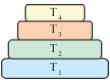
In the given figure,the various trophic levels are shown in a pyramid. At which trophic level is maximum energy available?
A
$T_1$
B
$T_2$
C
$T_4$
D
$T_3$
Solution
(A) According to the $10\%$ law of energy transfer in an ecosystem,only $10\%$ of the energy is transferred from one trophic level to the next higher trophic level.
Therefore,the maximum amount of energy is available at the first trophic level $(T_1)$,which consists of producers (plants).
As we move up the pyramid from $T_1$ to $T_4$,the amount of available energy decreases significantly at each successive level.
Therefore,the maximum amount of energy is available at the first trophic level $(T_1)$,which consists of producers (plants).
As we move up the pyramid from $T_1$ to $T_4$,the amount of available energy decreases significantly at each successive level.
0 likes
View Solution10
MediumMCQ
What will happen if the deer is missing in the food chain given below?
Grass $\to$ Deer $\to$ Tiger
Grass $\to$ Deer $\to$ Tiger
A
The population of tiger increases
B
The population of tiger decreases and the population of grass increases
C
Tiger will start eating grass
D
The population of grass decreases
Solution
(B) In the given food chain,Grass $\to$ Deer $\to$ Tiger,the deer acts as the primary consumer and the sole source of food for the tiger.
If the deer is removed from this ecosystem,the tiger will lose its food source,leading to a decline in the tiger population due to starvation.
Simultaneously,since the deer (the primary consumer) is no longer present to graze on the grass,the grass population will increase due to the lack of predation/consumption.
0 likes
View Solution11
MediumMCQ
If a grasshopper is eaten by a frog,then the energy transfer will be from
A
producer to decomposer
B
producer to primary consumer
C
secondary consumer to primary consumer
D
primary consumer to secondary consumer
Solution
(D) In an ecosystem,the energy flow follows a specific trophic level sequence.
$1$. Producers (plants) are at the first trophic level.
$2$. Primary consumers (herbivores like grasshoppers) feed on producers and occupy the second trophic level.
$3$. Secondary consumers (carnivores like frogs) feed on primary consumers and occupy the third trophic level.
When a grasshopper is eaten by a frog,the energy is transferred from the grasshopper (primary consumer) to the frog (secondary consumer).
0 likes
View Solution12
Easy
Write the common food chain of a pond ecosystem.
Solution
(N/A) common food chain in a pond ecosystem is as follows:
Phytoplankton (producers) $\to $ Zooplankton (primary consumers) $\to $ Small fish (secondary consumers) $\to $ Large fish or birds (tertiary consumers).
This sequence represents the flow of energy from producers to various levels of consumers within the aquatic environment.
Phytoplankton (producers) $\to $ Zooplankton (primary consumers) $\to $ Small fish (secondary consumers) $\to $ Large fish or birds (tertiary consumers).
This sequence represents the flow of energy from producers to various levels of consumers within the aquatic environment.
0 likes
View Solution13
Medium
Indicate the flow of energy in an ecosystem. Why is it unidirectional? Justify.
Solution
(N/A) The flow of energy in an ecosystem follows the path: $\text{Sun} \to \text{Producer} \to \text{Herbivore} \to \text{Carnivore}$.
This flow is considered unidirectional because energy is transferred from one trophic level to the next and cannot revert to the previous level.
Justification: According to the $10\%$ law of energy transfer,a significant amount of energy is lost as heat at each trophic level. Because the energy available at higher trophic levels is much lower than at lower levels,the energy cannot flow backward from a higher trophic level to a lower one.
0 likes
View Solution14
Medium
Give two differences between food chain and food web.
Solution
(N/A)
| Food chain | Food web |
| $(a)$ $A$ food chain is a linear sequence of organisms where nutrients and energy are transferred from one organism to another. | $(a)$ $A$ food web is a complex network of interconnected food chains that shows the multiple feeding relationships in an ecosystem. |
| $(b)$ In a food chain,an organism at a higher trophic level feeds on only one specific type of organism from the lower trophic level. | $(b)$ In a food web,an organism at a higher trophic level can feed on various types of organisms from different lower trophic levels. |
0 likes
View Solution15
EasyMCQ
In a food chain consisting of grass,insect,frog,and snake,what is the trophic level of the frog?
A
First trophic level
B
Second trophic level
C
Third trophic level
D
Fourth trophic level
Solution
(C) The food chain is represented as: Grass (Producer) $\rightarrow$ Insect (Primary Consumer) $\rightarrow$ Frog (Secondary Consumer) $\rightarrow$ Snake (Tertiary Consumer).
In this sequence,the grass occupies the $1^{\text{st}}$ trophic level.
The insect occupies the $2^{\text{nd}}$ trophic level.
The frog occupies the $3^{\text{rd}}$ trophic level.
The snake occupies the $4^{\text{th}}$ trophic level.
Therefore,the frog is at the $3^{\text{rd}}$ trophic level.
In this sequence,the grass occupies the $1^{\text{st}}$ trophic level.
The insect occupies the $2^{\text{nd}}$ trophic level.
The frog occupies the $3^{\text{rd}}$ trophic level.
The snake occupies the $4^{\text{th}}$ trophic level.
Therefore,the frog is at the $3^{\text{rd}}$ trophic level.
0 likes
View Solution16
EasyMCQ
What will be the amount of energy available to the organisms of the $2^{\text{nd}}$ trophic level of a food chain,if the energy available at the first trophic level is $10,000 \, J$?
A
$100 \, J$
B
$1,000 \, J$
C
$10,000 \, J$
D
$10 \, J$
Solution
(B) According to the $10\%$ Law of energy transfer in an ecosystem,only $10\%$ of the energy available at one trophic level is transferred to the next higher trophic level.
Given that the energy at the $1^{\text{st}}$ trophic level (producers) is $10,000 \, J$.
Energy at the $2^{\text{nd}}$ trophic level = $10\%$ of $10,000 \, J$.
Calculation: $(10 / 100) \times 10,000 = 1,000 \, J$.
Therefore,the energy available to the organisms of the $2^{\text{nd}}$ trophic level is $1,000 \, J$.
0 likes
View Solution17
EasyMCQ
The first trophic level in a food chain is always a green plant. Why?
A
They are producers.
B
They are consumers.
C
They are decomposers.
D
They are parasites.
Solution
(A) The first trophic level in a food chain is always a green plant because they are producers.
Only green plants possess chlorophyll,which allows them to capture radiant energy from the sun.
Through the process of photosynthesis,they convert this solar energy into chemical energy stored in the form of glucose (food).
Since all other organisms in a food chain depend on this stored chemical energy for their survival,plants must occupy the first trophic level.
0 likes
View Solution18
EasyMCQ
Which of the following are always at the second trophic level of food chains?
A
Carnivores
B
Autotrophs
C
Herbivores
D
Decomposers
Solution
(C) In a food chain,the first trophic level is occupied by producers (autotrophs) which synthesize their own food. Herbivores,which feed directly on these producers,always occupy the second trophic level. Carnivores occupy the third or higher trophic levels depending on the food chain structure.
0 likes
View Solution19
EasyMCQ
In an ecosystem,rats feed on grains. Name the trophic level to which the rats belong.
A
First trophic level
B
Second trophic level
C
Third trophic level
D
Fourth trophic level
Solution
(B) In an ecosystem,the food chain starts with producers (plants/grains) which occupy the $First$ trophic level.
Rats feed directly on grains,making them primary consumers.
Primary consumers occupy the $Second$ trophic level in a food chain.
Rats feed directly on grains,making them primary consumers.
Primary consumers occupy the $Second$ trophic level in a food chain.
0 likes
View Solution20
MediumMCQ
How does the concentration of a pesticide change once it enters a food chain?
A
It decreases at each trophic level.
B
It remains constant at each trophic level.
C
It increases at each trophic level.
D
It is eliminated at the first trophic level.
Solution
(C) The phenomenon where harmful chemicals like pesticides accumulate in the tissues of organisms at higher trophic levels is known as biomagnification.
Once a pesticide enters a food chain, it is not broken down or excreted easily.
As a result, its concentration increases progressively at each successive trophic level, reaching the highest levels in the top carnivores.
Once a pesticide enters a food chain, it is not broken down or excreted easily.
As a result, its concentration increases progressively at each successive trophic level, reaching the highest levels in the top carnivores.
0 likes
View Solution21
EasyMCQ
What would be the consequence if all the herbivores are removed from a grassland ecosystem?
A
The population of carnivores will increase.
B
The population of producers will decrease due to overgrazing.
C
The carnivores will die due to lack of food,and the producers will increase uncontrollably.
D
The ecosystem will remain balanced.
Solution
(C) In a grassland ecosystem,herbivores act as the primary consumers that feed on producers (plants).
If all herbivores are removed,the carnivores (secondary and tertiary consumers) will lose their source of food and eventually die out.
Simultaneously,the producers will no longer be consumed,leading to an uncontrolled increase in their population,which disrupts the ecological balance.
If all herbivores are removed,the carnivores (secondary and tertiary consumers) will lose their source of food and eventually die out.
Simultaneously,the producers will no longer be consumed,leading to an uncontrolled increase in their population,which disrupts the ecological balance.
0 likes
View Solution22
Easy
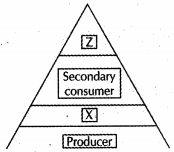
Write the appropriate names of the trophic levels $Z$ and $X$ in the figure given below.
Solution
(N/A) In an ecological pyramid,the trophic levels are arranged from the base to the apex.
$1$. The base level consists of Producers.
$2$. The level above the producers is $X$,which represents the Primary consumers (herbivores).
$3$. The level above the primary consumers is the Secondary consumers.
$4$. The top level $Z$ represents the Tertiary consumers (carnivores).
Therefore,$X$ is Primary consumers and $Z$ is Tertiary consumers.
0 likes
View Solution23
Medium
What are trophic levels? Give an example of a food chain and state the different trophic levels in it.
Solution
(N/A) Trophic levels are the specific stages or steps in a food chain through which energy is transferred from one organism to another.
Example of a food chain:
Grass $\rightarrow$ Grasshopper $\rightarrow$ Frog $\rightarrow$ Snake $\rightarrow$ Peacock
The different trophic levels in this food chain are as follows:
$1$. Grass (Producer): First trophic level $(T_1)$
$2$. Grasshopper (Primary consumer): Second trophic level $(T_2)$
$3$. Frog (Secondary consumer): Third trophic level $(T_3)$
$4$. Snake (Tertiary consumer): Fourth trophic level $(T_4)$
$5$. Peacock (Quaternary consumer): Fifth trophic level $(T_5)$
0 likes
View Solution24
EasyMCQ
Which of the following constitute a food-chain?
A
Grass,goat and human
B
Grass,wheat and mango
C
Goat,cow and elephant
D
Grass,fish and goat
Solution
(A) food-chain represents the sequence of organisms through which energy flows in an ecosystem,typically starting with a producer (plant) followed by consumers.
In the option $A$,Grass is a producer,Goat is a primary consumer (herbivore),and Human is a secondary or tertiary consumer (omnivore).
This sequence represents a valid flow of energy: $Grass \rightarrow Goat \rightarrow Human$.
Options $B$,$C$,and $D$ do not represent a logical feeding sequence where one organism consumes the other.
0 likes
View Solution25
MediumMCQ
What will happen if we kill all the organisms in one trophic level?
A
The ecosystem will remain unaffected.
B
The ecosystem will be damaged and the food chain will be disrupted.
C
The population of the next trophic level will increase.
D
The energy flow will become more efficient.
Solution
(B) If all the organisms or members of any trophic level are removed, the ecosystem will definitely be damaged.
For example, in the food chain: $Grass \rightarrow Grasshopper \rightarrow Frog \rightarrow Snake \rightarrow Peacock$.
If all grasshoppers are killed or removed, the frogs will not get food and will either die or migrate to another place in search of food.
If snakes are killed, the number of frogs will increase significantly, which will disturb the balance of the entire ecosystem.
0 likes
View Solution26
MediumMCQ
Will the impact of removing all the organisms in a trophic level be different for different trophic levels? Can the organisms of any trophic level be removed without causing any damage to the ecosystem?
A
Yes,the impact is the same for all levels; organisms can be removed without damage.
B
No,the impact is different for different levels; organisms cannot be removed without causing damage.
C
Yes,the impact is different; organisms can be removed without damage.
D
No,the impact is the same; organisms cannot be removed without damage.
Solution
(B) The impact of removing all organisms in a trophic level is indeed different for different trophic levels.
If producers are removed,the entire food chain collapses as there is no energy source.
If primary consumers are removed,producers overgrow and secondary consumers starve.
If top carnivores are removed,the population of lower trophic levels increases uncontrollably,leading to overgrazing and ecological imbalance.
Therefore,it is not possible to remove the organisms of any trophic level without causing significant damage to the ecosystem,as every level plays a crucial role in maintaining the balance of the food web.
1 likes
View Solution27
Easy
What is biological magnification? Will the levels of this magnification be different at different levels of the ecosystem?
Solution
(N/A) Biological magnification is the process of increasing the concentration of non-biodegradable toxic substances (such as pesticides or heavy metals) in the tissues of organisms at each successive trophic level of a food chain.
Yes,the levels of this magnification are different at different levels of the ecosystem.
The concentration of these chemicals increases as we move up the food chain.
Therefore,the maximum concentration is observed in the organisms at the highest trophic level (top carnivores),while the minimum concentration is found in the organisms at the lowest trophic level (producers).
0 likes
View Solution28
Easy
Draw a food chain which operates in a forest ecosystem.
Solution
(N/A) food chain represents the flow of energy from one trophic level to another. In a forest ecosystem,a typical food chain is:
Grass (Producer) $\rightarrow$ Deer (Primary Consumer) $\rightarrow$ Tiger (Secondary/Tertiary Consumer).
Grass (Producer) $\rightarrow$ Deer (Primary Consumer) $\rightarrow$ Tiger (Secondary/Tertiary Consumer).
0 likes
View Solution29
MediumMCQ
In a certain study conducted on the occurrence of $DDT$ along food chains in an ecosystem,the concentration of $DDT$ in grass was found to be $0.5\, ppm$ (parts per million),in sheep it was $2\, ppm$,and in man it was $10\, ppm$. Why was the concentration of $DDT$ maximum in the case of man?
A
Man is at the highest trophic level.
B
Man consumes more food.
C
$DDT$ is easily excreted by man.
D
$DDT$ is biodegradable.
Solution
(A) $DDT$ is a non-biodegradable chemical substance that cannot be broken down by biological processes.
It accumulates at each successive trophic level in a food chain,a phenomenon known as biological magnification or biomagnification.
Since man occupies the highest trophic level in this food chain,the concentration of $DDT$ is found to be the maximum in man due to the cumulative effect of its intake from lower trophic levels.
0 likes
View Solution30
Easy
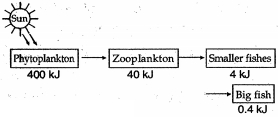
What is depicted in the scheme shown below?
Solution
(N/A) The scheme illustrates an aquatic food chain.
It demonstrates the $10 \%$ law of energy transfer,which states that only $10 \%$ of the energy available at one trophic level is transferred to the next higher trophic level.
In this example:
- Phytoplankton $(400 \text{ kJ})$ $\rightarrow$ Zooplankton $(40 \text{ kJ})$
- Zooplankton $(40 \text{ kJ})$ $\rightarrow$ Smaller fishes $(4 \text{ kJ})$
- Smaller fishes $(4 \text{ kJ})$ $\rightarrow$ Big fish $(0.4 \text{ kJ})$
Each step shows a $10 \%$ transfer of energy from the previous level.
0 likes
View Solution31
MediumMCQ
In the following food chain,grass provides $4000 \ J$ of energy to the grasshopper. How much energy will be available to the snake and the frog? Grass $\rightarrow$ Grasshopper $\rightarrow$ Frog $\rightarrow$ Snake.
A
Frog: $400 \ J$,Snake: $40 \ J$
B
Frog: $40 \ J$,Snake: $4 \ J$
C
Frog: $400 \ J$,Snake: $4 \ J$
D
Frog: $4 \ J$,Snake: $40 \ J$
Solution
(B) According to the $10 \%$ law of energy transfer in an ecosystem,only $10 \%$ of the energy available at one trophic level is transferred to the next higher trophic level.
Given: Energy at the producer level (Grass) = $4000 \ J$.
$1$. Energy available to the primary consumer (Grasshopper) = $10 \%$ of $4000 \ J = 400 \ J$.
$2$. Energy available to the secondary consumer (Frog) = $10 \%$ of $400 \ J = 40 \ J$.
$3$. Energy available to the tertiary consumer (Snake) = $10 \%$ of $40 \ J = 4 \ J$.
Therefore,the energy available to the frog is $40 \ J$ and to the snake is $4 \ J$.
0 likes
View Solution32
Easy
What is meant by biological magnification?
Solution
(N/A) Biological magnification,also known as biomagnification,refers to the progressive increase in the concentration of non-biodegradable chemicals (such as pesticides or heavy metals) at each successive trophic level in a food chain. This occurs because these substances are not broken down by organisms and are passed on to the next level in higher concentrations.
0 likes
View Solution33
EasyMCQ
Consider a food chain consisting of wheat, rat, snakes, and peacock. What will happen if all the snakes are killed?
A
The population of rats will decrease.
B
The population of peacocks will increase.
C
The population of rats will increase and the population of peacocks will decrease.
D
There will be no effect on the food chain.
Solution
(C) In the given food chain: $Wheat \rightarrow Rat \rightarrow Snake \rightarrow Peacock$.
If all the snakes are killed, the primary predator of the rats is removed, leading to an uncontrolled increase in the rat population.
Due to the lack of food (snakes), the population of peacocks will decrease significantly as they will starve.
Therefore, the removal of an intermediate trophic level disrupts the entire ecosystem balance.
0 likes
View Solution34
Easy
Choose one consumer each that belongs to the second and third trophic levels from the organisms given below:
Eagle,frog,tiger,rabbit,fox
Eagle,frog,tiger,rabbit,fox
Solution
(A) The trophic levels in an ecosystem are defined by the position an organism occupies in a food chain.
$(i)$ Second trophic level: These are primary consumers (herbivores) that feed directly on producers. Among the given organisms,the rabbit is a herbivore.
$(ii)$ Third trophic level: These are secondary consumers (carnivores) that feed on primary consumers. Among the given organisms,the frog and fox act as secondary consumers in various food chains.
0 likes
View Solution35
EasyMCQ
What will happen if all the deers are removed in the given food chain?
Plants $\rightarrow$ Deers $\rightarrow$ Tigers
Plants $\rightarrow$ Deers $\rightarrow$ Tigers
A
Tigers will increase in number.
B
Plants will decrease in number.
C
Tigers will die due to lack of food and plants will increase in number.
D
The food chain will remain unaffected.
Solution
(C) If deers are removed from the given food chain,the following consequences will occur:
$1$. Tigers will not survive because their primary source of food (deers) is removed.
$2$. The population of plants will increase significantly because the primary consumer (deers) that feeds on them is no longer present.
$1$. Tigers will not survive because their primary source of food (deers) is removed.
$2$. The population of plants will increase significantly because the primary consumer (deers) that feeds on them is no longer present.
0 likes
View Solution36
Easy
Food web increases the stability of an ecosystem. Justify.
Solution
(N/A) food web depicts the complex feeding connections within an ecological community. It consists of many interconnected food chains. If any one organism becomes endangered or extinct,the organisms that depend on it for food have alternative options available for their survival. This redundancy prevents the collapse of the food chain and,in this way,a food web increases the overall stability of an ecosystem.
0 likes
View Solution37
Medium
Define a food web. State its significance for an ecosystem.
Solution
(N/A) food web is a complex network of interconnected food chains that shows the feeding relationships among various organisms in an ecosystem.
Significance for an ecosystem:
$1$. It maintains ecological balance by ensuring the interdependence of different organisms.
$2$. It provides stability to the ecosystem by offering alternative food sources for consumers if one population declines.
$3$. It helps in the flow of energy and the cycling of nutrients through different trophic levels.
0 likes
View Solution38
Easy
$(a)$ What percentage of energy available at the producer level is transferred at successive trophic level in a food chain?
$(b)$ What percentage of the solar energy is trapped and utilised by the plants?
$(b)$ What percentage of the solar energy is trapped and utilised by the plants?
Solution
(N/A) According to the $10 \%$ Law of energy transfer,only $10 \%$ of the energy available at one trophic level is transferred to the next higher trophic level.
$(b)$ Green plants (producers) capture approximately $1 \%$ of the solar energy falling on their leaves and convert it into food energy through the process of photosynthesis.
$(b)$ Green plants (producers) capture approximately $1 \%$ of the solar energy falling on their leaves and convert it into food energy through the process of photosynthesis.
0 likes
View Solution39
MediumMCQ
What would happen if the number of carnivores decreases in an ecosystem?
A
Herbivore population will decrease.
B
Autotrophs will increase.
C
Herbivore population will increase,leading to overgrazing and ecosystem imbalance.
D
The ecosystem will become more stable.
Solution
(C) $(i)$ The population of herbivores will increase beyond control because their natural predators are reduced.
$(ii)$ Autotrophs (producers) will disappear from the earth due to overgrazing by the unchecked herbivore population.
$(iii)$ Both these factors will disrupt food chains and food webs,ultimately leading to the collapse or severe imbalance of the ecosystem.
$(ii)$ Autotrophs (producers) will disappear from the earth due to overgrazing by the unchecked herbivore population.
$(iii)$ Both these factors will disrupt food chains and food webs,ultimately leading to the collapse or severe imbalance of the ecosystem.
0 likes
View Solution40
Medium
State the direction of flow of energy in a food chain. Can food and energy from a trophic level move back to the previous level? Give reasons for your answer.
Solution
(N/A) $(i)$ The flow of energy in a food chain is unidirectional, moving from producers to primary consumers, then to secondary consumers, and finally to top carnivores.
$(ii)$ No, food and energy cannot move back to the previous trophic level. This is because energy is lost as heat at each trophic level during metabolic activities, as per the $10\%$ law of energy transfer. Once energy is transferred to a higher trophic level, it is no longer available to the previous level.
$(ii)$ No, food and energy cannot move back to the previous trophic level. This is because energy is lost as heat at each trophic level during metabolic activities, as per the $10\%$ law of energy transfer. Once energy is transferred to a higher trophic level, it is no longer available to the previous level.
0 likes
View Solution41
Medium
Mention the differences between food habits of organisms belonging to the first and third trophic level. Give one example of each of them.
Solution
(N/A)
| First Trophic Level | Third Trophic Level |
| $1$. The organisms of this trophic level are plants,also known as producers. | $1$. The organisms of this trophic level are animals,also known as secondary consumers. |
| $2$. They transform solar energy into chemical energy via photosynthesis. Example: Grass (all green plants). | $2$. They obtain chemical energy by consuming primary consumers (herbivores). Example: Carnivores (e.g.,Lion). |
0 likes
View Solution42
EasyMCQ
At one trophic level,an average of $10 \%$ of the energy taken is turned into its own body and made available for the next level of consumers. What happens to the rest of $90 \%$ of the energy?
A
It is stored as chemical energy.
B
It is lost as heat to the environment.
C
It is used for reproduction.
D
It is converted into biomass.
Solution
(B) According to the $10 \%$ Law of energy transfer in an ecosystem,only $10 \%$ of the energy available at one trophic level is transferred to the next trophic level.
The remaining $90 \%$ of the energy is lost to the environment.
This energy is primarily used by the organism for its own metabolic activities (such as respiration,movement,and growth) and is eventually released into the environment as heat.
The remaining $90 \%$ of the energy is lost to the environment.
This energy is primarily used by the organism for its own metabolic activities (such as respiration,movement,and growth) and is eventually released into the environment as heat.
0 likes
View Solution43
Medium
Distinguish between food chain and food web.
Solution
(N/A)
| Food chain | Food web |
| $1$. It is a straight sequence of organisms which depicts 'who eats whom'. | $1$. It is a complex network of many food chains existing in an ecosystem. |
| $2$. Food chain does not have any cross linkages. | $2$. Food web has many cross linkages. |
0 likes
View Solution44
Medium
What is the difference between the food habits of organisms belonging to the second and fourth trophic levels? Give one example of organisms belonging to each of these two trophic levels.
Solution
(N/A) Differences between the Second Trophic Level and the Fourth Trophic Level:
| Second Trophic Level | Fourth Trophic Level |
| $1$. The organisms of this trophic level are herbivores. | $1$. The organisms of this trophic level are carnivores. |
| $2$. They obtain more energy as they are closer to the producers. Example: $Deer, Rabbit, Grasshopper$. | $2$. They obtain less energy because they are further away from the producers. Example: $Snake, Peacock, Hawk$. |
0 likes
View Solution45
Medium
In the food chain
Grass $\rightarrow$ Deer $\rightarrow$ Lion
operating in a forest,what will happen if all the
$(a)$ lions are removed?
$(b)$ deers are removed?
Grass $\rightarrow$ Deer $\rightarrow$ Lion
operating in a forest,what will happen if all the
$(a)$ lions are removed?
$(b)$ deers are removed?
Solution
(N/A) If all lions are removed,the population of deer will increase significantly due to the lack of predators. This overpopulation will lead to overgrazing,causing a depletion of grass,which may eventually result in soil erosion.
$(b)$ If all deer are removed,the lions will lose their primary food source,leading to a decline in the lion population due to starvation. Conversely,the amount of grass will increase as there are no herbivores to consume it.
$(b)$ If all deer are removed,the lions will lose their primary food source,leading to a decline in the lion population due to starvation. Conversely,the amount of grass will increase as there are no herbivores to consume it.
0 likes
View Solution46
Easy
Why do food chains generally consist of only three or four steps?
Solution
(N/A) According to the $10\%$ law of energy transfer, only about $10\%$ of the energy available at one trophic level is transferred to the next higher trophic level.
Because so little energy is available for the next level of consumers, food chains generally consist of only three or four steps.
The loss of energy at each step is so significant that very little usable energy remains after four trophic levels to support a fifth level.
Because so little energy is available for the next level of consumers, food chains generally consist of only three or four steps.
The loss of energy at each step is so significant that very little usable energy remains after four trophic levels to support a fifth level.
0 likes
View Solution47
EasyMCQ
Organisms of a higher trophic level which feed on several types of organisms belonging to a lower trophic level constitute the
A
ecological pyramid
B
food web
C
ecosystem
D
food chain
Solution
(B) $food \text{ } chain$ is a linear sequence of organisms through which energy is transferred.
However, in nature, organisms rarely feed on only one type of organism.
Most organisms feed on multiple types of organisms from lower trophic levels, creating a complex, interconnected network of feeding relationships.
This interconnected network of multiple food chains is known as a $food \text{ } web$.
0 likes
View Solution48
EasyMCQ
Flow of energy in an ecosystem is always
A
bidirectional
B
multidirectional
C
unidirectional
D
no specific direction
Solution
(C) In an ecosystem, energy enters from the sun and is captured by producers (plants) through photosynthesis.
As energy moves from one trophic level to the next (e.g., from producers to primary consumers, then to secondary consumers), a significant portion of energy is lost as heat at each step, according to the $10\%$ law.
Because energy cannot be recycled or reused by the producers once it is lost as heat, the flow of energy is strictly unidirectional, moving from the sun to producers and then to higher trophic levels.
0 likes
View Solution49
MediumMCQ
In an ecosystem,the $10 \%$ of energy available for transfer from one trophic level to the next is in the form of
A
heat energy
B
light energy
C
chemical energy
D
mechanical energy
Solution
(C) According to the $10 \%$ Law proposed by Lindeman,only about $10 \%$ of the energy entering a particular trophic level of organisms is available for transfer to the next higher trophic level.
This energy is stored in the biomass of the organisms in the form of chemical energy (organic compounds like carbohydrates,proteins,and fats).
The remaining $90 \%$ of the energy is lost to the environment as heat during metabolic processes or used for the organism's own life activities.
This energy is stored in the biomass of the organisms in the form of chemical energy (organic compounds like carbohydrates,proteins,and fats).
The remaining $90 \%$ of the energy is lost to the environment as heat during metabolic processes or used for the organism's own life activities.
0 likes
View Solution50
MediumMCQ
What will happen if deer is missing in the food chain given below?
Grass $\rightarrow$ Deer $\rightarrow$ Tiger
Grass $\rightarrow$ Deer $\rightarrow$ Tiger
A
the population of tiger increases
B
the population of grass decreases
C
tiger will start eating grass
D
the population of tiger decreases and the population of grass increases.
Solution
(D) In the given food chain,Grass $\rightarrow$ Deer $\rightarrow$ Tiger,the deer acts as the primary consumer and the tiger acts as the secondary consumer.
If the deer is removed from this food chain,the tiger will lose its primary source of food,leading to a decrease in the tiger population due to starvation.
Simultaneously,since the deer (which consumes grass) is no longer present to graze,the grass population will increase due to the lack of predation.
Therefore,the correct consequence is that the population of tiger decreases and the population of grass increases.
0 likes
View SolutionOur Environment — Food Chains and Webs · Frequently Asked Questions
1Are these Our Environment questions useful for JEE and NEET?
Yes. All questions in this section are mapped to JEE Main and NEET exam patterns. Previous year questions from JEE Main, NEET, GUJCET and state-level exams are included with full solutions.
2Can I switch to Hindi or Gujarati for these questions?
Yes. Use the language tabs in the hero section or the sidebar to view the same questions and solutions in English, Hindi or Gujarati.
3How do I generate a question paper from this subtopic?
Use the Vedclass Exam Paper Generator — select the chapter and subtopic, set difficulty, and generate Sets A, B, C, D automatically. First 3 chapters of every subject are free.
Vedclass Products
For Students
Vedclass Test Series
Mock tests in real JEE/NEET style with performance analysis. 5-day free trial.
Start Free TrialFor Teachers
Exam Paper Generator
Generate Set A/B/C/D papers from this chapter in 2 minutes. 3 chapters free.
Try FreeFor Institutes
Online Exam Module
Live online exams with unlimited students, 360° analytics & white-label branding.
See DemoFor Teachers & Institutes
Generate a Our Environment Exam Paper in 2 Minutes
Select subtopic & difficulty — Sets A, B, C, D auto-generated with No Repeat logic.
First 3 chapters of every subject are free — no payment required.