
A English
Perpendicular from the Centre to a Chord Questions in English
Class 9 Mathematics · Circles · Perpendicular from the Centre to a Chord
25+
Questions
English
Language
100%
With Solutions
Showing 25 of 25 questions in English
1
Medium
Suppose you are given a circle. Give a construction to find its centre.
Solution
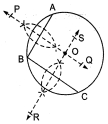
(N/A) Steps of construction:
$I.$ Take any three points on the given circle. Let these be $A, B$ and $C$.
$II.$ Join $AB$ and $BC$.
$III.$ Draw the perpendicular bisector $PQ$ of $AB$.
$IV.$ Draw the perpendicular bisector $RS$ of $BC$ such that it intersects $PQ$ at $O$.
Thus,$O$ is the required centre of the given circle.
$I.$ Take any three points on the given circle. Let these be $A, B$ and $C$.
$II.$ Join $AB$ and $BC$.
$III.$ Draw the perpendicular bisector $PQ$ of $AB$.
$IV.$ Draw the perpendicular bisector $RS$ of $BC$ such that it intersects $PQ$ at $O$.
Thus,$O$ is the required centre of the given circle.
0 likes
View Solution2
Difficult
If two circles intersect at two points,prove that their centres lie on the perpendicular bisector of the common chord.
Solution
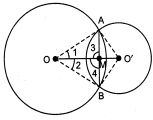
(N/A) Let there be two circles with centres $O$ and $O^{\prime}$ that intersect at points $A$ and $B$.
$AB$ is the common chord of the two circles,and $OO^{\prime}$ is the line segment joining the centres. Let $OO^{\prime}$ and $AB$ intersect at point $M$.
To prove that $OO^{\prime}$ is the perpendicular bisector of $AB$,we join $OA, OB, O^{\prime}A$,and $O^{\prime}B$.
In $\Delta OAO^{\prime}$ and $\Delta OBO^{\prime}$:
$OA = OB$ (radii of the same circle)
$O^{\prime}A = O^{\prime}B$ (radii of the same circle)
$OO^{\prime} = OO^{\prime}$ (common side)
By $SSS$ congruence criterion,$\Delta OAO^{\prime} \cong \Delta OBO^{\prime}$.
Therefore,$\angle 1 = \angle 2$ (by $CPCT$).
Now,in $\Delta AOM$ and $\Delta BOM$:
$OA = OB$ (radii of the same circle)
$OM = OM$ (common side)
$\angle 1 = \angle 2$ (proved above)
By $SAS$ congruence criterion,$\Delta AOM \cong \Delta BOM$.
Therefore,$AM = BM$ (by $CPCT$) and $\angle 3 = \angle 4$ (by $CPCT$).
Since $AB$ is a line segment,$\angle 3 + \angle 4 = 180^{\circ}$ (linear pair).
Thus,$2 \angle 3 = 180^{\circ} \Rightarrow \angle 3 = 90^{\circ}$.
Since $\angle 3 = \angle 4 = 90^{\circ}$ and $AM = BM$,$OO^{\prime}$ is the perpendicular bisector of $AB$.
0 likes
View Solution3
Medium
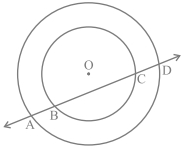
If a line intersects two concentric circles (circles with the same centre) with centre $O$ at $A, B, C$ and $D$,prove that $AB = CD$.
Solution
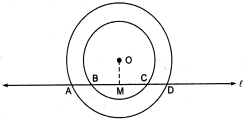
(N/A) We have two circles with the common centre $O$.
$A$ line $\ell$ intersects the outer circle at $A$ and $D$ and the inner circle at $B$ and $C$. To prove that $AB = CD$,let us draw $OM \perp \ell$.
For the outer circle,
$\because OM \perp \ell$,and the perpendicular from the centre to a chord bisects the chord,
$\therefore AM = MD$ --- $(1)$
For the inner circle,
$\because OM \perp \ell$,
$\therefore BM = MC$ --- $(2)$
Subtracting $(2)$ from $(1)$,we have:
$AM - BM = MD - MC$
$AB = CD$
Hence,it is proved.
0 likes
View Solution4
MediumMCQ
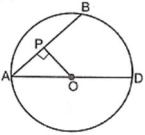
$AD$ is a diameter of a circle and $AB$ is a chord. If $AD = 34 \, cm$ and $AB = 30 \, cm$,the distance of $AB$ from the centre of the circle is (in $cm$):
A
$17$
B
$15$
C
$8$
D
$4$
Solution
(C) Let $O$ be the centre of the circle. Draw $OP \perp AB$.
Since the perpendicular from the centre to a chord bisects the chord,we have:
$AP = \frac{1}{2} \times AB = \frac{1}{2} \times 30 = 15 \, cm$.
The radius of the circle is $OA = \frac{AD}{2} = \frac{34}{2} = 17 \, cm$.
In the right-angled triangle $\Delta OPA$,by the Pythagorean theorem:
$OP^2 + AP^2 = OA^2$
$OP^2 + 15^2 = 17^2$
$OP^2 + 225 = 289$
$OP^2 = 289 - 225 = 64$
$OP = \sqrt{64} = 8 \, cm$.
Thus,the distance of the chord $AB$ from the centre is $8 \, cm$.
0 likes
View Solution5
MediumMCQ
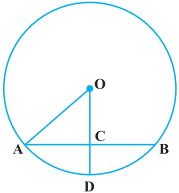
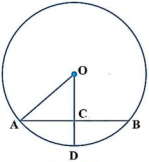
In the figure,if $OA = 5 \text{ cm}$,$AB = 8 \text{ cm}$,and $OD$ is perpendicular to $AB$,then $CD$ is equal to (in $\text{cm}$):
A
$4$
B
$3$
C
$5$
D
$2$
Solution
(D) Since the perpendicular from the centre of a circle to a chord bisects the chord,we have:
$AC = \frac{1}{2} \times AB = \frac{1}{2} \times 8 \text{ cm} = 4 \text{ cm}$.
In the right-angled triangle $\triangle OCA$,by the Pythagoras theorem:
$OC^2 + AC^2 = OA^2$
$OC^2 + 4^2 = 5^2$
$OC^2 + 16 = 25$
$OC^2 = 25 - 16 = 9$
$OC = \sqrt{9} = 3 \text{ cm}$.
Since $OD$ is the radius of the circle,$OD = OA = 5 \text{ cm}$.
Therefore,$CD = OD - OC = 5 \text{ cm} - 3 \text{ cm} = 2 \text{ cm}$.
0 likes
View Solution6
Medium
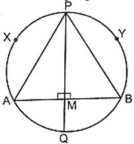
If the perpendicular bisector of a chord $AB$ of a circle $PXAQBY$ intersects the circle at $P$ and $Q$,prove that arc $PXA \cong$ arc $PYB$.
Solution
(N/A) Given: $PQ$ is the perpendicular bisector of chord $AB$ of a circle,intersecting the circle at $P$ and $Q$. Let $M$ be the point of intersection of $PQ$ and $AB$.
To prove: Arc $PXA \cong$ Arc $PYB$.
Proof:
In $\Delta APM$ and $\Delta BPM$:
$1$. $AM = BM$ (Since $PQ$ is the perpendicular bisector of $AB$)
$2$. $\angle AMP = \angle BMP = 90^{\circ}$ (Given)
$3$. $PM = PM$ (Common side)
Therefore,$\Delta APM \cong \Delta BPM$ by the $SAS$ congruence rule.
This implies $AP = BP$ by $CPCT$.
Since $AP$ and $BP$ are chords of the circle and $AP = BP$,their corresponding arcs are congruent.
Thus,arc $PXA \cong$ arc $PYB$.
0 likes
View Solution7
Difficult
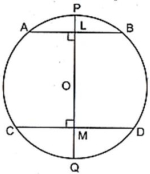
If a line segment joining the mid-points of two chords of a circle passes through the centre of the circle,prove that the two chords are parallel.
Solution
(N/A) Given: $AB$ and $CD$ are two chords of a circle with centre $O$. The mid-points of $AB$ and $CD$ are $L$ and $M$ respectively.
To prove: $AB \parallel CD$
Proof: Since $L$ is the mid-point of chord $AB$,therefore $OL \perp AB$,or $\angle ALO = 90^{\circ}$.
[Because the line joining the centre of a circle to the mid-point of a chord is perpendicular to the chord]
Similarly,$\angle CMO = 90^{\circ}$.
Therefore,$\angle ALO = \angle CMO = 90^{\circ}$.
Since these are corresponding angles formed by the transversal $LM$ intersecting lines $AB$ and $CD$,and they are equal,the lines must be parallel.
So,$AB \parallel CD$.
Hence,proved.
0 likes
View Solution8
Difficult
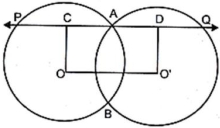
Two circles with centres $O$ and $O'$ intersect at two points $A$ and $B$. $A$ line $PQ$ is drawn parallel to $OO'$ through $A$ (or $B$) intersecting the circles at $P$ and $Q$. Prove that $PQ = 2 OO'$.
Solution
(N/A) Given: Two circles with centres $O$ and $O'$ intersect at $A$ and $B$. $A$ line $PQ$ is drawn parallel to $OO'$ passing through $A$,intersecting the circles at $P$ and $Q$.
To prove: $PQ = 2 OO'$.
Construction: Draw $OC \perp PA$ and $O'D \perp AQ$.
Proof:
$1$. Since the perpendicular from the centre of a circle to a chord bisects the chord,we have:
$PA = 2 CA$ (as $OC \perp PA$) $...(1)$
$AQ = 2 AD$ (as $O'D \perp AQ$) $...(2)$
$2$. Adding equations $(1)$ and $(2)$:
$PA + AQ = 2 CA + 2 AD$
$PQ = 2(CA + AD)$
$3$. Since $PQ \parallel OO'$,$OC \perp PQ$,and $O'D \perp PQ$,the quadrilateral $CDO'O$ is a rectangle.
Therefore,$CD = OO'$.
$4$. Substituting $CD = OO'$ in the equation $PQ = 2(CA + AD)$:
$PQ = 2 CD = 2 OO'$.
Hence,$PQ = 2 OO'$ is proved.
0 likes
View Solution9
Easy
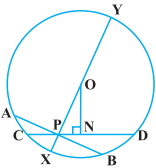
Prove that among all the chords of a circle passing through a given point inside the circle,the one that is perpendicular to the diameter passing through the point is the smallest.
Solution
(N/A) Let $P$ be the given point inside a circle with centre $O$. Draw the chord $AB$ which is perpendicular to the diameter $XY$ passing through $P$. Let $CD$ be any other chord passing through $P$. Draw $ON$ perpendicular to $CD$ from $O$.
In $\Delta ONP$,$\angle ONP = 90^{\circ}$. Since $OP$ is the hypotenuse,$OP > ON$.
We know that the chord nearer to the centre is larger than the chord which is farther from the centre.
Since $ON < OP$ (where $OP$ is the distance of chord $AB$ from the centre),the chord $CD$ is farther from the centre than the chord $AB$.
Therefore,$CD > AB$.
In other words,$AB$ is the smallest of all chords passing through $P$.
0 likes
View Solution10
Medium
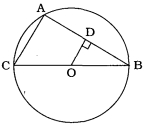
In the figure,$OD$ is perpendicular to chord $AB$ of a circle whose centre is $O.$ If $BC$ is a diameter,prove that $CA = 2OD$.
Solution
(N/A) We have a circle with centre $O$. $BC$ is a diameter and $AB$ is a chord such that $OD \perp AB$. Join $AC$.
The perpendicular from the centre of a circle to a chord bisects the chord. Therefore,$D$ is the midpoint of $AB$.
Since $O$ is the centre of the circle,$O$ is the midpoint of the diameter $BC$.
In $\triangle ABC$,$O$ is the midpoint of $BC$ and $D$ is the midpoint of $AB$. Therefore,$OD$ is the line segment joining the midpoints of two sides of $\triangle ABC$.
By the Midpoint Theorem,the line segment joining the midpoints of two sides of a triangle is parallel to the third side and is half of it.
Therefore,$OD \parallel CA$ and $OD = \frac{1}{2} CA$.
Hence,$CA = 2OD$.
0 likes
View Solution11
Medium
$AB$ and $CD$ are two parallel chords of a circle with centre $P$. $l$ is the perpendicular bisector of chord $AB$. Prove that $l$ bisects chord $CD$.
Solution
(N/A) $1$. Let the circle have center $P$. Since $l$ is the perpendicular bisector of chord $AB$,it must pass through the center $P$ of the circle.
$2$. We are given that $AB \parallel CD$.
$3$. Since $l$ is perpendicular to $AB$ $(l \perp AB)$ and $AB \parallel CD$,it follows that $l$ must also be perpendicular to $CD$ $(l \perp CD)$.
$4$. $A$ line passing through the center of a circle and perpendicular to a chord bisects the chord.
$5$. Since $l$ passes through the center $P$ and is perpendicular to $CD$,$l$ must bisect chord $CD$.
0 likes
View Solution12
Medium
$AB$ and $XY$ are two chords of a circle whose centre is $P$. $A$ line $l$ passing through the centre $P$ bisects chords $AB$ and $XY$ both. Prove that $AB \parallel XY$.
Solution
(N/A) $1$. Let the circle have centre $P$. Let the line $l$ pass through $P$ and intersect $AB$ at point $M$ and $XY$ at point $N$.
$2$. Since the line $l$ bisects chord $AB$ at $M$,by the theorem 'the line drawn through the centre of a circle to bisect a chord is perpendicular to the chord',we have $PM \perp AB$. Thus,$\angle PMA = 90^{\circ}$.
$3$. Similarly,since the line $l$ bisects chord $XY$ at $N$,we have $PN \perp XY$. Thus,$\angle PNY = 90^{\circ}$.
$4$. Since $M, P,$ and $N$ lie on the same line $l$,the angles $\angle PMA$ and $\angle PNY$ are corresponding angles formed by the transversal $l$ intersecting lines $AB$ and $XY$.
$5$. Since $\angle PMA = 90^{\circ}$ and $\angle PNY = 90^{\circ}$,the corresponding angles are equal $(\angle PMA = \angle PNY = 90^{\circ})$.
$6$. Therefore,by the converse of the corresponding angles axiom,$AB \parallel XY$.
0 likes
View Solution13
DifficultMCQ
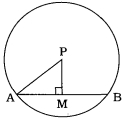
$P$ is the centre of the circle of radius $20\, cm$. $AB$ is a chord of the circle. If $AB = 32\, cm$,then find the distance of the chord $AB$ from the centre $P$.
A
$9$
B
$14$
C
$12$
D
$7$
Solution
(C) From $P$,draw $PM \perp AB$. Join $PA$.
The perpendicular from the centre of a circle to a chord bisects the chord.
$\therefore AM = MB = \frac{1}{2} AB = \frac{1}{2} \times 32 = 16\, cm$.
$PA$ is the radius of the circle,so $PA = 20\, cm$.
In $\Delta PMA$,$\angle M = 90^{\circ}$.
By Pythagoras theorem,$PA^2 = PM^2 + AM^2$.
$\therefore PM^2 = PA^2 - AM^2 = (20)^2 - (16)^2 = 400 - 256 = 144$.
$\therefore PM = \sqrt{144} = 12\, cm$.
Thus,the distance of the chord $AB$ from the centre $P$ is $12\, cm$.
0 likes
View Solution14
MediumMCQ
In a circle with centre $P$,$AB$ is a chord. If the length of a radius is $17\,cm$ and $AB = 30\,cm$,then find the distance of $AB$ from the centre $P$. (in $,cm$)
A
$7$
B
$8$
C
$6$
D
$4$
Solution
(B) Let $P$ be the centre of the circle and $AB$ be the chord of length $30\,cm$.
Draw a perpendicular $PM$ from the centre $P$ to the chord $AB$.
$A$ perpendicular from the centre of a circle to a chord bisects the chord.
Therefore,$AM = MB = \frac{AB}{2} = \frac{30}{2} = 15\,cm$.
In the right-angled triangle $\triangle PMA$,by Pythagoras theorem:
$PA^2 = PM^2 + AM^2$.
Given radius $PA = 17\,cm$ and $AM = 15\,cm$.
$17^2 = PM^2 + 15^2$.
$289 = PM^2 + 225$.
$PM^2 = 289 - 225 = 64$.
$PM = \sqrt{64} = 8\,cm$.
Thus,the distance of the chord $AB$ from the centre $P$ is $8\,cm$.
0 likes
View Solution15
MediumMCQ
In a circle with centre $P$,the length of chord $AB$ is $40 \, cm$. $AB$ lies at a distance of $21 \, cm$ from the centre $P$. Find the diameter of the circle. (in $, cm$)
A
$58$
B
$60$
C
$82$
D
$49$
Solution
(A) Let $P$ be the centre of the circle and $AB$ be the chord of length $40 \, cm$.
Let $M$ be the midpoint of $AB$. The perpendicular from the centre to a chord bisects the chord.
Therefore,$AM = MB = \frac{40}{2} = 20 \, cm$.
Given the distance from the centre to the chord is $PM = 21 \, cm$.
In the right-angled triangle $\triangle PMA$,by the Pythagorean theorem:
$PA^2 = PM^2 + AM^2$
$PA^2 = 21^2 + 20^2$
$PA^2 = 441 + 400 = 841$
$PA = \sqrt{841} = 29 \, cm$.
Here,$PA$ is the radius $(r)$ of the circle.
Diameter $(d)$ = $2 \times r = 2 \times 29 = 58 \, cm$.
0 likes
View Solution16
MediumMCQ
$AB$ and $CD$ are two parallel chords of a circle with centre $P$. Centre $P$ is not between the two chords $AB$ and $CD$. If $AB = 40\,cm$,$CD = 30\,cm$ and the radius of the circle is $25\,cm$,find the distance between $AB$ and $CD$. (in $,cm$)
A
$5$
B
$6$
C
$4$
D
$3$
Solution
(A) Let $P$ be the centre of the circle with radius $r = 25\,cm$.
Let $M$ and $N$ be the midpoints of chords $AB$ and $CD$ respectively.
Since the perpendicular from the centre to a chord bisects the chord,$AM = MB = AB/2 = 40/2 = 20\,cm$ and $CN = ND = CD/2 = 30/2 = 15\,cm$.
In right-angled $\triangle PMA$,by Pythagoras theorem: $PM^2 + AM^2 = PA^2 \implies PM^2 + 20^2 = 25^2 \implies PM^2 = 625 - 400 = 225 \implies PM = 15\,cm$.
In right-angled $\triangle PNC$,by Pythagoras theorem: $PN^2 + CN^2 = PC^2 \implies PN^2 + 15^2 = 25^2 \implies PN^2 = 625 - 225 = 400 \implies PN = 20\,cm$.
Since the centre $P$ is not between the chords,the distance between the chords is $|PN - PM| = |20 - 15| = 5\,cm$.
0 likes
View Solution17
MediumMCQ
$AB$ and $CD$ are two parallel chords of a circle with centre $P$. Also,the centre $P$ lies between the chords $AB$ and $CD$. If $AB = 20\,cm$,$CD = 48\,cm$,and the radius of the circle is $26\,cm$,find the distance between $AB$ and $CD$.
A
$23$
B
$30$
C
$34$
D
$36$
Solution
(C) Let $P$ be the centre of the circle and $r = 26\,cm$ be the radius.
Draw perpendiculars $PM$ and $PN$ from $P$ to chords $AB$ and $CD$ respectively.
Since the perpendicular from the centre to a chord bisects the chord,we have:
$AM = MB = \frac{AB}{2} = \frac{20}{2} = 10\,cm$
$CN = ND = \frac{CD}{2} = \frac{48}{2} = 24\,cm$
In right-angled $\triangle PMA$,by Pythagoras theorem:
$PM^2 + AM^2 = PA^2$
$PM^2 + 10^2 = 26^2$
$PM^2 = 676 - 100 = 576$
$PM = \sqrt{576} = 24\,cm$
In right-angled $\triangle PNC$,by Pythagoras theorem:
$PN^2 + CN^2 = PC^2$
$PN^2 + 24^2 = 26^2$
$PN^2 = 676 - 576 = 100$
$PN = \sqrt{100} = 10\,cm$
Since the centre $P$ lies between the chords,the distance between $AB$ and $CD$ is $PM + PN = 24 + 10 = 34\,cm$.
0 likes
View Solution18
MediumMCQ
$A$ line joining the midpoints of two chords passes through the centre of a circle. Prove that the chords are parallel.
A
The chords are parallel.
B
The chords are perpendicular.
C
The chords are equal in length.
D
The chords are not parallel.
Solution
(A) Let $AB$ and $CD$ be two chords of a circle with centre $O$. Let $M$ and $N$ be the midpoints of chords $AB$ and $CD$ respectively.
Given that the line $MN$ passes through the centre $O$.
Since $M$ is the midpoint of $AB$,the line segment joining the centre to the midpoint of a chord is perpendicular to the chord. Therefore,$OM \perp AB$,which implies $\angle OMA = 90^{\circ}$.
Similarly,since $N$ is the midpoint of $CD$,$ON \perp CD$,which implies $\angle ONC = 90^{\circ}$.
Since the points $M, O, N$ are collinear (as the line $MN$ passes through the centre $O$),the line $MN$ acts as a transversal to the chords $AB$ and $CD$.
The angles $\angle OMA$ and $\angle ONC$ are corresponding angles (or interior angles on the same side depending on the orientation). Specifically,$\angle OMA + \angle ONC = 90^{\circ} + 90^{\circ} = 180^{\circ}$ if they are interior angles on the same side.
Since the sum of the interior angles on the same side of the transversal $MN$ is $180^{\circ}$,the lines $AB$ and $CD$ must be parallel.
0 likes
View Solution19
MediumMCQ
In a circle with centre $P$,the length of a diameter is $20 \, cm$ and $AB$ is a chord of a circle at a distance $6 \, cm$ from the centre,then $AB = $ ........ $cm$.
A
$8$
B
$16$
C
$12$
D
$6$
Solution
(B) Given that the diameter of the circle is $20 \, cm$,the radius $r = \frac{20}{2} = 10 \, cm$.
Let $M$ be the midpoint of the chord $AB$ such that $PM \perp AB$. The distance from the centre $P$ to the chord $AB$ is $PM = 6 \, cm$.
In the right-angled triangle $\triangle PMA$,by the Pythagorean theorem:
$PA^2 = PM^2 + AM^2$
$10^2 = 6^2 + AM^2$
$100 = 36 + AM^2$
$AM^2 = 100 - 36 = 64$
$AM = \sqrt{64} = 8 \, cm$.
Since the perpendicular from the centre to a chord bisects the chord,$AB = 2 \times AM = 2 \times 8 = 16 \, cm$.
0 likes
View Solution20
MediumMCQ
In a circle with centre $P$,the distance of a chord $AB$ from the centre $P$ is $20 \, cm$. If $AB = 96 \, cm$,then the radius of the circle is .......... $cm$.
A
$52$
B
$26$
C
$39$
D
$13$
Solution
(A) Let $P$ be the centre of the circle and $AB$ be the chord. Let $M$ be the midpoint of the chord $AB$ such that $PM \perp AB$.
Given that the distance of the chord from the centre is $PM = 20 \, cm$.
The length of the chord $AB = 96 \, cm$.
Since the perpendicular from the centre to a chord bisects the chord,we have $AM = MB = \frac{AB}{2} = \frac{96}{2} = 48 \, cm$.
In the right-angled triangle $\triangle PMA$,by the Pythagorean theorem,$PA^2 = PM^2 + AM^2$.
Here,$PA$ is the radius $(r)$ of the circle.
$r^2 = 20^2 + 48^2$.
$r^2 = 400 + 2304 = 2704$.
$r = \sqrt{2704} = 52 \, cm$.
Thus,the radius of the circle is $52 \, cm$.
0 likes
View Solution21
MediumMCQ
In a circle with centre $P$,the diameter of the circle is $70 \, cm$. The chord $AB$ is at a distance of $21 \, cm$ from the centre of the circle,then $AB = \dots \, cm$.
A
$49$
B
$56$
C
$40$
D
$28$
Solution
(B) Given: Diameter of the circle $d = 70 \, cm$.
Radius $r = \frac{d}{2} = \frac{70}{2} = 35 \, cm$.
Let $M$ be the midpoint of chord $AB$ such that $PM \perp AB$.
The distance from the centre to the chord is $PM = 21 \, cm$.
In right-angled triangle $\triangle PMA$,by Pythagoras theorem:
$PA^2 = PM^2 + AM^2$
$35^2 = 21^2 + AM^2$
$1225 = 441 + AM^2$
$AM^2 = 1225 - 441 = 784$
$AM = \sqrt{784} = 28 \, cm$.
Since the perpendicular from the centre to a chord bisects the chord,$AB = 2 \times AM = 2 \times 28 = 56 \, cm$.
0 likes
View Solution22
EasyMCQ
The line segment joining any two points on a circle is called a ........ of the circle.
A
arc
B
chord
C
radius
D
diameter
Solution
(B) line segment joining any two points on a circle is known as a chord of the circle. If this chord passes through the center of the circle,it is called the diameter,which is the longest chord of the circle.
0 likes
View Solution23
EasyMCQ
The perpendicular from the centre of a circle to a chord ........... the chord.
A
diameter
B
radius
C
arc
D
bisects
Solution
(D) The theorem states that a perpendicular drawn from the centre of a circle to a chord bisects the chord. Therefore,the correct option is $D$.
0 likes
View Solution24
MediumMCQ
In a circle with radius $17 \, cm$,the length of a chord is $30 \, cm$. Find the distance of the chord from the centre. (in $, cm$)
A
$8$
B
$12$
C
$9$
D
$6$
Solution
(A) Let the circle have centre $O$ and radius $r = 17 \, cm$. Let $AB$ be the chord of length $30 \, cm$.
Draw a perpendicular $OM$ from the centre $O$ to the chord $AB$.
The perpendicular from the centre of a circle to a chord bisects the chord.
Therefore,$AM = MB = \frac{AB}{2} = \frac{30}{2} = 15 \, cm$.
In the right-angled triangle $\triangle OMA$,by the Pythagorean theorem:
$OA^2 = OM^2 + AM^2$.
Substituting the values: $17^2 = OM^2 + 15^2$.
$289 = OM^2 + 225$.
$OM^2 = 289 - 225 = 64$.
$OM = \sqrt{64} = 8 \, cm$.
Thus,the distance of the chord from the centre is $8 \, cm$.
0 likes
View Solution25
MediumMCQ
In a circle with radius $13 \, cm$,find the length of a chord lying at a distance of $12 \, cm$ from the centre. (in $, cm$)
A
$2$
B
$10$
C
$5$
D
$25$
Solution
(B) Let the circle have centre $O$ and radius $r = 13 \, cm$. Let $AB$ be the chord at a distance $OM = 12 \, cm$ from the centre,where $OM \perp AB$.
In the right-angled triangle $\triangle OMA$,by the Pythagorean theorem:
$OA^2 = OM^2 + AM^2$
$13^2 = 12^2 + AM^2$
$169 = 144 + AM^2$
$AM^2 = 169 - 144 = 25$
$AM = \sqrt{25} = 5 \, cm$.
Since the perpendicular from the centre to a chord bisects the chord,the length of the chord $AB = 2 \times AM = 2 \times 5 = 10 \, cm$.
0 likes
View SolutionCircles — Perpendicular from the Centre to a Chord · Frequently Asked Questions
1Are these Circles questions useful for JEE and NEET?
Yes. All questions in this section are mapped to JEE Main and NEET exam patterns. Previous year questions from JEE Main, NEET, GUJCET and state-level exams are included with full solutions.
2Can I switch to Hindi or Gujarati for these questions?
Yes. Use the language tabs in the hero section or the sidebar to view the same questions and solutions in English, Hindi or Gujarati.
3How do I generate a question paper from this subtopic?
Use the Vedclass Exam Paper Generator — select the chapter and subtopic, set difficulty, and generate Sets A, B, C, D automatically. First 3 chapters of every subject are free.
Vedclass Products
For Students
Vedclass Test Series
Mock tests in real JEE/NEET style with performance analysis. 5-day free trial.
Start Free TrialFor Teachers
Exam Paper Generator
Generate Set A/B/C/D papers from this chapter in 2 minutes. 3 chapters free.
Try FreeFor Institutes
Online Exam Module
Live online exams with unlimited students, 360° analytics & white-label branding.
See DemoFor Teachers & Institutes
Generate a Circles Exam Paper in 2 Minutes
Select subtopic & difficulty — Sets A, B, C, D auto-generated with No Repeat logic.
First 3 chapters of every subject are free — no payment required.