
A English
Mix Examples - Triangles Questions in English
Class 9 Mathematics · Triangles · Mix Examples - Triangles
16+
Questions
English
Language
100%
With Solutions
Showing 16 of 16 questions in English
1
EasyMCQ
How many triangles can be drawn having its angles as $53^{\circ}, 64^{\circ}$ and $63^{\circ}$? Give reason for your answer.
A
Only one triangle
B
Two triangles
C
Infinitely many triangles
D
None
Solution
(C) The sum of the given angles is $53^{\circ} + 64^{\circ} + 63^{\circ} = 180^{\circ}$.
Since the sum of the angles is exactly $180^{\circ}$,these angles can form a triangle.
However,the size of the triangle is not fixed because the lengths of the sides are not specified.
By changing the side lengths while keeping the angles constant,we can create triangles of different sizes.
Therefore,infinitely many triangles can be drawn with these specific angles.
0 likes
View Solution2
MediumMCQ
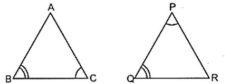
In triangles $ABC$ and $PQR$,$AB = AC$,$\angle C = \angle P$ and $\angle B = \angle Q$. The two triangles are
A
congruent but not isosceles
B
neither congruent nor isosceles
C
isosceles but not congruent
D
isosceles and congruent
Solution
(C) Given: In $\triangle ABC$,$AB = AC$. Therefore,$\angle B = \angle C$ (Angles opposite to equal sides are equal).
Given: $\angle C = \angle P$ and $\angle B = \angle Q$.
Since $\angle B = \angle C$,we have $\angle Q = \angle P$.
In $\triangle PQR$,since $\angle Q = \angle P$,the sides opposite to these angles must be equal,so $PR = QR$. Thus,$\triangle PQR$ is an isosceles triangle.
However,we do not have enough information (such as a side length or a specific angle measure) to prove that $\triangle ABC \cong \triangle PQR$. For example,the triangles could have different sizes while maintaining the same angle relationships.
Therefore,both triangles are isosceles,but they are not necessarily congruent.
0 likes
View Solution3
Medium
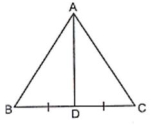
$AD$ is a median of the triangle $ABC$. Is it true that $AB + BC + CA > 2AD$? Give reason for your answer.
Solution
(N/A) In $\triangle ABD$,we have:
$AB + BD > AD$ $\ldots(1)$
[Since the sum of the lengths of any two sides of a triangle must be greater than the third side]
In $\triangle ADC$,we have:
$AC + CD > AD$ $\ldots(2)$
[Since the sum of the lengths of any two sides of a triangle must be greater than the third side]
Adding $(1)$ and $(2)$,we get:
$AB + BD + CD + AC > 2AD$
Since $AD$ is the median of $\triangle ABC$,$BD = CD$. Therefore,$BD + CD = BC$.
Substituting this into the inequality,we get:
$AB + BC + CA > 2AD$
Yes,the statement is true.
0 likes
View Solution4
Medium
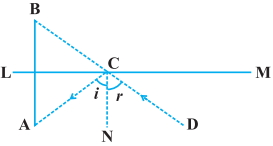
The image of an object placed at a point $A$ before a plane mirror $LM$ is seen at the point $B$ by an observer at $D$ as shown in the figure. Prove that the image is as far behind the mirror as the object is in front of the mirror.
Solution
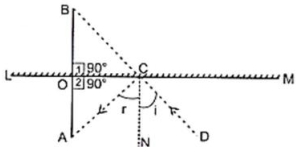
(N/A) Let $AB$ intersect $LM$ at $O$. We have to prove that $AO = BO$.
Now,$\angle i = \angle r$ ... $(1)$
[$\because$ Angle of incidence = Angle of reflection]
$\angle B = \angle i$ [Corresponding angles] ... $(2)$
And $\angle A = \angle r$ [Alternate interior angles] ... $(3)$
From $(1)$,$(2)$ and $(3)$,we get $\angle B = \angle A$.
In $\triangle BOC$ and $\triangle AOC$,we have:
$\angle 1 = \angle 2 = 90^{\circ}$ [Given]
$OC = OC$ [Common side]
$\angle B = \angle A$ [Proved above]
Therefore,$\triangle BOC \cong \triangle AOC$ [$AAS$ congruence rule].
Hence,$AO = BO$ [$CPCT$].
0 likes
View Solution5
Difficult
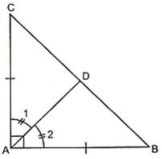
$ABC$ is a right-angled triangle with $AB = AC$. The bisector of $\angle A$ meets $BC$ at $D$. Prove that $BC = 2 AD$.
Solution
(N/A) Given: $A$ right-angled triangle $ABC$ where $AB = AC$ and the bisector of $\angle A$ meets $BC$ at $D$.
To prove: $BC = 2 AD$.
Proof: In $\triangle ABC$,since $AB = AC$ and it is a right-angled triangle,$\angle BAC = 90^{\circ}$.
In $\triangle CAD$ and $\triangle BAD$:
$AC = AB$ (Given)
$\angle CAD = \angle BAD$ (Since $AD$ is the bisector of $\angle A$)
$AD = AD$ (Common side)
By $SAS$ congruence criterion,$\triangle CAD \cong \triangle BAD$.
Therefore,$CD = BD$ (by $CPCT$).
Since $AD$ is the angle bisector of the right angle in an isosceles right triangle,$AD$ is also the median to the hypotenuse.
In a right-angled triangle,the median to the hypotenuse is half the length of the hypotenuse.
Thus,$AD = \frac{1}{2} BC$.
Multiplying both sides by $2$,we get $2 AD = BC$.
Hence,$BC = 2 AD$ is proved.
0 likes
View Solution6
Difficult
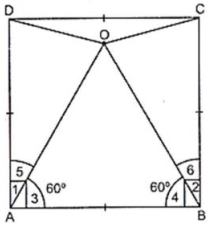
$O$ is a point in the interior of a square $ABCD$ such that $\triangle OAB$ is an equilateral triangle. Show that $\triangle OCD$ is an isosceles triangle.
Solution
(N/A) Given: $A$ square $ABCD$ and $\triangle OAB$ is an equilateral triangle,so $OA = OB = AB$.
To prove: $\triangle OCD$ is an isosceles triangle.
Proof: In square $ABCD$,$\angle DAB = \angle CBA = 90^{\circ}$.
Since $\triangle OAB$ is equilateral,$\angle OAB = \angle OBA = 60^{\circ}$.
Now,$\angle DAO = \angle DAB - \angle OAB = 90^{\circ} - 60^{\circ} = 30^{\circ}$.
Similarly,$\angle CBO = \angle CBA - \angle OBA = 90^{\circ} - 60^{\circ} = 30^{\circ}$.
In $\triangle DAO$ and $\triangle CBO$:
$AD = BC$ (Sides of a square)
$\angle DAO = \angle CBO = 30^{\circ}$ (Proved above)
$OA = OB$ (Sides of an equilateral triangle)
By $SAS$ congruence criterion,$\triangle DAO \cong \triangle CBO$.
Therefore,$OD = OC$ (Corresponding parts of congruent triangles).
Since $OD = OC$,$\triangle OCD$ is an isosceles triangle.
Hence,proved.
0 likes
View Solution7
Difficult
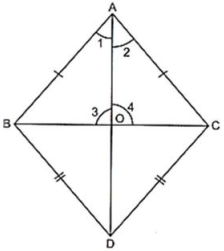
$ABC$ and $DBC$ are two triangles on the same base $BC$ such that $A$ and $D$ lie on the opposite sides of $BC$,$AB = AC$ and $DB = DC$. Show that $AD$ is the perpendicular bisector of $BC$.
Solution
(N/A) Given: $\triangle ABC$ and $\triangle DBC$ on the same base $BC$. Also,$AB = AC$ and $BD = CD$.
To prove: $AD$ is the perpendicular bisector of $BC$,i.e.,$OB = OC$ and $\angle AOB = \angle AOC = 90^{\circ}$.
Proof: In $\triangle ABD$ and $\triangle ACD$,we have:
$AB = AC$ [Given]
$BD = CD$ [Given]
$AD = AD$ [Common side]
So,by $SSS$ criterion of congruence,we have:
$\triangle ABD \cong \triangle ACD$
Therefore,$\angle 1 = \angle 2$ [$CPCT$]
Now,in $\triangle ABO$ and $\triangle ACO$,we have:
$AB = AC$ [Given]
$\angle 1 = \angle 2$ [Proved above]
$AO = AO$ [Common side]
So,by $SAS$ criterion of congruence,we have:
$\triangle ABO \cong \triangle ACO$
Therefore,$BO = CO$ [$CPCT$]
And,$\angle 3 = \angle 4$ [$CPCT$]
But,$\angle 3 + \angle 4 = 180^{\circ}$ [Linear pair axiom]
$\Rightarrow \angle 3 + \angle 3 = 180^{\circ}$
$\Rightarrow 2\angle 3 = 180^{\circ}$
$\Rightarrow \angle 3 = 90^{\circ}$
Since $BO = CO$ and $\angle 3 = 90^{\circ}$,$AD$ is the perpendicular bisector of $BC$. Hence,proved.
0 likes
View Solution8
Difficult
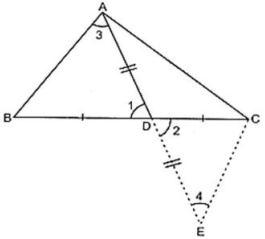
Prove that the sum of any two sides of a triangle is greater than twice the median with respect to the third side.
Solution
(N/A) Given: $\triangle ABC$ with median $AD$ to side $BC$.
To prove: $AB + AC > 2AD$.
Construction: Produce $AD$ to $E$ such that $DE = AD$ and join $EC$.
Proof: In $\triangle ADB$ and $\triangle EDC$:
$AD = ED$ (By construction)
$\angle 1 = \angle 2$ (Vertically opposite angles)
$DB = DC$ ($AD$ is the median)
By $SAS$ congruence criterion,$\triangle ADB \cong \triangle EDC$.
Therefore,$AB = EC$ $(CPCT)$.
Now,in $\triangle AEC$,the sum of any two sides is greater than the third side:
$AC + CE > AE$
Since $AE = AD + DE = AD + AD = 2AD$ and $CE = AB$:
$AC + AB > 2AD$.
Hence,it is proved that the sum of two sides is greater than twice the median to the third side.
0 likes
View Solution9
Difficult
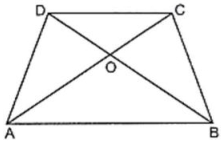
Show that in a quadrilateral $ABCD$,$AB + BC + CD + DA > AC + BD$.
Solution
(N/A) Given: $A$ quadrilateral $ABCD$.
To prove: $AB + BC + CD + DA > AC + BD$.
Proof: In $\triangle ABC$,we have $AB + BC > AC$ $\ldots(1)$ [Since the sum of the lengths of any two sides of a triangle must be greater than the third side].
In $\triangle BCD$,we have $BC + CD > BD$ $\ldots(2)$ [Same reason].
In $\triangle CDA$,we have $CD + DA > AC$ $\ldots(3)$ [Same reason].
In $\triangle DAB$,we have $DA + AB > BD$ $\ldots(4)$ [Same reason].
Adding $(1), (2), (3)$ and $(4)$,we get:
$(AB + BC) + (BC + CD) + (CD + DA) + (DA + AB) > AC + BD + AC + BD$
$2AB + 2BC + 2CD + 2DA > 2AC + 2BD$
$2(AB + BC + CD + DA) > 2(AC + BD)$
$AB + BC + CD + DA > AC + BD$.
Hence,proved.
0 likes
View Solution10
Difficult
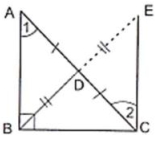
In a right triangle,prove that the line segment joining the mid-point of the hypotenuse to the opposite vertex is half the length of the hypotenuse.
Solution
(N/A) $ABC$ is a right triangle,right-angled at $B$,and $D$ is the mid-point of the hypotenuse $AC$. We need to prove that $BD = \frac{1}{2} AC$.
Construction: Produce $BD$ to $E$ such that $BD = DE$. Join $EC$.
In $\Delta ADB$ and $\Delta CDE$:
$AD = CD$ (Since $D$ is the mid-point of $AC$)
$\angle ADB = \angle CDE$ (Vertically opposite angles)
$BD = DE$ (By construction)
Therefore,$\Delta ADB \cong \Delta CDE$ (By $SAS$ congruence criterion).
Thus,$AB = EC$ $(CPCT)$ and $\angle 1 = \angle 2$ $(CPCT)$.
Since $\angle 1$ and $\angle 2$ are alternate interior angles,$EC \parallel BA$.
Now,$EC \parallel BA$ and $BC$ is the transversal,so $\angle ABC + \angle BCE = 180^{\circ}$.
Since $\angle ABC = 90^{\circ}$,$\angle BCE = 180^{\circ} - 90^{\circ} = 90^{\circ}$.
In $\Delta ABC$ and $\Delta ECB$:
$BC = CB$ (Common side)
$AB = EC$ (Proved above)
$\angle ABC = \angle ECB = 90^{\circ}$
Therefore,$\Delta ABC \cong \Delta ECB$ (By $SAS$ congruence criterion).
Thus,$AC = EB$ $(CPCT)$.
Since $BD = DE$,$BD = \frac{1}{2} BE$.
Substituting $BE = AC$,we get $BD = \frac{1}{2} AC$.
0 likes
View Solution11
Difficult
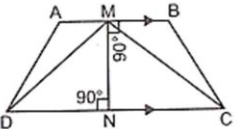
The line segment joining the mid-points $M$ and $N$ of the parallel sides $AB$ and $DC$ respectively of a trapezium $ABCD$ is perpendicular to both the sides $AB$ and $DC$. Prove that $AD = BC$.
Solution
(N/A) Join $MD$ and $MC$.
In $\Delta DMN$ and $\Delta CMN$:
$DN = CN$ [Since $N$ is the mid-point of $DC$]
$\angle DNM = \angle CNM = 90^{\circ}$ [Given]
$MN = MN$ [Common side]
Therefore,$\Delta DMN \cong \Delta CMN$ [By $SAS$ congruence rule]
This implies $DM = CM$ and $\angle NMD = \angle NMC$ ... $(1)$ [$CPCT$]
Now,consider $\Delta AMD$ and $\Delta BMC$:
$AM = BM$ [Since $M$ is the mid-point of $AB$]
$DM = CM$ [From $(1)$]
$\angle AMD = \angle AMN - \angle NMD$
$\angle BMC = \angle BMN - \angle NMC$
Since $\angle AMN = \angle BMN = 90^{\circ}$ and $\angle NMD = \angle NMC$,we have $\angle AMD = \angle BMC$ ... $(2)$
Therefore,$\Delta AMD \cong \Delta BMC$ [By $SAS$ congruence rule]
Thus,$AD = BC$ [$CPCT$].
0 likes
View Solution12
Difficult
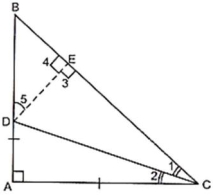
$ABC$ is a right triangle such that $AB = AC$ and the bisector of angle $C$ intersects the side $AB$ at $D$. Prove that $AC + AD = BC$.
Solution
(N/A) Given: $A$ right triangle $ABC$ where $AB = AC$ and $CD$ is the bisector of $\angle C$.
To prove: $AC + AD = BC$.
Construction: Draw $DE \perp BC$.
Proof: In right triangle $ABC$,we have $AB = AC$ (Given).
Since $BC$ is the hypotenuse,$\angle A = 90^{\circ}$.
In $\triangle DAC$ and $\triangle DEC$:
$\angle DAC = \angle DEC = 90^{\circ}$ (Given and construction).
$\angle ACD = \angle ECD$ (Since $CD$ is the bisector of $\angle C$).
$CD = CD$ (Common side).
By $AAS$ congruence criterion,$\triangle DAC \cong \triangle DEC$.
Therefore,$AD = DE$ and $AC = CE$ (by $CPCT$).
In $\triangle ABC$,since $AB = AC$,$\angle B = \angle ACB$. Since $\angle A = 90^{\circ}$,$\angle B + \angle ACB = 90^{\circ}$,so $2\angle B = 90^{\circ}$,which means $\angle B = 45^{\circ}$.
In $\triangle DEB$,$\angle DEB = 90^{\circ}$ and $\angle B = 45^{\circ}$,so $\angle EDB = 180^{\circ} - (90^{\circ} + 45^{\circ}) = 45^{\circ}$.
Since $\angle EDB = \angle B = 45^{\circ}$,the sides opposite to them are equal: $DE = BE$.
Since $AD = DE$ and $DE = BE$,we have $AD = BE$.
Now,$BC = CE + BE$.
Substituting $CE = AC$ and $BE = AD$,we get $BC = AC + AD$.
Hence,$AC + AD = BC$ is proved.
0 likes
View Solution13
Medium
$AB$ and $CD$ are the smallest and largest sides of a quadrilateral $ABCD$. Determine which is greater,$\angle B$ or $\angle D$.
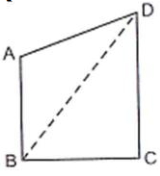
Solution
(A) Given: $A$ quadrilateral $ABCD$ in which $AB$ is the smallest side and $CD$ is the largest side.
To prove: $\angle B > \angle D$.
Construction: Join $BD$.
Proof: In $\triangle ABD$,since $AB$ is the smallest side of the quadrilateral,we have $AD > AB$. The angle opposite to the longer side is greater,therefore $\angle ABD > \angle ADB$ ... $(1)$.
In $\triangle CBD$,since $CD$ is the largest side of the quadrilateral,we have $CD > BC$. The angle opposite to the longer side is greater,therefore $\angle CBD > \angle BDC$ ... $(2)$.
Adding $(1)$ and $(2)$,we get:
$\angle ABD + \angle CBD > \angle ADB + \angle BDC$
$\Rightarrow \angle ABC > \angle ADC$
$\Rightarrow \angle B > \angle D$.
Hence,it is proved that $\angle B$ is greater than $\angle D$.
0 likes
View Solution14
EasyMCQ
How many subsidiary triangles does a Sriyantra have?
A
$43$
B
$22$
C
$40$
D
$19$
Solution
(A) $Sriyantra$ is a complex geometric figure formed by the intersection of $9$ triangles. These $9$ triangles are of two types: $4$ triangles with their vertices pointing upwards (representing $Shiva$) and $5$ triangles with their vertices pointing downwards (representing $Shakti$). These $9$ primary triangles intersect to form $43$ smaller subsidiary triangles,which are known as $triangles$ within the $Sriyantra$ structure. Therefore,the total number of subsidiary triangles is $43$.
0 likes
View Solution15
Easy
State whether each of the following statements is true or false:
$(1)$ If a transversal intersects two parallel lines,then the interior angles on the same side of the transversal are equal.
$(2)$ The maximum number of acute angles in any triangle is two.
$(1)$ If a transversal intersects two parallel lines,then the interior angles on the same side of the transversal are equal.
$(2)$ The maximum number of acute angles in any triangle is two.
Solution
(B) $(1)$ False. If a transversal intersects two parallel lines,the interior angles on the same side of the transversal are supplementary (their sum is $180^{\circ}$),not equal.
$(2)$ False. In any triangle,the sum of all three angles is $180^{\circ}$. It is possible for all three angles to be acute (e.g.,in an equilateral triangle,all angles are $60^{\circ}$),so the maximum number of acute angles in a triangle is three.
$(2)$ False. In any triangle,the sum of all three angles is $180^{\circ}$. It is possible for all three angles to be acute (e.g.,in an equilateral triangle,all angles are $60^{\circ}$),so the maximum number of acute angles in a triangle is three.
0 likes
View Solution16
MediumMCQ
State whether each of the following statements is true or false:
$(1)$ In $\Delta ABC$ and $\Delta PQR$,$AB = PQ$,$BC = PR$ and $\angle B = \angle P$,then $\Delta ABC \cong \Delta PQR$.
$(2)$ The exterior angles at two vertices of any triangle cannot both be acute.
$(1)$ In $\Delta ABC$ and $\Delta PQR$,$AB = PQ$,$BC = PR$ and $\angle B = \angle P$,then $\Delta ABC \cong \Delta PQR$.
$(2)$ The exterior angles at two vertices of any triangle cannot both be acute.
A
True
B
False
C
Both $(1)$ and $(2)$ are True
D
Both $(1)$ and $(2)$ are False
Solution
(B) $(1)$ False: For two triangles to be congruent by the $SAS$ (Side-Angle-Side) congruence rule,the angle must be included between the two sides. Here,in $\Delta ABC$,the angle between $AB$ and $BC$ is $\angle B$. In $\Delta PQR$,the angle between $PQ$ and $PR$ is $\angle P$. However,the given condition is $BC = PR$,but the sides forming $\angle P$ are $PQ$ and $PR$. Since $BC$ is not the side $QR$,the $SAS$ criterion is not satisfied.
$(2)$ True: The sum of an interior angle and its corresponding exterior angle is $180^{\circ}$. If an exterior angle is acute $(< 90^{\circ})$,the corresponding interior angle must be obtuse $(> 90^{\circ})$. $A$ triangle can have at most one obtuse angle. Therefore,it is impossible for two exterior angles to be acute,as that would imply the existence of two obtuse interior angles,which violates the angle sum property of a triangle.
$(2)$ True: The sum of an interior angle and its corresponding exterior angle is $180^{\circ}$. If an exterior angle is acute $(< 90^{\circ})$,the corresponding interior angle must be obtuse $(> 90^{\circ})$. $A$ triangle can have at most one obtuse angle. Therefore,it is impossible for two exterior angles to be acute,as that would imply the existence of two obtuse interior angles,which violates the angle sum property of a triangle.
0 likes
View SolutionTriangles — Mix Examples - Triangles · Frequently Asked Questions
1Are these Triangles questions useful for JEE and NEET?
Yes. All questions in this section are mapped to JEE Main and NEET exam patterns. Previous year questions from JEE Main, NEET, GUJCET and state-level exams are included with full solutions.
2Can I switch to Hindi or Gujarati for these questions?
Yes. Use the language tabs in the hero section or the sidebar to view the same questions and solutions in English, Hindi or Gujarati.
3How do I generate a question paper from this subtopic?
Use the Vedclass Exam Paper Generator — select the chapter and subtopic, set difficulty, and generate Sets A, B, C, D automatically. First 3 chapters of every subject are free.
Vedclass Products
For Students
Vedclass Test Series
Mock tests in real JEE/NEET style with performance analysis. 5-day free trial.
Start Free TrialFor Teachers
Exam Paper Generator
Generate Set A/B/C/D papers from this chapter in 2 minutes. 3 chapters free.
Try FreeFor Institutes
Online Exam Module
Live online exams with unlimited students, 360° analytics & white-label branding.
See DemoFor Teachers & Institutes
Generate a Triangles Exam Paper in 2 Minutes
Select subtopic & difficulty — Sets A, B, C, D auto-generated with No Repeat logic.
First 3 chapters of every subject are free — no payment required.