
A English
Criteria for Congruence of Triangles Questions in English
Class 9 Mathematics · Triangles · Criteria for Congruence of Triangles
61+
Questions
English
Language
100%
With Solutions
Showing 50 of 61 questions in English
1
Medium
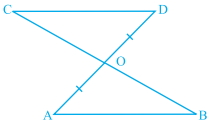
Line-segment $AB$ is parallel to another line-segment $CD$. $O$ is the mid-point of $AD$ (see Fig). Show that $(i)$ $\Delta AOB \cong \Delta DOC$ $(ii)$ $O$ is also the mid-point of $BC$.
Solution
$(i)$ Consider $\Delta AOB$ and $\Delta DOC$.
$\angle OAB = \angle ODC$ (Alternate interior angles as $AB \parallel CD$ and $AD$ is the transversal)
$\angle AOB = \angle DOC$ (Vertically opposite angles)
$OA = OD$ (Given,as $O$ is the mid-point of $AD$)
Therefore,by $ASA$ congruence rule,$\Delta AOB \cong \Delta DOC$.
$(ii)$ Since $\Delta AOB \cong \Delta DOC$,then by $CPCT$ (Corresponding Parts of Congruent Triangles),
$OB = OC$
Thus,$O$ is the mid-point of $BC$.
0 likes
View Solution2
Medium
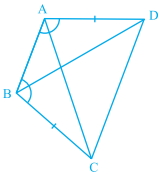
$ABCD$ is a quadrilateral in which $AD = BC$ and $\angle DAB = \angle CBA$ (see figure). Prove that:
$(i)$ $\Delta ABD \cong \Delta BAC$
$(ii)$ $BD = AC$
$(iii)$ $\angle ABD = \angle BAC$
$(i)$ $\Delta ABD \cong \Delta BAC$
$(ii)$ $BD = AC$
$(iii)$ $\angle ABD = \angle BAC$
Solution
(N/A) $(i)$ In quadrilateral $ABCD$,we have $AD = BC$ and $\angle DAB = \angle CBA$.
Consider $\Delta ABD$ and $\Delta BAC$:
$AD = BC$ (Given)
$AB = BA$ (Common side)
$\angle DAB = \angle CBA$ (Given)
Therefore,by $SAS$ (Side-Angle-Side) congruence criterion,we have $\Delta ABD \cong \Delta BAC$.
$(ii)$ Since $\Delta ABD \cong \Delta BAC$,their corresponding parts are equal $(CPCT)$.
Therefore,$BD = AC$.
$(iii)$ Since $\Delta ABD \cong \Delta BAC$,their corresponding parts are equal $(CPCT)$.
Therefore,$\angle ABD = \angle BAC$.
0 likes
View Solution3
Medium
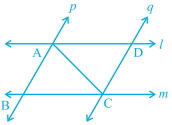
$l$ and $m$ are two parallel lines intersected by another pair of parallel lines $p$ and $q$ (see Fig). Show that $\Delta ABC \cong \Delta CDA$.
Solution
(N/A) Given: $l \parallel m$ and $p \parallel q$.
To prove: $\Delta ABC \cong \Delta CDA$.
Proof:
Since $l \parallel m$ and $AC$ is a transversal,
$\therefore \angle BAC = \angle DCA$ [Alternate interior angles]
Also,since $p \parallel q$ and $AC$ is a transversal,
$\therefore \angle BCA = \angle DAC$ [Alternate interior angles]
Now,in $\Delta ABC$ and $\Delta CDA$:
$\angle BAC = \angle DCA$ [Proved above]
$\angle BCA = \angle DAC$ [Proved above]
$AC = CA$ [Common side]
Therefore,by the $ASA$ (Angle-Side-Angle) congruence criterion,$\Delta ABC \cong \Delta CDA$.
0 likes
View Solution4
Medium
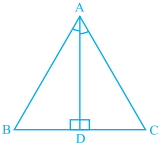
In $\Delta ABC$,the bisector $AD$ of $\angle A$ is perpendicular to side $BC$ (see figure). Show that $AB = AC$ and $\Delta ABC$ is isosceles.
Solution
(N/A) In $\Delta ABD$ and $\Delta ACD$:
$\angle BAD = \angle CAD$ (Given,as $AD$ is the bisector of $\angle A$)
$AD = AD$ (Common side)
$\angle ADB = \angle ADC = 90^\circ$ (Given,as $AD \perp BC$)
Therefore,by the $ASA$ (Angle-Side-Angle) congruence rule,$\Delta ABD \cong \Delta ACD$.
Since the triangles are congruent,their corresponding parts are equal $(CPCT)$.
Thus,$AB = AC$.
Since two sides of $\Delta ABC$ are equal,$\Delta ABC$ is an isosceles triangle.
0 likes
View Solution5
Easy
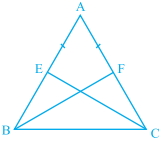
$E$ and $F$ are respectively the mid-points of equal sides $AB$ and $AC$ of $\Delta ABC$ (see figure). Show that $BF = CE$.
Solution
(N/A) In $\Delta ABF$ and $\Delta ACE$:
$AB = AC$ (Given)
$\angle A = \angle A$ (Common angle)
$AF = AE$ (Since $F$ and $E$ are mid-points of equal sides $AC$ and $AB$ respectively,$AF = \frac{1}{2} AC$ and $AE = \frac{1}{2} AB$. Since $AB = AC$,it follows that $AF = AE$.)
Therefore,$\Delta ABF \cong \Delta ACE$ by the $SAS$ congruence rule.
Since the triangles are congruent,their corresponding parts are equal.
Thus,$BF = CE$ (by $CPCT$).
0 likes
View Solution6
Medium
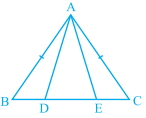
In an isosceles triangle $ABC$ with $AB = AC$,$D$ and $E$ are points on $BC$ such that $BE = CD$ (see Fig). Show that $AD = AE$.
Solution
(N/A) In $\Delta ABD$ and $\Delta ACE$:
$AB = AC$ (Given) ........... $(1)$
$\angle B = \angle C$ (Angles opposite to equal sides) ........... $(2)$
Also,$BE = CD$
Subtracting $DE$ from both sides:
$BE - DE = CD - DE$
$BD = CE$ ........... $(3)$
Therefore,$\Delta ABD \cong \Delta ACE$ (Using $(1)$,$(2)$,$(3)$ and $SAS$ congruence rule).
This gives $AD = AE$ $(CPCT)$.
0 likes
View Solution7
Medium
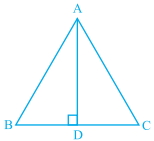
In $\Delta ABC$,$AD$ is the perpendicular bisector of $BC$ (see figure). Show that $\Delta ABC$ is an isosceles triangle in which $AB = AC$.
Solution
(N/A) Given: $AD$ is the perpendicular bisector of $BC$,which implies $BD = CD$ and $\angle ADB = \angle ADC = 90^o$.
In $\Delta ABD$ and $\Delta ACD$:
$AD = AD$ (Common side)
$\angle ADB = \angle ADC = 90^o$ (Given)
$BD = CD$ (Since $AD$ is the bisector of $BC$)
Therefore,$\Delta ABD \cong \Delta ACD$ by the $SAS$ congruence criterion.
Since the triangles are congruent,their corresponding parts are equal $(CPCT)$.
Thus,$AB = AC$.
Since two sides of $\Delta ABC$ are equal,it is an isosceles triangle.
0 likes
View Solution8
Medium
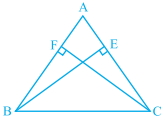
$\Delta ABC$ is an isosceles triangle in which altitudes $BE$ and $CF$ are drawn to equal sides $AC$ and $AB$ respectively. Show that these altitudes are equal.
Solution
(N/A) Given: $\Delta ABC$ is an isosceles triangle with $AB = AC$.
Altitudes $BE \perp AC$ and $CF \perp AB$.
To prove: $BE = CF$.
Proof:
In $\Delta ABE$ and $\Delta ACF$:
$1$. $\angle A = \angle A$ (Common angle)
$2$. $AB = AC$ (Given)
$3$. $\angle AEB = \angle AFC = 90^\circ$ (Since $BE$ and $CF$ are altitudes)
Therefore,by $AAS$ congruence criterion,$\Delta ABE \cong \Delta ACF$.
Since the triangles are congruent,their corresponding parts are equal $(CPCT)$.
Thus,$BE = CF$.
1 likes
View Solution9
Difficult
$AB$ is a line segment. $P$ and $Q$ are points on opposite sides of $AB$ such that each of them is equidistant from the points $A$ and $B$ (see figure). Show that the line $PQ$ is the perpendicular bisector of $AB$.
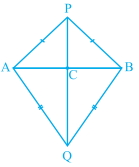
Solution
(N/A) Given: $PA = PB$ and $QA = QB$. We need to show that $PQ \perp AB$ and $PQ$ bisects $AB$. Let $PQ$ intersect $AB$ at $C$.
Consider $\Delta PAQ$ and $\Delta PBQ$:
$AP = BP$ (Given)
$AQ = BQ$ (Given)
$PQ = PQ$ (Common side)
Therefore,$\Delta PAQ \cong \Delta PBQ$ by $SSS$ congruence rule.
This implies $\angle APQ = \angle BPQ$ by $CPCT$.
Now,consider $\Delta PAC$ and $\Delta PBC$:
$AP = BP$ (Given)
$\angle APC = \angle BPC$ (Since $\angle APQ = \angle BPQ$)
$PC = PC$ (Common side)
Therefore,$\Delta PAC \cong \Delta PBC$ by $SAS$ congruence rule.
This implies $AC = BC$ and $\angle ACP = \angle BCP$ by $CPCT$.
Since $\angle ACP + \angle BCP = 180^o$ (Linear pair),
$2 \angle ACP = 180^o \implies \angle ACP = 90^o$.
Since $AC = BC$ and $\angle ACP = 90^o$,$PQ$ is the perpendicular bisector of $AB$.
0 likes
View Solution10
Medium
$P$ is a point equidistant from two lines $l$ and $m$ intersecting at point $A$. Show that the line $AP$ bisects the angle between them.
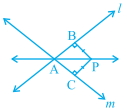
Solution
(N/A) Given: Lines $l$ and $m$ intersect at point $A$. $P$ is a point such that $PB \perp l$ and $PC \perp m$,with $PB = PC$.
To prove: Line $AP$ bisects the angle between lines $l$ and $m$,i.e.,$\angle PAB = \angle PAC$.
Proof: Consider $\Delta PAB$ and $\Delta PAC$.
In these two triangles:
$1$. $PB = PC$ (Given,as $P$ is equidistant from the lines)
$2$. $\angle PBA = \angle PCA = 90^o$ (Given,as $PB \perp l$ and $PC \perp m$)
$3$. $PA = PA$ (Common side)
Therefore,by the $RHS$ congruence rule,$\Delta PAB \cong \Delta PAC$.
Since the triangles are congruent,their corresponding parts are equal $(CPCT)$.
Thus,$\angle PAB = \angle PAC$.
This shows that the line $AP$ bisects the angle between lines $l$ and $m$.
0 likes
View Solution11
Medium
$AD$ is an altitude of an isosceles triangle $ABC$ in which $AB = AC$. Show that:
$(i)$ $AD$ bisects $BC$
$(ii)$ $AD$ bisects $\angle A$.
$(i)$ $AD$ bisects $BC$
$(ii)$ $AD$ bisects $\angle A$.
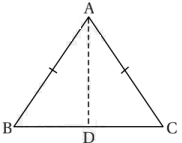
Solution
(N/A) $(i)$ In $\Delta ABD$ and $\Delta ACD$,we have:
$AB = AC$ [Given]
$\angle ADB = \angle ADC = 90^\circ$ [Since $AD$ is an altitude]
$AD = AD$ [Common side]
Therefore,by $RHS$ congruence rule,$\Delta ABD \cong \Delta ACD$.
Since the triangles are congruent,their corresponding parts are equal $(CPCT)$.
Therefore,$BD = CD$,which means $AD$ bisects $BC$.
$(ii)$ Since $\Delta ABD \cong \Delta ACD$,their corresponding angles are equal $(CPCT)$.
Therefore,$\angle BAD = \angle CAD$,which means $AD$ bisects $\angle A$.
0 likes
View Solution12
Medium
Two sides $AB$ and $BC$ and median $AM$ of one triangle $ABC$ are respectively equal to sides $PQ$ and $QR$ and median $PN$ of $\Delta PQR$ (see Fig). Show that:
$(i)$ $\Delta ABM \cong \Delta PQN$
$(ii)$ $\Delta ABC \cong \Delta PQR$
$(i)$ $\Delta ABM \cong \Delta PQN$
$(ii)$ $\Delta ABC \cong \Delta PQR$
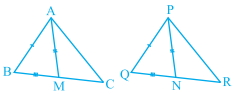
Solution
(N/A) In $\Delta ABC$,$AM$ is a median [Given].
$\therefore BM = \frac{1}{2} BC$ ........... $(1)$
In $\Delta PQR$,$PN$ is a median.
$\therefore QN = \frac{1}{2} QR$ ........... $(2)$
$\because BC = QR$ [Given]
$\therefore \frac{1}{2} BC = \frac{1}{2} QR$
$\Rightarrow BM = QN$ [From $(1)$ and $(2)$]
$(i)$ In $\Delta ABM$ and $\Delta PQN$,we have:
$AB = PQ$ [Given]
$AM = PN$ [Given]
$BM = QN$ [Proved above]
$\therefore \Delta ABM \cong \Delta PQN$ [$SSS$ congruence criterion]
$(ii)$ $\because \Delta ABM \cong \Delta PQN$
$\therefore$ Their corresponding parts are congruent $(CPCT)$.
$\Rightarrow \angle B = \angle Q$
Now,in $\Delta ABC$ and $\Delta PQR$,we have:
$AB = PQ$ [Given]
$\angle B = \angle Q$ [Proved above]
$BC = QR$ [Given]
$\therefore \Delta ABC \cong \Delta PQR$ [$SAS$ congruence criterion]
0 likes
View Solution13
Difficult
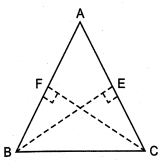
$BE$ and $CF$ are two equal altitudes of a triangle $ABC$. Using $RHS$ congruence rule,prove that the triangle $ABC$ is isosceles.
Solution
(N/A) Given: $BE \perp AC$ and $CF \perp AB$ such that $BE = CF$.
To prove: $\Delta ABC$ is an isosceles triangle,i.e.,$AB = AC$.
Proof:
In right-angled triangles $\Delta BEC$ and $\Delta CFB$:
$1$. $\angle BEC = \angle CFB = 90^\circ$ (Altitudes are perpendicular to the sides).
$2$. $BC = CB$ (Common hypotenuse).
$3$. $BE = CF$ (Given).
Therefore,by $RHS$ congruence rule,$\Delta BEC \cong \Delta CFB$.
Since the triangles are congruent,their corresponding parts are equal $(CPCT)$:
$\angle BCE = \angle CBF$
This implies $\angle BCA = \angle CBA$.
In $\Delta ABC$,since the angles opposite to equal sides are equal,the sides opposite to equal angles are also equal.
Therefore,$AB = AC$.
Hence,$\Delta ABC$ is an isosceles triangle.
0 likes
View Solution14
Medium
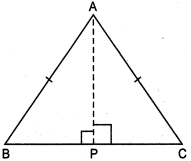
$ABC$ is an isosceles triangle with $AB = AC$. Draw $AP \perp BC$ to show that $\angle B = \angle C$.
Solution
(N/A) Given: $ABC$ is an isosceles triangle with $AB = AC$. $AP \perp BC$.
To prove: $\angle B = \angle C$.
Proof:
In $\Delta ABP$ and $\Delta ACP$:
$1$. $\angle APB = \angle APC = 90^\circ$ (Since $AP \perp BC$)
$2$. $AB = AC$ (Given)
$3$. $AP = AP$ (Common side)
Therefore,by $RHS$ congruence criterion,$\Delta ABP \cong \Delta ACP$.
Since the triangles are congruent,their corresponding parts are equal $(CPCT)$.
Thus,$\angle B = \angle C$.
0 likes
View Solution15
EasyMCQ
If $\triangle ABC \cong \triangle PQR$ and $\triangle ABC$ is not congruent to $\triangle RPQ$,then which of the following is not true?
A
$BC = PQ$
B
$AC = PR$
C
$QR = BC$
D
$AB = PQ$
Solution
(A) Given that $\triangle ABC \cong \triangle PQR$. By the rule of correspondence in congruent triangles,the corresponding parts are equal:
$AB = PQ$,$BC = QR$,and $AC = PR$.
Also,the angles are equal: $\angle A = \angle P$,$\angle B = \angle Q$,and $\angle C = \angle R$.
We are given that $\triangle ABC$ is not congruent to $\triangle RPQ$. This implies that the correspondence $A \leftrightarrow R$,$B \leftrightarrow P$,and $C \leftrightarrow Q$ does not hold.
Let's check the options based on $\triangle ABC \cong \triangle PQR$:
Option $A$: $BC = PQ$. From the correspondence,$BC = QR$. Thus,$BC = PQ$ is generally not true.
Option $B$: $AC = PR$. This is true by correspondence.
Option $C$: $QR = BC$. This is true by correspondence.
Option $D$: $AB = PQ$. This is true by correspondence.
Therefore,the statement that is not true is $BC = PQ$.
0 likes
View Solution16
EasyMCQ
Which of the following is not a criterion for congruence of triangles?
A
$SAS$
B
$SSA$
C
$ASA$
D
$SSS$
Solution
(B) The criteria for congruence of triangles are $SAS$ (Side-Angle-Side),$ASA$ (Angle-Side-Angle),$SSS$ (Side-Side-Side),$AAS$ (Angle-Angle-Side),and $RHS$ (Right angle-Hypotenuse-Side).
$SSA$ (Side-Side-Angle) is not a valid criterion for the congruence of triangles because it does not uniquely determine a triangle.
$SSA$ (Side-Side-Angle) is not a valid criterion for the congruence of triangles because it does not uniquely determine a triangle.
0 likes
View Solution17
EasyMCQ
If $AB = QR$,$BC = PR$,and $CA = PQ$,then
A
$\triangle ABC \cong \triangle PQR$
B
$\triangle BAC \cong \triangle RPQ$
C
$\triangle CBA \cong \triangle PRQ$
D
$\triangle PQR \cong \triangle BCA$
Solution
(C) Given the side correspondences: $AB = QR$,$BC = PR$,and $CA = PQ$.
To determine the congruence,we map the vertices based on the equal sides:
$1$. Since $AB = QR$,vertex $A$ corresponds to $Q$ and vertex $B$ corresponds to $R$.
$2$. Since $BC = PR$,vertex $B$ corresponds to $P$ and vertex $C$ corresponds to $R$.
$3$. Since $CA = PQ$,vertex $C$ corresponds to $P$ and vertex $A$ corresponds to $Q$.
Matching the vertices: $A \leftrightarrow Q$,$B \leftrightarrow R$,and $C \leftrightarrow P$ is not correct based on the side $BC=PR$. Let's re-evaluate:
$A$ corresponds to $Q$,$B$ corresponds to $R$,and $C$ corresponds to $P$.
Looking at the sides: $AB$ corresponds to $QR$,$BC$ corresponds to $RP$,and $CA$ corresponds to $PQ$.
Thus,$\triangle ABC \cong \triangle QRP$.
Re-checking the options provided:
If $AB=QR, BC=PR, CA=PQ$,then the correspondence is $A \leftrightarrow Q, B \leftrightarrow R, C \leftrightarrow P$.
Therefore,$\triangle CBA \cong \triangle PRQ$ is correct because $CB=PR, BA=RQ, AC=QP$.
0 likes
View Solution18
EasyMCQ
In triangles $ABC$ and $DEF$,$AB = FD$ and $\angle A = \angle D$. The two triangles will be congruent by the $SAS$ axiom if:
A
$BC = EF$
B
$AC = EF$
C
$BC = DE$
D
$AC = DE$
Solution
(D) According to the $SAS$ (Side-Angle-Side) congruence axiom,two triangles are congruent if two sides and the included angle of one triangle are equal to the corresponding two sides and the included angle of the other triangle.
Given: $AB = FD$ and $\angle A = \angle D$.
For the triangles to be congruent by $SAS$,the sides forming the angle $\angle A$ (which are $AB$ and $AC$) must be equal to the sides forming the angle $\angle D$ (which are $FD$ and $DE$).
Since $AB = FD$ is already given,we must have $AC = DE$ for the $SAS$ condition to be satisfied.
0 likes
View Solution19
Easy
In the two triangles $ABC$ and $DEF$,$AB = DE$ and $AC = EF$. Name two angles from the two triangles that must be equal so that the two triangles are congruent. Give reason for your answer.
Solution
(A) To prove that $\triangle ABC \cong \triangle DEF$ (or a variation thereof) using the $SAS$ (Side-Angle-Side) congruence criterion,the angle must be included between the two given sides.
For $\triangle ABC$,the sides are $AB$ and $AC$,so the included angle is $\angle A$.
For $\triangle DEF$,the sides are $DE$ and $EF$,so the included angle is $\angle E$.
Therefore,if $\angle A = \angle E$,then by the $SAS$ congruence rule,$\triangle ABC \cong \triangle DEF$.
For $\triangle ABC$,the sides are $AB$ and $AC$,so the included angle is $\angle A$.
For $\triangle DEF$,the sides are $DE$ and $EF$,so the included angle is $\angle E$.
Therefore,if $\angle A = \angle E$,then by the $SAS$ congruence rule,$\triangle ABC \cong \triangle DEF$.
0 likes
View Solution20
Easy
In triangles $ABC$ and $DEF$,$\angle A = \angle D$,$\angle B = \angle E$ and $AB = EF$. Will the two triangles be congruent? Give reasons for your answer.
Solution
(NO) The two triangles are not necessarily congruent. For two triangles to be congruent by the $ASA$ (Angle-Side-Angle) criterion,the side must be included between the two angles. In $\triangle ABC$,the side included between $\angle A$ and $\angle B$ is $AB$. In $\triangle DEF$,the side included between $\angle D$ and $\angle E$ is $DE$. Since the given condition is $AB = EF$ instead of $AB = DE$,the triangles do not satisfy the $ASA$ congruence criterion. Therefore,they are not necessarily congruent.
0 likes
View Solution21
Easy
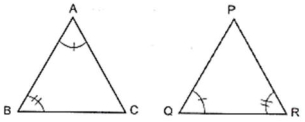
In triangles $ABC$ and $PQR$,$\angle A = \angle Q$ and $\angle B = \angle R$. Which side of $\triangle PQR$ should be equal to side $AB$ of $\triangle ABC$ so that the two triangles are congruent? Give reason for your answer.
Solution
(N/A) In triangles $ABC$ and $PQR$,we have:
$\angle A = \angle Q$ (Given)
$\angle B = \angle R$ (Given)
For the two triangles to be congruent by the $ASA$ (Angle-Side-Angle) congruence rule,the side included between the two angles must be equal.
In $\triangle ABC$,the side included between $\angle A$ and $\angle B$ is $AB$.
In $\triangle PQR$,the side included between $\angle Q$ and $\angle R$ is $QR$.
Therefore,for the triangles to be congruent,side $AB$ must be equal to side $QR$ $(AB = QR)$.
0 likes
View Solution22
Medium
In triangles $ABC$ and $PQR$,$\angle A = \angle Q$ and $\angle B = \angle R$. Which side of $\triangle PQR$ should be equal to side $BC$ of $\triangle ABC$ so that the two triangles are congruent? Give reason for your answer.
Solution
(N/A) In triangles $ABC$ and $PQR$,we are given:
$\angle A = \angle Q$ and $\angle B = \angle R$.
For the two triangles to be congruent by the $AAS$ (Angle-Angle-Side) congruence rule,the side corresponding to $BC$ in $\triangle ABC$ must be equal to the side corresponding to $RP$ in $\triangle PQR$.
Therefore,$BC = RP$.
This ensures that the two triangles are congruent by the $AAS$ congruence criterion.
0 likes
View Solution23
Easy
"If two sides and an angle of one triangle are equal to two sides and an angle of another triangle,then the two triangles must be congruent." Is the statement true? Why?
Solution
(B) The statement is false. For two triangles to be congruent by the $SAS$ (Side-Angle-Side) congruence rule,the angle must be the included angle between the two sides. If the angle is not the included angle,the triangles are not necessarily congruent.
0 likes
View Solution24
Easy
"If two angles and a side of one triangle are equal to two angles and a side of another triangle,then the two triangles must be congruent." Is the statement true? Why?
Solution
(A) The statement is true,provided that the side is the included side between the two angles ($ASA$ Congruence Rule) or the side is corresponding to the same relative position in both triangles ($AAS$ Congruence Rule).
If two angles and any side of one triangle are equal to the corresponding two angles and the corresponding side of another triangle,the triangles are congruent by the $AAS$ (Angle-Angle-Side) congruence criterion.
Therefore,the condition of correspondence is essential for the triangles to be congruent.
0 likes
View Solution25
Easy
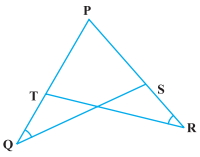
In the given figure,$PQ = PR$ and $\angle Q = \angle R$. Prove that $\triangle PQS \cong \triangle PRT$.
Solution
(N/A) In $\triangle PQS$ and $\triangle PRT$:
$1$. $PQ = PR$ (Given)
$2$. $\angle Q = \angle R$ (Given)
$3$. $\angle QPS = \angle RPT$ (Common angle $\angle P$)
Therefore,by the $ASA$ (Angle-Side-Angle) congruence criterion,$\triangle PQS \cong \triangle PRT$.
$1$. $PQ = PR$ (Given)
$2$. $\angle Q = \angle R$ (Given)
$3$. $\angle QPS = \angle RPT$ (Common angle $\angle P$)
Therefore,by the $ASA$ (Angle-Side-Angle) congruence criterion,$\triangle PQS \cong \triangle PRT$.
0 likes
View Solution26
Easy
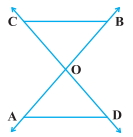
In the figure,two lines $AB$ and $CD$ intersect each other at the point $O$ such that $BC \parallel DA$ and $BC = DA$. Show that $O$ is the midpoint of both the line segments $AB$ and $CD$.
Solution
(N/A) Given: $BC \parallel AD$ and $BC = DA$.
Consider $\triangle BOC$ and $\triangle AOD$:
$1$. $\angle CBO = \angle DAO$ (Alternate interior angles,since $BC \parallel AD$)
$2$. $\angle BCO = \angle ADO$ (Alternate interior angles,since $BC \parallel AD$)
$3$. $BC = DA$ (Given)
By the $ASA$ (Angle-Side-Angle) congruence criterion,$\triangle BOC \cong \triangle AOD$.
Since the triangles are congruent,their corresponding parts are equal $(CPCT)$:
$OB = OA$ and $OC = OD$.
Therefore,$O$ is the midpoint of both the line segments $AB$ and $CD$.
0 likes
View Solution27
Medium
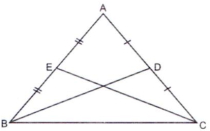
$ABC$ is an isosceles triangle with $AB = AC$. $BD$ and $CE$ are its two medians. Show that $BD = CE$.
Solution
(N/A) Given: $\triangle ABC$ with $AB = AC$.
$D$ is the mid-point of $AC$ and $E$ is the mid-point of $AB$.
To prove: $BD = CE$.
Proof: In $\triangle ABD$ and $\triangle ACE$:
$1$. $AB = AC$ (Given)
$2$. $\angle BAD = \angle CAE$ (Common angle)
$3$. $AD = AE$ (Since $AB = AC$,their halves are equal,i.e.,$\frac{1}{2}AB = \frac{1}{2}AC$)
By $SAS$ congruence criterion,$\triangle ABD \cong \triangle ACE$.
Therefore,$BD = CE$ by $CPCT$ (Corresponding Parts of Congruent Triangles).
0 likes
View Solution28
Medium
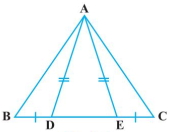
In the figure,$D$ and $E$ are points on side $BC$ of a $\triangle ABC$ such that $BD = CE$ and $AD = AE$. Show that $\triangle ABD \cong \triangle ACE$.
Solution
(N/A) Given: $\triangle ABC$ in which $BD = CE$ and $AD = AE$.
To Prove: $\triangle ABD \cong \triangle ACE$.
Proof: In $\triangle ADE$,we have
$AD = AE$ [Given]
$\Rightarrow \angle ADE = \angle AED$ [Angles opposite to equal sides of a triangle are equal]
Now,$\angle ADB + \angle ADE = 180^{\circ}$ [Linear pair axiom]
$\angle AEC + \angle AED = 180^{\circ}$ [Linear pair axiom]
From these equations,we get:
$\angle ADB + \angle ADE = \angle AEC + \angle AED$
Since $\angle ADE = \angle AED$,we have $\angle ADB = \angle AEC$.
Now,in $\triangle ABD$ and $\triangle ACE$:
$AD = AE$ [Given]
$\angle ADB = \angle AEC$ [Proved above]
$BD = CE$ [Given]
So,by $SAS$ criterion of congruence,we have
$\triangle ABD \cong \triangle ACE$.
Hence,proved.
0 likes
View Solution29
Difficult
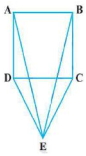
$CDE$ is an equilateral triangle formed on side $CD$ of a square $ABCD$ (see figure). Show that $\triangle ADE \cong \triangle BCE$.
Solution
(N/A) Given: An equilateral triangle $CDE$ is formed on side $CD$ of square $ABCD$.
To prove: $\triangle ADE \cong \triangle BCE$.
Proof: In square $ABCD$,we have:
$AD = BC$ (Sides of a square are equal) ... $(1)$
$\angle ADC = \angle BCD = 90^{\circ}$ (Angles of a square) ... $(2)$
In equilateral triangle $CDE$,we have:
$DE = CE$ (Sides of an equilateral triangle are equal) ... $(3)$
$\angle CDE = \angle DCE = 60^{\circ}$ (Angles of an equilateral triangle) ... $(4)$
Adding $(2)$ and $(4)$:
$\angle ADC + \angle CDE = \angle BCD + \angle DCE$
$\angle ADE = \angle BCE$ ... $(5)$
Now,in $\triangle ADE$ and $\triangle BCE$:
$AD = BC$ (From $1$)
$\angle ADE = \angle BCE$ (From $5$)
$DE = CE$ (From $3$)
Therefore,by $SAS$ congruence criterion,$\triangle ADE \cong \triangle BCE$.
0 likes
View Solution30
Medium
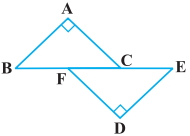
In the given figure,$BA \perp AC$ and $DE \perp DF$ such that $BA = DE$ and $BF = EC$. Show that $\triangle ABC \cong \triangle DEF$.
Solution
(N/A) Given: $BA \perp AC$,$DE \perp DF$,$BA = DE$,and $BF = EC$.
Step $1$: Establish the equality of the hypotenuses.
We are given $BF = EC$.
Adding $FC$ to both sides,we get:
$BF + FC = EC + FC$
$BC = EF$
Step $2$: Compare the two triangles.
In $\triangle ABC$ and $\triangle DEF$:
$1$. $\angle A = \angle D = 90^{\circ}$ (Given as $BA \perp AC$ and $DE \perp DF$)
$2$. $BA = DE$ (Given)
$3$. $BC = EF$ (Hypotenuse,proved above)
Step $3$: Conclusion.
By the $RHS$ (Right angle-Hypotenuse-Side) congruence rule,$\triangle ABC \cong \triangle DEF$.
0 likes
View Solution31
Medium
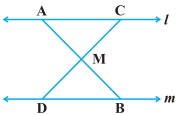
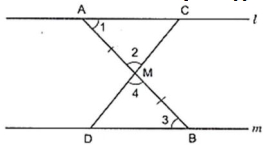
In the given figure,$l \parallel m$ and $M$ is the mid-point of a line segment $AB$. Show that $M$ is also the mid-point of any line segment $CD,$ having its end points on $l$ and $m,$ respectively.
Solution
(N/A) In $\triangle AMC$ and $\triangle BMD$,we have:
$\angle MAC = \angle MBD$ (Alternate interior angles,since $l \parallel m$)
$\angle AMC = \angle BMD$ (Vertically opposite angles)
$AM = BM$ (Given,as $M$ is the mid-point of $AB$)
Therefore,$\triangle AMC \cong \triangle BMD$ (By $ASA$ congruence rule)
Thus,$CM = DM$ (By $CPCT$)
Hence,$M$ is also the mid-point of $CD.$
0 likes
View Solution32
Medium
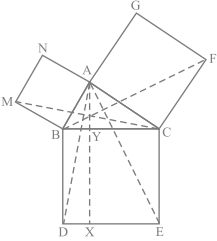
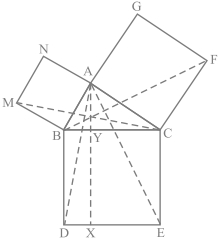
In the figure,$ABC$ is a right triangle right-angled at $A$. $BCED$,$ACFG$,and $ABMN$ are squares on the sides $BC$,$CA$,and $AB$ respectively. Line segment $AX \perp DE$ meets $BC$ at $Y$. Show that: $\Delta MBC \cong \Delta ABD$.
Solution
(N/A) We have a right-angled $\Delta ABC$ such that $BCED$,$ACFG$,and $ABMN$ are squares on its sides $BC$,$CA$,and $AB$ respectively. Line segment $AX \perp DE$ is drawn such that it meets $BC$ at $Y$.
To prove that $\Delta MBC \cong \Delta ABD$:
In $\Delta ABD$ and $\Delta MBC$,we have:
$AB = MB$ (Sides of the square $ABMN$)
$BD = BC$ (Sides of the square $BCED$)
$\angle MBA = 90^\circ$ and $\angle CBD = 90^\circ$ (Angles of squares)
Therefore,$\angle MBA = \angle CBD = 90^\circ$.
Adding $\angle ABC$ to both sides:
$\angle MBA + \angle ABC = \angle CBD + \angle ABC$
$\angle MBC = \angle ABD$
Thus,by the $SAS$ (Side-Angle-Side) congruence criterion:
$\Delta MBC \cong \Delta ABD$.
0 likes
View Solution33
Medium
In the figure,$ABC$ is a right-angled triangle with the right angle at $A$. $BCED$,$ACFG$,and $ABMN$ are squares constructed on the sides $BC$,$CA$,and $AB$ respectively. The line segment $AX \perp DE$ meets $BC$ at $Y$. Show that: $\Delta FCB \cong \Delta ACE$.
Solution
(N/A) To prove: $\Delta FCB \cong \Delta ACE$
In $\Delta FCB$ and $\Delta ACE$:
$1$. $FC = AC$ (Sides of the same square $ACFG$)
$2$. $CB = CE$ (Sides of the same square $BCED$)
$3$. $\angle FCA = \angle BCE = 90^\circ$ (Angles of squares)
Adding $\angle ACB$ to both sides:
$\angle FCA + \angle ACB = \angle BCE + \angle ACB$
$\angle FCB = \angle ACE$
Therefore,by the $SAS$ (Side-Angle-Side) congruence criterion:
$\Delta FCB \cong \Delta ACE$
0 likes
View Solution34
Medium
Prove that if in two triangles,two angles and the included side of one triangle are equal to two angles and the included side of the other triangle,then the two triangles are congruent.
Solution
(N/A) This is the $ASA$ (Angle-Side-Angle) congruence criterion.
Let there be two triangles $\triangle ABC$ and $\triangle DEF$ such that $\angle B = \angle E$,$\angle C = \angle F$,and $BC = EF$.
We need to prove that $\triangle ABC \cong \triangle DEF$.
Case $1$: If $AB = DE$,then $\triangle ABC \cong \triangle DEF$ by $SAS$ congruence rule.
Case $2$: If $AB < DE$,take a point $P$ on $DE$ such that $DP = AB$. Join $PF$. In $\triangle ABC$ and $\triangle DPF$,$AB = DP$,$\angle B = \angle E$,and $BC = EF$. Thus,$\triangle ABC \cong \triangle DPF$ by $SAS$. This implies $\angle ACB = \angle DPF$. But we are given $\angle ACB = \angle DFE$. Therefore,$\angle DPF = \angle DFE$,which is only possible if $P$ coincides with $E$. Thus,$AB = DE$ and $\triangle ABC \cong \triangle DEF$.
Case $3$: If $AB > DE$,a similar argument shows $AB = DE$ and the triangles are congruent.
0 likes
View Solution35
Medium
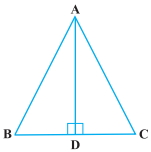
$ABC$ is an isosceles triangle with $AB = AC$ and $D$ is a point on $BC$ such that $AD \perp BC$. To prove that $\angle BAD = \angle CAD$,a student proceeded as follows:
In $\triangle ABD$ and $\triangle ACD$:
$AB = AC$ (Given)
$\angle B = \angle C$ (because $AB = AC$)
and $\angle ADB = \angle ADC$
Therefore,$\triangle ABD \cong \triangle ACD$ $(AAS)$
So,$\angle BAD = \angle CAD$ $(CPCT)$
What is the defect in the above arguments?
In $\triangle ABD$ and $\triangle ACD$:
$AB = AC$ (Given)
$\angle B = \angle C$ (because $AB = AC$)
and $\angle ADB = \angle ADC$
Therefore,$\triangle ABD \cong \triangle ACD$ $(AAS)$
So,$\angle BAD = \angle CAD$ $(CPCT)$
What is the defect in the above arguments?
Solution
(N/A) The defect in the student's argument is that they used the $AAS$ (Angle-Angle-Side) congruence criterion,but the side $AD$ is not included between the angles $\angle B$ and $\angle ADB$ in $\triangle ABD$.
Correct proof:
In $\triangle ABD$ and $\triangle ACD$:
$AB = AC$ (Given)
$AD = AD$ (Common side)
$\angle ADB = \angle ADC = 90^{\circ}$ (Given $AD \perp BC$)
Therefore,by $RHS$ (Right angle-Hypotenuse-Side) congruence criterion:
$\triangle ABD \cong \triangle ACD$
Thus,$\angle BAD = \angle CAD$ $(CPCT)$.
0 likes
View Solution36
Medium
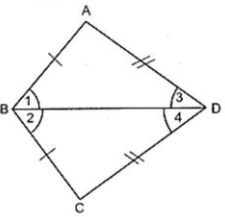
$ABCD$ is a quadrilateral in which $AB = BC$ and $AD = CD$. Show that $BD$ bisects both the angles $ABC$ and $ADC$.
Solution
(N/A) In $\triangle ABD$ and $\triangle CBD$,we have:
$AB = CB$ [Given]
$AD = CD$ [Given]
$BD = BD$ [Common side]
Therefore,$\triangle ABD \cong \triangle CBD$ [By $SSS$ congruence rule]
$\Rightarrow \angle ABD = \angle CBD$ [$CPCT$]
And $\angle ADB = \angle CDB$ [$CPCT$]
Hence,$BD$ bisects both the angles $ABC$ and $ADC$.
$AB = CB$ [Given]
$AD = CD$ [Given]
$BD = BD$ [Common side]
Therefore,$\triangle ABD \cong \triangle CBD$ [By $SSS$ congruence rule]
$\Rightarrow \angle ABD = \angle CBD$ [$CPCT$]
And $\angle ADB = \angle CDB$ [$CPCT$]
Hence,$BD$ bisects both the angles $ABC$ and $ADC$.
0 likes
View Solution37
Medium
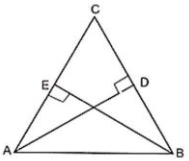
$ABC$ is an isosceles triangle in which $AC = BC$. $AD$ and $BE$ are respectively two altitudes to sides $BC$ and $AC$. Prove that $AE = BD$.
Solution
(N/A) In $\triangle ADC$ and $\triangle BEC$ we have:
$AC = BC$ [Given] ... $(1)$
$\angle ADC = \angle BEC = 90^{\circ}$ [Given as altitudes]
$\angle ACD = \angle BCE$ [Common angle]
Therefore,$\triangle ADC \cong \triangle BEC$ [By $AAS$ congruence rule]
Therefore,$CD = CE$ ... $(2)$ [$CPCT$]
Subtracting $(2)$ from $(1)$,we get:
$AC - CE = BC - CD$
$AE = BD$
Hence,proved.
0 likes
View Solution38
Medium
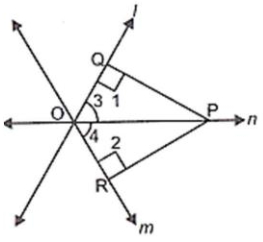
Two lines $l$ and $m$ intersect at the point $O$ and $P$ is a point on a line $n$ passing through the point $O$ such that $P$ is equidistant from $l$ and $m$. Prove that $n$ is the bisector of the angle formed by $l$ and $m$.
Solution
(N/A) Given: Lines $l$ and $m$ intersect at point $O$. $P$ is a point on line $n$ passing through $O$ such that $PQ \perp l$ and $PR \perp m$,where $PQ = PR$.
To prove: $n$ is the bisector of $\angle QOR$.
Proof: In $\triangle OQP$ and $\triangle ORP$,we have:
$\angle OQP = \angle ORP = 90^{\circ}$ (Given that $P$ is equidistant from $l$ and $m$)
$OP = OP$ (Common side)
$PQ = PR$ (Given)
By $RHS$ (Right angle-Hypotenuse-Side) criterion of congruence,we have:
$\triangle OQP \cong \triangle ORP$
Therefore,$\angle QOP = \angle ROP$ (by $CPCT$ - Corresponding Parts of Congruent Triangles).
Thus,$n$ is the bisector of $\angle QOR$. Hence proved.
0 likes
View Solution39
Medium
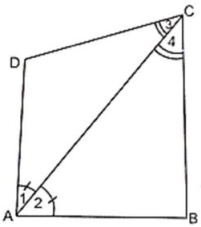
$ABCD$ is a quadrilateral such that diagonal $AC$ bisects the angles $A$ and $C.$ Prove that $AB = AD$ and $CB = CD.$
Solution
(N/A) Given: $A$ quadrilateral $ABCD$ such that $\angle 1 = \angle 2$ and $\angle 3 = \angle 4.$
To prove: $AB = AD$ and $CB = CD.$
Proof: In $\triangle ABC$ and $\triangle ADC$,we have:
$\angle 1 = \angle 2$ [Given]
$AC = AC$ [Common side]
$\angle 3 = \angle 4$ [Given]
So,by $ASA$ criterion of congruence,we have:
$\triangle ABC \cong \triangle ADC$
Therefore,$AB = AD$ [by $CPCT$]
And $CB = CD$ [by $CPCT$]
Hence,proved.
0 likes
View Solution40
Difficult
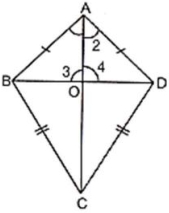
$ABCD$ is a quadrilateral such that $AB = AD$ and $CB = CD$. Prove that $AC$ is the perpendicular bisector of $BD$.
Solution
(N/A) Given: $A$ quadrilateral $ABCD$ in which $AB = AD$ and $CB = CD$.
To prove: $AC$ is the perpendicular bisector of $BD$.
Proof: In $\triangle ABC$ and $\triangle ADC$,we have:
$AB = AD$ (Given)
$BC = CD$ (Given)
$AC = AC$ (Common side)
So,by $SSS$ congruence criterion,we have:
$\triangle ABC \cong \triangle ADC$
Therefore,$\angle 1 = \angle 2$ (by $CPCT$)
Now,in $\triangle AOB$ and $\triangle AOD$,we have:
$AB = AD$ (Given)
$\angle 1 = \angle 2$ (Proved above)
$AO = AO$ (Common side)
So,by $SAS$ congruence criterion,we have:
$\triangle AOB \cong \triangle AOD$
Therefore,$BO = DO$ (by $CPCT$)
And $\angle 3 = \angle 4$ (by $CPCT$)
But,$\angle 3 + \angle 4 = 180^{\circ}$ (Linear pair axiom)
Since $\angle 3 = \angle 4$,we have:
$\angle 3 + \angle 3 = 180^{\circ}$
$2\angle 3 = 180^{\circ}$
$\angle 3 = 90^{\circ}$
Since $BO = DO$ and $\angle 3 = 90^{\circ}$,$AC$ is the perpendicular bisector of $BD$.
Hence,proved.
0 likes
View Solution41
Medium
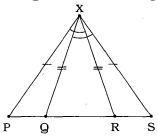
In the given figure,$XP = XS$,$XQ = XR$ and $\angle PXR = \angle SXQ$. Prove that $PQ = SR$.
Solution
(N/A) Given: $\angle PXR = \angle SXQ$
Subtracting $\angle QXR$ from both sides:
$\angle PXR - \angle QXR = \angle SXQ - \angle QXR$
$\therefore \angle PXQ = \angle SXR \quad \dots(1)$
Now,in $\Delta XPQ$ and $\Delta XSR$:
$XP = XS$ (Given)
$XQ = XR$ (Given)
$\angle PXQ = \angle SXR$ [From $(1)$]
$\therefore \Delta XPQ \cong \Delta XSR$ (By $SAS$ congruence criterion)
$\therefore PQ = SR$ (By $CPCT$)
0 likes
View Solution42
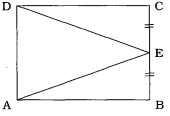
Medium
In rectangle $ABCD$,$E$ is the midpoint of $BC$. Prove that $AE = DE$.
Solution
(N/A) In rectangle $ABCD$,
$AB = DC$ (Opposite sides of a rectangle are equal)
and $\angle B = \angle C = 90^{\circ}$ (Each angle of a rectangle is $90^{\circ}$).
Also,$E$ is the midpoint of $BC$,so $BE = CE$.
Now,consider $\Delta ABE$ and $\Delta DCE$:
$AB = DC$ (Proved above)
$\angle B = \angle C = 90^{\circ}$ (Proved above)
$BE = CE$ (Given that $E$ is the midpoint of $BC$)
By the $SAS$ (Side-Angle-Side) congruence criterion,$\Delta ABE \cong \Delta DCE$.
Since the triangles are congruent,their corresponding parts are equal.
Therefore,$AE = DE$ (by $CPCT$ - Corresponding Parts of Congruent Triangles).
0 likes
View Solution43
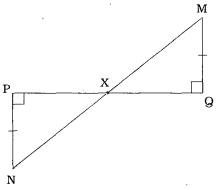
Easy
In the given figure,$PN$ and $QM$ are both perpendicular to line segment $PQ$. Also,$X$ is the midpoint of $PQ$ as well as $MN$. Prove that $\triangle PNX \cong \triangle QMX$.
Solution
(N/A) Given:
$1$. $PN \perp PQ$ and $QM \perp PQ$.
$2$. $X$ is the midpoint of $PQ$,so $PX = QX$.
$3$. $X$ is the midpoint of $MN$,so $NX = MX$.
To prove: $\triangle PNX \cong \triangle QMX$.
Proof:
In $\triangle PNX$ and $\triangle QMX$:
$1$. $PX = QX$ (Given,$X$ is the midpoint of $PQ$).
$2$. $NX = MX$ (Given,$X$ is the midpoint of $MN$).
$3$. $\angle PNX = \angle QMX$ (Since $PN \parallel QM$ because both are perpendicular to $PQ$,and $MN$ is a transversal,these are alternate interior angles).
Alternatively,using $SAS$ congruence criterion:
$1$. $PX = QX$ (Given).
$2$. $\angle P = \angle Q = 90^\circ$ (Given).
$3$. $NX = MX$ (Given).
Therefore,by $RHS$ congruence criterion (or $SAS$),$\triangle PNX \cong \triangle QMX$.
0 likes
View Solution44
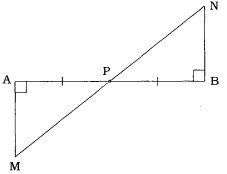
Easy
In the given figure,$AM$ and $BN$ are both perpendicular to $AB$. $MN$ intersects $AB$ at $P$. Also,$P$ is the midpoint of $AB$. Prove that $AM = BN$ and $P$ is the midpoint of $MN$.
Solution
(N/A) Consider $\triangle APM$ and $\triangle BPN$.
$1$. $\angle MAP = \angle NBP = 90^{\circ}$ (Given that $AM \perp AB$ and $BN \perp AB$).
$2$. $AP = BP$ ($P$ is the midpoint of $AB$,given).
$3$. $\angle APM = \angle BPN$ (Vertically opposite angles).
Therefore,by the $ASA$ (Angle-Side-Angle) congruence criterion,$\triangle APM \cong \triangle BPN$.
Since the triangles are congruent,their corresponding parts are equal $(CPCT)$:
- $AM = BN$ (Hence proved).
- $PM = PN$ (Since $PM$ and $PN$ are corresponding sides).
Since $PM = PN$,$P$ is the midpoint of $MN$ (Hence proved).
1 likes
View Solution45
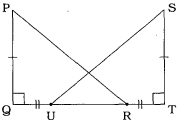
Medium
In the given figure,if $PQ = ST$,$QU = TR$,$PQ \perp QT$ and $ST \perp TQ$,then prove that $PR = SU$.
Solution
(N/A) Given: $PQ = ST$,$QU = TR$,$\angle PQT = 90^\circ$ and $\angle STQ = 90^\circ$.
To prove: $PR = SU$.
Proof:
Consider $\triangle PQR$ and $\triangle STU$.
$1$. $PQ = ST$ (Given)
$2$. $\angle PQR = \angle STU = 90^\circ$ (Given)
$3$. $QR = QU + UR$ and $TU = TR + UR$.
Since $QU = TR$,we have $QR = TR + UR = TU$.
Thus,$QR = TU$.
By $SAS$ congruence criterion,$\triangle PQR \cong \triangle STU$.
Since the triangles are congruent,their corresponding parts are equal $(CPCT)$.
Therefore,$PR = SU$.
2 likes
View Solution46
Medium
Point $M$ lies on the perpendicular bisector of $PQ$. Also $M$ does not lie on $PQ$. Prove that $M$ is equidistant from $P$ and $Q$.
Solution
(N/A) Let $PQ$ be a line segment and $L$ be its perpendicular bisector. Let $M$ be a point on $L$ such that $M$ does not lie on $PQ$. Let $L$ intersect $PQ$ at point $O$. Since $L$ is the perpendicular bisector of $PQ$,we have $PO = OQ$ and $\angle MOP = \angle MOQ = 90^{\circ}$. Consider $\triangle MOP$ and $\triangle MOQ$. In these triangles: $1$. $PO = OQ$ (Given). $2$. $\angle MOP = \angle MOQ = 90^{\circ}$ (Given). $3$. $MO = MO$ (Common side). By the $SAS$ (Side-Angle-Side) congruence criterion,$\triangle MOP \cong \triangle MOQ$. Since the triangles are congruent,their corresponding parts are equal $(CPCT)$. Therefore,$MP = MQ$. Thus,point $M$ is equidistant from $P$ and $Q$.
0 likes
View Solution47
Medium
In the given figure,$AB = AC$ and $BP = CQ$. Prove that $\Delta APQ$ is an isosceles triangle.
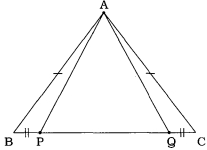
Solution
(N/A) In $\triangle ABC$,$AB = AC$ (Given).
$\therefore \angle ABC = \angle ACB$ ($\because$ Angles opposite to equal sides are equal).
Since $P$ lies on $BC$ and $Q$ lies on $BC$,we have $\angle ABP = \angle ACQ$.
Now,in $\triangle ABP$ and $\triangle ACQ$:
$AB = AC$ (Given)
$BP = CQ$ (Given)
$\angle ABP = \angle ACQ$ (Proved above)
So,by $SAS$ congruence criterion,$\triangle ABP \cong \triangle ACQ$.
$\therefore AP = AQ$ (by $CPCT$).
Now,in $\triangle APQ$,since $AP = AQ$,$\Delta APQ$ is an isosceles triangle.
0 likes
View Solution48
Medium
Line segments $AB$ and $CD$ bisect each other at $P$. If $PA = PD$ and $PB = PC$,prove that $AC = BD$.
Solution
(N/A) Given: $AB$ and $CD$ bisect each other at $P$. This implies $PA = PB$ and $PC = PD$.
However,the problem states $PA = PD$ and $PB = PC$.
Consider $\triangle APC$ and $\triangle BPD$:
$1$. $PA = PD$ (Given)
$2$. $\angle APC = \angle BPD$ (Vertically opposite angles)
$3$. $PC = PB$ (Given)
By $SAS$ (Side-Angle-Side) congruence criterion,$\triangle APC \cong \triangle BPD$.
Since the triangles are congruent,their corresponding parts are equal $(CPCT)$.
Therefore,$AC = BD$.
0 likes
View Solution49
Medium
In the given figure,$PS = QR$ and $PR = QS$. Prove that $(1) \angle PSQ = \angle QRP$ and $(2) \angle SPQ = \angle RQP$.
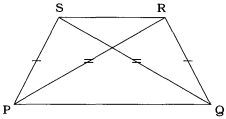
Solution
(N/A) In $\Delta SPQ$ and $\Delta RQP$:
$PS = QR$ (Given)
$QS = PR$ (Given)
$PQ = QP$ (Common side)
Therefore,by $SSS$ congruence criterion,$\Delta SPQ \cong \Delta RQP$.
Since the triangles are congruent,their corresponding parts are equal $(CPCT)$.
Thus,$(1) \angle PSQ = \angle QRP$ and $(2) \angle SPQ = \angle RQP$.
$PS = QR$ (Given)
$QS = PR$ (Given)
$PQ = QP$ (Common side)
Therefore,by $SSS$ congruence criterion,$\Delta SPQ \cong \Delta RQP$.
Since the triangles are congruent,their corresponding parts are equal $(CPCT)$.
Thus,$(1) \angle PSQ = \angle QRP$ and $(2) \angle SPQ = \angle RQP$.
0 likes
View Solution50
Difficult
In the given figure,$AB \perp BQ$,$PQ \perp QB$,$AC = PR$ and $BR = QC$. Prove that $\angle BAC = \angle QPR$.
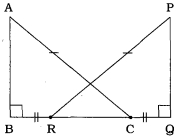
Solution
(N/A) Given: $AB \perp BQ$,$PQ \perp QB$,$AC = PR$ and $BR = QC$.
Since $AB \perp BQ$,$\angle ABQ = 90^{\circ}$. Thus,$\angle ABC = 90^{\circ}$.
Since $PQ \perp QB$,$\angle PQB = 90^{\circ}$. Thus,$\angle PQR = 90^{\circ}$.
Given $BR = QC$.
Adding $RC$ to both sides,we get $BR + RC = QC + RC$.
Therefore,$BC = QR$......$(1)$
In $\Delta ABC$ and $\Delta PQR$:
$AC = PR$ (Given)
$\angle ABC = \angle PQR = 90^{\circ}$ (Proved above)
$BC = QR$ [From $(1)$]
By $RHS$ congruence criterion,$\Delta ABC \cong \Delta PQR$.
Therefore,$\angle BAC = \angle QPR$ (by $CPCT$).
0 likes
View SolutionTriangles — Criteria for Congruence of Triangles · Frequently Asked Questions
1Are these Triangles questions useful for JEE and NEET?
Yes. All questions in this section are mapped to JEE Main and NEET exam patterns. Previous year questions from JEE Main, NEET, GUJCET and state-level exams are included with full solutions.
2Can I switch to Hindi or Gujarati for these questions?
Yes. Use the language tabs in the hero section or the sidebar to view the same questions and solutions in English, Hindi or Gujarati.
3How do I generate a question paper from this subtopic?
Use the Vedclass Exam Paper Generator — select the chapter and subtopic, set difficulty, and generate Sets A, B, C, D automatically. First 3 chapters of every subject are free.
Vedclass Products
For Students
Vedclass Test Series
Mock tests in real JEE/NEET style with performance analysis. 5-day free trial.
Start Free TrialFor Teachers
Exam Paper Generator
Generate Set A/B/C/D papers from this chapter in 2 minutes. 3 chapters free.
Try FreeFor Institutes
Online Exam Module
Live online exams with unlimited students, 360° analytics & white-label branding.
See DemoFor Teachers & Institutes
Generate a Triangles Exam Paper in 2 Minutes
Select subtopic & difficulty — Sets A, B, C, D auto-generated with No Repeat logic.
First 3 chapters of every subject are free — no payment required.