
A English
Mix Examples - GRAVITATION Questions in English
Class 9 Science · GRAVITATION · Mix Examples - GRAVITATION
10+
Questions
English
Language
100%
With Solutions
Showing 10 of 10 questions in English
1
EasyMCQ
What is the importance of the universal law of gravitation?
A
It binds us to the Earth.
B
It is responsible for the motion of the Moon around the Earth.
C
It is responsible for the motion of planets around the Sun and the occurrence of tides due to the Moon and the Sun.
D
All of the above.
Solution
(D) The universal law of gravitation is significant because:
$1$. It binds us to the Earth.
$2$. It is responsible for the motion of the Moon around the Earth.
$3$. It is responsible for the motion of planets around the Sun.
$4$. It causes the occurrence of tides due to the Moon and the Sun.
$1$. It binds us to the Earth.
$2$. It is responsible for the motion of the Moon around the Earth.
$3$. It is responsible for the motion of planets around the Sun.
$4$. It causes the occurrence of tides due to the Moon and the Sun.
0 likes
View Solution2
Medium
How does the force of attraction between two bodies depend upon their masses and the distance between them? $A$ student thought that two bricks tied together would fall faster than a single one under the action of gravity. Do you agree with his hypothesis or not? Comment.
Solution
(N/A) According to Newton's law of universal gravitation,the force of attraction $(F)$ between two bodies is directly proportional to the product of their masses ($m_{1}$ and $m_{2}$) and inversely proportional to the square of the distance $(d)$ between them: $F \propto m_{1} m_{2}$ and $F \propto \frac{1}{d^{2}}$.
This hypothesis is incorrect. Two bricks tied together will fall at the same rate as a single brick under the action of gravity in a vacuum (free-fall). This is because the acceleration due to gravity $(g)$ is independent of the mass of the falling object. Since both objects experience the same acceleration $(g \approx 9.8 \ m/s^{2})$,they will reach the ground at the same time.
This hypothesis is incorrect. Two bricks tied together will fall at the same rate as a single brick under the action of gravity in a vacuum (free-fall). This is because the acceleration due to gravity $(g)$ is independent of the mass of the falling object. Since both objects experience the same acceleration $(g \approx 9.8 \ m/s^{2})$,they will reach the ground at the same time.
0 likes
View Solution3
Medium
When an object, say an apple, falls towards the Earth, the Earth rises up to meet it. Is this true? If so, why is the Earth's motion not noticeable?
Solution
(N/A) Yes, the statement is true. According to Newton's $Third$ $Law$ of $Motion$, the Earth exerts a gravitational force on the apple, and the apple exerts an equal and opposite force on the Earth. According to Newton's $Second$ $Law$ of $Motion$ $(F = ma)$, the acceleration produced is inversely proportional to the mass of the object $(a = F/m)$. Since the mass of the Earth is extremely large compared to the mass of the apple, the acceleration produced in the Earth is negligible and therefore not noticeable.
0 likes
View Solution4
MediumMCQ
The gravitational force between two objects is $F$. How will this force change when:
$(i)$ the distance between them is reduced to half?
$(ii)$ the mass of one of the objects becomes four times?
$(i)$ the distance between them is reduced to half?
$(ii)$ the mass of one of the objects becomes four times?
A
Force becomes $4F$ in both cases.
B
Force becomes $F/4$ and $4F$ respectively.
C
Force becomes $F/2$ and $4F$ respectively.
D
Force becomes $2F$ and $4F$ respectively.
Solution
(A) According to Newton's law of universal gravitation,$F = G \frac{m_1 m_2}{r^2}$.
$(i)$ If the distance $r$ is reduced to half,i.e.,$r' = r/2$,the new force $F'$ is:
$F' = G \frac{m_1 m_2}{(r/2)^2} = G \frac{m_1 m_2}{r^2 / 4} = 4 \left( G \frac{m_1 m_2}{r^2} \right) = 4F$.
So,the force becomes $4$ times the original force.
$(ii)$ If the mass of one object becomes four times,i.e.,$m_1' = 4m_1$,the new force $F''$ is:
$F'' = G \frac{(4m_1) m_2}{r^2} = 4 \left( G \frac{m_1 m_2}{r^2} \right) = 4F$.
So,the force becomes $4$ times the original force.
0 likes
View Solution5
Medium
$(i)$ We observe weightlessness in a satellite although a satellite moves under Earth's gravity. Explain.
$(ii)$ $A$ ball is thrown up with a velocity of $15 \, m s^{-1}$. What is the maximum height attained by it? $(g = 9.8 \, m s^{-2})$
$(ii)$ $A$ ball is thrown up with a velocity of $15 \, m s^{-1}$. What is the maximum height attained by it? $(g = 9.8 \, m s^{-2})$
Solution
(N/A) $(i)$ Weightlessness is observed in a satellite because the satellite and all objects inside it are in a state of free fall towards the Earth. Since there is no external contact force (normal force) acting on the body to oppose gravity,the apparent weight becomes zero.
$(ii)$ Given:
Initial velocity $(u) = 15 \, m s^{-1}$
Final velocity at maximum height $(v) = 0 \, m s^{-1}$
Acceleration due to gravity $(g) = -9.8 \, m s^{-2}$
Using the third equation of motion: $v^2 - u^2 = 2gh$
$0^2 - (15)^2 = 2 \times (-9.8) \times h$
$-225 = -19.6 \times h$
$h = \frac{225}{19.6} \approx 11.48 \, m$
Thus,the maximum height attained is approximately $11.48 \, m$.
0 likes
View Solution6
Medium
$(a)$ The Earth is acted upon by the gravitation of the Sun,yet it does not fall into the Sun. Why?
$(b)$ An object of mass $500 \, g$ is dropped from a tower of height $5 \, m$. Calculate its momentum when it touches the ground (given $g = 10 \, m s^{-2}$).
$(b)$ An object of mass $500 \, g$ is dropped from a tower of height $5 \, m$. Calculate its momentum when it touches the ground (given $g = 10 \, m s^{-2}$).
Solution
(N/A) This is because the gravitational force of attraction between the Sun and the Earth provides the necessary centripetal force for the Earth's orbital motion.
$(b)$ Given: Mass $m = 500 \, g = 0.5 \, kg$,Height $h = 5 \, m$,Acceleration due to gravity $g = 10 \, m s^{-2}$,Initial velocity $u = 0$.
Using the third equation of motion: $v^2 - u^2 = 2gh$
$v^2 - 0 = 2 \times 10 \times 5 = 100$
$v = \sqrt{100} = 10 \, m s^{-1}$
Momentum $p = m \times v$
$p = 0.5 \, kg \times 10 \, m s^{-1} = 5 \, kg \, m s^{-1}$.
0 likes
View Solution7
Medium
$(i)$ Seema buys a few grains of gold at the poles as per the instructions of one of her friends. She hands over the same when she meets her at the equator. Will the friend agree with the weight of gold bought? If not,why?
$(ii)$ If the moon attracts the earth,why does the earth not move towards the moon?
$(ii)$ If the moon attracts the earth,why does the earth not move towards the moon?
Solution
(N/A) $(i)$ No,the friend will not agree. Weight is the force with which the earth attracts an object,given by the formula $W = m \times g$. Since the acceleration due to gravity $(g)$ is greater at the poles than at the equator,the weight of the same amount of gold will be less at the equator compared to the poles.
$(ii)$ According to Newton's third law of motion,the moon exerts an equal and opposite force on the earth. However,the earth does not move towards the moon because the mass of the earth is extremely large compared to the mass of the moon. According to Newton's second law $(F = m \times a)$,the acceleration produced is inversely proportional to the mass $(a = F / m)$. Thus,the acceleration of the earth is negligible.
$(ii)$ According to Newton's third law of motion,the moon exerts an equal and opposite force on the earth. However,the earth does not move towards the moon because the mass of the earth is extremely large compared to the mass of the moon. According to Newton's second law $(F = m \times a)$,the acceleration produced is inversely proportional to the mass $(a = F / m)$. Thus,the acceleration of the earth is negligible.
0 likes
View Solution8
Medium
$(a)$ Differentiate between $G$ and $g$.
$(b)$ Is the value of $g$ the same everywhere on Earth? Reason out.
$(c)$ How does the gravitational force between two objects change if the distance between them is tripled?
$(b)$ Is the value of $g$ the same everywhere on Earth? Reason out.
$(c)$ How does the gravitational force between two objects change if the distance between them is tripled?
Solution
(A) $G$ is the Universal Gravitational Constant with a fixed value of $6.673 \times 10^{-11} \text{ N m}^2 \text{ kg}^{-2}$. It remains constant everywhere in the universe.
$g$ is the acceleration due to gravity,which varies depending on the location. Its $SI$ unit is $\text{m s}^{-2}$.
$(b)$ No,the value of $g$ is not the same everywhere on Earth. The Earth is not a perfect sphere; it is flattened at the poles and bulges at the equator. Since $g = \frac{GM}{R^2}$,the radius $R$ is smaller at the poles compared to the equator. Therefore,the value of $g$ is greater at the poles and smaller at the equator.
$(c)$ According to Newton's Law of Universal Gravitation,$F = \frac{G M m}{r^2}$,so $F \propto \frac{1}{r^2}$.
If the distance $r$ is tripled $(r' = 3r)$,the new force $F'$ becomes $F' = \frac{G M m}{(3r)^2} = \frac{G M m}{9r^2} = \frac{1}{9} F$.
Thus,the gravitational force becomes one-ninth of its original value.
0 likes
View Solution9
DifficultMCQ
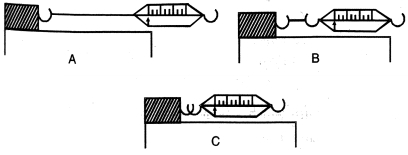
Three students $A, B$ and $C$ were performing an experiment to establish the relation between the weight of a wooden block and the minimum force required to just move it on a horizontal surface. The experimental setup used by each is as shown in the figures given below.
The result obtained by them will be:
The result obtained by them will be:
A
same for each
B
most accurate for $A$
C
most accurate for $B$
D
most accurate for $C$
Solution
(B) In the experiment to measure the force required to move a wooden block,it is essential that the force applied by the spring balance is horizontal to ensure that the entire force contributes to overcoming the static friction.
In setup $A$,the string is pulled horizontally,ensuring the force vector is parallel to the surface.
In setup $B$,the string is also horizontal,but the connection is direct and stable.
In setup $C$,the use of a coiled spring can introduce vertical components of force or oscillations,leading to inaccuracies.
Setup $A$ provides the most direct and horizontal application of force,minimizing errors due to alignment,thus yielding the most accurate result.
0 likes
View Solution10
Medium
$(a)$ Prove that if the Earth attracts two bodies placed at the same distance from the center of the Earth with equal force,then their masses will be the same.
$(b)$ Mathematically express the acceleration due to gravity experienced by a free-falling object.
$(c)$ Why is $G$ called a universal gravitational constant?
$(b)$ Mathematically express the acceleration due to gravity experienced by a free-falling object.
$(c)$ Why is $G$ called a universal gravitational constant?
Solution
(N/A) Let the masses of two bodies be $m_{1}$ and $m_{2}$.
Let the mass of the Earth be $M$ and the distance from the center of the Earth be $d$.
According to Newton's law of universal gravitation,the force $F$ is given by $F = \frac{GMm}{d^{2}}$.
For the two bodies,$F_{1} = \frac{GMm_{1}}{d^{2}}$ and $F_{2} = \frac{GMm_{2}}{d^{2}}$.
Given that $F_{1} = F_{2}$,we have $\frac{GMm_{1}}{d^{2}} = \frac{GMm_{2}}{d^{2}}$.
By canceling the common terms $\frac{GM}{d^{2}}$ from both sides,we get $m_{1} = m_{2}$.
$(b)$ The acceleration due to gravity $g$ for an object of mass $m$ at the surface of the Earth (radius $R$) is given by $g = \frac{GM}{R^{2}}$.
$(c)$ $G$ is called a universal gravitational constant because its value remains the same throughout the entire universe,regardless of the location or the nature of the interacting bodies.
0 likes
View SolutionGRAVITATION — Mix Examples - GRAVITATION · Frequently Asked Questions
1Are these GRAVITATION questions useful for JEE and NEET?
Yes. All questions in this section are mapped to JEE Main and NEET exam patterns. Previous year questions from JEE Main, NEET, GUJCET and state-level exams are included with full solutions.
2Can I switch to Hindi or Gujarati for these questions?
Yes. Use the language tabs in the hero section or the sidebar to view the same questions and solutions in English, Hindi or Gujarati.
3How do I generate a question paper from this subtopic?
Use the Vedclass Exam Paper Generator — select the chapter and subtopic, set difficulty, and generate Sets A, B, C, D automatically. First 3 chapters of every subject are free.
Vedclass Products
For Students
Vedclass Test Series
Mock tests in real JEE/NEET style with performance analysis. 5-day free trial.
Start Free TrialFor Teachers
Exam Paper Generator
Generate Set A/B/C/D papers from this chapter in 2 minutes. 3 chapters free.
Try FreeFor Institutes
Online Exam Module
Live online exams with unlimited students, 360° analytics & white-label branding.
See DemoFor Teachers & Institutes
Generate a GRAVITATION Exam Paper in 2 Minutes
Select subtopic & difficulty — Sets A, B, C, D auto-generated with No Repeat logic.
First 3 chapters of every subject are free — no payment required.