
A English
Improvement in Crop Yields Questions in English
Class 9 Science · IMPROVEMENT IN FOOD RESOURCES · Improvement in Crop Yields
84+
Questions
English
Language
100%
With Solutions
Showing 50 of 84 questions in English
1
MediumMCQ
What do we get from cereals,pulses,fruits and vegetables?
A
Carbohydrates,proteins,vitamins and minerals
B
Only fats
C
Only carbohydrates
D
Only proteins
Solution
(A) The nutrients obtained from these food sources are as follows:
$1$. Cereals (wheat,rice,maize,etc.): These are primary sources of carbohydrates which provide energy to the body.
$2$. Pulses (pea,gram,soybean,etc.): These are rich sources of proteins required for growth and repair.
$3$. Vegetables and fruits: These provide essential vitamins,minerals,carbohydrates,proteins,and fats,which are necessary for maintaining good health and immunity.
0 likes
View Solution2
EasyMCQ
What are the desirable agronomic characteristics for crop improvements?
A
Tallness and profuse branching in cereals
B
Dwarfness in fodder crops
C
Tallness and profuse branching in fodder crops
D
High nutrient consumption in all crops
Solution
(C) Desirable agronomic characteristics are specific to the type of crop being grown:
$1$. For fodder crops,tallness and profuse branching are desirable traits because they increase the total biomass available for livestock.
$2$. For cereal crops,dwarfness is a desirable trait because it ensures that the plant uses fewer nutrients for vegetative growth,allowing more energy to be directed toward grain production,and it also makes the crop less prone to lodging (falling over due to wind or rain).
2 likes
View Solution3
Easy
What are macro-nutrients and why are they called macronutrients?
Solution
(N/A) Macronutrients are essential mineral elements that are required by plants in relatively large quantities for their growth and development.
They are called macronutrients because the term 'macro' implies 'large' or 'great', indicating that these nutrients are needed in significant amounts (usually in excess of $10 \text{ mmol kg}^{-1}$ of dry matter) compared to micronutrients.
Examples include:
$(i)$ $N, P, S$ which are essential components of proteins.
$(ii)$ $Ca$ which is a structural component of the cell wall.
$(iii)$ $Mg$ which is a central component of the chlorophyll molecule.
0 likes
View Solution4
Medium
Compare the use of manure and fertilizers in maintaining soil fertility.
Solution
(N/A) Use of manure in maintaining soil quality:
$(i)$ Manures are a very rich source of organic matter (humus) for the soil. Humus helps to restore the water retention capacity of sandy soil and improves drainage in clayey soil.
$(ii)$ Manures are sources of beneficial soil organisms,such as soil-friendly bacteria.
Use of fertilizers on soil quality:
$(i)$ Excess use of fertilizers causes dryness of the soil,which increases the rate of soil erosion.
$(ii)$ Continuous use of fertilizers decreases the organic matter content,which reduces the porosity of the soil,preventing plant roots from getting sufficient oxygen.
0 likes
View Solution5
MediumMCQ
Which of the following conditions will give the most benefits? Why?
$(a)$ Farmers use high-quality seeds,do not adopt irrigation or use fertilizers.
$(b)$ Farmers use ordinary seeds,adopt irrigation and use fertilizer.
$(c)$ Farmers use quality seeds,adopt irrigation,use fertilizer and use crop protection measures.
$(a)$ Farmers use high-quality seeds,do not adopt irrigation or use fertilizers.
$(b)$ Farmers use ordinary seeds,adopt irrigation and use fertilizer.
$(c)$ Farmers use quality seeds,adopt irrigation,use fertilizer and use crop protection measures.
A
$(a)$ Farmers use high-quality seeds,do not adopt irrigation or use fertilizers.
B
$(b)$ Farmers use ordinary seeds,adopt irrigation and use fertilizer.
C
$(c)$ Farmers use quality seeds,adopt irrigation,use fertilizer and use crop protection measures.
Solution
(C) The $(c)$ option is the best condition to obtain the most benefits.
This is because crop production is a complex process that depends on multiple factors.
Using only high-quality seeds is insufficient if the plants do not receive adequate water through irrigation,essential nutrients through fertilizers,and protection from pests,diseases,and weeds through crop protection measures.
Option $(c)$ integrates all these essential agricultural practices,ensuring optimal growth and maximum yield.
0 likes
View Solution6
Medium
Explain any one method of crop production which ensures high yield.
Solution
(N/A) Intercropping is a method used for high-yielding crop production. In this method,two or more crops are grown simultaneously on the same field in a definite pattern. $A$ few rows of one crop alternate with a few rows of a second crop.
Example: Soybean and maize,or finger millet (bajara) and cowpea (lobia). The selected crops should have different nutrient requirements. This ensures maximum utilization of the nutrients supplied. It also prevents pests and diseases from spreading to all the plants belonging to one crop in a field. This method results in a better crop yield.
Example: Soybean and maize,or finger millet (bajara) and cowpea (lobia). The selected crops should have different nutrient requirements. This ensures maximum utilization of the nutrients supplied. It also prevents pests and diseases from spreading to all the plants belonging to one crop in a field. This method results in a better crop yield.
0 likes
View Solution7
EasyMCQ
Why are manure and fertilizers used in fields?
A
To increase the soil fertility and provide essential nutrients to plants.
B
To kill the pests and insects in the field.
C
To reduce the water requirement of the crops.
D
To change the pH of the soil to acidic.
Solution
(A) Manure and fertilizers are used in fields to replenish the soil with essential nutrients such as $N$,$P$,and $K$.
These nutrients are vital for the healthy vegetative growth of plants,including the development of leaves,stems,and roots.
By providing a nutrient-rich environment,they ensure the production of healthy crops,which ultimately leads to higher agricultural yields.
These nutrients are vital for the healthy vegetative growth of plants,including the development of leaves,stems,and roots.
By providing a nutrient-rich environment,they ensure the production of healthy crops,which ultimately leads to higher agricultural yields.
0 likes
View Solution8
What are the advantages of inter-cropping and crop rotation?
Solution
(N/A) Advantages of inter-cropping:
$1$. It helps in maintaining soil fertility.
$2$. It saves time and labour.
$3$. It increases productivity per unit area.
$4$. Both crops can be easily harvested and threshed separately.
Advantages of crop rotation:
$1$. It improves soil fertility.
$2$. It reduces pest infestation and diseases.
$3$. It helps in weed control.
$4$. It avoids the depletion of a particular nutrient from the soil.
0 likes
View Solution9
Difficult
What is genetic manipulation? How is it useful in agricultural practices?
Solution
(N/A) Genetic manipulation is the process of transferring desirable genes from one organism to another to produce varieties with specific,beneficial characteristics.
Examples include the development of fodder crops with profuse branching or high-yielding varieties of maize and wheat.
Uses in agricultural practices:
$1$. It improves adaptability to adverse environmental conditions such as drought,salinity,or extreme temperatures.
$2$. It allows for the incorporation of desirable traits like disease resistance or pest resistance.
$3$. It helps in significantly increasing crop yield and improving the nutritional quality of the produce.
$4$. It can lead to shorter maturation periods,allowing for multiple cropping cycles within a single year.
0 likes
View Solution10
MediumMCQ
Which one is an oil-yielding plant among the following?
A
Sunflower
B
Lentil
C
Cauliflower
D
Hibiscus
Solution
(A) Lentils are pulse-yielding plants.
Cauliflower is a vegetable.
Hibiscus is a flowering plant.
Sunflower seeds are rich in oil and are used for extracting edible oil.
Cauliflower is a vegetable.
Hibiscus is a flowering plant.
Sunflower seeds are rich in oil and are used for extracting edible oil.
0 likes
View Solution11
MediumMCQ
Which one is not a source of carbohydrate?
A
Rice
B
Gram
C
Sorghum
D
Millets
Solution
(B) Carbohydrates are the main source of energy in food crops. Rice,Sorghum,and Millets are primarily carbohydrate-rich crops. Gram (chickpea) is a pulse crop and is primarily a rich source of protein,not carbohydrate.
0 likes
View Solution12
MediumMCQ
Find out the correct sentence:
$(i)$ Hybridisation means crossing between genetically dissimilar plants.
$(ii)$ Cross between two varieties is called as inter-varietal hybridisation.
$(iii)$ Introducing genes of desired character into a plant gives genetically modified crop.
$(iv)$ Cross between plants of two species is called as inter-specific hybridisation.
A
$(i)$ and $(iii)$
B
$(ii)$ and $(iv)$
C
$(ii)$ and $(iii)$
D
$(iii)$ and $(iv)$
Solution
(A) Statement $(i)$ is correct: Hybridisation is the crossing between genetically dissimilar plants.
Statement $(ii)$ is correct: $A$ cross between two different varieties is known as inter-varietal hybridisation.
Statement $(iii)$ is correct: Introducing genes of desired characters into a plant results in a genetically modified crop.
Statement $(iv)$ is incorrect: $A$ cross between plants of two different species is called inter-specific hybridisation,not inter-varietal.
Therefore,statements $(i)$,$(ii)$,and $(iii)$ are correct. Given the options,$(i)$ and $(iii)$ are correct,but $(ii)$ and $(iii)$ are also correct. Based on standard textbook definitions,$(i)$ and $(iii)$ are the most accurate choices provided in option $A$.
0 likes
View Solution13
MediumMCQ
Find out the correct sentence about manure:
$(i)$ Manure contains large quantities of organic matter and small quantities of nutrients.
$(ii)$ It increases the water holding capacity of sandy soil.
$(iii)$ It helps in draining out of excess of water from clayey soil.
$(iv)$ Its excessive use pollutes environment because it is made of animal excretory waste.
A
$(i)$ and $(iii)$
B
$(iii)$ and $(iv)$
C
$(ii)$ and $(iii)$
D
$(i), (ii)$ and $(iii)$
Solution
(D) Statement $(i)$ is correct: Manure is a bulky source of organic matter that provides nutrients in small quantities.
Statement $(ii)$ is correct: The addition of organic matter improves the soil structure,thereby increasing the water-holding capacity of sandy soil.
Statement $(iii)$ is correct: Organic matter helps in improving the soil structure of clayey soil,which facilitates the drainage of excess water.
Statement $(iv)$ is incorrect: Manure is eco-friendly and sustainable; it does not pollute the environment but rather helps in recycling agricultural and animal waste.
Therefore,the correct statements are $(i), (ii)$,and $(iii)$.
0 likes
View Solution14
MediumMCQ
Which one of the following nutrients is not available in fertilizers?
A
Nitrogen
B
Phosphorus
C
Potassium
D
Iron
Solution
(D) Fertilizers are commercially produced plant nutrients that supply essential elements like Nitrogen $(N)$,Phosphorus $(P)$,and Potassium $(K)$. Iron is a micronutrient that plants absorb directly from the soil. There are no standard commercial fertilizers formulated to supply iron to plants.
0 likes
View Solution15
Medium
Fill in the blanks:
$(a)$ Pigeon pea is a good source of . . . . . . .
$(b)$ Berseem is an important . . . . . . crop.
$(c)$ The crops which are grown in the rainy season are called . . . . . . crops.
$(d)$ . . . . . . are rich in vitamins.
$(e)$ . . . . . . crop grows in the winter season.
$(a)$ Pigeon pea is a good source of . . . . . . .
$(b)$ Berseem is an important . . . . . . crop.
$(c)$ The crops which are grown in the rainy season are called . . . . . . crops.
$(d)$ . . . . . . are rich in vitamins.
$(e)$ . . . . . . crop grows in the winter season.
Solution
(N/A) Pigeon pea is a good source of protein.
$(b)$ Berseem is an important fodder crop.
$(c)$ The crops which are grown in the rainy season are called Kharif crops.
$(d)$ Vegetables are rich in vitamins.
$(e)$ Rabi crop grows in the winter season.
$(b)$ Berseem is an important fodder crop.
$(c)$ The crops which are grown in the rainy season are called Kharif crops.
$(d)$ Vegetables are rich in vitamins.
$(e)$ Rabi crop grows in the winter season.
0 likes
View Solution16
Medium
What is a $GM$ crop? Name any one such crop which is grown in India.
Solution
(N/A) crop that has been developed by introducing a new gene from another source to obtain a desired character is called a genetically modified $(GM)$ crop.
$Bt$ Cotton is an example of a $GM$ crop grown in India,which is made insect-resistant by introducing a gene from the bacterium $Bacillus$ $thuringiensis$.
$Bt$ Cotton is an example of a $GM$ crop grown in India,which is made insect-resistant by introducing a gene from the bacterium $Bacillus$ $thuringiensis$.
0 likes
View Solution17
Medium
List out some useful traits in improved crops.
Solution
(N/A) Useful traits of improved crops are:
$(a)$ Higher yield: To increase the productivity of the crop per acre.
$(b)$ Improved nutritional quality: To enhance the protein,oil,vitamin,mineral,or micronutrient content.
$(c)$ Resistance to biotic and abiotic stresses: To make crops resistant to diseases,insects,and pests (biotic) and stresses like drought,salinity,heat,or cold (abiotic).
$(d)$ Change in maturity duration: To develop varieties that mature in a shorter duration,allowing farmers to grow multiple crops in a year.
$(e)$ Wide range of adaptability: To allow crops to grow in different climatic conditions.
$(f)$ Desired agronomic characteristics: To develop traits like dwarfness in cereals (for less nutrient consumption) or tallness and profuse branching in fodder crops.
0 likes
View Solution18
MediumMCQ
Why is organic matter important for crop production?
A
It improves soil structure.
B
It increases the water-holding capacity of sandy soil.
C
It helps in drainage and prevents waterlogging in clayey soil.
D
All of the above.
Solution
(D) Organic matter is crucial for crop production for the following reasons:
$(a)$ It improves the physical structure of the soil,making it more porous and suitable for root growth.
$(b)$ It increases the water-holding capacity of sandy soil,which helps in retaining moisture for plants.
$(c)$ In clayey soil,the addition of organic matter helps in improving drainage and prevents waterlogging,which is essential for healthy plant development.
0 likes
View Solution19
EasyMCQ
Why is excess use of fertilizers detrimental for the environment?
A
They increase soil fertility indefinitely.
B
They lead to soil degradation and water pollution.
C
They are too expensive for farmers.
D
They kill all beneficial insects.
Solution
(B) Excess use of fertilizers is detrimental because they are not fully absorbed by plants.
Residual amounts of these chemicals leach into the groundwater,causing water pollution.
They can also lead to soil degradation by altering the soil pH and killing beneficial soil microorganisms.
Furthermore,runoff from fields can cause eutrophication in nearby water bodies,leading to the depletion of oxygen and harm to aquatic life.
0 likes
View Solution20
Medium
Give one word for the following:
$(a)$ Farming without the use of chemicals as fertilizers,herbicides,and pesticides is known as . . . . . . .
$(b)$ Growing of wheat and groundnut on the same field is called as . . . . . . .
$(c)$ Planting soybean and maize in alternate rows in the same field is called as . . . . . . .
$(d)$ Growing different crops on a piece of land in pre-planned succession is known as . . . . . . .
$(e)$ Xanthium and Parthenium are commonly known as . . . . . . .
$(f)$ Causal organism of any disease is called as . . . . . . .
Solution
(N/A) Organic farming
$(b)$ Mixed cropping
$(c)$ Inter-cropping
$(d)$ Crop rotation
$(e)$ Weeds
$(f)$ Pathogen
$(b)$ Mixed cropping
$(c)$ Inter-cropping
$(d)$ Crop rotation
$(e)$ Weeds
$(f)$ Pathogen
0 likes
View Solution21
MediumMCQ
If there is low rainfall in a village throughout the year,what measures will you suggest to the farmers for better cropping?
A
Use of high-yielding varieties only.
B
Practice farming with drought-resistant and early-maturing crop varieties.
C
Increase the use of chemical fertilizers.
D
Avoid farming during the rainy season.
Solution
(B) Farmers in low rainfall areas should be suggested to:
$(a)$ Practice farming with drought-resistant and early-maturing varieties of crops,as these varieties can survive with limited water and complete their life cycle quickly.
$(b)$ Enrich the soil with more humus (organic matter),as it significantly increases the water-holding capacity of the soil and helps retain moisture for a longer duration.
0 likes
View Solution22
Medium
Group the following crops and tabulate them as energy-yielding,protein-yielding,oil-yielding,and fodder crops: Wheat,rice,berseem,maize,gram,oat,pigeon pea,sudan grass,lentil,soybean,groundnut,castor,and mustard.
Solution
(N/A) $(1)$ Energy-yielding: Wheat,rice,maize.
$(2)$ Protein-yielding: Gram,pigeon pea,lentil,soybean.
$(3)$ Oil-yielding: Groundnut,castor,mustard,soybean.
$(4)$ Fodder crops: Berseem,oat,sudan grass.
$(2)$ Protein-yielding: Gram,pigeon pea,lentil,soybean.
$(3)$ Oil-yielding: Groundnut,castor,mustard,soybean.
$(4)$ Fodder crops: Berseem,oat,sudan grass.
0 likes
View Solution23
Medium
Define the terms hybridization and photoperiod.
Solution
(N/A) Hybridization: Hybridization refers to the crossing between genetically dissimilar organisms to produce offspring with desirable traits.
Photoperiod: Photoperiod is the duration of sunlight available to a plant. It significantly affects the growth,flowering,and maturation of crops.
Photoperiod: Photoperiod is the duration of sunlight available to a plant. It significantly affects the growth,flowering,and maturation of crops.
0 likes
View Solution24
Medium
Fill in the blanks:
$(a)$ Photoperiod affects the . . . . . . .
$(b)$ Kharif crops are cultivated from . . . . . . to . . . . . . .
$(c)$ Rabi crops are cultivated from . . . . . . to . . . . . . .
$(d)$ Paddy,maize,green gram,and black gram are . . . . . . crops.
$(e)$ Wheat,gram,pea,and mustard are . . . . . . crops.
Solution
(N/A) Photoperiod affects the flowering of plants.
$(b)$ Kharif crops are cultivated from June to October.
$(c)$ Rabi crops are cultivated from November to April.
$(d)$ Paddy,maize,green gram,and black gram are Kharif crops.
$(e)$ Wheat,gram,pea,and mustard are Rabi crops.
$(b)$ Kharif crops are cultivated from June to October.
$(c)$ Rabi crops are cultivated from November to April.
$(d)$ Paddy,maize,green gram,and black gram are Kharif crops.
$(e)$ Wheat,gram,pea,and mustard are Rabi crops.
0 likes
View Solution25
Easy
Cultivation practices and crop yield are related to environmental conditions. Explain.
Solution
(N/A) Different crops and cultivation practices require specific environmental conditions such as temperature,humidity,and photoperiod for their growth and the completion of their life cycle.
$1$. Photoperiod: The duration of sunlight exposure affects the flowering and growth of plants.
$2$. Temperature: Different crops have specific temperature requirements for germination and development.
$3$. Seasonal Variation: Crops are categorized based on their environmental needs,such as $Kharif$ crops (grown in the rainy season) and $Rabi$ crops (grown in the winter season).
Therefore,selecting the right crop for the right season and environment is essential for maximizing crop yield.
0 likes
View Solution26
Medium
Fill in the blanks:
$(a)$ $A$ total of . . . . . . nutrients are essential to plants.
$(b)$ . . . . . . and . . . . . . are supplied by air to plants.
$(c)$ . . . . . . is supplied by water to plants.
$(d)$ Soil supplies . . . . . . nutrients to plants.
$(e)$ . . . . . . nutrients are required in large quantities and are called . . . . . . .
$(f)$ . . . . . . nutrients are needed in small quantities for plants and are called . . . . . . .
Solution
(N/A) $16$ nutrients are essential for plants.
$(b)$ Carbon and Oxygen are supplied by air to plants.
$(c)$ Hydrogen is supplied by water to plants.
$(d)$ Soil supplies $13$ nutrients to plants.
$(e)$ Six nutrients are required in large quantities and are called macronutrients.
$(f)$ Seven nutrients are needed in small quantities for plants and are called micronutrients.
0 likes
View Solution27
Medium
Differentiate between compost and vermicompost.
Solution
(N/A) Compost: It is the process of decomposition of farm waste materials such as livestock excreta,vegetable wastes,animal refuse,domestic waste,straw,and eradicated weeds,which are then used as manure.
Vermicompost: It is the compost prepared from organic matter by using earthworms,which significantly hastens the process of decomposition.
Vermicompost: It is the compost prepared from organic matter by using earthworms,which significantly hastens the process of decomposition.
0 likes
View Solution28
MediumMCQ
Arrange these statements in the correct sequence for the preparation of green manure.
$(a)$ Green plants are decomposed in the soil.
$(b)$ Green plants are cultivated for preparing manure or crop plant parts are used.
$(c)$ Plants are ploughed and mixed into the soil.
$(d)$ After decomposition,it becomes green manure.
$(a)$ Green plants are decomposed in the soil.
$(b)$ Green plants are cultivated for preparing manure or crop plant parts are used.
$(c)$ Plants are ploughed and mixed into the soil.
$(d)$ After decomposition,it becomes green manure.
A
$(c) \to (b) \to (a) \to (d)$
B
$(b) \to (c) \to (a) \to (d)$
C
$(b) \to (c) \to (d) \to (a)$
D
$(b) \to (d) \to (a) \to (c)$
Solution
(B) The correct sequence for the preparation of green manure is as follows:
$1$. $(b)$ Green plants are cultivated for preparing manure or crop plant parts are used.
$2$. $(c)$ Plants are ploughed and mixed into the soil.
$3$. $(a)$ Green plants are decomposed in the soil.
$4$. $(d)$ After decomposition,it becomes green manure.
Therefore,the correct sequence is $(b) \to (c) \to (a) \to (d)$.
0 likes
View Solution29
Medium
Discuss the role of hybridisation in crop improvement.
Solution
(N/A) Hybridisation refers to the crossing between genetically dissimilar plants. It can be inter-varietal (between different varieties),inter-specific (between different species),or inter-generic (between different genera).
Two plants with desirable traits are selected and cross-bred to obtain a new progeny that combines the beneficial characteristics of both parents.
This method is crucial in crop improvement as it helps in developing varieties with higher yield,improved quality,better disease resistance,and enhanced pest resistance.
0 likes
View Solution30
Medium
Define $(i)$ Vermicompost,$(ii)$ Green manure,and $(iii)$ Biofertilizer.
Solution
(N/A) $(i)$ Vermicompost: Compost is a type of manure rich in organic matter and nutrients. The compost prepared by using earthworms to hasten the process of decomposition of plant and animal refuse is called Vermicompost.
$(ii)$ Green manure: The manure prepared by decomposing green plants in the field itself is called green manure. For example,sun hemp is grown in fields,mulched by ploughing,and allowed to decompose in the field to prepare green manure.
$(iii)$ Biofertilizer: Living organisms that are used as fertilizers to supply nutrients to plants are called biofertilizers. For example,blue-green algae,which fix nitrogen in the soil of rice fields,act as biofertilizers.
0 likes
View Solution31
Difficult
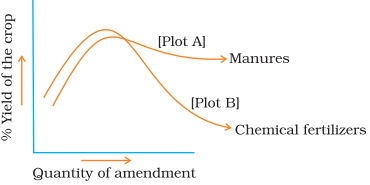
The figure shows two crop fields [Plots $A$ and $B$] that have been treated with manures and chemical fertilizers,respectively,while keeping other environmental factors constant. Observe the graph and answer the following questions.
$(i)$ Why does plot $B$ show a sudden increase and then a gradual decrease in yield?
$(ii)$ Why is the highest peak in the plot $A$ graph slightly delayed?
$(iii)$ What is the reason for the different patterns of the two graphs?
$(i)$ Why does plot $B$ show a sudden increase and then a gradual decrease in yield?
$(ii)$ Why is the highest peak in the plot $A$ graph slightly delayed?
$(iii)$ What is the reason for the different patterns of the two graphs?
Solution
(N/A) $(i)$ With the addition of chemical fertilizers,there is a sudden increase in yield due to the release of nutrients like $N, P, K$ in high quantities. The gradual decline in the graph may be due to the continuous use and high quantity of chemicals,which kill microbes useful for replenishing organic matter in the soil. This decreases soil fertility.
$(ii)$ Manures supply small quantities of nutrients to the soil slowly as they contain large amounts of organic matter. They enrich the soil with nutrients,thereby increasing soil fertility continuously.
$(iii)$ The difference in the two graphs indicates that the use of manure is beneficial for long-term cropping as the yield tends to remain high even when the quantity of manure increases.
In the case of Plot $B$,chemical fertilizers may cause various problems when used continuously for a long time. The loss of microbial activity reduces the decomposition of organic matter,and as a result,soil fertility is lost,which negatively affects the yield.
2 likes
View Solution32
Easy
Mention any two abiotic factors that affect crop production.
Solution
(N/A) Abiotic factors are non-living components of the environment that influence crop growth and yield. Two such factors are:
$1$. Drought: Lack of water availability leads to stunted growth and reduced yield.
$2$. Salinity: High salt concentration in the soil can interfere with nutrient uptake and cause osmotic stress in plants.
$1$. Drought: Lack of water availability leads to stunted growth and reduced yield.
$2$. Salinity: High salt concentration in the soil can interfere with nutrient uptake and cause osmotic stress in plants.
0 likes
View Solution33
EasyMCQ
Name the type of nutrient that we get from mustard seeds and linseed.
A
Carbohydrates
B
Proteins
C
Fats
D
Vitamins
Solution
(C) Mustard seeds and linseed are oilseeds. Oilseeds are rich sources of fats,which provide energy to the body. Therefore,we obtain fats from these seeds.
0 likes
View Solution34
Easy
Name two protein-containing rabi crops.
Solution
(N/A) The two protein-containing rabi crops are gram (chickpea) and peas. These crops are legumes,which are well-known for being rich sources of plant-based proteins.
0 likes
View Solution35
EasyMCQ
Identify two crops from the following which provide us carbohydrates for energy requirement:
Black gram,Wheat,Lentil,Rice
Black gram,Wheat,Lentil,Rice
A
Black gram and Lentil
B
Wheat and Rice
C
Black gram and Rice
D
Lentil and Wheat
Solution
(B) Carbohydrates are the primary source of energy for the human body. Among the given crops, $Wheat$ and $Rice$ are cereal crops that are rich in carbohydrates.
Black gram and Lentil are pulses, which are primarily sources of proteins.
Black gram and Lentil are pulses, which are primarily sources of proteins.
0 likes
View Solution36
EasyMCQ
On what factors do the growth of plants and flowering depend?
A
Soil fertility and water
B
Temperature and photoperiods
C
Carbon dioxide and oxygen
D
Wind speed and humidity
Solution
(B) The growth of plants and their flowering are primarily dependent on two key environmental factors:
$1$. Temperature: Different plants have specific temperature ranges required for optimal metabolic activities and growth.
$2$. Photoperiods: This refers to the duration of exposure to sunlight. Many plants require a specific duration of light and darkness to trigger the transition from vegetative growth to flowering.
0 likes
View Solution37
EasyMCQ
What are those crops called which are grown in the rainy season?
A
Kharif crops
B
Rabi crops
C
Zaid crops
D
Cash crops
Solution
(A) The crops grown in the rainy season are called $Kharif$ crops.
These crops are typically sown in the month of $June$ and harvested in $October$.
Examples include paddy,maize,soybean,groundnut,and cotton.
These crops are typically sown in the month of $June$ and harvested in $October$.
Examples include paddy,maize,soybean,groundnut,and cotton.
0 likes
View Solution38
EasyMCQ
What are those crops called which are grown in the winter season?
A
Kharif crops
B
Rabi crops
C
Zaid crops
D
Cash crops
Solution
(B) The crops grown in the winter season are called $Rabi$ crops.
These crops are typically sown in the month of $November$ and harvested in $April$.
Examples include wheat,gram,and mustard.
These crops are typically sown in the month of $November$ and harvested in $April$.
Examples include wheat,gram,and mustard.
0 likes
View Solution39
EasyMCQ
What are those crops called which are grown in the winter season?
A
Kharif crops
B
Rabi crops
C
Zaid crops
D
Cash crops
Solution
(B) The crops grown in the winter season are called $Rabi$ crops.
These crops are typically sown in the month of $November$ and harvested in $April$.
Examples include wheat,gram,peas,mustard,and linseed.
These crops are typically sown in the month of $November$ and harvested in $April$.
Examples include wheat,gram,peas,mustard,and linseed.
0 likes
View Solution40
EasyMCQ
How can genetically modified crops be obtained?
A
By traditional hybridization
B
By introducing a gene that provides the desired characteristics
C
By using chemical fertilizers
D
By selective breeding
Solution
(B) Genetically modified crops (GMCs) are obtained through genetic engineering or biotechnology. This process involves identifying a specific gene that codes for a desired trait (such as pest resistance,drought tolerance,or improved nutritional value) and inserting it into the genome of the target crop plant. This allows the plant to express the new trait,which is not naturally present in its original genetic makeup.
0 likes
View Solution41
Easy
State one importance of photoperiod in agriculture.
Solution
(N/A) Photoperiod refers to the duration of exposure to sunlight. It is crucial in agriculture because it determines the growth of plants and the timing of flowering,which directly impacts crop yield and seasonal cultivation.
0 likes
View Solution42
Easy
List two desirable traits for fodder crops.
Solution
(N/A) The two desirable traits for fodder crops are:
$1$. Tallness: This increases the overall biomass yield.
$2$. Profuse branching: This increases the number of leaves and stems,providing more nutritional material for livestock.
$1$. Tallness: This increases the overall biomass yield.
$2$. Profuse branching: This increases the number of leaves and stems,providing more nutritional material for livestock.
0 likes
View Solution43
MediumMCQ
What is the advantage of green manure?
A
It increases soil salinity.
B
It enriches the soil with nitrogen and phosphorus.
C
It promotes the growth of weeds.
D
It reduces the water-holding capacity of the soil.
Solution
(B) Green manure consists of plants that are grown and then ploughed back into the soil to act as fertilizers.
These plants decompose in the soil,which significantly enriches the soil with essential nutrients,particularly nitrogen and phosphorus.
This process improves soil fertility and structure,thereby promoting better crop growth.
These plants decompose in the soil,which significantly enriches the soil with essential nutrients,particularly nitrogen and phosphorus.
This process improves soil fertility and structure,thereby promoting better crop growth.
0 likes
View Solution44
Easy
Write the name of a bio-fertilizer.
Solution
(N/A) bio-fertilizer is a substance that contains living microorganisms which,when applied to seeds,plant surfaces,or soil,colonize the rhizosphere or the interior of the plant and promote growth by increasing the supply or availability of primary nutrients to the host plant.
Examples of bio-fertilizers include $Rhizobium$,$Azotobacter$,$Azospirillum$,and Blue-Green Algae (Cyanobacteria) like $Anabaena$ and $Nostoc$.
Examples of bio-fertilizers include $Rhizobium$,$Azotobacter$,$Azospirillum$,and Blue-Green Algae (Cyanobacteria) like $Anabaena$ and $Nostoc$.
0 likes
View Solution45
Easy
Name any one method of incorporating desirable characters into a crop variety.
Solution
(N/A) One common method for incorporating desirable characters into a crop variety is $Hybridisation$. This process involves crossing two genetically dissimilar plants to combine their beneficial traits into a single offspring. Another modern method is $Gene$ $manipulation$ (or $Genetic$ $engineering$),which involves the direct transfer of specific genes from one organism to another to introduce desired traits.
0 likes
View Solution46
Easy
What do you mean by:
$(a)$ Blue revolution?
$(b)$ Yellow revolution?
$(a)$ Blue revolution?
$(b)$ Yellow revolution?
Solution
(N/A) Blue revolution: It refers to the rapid increase in the production of fish and marine products through the development and expansion of aquaculture.
$(b)$ Yellow revolution: It refers to the significant increase in the production of edible oilseeds through the adoption of high-yielding varieties and improved agricultural practices.
$(b)$ Yellow revolution: It refers to the significant increase in the production of edible oilseeds through the adoption of high-yielding varieties and improved agricultural practices.
0 likes
View Solution47
Medium
Sidak,when visiting a supermarket,was surprised to see yellow,green,and red-coloured capsicum available in the stalls. It was a drastic change in the quality and quantity of capsicum.
$(a)$ What is this change due to?
$(b)$ How are such crops produced?
$(a)$ What is this change due to?
$(b)$ How are such crops produced?
Solution
(N/A) The drastic change is due to the development and cultivation of genetically modified crops or improved varieties through plant breeding techniques.
$(b)$ Such crops are produced by introducing a specific gene that provides the desired characteristics (such as colour,pest resistance,or shelf life) into the plant genome,or through selective breeding and hybridization processes.
$(b)$ Such crops are produced by introducing a specific gene that provides the desired characteristics (such as colour,pest resistance,or shelf life) into the plant genome,or through selective breeding and hybridization processes.
0 likes
View Solution48
Medium
Mention the basis of crop selection in intercropping and crop-rotation.
Solution
(N/A) Basis of crop selection in intercropping: The two crops chosen should have different nutrient requirements to ensure maximum utilization of the nutrients supplied in the soil.
Basis of crop selection in crop-rotation: The choice of the crop to be cultivated after one harvest is primarily decided by the availability of moisture and irrigation facilities.
Basis of crop selection in crop-rotation: The choice of the crop to be cultivated after one harvest is primarily decided by the availability of moisture and irrigation facilities.
0 likes
View Solution49
EasyMCQ
While selecting a breed of crop,which characteristics of the crop are to be taken into account by the farmers?
A
Disease resistance
B
Response to fertilizers
C
High yield
D
All of the above
Solution
(D) When selecting a crop variety,farmers consider several key factors to ensure productivity and sustainability:
$1$. Disease resistance: The crop should be resistant to various biotic stresses like diseases,insects,and pests.
$2$. Response to fertilizers: The crop variety should respond well to fertilizers to maximize growth and yield.
$3$. High yield: The primary goal is to increase the productivity of the crop per acre.
$4$. Quality considerations: Factors like protein content in pulses,oil content in oilseeds,and baking quality in wheat are also important.
0 likes
View Solution50
MediumMCQ
Why is there a need for varietal improvement?
A
To increase the yield of crops.
B
To improve the quality of produce.
C
To develop resistance against biotic and abiotic stresses.
D
All of the above.
Solution
(D) The main objectives of varietal improvement are as follows:
$(i)$ Higher yield: To increase the productivity of the crop per acre.
$(ii)$ Improved quality: To enhance the quality of the produce,such as protein,oil,or vitamin content.
$(iii)$ Biotic and abiotic resistance: To develop varieties that can withstand biotic stresses (diseases,insects,and nematodes) and abiotic stresses (drought,salinity,waterlogging,and heat).
$(iv)$ Change in maturity duration: To develop varieties that mature uniformly and quickly.
$(v)$ Wider adaptability: To allow crops to grow in different environmental conditions.
Since all these factors are essential for agricultural development,the correct option is $(D)$.
0 likes
View SolutionIMPROVEMENT IN FOOD RESOURCES — Improvement in Crop Yields · Frequently Asked Questions
1Are these IMPROVEMENT IN FOOD RESOURCES questions useful for JEE and NEET?
Yes. All questions in this section are mapped to JEE Main and NEET exam patterns. Previous year questions from JEE Main, NEET, GUJCET and state-level exams are included with full solutions.
2Can I switch to Hindi or Gujarati for these questions?
Yes. Use the language tabs in the hero section or the sidebar to view the same questions and solutions in English, Hindi or Gujarati.
3How do I generate a question paper from this subtopic?
Use the Vedclass Exam Paper Generator — select the chapter and subtopic, set difficulty, and generate Sets A, B, C, D automatically. First 3 chapters of every subject are free.
Vedclass Products
For Students
Vedclass Test Series
Mock tests in real JEE/NEET style with performance analysis. 5-day free trial.
Start Free TrialFor Teachers
Exam Paper Generator
Generate Set A/B/C/D papers from this chapter in 2 minutes. 3 chapters free.
Try FreeFor Institutes
Online Exam Module
Live online exams with unlimited students, 360° analytics & white-label branding.
See DemoFor Teachers & Institutes
Generate a IMPROVEMENT IN FOOD RESOURCES Exam Paper in 2 Minutes
Select subtopic & difficulty — Sets A, B, C, D auto-generated with No Repeat logic.
First 3 chapters of every subject are free — no payment required.