
A English
Describing Motion Questions in English
Class 9 Science · MOTION · Describing Motion
41+
Questions
English
Language
100%
With Solutions
Showing 41 of 41 questions in English
1
Medium
An object has moved through a distance. Can it have zero displacement? If yes,support your answer with an example.
Solution
(N/A) Yes,an object can have zero displacement even when it has moved through a distance.
This occurs when the final position of the object coincides with its initial position.
For example,if a person walks around a circular park and returns to the exact starting point,the total distance covered is equal to the circumference of the park,but the displacement is $0$ because the initial and final positions are the same.
2 likes
View Solution2
MediumMCQ
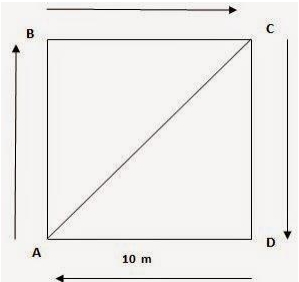
$A$ farmer moves along the boundary of a square field of side $10 \, m$ in $40 \, s$. What will be the magnitude of displacement (in $m$) of the farmer at the end of $2 \, min \; 20 \, s$ from his initial position?
A
$16.14$
B
$14.14$
C
$24.14$
D
$14.41$
Solution
(B) Given, side of the square field $= 10 \, m$.
Perimeter of the square field $= 4 \times 10 \, m = 40 \, m$.
The farmer completes one round of the field in $40 \, s$.
Total time taken $= 2 \, min \; 20 \, s = (2 \times 60) \, s + 20 \, s = 140 \, s$.
Number of rounds completed by the farmer $= \frac{\text{Total time}}{\text{Time for one round}} = \frac{140 \, s}{40 \, s} = 3.5 \, \text{rounds}$.
After $3$ complete rounds, the farmer will be back at the starting position. In the remaining $0.5$ round, the farmer will cover half the perimeter, i.e., $20 \, m$, and will reach the diagonally opposite corner of the square.
Let the starting point be $A$ and the diagonally opposite point be $C$. The displacement is the length of the diagonal $AC$.
Using the Pythagorean theorem, $AC = \sqrt{(10 \, m)^2 + (10 \, m)^2} = \sqrt{100 + 100} \, m = \sqrt{200} \, m = 10\sqrt{2} \, m$.
Taking $\sqrt{2} \approx 1.414$, the displacement $= 10 \times 1.414 \, m = 14.14 \, m$.
2 likes
View Solution3
MediumMCQ
Which of the following is true for displacement?
A
It cannot be zero.
B
Its magnitude is greater than the distance travelled by the object.
C
It is always equal to the distance travelled.
D
None of the above.
Solution
(D) Displacement is the shortest distance between the initial and final positions of an object.
$1$. Displacement can be zero if the initial and final positions of the object are the same (e.g., in circular motion).
$2$. The magnitude of displacement is always less than or equal to the distance travelled by the object $(|\text{Displacement}| \le \text{Distance})$.
Therefore, both statements $(a)$ and $(b)$ are false. The correct option is $(d)$.
1 likes
View Solution4
EasyMCQ
Under what condition$(s)$ is the magnitude of average velocity of an object equal to its average speed?
A
When the object moves in a circular path.
B
When the object moves in a straight line without changing direction.
C
When the object is at rest.
D
When the object moves with variable acceleration.
Solution
(B) The magnitude of average velocity is defined as the ratio of the total displacement to the total time taken. The average speed is defined as the ratio of the total distance traveled to the total time taken.
For an object moving in a straight line without changing its direction,the total distance traveled is equal to the magnitude of the total displacement.
Therefore,under the condition of motion in a straight line without changing direction,the magnitude of average velocity is equal to the average speed.
0 likes
View Solution5
EasyMCQ
What does the odometer of an automobile measure?
A
Speed
B
Distance
C
Acceleration
D
Velocity
Solution
(B) The odometer is a device used in automobiles to measure the total distance traveled by the vehicle.
It records the cumulative distance covered from the time the vehicle was manufactured or since the last reset.
It records the cumulative distance covered from the time the vehicle was manufactured or since the last reset.
1 likes
View Solution6
EasyMCQ
What does the path of an object look like when it is in uniform motion?
A
Circular path
B
Straight line path
C
Parabolic path
D
Irregular path
Solution
(B) Uniform motion is defined as the motion of an object in which it travels equal distances in equal intervals of time along a straight line.
Therefore,the path of an object in uniform motion is always a straight line.
Therefore,the path of an object in uniform motion is always a straight line.
1 likes
View Solution7
Medium
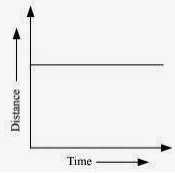
What can you say about the motion of an object whose distance-time graph is a straight line parallel to the time axis?
Solution
If the distance-time graph is a straight line parallel to the time axis,it indicates that the distance of the object from the reference point remains constant as time passes.
This means the object is not changing its position with respect to time.
Therefore,the object is at rest.
This means the object is not changing its position with respect to time.
Therefore,the object is at rest.
0 likes
View Solution8
MediumMCQ
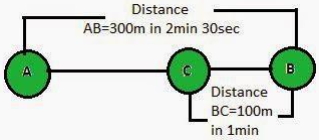
Joseph jogs from one end $A$ to the other end $B$ of a straight $300 \, m$ road in $2 \, min$ $30 \, sec$ and then turns around and jogs $100 \, m$ back to point $C$ in another $1 \, min$. What are Joseph's average speeds and velocities in jogging from $A$ to $B$?
A
$0.2 \, m s^{-1}$ and $2.0 \, m s^{-1}$
B
$2 \, m s^{-1}$ and $2 \, m s^{-1}$
C
$4 \, m s^{-1}$ and $2 \, m s^{-1}$
D
$2 \, m s^{-1}$ and $4 \, m s^{-1}$
Solution
(B) The distance covered from $A$ to $B$ is $300 \, m$.
The time taken to travel from $A$ to $B$ is $2 \, min \, 30 \, sec = (2 \times 60) + 30 = 150 \, s$.
Average speed from $A$ to $B$ is defined as the total distance divided by the total time taken:
$\text{Average Speed} = \frac{\text{Total Distance}}{\text{Total Time}} = \frac{300 \, m}{150 \, s} = 2 \, m s^{-1}$.
Velocity from $A$ to $B$ is defined as the displacement divided by the total time taken. Since the motion is in a straight line from $A$ to $B$,the displacement is equal to the distance $(300 \, m)$:
$\text{Velocity} = \frac{\text{Displacement}}{\text{Total Time}} = \frac{300 \, m}{150 \, s} = 2 \, m s^{-1}$.
Thus,the average speed and velocity from $A$ to $B$ are both $2 \, m s^{-1}$.
0 likes
View Solution9
MediumMCQ
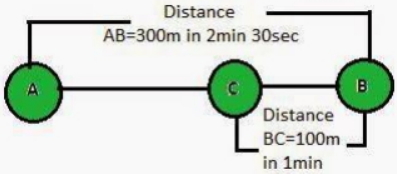
Joseph jogs from one end $A$ to the other end $B$ of a straight $300 \, m$ road in $2 \, min$ $30 \, sec$ and then turns around and jogs $100 \, m$ back to point $C$ in another $1 \, min$. What are Joseph's average speeds and velocities in jogging from $A$ to $C$?
A
$904 \, m s^{-1}$ and $952 \, m s^{-1}$
B
$0.904 \, m s^{-1}$ and $1.952 \, m s^{-1}$
C
$1.904 \, m s^{-1}$ and $0.952 \, m s^{-1}$
D
$0.809 \, m s^{-1}$ and $0.599 \, m s^{-1}$
Solution
(C) Total distance covered from $A$ to $C = AB + BC = 300 \, m + 100 \, m = 400 \, m$.
Total time taken from $A$ to $C = \text{Time for } AB + \text{Time for } BC = (2 \times 60 + 30) \, s + 60 \, s = 150 \, s + 60 \, s = 210 \, s$.
Average speed = $\text{Total distance} / \text{Total time} = 400 \, m / 210 \, s \approx 1.904 \, m s^{-1}$.
Displacement from $A$ to $C = AB - BC = 300 \, m - 100 \, m = 200 \, m$.
Average velocity = $\text{Displacement} / \text{Total time} = 200 \, m / 210 \, s \approx 0.952 \, m s^{-1}$.
0 likes
View Solution10
EasyMCQ
The numerical ratio of displacement to distance for a moving object is
A
always less than $1$
B
always equal to $1$
C
equal or less than $1$
D
always more than $1$
Solution
(C) Displacement is the shortest path between the initial and final positions,while distance is the total path length covered by an object.
Since the shortest path is always less than or equal to the total path length,the magnitude of displacement is always less than or equal to the distance.
Therefore,the ratio of displacement to distance is always $\leq 1$.
Since the shortest path is always less than or equal to the total path length,the magnitude of displacement is always less than or equal to the distance.
Therefore,the ratio of displacement to distance is always $\leq 1$.
0 likes
View Solution11
MediumMCQ
In which of the following cases of motion,are the distance moved and the magnitude of displacement equal?
A
The pendulum is moving to and fro
B
The car is moving in a circular path
C
The car is moving on a straight road
D
The Earth is revolving around the Sun
Solution
(C) Distance is the total path length covered by an object,while displacement is the shortest distance between the initial and final positions.
When an object moves along a straight-line path without changing its direction,the total distance covered is equal to the magnitude of the displacement.
In cases of circular motion,to-and-fro motion,or orbital motion,the object changes its direction,causing the displacement to be less than the total distance covered.
Therefore,the correct option is $C$.
0 likes
View Solution12
Easy
The displacement of a moving object in a given interval of time is zero. Would the distance travelled by the object also be zero? Justify your answer.
Solution
(B) No,the distance travelled by the object would not necessarily be zero.
Displacement is a vector quantity defined as the shortest distance between the initial and final positions,whereas distance is a scalar quantity representing the total path length covered by the object.
Displacement becomes zero when an object returns to its starting point (initial position = final position) after completing a journey.
However,the object has still covered a path to return to the start,meaning the total distance travelled is greater than zero.
For example,if an athlete runs one complete lap around a circular track,their displacement is $0$,but the distance travelled is equal to the circumference of the track $(2 \pi r)$.
0 likes
View Solution13
EasyMCQ
Name a physical quantity that essentially changes as a body moves.
A
Mass
B
Distance
C
Density
D
Volume
Solution
(B) When a body is in motion,its position changes with respect to time.
Consequently,the distance covered by the body and its displacement from the initial point change continuously.
Therefore,distance or displacement are the physical quantities that essentially change as a body moves.
Consequently,the distance covered by the body and its displacement from the initial point change continuously.
Therefore,distance or displacement are the physical quantities that essentially change as a body moves.
0 likes
View Solution14
EasyMCQ
Under what condition will the magnitude of the displacement be equal to the distance travelled by an object?
A
When the object moves in a circular path.
B
When the object moves along a straight line in one direction.
C
When the object moves in a zig-zag path.
D
When the object returns to its starting point.
Solution
(B) The magnitude of displacement is the shortest distance between the initial and final positions of an object.
Distance is the total path length covered by the object.
When an object moves along a straight line without changing its direction,the total path length covered is exactly equal to the straight-line distance between the starting and ending points.
Therefore,the magnitude of displacement is equal to the distance travelled only when the object moves along a straight line in one direction.
0 likes
View Solution15
EasyMCQ
Under what condition will the displacement and distance have the same magnitude?
A
When the object moves in a circular path.
B
When the object moves in a straight line without changing direction.
C
When the object moves with uniform acceleration.
D
When the object returns to its starting point.
Solution
(B) Distance is the total path length covered by an object,while displacement is the shortest distance between the initial and final positions.
For the magnitude of displacement to be equal to the distance,the object must move in a straight line in a single direction without any change in direction.
If the object changes its direction,the total path length (distance) will be greater than the straight-line distance (displacement) between the start and end points.
0 likes
View Solution16
EasyMCQ
$A$ boy hits a football high up into the air. He runs and catches the football before it hits the ground. Which of the two,the boy or the football,has had greater displacement?
A
The boy
B
The football
C
Both have the same displacement
D
Cannot be determined
Solution
(C) Displacement is defined as the shortest distance between the initial position and the final position of an object.
In this scenario,both the boy and the football start from the same initial position (where the boy kicks the ball) and end at the same final position (where the boy catches the ball).
Since the initial and final positions are identical for both,their displacement is equal.
Although the path taken by the football is a curved trajectory (projectile motion) and the path taken by the boy is a straight or curved path on the ground,the displacement depends only on the start and end points,not the path taken.
0 likes
View Solution17
EasyMCQ
Under what conditions of motion,the distance covered by a body is equal to the magnitude of its displacement?
A
When the body moves in a circular path.
B
When the body moves along a straight line path without changing its direction.
C
When the body moves with a constant speed.
D
When the body moves with a constant acceleration.
Solution
(B) The distance covered by a body is equal to the magnitude of its displacement when the body moves along a straight-line path in a single direction.
In this scenario,the path length (distance) is identical to the straight-line distance between the initial and final positions (displacement).
If the body reverses its direction,the distance will be greater than the magnitude of the displacement.
In this scenario,the path length (distance) is identical to the straight-line distance between the initial and final positions (displacement).
If the body reverses its direction,the distance will be greater than the magnitude of the displacement.
0 likes
View Solution18
EasyMCQ
Can the distance travelled by a particle be zero when displacement is not zero?
A
Yes
B
No
C
Sometimes
D
Depends on the path
Solution
(B) No,it is not possible. Distance is the total path length covered by an object. If an object moves,it must cover some distance. Displacement is the shortest distance between the initial and final positions. If displacement is not zero,it means the object has changed its position,which implies that the object must have moved,and therefore,the distance travelled cannot be zero.
0 likes
View Solution19
EasyMCQ
If the displacement of a body is proportional to the time elapsed,what type of motion does the body possess?
A
Uniform motion
B
Non-uniform motion
C
Uniformly accelerated motion
D
Non-uniformly accelerated motion
Solution
(A) The displacement $s$ of a body is proportional to the time $t$ elapsed,which can be expressed as $s \propto t$ or $s = kt$,where $k$ is a constant representing velocity.
Since the velocity $(v = ds/dt = k)$ remains constant over time,the body is said to be in uniform motion.
Therefore,the correct answer is uniform motion.
Since the velocity $(v = ds/dt = k)$ remains constant over time,the body is said to be in uniform motion.
Therefore,the correct answer is uniform motion.
0 likes
View Solution20
EasyMCQ
When is an object in motion considered to be a point object?
A
When the object is very small.
B
When the object is very large.
C
When the distance traveled by the object is much larger than its size.
D
When the object is stationary.
Solution
(C) An object in motion is considered to be a point object if the distance it travels is very large compared to the dimensions (size) of the object itself. In such cases,the size of the object becomes negligible relative to the path covered.
0 likes
View Solution21
EasyMCQ
Can the displacement of a particle be zero when the distance travelled is not zero?
A
Yes
B
No
C
Depends on the path
D
Cannot be determined
Solution
(A) Yes,the displacement of a particle can be zero even when the distance travelled is not zero.
This occurs when an object moves along a closed path and returns to its initial position.
For example,if a particle moves in a circular path of radius $r$ and completes one full revolution,the distance travelled is the circumference of the circle $(2\pi r)$,while the displacement is $0$ because the final position coincides with the initial position.
0 likes
View Solution22
Medium
Differentiate between distance and displacement.
Solution
(N/A)
| Distance | Displacement |
|---|---|
| $(i)$ It is the actual path length travelled by the body. | $(i)$ It is the shortest distance between the initial and final positions. |
| $(ii)$ It is a scalar quantity. | $(ii)$ It is a vector quantity. |
| $(iii)$ It cannot be zero for a moving body. | $(iii)$ It can be zero,positive,or negative. |
0 likes
View Solution23
Easy
Distinguish between the terms distance and displacement.
Solution
(N/A) Distance is the length of the actual path traversed between the initial and final positions of an object. It is a scalar quantity and can never be negative.
Displacement is the shortest path between the initial and final positions of an object. It is a vector quantity and can be positive,negative,or zero.
Displacement is the shortest path between the initial and final positions of an object. It is a vector quantity and can be positive,negative,or zero.
0 likes
View Solution24
Easy
By giving an example,prove that rest and motion are relative terms.
Solution
(N/A) Rest and motion are relative terms because they depend on the frame of reference of the observer.
For example,consider a passenger sitting inside a moving train.
With respect to another passenger sitting in the same compartment,the passenger is in a state of rest because their relative position does not change with time.
However,with respect to an observer standing on the platform outside the train,the same passenger is in a state of motion because their position changes continuously as the train moves.
Thus,the state of rest or motion is not absolute but depends on the observer's frame of reference.
0 likes
View Solution25
Medium
Ravi told his friend that his house is $1 \,km$ toward south from the main Post Office. Express the displacement and the distance moved by the friend from the Post Office when he arrives at Ravi's house. Mention the reference point chosen by you.
Solution
(N/A) The reference point chosen is the Post Office,which acts as the origin of the motion.
Since the friend travels in a straight line from the Post Office to Ravi's house,the path length is equal to the shortest distance between the two points.
Distance is the total path length covered,which is $1 \,km$.
Displacement is the shortest distance between the initial position (Post Office) and the final position (Ravi's house),which is $1 \,km$ in the southward direction.
Therefore,both the distance and the magnitude of displacement are $1 \,km$.
0 likes
View Solution26
Medium
What is meant by uniform motion? Can you think of an example of a body in uniform motion?
Solution
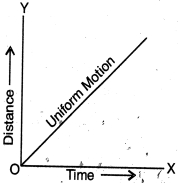
(N/A) body is said to be in uniform motion if it travels equal distances in equal intervals of time,no matter how small these time intervals may be.
For example,a car moving at a constant speed of $10 \ m/s$ will cover equal distances of $10 \ m$ every second,so its motion is uniform.
The distance-time graph for uniform motion is a straight line as shown in the figure.
For example,a car moving at a constant speed of $10 \ m/s$ will cover equal distances of $10 \ m$ every second,so its motion is uniform.
The distance-time graph for uniform motion is a straight line as shown in the figure.
0 likes
View Solution27
EasyMCQ
$A$ body is moving with a velocity of $10 \, m s^{-1}$. If the motion is uniform,what will be its velocity after $10 \, s$ (in $, m s^{-1}$)?
A
$5$
B
$10$
C
$20$
D
$0$
Solution
(B) Uniform motion is defined as the motion of an object in which it travels equal distances in equal intervals of time,implying that the velocity of the object remains constant over time.
Since the initial velocity is $10 \, m s^{-1}$ and the motion is uniform,there is no acceleration $(a = 0)$.
Therefore,the velocity of the body will remain unchanged at $10 \, m s^{-1}$ even after $10 \, s$.
Since the initial velocity is $10 \, m s^{-1}$ and the motion is uniform,there is no acceleration $(a = 0)$.
Therefore,the velocity of the body will remain unchanged at $10 \, m s^{-1}$ even after $10 \, s$.
0 likes
View Solution28
Easy
Two cars moving in opposite directions cover the same distance $d$ in one hour. If the cars were moving in a north-south direction,what will be their displacement in one hour?
Solution
(D) Displacement is a vector quantity defined as the shortest distance between the initial and final positions of an object in a specific direction.
Since both cars cover the same distance $d$ in one hour in opposite directions (north and south),their displacement will be $d$ towards the north for the first car and $d$ towards the south for the second car.
Since both cars cover the same distance $d$ in one hour in opposite directions (north and south),their displacement will be $d$ towards the north for the first car and $d$ towards the south for the second car.
0 likes
View Solution29
Easy
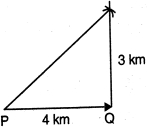
$A$ cyclist travels a distance of $4\, km$ from $P$ to $Q$ and then moves a distance of $3\, km$ at a right angle to $PQ$. Find his resultant displacement graphically.
Solution
(N/A) Graphically,the path forms a right-angled triangle where the base is $4\, km$ and the perpendicular height is $3\, km$.
The resultant displacement is the hypotenuse of this triangle.
Using the Pythagorean theorem:
$S = \sqrt{(4\, km)^2 + (3\, km)^2}$
$S = \sqrt{16 + 9}\, km$
$S = \sqrt{25}\, km$
$S = 5\, km$
Thus,the resultant displacement is $5\, km$.
The resultant displacement is the hypotenuse of this triangle.
Using the Pythagorean theorem:
$S = \sqrt{(4\, km)^2 + (3\, km)^2}$
$S = \sqrt{16 + 9}\, km$
$S = \sqrt{25}\, km$
$S = 5\, km$
Thus,the resultant displacement is $5\, km$.
0 likes
View Solution30
EasyMCQ
What is the name given to the path followed by a projectile?
A
Orbit
B
Trajectory
C
Range
D
Velocity
Solution
(B) The path followed by an object projected into the air,which is subject only to the acceleration of gravity,is called a $Trajectory$. This path is typically parabolic in shape.
0 likes
View Solution31
MediumMCQ
Mohan and Virender were discussing the following problem: $A$ boy kicks a football high into the air. He runs and catches the football before it hits the ground. Which of the two,the boy or the football,has had greater displacement? Mohan was of the opinion that the football has travelled into the air and back,while the boy and the ball have covered the same displacement. Virender told him that it is not true. Both of them discussed and sorted the matter between them.
$(a)$ Who do you think is right,Mohan or Virender?
$(b)$ What are the values you see in Raman?
$(a)$ Who do you think is right,Mohan or Virender?
$(b)$ What are the values you see in Raman?
A
$(a)$ Who do you think is right,Mohan or Virender?
B
$(b)$ What are the values you see in Raman?
Solution
(A) Both have undergone the same displacement. Displacement is defined as the shortest distance between the initial and final positions. Since both the boy and the football started at the same initial position and ended at the same final position,their displacement is identical,even though the football travelled a longer path (distance) through the air.
$(b)$ The values observed in Raman include critical thinking,scientific temperament,and the ability to engage in constructive peer discussion to resolve misconceptions.
$(b)$ The values observed in Raman include critical thinking,scientific temperament,and the ability to engage in constructive peer discussion to resolve misconceptions.
0 likes
View Solution32
Difficult
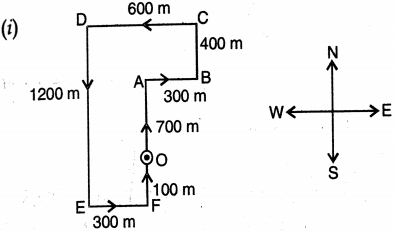
$A$ hiker rides $700\, m$ north,$300\, m$ east,$400\, m$ north,$600\, m$ west,$1200\, m$ south,$300\, m$ east,and finally $100\, m$ north. Draw the path of motion of the hiker. What distance did he cover? What was his displacement?
Solution
(N/A) To calculate the total distance and displacement,we represent the motion on a coordinate system.
$1$. Total Distance:
Distance is the total path length covered by the hiker.
Total Distance $= 700\, m + 300\, m + 400\, m + 600\, m + 1200\, m + 300\, m + 100\, m = 3600\, m$.
$2$. Displacement:
Displacement is the shortest distance between the initial and final positions.
Let the starting point $O$ be $(0, 0)$.
- Move $700\, m$ North: Position $(0, 700)$.
- Move $300\, m$ East: Position $(300, 700)$.
- Move $400\, m$ North: Position $(300, 1100)$.
- Move $600\, m$ West: Position $(300 - 600, 1100) = (-300, 1100)$.
- Move $1200\, m$ South: Position $(-300, 1100 - 1200) = (-300, -100)$.
- Move $300\, m$ East: Position $(-300 + 300, -100) = (0, -100)$.
- Move $100\, m$ North: Position $(0, -100 + 100) = (0, 0)$.
Since the final position $(0, 0)$ is the same as the initial position,the displacement is $0\, m$.
0 likes
View Solution33
Medium
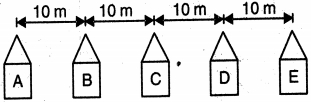
There are $5$ houses on a street,$A, B, C, D$ and $E$. For all cases,assume that positions to the right are positive.
$(i)$ Draw a frame of reference with house $A$ as the origin and the positions of houses $B, C, D$ and $E$.
$(ii)$ You live in house $C$. What is your position relative to house $E$?
$(iii)$ What are the positions of houses $A$ and $D$,if house $B$ is taken as the reference point?
$(i)$ Draw a frame of reference with house $A$ as the origin and the positions of houses $B, C, D$ and $E$.
$(ii)$ You live in house $C$. What is your position relative to house $E$?
$(iii)$ What are the positions of houses $A$ and $D$,if house $B$ is taken as the reference point?
Solution
(N/A) $(i)$ Taking house $A$ as the origin $(0 \ m)$,the positions of the houses are: $A = 0 \ m, B = 10 \ m, C = 20 \ m, D = 30 \ m, E = 40 \ m$.
$(ii)$ Position of house $C = 20 \ m$ and position of house $E = 40 \ m$. The position of $C$ relative to $E$ is $20 \ m - 40 \ m = -20 \ m$. This means house $C$ is $20 \ m$ to the left of house $E$.
$(iii)$ Taking house $B$ as the reference point $(0 \ m)$,the position of house $A$ is $-10 \ m$ and the position of house $D$ is $20 \ m$.

0 likes
View Solution34
Medium
$(a)$ Differentiate between distance and displacement.
$(b)$ Under what conditions is the magnitude of average velocity of an object equal to its average speed?
$(b)$ Under what conditions is the magnitude of average velocity of an object equal to its average speed?
Solution
(N/A) Distance is the total path length covered by an object,whereas displacement is the shortest distance between the initial and final positions of an object.
Distance is a scalar quantity,while displacement is a vector quantity.
Distance can never be negative or zero for a moving object,whereas displacement can be positive,negative,or zero.
$(b)$ The magnitude of average velocity is equal to the average speed when an object moves along a straight-line path in a single direction without changing its direction of motion.
0 likes
View Solution35
Medium
$A$ body thrown in the vertically upward direction rises up to a height $h$ and comes back to the position of its start. Calculate: $(a)$ the total distance travelled by the body and $(b)$ the displacement of the body. Under what condition will the magnitude of the displacement be equal to the distance travelled by an object?
Solution
(N/A) Since the body travels a distance $h$ upwards and $h$ downwards,the total distance travelled is $h + h = 2h$.
$(b)$ As the body returns to its starting point,the displacement is $0$.
The magnitude of the displacement is equal to the distance travelled if the object moves along a straight line in a single direction without changing its direction.
$(b)$ As the body returns to its starting point,the displacement is $0$.
The magnitude of the displacement is equal to the distance travelled if the object moves along a straight line in a single direction without changing its direction.
0 likes
View Solution36
EasyMCQ
$A$ body moves on three quarters of a circle of radius $r$. The displacement and distance The displacement and distance travelled by it are:
A
displacement $= r$, distance $= 3r$
B
distance $= 2r$, displacement $= \frac{3\pi r}{2}$
C
displacement $= \sqrt{2}r$, distance $= \frac{3\pi r}{2}$
D
displacement $= 0$, distance $= \frac{3\pi r}{2}$
Solution
(C) $1$. Distance is the total path length covered by the body. For three-quarters of a circle, the distance is $\frac{3}{4}$ of the circumference $(2\pi r)$.
Distance $= \frac{3}{4} \times 2\pi r = \frac{3\pi r}{2}$.
$2$. Displacement is the shortest straight-line distance between the initial and final positions. If the body starts at point $A$ and moves three-quarters of the circle to point $B$, the angle subtended at the center is $270^{\circ}$ (or $-90^{\circ}$).
$3$. The initial position vector is $(r, 0)$ and the final position vector is $(0, -r)$.
The displacement magnitude is the hypotenuse of a right-angled triangle with sides $r$ and $r$.
Displacement $= \sqrt{r^2 + r^2} = \sqrt{2r^2} = \sqrt{2}r$.
0 likes
View Solution37
Easy
State whether the following statement is true or false:
Kinematics deals with the motion of non-living objects without taking into account the cause of their motion.
Kinematics deals with the motion of non-living objects without taking into account the cause of their motion.
Solution
(TRUE) The statement is True.
Kinematics is a branch of mechanics that describes the motion of objects (points,bodies,and systems of bodies) without considering the forces that cause them to move. It focuses on parameters such as position,velocity,acceleration,and time.
Kinematics is a branch of mechanics that describes the motion of objects (points,bodies,and systems of bodies) without considering the forces that cause them to move. It focuses on parameters such as position,velocity,acceleration,and time.
0 likes
View Solution38
Easy
State whether the following statement is true or false:
Motion along a curved line is called translatory or rectilinear motion.
Motion along a curved line is called translatory or rectilinear motion.
Solution
(FALSE) The statement is False.
Rectilinear motion is defined as the motion of an object along a straight line.
Motion along a curved path is known as curvilinear motion.
Translatory motion refers to motion where all parts of a body move in the same direction at the same time,which can occur along a straight or curved path,but it is not synonymous with rectilinear motion.
0 likes
View Solution39
Easy
State whether the following statement is true or false:
$A$ body is said to be at rest if it does not change its position with respect to its reference point.
$A$ body is said to be at rest if it does not change its position with respect to its reference point.
Solution
(TRUE) The statement is True.
Definition: An object is said to be at rest if its position does not change with respect to a fixed reference point (or frame of reference) as time passes.
Definition: An object is said to be at rest if its position does not change with respect to a fixed reference point (or frame of reference) as time passes.
0 likes
View Solution40
Easy
State whether the following statement is true or false:
$A$ quantity which can be completely specified by magnitude as well as direction is called a scalar quantity.
$A$ quantity which can be completely specified by magnitude as well as direction is called a scalar quantity.
Solution
(B) The statement is False.
$A$ quantity that is specified by both magnitude and direction is known as a vector quantity.
$A$ scalar quantity is a physical quantity that is specified only by its magnitude,such as distance,speed,or mass.
$A$ quantity that is specified by both magnitude and direction is known as a vector quantity.
$A$ scalar quantity is a physical quantity that is specified only by its magnitude,such as distance,speed,or mass.
0 likes
View Solution41
EasyMCQ
State whether the following statement is true or false:
$A$ motion is said to be uniform if a body undergoes equal displacements in equal intervals of time.
$A$ motion is said to be uniform if a body undergoes equal displacements in equal intervals of time.
A
True
B
False
Solution
(A) The statement is $True$.
Uniform motion is defined as the motion of an object in which the object travels equal distances in equal intervals of time along a straight line. Since displacement is the shortest distance between two points in a specific direction,undergoing equal displacements in equal intervals of time is the fundamental characteristic of uniform motion.
Uniform motion is defined as the motion of an object in which the object travels equal distances in equal intervals of time along a straight line. Since displacement is the shortest distance between two points in a specific direction,undergoing equal displacements in equal intervals of time is the fundamental characteristic of uniform motion.
0 likes
View SolutionMOTION — Describing Motion · Frequently Asked Questions
1Are these MOTION questions useful for JEE and NEET?
Yes. All questions in this section are mapped to JEE Main and NEET exam patterns. Previous year questions from JEE Main, NEET, GUJCET and state-level exams are included with full solutions.
2Can I switch to Hindi or Gujarati for these questions?
Yes. Use the language tabs in the hero section or the sidebar to view the same questions and solutions in English, Hindi or Gujarati.
3How do I generate a question paper from this subtopic?
Use the Vedclass Exam Paper Generator — select the chapter and subtopic, set difficulty, and generate Sets A, B, C, D automatically. First 3 chapters of every subject are free.
Vedclass Products
For Students
Vedclass Test Series
Mock tests in real JEE/NEET style with performance analysis. 5-day free trial.
Start Free TrialFor Teachers
Exam Paper Generator
Generate Set A/B/C/D papers from this chapter in 2 minutes. 3 chapters free.
Try FreeFor Institutes
Online Exam Module
Live online exams with unlimited students, 360° analytics & white-label branding.
See DemoFor Teachers & Institutes
Generate a MOTION Exam Paper in 2 Minutes
Select subtopic & difficulty — Sets A, B, C, D auto-generated with No Repeat logic.
First 3 chapters of every subject are free — no payment required.