
A English
Infectious Diseases and their Spread Questions in English
Class 9 Science · WHY DO WE FALL ILL? · Infectious Diseases and their Spread
53+
Questions
English
Language
100%
With Solutions
Showing 50 of 53 questions in English
1
Medium
What are the different means by which infectious diseases are spread?
Solution
(N/A) Infectious diseases spread through various modes of transmission. These include:
$a)$ Through air: When an infected person sneezes or coughs,they release droplets containing pathogens. These droplets can be inhaled by a healthy person,allowing the microbes to enter a new host.
Examples: $Common$ $cold$,$pneumonia$,and $tuberculosis$.
$b)$ Through water: Consumption of contaminated water can lead to the spread of diseases to many people.
Examples: $Cholera$,$amoebiasis$,and $hepatitis$.
$c)$ Through sexual contact: Certain diseases like $AIDS$ and $syphilis$ are transmitted through sexual contact. Additionally,the $AIDS$ virus can spread through blood transfusion,shared infected syringes,from an infected mother to her baby during pregnancy,or through breastfeeding.
$d)$ Through vectors: Some animals act as intermediaries or vectors. These vectors carry pathogens from an infected person to a healthy person.
Example: $Mosquitoes$ spread the malaria-causing organism in humans while sucking their blood.
0 likes
View Solution2
MediumMCQ
Under which of the following conditions are you most likely to fall sick?
$(a)$ When you are taking examinations.
$(b)$ When you have travelled by bus and train for two days.
$(c)$ When your friend is suffering from measles.
Why?
$(a)$ When you are taking examinations.
$(b)$ When you have travelled by bus and train for two days.
$(c)$ When your friend is suffering from measles.
Why?
A
When you are taking examinations.
B
When you have travelled by bus and train for two days.
C
When your friend is suffering from measles.
Solution
(C) The most likely condition to fall sick is $(c)$,when your friend is suffering from measles.
Measles is an infectious viral disease that spreads through droplets released from the nose or throat of an infected person. Being in close contact with a friend suffering from measles increases the risk of exposure to the virus,thereby making you more likely to contract the disease.
Measles is an infectious viral disease that spreads through droplets released from the nose or throat of an infected person. Being in close contact with a friend suffering from measles increases the risk of exposure to the virus,thereby making you more likely to contract the disease.
0 likes
View Solution3
EasyMCQ
Which one of the following diseases is not transmitted by a mosquito?
A
Brain fever
B
Malaria
C
Typhoid
D
Dengue
Solution
(C) Typhoid is a bacterial disease caused by $Salmonella$ $typhi$.
It is not transmitted by a mosquito vector.
It spreads primarily through the consumption of contaminated food and water.
It is not transmitted by a mosquito vector.
It spreads primarily through the consumption of contaminated food and water.
0 likes
View Solution4
MediumMCQ
Which of the following can make you ill if you come in contact with an infected person?
A
High blood pressure
B
Genetic abnormalities
C
Sneezing
D
Blood cancer
Solution
(C) Diseases or conditions like high blood pressure,genetic abnormalities,and blood cancer are non-infectious and cannot be transmitted through contact with an infected person.
Sneezing is a common mechanism for the transmission of pathogens (such as viruses or bacteria) that cause infectious diseases like the common cold,influenza,or tuberculosis.
When an infected person sneezes,they release droplets containing pathogens into the air,which can then be inhaled by a healthy person,leading to infection.
Therefore,sneezing is the correct answer as it is associated with the spread of communicable diseases.
0 likes
View Solution5
MediumMCQ
$AIDS$ cannot be transmitted by:
A
Sexual contact
B
Hugs
C
Breastfeeding
D
Blood transfusion
Solution
(B) $AIDS$ (Acquired Immuno Deficiency Syndrome) is caused by the $HIV$ virus. It is transmitted through the exchange of bodily fluids such as blood,semen,vaginal fluids,and breast milk. It is also transmitted through unprotected sexual contact and the use of contaminated needles. However,$AIDS$ is not transmitted through casual physical contact such as hugging,shaking hands,or sharing personal items,as the virus does not survive long outside the human body and is not present in sweat or saliva in sufficient quantities to cause infection.
0 likes
View Solution6
EasyMCQ
If you live in an overcrowded and poorly ventilated house,it is possible that you may suffer from which of the following diseases?
A
Cancer
B
$AIDS$
C
Air-borne diseases
D
Cholera
Solution
(C) Living in overcrowded and poorly ventilated spaces facilitates the transmission of pathogens through the air. When many people share a small,enclosed space with poor air circulation,droplets containing infectious agents released by an infected person can easily be inhaled by others,thereby increasing the risk of air-borne diseases.
0 likes
View Solution7
MediumMCQ
Which disease is not transmitted by mosquitoes?
A
Dengue
B
Malaria
C
Brain fever or encephalitis
D
Pneumonia
Solution
(D) Pneumonia is a respiratory disease caused by bacteria like $Streptococcus \text{ } pneumoniae$. It is primarily transmitted through the air via droplets released when an infected person coughs or sneezes. In contrast, Dengue, Malaria, and Encephalitis are vector-borne diseases transmitted by mosquitoes.
0 likes
View Solution8
MediumMCQ
We should not allow mosquitoes to breed in our surroundings because they
A
multiply very fast and cause pollution
B
bite and cause skin diseases
C
are vectors for many diseases
D
are not important insects
Solution
(C) Mosquitoes act as vectors for various serious diseases such as $Malaria$, $Dengue$, and $Chikungunya$. They transmit pathogens from an infected person to a healthy person. Therefore, it is essential to prevent their breeding in our surroundings to maintain public health.
0 likes
View Solution9
EasyMCQ
Viruses,which cause hepatitis,are transmitted through
A
water
B
air
C
food
D
personal contact
Solution
(A) Hepatitis is a viral disease. Hepatitis $A$ and $E$ are primarily transmitted through the consumption of contaminated water and food. Hepatitis $B$,$C$,and $D$ are transmitted through the exchange of infected body fluids,such as blood or sexual contact. Given the options provided,contaminated water is a primary mode of transmission for several types of hepatitis.
0 likes
View Solution10
MediumMCQ
Vectors can be defined as
A
microorganisms which cause many diseases
B
animals that carry the infecting agents from a sick person to another healthy person
C
an infected person
D
diseased plants
Solution
(B) Vectors are living organisms that act as carriers of disease-causing pathogens. They transmit infectious agents from an infected individual to a healthy individual without necessarily causing the disease themselves. Common examples include mosquitoes,ticks,and fleas.
0 likes
View Solution11
Easy
Fill in the blanks:
$(a)$ Pneumonia is an example of . . . . . . disease.
$(b)$ Many skin diseases are caused by . . . . . . .
$(c)$ Antibiotics commonly block biochemical pathways important for the growth of . . . . . . .
$(d)$ Living organisms carrying the infecting agents from one person to another are called . . . . . . .
Solution
(N/A) Pneumonia is an infectious or communicable disease because it spreads from an infected person to a healthy person.
$(b)$ Many skin diseases,such as ringworm,are caused by fungi.
$(c)$ Antibiotics are medicines that specifically target and block biochemical pathways essential for the growth and survival of bacteria.
$(d)$ Living organisms that carry infectious agents from an infected host to a healthy person are known as vectors (e.g.,mosquitoes).
0 likes
View Solution12
Medium
Classify the following diseases as infectious or non-infectious:
$(a)$ $AIDS$
$(b)$ Tuberculosis
$(c)$ Cholera
$(d)$ High blood pressure
$(e)$ Heart disease
$(f)$ Pneumonia
$(g)$ Cancer
$(a)$ $AIDS$
$(b)$ Tuberculosis
$(c)$ Cholera
$(d)$ High blood pressure
$(e)$ Heart disease
$(f)$ Pneumonia
$(g)$ Cancer
Solution
(N/A) Infectious diseases are caused by pathogens (like bacteria, viruses, fungi, or parasites) and can spread from one person to another. Non-infectious diseases are not caused by pathogens and do not spread between individuals.
$(a)$ $AIDS$: Infectious (caused by $HIV$)
$(b)$ Tuberculosis: Infectious (caused by $Mycobacterium$ $\text{tuberculosis}$)
$(c)$ Cholera: Infectious (caused by $Vibrio$ $\text{cholerae}$)
$(d)$ High blood pressure: Non-infectious (lifestyle/genetic factors)
$(e)$ Heart disease: Non-infectious (lifestyle/genetic factors)
$(f)$ Pneumonia: Infectious (caused by bacteria or viruses)
$(g)$ Cancer: Non-infectious (uncontrolled cell division)
0 likes
View Solution13
EasyMCQ
Name any three diseases transmitted through vectors.
A
Malaria,Dengue,and Chikungunya
B
Tuberculosis,Cholera,and Typhoid
C
Diabetes,Cancer,and Hypertension
D
Influenza,Common Cold,and Measles
Solution
(A) Vector-borne diseases are those that are transmitted to humans by vectors such as mosquitoes,ticks,or flies.
Three examples of such diseases are:
$1$. Malaria: Transmitted by the female $Anopheles$ mosquito.
$2$. Dengue: Transmitted by the $Aedes$ $aegypti$ mosquito.
$3$. Chikungunya: Also transmitted by the $Aedes$ mosquito.
Three examples of such diseases are:
$1$. Malaria: Transmitted by the female $Anopheles$ mosquito.
$2$. Dengue: Transmitted by the $Aedes$ $aegypti$ mosquito.
$3$. Chikungunya: Also transmitted by the $Aedes$ mosquito.
0 likes
View Solution14
Easy
Define an infectious disease. Give any one example of it.
Solution
(N/A) An infectious disease is a disease caused by pathogens (such as bacteria,viruses,fungi,or parasites) that can spread from an infected person to a healthy person through various modes of transmission like air,water,food,or physical contact.
Example: $Common \ cold$ or $Chickenpox$.
Example: $Common \ cold$ or $Chickenpox$.
0 likes
View Solution15
EasyMCQ
What are communicable diseases?
A
Diseases that spread through direct contact only.
B
Diseases that can spread from an infected person to a healthy person.
C
Diseases caused by genetic mutations.
D
Diseases that are caused by lifestyle choices.
Solution
(B) Communicable diseases are those illnesses that can spread from an infected person to a healthy person through various means such as air,water,food,or physical contact.
These diseases are caused by microbial agents like bacteria,viruses,fungi,or parasites.
Because these pathogens can be transmitted from one individual to another,the diseases they cause are termed as communicable or infectious diseases.
These diseases are caused by microbial agents like bacteria,viruses,fungi,or parasites.
Because these pathogens can be transmitted from one individual to another,the diseases they cause are termed as communicable or infectious diseases.
0 likes
View Solution16
Medium
It was diagnosed that a patient has lost the power of fighting against any infection.
$(i)$ Name the disease from which the patient is suffering.
$(ii)$ Name the pathogen responsible for the disease.
$(i)$ Name the disease from which the patient is suffering.
$(ii)$ Name the pathogen responsible for the disease.
Solution
(N/A) $(i)$ The disease is $AIDS$ (Acquired Immuno Deficiency Syndrome).
$(ii)$ The pathogen responsible for $AIDS$ is the $Human$ $Immunodeficiency$ $Virus$ $(HIV)$.
$(ii)$ The pathogen responsible for $AIDS$ is the $Human$ $Immunodeficiency$ $Virus$ $(HIV)$.
0 likes
View Solution17
EasyMCQ
Your younger brother observes some mosquitoes sucking juices of cut fruit pieces,though it is common knowledge that mosquitoes suck blood of humans. How will you explain this behaviour to him?
A
Only male mosquitoes suck blood.
B
Only female mosquitoes suck blood for egg production,while both sexes feed on plant juices/nectar for energy.
C
Mosquitoes have changed their diet due to evolution.
D
Mosquitoes suck fruit juice when they are sick.
Solution
(B) In many species of mosquitoes,males feed on fruit juices or plant nectar to obtain carbohydrates for energy. Females also feed on these substances for energy,but they require a blood meal to obtain the proteins and lipids necessary for the development and maturation of their eggs.
0 likes
View Solution18
Medium
What causes encephalitis? How does it enter the body? Which organ does it infect? What are the symptoms if this organ is infected? How can it be prevented?
Solution
(N/A) Encephalitis is primarily caused by a virus. It enters the body through the bite of an infected mosquito.
The virus specifically infects the brain.
Symptoms: If the brain is infected,the following symptoms occur:
- Severe headache
- Vomiting
- Fits (seizures)
- Unconsciousness or confusion.
Prevention: It can be prevented by avoiding mosquito bites,using mosquito nets,and controlling mosquito breeding sites.
0 likes
View Solution19
Medium
State in tabular form the modes of transmission of each of the following diseases:
$(a)$ Syphilis
$(b)$ Tuberculosis
$(c)$ Jaundice
$(d)$ Japanese encephalitis
$(a)$ Syphilis
$(b)$ Tuberculosis
$(c)$ Jaundice
$(d)$ Japanese encephalitis
Solution
(N/A)
| Name of disease | Mode of transmission |
|---|---|
| $(a)$ Syphilis | Sexual contact |
| $(b)$ Tuberculosis | Air (droplet infection) |
| $(c)$ Jaundice | Contaminated water |
| $(d)$ Japanese encephalitis | Mosquito bite (vector-borne) |
0 likes
View Solution20
Medium
$(a)$ State the method of transmission of each of the following diseases:
$(i)$ Cholera
$(ii)$ $AIDS$
$(iii)$ Malaria
$(iv)$ Pneumonia
$(b)$ Name the disease a person will get if the pathogen targets the liver of a person.
$(i)$ Cholera
$(ii)$ $AIDS$
$(iii)$ Malaria
$(iv)$ Pneumonia
$(b)$ Name the disease a person will get if the pathogen targets the liver of a person.
Solution
(N/A) Methods of transmission:
$(i)$ Cholera: It is a water-borne disease transmitted through the consumption of contaminated food or water.
$(ii)$ $AIDS$: It is transmitted through sexual contact with an infected person,sharing infected needles,or blood transfusion.
$(iii)$ Malaria: It is transmitted through the bite of an infected female $Anopheles$ mosquito,which acts as a vector.
$(iv)$ Pneumonia: It is an air-borne disease transmitted through droplets released by an infected person during coughing or sneezing.
$(b)$ If the pathogen targets the liver,the person will suffer from Hepatitis (commonly known as jaundice).
0 likes
View Solution21
Medium
Differentiate between infectious and non-infectious diseases (any three differences).
Solution
(N/A)
| Infectious Diseases | Non-Infectious Diseases |
| $(i)$ These diseases spread from an infected person to a healthy person. | $(i)$ These diseases do not spread from an infected person to a healthy person. |
| $(ii)$ These are usually caused by pathogens like bacteria,viruses,fungi,or parasites. | $(ii)$ These are caused by internal factors like genetic disorders,hormonal imbalances,or lifestyle choices. |
| $(iii)$ These are communicable diseases,e.g.,common cold,influenza,and tuberculosis. | $(iii)$ These are non-communicable diseases,e.g.,diabetes,hypertension,and cancer. |
0 likes
View Solution22
Medium
What are the symptoms and causes of malaria? What is the mode of transmission of the disease? How can it be prevented and controlled?
Solution
(N/A) Disease: Malaria.
Causative microorganism: $Plasmodium$ (a protozoan).
Mode of transmission: Bite of an infected female $Anopheles$ mosquito.
Symptoms: General weakness,muscular pain,nausea,and high fever accompanied by sweating and shivering.
Prevention and Control: Use mosquito nets and repellents. Spray kerosene or oil on stagnant water to kill mosquito larvae. Avoid the accumulation of stagnant water in the surroundings to prevent mosquito breeding.
Treatment: Antimalarial drugs like quinine (derived from the $Cinchona$ tree) are used for treatment.
0 likes
View Solution23
Medium
Study the given chart carefully and fill in the blanks $(a)$,$(b)$,and $(c)$:
| $S$.No. | Name of the disease | Causative organism | Mode of transmission |
|---|---|---|---|
| $1$. Polio | $(a)$ | Infection of virus directly/orally | |
| $2$. $(b)$ | Lyssa virus | Virus enters human body with saliva of an infected animal | |
| $3$. Typhoid | Salmonella typhi | $(c)$ |
Solution
(A) Poliomyelitis virus (Polio virus).
$(b)$ Rabies.
$(c)$ Bacteria enters the body via the gastrointestinal tract through contaminated food or water.
$(b)$ Rabies.
$(c)$ Bacteria enters the body via the gastrointestinal tract through contaminated food or water.
0 likes
View Solution24
Medium
Complete the given table:
| Disease | Causative organism | Mode of transmission |
|---|---|---|
| Dengue fever | $... (a) ...$ | $... (b) ...$ |
| $... (c) ...$ | Vibrio cholerae | Contaminated food and water |
| $... (d) ...$ | $HIV$ | $... (e) ...$ |
| Common cold | Virus | $... (f) ...$ |
Solution
(N/A) Dengue virus (Flavivirus)
$(b)$ Aedes mosquito (Vector)
$(c)$ Cholera
$(d)$ $AIDS$
$(e)$ Sexual contact,blood transfusion,or sharing infected needles
$(f)$ Droplet infection (Airborne)
$(b)$ Aedes mosquito (Vector)
$(c)$ Cholera
$(d)$ $AIDS$
$(e)$ Sexual contact,blood transfusion,or sharing infected needles
$(f)$ Droplet infection (Airborne)
0 likes
View Solution25
Medium
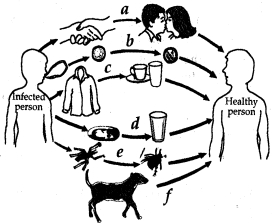
Label the modes of disease transmission from $(a)$ to $(f)$ in the provided diagram.
Solution
(N/A) Direct contact (e.g.,physical touch or kissing).
$(b)$ By air (e.g.,droplets from coughing or sneezing).
$(c)$ Indirect contact (e.g.,sharing personal items like clothes or utensils).
$(d)$ By food/water (e.g.,contaminated food or water).
$(e)$ Mosquito/insect (e.g.,vector-borne transmission).
$(f)$ Rabid animal (e.g.,animal bite).
$(b)$ By air (e.g.,droplets from coughing or sneezing).
$(c)$ Indirect contact (e.g.,sharing personal items like clothes or utensils).
$(d)$ By food/water (e.g.,contaminated food or water).
$(e)$ Mosquito/insect (e.g.,vector-borne transmission).
$(f)$ Rabid animal (e.g.,animal bite).
0 likes
View Solution26
Medium
Given below are a few situations:
$(i)$ Geeta of Class $IX$ was having a common cold. She sits with Sarika,who also develops the disease.
$(ii)$ Animesh of Class $IX$ shifted to a new residence with his family where a water purification system has not been installed yet. He develops Cholera and Dysentery.
$(i)$ Geeta of Class $IX$ was having a common cold. She sits with Sarika,who also develops the disease.
$(ii)$ Animesh of Class $IX$ shifted to a new residence with his family where a water purification system has not been installed yet. He develops Cholera and Dysentery.
Solution
(N/A) $(i)$ Transmission by air (airborne disease).
$(ii)$ Transmission by water (waterborne disease).
Both situations describe the spread of communicable diseases.
$(ii)$ Transmission by water (waterborne disease).
Both situations describe the spread of communicable diseases.
0 likes
View Solution27
Medium
$A$ person was bitten by a stray dog. After some days,his nature became irritated,and he started fearing water.
$(a)$ Name the disease.
$(b)$ Is there any vaccine plan available?
$(c)$ Is there any plan of your local authority for the control of this disease?
$(a)$ Name the disease.
$(b)$ Is there any vaccine plan available?
$(c)$ Is there any plan of your local authority for the control of this disease?
Solution
(N/A) The disease is Rabies (also known as Hydrophobia).
$(b)$ Yes,an anti-rabies vaccine is available for both pre-exposure and post-exposure prophylaxis.
$(c)$ Yes,local authorities implement programs such as the compulsory vaccination of pet dogs,stray dog population control through sterilization ($ABC$ - Animal Birth Control),and public awareness campaigns to prevent the spread of rabies.
0 likes
View Solution28
Medium
Write the cause,symptoms,and prevention of $AIDS$.
Solution
(N/A) Cause: $AIDS$ is caused by the $HIV$ ($Human$ $Immunodeficiency$ $Virus$).
Symptoms: The symptoms include significant weight loss,night sweats,loss of appetite,persistent fever,and overall weakness of the body due to a compromised immune system.
Prevention: $AIDS$ can be prevented by avoiding sexual contact with unknown persons,using only sterilized needles and blades,and ensuring that blood used for transfusion is screened and free from $HIV$.
0 likes
View Solution29
Medium
List three harmful effects of infectious disease.
Solution
(N/A) The three harmful effects of infectious disease are:
$(a)$ The body functions of the person suffering from the disease are damaged and may never recover completely.
$(b)$ Treatment of the disease takes time,and the person suffering is likely to be bedridden for some time,leading to a loss of productivity.
$(c)$ The infected person serves as a source of infection,which can spread the disease to other healthy individuals in the community.
0 likes
View Solution30
Medium
Give the cause and remedy for:
$(a)$ Hepatitis
$(b)$ $AIDS$
$(c)$ Malaria
$(a)$ Hepatitis
$(b)$ $AIDS$
$(c)$ Malaria
Solution
(N/A)
| Disease | Cause and Remedy |
|---|---|
| $(a)$ Hepatitis | $(i)$ Cause: Hepatitis virus. $(ii)$ Remedy: Avoid contaminated food and water,and get vaccinated for Hepatitis $A$ and $B$. |
| $(b)$ $AIDS$ | $(i)$ Cause: Human Immunodeficiency Virus $(HIV)$. $(ii)$ Remedy: Avoid sharing needles,razors,or blades,and practice safe sexual contact. |
| $(c)$ Malaria | $(i)$ Cause: Protozoan parasite transmitted by female Anopheles mosquitoes. $(ii)$ Remedy: Maintain hygienic conditions,prevent water stagnation to stop mosquito breeding,and use mosquito repellents or nets. |
0 likes
View Solution31
Medium
$A$ person has lost his power to fight infections. Name the disease the person is suffering from. State the pathogen and modes of transmission of this disease.
Solution
(N/A) The person is suffering from $AIDS$ (Acquired Immuno Deficiency Syndrome).
The pathogen responsible for this disease is a virus known as $HIV$ (Human Immunodeficiency Virus).
The modes of transmission of $HIV$ are:
$(i)$ Unprotected intimate sexual contact with an infected person.
$(ii)$ Transfusion of contaminated blood or blood products.
$(iii)$ Sharing of contaminated needles,syringes,or razors used by an infected person.
0 likes
View Solution32
Medium
Classify the following diseases into communicable and non-communicable diseases:
$(a)$ Cancer
$(b)$ High blood pressure
$(c)$ Common cold
$(d)$ Diabetes
$(e)$ Tuberculosis
$(f)$ Night blindness
$(g)$ $SARS$
$(h)$ Typhoid
$(i)$ Cholera
$(j)$ Dengue
$(a)$ Cancer
$(b)$ High blood pressure
$(c)$ Common cold
$(d)$ Diabetes
$(e)$ Tuberculosis
$(f)$ Night blindness
$(g)$ $SARS$
$(h)$ Typhoid
$(i)$ Cholera
$(j)$ Dengue
Solution
(N/A) Diseases are classified based on whether they can spread from an infected person to a healthy person (communicable) or not (non-communicable).
$(a)$ Cancer: Non-communicable (caused by genetic mutations or environmental factors,not pathogens).
$(b)$ High blood pressure: Non-communicable (a lifestyle or physiological disorder).
$(c)$ Common cold: Communicable (caused by viruses,spreads through droplets).
$(d)$ Diabetes: Non-communicable (a metabolic disorder).
$(e)$ Tuberculosis: Communicable (caused by bacteria,spreads through air).
$(f)$ Night blindness: Non-communicable (caused by Vitamin $A$ deficiency).
$(g)$ $SARS$: Communicable (caused by a virus,spreads through respiratory droplets).
$(h)$ Typhoid: Communicable (caused by bacteria,spreads through contaminated food/water).
$(i)$ Cholera: Communicable (caused by bacteria,spreads through contaminated food/water).
$(j)$ Dengue: Communicable (caused by a virus,transmitted by mosquitoes).
0 likes
View Solution33
Medium
Write the names of three diseases caused by viruses. Give a full account of any one of them.
Solution
(N/A) Three diseases caused by viruses are:
$(a)$ Influenza
$(b)$ Hepatitis
$(c)$ $AIDS$
Detailed account of $AIDS$ (Acquired Immuno Deficiency Syndrome):
Cause: It is caused by the retrovirus $HIV$ (Human Immuno Deficiency Virus).
Mode of Transmission:
$(i)$ Blood transfusion.
$(ii)$ Unprotected sexual contact.
$(iii)$ Use of contaminated needles and syringes,sharing razors,or piercing instruments.
$(iv)$ From an infected mother to the developing foetus through the placenta.
Symptoms:
$(i)$ Prolonged fever.
$(ii)$ Swollen lymph glands.
$(iii)$ Significant weight loss and loss of appetite.
$(iv)$ Unexplained bleeding.
$(v)$ Decreased count of blood platelets causing haemorrhage.
$(vi)$ Loss of memory and mental ability.
$(vii)$ The patient becomes highly susceptible to opportunistic infections.
Detection:
It is detected using the $ELISA$ test and the Western Blot test.
Prevention:
$(i)$ Practicing safe sex.
$(ii)$ Use of disposable syringes,needles,and fresh razors.
$(iii)$ Mandatory testing of blood before transfusion.
$(iv)$ Public education through $AIDS$ awareness programmes.
$(v)$ Avoiding pregnancy in $HIV$-infected mothers.
Treatment: There is no permanent cure for $AIDS$ so far; only antiretroviral therapy is used to manage the viral load.
0 likes
View Solution34
Medium
How does the $HIV$ virus affect the body and kill the affected person?
Solution
(N/A) In $HIV$ infection:
$(i)$ The virus enters the immune system and damages its function by targeting $T-helper$ cells.
$(ii)$ The body can no longer effectively fight off the many minor infections that it encounters every day.
$(iii)$ $A$ very small cold can progress into severe $Pneumonia$,and minor gut infections can lead to major diarrhea with significant blood loss,eventually leading to the death of the patient.
0 likes
View Solution35
Medium
$A$ rabid dog was seen in a colony and everyone was afraid of going near to it. Name the disease and state how this disease is transmitted. The dog is presently considered the reservoir of the disease. What is the meaning of 'reservoir' here? What steps should the Government take to prevent the spread of the disease?
Solution
(N/A) The disease is $Rabies$ and it is transmitted by the bite of a rabid dog.
The word 'reservoir' here means that the dog acts as a carrier or a source of the pathogen,which can be transmitted to humans.
The government should take the following steps to prevent the spread of the disease:
$1.$ Provide anti-rabies vaccines to patients who have been bitten.
$2.$ Implement compulsory immunization programs for stray dogs and cats. Pet dogs must also be vaccinated with anti-rabies vaccines.
$3.$ Identify and isolate or eliminate animals showing symptoms of rabies,such as excessive salivation and aggressive behavior.
0 likes
View Solution36
Advanced
The number of dengue cases has increased in Sana's village in the last one year. She read in her textbook that diseases like dengue spread through mosquitoes which breed in stagnant water. She immediately suggested to her friends that they should kill the mosquitoes in water bodies in the locality. They also took the help of the nearest municipal office.
$(a)$ Which preventive measures do you suggest for the prevention of such diseases caused by mosquitoes? Mention any two measures.
$(b)$ Which values are displayed by Sana in taking this initiative?
$(c)$ Suggest one school activity to promote such values in school students.
$(a)$ Which preventive measures do you suggest for the prevention of such diseases caused by mosquitoes? Mention any two measures.
$(b)$ Which values are displayed by Sana in taking this initiative?
$(c)$ Suggest one school activity to promote such values in school students.
Solution
(N/A) Preventive measures include:
$(i)$ Avoid water logging in and around the house to prevent mosquito breeding.
$(ii)$ Use mosquito nets,repellents,and wear full-sleeved clothing to prevent mosquito bites.
$(b)$ The values displayed by Sana are:
$(i)$ Social responsibility and community service.
$(ii)$ Proactive approach and awareness regarding public health.
$(c)$ $A$ school activity to promote such values could be organizing a 'Cleanliness Drive' or an 'Awareness Campaign' where students visit nearby areas to educate people about the dangers of stagnant water and vector-borne diseases.
0 likes
View Solution37
Medium
Kavita,the science teacher,was teaching her students about the types of diseases based on duration: acute and chronic diseases. She also discussed their ability to spread in public and their immediate causes.
$(a)$ What are acute and chronic diseases? Give one example of each.
$(b)$ Name the type of diseases which spread by coming in contact with a sick person. Name the different types of organisms which cause diseases.
$(a)$ What are acute and chronic diseases? Give one example of each.
$(b)$ Name the type of diseases which spread by coming in contact with a sick person. Name the different types of organisms which cause diseases.
Solution
(N/A) Acute diseases are those that last for a very short period of time,e.g.,common cold or diarrhoea. Chronic diseases are those that last for a long time,even for a lifetime,e.g.,asthma or elephantiasis.
$(b)$ Diseases that spread by coming in contact with a sick person are called infectious or communicable diseases. These diseases are caused by various pathogens such as viruses,bacteria,fungi,protozoans,and worms.
$(b)$ Diseases that spread by coming in contact with a sick person are called infectious or communicable diseases. These diseases are caused by various pathogens such as viruses,bacteria,fungi,protozoans,and worms.
0 likes
View Solution38
Medium
Mahima is suffering from cholera. It is likely that the children sitting around her will be exposed to the infection:
$(a)$ Do all the students get infected and suffer from disease?
$(b)$ List two major symptoms of cholera.
$(c)$ What are the different ways of spread of this disease?
$(a)$ Do all the students get infected and suffer from disease?
$(b)$ List two major symptoms of cholera.
$(c)$ What are the different ways of spread of this disease?
Solution
(N/A) No, all students will not get infected and suffer from the disease because a large inoculum (number of pathogens) is required to transmit the disease.
$(b)$ Two major symptoms of cholera are:
$(i)$ Severe watery diarrhea (often described as rice-water stools).
$(ii)$ Dehydration, which can lead to low blood pressure and muscle cramps.
$(c)$ The different ways of spread of this disease are:
$(i)$ Consumption of contaminated water containing the bacterium $Vibrio$ $\text{cholerae}$.
$(ii)$ Consumption of food contaminated by soiled hands or flies carrying the pathogen.
0 likes
View Solution39
Medium
Classify infectious agents into different categories and also mention the diseases caused by them.
Solution
(N/A) Infectious agents are biological pathogens that cause diseases in hosts. They can be classified into several categories as follows:
| Infectious Agents | Diseases Caused |
|---|---|
| $I$. Viruses | Common cold,influenza,mumps,poliomyelitis,rabies,smallpox,measles,$AIDS$,etc. |
| $II$. Rickettsiae | Typhus fever,Trench fever. |
| $III$. Bacteria | Tuberculosis,cholera,tetanus,syphilis,pneumonia,etc. |
| $IV$. Fungi | Ringworm,athlete's foot. |
| $V$. Protozoa | Malaria,sleeping sickness,amoebic dysentery,etc. |
| $VI$. Helminths (Worms) | Filariasis,ascariasis,tapeworm infection,etc. |
| $VII$. Mites | Scabies. |
0 likes
View Solution40
Medium
What are the different means by which infectious diseases are spread?
Solution
(N/A) The different means by which infectious diseases spread are:
$(i)$ By direct contact between a healthy and an infected person.
$(ii)$ By indirect contact between a healthy and an infected person.
$(iii)$ Through air (droplets,aerosols).
$(iv)$ Through contaminated food and water.
$(v)$ By vectors such as mosquitoes,flies,and other insects.
$(vi)$ By the bite of a rabid animal (e.g.,dogs,bats).
0 likes
View Solution41
EasyMCQ
Which disease is not transmitted by mosquitoes?
A
Pneumonia
B
Malaria
C
Brain fever or encephalitis
D
Dengue
Solution
(A) Pneumonia is a respiratory infection caused by bacteria (such as $Streptococcus$ $\text{pneumoniae}$), viruses, or fungi. It is transmitted through respiratory droplets when an infected person coughs or sneezes, not by mosquitoes.
Malaria is transmitted by the bite of an infected female $Anopheles$ mosquito.
Brain fever (encephalitis) can be transmitted by mosquitoes (e.g., Japanese encephalitis).
Dengue is transmitted by the bite of an infected $Aedes$ mosquito.
Malaria is transmitted by the bite of an infected female $Anopheles$ mosquito.
Brain fever (encephalitis) can be transmitted by mosquitoes (e.g., Japanese encephalitis).
Dengue is transmitted by the bite of an infected $Aedes$ mosquito.
0 likes
View Solution42
EasyMCQ
Bacterial diseases are:
A
Typhoid fever and cholera
B
Tuberculosis and anthrax
C
Only $(a)$ is correct
D
Both $(a)$ and $(b)$ are correct
Solution
(D) Bacterial diseases are caused by pathogenic bacteria.
$1$. Typhoid fever is caused by the bacterium $Salmonella$ $typhi$.
$2$. Cholera is caused by the bacterium $Vibrio$ $cholerae$.
$3$. Tuberculosis $(TB)$ is caused by the bacterium $Mycobacterium$ $tuberculosis$.
$4$. Anthrax is caused by the bacterium $Bacillus$ $anthracis$.
Since all four diseases listed in options $(a)$ and $(b)$ are caused by bacteria, both options are correct. Therefore, the correct answer is $(d)$.
0 likes
View Solution43
EasyMCQ
Which one of the following is not a bacterial disease?
A
Cholera
B
Influenza
C
Anthrax
D
Tuberculosis
Solution
(B) bacterial disease is caused by pathogenic bacteria.
$1$. Cholera is caused by the bacterium $Vibrio cholerae$.
$2$. Anthrax is caused by the bacterium $Bacillus anthracis$.
$3$. Tuberculosis is caused by the bacterium $Mycobacterium tuberculosis$.
$4$. Influenza (commonly known as the flu) is a viral disease caused by the influenza virus.
Therefore, Influenza is not a bacterial disease.
0 likes
View Solution44
EasyMCQ
$AIDS$ cannot be transmitted by:
A
Sexual contact
B
Breast feeding
C
Hugs
D
Blood transfusion
Solution
(C) $AIDS$ (Acquired Immuno Deficiency Syndrome) is caused by the $HIV$ virus.
It is transmitted through the exchange of infected body fluids,such as blood,semen,vaginal secretions,and breast milk.
$1$. Sexual contact involves the exchange of body fluids,which can transmit the virus.
$2$. Breast feeding can transmit the virus from an infected mother to her infant.
$3$. Blood transfusion using infected blood is a known mode of transmission.
$4$. Hugs,shaking hands,sharing food,or casual physical contact do not involve the exchange of infected body fluids,therefore $AIDS$ cannot be transmitted through hugs.
0 likes
View Solution45
EasyMCQ
Which one of the following diseases is not transmitted by mosquitoes?
A
Typhoid
B
Malaria
C
Brain fever
D
Dengue
Solution
(A) $Typhoid$ is a bacterial disease caused by the bacterium $Salmonella$ $typhi$. It is primarily transmitted through the ingestion of contaminated food or water (fecal-oral route),not by mosquitoes.
$Malaria$ is caused by $Plasmodium$ parasites and is transmitted by the bite of an infected female $Anopheles$ mosquito.
$Brain$ $fever$ (often referring to Japanese Encephalitis) is a viral disease transmitted by $Culex$ mosquitoes.
$Dengue$ is a viral disease transmitted by the bite of an infected $Aedes$ $aegypti$ mosquito.
Therefore,$Typhoid$ is the correct answer.
0 likes
View Solution46
EasyMCQ
Which of the following diseases is caused by bacteria?
A
Typhoid
B
Malaria
C
Tuberculosis
D
All of the above
Solution
(D) The diseases caused by bacteria are as follows:
$1$. Typhoid is caused by the bacterium $Salmonella \text{ } typhi$.
$2$. Tuberculosis is caused by the bacterium $Mycobacterium \text{ } tuberculosis$.
$3$. Anthrax is caused by the bacterium $Bacillus \text{ } anthracis$.
Since options $A$, $C$, and $D$ are all caused by bacteria, the question implies identifying bacterial diseases. However, if this is a multiple-choice question where only one answer is expected, there is an error in the options provided. Assuming the question asks to identify a bacterial disease from a list where others are not, or if it is a multiple-correct type, all $A$, $C$, and $D$ are correct. Given the standard format, if we must choose one, all listed options except Malaria (which is caused by a protozoan) are bacterial. Therefore, the question is flawed as presented. If we assume the question intended to ask which is $NOT$ bacterial, the answer would be Malaria. If it asks which $IS$ bacterial, $A$, $C$, and $D$ are all correct.
0 likes
View Solution47
EasyMCQ
Viruses,which cause hepatitis,are transmitted through:
A
Air
B
Water
C
Food
D
Personal contact
Solution
(B) Hepatitis is a viral infection that causes inflammation of the liver.
There are several types of hepatitis viruses,such as Hepatitis $A$,$B$,$C$,$D$,and $E$.
Hepatitis $A$ and $E$ are primarily transmitted through the fecal-oral route,which means they are spread through contaminated water or food.
Since the question asks for the transmission mode of hepatitis viruses in a general context (often referring to Hepatitis $A$ in school-level biology),water is the most appropriate answer among the given choices.
0 likes
View Solution48
EasyMCQ
If you live in an overcrowded and poorly ventilated house,it is possible that you may suffer from which of the following diseases?
A
Cancer
B
Cholera
C
$AIDS$
D
Air-borne diseases
Solution
(D) Overcrowded and poorly ventilated living conditions facilitate the rapid spread of infectious pathogens through the air.
When many people share a small,enclosed space with limited air circulation,droplets containing pathogens released by an infected person (through coughing or sneezing) remain suspended in the air for longer periods.
This environment significantly increases the risk of contracting air-borne diseases such as tuberculosis,influenza,or the common cold.
Therefore,the correct option is $D$.
0 likes
View Solution49
EasyMCQ
Vectors can be defined as:
A
Diseased plants
B
Microorganisms which cause many diseases
C
Infected person
D
Animals that carry the infecting agents from a sick person to another healthy person
Solution
(D) Vectors are living organisms that can transmit infectious pathogens between humans or from animals to humans.
They do not cause the disease themselves but act as carriers (intermediaries) for the pathogens.
For example,the female $Anopheles$ mosquito acts as a vector for the malaria parasite $(Plasmodium)$.
Therefore,option $D$ is the correct definition.
They do not cause the disease themselves but act as carriers (intermediaries) for the pathogens.
For example,the female $Anopheles$ mosquito acts as a vector for the malaria parasite $(Plasmodium)$.
Therefore,option $D$ is the correct definition.
0 likes
View Solution50
MediumMCQ
We should not allow mosquitoes to breed in our surroundings because they :
A
Multiply very fast and cause pollution
B
Bite and cause skin diseases
C
Are vectors for many diseases
D
Are not important insects
Solution
(C) Mosquitoes are considered vectors because they carry disease-causing pathogens from an infected person or animal to a healthy person.
They transmit serious diseases such as $Malaria$,$Dengue$,$Chikungunya$,and $Zika$ virus.
By preventing their breeding,we can significantly reduce the transmission of these infectious diseases in our surroundings.
They transmit serious diseases such as $Malaria$,$Dengue$,$Chikungunya$,and $Zika$ virus.
By preventing their breeding,we can significantly reduce the transmission of these infectious diseases in our surroundings.
0 likes
View SolutionWHY DO WE FALL ILL? — Infectious Diseases and their Spread · Frequently Asked Questions
1Are these WHY DO WE FALL ILL? questions useful for JEE and NEET?
Yes. All questions in this section are mapped to JEE Main and NEET exam patterns. Previous year questions from JEE Main, NEET, GUJCET and state-level exams are included with full solutions.
2Can I switch to Hindi or Gujarati for these questions?
Yes. Use the language tabs in the hero section or the sidebar to view the same questions and solutions in English, Hindi or Gujarati.
3How do I generate a question paper from this subtopic?
Use the Vedclass Exam Paper Generator — select the chapter and subtopic, set difficulty, and generate Sets A, B, C, D automatically. First 3 chapters of every subject are free.
Vedclass Products
For Students
Vedclass Test Series
Mock tests in real JEE/NEET style with performance analysis. 5-day free trial.
Start Free TrialFor Teachers
Exam Paper Generator
Generate Set A/B/C/D papers from this chapter in 2 minutes. 3 chapters free.
Try FreeFor Institutes
Online Exam Module
Live online exams with unlimited students, 360° analytics & white-label branding.
See DemoFor Teachers & Institutes
Generate a WHY DO WE FALL ILL? Exam Paper in 2 Minutes
Select subtopic & difficulty — Sets A, B, C, D auto-generated with No Repeat logic.
First 3 chapters of every subject are free — no payment required.