
A English
Geometrical Meaning of the Zeroes of a Polynomial Questions in English
Class 10 Mathematics · Polynomials · Geometrical Meaning of the Zeroes of a Polynomial
61+
Questions
English
Language
100%
With Solutions
Showing 11 of 61 questions in English
51
EasyMCQ
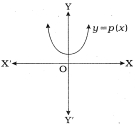
The number of real zeros of $y=p(x)$ is........... in the given figure.
A
$2$
B
$3$
C
$1$
D
$0$
Solution
(D) The number of real zeros of a polynomial $y=p(x)$ is equal to the number of points where the graph of the polynomial intersects the $X$-axis.
In the given figure,the parabola $y=p(x)$ lies entirely above the $X$-axis and does not intersect or touch the $X$-axis at any point.
Therefore,the number of real zeros of the polynomial $p(x)$ is $0$.
In the given figure,the parabola $y=p(x)$ lies entirely above the $X$-axis and does not intersect or touch the $X$-axis at any point.
Therefore,the number of real zeros of the polynomial $p(x)$ is $0$.
0 likes
View Solution52
EasyMCQ
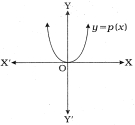
The number of real zeros of $y=p(x)$ is ........... in the given figure.
A
$1$
B
$2$
C
$3$
D
$0$
Solution
(A) The number of real zeros of a polynomial $y=p(x)$ is equal to the number of points where the graph of the polynomial intersects the $X$-axis.
In the given figure,the parabola $y=p(x)$ touches the $X$-axis at only one point,which is the origin $(0, 0)$.
Since the graph intersects/touches the $X$-axis at exactly one point,the number of real zeros is $1$.
In the given figure,the parabola $y=p(x)$ touches the $X$-axis at only one point,which is the origin $(0, 0)$.
Since the graph intersects/touches the $X$-axis at exactly one point,the number of real zeros is $1$.
0 likes
View Solution53
EasyMCQ
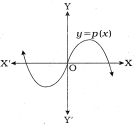
The number of real zeros of $y=p(x)$ is ......... in the given figure.
A
$4$
B
$3$
C
$2$
D
$1$
Solution
(B) The number of real zeros of a polynomial $y=p(x)$ is equal to the number of points where the graph of the polynomial intersects the $x$-axis.
In the given figure,the curve $y=p(x)$ intersects the $x$-axis at $3$ distinct points.
Therefore,the number of real zeros of $p(x)$ is $3$.
In the given figure,the curve $y=p(x)$ intersects the $x$-axis at $3$ distinct points.
Therefore,the number of real zeros of $p(x)$ is $3$.
0 likes
View Solution54
EasyMCQ
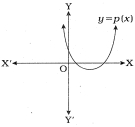
Find the number of real zeros of the polynomial $y = p(x)$ from the given figure.
A
$1$
B
$2$
C
$3$
D
$4$
Solution
(B) The number of real zeros of a polynomial $y = p(x)$ is equal to the number of points where the graph of the polynomial intersects the $x$-axis.
In the given figure,the parabola $y = p(x)$ intersects the $x$-axis at exactly $2$ distinct points.
Therefore,the number of real zeros of the polynomial is $2$.
In the given figure,the parabola $y = p(x)$ intersects the $x$-axis at exactly $2$ distinct points.
Therefore,the number of real zeros of the polynomial is $2$.
0 likes
View Solution55
EasyMCQ
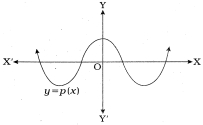
The number of real zeros of $y=p(x)$ is .......... in the given figure.
A
$4$
B
$3$
C
$2$
D
$1$
Solution
(A) The number of real zeros of a polynomial $y=p(x)$ is equal to the number of points where the graph of the polynomial intersects the $x$-axis.
In the given figure,the curve $y=p(x)$ intersects the $x$-axis at $4$ distinct points.
Therefore,the number of real zeros of $p(x)$ is $4$.
In the given figure,the curve $y=p(x)$ intersects the $x$-axis at $4$ distinct points.
Therefore,the number of real zeros of $p(x)$ is $4$.
0 likes
View Solution56
EasyMCQ
The maximum number of zeros of $p(x) = ax^4 + bx^3 + cx^2 + dx + e$ where $a \neq 0$ and $a, b, c, d, e \in R$ can be:
A
$5$
B
$4$
C
$3$
D
$1$
Solution
(B) The given expression $p(x) = ax^4 + bx^3 + cx^2 + dx + e$ is a polynomial of degree $4$ because the highest power of the variable $x$ is $4$ and $a \neq 0$.
According to the Fundamental Theorem of Algebra,a polynomial of degree $n$ has at most $n$ real zeros.
Since the degree of the given polynomial is $4$,the maximum number of zeros it can have is $4$.
According to the Fundamental Theorem of Algebra,a polynomial of degree $n$ has at most $n$ real zeros.
Since the degree of the given polynomial is $4$,the maximum number of zeros it can have is $4$.
0 likes
View Solution57
MediumMCQ
As per the given figure,the graph of $y=p(x)$ has $\ldots \ldots$ real zeros.

A
$0$
B
$1$
C
$2$
D
$3$
Solution
(C) The number of real zeros of a polynomial $p(x)$ is equal to the number of points where its graph $y=p(x)$ intersects the $X$-axis.
In the given figure,the curve $y=p(x)$ intersects the $X$-axis at two distinct points.
Therefore,the polynomial $p(x)$ has $2$ real zeros.
In the given figure,the curve $y=p(x)$ intersects the $X$-axis at two distinct points.
Therefore,the polynomial $p(x)$ has $2$ real zeros.
0 likes
View Solution58
DifficultMCQ
Which of the following groups matches the data of Part $I$ with the data of Part $II$?
| Part $I$ | Part $II$ |
| $1.$ The graph of $p(x)=x^{2}-5x+6$ | $a.$ Intersects the $X$-axis at one point. |
| $2.$ The graph of $p(x)=x^{2}-10x+25$ | $b.$ Intersects the $X$-axis at zero points. |
| $3.$ The graph of $p(x)=x^{3}-4x$ | $c.$ Intersects the $X$-axis at two points. |
| $4.$ The graph of $p(x)=x^{2}+4x+5$ | $d.$ Intersects the $X$-axis at three points. |
A
$(1-c), (2-a), (3-d), (4-b)$
B
$(1-b), (2-c), (3-a), (4-d)$
C
$(1-d), (2-b), (3-c), (4-a)$
D
$(1-a), (2-d), (3-b), (4-c)$
Solution
(A) To determine the number of points where the graph of a polynomial $p(x)$ intersects the $X$-axis,we find the number of real roots of the equation $p(x) = 0$.
$1.$ $p(x) = x^{2}-5x+6 = (x-2)(x-3)$. The roots are $x=2, 3$. It intersects the $X$-axis at two points. So,$1-c$.
$2.$ $p(x) = x^{2}-10x+25 = (x-5)^{2}$. The root is $x=5$ (repeated). It intersects the $X$-axis at one point. So,$2-a$.
$3.$ $p(x) = x^{3}-4x = x(x^{2}-4) = x(x-2)(x+2)$. The roots are $x=0, 2, -2$. It intersects the $X$-axis at three points. So,$3-d$.
$4.$ $p(x) = x^{2}+4x+5$. The discriminant $D = b^{2}-4ac = 16 - 4(1)(5) = 16 - 20 = -4$. Since $D < 0$,there are no real roots. It intersects the $X$-axis at zero points. So,$4-b$.
Thus,the correct matching is $(1-c), (2-a), (3-d), (4-b)$.
0 likes
View Solution59
EasyMCQ
The graph of the linear polynomial $p(x) = 5x + 3$ is a . . . . . . .
A
straight line
B
parabola
C
ray
D
line segment
Solution
(A) linear polynomial is of the form $p(x) = ax + b$,where $a \neq 0$. The graph of a linear polynomial always represents a straight line in the Cartesian plane. Since $p(x) = 5x + 3$ is a linear polynomial,its graph is a straight line.
0 likes
View Solution60
MediumMCQ
The graph of the polynomial $p(x) = ax - b$,where $a \neq 0$ and $a, b \in R$,intersects the $X$-axis at which unique point?
A
$(-\frac{b}{a}, 0)$
B
$(0, \frac{b}{a})$
C
$(\frac{b}{a}, 0)$
D
$(\frac{a}{b}, 0)$
Solution
(C) To find the point where the graph of the polynomial $p(x) = ax - b$ intersects the $X$-axis,we set $p(x) = 0$.
Setting $ax - b = 0$ gives $ax = b$.
Solving for $x$,we get $x = \frac{b}{a}$.
Since the point lies on the $X$-axis,its y-coordinate is $0$.
Therefore,the graph intersects the $X$-axis at the point $(\frac{b}{a}, 0)$.
Setting $ax - b = 0$ gives $ax = b$.
Solving for $x$,we get $x = \frac{b}{a}$.
Since the point lies on the $X$-axis,its y-coordinate is $0$.
Therefore,the graph intersects the $X$-axis at the point $(\frac{b}{a}, 0)$.
0 likes
View Solution61
MediumMCQ
The number of real zeros of the polynomial $p(x) = x^3 - x$ is . . . . . . .
A
$3$
B
$1$
C
$2$
D
$0$
Solution
(A) To find the zeros of the polynomial $p(x) = x^3 - x$,we set $p(x) = 0$.
$x^3 - x = 0$
Factor out $x$:
$x(x^2 - 1) = 0$
Using the difference of squares formula $a^2 - b^2 = (a - b)(a + b)$:
$x(x - 1)(x + 1) = 0$
Setting each factor to zero,we get:
$x = 0$,$x - 1 = 0 \implies x = 1$,and $x + 1 = 0 \implies x = -1$.
Thus,the zeros are $0, 1, -1$.
There are $3$ real zeros.
$x^3 - x = 0$
Factor out $x$:
$x(x^2 - 1) = 0$
Using the difference of squares formula $a^2 - b^2 = (a - b)(a + b)$:
$x(x - 1)(x + 1) = 0$
Setting each factor to zero,we get:
$x = 0$,$x - 1 = 0 \implies x = 1$,and $x + 1 = 0 \implies x = -1$.
Thus,the zeros are $0, 1, -1$.
There are $3$ real zeros.
0 likes
View SolutionPolynomials — Geometrical Meaning of the Zeroes of a Polynomial · Frequently Asked Questions
1Are these Polynomials questions useful for JEE and NEET?
Yes. All questions in this section are mapped to JEE Main and NEET exam patterns. Previous year questions from JEE Main, NEET, GUJCET and state-level exams are included with full solutions.
2Can I switch to Hindi or Gujarati for these questions?
Yes. Use the language tabs in the hero section or the sidebar to view the same questions and solutions in English, Hindi or Gujarati.
3How do I generate a question paper from this subtopic?
Use the Vedclass Exam Paper Generator — select the chapter and subtopic, set difficulty, and generate Sets A, B, C, D automatically. First 3 chapters of every subject are free.
Vedclass Products
For Students
Vedclass Test Series
Mock tests in real JEE/NEET style with performance analysis. 5-day free trial.
Start Free TrialFor Teachers
Exam Paper Generator
Generate Set A/B/C/D papers from this chapter in 2 minutes. 3 chapters free.
Try FreeFor Institutes
Online Exam Module
Live online exams with unlimited students, 360° analytics & white-label branding.
See DemoFor Teachers & Institutes
Generate a Polynomials Exam Paper in 2 Minutes
Select subtopic & difficulty — Sets A, B, C, D auto-generated with No Repeat logic.
First 3 chapters of every subject are free — no payment required.