
A English
Mix Examples - Triangles Questions in English
Class 10 Mathematics · Triangles · Mix Examples - Triangles
109+
Questions
English
Language
100%
With Solutions
Showing 50 of 109 questions in English
51
MediumMCQ
The perimeter of rhombus $ABCD$ is $68$. If $AC = 30$,find $BD$.
A
$16$
B
$30$
C
$35$
D
$45$
Solution
(A) rhombus is a quadrilateral where all sides are equal. Let the side length be $s$.
Given the perimeter is $68$,we have $4s = 68$,which implies $s = 17$.
In a rhombus,the diagonals bisect each other at right angles $(90^{\circ})$.
Let the diagonals $AC$ and $BD$ intersect at point $O$.
Since $AC = 30$,the length $AO = AC / 2 = 15$.
In the right-angled triangle $\triangle AOB$,by the Pythagorean theorem,$AO^2 + BO^2 = AB^2$.
Substituting the values: $15^2 + BO^2 = 17^2$.
$225 + BO^2 = 289$.
$BO^2 = 289 - 225 = 64$.
$BO = \sqrt{64} = 8$.
Since the diagonals bisect each other,$BD = 2 \times BO = 2 \times 8 = 16$.
0 likes
View Solution52
MediumMCQ
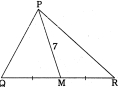
In $\Delta PQR$,$\overline{PM}$ is a median. If $PQ^{2} + PR^{2} = 148$ and $PM = 7$,find $QR$.
A
$70$
B
$40$
C
$10$
D
$30$
Solution
(C) In $\Delta PQR$,$\overline{PM}$ is a median.
By Apollonius' theorem:
$PQ^{2} + PR^{2} = 2(PM^{2} + QM^{2})$
Given $PQ^{2} + PR^{2} = 148$ and $PM = 7$:
$148 = 2(7^{2} + QM^{2})$
$74 = 49 + QM^{2}$
$QM^{2} = 74 - 49$
$QM^{2} = 25$
$QM = 5$
Since $\overline{PM}$ is a median,$M$ is the midpoint of $\overline{QR}$.
Therefore,$QR = 2 \times QM = 2 \times 5 = 10$.
0 likes
View Solution53
MediumMCQ
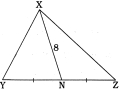
In $\Delta XYZ$,$\overline{XN}$ is a median. If $XY^2 + XZ^2 = 200$ and $XN = 8$,find $YZ$.
A
$15$
B
$25$
C
$20$
D
$12$
Solution
(D) In $\Delta XYZ$,$\overline{XN}$ is a median.
By Apollonius' theorem:
$XY^2 + XZ^2 = 2(XN^2 + YN^2)$
$200 = 2(8^2 + YN^2)$
$100 = 64 + YN^2$
$YN^2 = 36$
$YN = 6$
Since $\overline{XN}$ is a median,$N$ is the midpoint of $\overline{YZ}$.
Therefore,$YZ = 2 \times YN = 2 \times 6 = 12$.
By Apollonius' theorem:
$XY^2 + XZ^2 = 2(XN^2 + YN^2)$
$200 = 2(8^2 + YN^2)$
$100 = 64 + YN^2$
$YN^2 = 36$
$YN = 6$
Since $\overline{XN}$ is a median,$N$ is the midpoint of $\overline{YZ}$.
Therefore,$YZ = 2 \times YN = 2 \times 6 = 12$.
0 likes
View Solution54
MediumMCQ
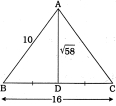
In $\Delta ABC$,$\overline{AD}$ is a median. If $AB = 10$,$BC = 16$ and $AD = \sqrt{58}$,find $AC$.
A
$12$
B
$15$
C
$19$
D
$20$
Solution
(A) In $\Delta ABC$,$\overline{AD}$ is a median to side $\overline{BC}$.
Therefore,$D$ is the midpoint of $\overline{BC}$.
$BD = \frac{1}{2} BC = \frac{1}{2}(16) = 8$.
By Apollonius' theorem for $\Delta ABC$ with median $\overline{AD}$:
$AB^2 + AC^2 = 2(AD^2 + BD^2)$
Substituting the given values:
$10^2 + AC^2 = 2((\sqrt{58})^2 + 8^2)$
$100 + AC^2 = 2(58 + 64)$
$100 + AC^2 = 2(122)$
$100 + AC^2 = 244$
$AC^2 = 244 - 100$
$AC^2 = 144$
$AC = \sqrt{144} = 12$.
0 likes
View Solution55
DifficultMCQ
In $\Delta ABC,$ $\overline{AD}$ is a median. If $AD=7,$ $AC=7$ and $BD=4,$ find the perimeter of $\Delta ABC.$
A
$30$
B
$24$
C
$35$
D
$40$
Solution
(B) In $\Delta ABC,$ $\overline{AD}$ is a median.
Since $D$ is the midpoint of $\overline{BC},$ we have $BC = 2BD = 2(4) = 8.$
By Apollonius' theorem for $\Delta ABC$ with median $\overline{AD},$
$AB^2 + AC^2 = 2(AD^2 + BD^2)$
$AB^2 + 7^2 = 2(7^2 + 4^2)$
$AB^2 + 49 = 2(49 + 16)$
$AB^2 + 49 = 2(65)$
$AB^2 + 49 = 130$
$AB^2 = 130 - 49 = 81$
$AB = 9$
Perimeter of $\Delta ABC = AB + BC + AC = 9 + 8 + 7 = 24.$

0 likes
View Solution56
Difficult
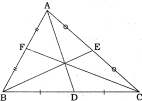
In $\Delta ABC$,$\overline{AD}$,$\overline{BE}$ and $\overline{CF}$ are medians. Prove that $3(AB^2 + BC^2 + AC^2) = 4(AD^2 + BE^2 + CF^2)$.
Solution
(N/A) In $\Delta ABC$,$\overline{AD}$,$\overline{BE}$ and $\overline{CF}$ are medians. Therefore,$D$,$E$,and $F$ are the midpoints of $\overline{BC}$,$\overline{AC}$,and $\overline{AB}$ respectively.
By Apollonius' theorem in $\Delta ABC$ with median $\overline{AD}$:
$AB^2 + AC^2 = 2(AD^2 + BD^2)$
Since $BD = \frac{1}{2}BC$,we have:
$AB^2 + AC^2 = 2AD^2 + 2(\frac{BC}{2})^2 = 2AD^2 + \frac{BC^2}{2}$
$2AD^2 = AB^2 + AC^2 - \frac{BC^2}{2} \quad \dots(1)$
Similarly,for medians $\overline{BE}$ and $\overline{CF}$:
$2BE^2 = AB^2 + BC^2 - \frac{AC^2}{2} \quad \dots(2)$
$2CF^2 = AC^2 + BC^2 - \frac{AB^2}{2} \quad \dots(3)$
Adding equations $(1)$,$(2)$,and $(3)$:
$2(AD^2 + BE^2 + CF^2) = (AB^2 + AB^2 - \frac{AB^2}{2}) + (BC^2 + BC^2 - \frac{BC^2}{2}) + (AC^2 + AC^2 - \frac{AC^2}{2})$
$2(AD^2 + BE^2 + CF^2) = \frac{3}{2}AB^2 + \frac{3}{2}BC^2 + \frac{3}{2}AC^2$
$2(AD^2 + BE^2 + CF^2) = \frac{3}{2}(AB^2 + BC^2 + AC^2)$
Multiplying both sides by $2$:
$4(AD^2 + BE^2 + CF^2) = 3(AB^2 + BC^2 + AC^2)$
0 likes
View Solution57
MediumMCQ
In $\Delta ABC$,$\overline{AD}$ is a median. If $AB^2 + AC^2 = 122$ and $AD = 6$,find $BC$.
A
$50$
B
$40$
C
$30$
D
$10$
Solution
(D) According to Apollonius's Theorem,for any triangle $\Delta ABC$ with median $\overline{AD}$ to side $\overline{BC}$,the following relation holds:
$AB^2 + AC^2 = 2(AD^2 + BD^2)$
Given that $AB^2 + AC^2 = 122$ and $AD = 6$,we substitute these values into the formula:
$122 = 2(6^2 + BD^2)$
$122 = 2(36 + BD^2)$
Divide both sides by $2$:
$61 = 36 + BD^2$
$BD^2 = 61 - 36$
$BD^2 = 25$
$BD = \sqrt{25} = 5$
Since $\overline{AD}$ is a median,$D$ is the midpoint of $\overline{BC}$,so $BC = 2 \times BD$.
$BC = 2 \times 5 = 10$.
0 likes
View Solution58
MediumMCQ
In $\Delta ABC$,$\overline{AD}$ is a median. If $AB = 18$,$AC = 14$,and $AD = 14$,find the perimeter of $\Delta ABC$.
A
$48$
B
$55$
C
$60$
D
$75$
Solution
(A) According to Apollonius' Theorem for $\Delta ABC$ with median $\overline{AD}$:
$AB^2 + AC^2 = 2(AD^2 + BD^2)$
Substitute the given values: $18^2 + 14^2 = 2(14^2 + BD^2)$
$324 + 196 = 2(196 + BD^2)$
$520 = 2(196 + BD^2)$
$260 = 196 + BD^2$
$BD^2 = 260 - 196 = 64$
$BD = 8$
Since $\overline{AD}$ is a median,$BD = DC = 8$.
Therefore,$BC = BD + DC = 8 + 8 = 16$.
The perimeter of $\Delta ABC = AB + AC + BC = 18 + 14 + 16 = 48$.
0 likes
View Solution59
MediumMCQ
In $\Delta ABC$,$\overline{AD}$ is a median. If $AB = 8$,$AC = 15$ and $AD = 8.5$,find $BC$.
A
$20$
B
$15$
C
$17$
D
$30$
Solution
(C) According to Apollonius's Theorem,for any triangle $\Delta ABC$ with median $\overline{AD}$ to side $\overline{BC}$:
$AB^2 + AC^2 = 2(AD^2 + BD^2)$
Given $AB = 8$,$AC = 15$,and $AD = 8.5$.
Substituting the values:
$8^2 + 15^2 = 2(8.5^2 + BD^2)$
$64 + 225 = 2(72.25 + BD^2)$
$289 = 2(72.25 + BD^2)$
$144.5 = 72.25 + BD^2$
$BD^2 = 144.5 - 72.25 = 72.25$
$BD = \sqrt{72.25} = 8.5$
Since $\overline{AD}$ is a median,$D$ is the midpoint of $\overline{BC}$,so $BC = 2 \times BD$.
$BC = 2 \times 8.5 = 17$.
0 likes
View Solution60
MediumMCQ
In $\Delta XYZ$,$\overline{XM}$ is a median. If $XY = 20$,$XZ = 21$ and $XM = 14.5$,find $YZ$.
A
$30$
B
$35$
C
$40$
D
$29$
Solution
(D) According to Apollonius's Theorem for $\Delta XYZ$ with median $\overline{XM}$ to side $\overline{YZ}$:
$XY^2 + XZ^2 = 2(XM^2 + YM^2)$
Given $XY = 20$,$XZ = 21$,and $XM = 14.5$.
Substituting the values:
$20^2 + 21^2 = 2(14.5^2 + YM^2)$
$400 + 441 = 2(210.25 + YM^2)$
$841 = 2(210.25 + YM^2)$
$420.5 = 210.25 + YM^2$
$YM^2 = 420.5 - 210.25 = 210.25$
$YM = \sqrt{210.25} = 14.5$
Since $\overline{XM}$ is a median,$M$ is the midpoint of $\overline{YZ}$,so $YZ = 2 \times YM$.
$YZ = 2 \times 14.5 = 29$.
0 likes
View Solution61
MediumMCQ
In $\Delta XYZ$,$\overline{XM}$ is a median. If $XY = 11$ and $XM = YM = 30.5$,find $XZ$.
A
$35$
B
$40$
C
$45$
D
$60$
Solution
(D) In $\Delta XYZ$,$\overline{XM}$ is a median to the side $\overline{YZ}$.
By definition of a median,$M$ is the midpoint of $\overline{YZ}$,so $YM = MZ = 30.5$.
Thus,the length of the side $YZ = YM + MZ = 30.5 + 30.5 = 61$.
We use Apollonius's Theorem for $\Delta XYZ$ with median $\overline{XM}$:
$XY^2 + XZ^2 = 2(XM^2 + YM^2)$.
Substitute the given values: $11^2 + XZ^2 = 2(30.5^2 + 30.5^2)$.
$121 + XZ^2 = 2(930.25 + 930.25)$.
$121 + XZ^2 = 2(1860.5)$.
$121 + XZ^2 = 3721$.
$XZ^2 = 3721 - 121$.
$XZ^2 = 3600$.
$XZ = \sqrt{3600} = 60$.
0 likes
View Solution62
Medium
Prove that in a parallelogram,the sum of squares of all the sides is equal to the sum of squares of the diagonals.
Solution
(N/A) Let $ABCD$ be a parallelogram with diagonals $AC$ and $BD$ intersecting at $O$.
By the Parallelogram Law,we know that the sum of the squares of the four sides is equal to the sum of the squares of the two diagonals.
Let the sides be $AB$,$BC$,$CD$,and $DA$. Since $ABCD$ is a parallelogram,$AB = CD$ and $BC = DA$.
According to Apollonius Theorem in $\triangle ABC$ and $\triangle ADC$ with median $BO$ (where $O$ is the midpoint of $AC$):
$AB^2 + BC^2 = 2(BO^2 + AO^2)$
$AD^2 + CD^2 = 2(DO^2 + AO^2)$
Since $O$ is the midpoint of $BD$,$BO = DO$.
Adding the two equations:
$AB^2 + BC^2 + CD^2 + DA^2 = 2(BO^2 + AO^2 + DO^2 + AO^2) = 2(2BO^2 + 2AO^2) = 4BO^2 + 4AO^2$.
Since $BD = 2BO$ and $AC = 2AO$,then $BD^2 = 4BO^2$ and $AC^2 = 4AO^2$.
Therefore,$AB^2 + BC^2 + CD^2 + DA^2 = AC^2 + BD^2$.
0 likes
View Solution63
MediumMCQ
In $\Delta PQR$,$m \angle Q = 90^\circ$. If $PQ = 5$ and $PR = 13$,find the area of $\Delta PQR$.
A
$40$
B
$35$
C
$30$
D
$45$
Solution
(C) Given that $\Delta PQR$ is a right-angled triangle with $m \angle Q = 90^\circ$.
$PQ$ and $QR$ are the legs,and $PR$ is the hypotenuse.
Using the Pythagorean theorem: $PQ^2 + QR^2 = PR^2$.
Substitute the given values: $5^2 + QR^2 = 13^2$.
$25 + QR^2 = 169$.
$QR^2 = 169 - 25 = 144$.
$QR = \sqrt{144} = 12$.
The area of a right-angled triangle is given by $\text{Area} = \frac{1}{2} \times \text{base} \times \text{height}$.
$\text{Area} = \frac{1}{2} \times PQ \times QR = \frac{1}{2} \times 5 \times 12$.
$\text{Area} = 5 \times 6 = 30$.
0 likes
View Solution64
MediumMCQ
$\square ABCD$ is a square. If its perimeter is $40$, find $AC + BD$. (in $\sqrt{2}$)
A
$10$
B
$20$
C
$30$
D
$40$
Solution
(B) Let the side length of the square be $s$.
The perimeter of a square is given by $4s$.
Given $4s = 40$, so $s = 10$.
The diagonals of a square are equal in length.
The length of the diagonal $d$ of a square with side $s$ is given by $d = s \sqrt{2}$.
Thus, $AC = BD = 10 \sqrt{2}$.
Therefore, $AC + BD = 10 \sqrt{2} + 10 \sqrt{2} = 20 \sqrt{2}$.
0 likes
View Solution65
MediumMCQ
In $\Delta ABC$,$\overline{AD}$ is a median. If $AB^2 + AC^2 = 338$ and $AD = 5$,find $BC$.
A
$30$
B
$15$
C
$20$
D
$24$
Solution
(D) According to Apollonius's Theorem for $\Delta ABC$ with median $\overline{AD}$:
$AB^2 + AC^2 = 2(AD^2 + BD^2)$
Given $AB^2 + AC^2 = 338$ and $AD = 5$.
Substituting the values into the formula:
$338 = 2(5^2 + BD^2)$
$338 = 2(25 + BD^2)$
$169 = 25 + BD^2$
$BD^2 = 169 - 25 = 144$
$BD = \sqrt{144} = 12$
Since $\overline{AD}$ is a median,$D$ is the midpoint of $\overline{BC}$,so $BC = 2 \times BD$.
$BC = 2 \times 12 = 24$.
0 likes
View Solution66
MediumMCQ
In rhombus $ABCD$,$AC > BD$ and $\overline{AC} \cap \overline{BD} = \{M\}$. If $AM + DM = 17$ and $AB = 13$,find $BD$.
A
$50$
B
$40$
C
$20$
D
$10$
Solution
(D) In a rhombus,the diagonals bisect each other at right angles. Let $AM = x$ and $DM = y$.
Since the diagonals intersect at $M$ at a $90^{\circ}$ angle,$\triangle AMB$ is a right-angled triangle.
By the Pythagorean theorem,$AM^2 + BM^2 = AB^2$.
Given $AM + DM = 17$,we have $x + y = 17$,so $y = 17 - x$.
In $\triangle AMB$,$x^2 + BM^2 = 13^2 = 169$.
In $\triangle AMD$,$x^2 + y^2 = AD^2$. Since all sides of a rhombus are equal,$AD = AB = 13$.
Thus,$x^2 + y^2 = 169$.
Substituting $y = 17 - x$: $x^2 + (17 - x)^2 = 169$.
$x^2 + 289 - 34x + x^2 = 169$.
$2x^2 - 34x + 120 = 0$.
$x^2 - 17x + 60 = 0$.
$(x - 12)(x - 5) = 0$.
So,$x = 12$ or $x = 5$.
If $x = 12$,then $y = 17 - 12 = 5$.
If $x = 5$,then $y = 17 - 5 = 12$.
Since $AC > BD$,$AM > DM$,so $x > y$. Thus,$x = 12$ and $y = 5$.
$DM = y = 5$.
Since the diagonals bisect each other,$BD = 2 \times DM = 2 \times 5 = 10$.
0 likes
View Solution67
MediumMCQ
In $\Delta ABC$,$m \angle B = 90^{\circ}$,$AC - BC = 2$ and $BC - AB = 7$. Find the perimeter of $\Delta ABC$.
A
$60$
B
$50$
C
$40$
D
$30$
Solution
(C) Let $AB = x$.
Given $BC - AB = 7$,so $BC = x + 7$.
Given $AC - BC = 2$,so $AC = BC + 2 = (x + 7) + 2 = x + 9$.
Since $\Delta ABC$ is a right-angled triangle with $m \angle B = 90^{\circ}$,by the Pythagorean theorem:
$AB^2 + BC^2 = AC^2$
$x^2 + (x + 7)^2 = (x + 9)^2$
$x^2 + x^2 + 14x + 49 = x^2 + 18x + 81$
$2x^2 + 14x + 49 = x^2 + 18x + 81$
$x^2 - 4x - 32 = 0$
$(x - 8)(x + 4) = 0$
Since $x$ represents a length,$x = 8$.
Thus,$AB = 8$,$BC = 8 + 7 = 15$,and $AC = 8 + 9 = 17$.
The perimeter of $\Delta ABC = AB + BC + AC = 8 + 15 + 17 = 40$.
0 likes
View Solution68
MediumMCQ
$\square ABCD$ is a rectangle. If $AB^{2} + BC^{2} + CD^{2} + DA^{2} = 128$,find the length of diagonal $\overline{AC}$.
A
$10$
B
$15$
C
$13$
D
$8$
Solution
(D) In a rectangle $\square ABCD$,opposite sides are equal,so $AB = CD$ and $BC = DA$.
Given the equation: $AB^{2} + BC^{2} + CD^{2} + DA^{2} = 128$.
Substituting the equal sides,we get: $AB^{2} + BC^{2} + AB^{2} + BC^{2} = 128$.
This simplifies to: $2(AB^{2} + BC^{2}) = 128$.
Dividing by $2$,we get: $AB^{2} + BC^{2} = 64$.
In the right-angled triangle $\triangle ABC$,by the Pythagorean theorem: $AC^{2} = AB^{2} + BC^{2}$.
Therefore,$AC^{2} = 64$.
Taking the square root of both sides,$AC = \sqrt{64} = 8$.
0 likes
View Solution69
EasyMCQ
The area of an equilateral triangle is $36 \sqrt{3}$. Find the measure of its sides.
A
$25$
B
$12$
C
$74$
D
$59$
Solution
(B) The area of an equilateral triangle with side length $a$ is given by the formula: $\text{Area} = \frac{\sqrt{3}}{4} a^2$.
Given that the area is $36 \sqrt{3}$,we can set up the equation:
$\frac{\sqrt{3}}{4} a^2 = 36 \sqrt{3}$.
Divide both sides by $\sqrt{3}$:
$\frac{1}{4} a^2 = 36$.
Multiply both sides by $4$:
$a^2 = 36 \times 4 = 144$.
Taking the square root of both sides:
$a = \sqrt{144} = 12$.
Therefore,the measure of its side is $12$.
0 likes
View Solution70
MediumMCQ
In $\Delta ABC$,$\overline{AM}$ is an altitude. If $AB = AC = 25$ and $BC = 14$,find $AM$.
A
$40$
B
$34$
C
$20$
D
$24$
Solution
(D) Given that $\Delta ABC$ is an isosceles triangle with $AB = AC = 25$ and base $BC = 14$.
Since $\overline{AM}$ is an altitude to the base $BC$,in an isosceles triangle,the altitude from the vertex to the base also acts as the median.
Therefore,$M$ is the midpoint of $BC$.
Thus,$BM = MC = \frac{BC}{2} = \frac{14}{2} = 7$.
In the right-angled triangle $\Delta ABM$,by the Pythagorean theorem:
$AB^2 = AM^2 + BM^2$
$25^2 = AM^2 + 7^2$
$625 = AM^2 + 49$
$AM^2 = 625 - 49 = 576$
$AM = \sqrt{576} = 24$.
Hence,the length of the altitude $AM$ is $24$.
0 likes
View Solution71
DifficultMCQ
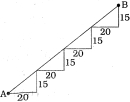
As shown in the adjoining diagram of a staircase,the width of each step is $20 \, cm$ and the height is $15 \, cm$. Find the distance between points $A$ and $B$ in meters.
A
$0.5$
B
$1$
C
$1.25$
D
$2$
Solution
(B) From the diagram,there are $4$ steps in total.
Total horizontal distance (base) $= 4 \times 20 \, cm = 80 \, cm = 0.8 \, m$.
Total vertical distance (height) $= 4 \times 15 \, cm = 60 \, cm = 0.6 \, m$.
The distance between points $A$ and $B$ forms the hypotenuse of a right-angled triangle with base $0.8 \, m$ and height $0.6 \, m$.
Using the Pythagorean theorem: $AB = \sqrt{(0.8)^2 + (0.6)^2} = \sqrt{0.64 + 0.36} = \sqrt{1.00} = 1 \, m$.
0 likes
View Solution72
Medium
In $\Delta ABC$,$m\angle B = 90^{\circ}$. $D$ is the midpoint of $\overline{BC}$ and $F$ is the midpoint of $\overline{AB}$. Prove that $AD^{2} + CF^{2} = \frac{5}{4} AC^{2}$.
Solution
(N/A) $1$. In $\Delta ABC$,by the Pythagorean theorem,$AC^{2} = AB^{2} + BC^{2}$.
$2$. In right-angled $\Delta ABD$,$AD^{2} = AB^{2} + BD^{2}$. Since $D$ is the midpoint of $BC$,$BD = \frac{1}{2} BC$. Thus,$AD^{2} = AB^{2} + (\frac{1}{2} BC)^{2} = AB^{2} + \frac{1}{4} BC^{2}$.
$3$. In right-angled $\Delta CBF$,$CF^{2} = BC^{2} + BF^{2}$. Since $F$ is the midpoint of $AB$,$BF = \frac{1}{2} AB$. Thus,$CF^{2} = BC^{2} + (\frac{1}{2} AB)^{2} = BC^{2} + \frac{1}{4} AB^{2}$.
$4$. Adding the two equations: $AD^{2} + CF^{2} = (AB^{2} + \frac{1}{4} BC^{2}) + (BC^{2} + \frac{1}{4} AB^{2})$.
$5$. Simplifying: $AD^{2} + CF^{2} = (1 + \frac{1}{4}) AB^{2} + (1 + \frac{1}{4}) BC^{2} = \frac{5}{4} AB^{2} + \frac{5}{4} BC^{2}$.
$6$. Factoring out $\frac{5}{4}$: $AD^{2} + CF^{2} = \frac{5}{4} (AB^{2} + BC^{2})$.
$7$. Since $AB^{2} + BC^{2} = AC^{2}$,we get $AD^{2} + CF^{2} = \frac{5}{4} AC^{2}$.
0 likes
View Solution73
Medium
$\Delta ABC$ is an acute-angled triangle and $\overline{AM}$ is an altitude. Prove that $AC^{2} = AB^{2} + BC^{2} - 2 \cdot BC \cdot BM$.
Solution
(N/A) In $\Delta ABC$,$\overline{AM}$ is the altitude to side $\overline{BC}$,so $\angle AMB = 90^{\circ}$ and $\angle AMC = 90^{\circ}$.
In $\Delta AMC$,by Pythagoras theorem: $AC^{2} = AM^{2} + MC^{2}$.
Since $M$ lies on $BC$,we have $MC = BC - BM$.
Substituting this into the equation: $AC^{2} = AM^{2} + (BC - BM)^{2}$.
Expanding the square: $AC^{2} = AM^{2} + BC^{2} + BM^{2} - 2 \cdot BC \cdot BM$.
In $\Delta AMB$,by Pythagoras theorem: $AB^{2} = AM^{2} + BM^{2}$.
Substituting $AM^{2} + BM^{2} = AB^{2}$ into the equation: $AC^{2} = AB^{2} + BC^{2} - 2 \cdot BC \cdot BM$.
Hence,the result is proved.
0 likes
View Solution74
Medium
As shown in the adjoining diagram,$\angle B$ is an obtuse angle and $\overline{AM}$ is an altitude in $\Delta ABC$. Prove that $AC^{2} = AB^{2} + BC^{2} + 2 \cdot BC \cdot BM$.

Solution
(N/A) In $\Delta AMC$,$\angle AMC = 90^{\circ}$. By Pythagoras theorem,$AC^{2} = AM^{2} + MC^{2}$.
Since $MC = MB + BC$,we have $AC^{2} = AM^{2} + (MB + BC)^{2}$.
Expanding the square,$AC^{2} = AM^{2} + MB^{2} + BC^{2} + 2 \cdot MB \cdot BC$.
In $\Delta AMB$,$\angle AMB = 90^{\circ}$. By Pythagoras theorem,$AB^{2} = AM^{2} + MB^{2}$.
Substituting $AB^{2}$ for $AM^{2} + MB^{2}$ in the equation,we get $AC^{2} = AB^{2} + BC^{2} + 2 \cdot BC \cdot BM$.
0 likes
View Solution75
MediumMCQ
If the measures of the sides of a triangle are $\ldots \ldots \ldots,$ then it is not a right-angled triangle.
A
$3, 4, 5$
B
$5, 12, 13$
C
$7, 24, 25$
D
$8, 24, 26$
Solution
(D) triangle is a right-angled triangle if the square of the longest side is equal to the sum of the squares of the other two sides (Pythagoras theorem: $a^2 + b^2 = c^2$).
For option $A$: $3^2 + 4^2 = 9 + 16 = 25 = 5^2$. This is a right-angled triangle.
For option $B$: $5^2 + 12^2 = 25 + 144 = 169 = 13^2$. This is a right-angled triangle.
For option $C$: $7^2 + 24^2 = 49 + 576 = 625 = 25^2$. This is a right-angled triangle.
For option $D$: $8^2 + 24^2 = 64 + 576 = 640$,while $26^2 = 676$. Since $640 \neq 676$,this is not a right-angled triangle.
0 likes
View Solution76
MediumMCQ
In $\Delta XYZ$,$m\angle X = 90^{\circ}$,$XY = 8$ and $YZ = 17$. Then,the area of $\Delta XYZ$ is.............
A
$30$
B
$40$
C
$50$
D
$60$
Solution
(D) Given that $\Delta XYZ$ is a right-angled triangle with $m\angle X = 90^{\circ}$.
Here,$YZ$ is the hypotenuse and $XY$ is one of the legs.
Using the Pythagorean theorem: $XY^2 + XZ^2 = YZ^2$.
Substituting the given values: $8^2 + XZ^2 = 17^2$.
$64 + XZ^2 = 289$.
$XZ^2 = 289 - 64 = 225$.
$XZ = \sqrt{225} = 15$.
The area of a right-angled triangle is given by $\text{Area} = \frac{1}{2} \times \text{base} \times \text{height}$.
$\text{Area} = \frac{1}{2} \times XY \times XZ$.
$\text{Area} = \frac{1}{2} \times 8 \times 15 = 4 \times 15 = 60$.
0 likes
View Solution77
EasyMCQ
In $\Delta ABC$,$\overline{AD}$ is a median. If $AB = 8$,$BC = 18$,and $AD = 7$,then $AC = \ldots$
A
$14$
B
$16$
C
$7$
D
$10$
Solution
(A) According to Apollonius's theorem for $\Delta ABC$ with median $\overline{AD}$:
$AB^2 + AC^2 = 2(AD^2 + BD^2)$
Given that $\overline{AD}$ is a median to side $\overline{BC}$,$D$ is the midpoint of $\overline{BC}$.
Therefore,$BD = DC = \frac{BC}{2} = \frac{18}{2} = 9$.
Substituting the given values into the theorem:
$8^2 + AC^2 = 2(7^2 + 9^2)$
$64 + AC^2 = 2(49 + 81)$
$64 + AC^2 = 2(130)$
$64 + AC^2 = 260$
$AC^2 = 260 - 64$
$AC^2 = 196$
$AC = \sqrt{196} = 14$.
0 likes
View Solution78
EasyMCQ
In $\Delta ABC$,$AB = 4$,$BC = 2\sqrt{3}$,and $AC = 2\sqrt{7}$. Then,in $\Delta ABC$,the length of the median on the longest side is $\ldots$
A
$8\sqrt{3}$
B
$48\sqrt{3}$
C
$\sqrt{7}$
D
$\sqrt{3}$
Solution
(C) First,identify the longest side of $\Delta ABC$. We have $AB = 4$,$BC = 2\sqrt{3} \approx 3.46$,and $AC = 2\sqrt{7} \approx 5.29$. Since $AC$ is the longest side,we need to find the length of the median $BD$ drawn to side $AC$.
Using Apollonius Theorem for $\Delta ABC$ with median $BD$ on side $AC$:
$AB^2 + BC^2 = 2(BD^2 + AD^2)$
Since $D$ is the midpoint of $AC$,$AD = AC/2 = (2\sqrt{7})/2 = \sqrt{7}$.
Substitute the values: $4^2 + (2\sqrt{3})^2 = 2(BD^2 + (\sqrt{7})^2)$
$16 + 12 = 2(BD^2 + 7)$
$28 = 2(BD^2 + 7)$
$14 = BD^2 + 7$
$BD^2 = 7$
$BD = \sqrt{7}$.
0 likes
View Solution79
DifficultMCQ
In rhombus $ABCD$,$\overline{AC} \cap \overline{BD} = \{O\}$. Then the area of $\Delta OAB = \ldots \ldots \ldots \ldots \times$ area of $\square ABCD$.
A
$\frac{1}{2}$
B
$\frac{1}{3}$
C
$\frac{1}{4}$
D
$\frac{1}{8}$
Solution
(C) The diagonals of a rhombus bisect each other at right angles.
This division creates four congruent triangles within the rhombus.
Therefore,$\Delta OAB \cong \Delta OCB \cong \Delta OCD \cong \Delta OAD$.
Since these four triangles are congruent,their areas are equal:
$\text{Area}(\Delta OAB) = \text{Area}(\Delta OCB) = \text{Area}(\Delta OCD) = \text{Area}(\Delta OAD)$.
The total area of the rhombus $ABCD$ is the sum of the areas of these four triangles:
$\text{Area}(\square ABCD) = \text{Area}(\Delta OAB) + \text{Area}(\Delta OCB) + \text{Area}(\Delta OCD) + \text{Area}(\Delta OAD)$.
Substituting the equal areas,we get:
$\text{Area}(\square ABCD) = 4 \times \text{Area}(\Delta OAB)$.
Thus,$\text{Area}(\Delta OAB) = \frac{1}{4} \times \text{Area}(\square ABCD)$.

0 likes
View Solution80
DifficultMCQ
In $\Delta ABC$,$D$,$E$ and $F$ are the midpoints of $\overline{BC}$,$\overline{CA}$ and $\overline{AB}$ respectively. Then,$\text{Area}(BDEF) = \ldots \times \text{Area}(\Delta ABC)$.
A
$2$
B
$\frac{1}{2}$
C
$\frac{1}{4}$
D
$\frac{3}{4}$
Solution
(B) In $\Delta ABC$,$D$,$E$,and $F$ are the midpoints of sides $BC$,$CA$,and $AB$ respectively. By the midpoint theorem,the triangle is divided into four congruent triangles: $\Delta AFE$,$\Delta FBD$,$\Delta EDC$,and $\Delta DEF$.
Therefore,$\text{Area}(\Delta AFE) = \text{Area}(\Delta FBD) = \text{Area}(\Delta EDC) = \text{Area}(\Delta DEF) = \frac{1}{4} \text{Area}(\Delta ABC)$.
The quadrilateral $BDEF$ is composed of $\Delta FBD$ and $\Delta DEF$.
Thus,$\text{Area}(BDEF) = \text{Area}(\Delta FBD) + \text{Area}(\Delta DEF) = \frac{1}{4} \text{Area}(\Delta ABC) + \frac{1}{4} \text{Area}(\Delta ABC) = \frac{1}{2} \text{Area}(\Delta ABC)$.

0 likes
View Solution81
DifficultMCQ
In $\Delta ABC$,$P, Q$ and $R$ are the midpoints of $\overline{BC}, \overline{CA}$ and $\overline{AB}$ respectively. Then,$Area(BCQR) = \ldots \ldots \ldots \times Area(ABC)$.
A
$3$
B
$\frac{1}{2}$
C
$2$
D
$\frac{3}{4}$
Solution
(D) In $\Delta ABC$,since $P, Q,$ and $R$ are the midpoints of sides $BC, CA,$ and $AB$ respectively,the triangle is divided into four congruent triangles: $\Delta ARQ, \Delta RBP, \Delta QPC,$ and $\Delta PQR$.
Therefore,$Area(\Delta ARQ) = Area(\Delta RBP) = Area(\Delta QPC) = Area(\Delta PQR) = \frac{1}{4} Area(\Delta ABC)$.
The quadrilateral $BCQR$ is composed of three of these triangles: $\Delta RBP, \Delta QPC,$ and $\Delta PQR$.
Thus,$Area(BCQR) = Area(\Delta RBP) + Area(\Delta QPC) + Area(\Delta PQR) = \frac{1}{4} Area(\Delta ABC) + \frac{1}{4} Area(\Delta ABC) + \frac{1}{4} Area(\Delta ABC) = \frac{3}{4} Area(\Delta ABC)$.

0 likes
View Solution82
MediumMCQ
In $\Delta ABC$,$\overline{AM}$ and $\overline{CN}$ are altitudes. If $AB = 12$,$BC = 15$ and $AM = 9.6$,then $CN = \ldots$
A
$12$
B
$6.4$
C
$7.2$
D
$6$
Solution
(A) The area of a triangle can be calculated using the formula: $\text{Area} = \frac{1}{2} \times \text{base} \times \text{height}$.
For $\Delta ABC$,we can express the area in two ways:
$1. \text{Area} = \frac{1}{2} \times BC \times AM$
$2. \text{Area} = \frac{1}{2} \times AB \times CN$
Equating both expressions for the area:
$\frac{1}{2} \times BC \times AM = \frac{1}{2} \times AB \times CN$
$BC \times AM = AB \times CN$
Substitute the given values: $15 \times 9.6 = 12 \times CN$
$144 = 12 \times CN$
$CN = \frac{144}{12} = 12$
Thus,$CN = 12$.
0 likes
View Solution83
MediumMCQ
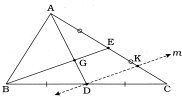
In $\Delta ABC$,$D$ and $E$ are the midpoints of $\overline{BC}$ and $\overline{AC}$ respectively. $\overline{AD}$ and $\overline{BE}$ intersect at $G$. Line $m$ passing through $D$ and parallel to $\overline{BE}$ intersects $\overline{AC}$ at $K$. Then,$AC = \ldots$ (in $EK$)
A
$2$
B
$3$
C
$4$
D
$6$
Solution
(C) In $\Delta ABC$,$E$ is the midpoint of $\overline{AC}$.
Therefore,$AC = 2EC$ $(1)$.
In $\Delta BEC$,line $DK$ passes through the midpoint $D$ of $\overline{BC}$ and is parallel to $\overline{BE}$.
By the Converse of the Midpoint Theorem,$K$ is the midpoint of $\overline{EC}$.
Therefore,$EC = 2EK$ $(2)$.
Substituting $(2)$ into $(1)$,we get $AC = 2(2EK) = 4EK$.
0 likes
View Solution84
MediumMCQ
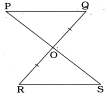
The two triangles in the figure are congruent using a congruence theorem. It is given that $OQ = OR$. Which of these conditions,along with the given condition,is sufficient to prove that the two triangles are congruent to each other?
A
$\angle P = \angle S$
B
$\angle Q = \angle R$
C
$OP = OS$
D
$PQ = SR$
Solution
(C) In $\triangle OPQ$ and $\triangle OSR$,we are given $OQ = OR$.
Also,$\angle POQ = \angle SOR$ because they are vertically opposite angles.
To prove the triangles are congruent by the $SAS$ (Side-Angle-Side) congruence criterion,we need another side adjacent to the angle $\angle POQ$ and $\angle SOR$ to be equal.
The sides adjacent to the angles are $OP$ and $OQ$ in $\triangle OPQ$,and $OS$ and $OR$ in $\triangle OSR$.
Since we already have $OQ = OR$,we need $OP = OS$ to satisfy the $SAS$ condition.
Therefore,the condition $OP = OS$ is sufficient.
0 likes
View Solution85
MediumMCQ
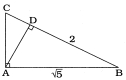
In $\Delta ABC$,$m \angle A = 90^{\circ}$ and $\overline{AD}$ is an altitude. If $AB = \sqrt{5}$ and $BD = 2$,then the length of hypotenuse $\overline{BC}$ is.........
A
$2\sqrt{5}$
B
$3$
C
$\sqrt{10}$
D
$2.5$
Solution
(D) In $\Delta ABC$,$m \angle A = 90^{\circ}$ and $\overline{AD}$ is an altitude to the hypotenuse $\overline{BC}$.
According to the geometric mean theorem for right-angled triangles,$AB^{2} = BD \cdot BC$.
Substituting the given values: $(\sqrt{5})^{2} = 2 \cdot BC$.
$5 = 2 \cdot BC$.
$BC = \frac{5}{2} = 2.5$.
Therefore,the length of the hypotenuse $\overline{BC}$ is $2.5$.
According to the geometric mean theorem for right-angled triangles,$AB^{2} = BD \cdot BC$.
Substituting the given values: $(\sqrt{5})^{2} = 2 \cdot BC$.
$5 = 2 \cdot BC$.
$BC = \frac{5}{2} = 2.5$.
Therefore,the length of the hypotenuse $\overline{BC}$ is $2.5$.
0 likes
View Solution86
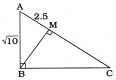
MediumMCQ
In $\Delta ABC$,$m \angle B = 90^{\circ}$ and $\overline{BM}$ is an altitude. If $AB = \sqrt{10}$ and $AM = 2.5$,then $MC = \ldots$
A
$1.5$
B
$4$
C
$7.5$
D
$5$
Solution
(A) In $\Delta ABC$,$m \angle B = 90^{\circ}$ and $\overline{BM}$ is an altitude to the hypotenuse $AC$.
According to the geometric mean theorem for right-angled triangles,$AB^2 = AM \cdot AC$.
Given $AB = \sqrt{10}$ and $AM = 2.5$.
Substituting the values: $(\sqrt{10})^2 = 2.5 \cdot AC$.
$10 = 2.5 \cdot AC$.
$AC = \frac{10}{2.5} = 4$.
Since $AC = AM + MC$,we have $4 = 2.5 + MC$.
$MC = 4 - 2.5 = 1.5$.
According to the geometric mean theorem for right-angled triangles,$AB^2 = AM \cdot AC$.
Given $AB = \sqrt{10}$ and $AM = 2.5$.
Substituting the values: $(\sqrt{10})^2 = 2.5 \cdot AC$.
$10 = 2.5 \cdot AC$.
$AC = \frac{10}{2.5} = 4$.
Since $AC = AM + MC$,we have $4 = 2.5 + MC$.
$MC = 4 - 2.5 = 1.5$.
0 likes
View Solution87
DifficultMCQ
In $\Delta PQR$,$m\angle Q = 90^{\circ}$,$PR = a^{2} + b^{2}$ and $QR = a^{2} - b^{2}$. Then,$PQ = \ldots$ $(a, b \in R^{+}; a > b)$
A
$a$
B
$b$
C
$2ab$
D
$4ab$
Solution
(C) In $\Delta PQR$,since $m\angle Q = 90^{\circ}$,the triangle is a right-angled triangle.
By the Pythagoras theorem,$PR^{2} = PQ^{2} + QR^{2}$.
Therefore,$PQ^{2} = PR^{2} - QR^{2}$.
Substituting the given values:
$PQ^{2} = (a^{2} + b^{2})^{2} - (a^{2} - b^{2})^{2}$.
Using the algebraic identity $(x + y)^{2} - (x - y)^{2} = 4xy$,where $x = a^{2}$ and $y = b^{2}$:
$PQ^{2} = 4(a^{2})(b^{2}) = 4a^{2}b^{2}$.
Taking the square root on both sides:
$PQ = \sqrt{4a^{2}b^{2}} = 2ab$.

0 likes
View Solution88
DifficultMCQ
In $\Delta ABC$,$AB = AC$ and $m \angle A = 90^\circ$. If $BC = \sqrt{2} a$,then the area of $\Delta ABC$ is $\ldots \ldots \ldots \ldots$ $(a \in R^+)$.
A
$2a$
B
$\frac{1}{2} a^2$
C
$2a^2$
D
$a^2$
Solution
(B) Let $AB = AC = x$.
In $\Delta ABC$,$m \angle A = 90^\circ$.
By the Pythagorean theorem,$AB^2 + AC^2 = BC^2$.
Substituting the given values: $x^2 + x^2 = (\sqrt{2} a)^2$.
$2x^2 = 2a^2$.
$x^2 = a^2$,so $x = a$ (since $a \in R^+$).
Thus,$AB = AC = a$.
The area of $\Delta ABC = \frac{1}{2} \times \text{base} \times \text{height} = \frac{1}{2} \times AB \times AC$.
Area $= \frac{1}{2} \times a \times a = \frac{1}{2} a^2$.

0 likes
View Solution89
MediumMCQ
In $\Delta ABC$,$m \angle B = 90^{\circ}$ and $\overline{BM}$ is an altitude to the hypotenuse $\overline{AC}$. If $AM - MC = 7$ and $AB^{2} - BC^{2} = 175$,then $AC = \ldots$
A
$\sqrt{224}$
B
$\sqrt{216}$
C
$25$
D
$20$
Solution
(C) In $\Delta ABC$,$m \angle B = 90^{\circ}$ and $\overline{BM}$ is an altitude to the hypotenuse $\overline{AC}$.
By the properties of right-angled triangles with an altitude to the hypotenuse,we have:
$AB^{2} = AM \cdot AC$ and $BC^{2} = MC \cdot AC$
Subtracting these two equations:
$AB^{2} - BC^{2} = AM \cdot AC - MC \cdot AC$
$AB^{2} - BC^{2} = AC(AM - MC)$
Given that $AB^{2} - BC^{2} = 175$ and $AM - MC = 7$,we substitute these values:
$175 = AC(7)$
$AC = \frac{175}{7}$
$AC = 25$

0 likes
View Solution90
DifficultMCQ
$\square PQRS$ is a rectangle. $PQ + QR = 7$ and the area of $\square PQRS$ is $12$. Then,$PR = \ldots$
A
$5$
B
$4$
C
$3$
D
$6$
Solution
(A) Given that $\square PQRS$ is a rectangle.
Area of rectangle $PQRS = PQ \cdot QR = 12$.
Sum of adjacent sides $PQ + QR = 7$.
In $\triangle PQR$,$\angle Q = 90^\circ$.
By Pythagoras theorem,$PR^2 = PQ^2 + QR^2$.
We know that $(PQ + QR)^2 = PQ^2 + QR^2 + 2(PQ \cdot QR)$.
Therefore,$PQ^2 + QR^2 = (PQ + QR)^2 - 2(PQ \cdot QR)$.
Substituting the given values: $PR^2 = (7)^2 - 2(12)$.
$PR^2 = 49 - 24 = 25$.
Taking the square root on both sides,$PR = 5$.

0 likes
View Solution91
MediumMCQ
In $\Delta ABC$,$m \angle A = m \angle B + m \angle C$. If $AB = 7$ and $BC = 25$,the perimeter of $\Delta ABC = ........$
A
$24$
B
$56$
C
$64$
D
$48$
Solution
(B) Given that in $\Delta ABC$,$m \angle A = m \angle B + m \angle C$.
We know that the sum of angles in a triangle is $180^{\circ}$,so $m \angle A + m \angle B + m \angle C = 180^{\circ}$.
Substituting $m \angle B + m \angle C$ with $m \angle A$,we get $m \angle A + m \angle A = 180^{\circ}$,which implies $2 m \angle A = 180^{\circ}$,so $m \angle A = 90^{\circ}$.
Since $\Delta ABC$ is a right-angled triangle with the right angle at $A$,$BC$ is the hypotenuse.
By the Pythagorean theorem,$BC^2 = AB^2 + AC^2$.
Given $AB = 7$ and $BC = 25$,we have $25^2 = 7^2 + AC^2$.
$625 = 49 + AC^2$,so $AC^2 = 625 - 49 = 576$.
Thus,$AC = \sqrt{576} = 24$.
The perimeter of $\Delta ABC = AB + BC + AC = 7 + 25 + 24 = 56$.
0 likes
View Solution92
DifficultMCQ
$A$ $6.5 \, m$ long ladder leans on a wall to reach a height of $6 \, m$ on the wall. Then,the lower end of the ladder remains $\ldots \ldots \ldots \ldots \, m$ away from the wall.
A
$5$
B
$4$
C
$3.5$
D
$2.5$
Solution
(D) Let $\overline{AC}$ represent the ladder and $\overline{AB}$ represent the height of the wall.
In $\Delta ABC$,$\angle B = 90^{\circ}$.
By the Pythagorean theorem,$AC^2 = AB^2 + BC^2$.
Given $AC = 6.5 \, m$ and $AB = 6 \, m$.
$6.5^2 = 6^2 + BC^2$
$42.25 = 36 + BC^2$
$BC^2 = 42.25 - 36 = 6.25$
$BC = \sqrt{6.25} = 2.5 \, m$.
Thus,the lower end of the ladder is $2.5 \, m$ away from the wall.
In $\Delta ABC$,$\angle B = 90^{\circ}$.
By the Pythagorean theorem,$AC^2 = AB^2 + BC^2$.
Given $AC = 6.5 \, m$ and $AB = 6 \, m$.
$6.5^2 = 6^2 + BC^2$
$42.25 = 36 + BC^2$
$BC^2 = 42.25 - 36 = 6.25$
$BC = \sqrt{6.25} = 2.5 \, m$.
Thus,the lower end of the ladder is $2.5 \, m$ away from the wall.

0 likes
View Solution93
DifficultMCQ
In $\Delta ABC$,$D$ is the midpoint of $\overline{BC}$,$AB = 7$,$AC = 5$ and $AD = 5$. Then $BC = \ldots$
A
$6$
B
$5$
C
$4 \sqrt{3}$
D
$5 \sqrt{2}$
Solution
(C) In $\Delta ABC$,$D$ is the midpoint of $\overline{BC}$. Therefore,$\overline{AD}$ is a median.
By Apollonius' theorem:
$AB^2 + AC^2 = 2(AD^2 + BD^2)$
$7^2 + 5^2 = 2(5^2 + BD^2)$
$49 + 25 = 2(25 + BD^2)$
$74 = 2(25 + BD^2)$
$37 = 25 + BD^2$
$BD^2 = 12$
$BD = \sqrt{12} = 2\sqrt{3}$
Since $D$ is the midpoint of $\overline{BC}$,$BC = 2 \times BD = 2 \times 2\sqrt{3} = 4\sqrt{3}$.
By Apollonius' theorem:
$AB^2 + AC^2 = 2(AD^2 + BD^2)$
$7^2 + 5^2 = 2(5^2 + BD^2)$
$49 + 25 = 2(25 + BD^2)$
$74 = 2(25 + BD^2)$
$37 = 25 + BD^2$
$BD^2 = 12$
$BD = \sqrt{12} = 2\sqrt{3}$
Since $D$ is the midpoint of $\overline{BC}$,$BC = 2 \times BD = 2 \times 2\sqrt{3} = 4\sqrt{3}$.

0 likes
View Solution94
MediumMCQ
In $\Delta ABC$,$\overline{AD}$ is a median and $AB^2 + AC^2 = 148$. If $AD = 7$,then $BC = \ldots$
A
$5$
B
$7$
C
$10$
D
$14$
Solution
(C) In $\Delta ABC$,$\overline{AD}$ is a median to side $\overline{BC}$.
According to Apollonius's Theorem,$AB^2 + AC^2 = 2(AD^2 + BD^2)$.
Given $AB^2 + AC^2 = 148$ and $AD = 7$.
Substituting the values: $148 = 2(7^2 + BD^2)$.
$148 = 2(49 + BD^2)$.
$74 = 49 + BD^2$.
$BD^2 = 74 - 49 = 25$.
$BD = \sqrt{25} = 5$.
Since $\overline{AD}$ is a median,$D$ is the midpoint of $\overline{BC}$,so $BC = 2 \times BD$.
$BC = 2 \times 5 = 10$.
0 likes
View Solution95
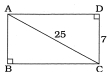
MediumMCQ
In rectangle $ABCD$,$AC = 25$ and $CD = 7$. Then,the perimeter of the rectangle is........
A
$64$
B
$62$
C
$49$
D
$56$
Solution
(B) In $\Delta ADC$,$\angle D = 90^{\circ}$.
By Pythagoras theorem,$AC^{2} = AD^{2} + CD^{2}$.
$25^{2} = AD^{2} + 7^{2}$.
$625 = AD^{2} + 49$.
$AD^{2} = 625 - 49 = 576$.
$AD = \sqrt{576} = 24$.
The perimeter of rectangle $ABCD = 2(AD + CD) = 2(24 + 7) = 2(31) = 62$.
By Pythagoras theorem,$AC^{2} = AD^{2} + CD^{2}$.
$25^{2} = AD^{2} + 7^{2}$.
$625 = AD^{2} + 49$.
$AD^{2} = 625 - 49 = 576$.
$AD = \sqrt{576} = 24$.
The perimeter of rectangle $ABCD = 2(AD + CD) = 2(24 + 7) = 2(31) = 62$.
0 likes
View Solution96
MediumMCQ
In rhombus $XYZW$,$XZ = 14$ and $YW = 48$. Then,$XY = \ldots \ldots \ldots$.
A
$31$
B
$25$
C
$50$
D
$24$
Solution
(B) In rhombus $XYZW$,let the diagonals $XZ$ and $YW$ intersect at point $O$.
The diagonals of a rhombus bisect each other at right angles.
Therefore,$OX = \frac{1}{2} XZ = \frac{1}{2} \times 14 = 7$ and $OY = \frac{1}{2} YW = \frac{1}{2} \times 48 = 24$.
In the right-angled triangle $\Delta XOY$,by the Pythagorean theorem:
$XY^2 = OX^2 + OY^2$
$XY^2 = 7^2 + 24^2$
$XY^2 = 49 + 576 = 625$
$XY = \sqrt{625} = 25$.

0 likes
View Solution97
DifficultMCQ
In $\Delta PQR$,$m \angle Q : m \angle R : m \angle P = 1 : 2 : 1$. If $PQ = 2 \sqrt{6}$,then $PR = \ldots$
A
$\sqrt{6}$
B
$2 \sqrt{6}$
C
$2 \sqrt{3}$
D
$2 \sqrt{2}$
Solution
(C) Given that in $\Delta PQR$,$m \angle Q : m \angle R : m \angle P = 1 : 2 : 1$.
Let the angles be $x, 2x, x$.
Since the sum of angles in a triangle is $180^{\circ}$,we have $x + 2x + x = 180^{\circ}$,which gives $4x = 180^{\circ}$,so $x = 45^{\circ}$.
Thus,$m \angle Q = 45^{\circ}$,$m \angle R = 90^{\circ}$,and $m \angle P = 45^{\circ}$.
Since $m \angle P = m \angle Q$,the sides opposite to these angles are equal,so $QR = PR$.
In the right-angled $\Delta PQR$ (where $m \angle R = 90^{\circ}$),by the Pythagorean theorem:
$PQ^2 = PR^2 + QR^2$
Since $QR = PR$,we have $PQ^2 = PR^2 + PR^2 = 2PR^2$.
Given $PQ = 2 \sqrt{6}$,so $PQ^2 = (2 \sqrt{6})^2 = 4 \times 6 = 24$.
Therefore,$24 = 2PR^2$,which implies $PR^2 = 12$.
Taking the square root,$PR = \sqrt{12} = 2 \sqrt{3}$.

0 likes
View Solution98
MediumMCQ
In $\Delta ABC$,$\overline{AB} \cong \overline{AC}$ and $\overline{AD}$ is a median. If $AD = 12$ and $BC = 18$,then the area of $\Delta ABC$ is.............
A
$90$
B
$96$
C
$105$
D
$108$
Solution
(D) In $\Delta ABC$,$\overline{AB} \cong \overline{AC}$,which means $\Delta ABC$ is an isosceles triangle.
In an isosceles triangle,the median to the base is also the altitude to the base.
Therefore,$\overline{AD} \perp \overline{BC}$,so $\overline{AD}$ is the height of the triangle with respect to base $\overline{BC}$.
Area of $\Delta ABC = \frac{1}{2} \times \text{base} \times \text{height}$
Area $= \frac{1}{2} \times BC \times AD$
Area $= \frac{1}{2} \times 18 \times 12$
Area $= 9 \times 12 = 108$.

0 likes
View Solution99
DifficultMCQ
In $\Delta ABC$,$m \angle A + m \angle C = m \angle B$ and $AC : AB = 17 : 15$. If $BC = 8$,then the area of $\Delta ABC$ is.............
A
$60$
B
$90$
C
$180$
D
$102$
Solution
(A) In $\Delta ABC$,the sum of angles is $m \angle A + m \angle B + m \angle C = 180^\circ$.
Given $m \angle A + m \angle C = m \angle B$,substituting this into the sum gives $m \angle B + m \angle B = 180^\circ$,so $2 m \angle B = 180^\circ$,which means $m \angle B = 90^\circ$.
Since $\Delta ABC$ is a right-angled triangle at $B$,by the Pythagorean theorem,$AC^2 = AB^2 + BC^2$.
Let $AC = 17x$ and $AB = 15x$. Given $BC = 8$,we have $(17x)^2 = (15x)^2 + 8^2$.
$289x^2 = 225x^2 + 64$.
$64x^2 = 64$,so $x^2 = 1$,which gives $x = 1$.
Thus,$AB = 15(1) = 15$ and $AC = 17(1) = 17$.
The area of the right-angled triangle is $\frac{1}{2} \times \text{base} \times \text{height} = \frac{1}{2} \times BC \times AB$.
Area $= \frac{1}{2} \times 8 \times 15 = 4 \times 15 = 60$.
0 likes
View Solution100
MediumMCQ
The perimeter of an equilateral triangle is $12$. Then,its area is............
A
$4 \sqrt{2}$
B
$4 \sqrt{3}$
C
$6$
D
$6 \sqrt{3}$
Solution
(B) The perimeter of an equilateral triangle is given by the formula: $P = 3 \times \text{side}$.
Given $P = 12$,we have $12 = 3 \times \text{side}$.
Therefore,the side length is $\text{side} = \frac{12}{3} = 4$.
The area of an equilateral triangle is given by the formula: $\text{Area} = \frac{\sqrt{3}}{4} \times \text{side}^2$.
Substituting the side length: $\text{Area} = \frac{\sqrt{3}}{4} \times 4^2 = \frac{\sqrt{3}}{4} \times 16 = 4\sqrt{3}$.
0 likes
View SolutionTriangles — Mix Examples - Triangles · Frequently Asked Questions
1Are these Triangles questions useful for JEE and NEET?
Yes. All questions in this section are mapped to JEE Main and NEET exam patterns. Previous year questions from JEE Main, NEET, GUJCET and state-level exams are included with full solutions.
2Can I switch to Hindi or Gujarati for these questions?
Yes. Use the language tabs in the hero section or the sidebar to view the same questions and solutions in English, Hindi or Gujarati.
3How do I generate a question paper from this subtopic?
Use the Vedclass Exam Paper Generator — select the chapter and subtopic, set difficulty, and generate Sets A, B, C, D automatically. First 3 chapters of every subject are free.
Vedclass Products
For Students
Vedclass Test Series
Mock tests in real JEE/NEET style with performance analysis. 5-day free trial.
Start Free TrialFor Teachers
Exam Paper Generator
Generate Set A/B/C/D papers from this chapter in 2 minutes. 3 chapters free.
Try FreeFor Institutes
Online Exam Module
Live online exams with unlimited students, 360° analytics & white-label branding.
See DemoFor Teachers & Institutes
Generate a Triangles Exam Paper in 2 Minutes
Select subtopic & difficulty — Sets A, B, C, D auto-generated with No Repeat logic.
First 3 chapters of every subject are free — no payment required.