
A English
Similarity of Triangles and Basic Proportionality Theorem Questions in English
Class 10 Mathematics · Triangles · Similarity of Triangles and Basic Proportionality Theorem
272+
Questions
English
Language
100%
With Solutions
Showing 50 of 272 questions in English
1
Easy
If a line intersects sides $AB$ and $AC$ of a $\Delta ABC$ at $D$ and $E$ respectively and is parallel to $BC$,prove that $\frac{AD}{AB} = \frac{AE}{AC}$ (see Figure).
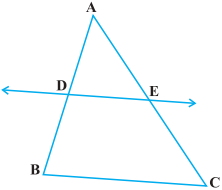
Solution
(N/A) Given: In $\Delta ABC$,$DE || BC$,where $D$ and $E$ are points on $AB$ and $AC$ respectively.
According to the Basic Proportionality Theorem (Thales Theorem),if a line is drawn parallel to one side of a triangle to intersect the other two sides in distinct points,the other two sides are divided in the same ratio.
Therefore,$\frac{AD}{DB} = \frac{AE}{EC}$.
Taking the reciprocal of both sides:
$\frac{DB}{AD} = \frac{EC}{AE}$.
Adding $1$ to both sides:
$\frac{DB}{AD} + 1 = \frac{EC}{AE} + 1$.
Taking the common denominator:
$\frac{DB + AD}{AD} = \frac{EC + AE}{AE}$.
Since $DB + AD = AB$ and $EC + AE = AC$,we get:
$\frac{AB}{AD} = \frac{AC}{AE}$.
Taking the reciprocal again:
$\frac{AD}{AB} = \frac{AE}{AC}$.
Hence,it is proved.
0 likes
View Solution2
Medium
$ABCD$ is a trapezium with $AB \parallel DC.$ $E$ and $F$ are points on non-parallel sides $AD$ and $BC$ respectively such that $EF \parallel AB$ (see Figure). Show that $\frac{AE}{ED} = \frac{BF}{FC}$.
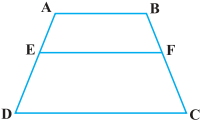
Solution
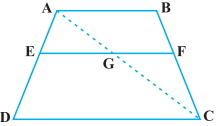
(N/A) Let us join $AC$ to intersect $EF$ at $G$ (see Figure).
Given: $AB \parallel DC$ and $EF \parallel AB$.
Since lines parallel to the same line are parallel to each other,we have $EF \parallel DC$.
Now,in $\Delta ADC$,since $EG \parallel DC$ (as $EF \parallel DC$),by Basic Proportionality Theorem,we have:
$\frac{AE}{ED} = \frac{AG}{GC} \quad ...(1)$
Similarly,in $\Delta CAB$,since $GF \parallel AB$ (as $EF \parallel AB$),by Basic Proportionality Theorem,we have:
$\frac{CG}{AG} = \frac{CF}{BF}$
Taking the reciprocal of both sides,we get:
$\frac{AG}{GC} = \frac{BF}{FC} \quad ...(2)$
From equations $(1)$ and $(2)$,we get:
$\frac{AE}{ED} = \frac{BF}{FC}$.
0 likes
View Solution3
Medium
In the figure,$\frac{PS}{SQ} = \frac{PT}{TR}$ and $\angle PST = \angle PRQ$. Prove that $\triangle PQR$ is an isosceles triangle.
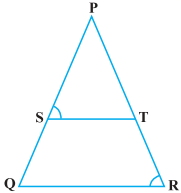
Solution
(N/A) It is given that $\frac{PS}{SQ} = \frac{PT}{TR}$.
By the Converse of Thales Theorem (Basic Proportionality Theorem),$ST \parallel QR$.
Therefore,$\angle PST = \angle PQR$ (Corresponding angles) $...(1)$
Also,it is given that $\angle PST = \angle PRQ$ $...(2)$
From equations $(1)$ and $(2)$,we get $\angle PQR = \angle PRQ$.
Since the angles opposite to the sides $PQ$ and $PR$ are equal,the sides themselves must be equal.
Therefore,$PQ = PR$.
Hence,$\triangle PQR$ is an isosceles triangle.
0 likes
View Solution4
Medium
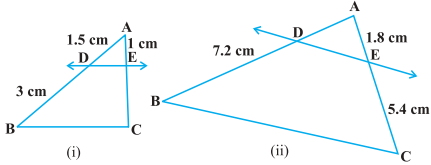
In Figure $(i)$ and $(ii),$ $DE || BC.$ Find $EC$ in $(i)$ and $AD$ in $(ii).$
Solution
(N/A) $(i)$ Let $EC = x \text{ cm}.$
It is given that $DE || BC.$
By using the Basic Proportionality Theorem,we obtain:
$\frac{AD}{DB} = \frac{AE}{EC}$
$\frac{1.5}{3} = \frac{1}{x}$
$x = \frac{3 \times 1}{1.5}$
$x = 2$
$\therefore EC = 2 \text{ cm}.$
$(ii)$ Let $AD = x \text{ cm}.$
It is given that $DE || BC.$
By using the Basic Proportionality Theorem,we obtain:
$\frac{AD}{DB} = \frac{AE}{EC}$
$\frac{x}{7.2} = \frac{1.8}{5.4}$
$x = \frac{1.8 \times 7.2}{5.4}$
$x = 2.4$
$\therefore AD = 2.4 \text{ cm}.$
It is given that $DE || BC.$
By using the Basic Proportionality Theorem,we obtain:
$\frac{AD}{DB} = \frac{AE}{EC}$
$\frac{1.5}{3} = \frac{1}{x}$
$x = \frac{3 \times 1}{1.5}$
$x = 2$
$\therefore EC = 2 \text{ cm}.$
$(ii)$ Let $AD = x \text{ cm}.$
It is given that $DE || BC.$
By using the Basic Proportionality Theorem,we obtain:
$\frac{AD}{DB} = \frac{AE}{EC}$
$\frac{x}{7.2} = \frac{1.8}{5.4}$
$x = \frac{1.8 \times 7.2}{5.4}$
$x = 2.4$
$\therefore AD = 2.4 \text{ cm}.$
0 likes
View Solution5
Medium
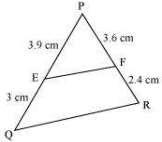
$E$ and $F$ are points on the sides $PQ$ and $PR$ respectively of a $\Delta PQR$. For the following case,state whether $EF || QR$: $PE = 3.9 \ cm, EQ = 3 \ cm, PF = 3.6 \ cm$ and $FR = 2.4 \ cm$.
Solution
(N/A) According to the Converse of Thales Theorem (Basic Proportionality Theorem),$EF || QR$ if and only if $\frac{PE}{EQ} = \frac{PF}{FR}$.
Given values are:
$PE = 3.9 \ cm$
$EQ = 3 \ cm$
$PF = 3.6 \ cm$
$FR = 2.4 \ cm$
Calculating the ratios:
$\frac{PE}{EQ} = \frac{3.9}{3} = 1.3$
$\frac{PF}{FR} = \frac{3.6}{2.4} = 1.5$
Since $\frac{PE}{EQ} \neq \frac{PF}{FR}$ $(1.3 \neq 1.5)$,the condition for $EF$ being parallel to $QR$ is not satisfied.
Therefore,$EF$ is not parallel to $QR$.
0 likes
View Solution6
Easy
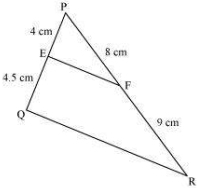
$E$ and $F$ are points on the sides $PQ$ and $PR$ respectively of a $\Delta PQR$. For the given case,state whether $EF || QR$:
$PE = 4 \, cm, QE = 4.5 \, cm, PF = 8 \, cm$ and $RF = 9 \, cm$.
$PE = 4 \, cm, QE = 4.5 \, cm, PF = 8 \, cm$ and $RF = 9 \, cm$.
Solution
(N/A) Given:
$PE = 4 \, cm, QE = 4.5 \, cm, PF = 8 \, cm, RF = 9 \, cm$.
According to the Converse of the Basic Proportionality Theorem (Thales Theorem),if a line divides any two sides of a triangle in the same ratio,then the line is parallel to the third side.
Calculate the ratios:
$\frac{PE}{EQ} = \frac{4}{4.5} = \frac{40}{45} = \frac{8}{9}$.
$\frac{PF}{FR} = \frac{8}{9}$.
Since $\frac{PE}{EQ} = \frac{PF}{FR}$,by the Converse of the Basic Proportionality Theorem,$EF$ is parallel to $QR$ $(EF || QR)$.
0 likes
View Solution7
Medium
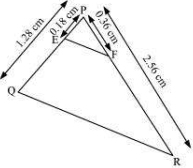
$E$ and $F$ are points on the sides $PQ$ and $PR$ respectively of a $\Delta PQR$. For each of the following cases,state whether $EF || QR$. $PQ = 1.28 \, cm, PR = 2.56 \, cm, PE = 0.18 \, cm$ and $PF = 0.36 \, cm$.
Solution
(A) Given: $PQ = 1.28 \, cm, PR = 2.56 \, cm, PE = 0.18 \, cm, PF = 0.36 \, cm$.
According to the converse of the Basic Proportionality Theorem (Thales Theorem),if a line divides two sides of a triangle in the same ratio,then the line is parallel to the third side.
Calculate the ratios:
$\frac{PE}{PQ} = \frac{0.18}{1.28} = \frac{18}{128} = \frac{9}{64}$
$\frac{PF}{PR} = \frac{0.36}{2.56} = \frac{36}{256} = \frac{9}{64}$
Since $\frac{PE}{PQ} = \frac{PF}{PR} = \frac{9}{64}$,the line $EF$ divides the sides $PQ$ and $PR$ in the same ratio.
Therefore,by the converse of the Basic Proportionality Theorem,$EF || QR$.
1 likes
View Solution8
Medium
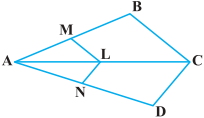
In the figure,if $LM \parallel CB$ and $LN \parallel CD$,prove that $\frac{AM}{AB} = \frac{AN}{AD}$.
Solution
(N/A) In the given figure,$LM \parallel CB$.
By using the Basic Proportionality Theorem (Thales Theorem) in $\triangle ABC$,we obtain:
$\frac{AM}{AB} = \frac{AL}{AC} \quad ...(i)$
Similarly,in $\triangle ADC$,since $LN \parallel CD$,by using the Basic Proportionality Theorem,we obtain:
$\frac{AN}{AD} = \frac{AL}{AC} \quad ...(ii)$
From equation $(i)$ and equation $(ii)$,we observe that the right-hand sides are equal.
Therefore,we obtain:
$\frac{AM}{AB} = \frac{AN}{AD}$
0 likes
View Solution9
Easy
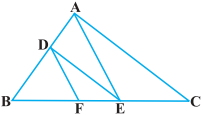
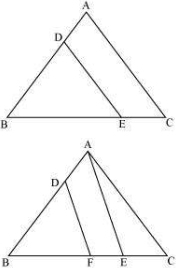
In the figure,$DE \parallel AC$ and $DF \parallel AE$. Prove that $\frac{BF}{FE} = \frac{BE}{EC}$.
Solution
(N/A) In $\Delta ABC$,$DE \parallel AC$.
By the Basic Proportionality Theorem $(BPT)$,we have:
$\frac{BD}{DA} = \frac{BE}{EC} \quad ...(i)$
In $\Delta BAE$,$DF \parallel AE$.
By the Basic Proportionality Theorem $(BPT)$,we have:
$\frac{BD}{DA} = \frac{BF}{FE} \quad ...(ii)$
From equations $(i)$ and $(ii)$,since the left-hand sides are equal,the right-hand sides must also be equal:
$\frac{BF}{FE} = \frac{BE}{EC}$
Hence,it is proved.
By the Basic Proportionality Theorem $(BPT)$,we have:
$\frac{BD}{DA} = \frac{BE}{EC} \quad ...(i)$
In $\Delta BAE$,$DF \parallel AE$.
By the Basic Proportionality Theorem $(BPT)$,we have:
$\frac{BD}{DA} = \frac{BF}{FE} \quad ...(ii)$
From equations $(i)$ and $(ii)$,since the left-hand sides are equal,the right-hand sides must also be equal:
$\frac{BF}{FE} = \frac{BE}{EC}$
Hence,it is proved.
0 likes
View Solution10
Medium
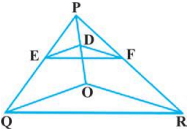
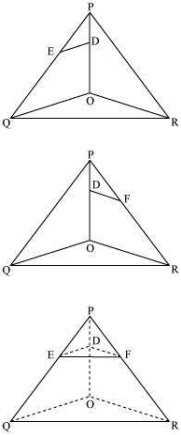
In the figure,$DE \parallel OQ$ and $DF \parallel OR$. Show that $EF \parallel QR$.
Solution
(N/A) In $\Delta POQ$,$DE \parallel OQ$.
Therefore,$\frac{PE}{EQ} = \frac{PD}{DO}$ (Basic Proportionality Theorem) $...(i)$
In $\Delta POR$,$DF \parallel OR$.
Therefore,$\frac{PF}{FR} = \frac{PD}{DO}$ (Basic Proportionality Theorem) $...(ii)$
From $(i)$ and $(ii)$,we obtain:
$\frac{PE}{EQ} = \frac{PF}{FR}$
Therefore,$EF \parallel QR$ (Converse of Basic Proportionality Theorem).
0 likes
View Solution11
Difficult
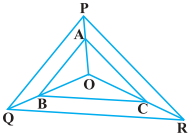
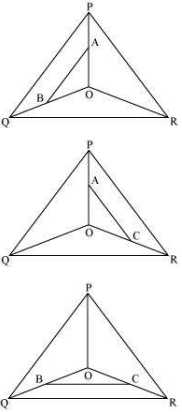
In the figure,$A, B$ and $C$ are points on $OP, OQ$ and $OR$ respectively such that $AB \parallel PQ$ and $AC \parallel PR$. Show that $BC \parallel QR$.
Solution
(N/A) In $\Delta POQ$,$AB \parallel PQ$.
Therefore,$\frac{OA}{AP} = \frac{OB}{BQ}$ (Basic Proportionality Theorem) $...(i)$
In $\Delta POR$,$AC \parallel PR$.
Therefore,$\frac{OA}{AP} = \frac{OC}{CR}$ (Basic Proportionality Theorem) $...(ii)$
From $(i)$ and $(ii)$,we obtain:
$\frac{OB}{BQ} = \frac{OC}{CR}$
Therefore,$BC \parallel QR$ (By the converse of the Basic Proportionality Theorem).
0 likes
View Solution12
Medium
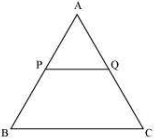
Using Theorem $6.1,$ prove that a line drawn through the mid-point of one side of a triangle parallel to another side bisects the third side.
Solution
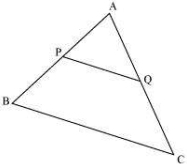
(N/A) Consider a triangle $ABC$ in which $P$ is the mid-point of side $AB$ and a line $PQ$ is drawn parallel to $BC$ such that it intersects $AC$ at $Q$.
According to the Basic Proportionality Theorem (Theorem $6.1$),if a line is drawn parallel to one side of a triangle to intersect the other two sides in distinct points,the other two sides are divided in the same ratio.
Therefore,we have:
$\frac{AP}{PB} = \frac{AQ}{QC}$
Since $P$ is the mid-point of $AB$,we have $AP = PB$,which implies $\frac{AP}{PB} = 1$.
Substituting this into the equation,we get:
$1 = \frac{AQ}{QC}$
$\Rightarrow AQ = QC$
This proves that $Q$ is the mid-point of $AC$,meaning the line $PQ$ bisects the third side $AC$.
0 likes
View Solution13
Medium
Using Theorem $6.2$,prove that the line joining the mid-points of any two sides of a triangle is parallel to the third side.
Solution
(N/A) Consider a triangle $ABC$ in which $P$ and $Q$ are the mid-points of sides $AB$ and $AC$ respectively.
Given: $AP = PB$ and $AQ = QC$.
To prove: $PQ \parallel BC$.
Proof:
Since $P$ is the mid-point of $AB$,we have $AP = PB$,which implies $\frac{AP}{PB} = 1$.
Since $Q$ is the mid-point of $AC$,we have $AQ = QC$,which implies $\frac{AQ}{QC} = 1$.
From the above two equations,we get $\frac{AP}{PB} = \frac{AQ}{QC}$.
According to the converse of the Basic Proportionality Theorem (Theorem $6.2$),if a line divides any two sides of a triangle in the same ratio,then the line is parallel to the third side.
Therefore,$PQ \parallel BC$.
0 likes
View Solution14
Medium
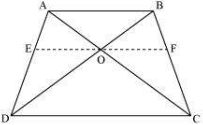
$ABCD$ is a trapezium in which $AB \parallel DC$ and its diagonals intersect each other at the point $O$. Show that $\frac{AO}{BO} = \frac{CO}{DO}$.
Solution
(N/A) Draw a line $EF$ through point $O$,such that $EF \parallel CD$.
In $\triangle ADC$,since $EO \parallel CD$,by using the Basic Proportionality Theorem $(BPT)$,we obtain:
$\frac{AE}{ED} = \frac{AO}{OC} \quad ...(1)$
Since $AB \parallel CD$ and $EF \parallel CD$,it follows that $EF \parallel AB$.
In $\triangle ABD$,since $EO \parallel AB$,by using the Basic Proportionality Theorem,we obtain:
$\frac{AE}{ED} = \frac{BO}{OD} \quad ...(2)$
From equations $(1)$ and $(2)$,we have:
$\frac{AO}{OC} = \frac{BO}{OD}$
Rearranging the terms,we get:
$\frac{AO}{BO} = \frac{OC}{OD}$
0 likes
View Solution15
Difficult
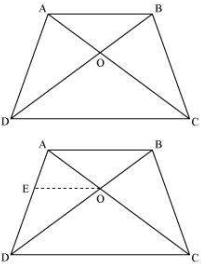
The diagonals of a quadrilateral $ABCD$ intersect each other at the point $O$ such that $\frac{AO}{BO} = \frac{CO}{DO}$. Show that $ABCD$ is a trapezium.
Solution
(N/A) Let us consider the following figure for the given question.
Draw a line $OE \parallel AB$ such that $E$ lies on $AD$.
In $\triangle ABD$,since $OE \parallel AB$,by using the Basic Proportionality Theorem $(BPT)$,we obtain:
$\frac{AE}{ED} = \frac{BO}{OD}$ $...(1)$
However,it is given that:
$\frac{AO}{BO} = \frac{CO}{DO}$
Rearranging the terms,we get:
$\frac{AO}{CO} = \frac{BO}{DO}$ $...(2)$
From equations $(1)$ and $(2)$,we obtain:
$\frac{AE}{ED} = \frac{AO}{CO}$
In $\triangle ADC$,since $\frac{AE}{ED} = \frac{AO}{OC}$,by the converse of the Basic Proportionality Theorem,we have:
$EO \parallel DC$
Since we constructed $OE \parallel AB$ and we proved $OE \parallel DC$,it follows that:
$AB \parallel DC$
Therefore,$ABCD$ is a trapezium because one pair of opposite sides is parallel.
0 likes
View Solution16
Difficult
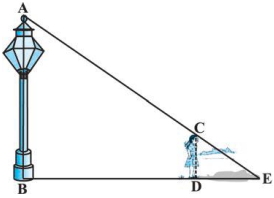
$A$ girl of height $90\, cm$ is walking away from the base of a lamp-post at a speed of $1.2\, m/s$. If the lamp is $3.6\, m$ above the ground,find the length of her shadow after $4\, seconds$.
Solution
(N/A) Let $AB$ denote the lamp-post and $CD$ the girl after walking for $4\, seconds$ away from the lamp-post.
From the figure,you can see that $DE$ is the shadow of the girl. Let $DE$ be $x$ meters.
Now,$BD = 1.2\, m/s \times 4\, s = 4.8\, m$.
Note that in $\Delta ABE$ and $\Delta CDE$:
$\angle B = \angle D = 90^{\circ}$ (Each is $90^{\circ}$ because the lamp-post and the girl are standing vertical to the ground).
$\angle E = \angle E$ (Common angle).
So,$\Delta ABE \sim \Delta CDE$ ($AA$ similarity criterion).
Therefore,$\frac{BE}{DE} = \frac{AB}{CD}$.
Given $AB = 3.6\, m$ and $CD = 90\, cm = 0.9\, m$.
$\frac{4.8 + x}{x} = \frac{3.6}{0.9}$.
$\frac{4.8 + x}{x} = 4$.
$4.8 + x = 4x$.
$3x = 4.8$.
$x = 1.6\, m$.
So,the length of the shadow of the girl after walking for $4\, seconds$ is $1.6\, m$.
0 likes
View Solution17
MediumMCQ
$D$ and $E$ are points on the sides $AB$ and $AC$ of a triangle $ABC$ respectively,such that $AD = 2 \, cm$,$BD = 3 \, cm$,$BC = 7.5 \, cm$,and $DE \parallel BC$. Find the length of $DE$ (in $cm$).
A
$2.5$
B
$3$
C
$5$
D
$6$
Solution
(B) Given that $DE \parallel BC$ in $\triangle ABC$,by the Basic Proportionality Theorem (Thales Theorem),$\triangle ADE \sim \triangle ABC$.
Therefore,the ratio of corresponding sides is equal: $\frac{AD}{AB} = \frac{DE}{BC}$.
Given $AD = 2 \, cm$ and $BD = 3 \, cm$,we have $AB = AD + BD = 2 + 3 = 5 \, cm$.
Substituting the values into the ratio: $\frac{2}{5} = \frac{DE}{7.5}$.
Solving for $DE$: $DE = \frac{2}{5} \times 7.5$.
$DE = 2 \times 1.5 = 3 \, cm$.
0 likes
View Solution18
Medium
In $\triangle ABC$,$AB = 24 \, cm$,$BC = 10 \, cm$,and $AC = 26 \, cm$. Is this triangle a right triangle? Give reasons for your answer.
Solution
(A) To determine if $\triangle ABC$ is a right triangle,we check if it satisfies the converse of the Pythagoras theorem,which states that if the square of the length of the longest side is equal to the sum of the squares of the lengths of the other two sides,then the triangle is a right triangle.
Given sides are $AB = 24 \, cm$,$BC = 10 \, cm$,and $AC = 26 \, cm$.
Calculate the squares of the sides:
$AB^2 = 24^2 = 576 \, cm^2$
$BC^2 = 10^2 = 100 \, cm^2$
$AC^2 = 26^2 = 676 \, cm^2$
Now,check the sum of the squares of the two smaller sides:
$AB^2 + BC^2 = 576 + 100 = 676 \, cm^2$
Since $AB^2 + BC^2 = AC^2$ $(576 + 100 = 676)$,the triangle satisfies the Pythagoras theorem.
Therefore,$\triangle ABC$ is a right triangle with the right angle at vertex $B$.
0 likes
View Solution19
MediumMCQ
$P$ and $Q$ are the points on the sides $DE$ and $DF$ of a triangle $DEF$ such that $DP = 5 \, cm$,$DE = 15 \, cm$,$DQ = 6 \, cm$,and $QF = 18 \, cm$. Is $PQ \parallel EF$? Give reasons for your answer.
A
Yes,$PQ \parallel EF$ because the ratios are equal.
B
No,$PQ$ is not parallel to $EF$ because the ratios are not equal.
C
Yes,$PQ \parallel EF$ by the Converse of Thales Theorem.
D
Cannot be determined.
Solution
(B) According to the Converse of the Basic Proportionality Theorem (Thales Theorem),$PQ \parallel EF$ if and only if $\frac{DP}{PE} = \frac{DQ}{QF}$.
Given $DP = 5 \, cm$ and $DE = 15 \, cm$,we find $PE = DE - DP = 15 - 5 = 10 \, cm$.
Thus,the ratio $\frac{DP}{PE} = \frac{5}{10} = \frac{1}{2}$.
Given $DQ = 6 \, cm$ and $QF = 18 \, cm$,the ratio $\frac{DQ}{QF} = \frac{6}{18} = \frac{1}{3}$.
Since $\frac{DP}{PE} \neq \frac{DQ}{QF}$ (i.e.,$\frac{1}{2} \neq \frac{1}{3}$),the line $PQ$ is not parallel to $EF$.
0 likes
View Solution20
Difficult
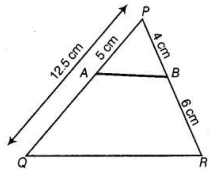
$A$ and $B$ are points on the sides $PQ$ and $PR$ of a triangle $PQR$ respectively,such that $PQ = 12.5 \, cm$,$PA = 5 \, cm$,$BR = 6 \, cm$,and $PB = 4 \, cm$. Is $AB \parallel QR$? Give reasons for your answer.
Solution
(A) Given: $PQ = 12.5 \, cm$,$PA = 5 \, cm$,$BR = 6 \, cm$,and $PB = 4 \, cm$.
First,calculate the length of $AQ$:
$AQ = PQ - PA = 12.5 - 5 = 7.5 \, cm$.
Now,calculate the ratios:
$\frac{PA}{AQ} = \frac{5}{7.5} = \frac{50}{75} = \frac{2}{3}$ ......$(i)$
$\frac{PB}{BR} = \frac{4}{6} = \frac{2}{3}$ ......$(ii)$
From equations $(i)$ and $(ii)$,we observe that:
$\frac{PA}{AQ} = \frac{PB}{BR}$
According to the converse of the Basic Proportionality Theorem (Thales Theorem),if a line divides any two sides of a triangle in the same ratio,then the line is parallel to the third side.
Therefore,$AB \parallel QR$.
0 likes
View Solution21
Medium
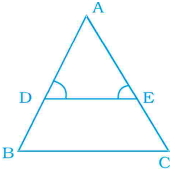
In the given figure,$\angle ADE = \angle AED$ and $\frac{AD}{DB} = \frac{AE}{EC}$. Prove that $\triangle ABC$ is an isosceles triangle.
Solution
(N/A) Given: $\frac{AD}{DB} = \frac{AE}{EC}$ and $\angle ADE = \angle AED$.
According to the converse of the Basic Proportionality Theorem (Thales Theorem),if a line divides any two sides of a triangle in the same ratio,then the line is parallel to the third side.
Therefore,$DE \parallel BC$.
Since $DE \parallel BC$ and $AB$ is a transversal,the corresponding angles are equal:
$\angle ADE = \angle ABC$ ....... $(1)$
Similarly,since $DE \parallel BC$ and $AC$ is a transversal:
$\angle AED = \angle ACB$ ....... $(2)$
We are given that $\angle ADE = \angle AED$.
Substituting the values from $(1)$ and $(2)$ into this equation,we get:
$\angle ABC = \angle ACB$.
In $\triangle ABC$,since the base angles are equal $(\angle B = \angle C)$,the sides opposite to these angles must also be equal.
Therefore,$AB = AC$.
Since two sides of $\triangle ABC$ are equal,$\triangle ABC$ is an isosceles triangle.
0 likes
View Solution22
MediumMCQ
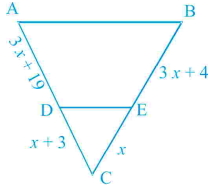
Find the value of $x$ for which $DE \parallel AB$ in the given figure.
A
$1$
B
$2$
C
$4$
D
$8$
Solution
(B) Given,$DE \parallel AB$.
By the Basic Proportionality Theorem (Thales Theorem),if a line is drawn parallel to one side of a triangle to intersect the other two sides in distinct points,the other two sides are divided in the same ratio.
Therefore,$\frac{CD}{AD} = \frac{CE}{BE}$.
Substituting the given values:
$\frac{x+3}{3x+19} = \frac{x}{3x+4}$
Cross-multiplying:
$(x+3)(3x+4) = x(3x+19)$
$3x^2 + 4x + 9x + 12 = 3x^2 + 19x$
$3x^2 + 13x + 12 = 3x^2 + 19x$
Subtracting $3x^2$ from both sides:
$13x + 12 = 19x$
$19x - 13x = 12$
$6x = 12$
$x = \frac{12}{6} = 2$.
Hence,the required value of $x$ is $2$.
0 likes
View Solution23
Medium
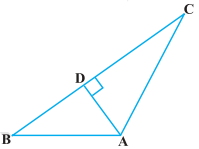
In the figure,if $AD \perp BC$,prove that $AB^2 + CD^2 = BD^2 + AC^2$.
Solution
(N/A) Given: In $\Delta ABC$,$AD \perp BC$.
To prove: $AB^2 + CD^2 = BD^2 + AC^2$.
Proof:
In right-angled $\Delta ADB$,by Pythagoras theorem:
$AB^2 = AD^2 + BD^2$ --- $(1)$
In right-angled $\Delta ADC$,by Pythagoras theorem:
$AC^2 = AD^2 + CD^2$ --- $(2)$
Subtracting equation $(2)$ from equation $(1)$:
$AB^2 - AC^2 = (AD^2 + BD^2) - (AD^2 + CD^2)$
$AB^2 - AC^2 = AD^2 + BD^2 - AD^2 - CD^2$
$AB^2 - AC^2 = BD^2 - CD^2$
Rearranging the terms,we get:
$AB^2 + CD^2 = BD^2 + AC^2$
Hence proved.
0 likes
View Solution24
Medium
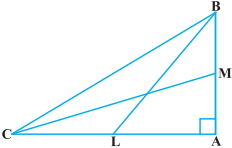
$BL$ and $CM$ are medians of a triangle $ABC$ right-angled at $A$. Prove that $4(BL^2 + CM^2) = 5BC^2$.
Solution
(N/A) $BL$ and $CM$ are medians of $\Delta ABC$ in which $\angle A = 90^{\circ}$.
From $\Delta ABC$,by Pythagoras theorem:
$BC^2 = AB^2 + AC^2$ $...(1)$
From $\Delta ABL$,since $L$ is the midpoint of $AC$,$AL = AC/2$:
$BL^2 = AB^2 + AL^2 = AB^2 + (AC/2)^2 = AB^2 + AC^2/4$
$4BL^2 = 4AB^2 + AC^2$ $...(2)$
From $\Delta CMA$,since $M$ is the midpoint of $AB$,$AM = AB/2$:
$CM^2 = AC^2 + AM^2 = AC^2 + (AB/2)^2 = AC^2 + AB^2/4$
$4CM^2 = 4AC^2 + AB^2$ $...(3)$
Adding $(2)$ and $(3)$:
$4(BL^2 + CM^2) = 4AB^2 + AC^2 + 4AC^2 + AB^2$
$4(BL^2 + CM^2) = 5AB^2 + 5AC^2$
$4(BL^2 + CM^2) = 5(AB^2 + AC^2)$
Using equation $(1)$,$AB^2 + AC^2 = BC^2$,so:
$4(BL^2 + CM^2) = 5BC^2$.
0 likes
View Solution25
Medium
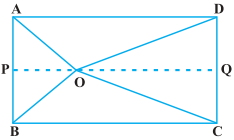
$O$ is any point inside a rectangle $ABCD$ (see Figure). Prove that $OB^{2} + OD^{2} = OA^{2} + OC^{2}$.
Solution
(N/A) Through $O$,draw $PQ \parallel BC$ such that $P$ lies on $AB$ and $Q$ lies on $DC$.
Now,$PQ \parallel BC$.
Therefore,$PQ \perp AB$ and $PQ \perp DC$ (since $\angle B = 90^{\circ}$ and $\angle C = 90^{\circ}$).
So,$\angle BPQ = 90^{\circ}$ and $\angle CQP = 90^{\circ}$.
Therefore,$BPQC$ and $APQD$ are both rectangles.
Now,from $\Delta OPB$,by Pythagoras theorem:
$OB^{2} = BP^{2} + OP^{2}$ $...(1)$
Similarly,from $\Delta OQD$:
$OD^{2} = OQ^{2} + DQ^{2}$ $...(2)$
From $\Delta OQC$,we have:
$OC^{2} = OQ^{2} + CQ^{2}$ $...(3)$
And from $\Delta OAP$,we have:
$OA^{2} = AP^{2} + OP^{2}$ $...(4)$
Adding $(1)$ and $(2)$:
$OB^{2} + OD^{2} = BP^{2} + OP^{2} + OQ^{2} + DQ^{2}$
Since $BP = CQ$ and $DQ = AP$ (opposite sides of rectangles $BPQC$ and $APQD$):
$OB^{2} + OD^{2} = CQ^{2} + OP^{2} + OQ^{2} + AP^{2}$
Rearranging the terms:
$OB^{2} + OD^{2} = (CQ^{2} + OQ^{2}) + (AP^{2} + OP^{2})$
Using equations $(3)$ and $(4)$:
$OB^{2} + OD^{2} = OC^{2} + OA^{2}$.
0 likes
View Solution26
Easy
Sides of triangles are given below. Determine which of them are right triangles. In case of a right triangle,write the length of its hypotenuse.
$7 \, cm, 24 \, cm, 25 \, cm$
$7 \, cm, 24 \, cm, 25 \, cm$
Solution
(A) The given sides of the triangle are $7 \, cm, 24 \, cm,$ and $25 \, cm$.
To check if it is a right-angled triangle,we use the converse of the Pythagoras theorem,which states that if the square of the longest side is equal to the sum of the squares of the other two sides,then the triangle is a right-angled triangle.
First,we calculate the squares of the given sides:
$7^2 = 49$
$24^2 = 576$
$25^2 = 625$
Now,we check if the sum of the squares of the two smaller sides equals the square of the largest side:
$49 + 576 = 625$
Since $7^2 + 24^2 = 25^2$,the given sides satisfy the Pythagoras theorem.
Therefore,the triangle is a right-angled triangle.
The longest side of a right-angled triangle is its hypotenuse. Thus,the length of the hypotenuse is $25 \, cm$.
0 likes
View Solution27
Medium
Sides of a triangle are given below. Determine whether it is a right triangle. In case of a right triangle,write the length of its hypotenuse.
$3 \text{ cm}, 8 \text{ cm}, 6 \text{ cm}$
$3 \text{ cm}, 8 \text{ cm}, 6 \text{ cm}$
Solution
(N/A) The given sides of the triangle are $3 \text{ cm}, 8 \text{ cm},$ and $6 \text{ cm}$.
According to the converse of the Pythagoras theorem,a triangle is a right triangle if the sum of the squares of the two smaller sides is equal to the square of the longest side.
Here,the squares of the sides are:
$3^2 = 9$
$6^2 = 36$
$8^2 = 64$
Checking the sum of the squares of the two smaller sides:
$3^2 + 6^2 = 9 + 36 = 45$
Since $45 \neq 64$ (i.e.,$3^2 + 6^2 \neq 8^2$),the condition for a right triangle is not satisfied.
Therefore,the given triangle is not a right triangle.
0 likes
View Solution28
Medium
Sides of triangles are given below. Determine which of them are right triangles. In case of a right triangle,write the length of its hypotenuse.
$50 \text{ cm}, 80 \text{ cm}, 100 \text{ cm}$
$50 \text{ cm}, 80 \text{ cm}, 100 \text{ cm}$
Solution
(NONE) Given that the sides of the triangle are $50 \text{ cm}, 80 \text{ cm},$ and $100 \text{ cm}.$
To check if it is a right-angled triangle,we apply the converse of the Pythagoras theorem,which states that in a triangle,if the square of the length of the longest side is equal to the sum of the squares of the lengths of the other two sides,then it is a right-angled triangle.
Calculate the squares of the sides:
$50^2 = 2500$
$80^2 = 6400$
$100^2 = 10000$
Now,check the sum of the squares of the two smaller sides:
$50^2 + 80^2 = 2500 + 6400 = 8900$
Comparing this with the square of the longest side:
$8900 \neq 10000$
Since $50^2 + 80^2 \neq 100^2$,the given triangle does not satisfy the Pythagoras theorem.
Therefore,the given triangle is not a right-angled triangle.
0 likes
View Solution29
Medium
Sides of triangles are given below. Determine which of them are right triangles. In case of a right triangle,write the length of its hypotenuse.
$13\, cm, 12\, cm, 5\, cm$
$13\, cm, 12\, cm, 5\, cm$
Solution
(A) Given that the sides are $13\, cm, 12\, cm,$ and $5\, cm$.
Squaring the lengths of these sides,we obtain $169, 144,$ and $25$.
Clearly,$144 + 25 = 169$.
Or,$12^2 + 5^2 = 13^2$.
The sides of the given triangle satisfy the Pythagoras theorem.
Therefore,it is a right triangle.
We know that the longest side of a right triangle is the hypotenuse.
Therefore,the length of the hypotenuse of this triangle is $13\, cm$.
0 likes
View Solution30
Difficult
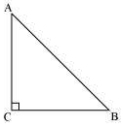
$ABC$ is an isosceles triangle right-angled at $C$. Prove that $AB^{2} = 2AC^{2}$.
Solution
(N/A) Given that $\triangle ABC$ is an isosceles triangle with $\angle C = 90^{\circ}$.
Since it is an isosceles triangle,the two legs must be equal,so $AC = CB$.
Applying the Pythagoras theorem in $\triangle ABC$ (which is right-angled at point $C$),we have:
$AC^{2} + CB^{2} = AB^{2}$
Since $AC = CB$,we can substitute $CB$ with $AC$ in the equation:
$AC^{2} + AC^{2} = AB^{2}$
$2AC^{2} = AB^{2}$
Hence,it is proved that $AB^{2} = 2AC^{2}$.
0 likes
View Solution31
Medium
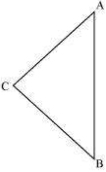
$ABC$ is an isosceles triangle with $AC = BC$. If $AB^2 = 2 AC^2$,prove that $ABC$ is a right triangle.
Solution
(N/A) Given that,
$AB^2 = 2 AC^2$
We can rewrite this as:
$AB^2 = AC^2 + AC^2$
Since it is given that $AC = BC$,we can substitute $BC$ for one of the $AC$ terms:
$AB^2 = AC^2 + BC^2$
This equation satisfies the converse of the Pythagoras theorem,which states that if the square of one side of a triangle is equal to the sum of the squares of the other two sides,then the angle opposite the first side is a right angle.
Therefore,$\triangle ABC$ is a right-angled triangle with the right angle at $C$.
0 likes
View Solution32
Difficult
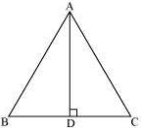
$ABC$ is an equilateral triangle of side $2a$. Find each of its altitudes.
Solution
(N/A) Let $AD$ be the altitude in the given equilateral triangle,$\triangle ABC$.
We know that an altitude in an equilateral triangle bisects the opposite side.
$\therefore BD = DC = a$
In $\triangle ADB$,we have $\angle ADB = 90^{\circ}$.
Applying the Pythagoras theorem,we obtain:
$AD^2 + DB^2 = AB^2$
$\Rightarrow AD^2 + a^2 = (2a)^2$
$\Rightarrow AD^2 + a^2 = 4a^2$
$\Rightarrow AD^2 = 3a^2$
$\Rightarrow AD = a\sqrt{3}$
In an equilateral triangle,all the altitudes are equal in length.
Therefore,the length of each altitude is $a\sqrt{3}$.
0 likes
View Solution33
Difficult
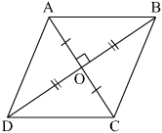
Prove that the sum of the squares of the sides of a rhombus is equal to the sum of the squares of its diagonals.
Solution
(N/A) Let $ABCD$ be a rhombus with diagonals $AC$ and $BD$ intersecting at $O$.
In $\Delta AOB, \Delta BOC, \Delta COD,$ and $\Delta AOD,$
Applying the Pythagoras theorem,we obtain:
$AB^2 = AO^2 + OB^2$ $...(1)$
$BC^2 = BO^2 + OC^2$ $...(2)$
$CD^2 = CO^2 + OD^2$ $...(3)$
$AD^2 = AO^2 + OD^2$ $...(4)$
Adding all these equations,we obtain:
$AB^2 + BC^2 + CD^2 + AD^2 = 2(AO^2 + OB^2 + OC^2 + OD^2)$
Since the diagonals of a rhombus bisect each other at right angles,$AO = OC = AC/2$ and $BO = OD = BD/2$.
Substituting these values:
$= 2((AC/2)^2 + (BD/2)^2 + (AC/2)^2 + (BD/2)^2)$
$= 2(2(AC/2)^2 + 2(BD/2)^2)$
$= 2(AC^2/2 + BD^2/2)$
$= AC^2 + BD^2$
Thus,the sum of the squares of the sides of a rhombus is equal to the sum of the squares of its diagonals.
0 likes
View Solution34
MediumMCQ
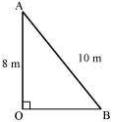
$A$ ladder $10\, m$ long reaches a window $8\, m$ above the ground. Find the distance of the foot of the ladder from the base of the wall. (in $, m$)
A
$6$
B
$8$
C
$10$
D
$14$
Solution
(A) Let $OA$ be the wall and $AB$ be the ladder,where $OA = 8\, m$ and $AB = 10\, m$.
Since the wall is perpendicular to the ground,$\triangle AOB$ is a right-angled triangle with $\angle AOB = 90^\circ$.
By Pythagoras theorem,$AB^2 = OA^2 + OB^2$.
Substituting the values: $(10)^2 = (8)^2 + OB^2$.
$100 = 64 + OB^2$.
$OB^2 = 100 - 64 = 36$.
$OB = \sqrt{36} = 6\, m$.
Therefore,the distance of the foot of the ladder from the base of the wall is $6\, m$.
0 likes
View Solution35
Medium
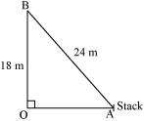
$A$ guy wire attached to a vertical pole of height $18\, m$ is $24\, m$ long and has a stake attached to the other end. How far from the base of the pole should the stake be driven so that the wire will be taut?
Solution
(N/A) Let $OB$ be the pole and $AB$ be the wire. The pole is vertical,so $\triangle AOB$ is a right-angled triangle with $\angle AOB = 90^{\circ}$.
By Pythagoras theorem,
$AB^{2} = OB^{2} + OA^{2}$
$(24\, m)^{2} = (18\, m)^{2} + OA^{2}$
$576\, m^{2} = 324\, m^{2} + OA^{2}$
$OA^{2} = (576 - 324)\, m^{2} = 252\, m^{2}$
$OA = \sqrt{252}\, m = \sqrt{36 \times 7}\, m = 6\sqrt{7}\, m$
Therefore,the distance from the base is $6\sqrt{7}\, m$ (approximately $15.87\, m$).
0 likes
View Solution36
Difficult
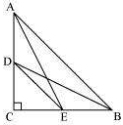
$D$ and $E$ are points on the sides $CA$ and $CB$ respectively of a triangle $ABC$ right-angled at $C$. Prove that $AE^{2} + BD^{2} = AB^{2} + DE^{2}$.
Solution
(N/A) Applying the Pythagoras theorem in $\triangle ACE$,we obtain:
$AC^{2} + CE^{2} = AE^{2}$ $...(1)$
Applying the Pythagoras theorem in $\triangle BCD$,we obtain:
$BC^{2} + CD^{2} = BD^{2}$ $...(2)$
Adding equation $(1)$ and equation $(2)$,we obtain:
$AC^{2} + CE^{2} + BC^{2} + CD^{2} = AE^{2} + BD^{2}$ $...(3)$
Applying the Pythagoras theorem in $\triangle CDE$,we obtain:
$DE^{2} = CD^{2} + CE^{2}$ $...(4)$
Applying the Pythagoras theorem in $\triangle ABC$,we obtain:
$AB^{2} = AC^{2} + BC^{2}$ $...(5)$
Substituting the values from equation $(4)$ and equation $(5)$ into equation $(3)$,we obtain:
$AB^{2} + DE^{2} = AE^{2} + BD^{2}$
Hence,$AE^{2} + BD^{2} = AB^{2} + DE^{2}$.
0 likes
View Solution37
Difficult
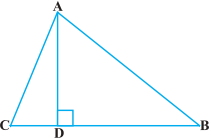
The perpendicular from $A$ on side $BC$ of a $\Delta ABC$ intersects $BC$ at $D$ such that $DB = 3CD$ (see Figure). Prove that $2AB^{2} = 2AC^{2} + BC^{2}$.
Solution
(N/A) Applying the Pythagoras theorem for $\triangle ACD$,we obtain:
$AC^{2} = AD^{2} + DC^{2}$
$AD^{2} = AC^{2} - DC^{2}$ $...(1)$
Applying the Pythagoras theorem for $\triangle ABD$,we obtain:
$AB^{2} = AD^{2} + DB^{2}$
$AD^{2} = AB^{2} - DB^{2}$ $...(2)$
From equation $(1)$ and equation $(2)$,we obtain:
$AC^{2} - DC^{2} = AB^{2} - DB^{2}$ $...(3)$
It is given that $DB = 3CD$. Since $BC = DB + CD$,we have $BC = 3CD + CD = 4CD$.
$\therefore CD = \frac{BC}{4}$ and $DB = 3CD = \frac{3BC}{4}$.
Substituting these values into equation $(3)$,we obtain:
$AC^{2} - \left(\frac{BC}{4}\right)^{2} = AB^{2} - \left(\frac{3BC}{4}\right)^{2}$
$AC^{2} - \frac{BC^{2}}{16} = AB^{2} - \frac{9BC^{2}}{16}$
$16AC^{2} - BC^{2} = 16AB^{2} - 9BC^{2}$
$16AB^{2} - 16AC^{2} = 8BC^{2}$
Dividing by $8$,we get:
$2AB^{2} = 2AC^{2} + BC^{2}$
0 likes
View Solution38
Difficult
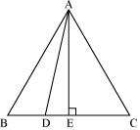
In an equilateral triangle $ABC$,$D$ is a point on side $BC$ such that $BD = \frac{1}{3} BC$. Prove that $9 AD^{2} = 7 AB^{2}$.
Solution
(N/A) Let the side of the equilateral triangle be $a$,and $AE$ be the altitude of $\Delta ABC$ drawn to $BC$.
Since $AE$ is the altitude of an equilateral triangle,it bisects the base $BC$.
$\therefore BE = EC = \frac{BC}{2} = \frac{a}{2}$.
In the right-angled triangle $\Delta ABE$,by Pythagoras theorem:
$AE^{2} = AB^{2} - BE^{2} = a^{2} - (\frac{a}{2})^{2} = a^{2} - \frac{a^{2}}{4} = \frac{3a^{2}}{4}$.
So,$AE = \frac{a\sqrt{3}}{2}$.
Given that $BD = \frac{1}{3} BC = \frac{a}{3}$.
Now,$DE = BE - BD = \frac{a}{2} - \frac{a}{3} = \frac{3a - 2a}{6} = \frac{a}{6}$.
In the right-angled triangle $\Delta ADE$,by Pythagoras theorem:
$AD^{2} = AE^{2} + DE^{2}$.
Substituting the values:
$AD^{2} = (\frac{a\sqrt{3}}{2})^{2} + (\frac{a}{6})^{2} = \frac{3a^{2}}{4} + \frac{a^{2}}{36}$.
Taking $LCM$ as $36$:
$AD^{2} = \frac{27a^{2} + a^{2}}{36} = \frac{28a^{2}}{36} = \frac{7a^{2}}{9}$.
Since $a = AB$,we have $AD^{2} = \frac{7 AB^{2}}{9}$.
Therefore,$9 AD^{2} = 7 AB^{2}$.
Hence proved.
0 likes
View Solution39
Difficult
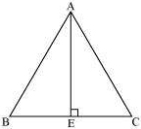
In an equilateral triangle,prove that three times the square of one side is equal to four times the square of one of its altitudes.
Solution
(N/A) Let the side of the equilateral triangle be $a$,and $AE$ be the altitude of $\triangle ABC$.
Since the altitude of an equilateral triangle bisects the base,
$BE = EC = \frac{BC}{2} = \frac{a}{2}$
Applying the Pythagoras theorem in the right-angled $\triangle ABE$,we obtain:
$AB^2 = AE^2 + BE^2$
Substituting the values $AB = a$ and $BE = \frac{a}{2}$:
$a^2 = AE^2 + (\frac{a}{2})^2$
$a^2 = AE^2 + \frac{a^2}{4}$
Rearranging the terms to solve for $AE^2$:
$AE^2 = a^2 - \frac{a^2}{4}$
$AE^2 = \frac{4a^2 - a^2}{4}$
$AE^2 = \frac{3a^2}{4}$
Multiplying both sides by $4$:
$4AE^2 = 3a^2$
Thus,it is proved that $4 \times$ (square of altitude) $= 3 \times$ (square of one side).
0 likes
View Solution40
DifficultMCQ
In $\Delta ABC$,$AB = 6\sqrt{3} \text{ cm}$,$AC = 12 \text{ cm}$,and $BC = 6 \text{ cm}$. The angle $B$ is (in $^o$):
A
$120$
B
$90$
C
$60$
D
$45$
Solution
(B) Given that,$AB = 6\sqrt{3} \text{ cm}$,$AC = 12 \text{ cm}$,and $BC = 6 \text{ cm}$.
Calculating the squares of the sides:
$AB^2 = (6\sqrt{3})^2 = 36 \times 3 = 108$
$BC^2 = (6)^2 = 36$
$AC^2 = (12)^2 = 144$
Now,observe that:
$AB^2 + BC^2 = 108 + 36 = 144$
Since $AB^2 + BC^2 = AC^2$,the triangle satisfies the converse of the Pythagoras theorem.
Therefore,$\triangle ABC$ is a right-angled triangle,with the right angle opposite to the hypotenuse $AC$.
Thus,$\angle B = 90^\circ$.
Hence,the correct answer is $(B)$.
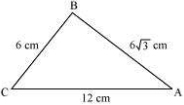
0 likes
View Solution41
Difficult
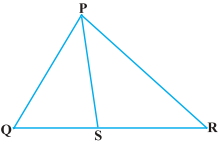
In the figure,$PS$ is the bisector of $\angle QPR$ of $\Delta PQR$. Prove that $\frac{QS}{SR} = \frac{PQ}{PR}$.
Solution
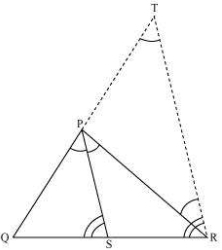
(N/A) Construction: Draw a line segment $RT$ parallel to $PS$ which intersects the extended line segment $QP$ at point $T$.
Given that,$PS$ is the angle bisector of $\angle QPR$.
Therefore,$\angle QPS = \angle SPR \quad \dots(1)$
By construction,$PS \parallel TR$ and $QT$ is a transversal.
Therefore,$\angle QPS = \angle QTR$ (Corresponding angles) $\quad \dots(2)$
Also,$PS \parallel TR$ and $PR$ is a transversal.
Therefore,$\angle SPR = \angle PRT$ (Alternate interior angles) $\quad \dots(3)$
From equations $(1)$,$(2)$,and $(3)$,we get:
$\angle QTR = \angle PRT$
In $\Delta PTR$,since $\angle QTR = \angle PRT$,the sides opposite to these angles are equal.
Therefore,$PT = PR \quad \dots(4)$
In $\Delta QTR$,since $PS \parallel TR$,by the Basic Proportionality Theorem $(BPT)$:
$\frac{QS}{SR} = \frac{QP}{PT}$
Substituting $PT = PR$ from equation $(4)$ into the above expression:
$\frac{QS}{SR} = \frac{PQ}{PR}$
Hence,it is proved.
0 likes
View Solution42
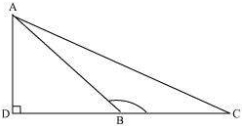
Medium
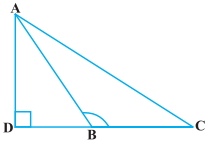
In the figure,$ABC$ is a triangle in which $\angle ABC > 90^{\circ}$ and $AD \perp CB$ produced. Prove that $AC^{2} = AB^{2} + BC^{2} + 2BC \cdot BD$.
Solution
(N/A) In $\triangle ADB$,applying the Pythagoras theorem,we have:
$AB^{2} = AD^{2} + BD^{2} \quad \dots(1)$
In $\triangle ADC$,applying the Pythagoras theorem,we have:
$AC^{2} = AD^{2} + DC^{2}$
Since $DC = DB + BC$,we can write:
$AC^{2} = AD^{2} + (DB + BC)^{2}$
$AC^{2} = AD^{2} + DB^{2} + BC^{2} + 2DB \cdot BC$
Substituting $AD^{2} + DB^{2} = AB^{2}$ from equation $(1)$:
$AC^{2} = AB^{2} + BC^{2} + 2BC \cdot BD$
0 likes
View Solution43
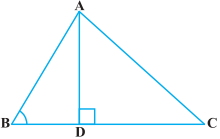
Medium
In the figure,$ABC$ is a triangle in which $\angle ABC < 90^{\circ}$ and $AD \perp BC$. Prove that $AC^{2} = AB^{2} + BC^{2} - 2BC \cdot BD$.
Solution
(N/A) Applying the Pythagoras theorem in $\triangle ADB$,we obtain:
$AD^{2} + DB^{2} = AB^{2}$
$\Rightarrow AD^{2} = AB^{2} - DB^{2} \dots(1)$
Applying the Pythagoras theorem in $\triangle ADC$,we obtain:
$AD^{2} + DC^{2} = AC^{2}$
Substituting the value of $AD^{2}$ from equation $(1)$:
$(AB^{2} - BD^{2}) + DC^{2} = AC^{2}$
Since $D$ lies on $BC$,we have $DC = BC - BD$. Substituting this into the equation:
$AB^{2} - BD^{2} + (BC - BD)^{2} = AC^{2}$
$AB^{2} - BD^{2} + (BC^{2} + BD^{2} - 2BC \cdot BD) = AC^{2}$
$AB^{2} + BC^{2} - 2BC \cdot BD = AC^{2}$
Thus,$AC^{2} = AB^{2} + BC^{2} - 2BC \cdot BD$.
0 likes
View Solution44
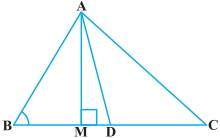
Medium
In the figure,$AD$ is a median of a triangle $ABC$ and $AM \perp BC$. Prove that $AC^{2} = AD^{2} + BC \cdot DM + \left(\frac{BC}{2}\right)^{2}$.
Solution
(N/A) Applying Pythagoras theorem in $\Delta AMD$,we obtain:
$AM^{2} + MD^{2} = AD^{2} \dots(1)$
Applying Pythagoras theorem in $\Delta AMC$,we obtain:
$AM^{2} + MC^{2} = AC^{2}$
Since $MC = MD + DC$,we have:
$AM^{2} + (MD + DC)^{2} = AC^{2}$
$AM^{2} + MD^{2} + DC^{2} + 2MD \cdot DC = AC^{2}$
Substituting $AM^{2} + MD^{2} = AD^{2}$ from equation $(1)$:
$AD^{2} + DC^{2} + 2MD \cdot DC = AC^{2}$
Since $AD$ is a median,$DC = \frac{BC}{2}$. Substituting this value:
$AD^{2} + \left(\frac{BC}{2}\right)^{2} + 2MD \cdot \left(\frac{BC}{2}\right) = AC^{2}$
$AD^{2} + \left(\frac{BC}{2}\right)^{2} + BC \cdot DM = AC^{2}$
Thus,$AC^{2} = AD^{2} + BC \cdot DM + \left(\frac{BC}{2}\right)^{2}$.
0 likes
View Solution45
Difficult
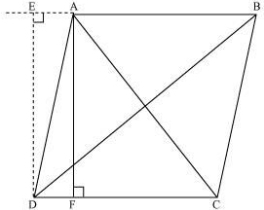
Prove that the sum of the squares of the diagonals of a parallelogram is equal to the sum of the squares of its sides.
Solution
(A) Let $ABCD$ be a parallelogram.
Let us draw perpendicular $DE$ on the extended side $AB$,and $AF$ on side $DC$.
Applying Pythagoras theorem in $\triangle DEA$,we obtain:
$DE^{2} + EA^{2} = DA^{2} \dots (i)$
Applying Pythagoras theorem in $\triangle DEB$,we obtain:
$DE^{2} + EB^{2} = DB^{2}$
$DE^{2} + (EA + AB)^{2} = DB^{2}$
$(DE^{2} + EA^{2}) + AB^{2} + 2EA \times AB = DB^{2}$
$DA^{2} + AB^{2} + 2EA \times AB = DB^{2} \dots (ii)$
Applying Pythagoras theorem in $\triangle AFC$,we obtain:
$AC^{2} = AF^{2} + FC^{2}$
$AC^{2} = AF^{2} + (DC - FD)^{2}$
$AC^{2} = AF^{2} + DC^{2} + FD^{2} - 2DC \times FD$
$AC^{2} = (AF^{2} + FD^{2}) + DC^{2} - 2DC \times FD$
$AC^{2} = AD^{2} + DC^{2} - 2DC \times FD \dots (iii)$
Since $ABCD$ is a parallelogram,$AB = CD \dots (iv)$ and $BC = AD \dots (v)$.
In $\triangle DEA$ and $\triangle AFD$:
$\angle DEA = \angle AFD = 90^{\circ}$
$\angle EAD = \angle ADF$ (since $EA \parallel DF$)
$AD = AD$ (Common side)
Therefore,$\triangle EAD \cong \triangle FDA$ ($AAS$ congruence criterion).
This implies $EA = DF \dots (vi)$.
Adding equations $(ii)$ and $(iii)$:
$DB^{2} + AC^{2} = DA^{2} + AB^{2} + 2EA \times AB + AD^{2} + DC^{2} - 2DC \times FD$
Using $AB = DC$ and $EA = DF$:
$DB^{2} + AC^{2} = AD^{2} + AB^{2} + 2EA \times AB + AD^{2} + AB^{2} - 2AB \times EA$
$DB^{2} + AC^{2} = 2AD^{2} + 2AB^{2}$
Since $AD = BC$ and $AB = CD$:
$AC^{2} + BD^{2} = AB^{2} + BC^{2} + CD^{2} + DA^{2}$.
0 likes
View Solution46
Difficult
In the figure,$D$ is a point on side $BC$ of $\Delta ABC$ such that $\frac{BD}{CD} = \frac{AB}{AC}$. Prove that $AD$ is the bisector of $\angle BAC$.
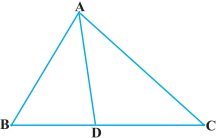
Solution
(N/A) Let us extend $BA$ to $P$ such that $AP = AC$. Join $PC$.
It is given that,
$\frac{BD}{CD} = \frac{AB}{AC}$
Since $AP = AC$,we can substitute $AP$ for $AC$:
$\frac{BD}{CD} = \frac{AB}{AP}$
By using the converse of the Basic Proportionality Theorem $(BPT)$ in $\Delta BPC$,we obtain:
$AD \parallel PC$
Therefore,$\angle BAD = \angle APC$ (Corresponding angles) $\dots(1)$
And,$\angle DAC = \angle ACP$ (Alternate interior angles) $\dots(2)$
By construction,we have $AP = AC$,which implies that in $\Delta APC$,the angles opposite to equal sides are equal:
$\angle APC = \angle ACP \dots(3)$
From equations $(1), (2),$ and $(3)$,we get:
$\angle BAD = \angle DAC$
Thus,$AD$ is the bisector of $\angle BAC$.
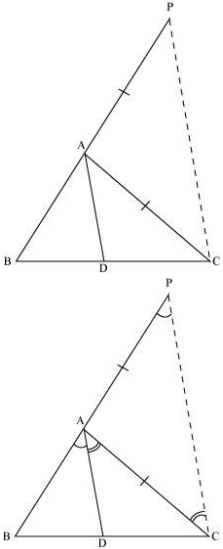
0 likes
View Solution47
Difficult
The vertices of a $\Delta ABC$ are $A(4, 6)$,$B(1, 5)$,and $C(7, 2)$. $A$ line is drawn to intersect sides $AB$ and $AC$ at $D$ and $E$ respectively,such that $\frac{AD}{AB} = \frac{AE}{AC} = \frac{1}{4}$. Calculate the area of $\Delta ADE$ and compare it with the area of $\Delta ABC$.
Solution
(1:16) Given that,$\frac{AD}{AB} = \frac{AE}{AC} = \frac{1}{4}$.
Since $\frac{AD}{AB} = \frac{AE}{AC}$,by the Converse of Thales Theorem (Basic Proportionality Theorem),$DE \parallel BC$.
Therefore,$\Delta ADE \sim \Delta ABC$ by $AA$ similarity criterion.
We know that the ratio of the areas of two similar triangles is equal to the square of the ratio of their corresponding sides.
Thus,$\frac{\text{Area}(\Delta ADE)}{\text{Area}(\Delta ABC)} = \left(\frac{AD}{AB}\right)^2 = \left(\frac{1}{4}\right)^2 = \frac{1}{16}$.
Now,calculate the area of $\Delta ABC$ using the coordinates $A(4, 6)$,$B(1, 5)$,and $C(7, 2)$:
Area $= \frac{1}{2} |x_1(y_2 - y_3) + x_2(y_3 - y_1) + x_3(y_1 - y_2)|$
Area $= \frac{1}{2} |4(5 - 2) + 1(2 - 6) + 7(6 - 5)|$
Area $= \frac{1}{2} |4(3) + 1(-4) + 7(1)| = \frac{1}{2} |12 - 4 + 7| = \frac{1}{2} |15| = 7.5$ square units.
Area of $\Delta ADE = \frac{1}{16} \times \text{Area}(\Delta ABC) = \frac{1}{16} \times 7.5 = \frac{7.5}{16} = \frac{15}{32}$ square units.
The ratio of the area of $\Delta ADE$ to the area of $\Delta ABC$ is $1:16$.
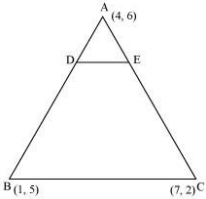
0 likes
View Solution48
DifficultMCQ
$ABCD$ is a trapezium in which $AB \parallel DC$ and $P$ and $Q$ are points on $AD$ and $BC$ respectively such that $PQ \parallel DC$. If $PD = 18 \, cm$,$BQ = 35 \, cm$ and $QC = 15 \, cm$,find $AD$ (in $cm$).
A
$60$
B
$24$
C
$50$
D
$70$
Solution
(A) Given,a trapezium $ABCD$ in which $AB \parallel DC$. $P$ and $Q$ are points on $AD$ and $BC$ respectively such that $PQ \parallel DC$. Thus,$AB \parallel PQ \parallel DC$.
Join $BD$. Let $BD$ intersect $PQ$ at point $O$.
In $\triangle ABD$,$PO \parallel AB$ (since $PQ \parallel AB$).
By the Basic Proportionality Theorem $(BPT)$,we have:
$\frac{AP}{PD} = \frac{BO}{OD}$ .......$(i)$
In $\triangle BDC$,$OQ \parallel DC$ (since $PQ \parallel DC$).
By the Basic Proportionality Theorem $(BPT)$,we have:
$\frac{BQ}{QC} = \frac{BO}{OD}$ .......$(ii)$
From equations $(i)$ and $(ii)$,we get:
$\frac{AP}{PD} = \frac{BQ}{QC}$
Substitute the given values $PD = 18 \, cm$,$BQ = 35 \, cm$,and $QC = 15 \, cm$:
$\frac{AP}{18} = \frac{35}{15}$
$AP = \frac{35 \times 18}{15}$
$AP = \frac{7 \times 18}{3} = 7 \times 6 = 42 \, cm$
Therefore,$AD = AP + PD = 42 \, cm + 18 \, cm = 60 \, cm$.
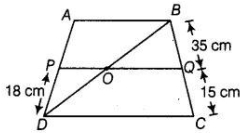
0 likes
View Solution49
Difficult
Prove that if in a triangle the square of one side is equal to the sum of the squares of the other two sides,then the angle opposite the first side is a right angle.
Solution
(N/A) Given: $A$ triangle $ABC$ such that $AC^2 = AB^2 + BC^2$.
To prove: $\angle B = 90^{\circ}$.
Construction: Construct a $\triangle PQR$ such that $\angle Q = 90^{\circ}$,$PQ = AB$,and $QR = BC$.
Proof:
In $\triangle PQR$,by Pythagoras theorem:
$PR^2 = PQ^2 + QR^2$
Since $PQ = AB$ and $QR = BC$,we have:
$PR^2 = AB^2 + BC^2$ ...... $(1)$
Given that $AC^2 = AB^2 + BC^2$ ...... $(2)$
From $(1)$ and $(2)$,$PR^2 = AC^2$,which implies $PR = AC$.
Now,in $\triangle ABC$ and $\triangle PQR$:
$AB = PQ$ (Construction)
$BC = QR$ (Construction)
$AC = PR$ (Proved above)
Therefore,$\triangle ABC \cong \triangle PQR$ by $SSS$ congruence criterion.
Thus,$\angle B = \angle Q$ by $CPCT$.
Since $\angle Q = 90^{\circ}$ by construction,it follows that $\angle B = 90^{\circ}$.
0 likes
View Solution50
Difficult
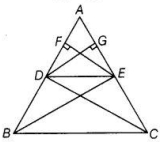
Prove that if a line is drawn parallel to one side of a triangle to intersect the other two sides,then the two sides are divided in the same ratio.
Solution
(N/A) Let a $\triangle ABC$ in which a line $DE$ parallel to $BC$ intersects $AB$ at $D$ and $AC$ at $E$. To prove: $DE$ divides the two sides in the same ratio,i.e.,$\frac{AD}{DB} = \frac{AE}{EC}$.
Construction: Join $BE, CD$ and draw $EF \perp AB$ and $DG \perp AC$.
Proof: Here,$\frac{\text{ar}(\triangle ADE)}{\text{ar}(\triangle BDE)} = \frac{\frac{1}{2} \times AD \times EF}{\frac{1}{2} \times DB \times EF} = \frac{AD}{DB}$ ......$(i)$ [Since,area of triangle $= \frac{1}{2} \times \text{base} \times \text{height}$]
Similarly,$\frac{\text{ar}(\triangle ADE)}{\text{ar}(\triangle DEC)} = \frac{\frac{1}{2} \times AE \times DG}{\frac{1}{2} \times EC \times DG} = \frac{AE}{EC}$ ......$(ii)$
Now,since $\triangle BDE$ and $\triangle DEC$ lie between the same parallel lines $DE$ and $BC$ and on the same base $DE$,therefore,$\text{ar}(\triangle BDE) = \text{ar}(\triangle DEC)$ ......$(iii)$
From Eqs. $(i), (ii)$ and $(iii)$,we get $\frac{AD}{DB} = \frac{AE}{EC}$.
Hence proved.
0 likes
View SolutionTriangles — Similarity of Triangles and Basic Proportionality Theorem · Frequently Asked Questions
1Are these Triangles questions useful for JEE and NEET?
Yes. All questions in this section are mapped to JEE Main and NEET exam patterns. Previous year questions from JEE Main, NEET, GUJCET and state-level exams are included with full solutions.
2Can I switch to Hindi or Gujarati for these questions?
Yes. Use the language tabs in the hero section or the sidebar to view the same questions and solutions in English, Hindi or Gujarati.
3How do I generate a question paper from this subtopic?
Use the Vedclass Exam Paper Generator — select the chapter and subtopic, set difficulty, and generate Sets A, B, C, D automatically. First 3 chapters of every subject are free.
Vedclass Products
For Students
Vedclass Test Series
Mock tests in real JEE/NEET style with performance analysis. 5-day free trial.
Start Free TrialFor Teachers
Exam Paper Generator
Generate Set A/B/C/D papers from this chapter in 2 minutes. 3 chapters free.
Try FreeFor Institutes
Online Exam Module
Live online exams with unlimited students, 360° analytics & white-label branding.
See DemoFor Teachers & Institutes
Generate a Triangles Exam Paper in 2 Minutes
Select subtopic & difficulty — Sets A, B, C, D auto-generated with No Repeat logic.
First 3 chapters of every subject are free — no payment required.