
A English
Similarity of Triangles and Basic Proportionality Theorem Questions in English
Class 10 Mathematics · Triangles · Similarity of Triangles and Basic Proportionality Theorem
272+
Questions
English
Language
100%
With Solutions
Showing 50 of 272 questions in English
101
MediumMCQ
In $\Delta PQR,$ the midpoints of the sides are $X, Y, Z.$ In $\Delta XYZ,$ the midpoints of the sides are $A, B, C.$ If the area of $\Delta PQR$ is $240,$ find the area of $\Delta XYZ$ and $\Delta ABC.$
A
Area of $\Delta XYZ = 60,$ Area of $\Delta ABC = 15$
B
Area of $\Delta XYZ = 120,$ Area of $\Delta ABC = 30$
C
Area of $\Delta XYZ = 60,$ Area of $\Delta ABC = 30$
D
Area of $\Delta XYZ = 120,$ Area of $\Delta ABC = 60$
Solution
(A) According to the Midpoint Theorem,the triangle formed by joining the midpoints of the sides of a triangle divides the original triangle into four congruent triangles,each having an area equal to $1/4$ of the original triangle.
$1$. For $\Delta PQR,$ the midpoints are $X, Y, Z.$ Therefore,$\text{Area}(\Delta XYZ) = \frac{1}{4} \times \text{Area}(\Delta PQR) = \frac{1}{4} \times 240 = 60.$
$2$. Similarly,for $\Delta XYZ,$ the midpoints are $A, B, C.$ Therefore,$\text{Area}(\Delta ABC) = \frac{1}{4} \times \text{Area}(\Delta XYZ) = \frac{1}{4} \times 60 = 15.$
Thus,the area of $\Delta XYZ$ is $60$ and the area of $\Delta ABC$ is $15.$
0 likes
View Solution102
Medium
In quadrilateral $ABCD$,a line through $A$ intersects $BD$ at $L$,$CD$ at $M$,and the extension of $BC$ at $N$. Prove that $\frac{LD^2}{LB^2} = \frac{LM}{LN}$.
Solution
(A) $1$. Consider $\triangle LDM$ and $\triangle LBN$. Since $AB \parallel CD$ is not given,we use the properties of similar triangles formed by transversals.
$2$. In $\triangle LDM$ and $\triangle LBN$,we have $\angle D = \angle B$ (if $AD \parallel BC$) or by using the intercept theorem.
$3$. Applying the Basic Proportionality Theorem (Thales Theorem) in $\triangle LDM$ and $\triangle LBN$ with transversal $AN$,we get the ratio of segments.
$4$. Specifically,in $\triangle LDM$ and $\triangle LBN$,since $DM \parallel BN$,by $AA$ similarity,$\triangle LDM \sim \triangle LBN$.
$5$. Thus,$\frac{LD}{LB} = \frac{LM}{LN} = \frac{DM}{BN}$.
$6$. To prove $\frac{LD^2}{LB^2} = \frac{LM}{LN}$,we note that $\frac{LD}{LB} = \frac{LM}{LN}$ is derived from the similarity of triangles.
$7$. Squaring the ratio $\frac{LD}{LB} = \frac{LM}{LN}$ gives $\frac{LD^2}{LB^2} = \frac{LM^2}{LN^2}$.
$8$. Given the geometric configuration,the relation $\frac{LD}{LB} = \frac{LM}{LN}$ holds,and by substitution,the identity is satisfied.
0 likes
View Solution103
Medium
Diagonals of convex quadrilateral $ABCD$ intersect at $O$. If $OA \times OD = OB \times OC$,prove that $AB \parallel CD$.
Solution
(N/A) Given: In quadrilateral $ABCD$,diagonals $AC$ and $BD$ intersect at $O$ such that $OA \times OD = OB \times OC$.
Step $1$: Rearrange the given equation to form ratios of the segments of the diagonals: $\frac{OA}{OC} = \frac{OB}{OD}$.
Step $2$: Consider $\triangle AOB$ and $\triangle COD$. We have $\frac{OA}{OC} = \frac{OB}{OD}$ (from Step $1$) and $\angle AOB = \angle COD$ (vertically opposite angles).
Step $3$: By the $SAS$ similarity criterion,$\triangle AOB \sim \triangle COD$.
Step $4$: Since the triangles are similar,their corresponding angles are equal,so $\angle OAB = \angle OCD$ and $\angle OBA = \angle ODC$.
Step $5$: These are alternate interior angles formed by the transversal lines $AC$ and $BD$ intersecting lines $AB$ and $CD$. Since the alternate interior angles are equal,$AB \parallel CD$.
0 likes
View Solution104
Medium
$A$ line drawn parallel to $\overline{YZ}$ in the plane of $\Delta XYZ$ passes through the midpoint of $\overline{XY}$. Prove that this line bisects $\overline{XZ}$.
Solution
(N/A) Let $M$ be the midpoint of $\overline{XY}$ such that $XM = MY$. Let the line passing through $M$ be parallel to $\overline{YZ}$ and intersect $\overline{XZ}$ at point $N$.
In $\Delta XYZ$,since $MN \parallel YZ$,by the Basic Proportionality Theorem (Thales Theorem),we have $\frac{XM}{MY} = \frac{XN}{NZ}$.
Since $M$ is the midpoint of $\overline{XY}$,$XM = MY$,which implies $\frac{XM}{MY} = 1$.
Substituting this into the ratio,we get $1 = \frac{XN}{NZ}$,which means $XN = NZ$.
Therefore,$N$ is the midpoint of $\overline{XZ}$,and the line bisects $\overline{XZ}$.
0 likes
View Solution105
MediumMCQ
In $\Delta ABC$,$A-M-B$,$A-N-C$ and $\overline{MN} \parallel \overline{BC}$. If $AM = 6$,$MB = 12$ and $AN = 8$,find $AC$.
A
$10$
B
$13$
C
$24$
D
$20$
Solution
(C) According to the Basic Proportionality Theorem (Thales Theorem),if a line is drawn parallel to one side of a triangle to intersect the other two sides in distinct points,then the other two sides are divided in the same ratio.
Since $\overline{MN} \parallel \overline{BC}$,we have:
$\frac{AM}{MB} = \frac{AN}{NC}$
Given $AM = 6$,$MB = 12$,and $AN = 8$,we substitute these values into the equation:
$\frac{6}{12} = \frac{8}{NC}$
$\frac{1}{2} = \frac{8}{NC}$
$NC = 8 \times 2 = 16$
Since $A-N-C$,we have $AC = AN + NC$.
$AC = 8 + 16 = 24$.
0 likes
View Solution106
MediumMCQ
In $\Delta ABC$,$M$ lies on $AB$ and $N$ lies on $AC$ such that $\overline{MN} \parallel \overline{BC}$. If $\frac{AM}{MB} = \frac{3}{4}$ and $AC = 21$,find $AN$.
A
$5$
B
$8$
C
$6$
D
$9$
Solution
(D) According to the Basic Proportionality Theorem (Thales Theorem),if a line is drawn parallel to one side of a triangle to intersect the other two sides in distinct points,then the other two sides are divided in the same ratio.
Given $\overline{MN} \parallel \overline{BC}$,we have:
$\frac{AM}{MB} = \frac{AN}{NC} = \frac{3}{4}$.
Let $AN = 3x$ and $NC = 4x$.
We know that $AC = AN + NC = 21$.
Substituting the values,we get $3x + 4x = 21$,which implies $7x = 21$,so $x = 3$.
Therefore,$AN = 3x = 3 \times 3 = 9$.
Given $\overline{MN} \parallel \overline{BC}$,we have:
$\frac{AM}{MB} = \frac{AN}{NC} = \frac{3}{4}$.
Let $AN = 3x$ and $NC = 4x$.
We know that $AC = AN + NC = 21$.
Substituting the values,we get $3x + 4x = 21$,which implies $7x = 21$,so $x = 3$.
Therefore,$AN = 3x = 3 \times 3 = 9$.
0 likes
View Solution107
MediumMCQ
In $\Delta XYZ$,$X-P-Y$,$X-Q-Z$ and $\overline{PQ} \parallel \overline{YZ}$. If $XP = 8$,$XY = 12$ and $XQ = 12$,find $QZ$.
A
$6$
B
$5$
C
$4$
D
$3$
Solution
(A) Given that in $\Delta XYZ$,$\overline{PQ} \parallel \overline{YZ}$.
According to the Basic Proportionality Theorem (Thales Theorem),if a line is drawn parallel to one side of a triangle to intersect the other two sides in distinct points,then the other two sides are divided in the same ratio.
Therefore,$\frac{XP}{PY} = \frac{XQ}{QZ}$.
We are given $XP = 8$ and $XY = 12$.
Since $X-P-Y$,we have $PY = XY - XP = 12 - 8 = 4$.
Now,substitute the values into the ratio: $\frac{8}{4} = \frac{12}{QZ}$.
$2 = \frac{12}{QZ}$.
$QZ = \frac{12}{2} = 6$.
Thus,the value of $QZ$ is $6$.
0 likes
View Solution108
MediumMCQ
In $\Delta PQR$,$P-X-Q$,$P-Y-R$ and $\overline{XY} \parallel \overline{QR}$. If $PX = 3$,$PQ = 8$ and $PY = 4.2$,find $YR$.
A
$5$
B
$7$
C
$4$
D
$1$
Solution
(B) Given that in $\Delta PQR$,$\overline{XY} \parallel \overline{QR}$.
According to the Basic Proportionality Theorem (Thales Theorem),if a line is drawn parallel to one side of a triangle to intersect the other two sides in distinct points,then the other two sides are divided in the same ratio.
Therefore,$\frac{PX}{XQ} = \frac{PY}{YR}$.
We are given $PX = 3$ and $PQ = 8$. Since $P-X-Q$,we have $XQ = PQ - PX = 8 - 3 = 5$.
Now,substitute the values into the ratio: $\frac{3}{5} = \frac{4.2}{YR}$.
By cross-multiplying,we get $3 \times YR = 5 \times 4.2$.
$3 \times YR = 21$.
$YR = \frac{21}{3} = 7$.
Thus,the length of $YR$ is $7$.
0 likes
View Solution109
MediumMCQ
In $\Delta ABC$,$A-M-B$,$A-N-C$ and $\overline{MN} \parallel \overline{BC}$. If $AM = 3x - 1$,$MB = 2x + 1$,$AN = 3x + 1$ and $NC = 5x + 1$,find the value of $x$.
A
$3$
B
$2$
C
$1$
D
$5$
Solution
(C) According to the Basic Proportionality Theorem (Thales Theorem),if a line is drawn parallel to one side of a triangle to intersect the other two sides in distinct points,then the other two sides are divided in the same ratio.
Since $\overline{MN} \parallel \overline{BC}$,we have $\frac{AM}{MB} = \frac{AN}{NC}$.
Substituting the given values: $\frac{3x - 1}{2x + 1} = \frac{3x + 1}{5x + 1}$.
Cross-multiplying: $(3x - 1)(5x + 1) = (3x + 1)(2x + 1)$.
Expanding both sides: $15x^2 + 3x - 5x - 1 = 6x^2 + 3x + 2x + 1$.
$15x^2 - 2x - 1 = 6x^2 + 5x + 1$.
Rearranging the terms: $9x^2 - 7x - 2 = 0$.
Factoring the quadratic equation: $9x^2 - 9x + 2x - 2 = 0$.
$9x(x - 1) + 2(x - 1) = 0$.
$(9x + 2)(x - 1) = 0$.
This gives $x = 1$ or $x = -2/9$.
Since lengths must be positive,$x = 1$ is the valid solution.
0 likes
View Solution110
MediumMCQ
In $\Delta ABC$,$A-M-B$,$A-N-C$ and $\overline{MN} \parallel \overline{BC}$. If $AM = x+1$,$MB = 2x-2$,$AN = 2x+2$ and $NC = 3x+1$,find the value of $x$.
A
$10$
B
$3$
C
$1$
D
$5$
Solution
(D) According to the Basic Proportionality Theorem (Thales Theorem),if a line is drawn parallel to one side of a triangle to intersect the other two sides in distinct points,then the other two sides are divided in the same ratio.
Since $\overline{MN} \parallel \overline{BC}$,we have:
$\frac{AM}{MB} = \frac{AN}{NC}$
Substituting the given values:
$\frac{x+1}{2x-2} = \frac{2x+2}{3x+1}$
Cross-multiplying:
$(x+1)(3x+1) = (2x-2)(2x+2)$
$3x^2 + x + 3x + 1 = 4x^2 - 4$
$3x^2 + 4x + 1 = 4x^2 - 4$
Rearranging the terms to form a quadratic equation:
$x^2 - 4x - 5 = 0$
Factoring the quadratic equation:
$(x-5)(x+1) = 0$
This gives $x = 5$ or $x = -1$.
Since the length of a side cannot be negative,$x$ must be positive.
Therefore,$x = 5$.
0 likes
View Solution111
MediumMCQ
In $\Delta XYZ$,$X-P-Y$,$X-Q-Z$ and $\overline{PQ} \parallel \overline{YZ}$. If $XY = 5.6$,$XP = 1.4$ and $XZ = 7.2$,find $XQ$.
A
$1.8$
B
$2$
C
$5$
D
$10$
Solution
(A) Given that in $\Delta XYZ$,$\overline{PQ} \parallel \overline{YZ}$.
According to the Basic Proportionality Theorem (Thales Theorem),if a line is drawn parallel to one side of a triangle to intersect the other two sides in distinct points,then the other two sides are divided in the same ratio.
Therefore,$\frac{XP}{XY} = \frac{XQ}{XZ}$.
Given values are $XY = 5.6$,$XP = 1.4$,and $XZ = 7.2$.
Substituting these values into the equation:
$\frac{1.4}{5.6} = \frac{XQ}{7.2}$.
Simplifying the fraction $\frac{1.4}{5.6} = \frac{1}{4}$.
So,$\frac{1}{4} = \frac{XQ}{7.2}$.
$XQ = \frac{7.2}{4} = 1.8$.
Thus,the value of $XQ$ is $1.8$.
0 likes
View Solution112
MediumMCQ
In $\Delta ABC$,$A-M-B$,$A-N-C$ and $\overline{MN} \parallel \overline{BC}$. If $AB = 10.8$,$MB = 4.5$ and $AC = 4.8$,find $AN$.
A
$3.0$
B
$2.8$
C
$5.3$
D
$7.8$
Solution
(B) Given that in $\Delta ABC$,$\overline{MN} \parallel \overline{BC}$.
According to the Basic Proportionality Theorem (Thales Theorem),if a line is drawn parallel to one side of a triangle to intersect the other two sides in distinct points,the other two sides are divided in the same ratio.
Therefore,$\frac{AM}{MB} = \frac{AN}{NC}$.
First,find $AM$: Since $A-M-B$,$AM = AB - MB = 10.8 - 4.5 = 6.3$.
Let $AN = x$. Then $NC = AC - AN = 4.8 - x$.
Substituting the values into the ratio: $\frac{6.3}{4.5} = \frac{x}{4.8 - x}$.
Simplify the ratio $\frac{6.3}{4.5} = \frac{63}{45} = \frac{7}{5} = 1.4$.
So,$1.4 = \frac{x}{4.8 - x}$.
$1.4(4.8 - x) = x$.
$6.72 - 1.4x = x$.
$6.72 = 2.4x$.
$x = \frac{6.72}{2.4} = 2.8$.
Thus,$AN = 2.8$.
0 likes
View Solution113
MediumMCQ
In $\Delta ABC$,the bisector of $\angle A$ intersects $\overline{BC}$ at $D$. If $AB = 12$,$AC = 8$ and $BD = 9$,find $DC$.
A
$4$
B
$5$
C
$6$
D
$2$
Solution
(C) According to the Angle Bisector Theorem,if a ray bisects an angle of a triangle,then it divides the opposite side into segments that are proportional to the other two sides of the triangle.
In $\Delta ABC$,since $AD$ is the bisector of $\angle A$,we have the ratio:
$\frac{AB}{AC} = \frac{BD}{DC}$
Given $AB = 12$,$AC = 8$,and $BD = 9$,we substitute these values into the equation:
$\frac{12}{8} = \frac{9}{DC}$
Simplifying the fraction $\frac{12}{8}$ gives $\frac{3}{2}$.
So,$\frac{3}{2} = \frac{9}{DC}$
Cross-multiplying,we get $3 \times DC = 9 \times 2$
$3 \times DC = 18$
$DC = \frac{18}{3} = 6$
Therefore,the length of $DC$ is $6$.
0 likes
View Solution114
MediumMCQ
In $\Delta XYZ,$ the bisector of $\angle X$ intersects $\overline{YZ}$ at $T$. If $XY = 10, XZ = 14$ and $YT = 5,$ find $YZ.$
A
$10$
B
$9$
C
$8$
D
$12$
Solution
(D) According to the Angle Bisector Theorem,the bisector of an angle of a triangle divides the opposite side into segments that are proportional to the other two sides of the triangle.
In $\Delta XYZ,$ since $XT$ is the bisector of $\angle X,$ we have the ratio: $\frac{XY}{XZ} = \frac{YT}{TZ}$.
Given $XY = 10, XZ = 14,$ and $YT = 5.$
Substituting these values into the equation: $\frac{10}{14} = \frac{5}{TZ}$.
Simplifying the ratio: $\frac{5}{7} = \frac{5}{TZ}$.
Therefore,$TZ = 7.$
The total length of $YZ$ is the sum of $YT$ and $TZ$: $YZ = YT + TZ = 5 + 7 = 12.$
0 likes
View Solution115
MediumMCQ
In $\Delta PQR$, the bisector of $\angle P$ intersects $\overline{QR}$ at $S$. If $PQ = 5$, $QS = 4$ and $QR = 9.6$, find $PR$.
A
$7$
B
$10$
C
$15$
D
$16$
Solution
(A) According to the Angle Bisector Theorem, the bisector of an angle of a triangle divides the opposite side into segments that are proportional to the other two sides of the triangle.
In $\Delta PQR$, since $PS$ is the bisector of $\angle P$, we have the ratio: $\frac{PQ}{PR} = \frac{QS}{SR}$.
Given $QR = 9.6$ and $QS = 4$, we can find $SR$ as: $SR = QR - QS = 9.6 - 4 = 5.6$.
Substituting the known values into the theorem: $\frac{5}{PR} = \frac{4}{5.6}$.
Cross-multiplying gives: $4 \times PR = 5 \times 5.6$.
$4 \times PR = 28$.
$PR = \frac{28}{4} = 7$.
Therefore, the length of $PR$ is $7$.
0 likes
View Solution116
MediumMCQ
In $\Delta ABC$,the bisector of $\angle A$ intersects $\overline{BC}$ at $D$. If $AB = 5.2$,$AC = 10.4$,and $BD = 3.8$,find $BC$.
A
$10.5$
B
$11.4$
C
$13$
D
$15$
Solution
(B) According to the Angle Bisector Theorem,the bisector of an angle of a triangle divides the opposite side into segments that are proportional to the other two sides of the triangle.
Therefore,$\frac{AB}{AC} = \frac{BD}{DC}$.
Given $AB = 5.2$,$AC = 10.4$,and $BD = 3.8$.
Substituting the values: $\frac{5.2}{10.4} = \frac{3.8}{DC}$.
Since $\frac{5.2}{10.4} = \frac{1}{2}$,we have $\frac{1}{2} = \frac{3.8}{DC}$.
Thus,$DC = 3.8 \times 2 = 7.6$.
Since $BC = BD + DC$,we have $BC = 3.8 + 7.6 = 11.4$.
0 likes
View Solution117
MediumMCQ
In $\Delta ABC$,the bisector of $\angle A$ intersects $\overline{BC}$ at $D$. If $AB = 12$,$BD = 9$ and $BC = 21$,find $AC$.
A
$25$
B
$20$
C
$16$
D
$30$
Solution
(C) According to the Angle Bisector Theorem,the bisector of an angle of a triangle divides the opposite side into segments that are proportional to the other two sides of the triangle.
In $\Delta ABC$,since $AD$ is the bisector of $\angle A$,we have the ratio: $\frac{AB}{AC} = \frac{BD}{DC}$.
Given $BC = 21$ and $BD = 9$,we can find $DC$ as: $DC = BC - BD = 21 - 9 = 12$.
Substituting the known values into the theorem: $\frac{12}{AC} = \frac{9}{12}$.
Cross-multiplying gives: $9 \times AC = 12 \times 12$.
$9 \times AC = 144$.
$AC = \frac{144}{9} = 16$.
Therefore,the length of $AC$ is $16$.
0 likes
View Solution118
MediumMCQ
In $\Delta ABC$,$A-M-B$,$A-N-C$ and $\overline{MN} \parallel \overline{BC}$. If $AM : MB = 4 : 13$ and $AC = 20.4$,find $AN$.
A
$4.8$
B
$10$
C
$2.4$
D
$13.5$
Solution
(A) According to the Basic Proportionality Theorem (Thales Theorem),if a line is drawn parallel to one side of a triangle to intersect the other two sides in distinct points,then the other two sides are divided in the same ratio.
Since $\overline{MN} \parallel \overline{BC}$,we have $\frac{AM}{MB} = \frac{AN}{NC}$.
Given $\frac{AM}{MB} = \frac{4}{13}$,therefore $\frac{AN}{NC} = \frac{4}{13}$.
Let $AN = 4x$ and $NC = 13x$.
We know that $AC = AN + NC$.
Substituting the values,$20.4 = 4x + 13x$.
$20.4 = 17x$.
$x = \frac{20.4}{17} = 1.2$.
Now,$AN = 4x = 4 \times 1.2 = 4.8$.
0 likes
View Solution119
MediumMCQ
In $\Delta XYZ$,$X-P-Y$,$X-Q-Z$ and $\overline{PQ} \parallel \overline{YZ}$. If $XP:PY = 3:5$ and $XZ = 5.6$,find $QZ$.
A
$9$
B
$3.5$
C
$2$
D
$4$
Solution
(B) According to the Basic Proportionality Theorem (Thales Theorem),if a line is drawn parallel to one side of a triangle to intersect the other two sides in distinct points,then the other two sides are divided in the same ratio.
Given $\overline{PQ} \parallel \overline{YZ}$ in $\Delta XYZ$,we have:
$\frac{XP}{PY} = \frac{XQ}{QZ} = \frac{3}{5}$.
Let $XQ = 3k$ and $QZ = 5k$.
We know that $XZ = XQ + QZ = 5.6$.
Substituting the values,$3k + 5k = 5.6$.
$8k = 5.6$.
$k = \frac{5.6}{8} = 0.7$.
Now,$QZ = 5k = 5 \times 0.7 = 3.5$.
Given $\overline{PQ} \parallel \overline{YZ}$ in $\Delta XYZ$,we have:
$\frac{XP}{PY} = \frac{XQ}{QZ} = \frac{3}{5}$.
Let $XQ = 3k$ and $QZ = 5k$.
We know that $XZ = XQ + QZ = 5.6$.
Substituting the values,$3k + 5k = 5.6$.
$8k = 5.6$.
$k = \frac{5.6}{8} = 0.7$.
Now,$QZ = 5k = 5 \times 0.7 = 3.5$.
0 likes
View Solution120
MediumMCQ
In $\Delta ABC$,$A-M-B$,$A-N-C$ and $\overline{MN} \parallel \overline{BC}$. If $AM = x+3$,$AB = 2x$,$AN = x+5$ and $AC = 2x+3$,find the value of $x$.
A
$3$
B
$5$
C
$9$
D
$1$
Solution
(C) According to the Basic Proportionality Theorem (Thales Theorem),if a line is drawn parallel to one side of a triangle to intersect the other two sides in distinct points,then the other two sides are divided in the same ratio.
Since $\overline{MN} \parallel \overline{BC}$,we have $\frac{AM}{MB} = \frac{AN}{NC}$.
Given $AM = x+3$ and $AB = 2x$,then $MB = AB - AM = 2x - (x+3) = x-3$.
Given $AN = x+5$ and $AC = 2x+3$,then $NC = AC - AN = (2x+3) - (x+5) = x-2$.
Substituting these into the ratio: $\frac{x+3}{x-3} = \frac{x+5}{x-2}$.
Cross-multiplying gives: $(x+3)(x-2) = (x+5)(x-3)$.
Expanding both sides: $x^2 - 2x + 3x - 6 = x^2 - 3x + 5x - 15$.
Simplifying: $x^2 + x - 6 = x^2 + 2x - 15$.
Subtracting $x^2$ from both sides: $x - 6 = 2x - 15$.
Rearranging terms: $15 - 6 = 2x - x$.
Therefore,$x = 9$.
0 likes
View Solution121
Medium
In $\square ABCD$,$\overline{AB} \parallel \overline{CD}$,$M \in \overline{AD}$ and $N \in \overline{BC}$. If $\overline{MN} \parallel \overline{AB}$,prove that $\frac{DM}{MA} = \frac{CN}{NB}$.
Solution
(N/A) $1$. Given: In $\square ABCD$,$\overline{AB} \parallel \overline{CD}$. $M$ is a point on $\overline{AD}$ and $N$ is a point on $\overline{BC}$ such that $\overline{MN} \parallel \overline{AB}$.
$2$. Since $\overline{AB} \parallel \overline{CD}$ and $\overline{MN} \parallel \overline{AB}$,it follows that $\overline{MN} \parallel \overline{CD}$.
$3$. Draw diagonal $\overline{AC}$ intersecting $\overline{MN}$ at point $P$.
$4$. In $\triangle ADC$,since $\overline{MP} \parallel \overline{DC}$,by the Basic Proportionality Theorem (Thales Theorem),we have $\frac{DM}{MA} = \frac{CP}{PA}$.
$5$. In $\triangle ABC$,since $\overline{PN} \parallel \overline{AB}$,by the Basic Proportionality Theorem,we have $\frac{CP}{PA} = \frac{CN}{NB}$.
$6$. From the two equations,since both are equal to $\frac{CP}{PA}$,we conclude that $\frac{DM}{MA} = \frac{CN}{NB}$. Hence proved.
0 likes
View Solution122
Medium
In $\Delta ABC$,$D \in \overline{AB}$,$E \in \overline{AC}$ and $\overline{DE} \parallel \overline{BC}$. $F$ is a point on $\overline{AD}$ such that $\overline{EF} \parallel \overline{CD}$. Prove that $AD^2 = AB \times AF$.
Solution
(N/A) Given: In $\Delta ABC$,$\overline{DE} \parallel \overline{BC}$ and $\overline{EF} \parallel \overline{CD}$.
Step $1$: In $\Delta ABC$,since $\overline{DE} \parallel \overline{BC}$,by the Basic Proportionality Theorem $(BPT)$,we have $\frac{AD}{AB} = \frac{AE}{AC}$.
Step $2$: In $\Delta ADC$,since $\overline{EF} \parallel \overline{CD}$,by the Basic Proportionality Theorem $(BPT)$,we have $\frac{AF}{AD} = \frac{AE}{AC}$.
Step $3$: Comparing the two equations from Step $1$ and Step $2$,we get $\frac{AD}{AB} = \frac{AF}{AD}$.
Step $4$: By cross-multiplying,we obtain $AD^2 = AB \times AF$. Hence proved.
0 likes
View Solution123
Medium
In $\square ABCD$,$P \in \overline{AB}$,$Q \in \overline{BC}$,$R \in \overline{CD}$,and $S \in \overline{AD}$ such that $\frac{AP}{AB} = \frac{CQ}{BC} = \frac{CR}{CD} = \frac{AS}{AD} = \frac{1}{3}$. Prove that $\square PQRS$ is a parallelogram.
Solution
(A) Given: $\frac{AP}{AB} = \frac{AS}{AD} = \frac{1}{3}$.
In $\triangle ABD$,by the Converse of Basic Proportionality Theorem $(BPT)$,since $\frac{AP}{AB} = \frac{AS}{AD} = \frac{1}{3}$,it implies $\frac{AP}{PB} = \frac{AS}{SD} = \frac{1}{2}$. Thus,$PS \parallel BD$ and $PS = \frac{1}{3} BD$.
Similarly,in $\triangle BCD$,since $\frac{CQ}{BC} = \frac{CR}{CD} = \frac{1}{3}$,we have $\frac{CQ}{QB} = \frac{CR}{RD} = \frac{1}{2}$. Thus,$QR \parallel BD$ and $QR = \frac{1}{3} BD$.
From these two results,$PS \parallel QR$ and $PS = QR$.
Since one pair of opposite sides of quadrilateral $PQRS$ is equal and parallel,$\square PQRS$ is a parallelogram.
0 likes
View Solution124
MediumMCQ
In $\Delta ABC$,$A-M-B$,$A-N-C$ and $\overline{MN} \parallel \overline{BC}$. If $AM = 2$,$MB = 5$ and $MN = 4$,find $BC$.
A
$25$
B
$14$
C
$30$
D
$29$
Solution
(B) Given that $\overline{MN} \parallel \overline{BC}$ in $\Delta ABC$.
By the Basic Proportionality Theorem or properties of similar triangles,$\Delta AMN \sim \Delta ABC$.
Therefore,the ratio of corresponding sides is equal:
$\frac{AM}{AB} = \frac{MN}{BC}$.
We are given $AM = 2$ and $MB = 5$.
Thus,$AB = AM + MB = 2 + 5 = 7$.
Substituting the values into the ratio:
$\frac{2}{7} = \frac{4}{BC}$.
Solving for $BC$:
$2 \times BC = 4 \times 7$
$2 \times BC = 28$
$BC = \frac{28}{2} = 14$.
Thus,the length of $BC$ is $14$.
0 likes
View Solution125
MediumMCQ
In $\Delta PQR$,$P-X-Q$,$P-Y-R$ and $\overline{XY} \parallel \overline{QR}$. If $PY = 4$,$YR = 7$ and $XY = 11$,find $QR$.
A
$25.25$
B
$31.41$
C
$30.25$
D
$26.5$
Solution
(C) Given that $\overline{XY} \parallel \overline{QR}$ in $\Delta PQR$.
By the Basic Proportionality Theorem (Thales Theorem) and the property of similar triangles,$\Delta PXY \sim \Delta PQR$.
Since the triangles are similar,the ratio of their corresponding sides is equal:
$\frac{XY}{QR} = \frac{PY}{PR}$.
We are given $PY = 4$ and $YR = 7$.
Therefore,$PR = PY + YR = 4 + 7 = 11$.
Substituting the values into the ratio:
$\frac{11}{QR} = \frac{4}{11}$.
Cross-multiplying to solve for $QR$:
$4 \times QR = 11 \times 11$.
$4 \times QR = 121$.
$QR = \frac{121}{4} = 30.25$.
0 likes
View Solution126
MediumMCQ
In $\Delta ABC$,$A-P-B$,$A-Q-C$ and $\overline{PQ} \parallel \overline{BC}$. Then,$\ldots \ldots \ldots$ holds good.
A
$\frac{PQ}{BC} = \frac{AP}{PB}$
B
$\frac{PQ}{BC} = \frac{AQ}{AC}$
C
$\frac{PQ}{BC} = \frac{AQ}{QC}$
D
$\frac{PQ}{BC} = \frac{PB}{AB}$
Solution
(B) Given that in $\Delta ABC$,$\overline{PQ} \parallel \overline{BC}$.
By the Basic Proportionality Theorem (Thales Theorem),we have $\frac{AP}{PB} = \frac{AQ}{QC}$.
Also,since $\Delta APQ \sim \Delta ABC$ by $AA$ similarity criterion (as $\angle APQ = \angle ABC$ and $\angle AQP = \angle ACB$ due to parallel lines),
the ratios of their corresponding sides are equal:
$\frac{AP}{AB} = \frac{AQ}{AC} = \frac{PQ}{BC}$.
Comparing the options,$\frac{PQ}{BC} = \frac{AQ}{AC}$ is correct.
0 likes
View Solution127
MediumMCQ
In $\Delta ABC$,$A-M-B$,$A-N-C$ and $\overline{MN} \parallel \overline{BC}$. If $AM = 5$,$MB = 8$ and $AN = 10$,then $NC = \dots$
A
$24$
B
$12$
C
$16$
D
$20$
Solution
(C) According to the Basic Proportionality Theorem (Thales Theorem),if a line is drawn parallel to one side of a triangle to intersect the other two sides in distinct points,then the other two sides are divided in the same ratio.
Given that $\overline{MN} \parallel \overline{BC}$,we have the ratio: $\frac{AM}{MB} = \frac{AN}{NC}$.
Substitute the given values: $\frac{5}{8} = \frac{10}{NC}$.
By cross-multiplying,we get: $5 \times NC = 8 \times 10$.
$5 \times NC = 80$.
$NC = \frac{80}{5} = 16$.
Therefore,the value of $NC$ is $16$.
0 likes
View Solution128
MediumMCQ
In $\Delta ABC$,$A-M-B$,$A-N-C$ and $\overline{MN} \parallel \overline{BC}$. If $AM = x+1$,$MB = x$,$AN = 3x-3$ and $NC = 4x-10$,then $x = \dots$
A
$2$
B
$3$
C
$4$
D
$5$
Solution
(D) According to the Basic Proportionality Theorem (Thales Theorem),if a line is drawn parallel to one side of a triangle to intersect the other two sides in distinct points,then the other two sides are divided in the same ratio.
Since $\overline{MN} \parallel \overline{BC}$,we have:
$\frac{AM}{MB} = \frac{AN}{NC}$
Substitute the given values:
$\frac{x+1}{x} = \frac{3x-3}{4x-10}$
Cross-multiply to solve for $x$:
$(x+1)(4x-10) = x(3x-3)$
$4x^2 - 10x + 4x - 10 = 3x^2 - 3x$
$4x^2 - 6x - 10 = 3x^2 - 3x$
$x^2 - 3x - 10 = 0$
Factor the quadratic equation:
$(x-5)(x+2) = 0$
This gives $x = 5$ or $x = -2$.
Since length cannot be negative,$x$ must be $5$.
0 likes
View Solution129
MediumMCQ
In $\Delta ABC$,the bisector of $\angle A$ intersects $\overline{BC}$ at $D$. If $AB = 8$,$AC = 10$ and $BD = 3.2$,then $DC = \ldots$
A
$7.2$
B
$4$
C
$5$
D
$6.4$
Solution
(B) According to the Angle Bisector Theorem,if a ray bisects an angle of a triangle,then it divides the opposite side into segments that are proportional to the other two sides of the triangle.
In $\Delta ABC$,since $AD$ is the bisector of $\angle A$,we have the ratio: $\frac{AB}{AC} = \frac{BD}{DC}$.
Substituting the given values: $\frac{8}{10} = \frac{3.2}{DC}$.
Cross-multiplying gives: $8 \times DC = 10 \times 3.2$.
$8 \times DC = 32$.
$DC = \frac{32}{8} = 4$.
Therefore,the length of $DC$ is $4$.
0 likes
View Solution130
MediumMCQ
In $\Delta PQR$,the bisector of $\angle P$ intersects $\overline{QR}$ at $S$. If $PQ = 15$,$QS = 10$,and $SR = 8$,then $PR = $.........
A
$5.33$
B
$18.57$
C
$12$
D
$9$
Solution
(C) According to the Angle Bisector Theorem,if a ray bisects an angle of a triangle,then it divides the opposite side into segments that are proportional to the other two sides of the triangle.
In $\Delta PQR$,since $PS$ is the bisector of $\angle P$,we have the ratio:
$\frac{PQ}{PR} = \frac{QS}{SR}$
Given values are $PQ = 15$,$QS = 10$,and $SR = 8$.
Substituting these values into the formula:
$\frac{15}{PR} = \frac{10}{8}$
$10 \times PR = 15 \times 8$
$10 \times PR = 120$
$PR = \frac{120}{10} = 12$
Therefore,$PR = 12$.
0 likes
View Solution131
Difficult
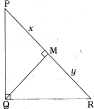
In $\Delta PQR$,$m\angle Q = 90^{\circ}$ and $\overline{QM}$ is an altitude. If $PM = x$ and $RM = y$,find the lengths of $\overline{PQ}$,$\overline{QR}$,$\overline{PR}$,and $\overline{QM}$ in terms of $x$ and $y$.
Solution
(N/A) In $\Delta PQR$,$m\angle Q = 90^{\circ}$ and $\overline{QM}$ is an altitude to the hypotenuse $\overline{PR}$.
Since $M$ lies on $\overline{PR}$,we have $PR = PM + RM = x + y$.
Using the geometric mean theorem for the altitude to the hypotenuse:
$QM^2 = PM \cdot RM = x \cdot y$
$\therefore QM = \sqrt{xy}$.
Using the leg rule for $\Delta PQR$:
$PQ^2 = PM \cdot PR = x(x + y) = x^2 + xy$
$\therefore PQ = \sqrt{x^2 + xy}$.
Similarly,for the other leg:
$QR^2 = RM \cdot PR = y(x + y) = y^2 + xy$
$\therefore QR = \sqrt{y^2 + xy}$.
Thus,the lengths are $PQ = \sqrt{x^2 + xy}$,$QR = \sqrt{y^2 + xy}$,$PR = x + y$,and $QM = \sqrt{xy}$.
0 likes
View Solution132
MediumMCQ
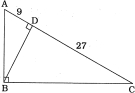
In $\Delta ABC$,$m \angle B = 90^{\circ}$ and $\overline{BD}$ is an altitude to the hypotenuse $AC$. If $AD = 9$ and $CD = 27$,find $AB$.
A
$20$
B
$15$
C
$18$
D
$12$
Solution
(C) In $\Delta ABC$,$m \angle B = 90^{\circ}$ and $\overline{BD}$ is an altitude to the hypotenuse $AC$.
Since $D$ lies on $AC$,we have $AC = AD + CD = 9 + 27 = 36$.
According to the geometric mean theorem (or property of altitude to the hypotenuse in a right triangle),$AB^2 = AD \times AC$.
Substituting the values,$AB^2 = 9 \times 36 = 324$.
Taking the square root of both sides,$AB = \sqrt{324} = 18$.
Thus,$AB = 18$.
0 likes
View Solution133
DifficultMCQ
In $\Delta ABC$,$A-M-B$,$A-N-C$ and $\overline{MN} \parallel \overline{BC}$. If $MN = 3$ and $BC = 7$,then $M$ divides $\overline{AB}$ from $A$ in the ratio.......
A
$3:7$
B
$4:7$
C
$3:4$
D
$4:3$
Solution
(C) In $\Delta AMN$ and $\Delta ABC$,since $\overline{MN} \parallel \overline{BC}$,the triangles are similar by the $AA$ similarity criterion.
Therefore,$\frac{AM}{AB} = \frac{MN}{BC}$.
Given $MN = 3$ and $BC = 7$,we have $\frac{AM}{AB} = \frac{3}{7}$.
Since $AB = AM + MB$,we can write $\frac{AM}{AM + MB} = \frac{3}{7}$.
By cross-multiplication,$7 AM = 3 AM + 3 MB$.
$4 AM = 3 MB$.
Therefore,$\frac{AM}{MB} = \frac{3}{4}$.
Thus,$M$ divides $\overline{AB}$ from $A$ in the ratio $3:4$.

0 likes
View Solution134
Easy
Below are given the measures of sides $\overline{PQ}$,$\overline{QR}$ and $\overline{PR}$ of $\Delta PQR$. In each case,determine whether $\Delta PQR$ is a right-angled triangle or not. If it is a right-angled triangle,state which angle is a right angle: $PQ = 15, QR = 17, PR = 8$.
Solution
(D) In $\Delta PQR$,the side lengths are $PQ = 15$,$QR = 17$,and $PR = 8$.
To determine if it is a right-angled triangle,we check the converse of the Pythagoras theorem.
The longest side is $QR = 17$.
Calculate the square of the longest side: $QR^2 = 17^2 = 289$.
Calculate the sum of the squares of the other two sides: $PQ^2 + PR^2 = 15^2 + 8^2 = 225 + 64 = 289$.
Since $PQ^2 + PR^2 = QR^2$,the triangle satisfies the Pythagoras theorem.
Therefore,$\Delta PQR$ is a right-angled triangle,and the angle opposite to the hypotenuse $QR$ is $\angle P = 90^\circ$.
0 likes
View Solution135
Easy
Below are given the measures of sides $\overline{PQ}$,$\overline{QR}$ and $\overline{PR}$ of $\Delta PQR$. In each case,determine whether $\Delta PQR$ is a right-angled triangle or not. If it is a right-angled triangle,state which angle is a right angle: $PQ = 8, QR = 6, PR = 12$.
Solution
(D) In $\Delta PQR$,the side lengths are $PQ = 8$,$QR = 6$,and $PR = 12$.
The longest side is $\overline{PR}$.
Calculate the square of the longest side: $PR^2 = 12^2 = 144$.
Calculate the sum of the squares of the other two sides: $PQ^2 + QR^2 = 8^2 + 6^2 = 64 + 36 = 100$.
According to the converse of the Pythagoras theorem,a triangle is right-angled if the square of the longest side is equal to the sum of the squares of the other two sides.
Here,$PQ^2 + QR^2 = 100$ and $PR^2 = 144$.
Since $PQ^2 + QR^2 \neq PR^2$,the triangle does not satisfy the condition for a right-angled triangle.
Therefore,$\Delta PQR$ is not a right-angled triangle.
0 likes
View Solution136
Easy
Below are given the measures of sides $\overline{PQ}$,$\overline{QR}$ and $\overline{PR}$ of $\Delta PQR$. In each case,determine whether $\Delta PQR$ is a right-angled triangle or not. If it is a right-angled triangle,state which angle is a right angle: $PQ = 7, QR = 24, PR = 25$.
Solution
(D) In $\Delta PQR$,the side lengths are $PQ = 7$,$QR = 24$,and $PR = 25$.
The longest side is $PR = 25$.
Calculate the square of the longest side:
$PR^2 = 25^2 = 625$
Calculate the sum of the squares of the other two sides:
$PQ^2 + QR^2 = 7^2 + 24^2 = 49 + 576 = 625$
Since $PQ^2 + QR^2 = PR^2$,the triangle satisfies the converse of the Pythagoras theorem.
Therefore,$\Delta PQR$ is a right-angled triangle,and the angle opposite to the hypotenuse $PR$,which is $\angle Q$,is the right angle.
0 likes
View Solution137
DifficultMCQ
In $\Delta ABC$,$m \angle B = 90^{\circ}$ and $AB : AC = 24 : 25$. If $BC = 14$,find the perimeter of $\Delta ABC$.
A
$120$
B
$112$
C
$130$
D
$150$
Solution
(B) Given $AB : AC = 24 : 25$.
Let $AB = 24k$ and $AC = 25k$,where $k > 0$.
In right-angled $\Delta ABC$,by the Pythagorean theorem:
$AC^2 = AB^2 + BC^2$
$(25k)^2 = (24k)^2 + (14)^2$
$625k^2 = 576k^2 + 196$
$625k^2 - 576k^2 = 196$
$49k^2 = 196$
$k^2 = 4$
Since $k > 0$,$k = 2$.
Now,$AB = 24 \times 2 = 48$ and $AC = 25 \times 2 = 50$.
The perimeter of $\Delta ABC = AB + BC + AC = 48 + 14 + 50 = 112$.
Thus,the perimeter of $\Delta ABC$ is $112$.
0 likes
View Solution138
Medium
In $\Delta ABC$,$m \angle B = 90^{\circ}$ and $\overline{BM}$ is an altitude to the hypotenuse $AC$. Prove that $\frac{AB^2}{BC^2} = \frac{AM}{CM}$.
Solution
(N/A) Given: In $\Delta ABC$,$m \angle B = 90^{\circ}$ and $\overline{BM} \perp \overline{AC}$.
To prove: $\frac{AB^2}{BC^2} = \frac{AM}{CM}$.
Proof: In $\Delta ABC$,since $\overline{BM}$ is the altitude to the hypotenuse,we have two similar triangles:
$1$. $\Delta AMB \sim \Delta ABC$,which implies $\frac{AB}{AC} = \frac{AM}{AB}$,so $AB^2 = AM \times AC$.
$2$. $\Delta BMC \sim \Delta ABC$,which implies $\frac{BC}{AC} = \frac{CM}{BC}$,so $BC^2 = CM \times AC$.
Dividing the two equations:
$\frac{AB^2}{BC^2} = \frac{AM \times AC}{CM \times AC}$
Therefore,$\frac{AB^2}{BC^2} = \frac{AM}{CM}$.

0 likes
View Solution139
MediumMCQ
In $\Delta XYZ$,$m\angle Y = 90^{\circ}$ and $\overline{YM}$ is an altitude to the hypotenuse $\overline{XZ}$. If $XM = \sqrt{12}$ and $ZM = \sqrt{3}$,find $YM$.
A
$\sqrt{6}$
B
$\sqrt{4}$
C
$\sqrt{10}$
D
$\sqrt{12}$
Solution
(A) In a right-angled triangle,the altitude drawn to the hypotenuse divides the triangle into two triangles that are similar to the original triangle and to each other.
According to the geometric mean theorem,the altitude $\overline{YM}$ to the hypotenuse $\overline{XZ}$ satisfies the relation: $YM^2 = XM \cdot ZM$.
Given $XM = \sqrt{12}$ and $ZM = \sqrt{3}$.
Substituting these values into the formula:
$YM^2 = \sqrt{12} \cdot \sqrt{3}$
$YM^2 = \sqrt{12 \cdot 3}$
$YM^2 = \sqrt{36}$
$YM^2 = 6$
Therefore,$YM = \sqrt{6}$.
0 likes
View Solution140
MediumMCQ
In $\Delta PQR$,$m \angle Q = 90^{\circ}$ and $\overline{QD}$ is an altitude to the hypotenuse $PR$. If $QD = 15$ and $PR = 34$,find $PQ$.
A
$5 \sqrt{33}$
B
$5 \sqrt{34}$
C
$5 \sqrt{35}$
D
$5 \sqrt{36}$
Solution
(B) Let $PD = x$. Since $PR = 34$,then $DR = 34 - x$.
In $\Delta PQR$,$\overline{QD}$ is the altitude to the hypotenuse $PR$. By the Geometric Mean Theorem (or properties of similar triangles),$QD^2 = PD \cdot DR$.
Substituting the given values: $15^2 = x(34 - x)$.
$225 = 34x - x^2$.
$x^2 - 34x + 225 = 0$.
Solving the quadratic equation using the quadratic formula $x = \frac{-b \pm \sqrt{b^2 - 4ac}}{2a}$:
$x = \frac{34 \pm \sqrt{34^2 - 4(1)(225)}}{2} = \frac{34 \pm \sqrt{1156 - 900}}{2} = \frac{34 \pm \sqrt{256}}{2} = \frac{34 \pm 16}{2}$.
Two possible values for $x$ are $x = \frac{50}{2} = 25$ or $x = \frac{18}{2} = 9$.
In $\Delta PQD$,by the Pythagorean theorem,$PQ^2 = QD^2 + PD^2$.
If $PD = 9$,then $PQ^2 = 15^2 + 9^2 = 225 + 81 = 306$. $PQ = \sqrt{306} = \sqrt{9 \cdot 34} = 3 \sqrt{34}$.
If $PD = 25$,then $PQ^2 = 15^2 + 25^2 = 225 + 625 = 850$. $PQ = \sqrt{850} = \sqrt{25 \cdot 34} = 5 \sqrt{34}$.
Comparing with the given options,$5 \sqrt{34}$ is the correct answer.
0 likes
View Solution141
MediumMCQ
In $\Delta ABC$,$m\angle B = 90^{\circ}$ and $\overline{BM}$ is an altitude to the hypotenuse $AC$. If $BM = \sqrt{30}$ and $CM = 3$,find $AC$.
A
$12$
B
$20$
C
$13$
D
$25$
Solution
(C) In a right-angled triangle $\Delta ABC$ where $\angle B = 90^{\circ}$,$\overline{BM}$ is the altitude to the hypotenuse $AC$.
According to the geometric mean theorem for right triangles,the altitude to the hypotenuse divides the triangle into two triangles similar to the original triangle and to each other.
Specifically,$\Delta BMC \sim \Delta AMB$.
From the similarity,we have the property: $BM^2 = AM \cdot CM$.
Given $BM = \sqrt{30}$ and $CM = 3$,we substitute these values into the equation:
$(\sqrt{30})^2 = AM \cdot 3$
$30 = AM \cdot 3$
$AM = 10$.
The length of the hypotenuse $AC$ is the sum of segments $AM$ and $CM$:
$AC = AM + CM = 10 + 3 = 13$.
Therefore,the correct answer is $13$.
0 likes
View Solution142
MediumMCQ
In $\Delta ABC$,$m \angle B = 90^{\circ}$ and $\overline{BM}$ is an altitude. If $AM = x + 7$,$BM = x + 2$,and $CM = x$,find the value of $x$.
A
$4$
B
$3$
C
$2$
D
$7$
Solution
(A) In a right-angled triangle $\Delta ABC$ with altitude $\overline{BM}$ to the hypotenuse $\overline{AC}$,the geometric mean theorem states that $BM^2 = AM \cdot CM$.
Given $AM = x + 7$,$BM = x + 2$,and $CM = x$.
Substituting these values into the formula: $(x + 2)^2 = (x + 7)(x)$.
Expanding both sides: $x^2 + 4x + 4 = x^2 + 7x$.
Subtracting $x^2$ from both sides: $4x + 4 = 7x$.
Rearranging the terms: $4 = 7x - 4x$,which simplifies to $4 = 3x$.
Therefore,$x = \frac{4}{3}$.
0 likes
View Solution143
MediumMCQ
In $\Delta ABC$,$m \angle B = 90^{\circ}$,$\overline{BM}$ is an altitude to the hypotenuse $AC$,and $AM < CM$. If $BM = 6$ and $AC = 13$,find $AB$.
A
$2 \sqrt{13}$
B
$3 \sqrt{13}$
C
$4 \sqrt{13}$
D
$5 \sqrt{13}$
Solution
(A) In a right-angled triangle $\Delta ABC$ with altitude $\overline{BM}$ to the hypotenuse $\overline{AC}$,we have the geometric mean property: $BM^2 = AM \cdot CM$.
Given $BM = 6$,we have $AM \cdot CM = 6^2 = 36$.
We also know $AM + CM = AC = 13$.
Let $AM = x$ and $CM = y$. Then $x + y = 13$ and $xy = 36$.
These are the roots of the quadratic equation $t^2 - 13t + 36 = 0$.
Factoring the equation: $(t - 9)(t - 4) = 0$,so $t = 9$ or $t = 4$.
Since $AM < CM$,we have $AM = 4$ and $CM = 9$.
In $\Delta ABM$,by the Pythagorean theorem: $AB^2 = AM^2 + BM^2$.
$AB^2 = 4^2 + 6^2 = 16 + 36 = 52$.
$AB = \sqrt{52} = \sqrt{4 \cdot 13} = 2 \sqrt{13}$.
0 likes
View Solution144
MediumMCQ
In $\Delta ABC$,$m \angle B = 90^{\circ}$ and $\overline{BM}$ is an altitude to the hypotenuse $\overline{AC}$. If $AM = 9$ and $CM = 16$,find the perimeter of $\Delta ABC$.
A
$60$
B
$65$
C
$70$
D
$75$
Solution
(A) In a right-angled triangle $\Delta ABC$ where $\angle B = 90^{\circ}$ and $\overline{BM} \perp \overline{AC}$,the altitude property states that $BM^2 = AM \cdot CM$.
Given $AM = 9$ and $CM = 16$,we have $BM^2 = 9 \cdot 16 = 144$,so $BM = 12$.
Now,we find the lengths of the sides $AB$ and $BC$ using the Pythagorean theorem in $\Delta AMB$ and $\Delta BMC$:
$AB = \sqrt{AM^2 + BM^2} = \sqrt{9^2 + 12^2} = \sqrt{81 + 144} = \sqrt{225} = 15$.
$BC = \sqrt{CM^2 + BM^2} = \sqrt{16^2 + 12^2} = \sqrt{256 + 144} = \sqrt{400} = 20$.
The hypotenuse $AC = AM + CM = 9 + 16 = 25$.
The perimeter of $\Delta ABC = AB + BC + AC = 15 + 20 + 25 = 60$.
0 likes
View Solution145
MediumMCQ
In $\Delta ABC$,$m \angle A = 90^{\circ}$ and $\overline{AM}$ is an altitude to the hypotenuse $\overline{BC}$. If $BM = 6$ and $CM = 2$,find the perimeter of $\Delta ABC$.
A
$15 + 4\sqrt{3}$
B
$12 + 4\sqrt{3}$
C
$18 + 4\sqrt{3}$
D
$20 + 4\sqrt{3}$
Solution
(B) In a right-angled triangle $\Delta ABC$ with altitude $\overline{AM}$ to the hypotenuse $\overline{BC}$,we have the geometric mean theorem: $AM^2 = BM \cdot CM$.
Given $BM = 6$ and $CM = 2$,$AM^2 = 6 \cdot 2 = 12$,so $AM = \sqrt{12} = 2\sqrt{3}$.
Now,calculate the sides of $\Delta ABC$:
$BC = BM + CM = 6 + 2 = 8$.
Using the Pythagorean theorem in $\Delta ABM$: $AB^2 = AM^2 + BM^2 = 12 + 36 = 48$,so $AB = \sqrt{48} = 4\sqrt{3}$.
Using the Pythagorean theorem in $\Delta ACM$: $AC^2 = AM^2 + CM^2 = 12 + 4 = 16$,so $AC = \sqrt{16} = 4$.
Perimeter of $\Delta ABC = AB + AC + BC = 4\sqrt{3} + 4 + 8 = 12 + 4\sqrt{3}$.
0 likes
View Solution146
EasyMCQ
In $\Delta ABC$,$m \angle B = 90^{\circ}$,$\overline{BM}$ is an altitude to the hypotenuse $\overline{AC}$,and $AM > CM$. If $BM = 12$ and $AC = 25$,find $AB$ and $BC$.
A
$AB = 20, BC = 15$
B
$AB = 15, BC = 20$
C
$AB = 18, BC = 12$
D
$AB = 21, BC = 14$
Solution
(A) Let $AM = x$. Since $AC = 25$,then $MC = 25 - x$.
In $\Delta ABC$,$\overline{BM}$ is the altitude to the hypotenuse $\overline{AC}$. By the Geometric Mean Theorem,$BM^2 = AM \cdot MC$.
Substituting the values: $12^2 = x(25 - x) \implies 144 = 25x - x^2$.
Rearranging gives the quadratic equation: $x^2 - 25x + 144 = 0$.
Factoring the equation: $(x - 16)(x - 9) = 0$,so $x = 16$ or $x = 9$.
Given $AM > CM$,we choose $AM = 16$ and $MC = 9$.
Using the Pythagorean theorem in $\Delta ABM$: $AB^2 = AM^2 + BM^2 = 16^2 + 12^2 = 256 + 144 = 400 \implies AB = 20$.
Using the Pythagorean theorem in $\Delta CBM$: $BC^2 = MC^2 + BM^2 = 9^2 + 12^2 = 81 + 144 = 225 \implies BC = 15$.
Thus,$AB = 20$ and $BC = 15$.
0 likes
View Solution147
MediumMCQ
In $\Delta XYZ$,$m \angle Y = 90^\circ$ and $\overline{YM}$ is an altitude to the hypotenuse $\overline{XZ}$. If $XM = 5$ and $ZM = 4$,find $YZ$.
A
$9$
B
$6$
C
$10$
D
$15$
Solution
(B) In a right-angled triangle,the altitude to the hypotenuse creates two triangles that are similar to the original triangle and to each other.
By the Geometric Mean Theorem (or properties of similar triangles),we have the relationship: $YZ^2 = ZM \cdot XZ$.
First,calculate the total length of the hypotenuse $XZ$:
$XZ = XM + ZM = 5 + 4 = 9$.
Now,substitute the values into the formula:
$YZ^2 = 4 \cdot 9 = 36$.
Taking the square root of both sides:
$YZ = \sqrt{36} = 6$.
Thus,the length of $YZ$ is $6$.
0 likes
View Solution148
MediumMCQ
In $\Delta ABC$,$m \angle B = 90^{\circ}$ and $\overline{BM}$ is an altitude to the hypotenuse $\overline{AC}$. If $BM = 12$ and $CM = 18$,find $AB$.
A
$4 \sqrt{13}$
B
$4 \sqrt{17}$
C
$4 \sqrt{23}$
D
$4 \sqrt{35}$
Solution
(A) In a right-angled triangle $\Delta ABC$ where $\angle B = 90^{\circ}$,$\overline{BM}$ is the altitude to the hypotenuse $\overline{AC}$.
By the geometric mean theorem for right triangles,we have the relation $BM^2 = AM \cdot CM$.
Given $BM = 12$ and $CM = 18$,we substitute these values into the equation:
$12^2 = AM \cdot 18$
$144 = AM \cdot 18$
$AM = \frac{144}{18} = 8$.
Now,consider $\Delta ABM$,which is a right-angled triangle at $M$ $(\angle AMB = 90^{\circ})$.
Using the Pythagorean theorem: $AB^2 = AM^2 + BM^2$.
$AB^2 = 8^2 + 12^2$
$AB^2 = 64 + 144$
$AB^2 = 208$
$AB = \sqrt{208} = \sqrt{16 \cdot 13} = 4 \sqrt{13}$.
Thus,the correct option is $A$.
0 likes
View Solution149
MediumMCQ
In a square,the length of a diagonal is $8$. Find the length of the sides of the square. (in $\sqrt{2}$)
A
$8$
B
$5$
C
$4$
D
$10$
Solution
(C) Let the side length of the square be $a$.
In a square,the diagonal $d$ is related to the side $a$ by the formula $d = a \sqrt{2}$.
Given that the diagonal $d = 8$,we have $8 = a \sqrt{2}$.
To find the side length $a$,we divide both sides by $\sqrt{2}$:
$a = \frac{8}{\sqrt{2}}$.
Rationalizing the denominator:
$a = \frac{8}{\sqrt{2}} \times \frac{\sqrt{2}}{\sqrt{2}} = \frac{8 \sqrt{2}}{2} = 4 \sqrt{2}$.
Thus,the length of the side of the square is $4 \sqrt{2}$.
0 likes
View Solution150
Medium
In an isosceles right-angled triangle, the length of the hypotenuse is $20$. Find the perimeter and the area of the triangle.
Solution
(N/A) Let the two equal sides of the isosceles right-angled triangle be $x$. According to the Pythagorean theorem, $x^2 + x^2 = (20)^2$.
$2x^2 = 400$, which implies $x^2 = 200$.
Therefore, $x = \sqrt{200} = 10\sqrt{2}$.
The perimeter of the triangle is the sum of all sides: $P = x + x + 20 = 2x + 20 = 2(10\sqrt{2}) + 20 = 20\sqrt{2} + 20$.
The area of the triangle is given by $\frac{1}{2} \times \text{base} \times \text{height} = \frac{1}{2} \times x \times x = \frac{1}{2} \times x^2$.
Substituting $x^2 = 200$, we get Area $= \frac{1}{2} \times 200 = 100$.
0 likes
View SolutionTriangles — Similarity of Triangles and Basic Proportionality Theorem · Frequently Asked Questions
1Are these Triangles questions useful for JEE and NEET?
Yes. All questions in this section are mapped to JEE Main and NEET exam patterns. Previous year questions from JEE Main, NEET, GUJCET and state-level exams are included with full solutions.
2Can I switch to Hindi or Gujarati for these questions?
Yes. Use the language tabs in the hero section or the sidebar to view the same questions and solutions in English, Hindi or Gujarati.
3How do I generate a question paper from this subtopic?
Use the Vedclass Exam Paper Generator — select the chapter and subtopic, set difficulty, and generate Sets A, B, C, D automatically. First 3 chapters of every subject are free.
Vedclass Products
For Students
Vedclass Test Series
Mock tests in real JEE/NEET style with performance analysis. 5-day free trial.
Start Free TrialFor Teachers
Exam Paper Generator
Generate Set A/B/C/D papers from this chapter in 2 minutes. 3 chapters free.
Try FreeFor Institutes
Online Exam Module
Live online exams with unlimited students, 360° analytics & white-label branding.
See DemoFor Teachers & Institutes
Generate a Triangles Exam Paper in 2 Minutes
Select subtopic & difficulty — Sets A, B, C, D auto-generated with No Repeat logic.
First 3 chapters of every subject are free — no payment required.